Wednesday, May 27, 2020

The History of the "Original" Blackhawk Restaurant on Wabash Avenue in Chicago's Loop.

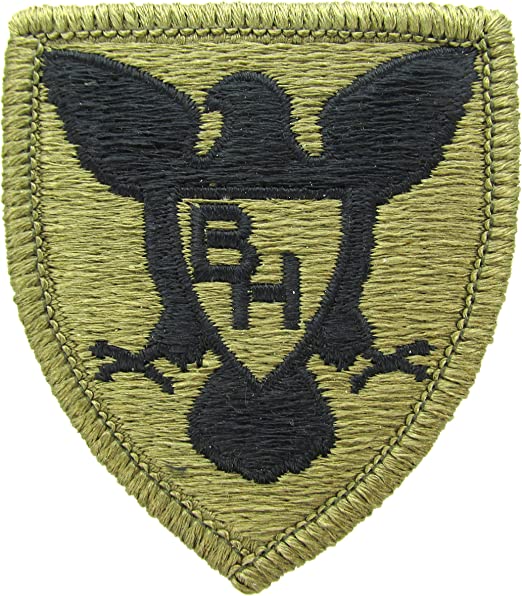
86th Infantry Division
The Blackhawk restaurant satisfied diners' 
sophisticated palates and music lovers.

From the moment Otto Roth opened the doors in the shadow of the 'L' at 139 North Wabash Avenue on December 27, 1920, the same year that Prohibition began in January until his son Don Roth closed it in 1984, a memorable 64-year run. 

The Blackhawk, a legend to several generations of Chicagoans, was named for the 86th Infantry Division Blackhawk in World War I to honor Chief Black Hawk, who assisted the U.S. Army in Illinois and Wisconsin during the early nineteenth century.
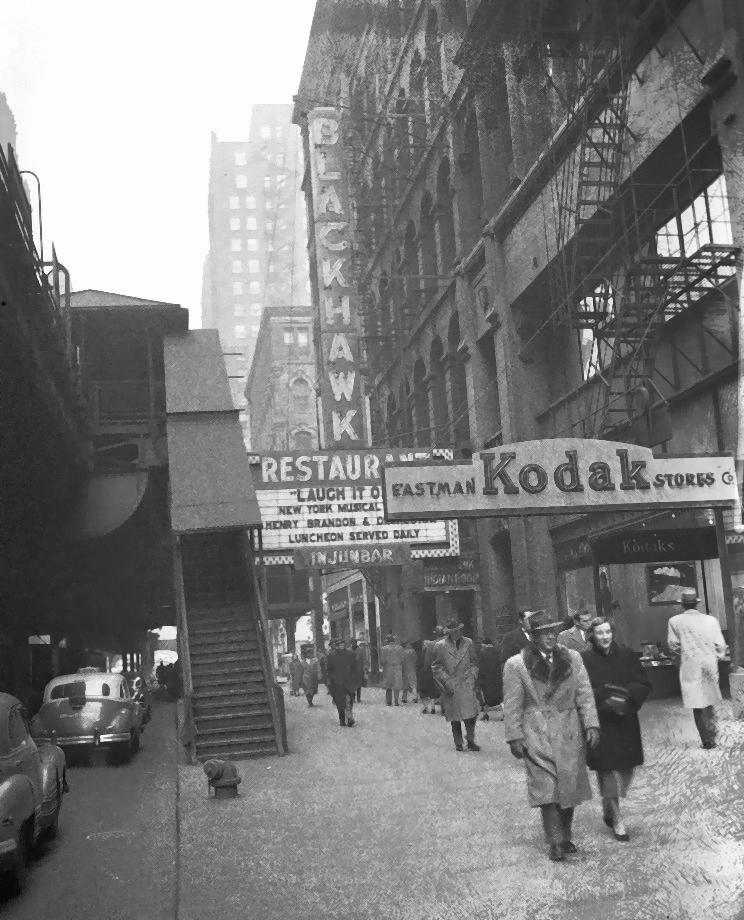
Looking South at the Blackhawk Restaurant on Wabash Avenue, Chicago's Loop, 1952. Note the name of the Blackhawk bar, "INJUNBAR."
Looking North at the Blackhawk Restaurant on Wabash Avenue, Chicago's Loop. 1952
Father and son were savvy innovators, tapping into diners' desires and setting trends before the word "trendsetter" became part of America's vernacular.
Looking South on Wabash from Randolph at Don Roth's Blackhawk Restaurant in 1979.
The main floor 600-seat dining room had magnificent murals, rich wood panels, and crystal chandeliers. An extensive continental menu was served by impeccable waiters to patrons seated at tables gleaming with white tablecloths, cloth napkins, and crystal, silver, with crested china. Classical musicians played from the balcony as diners ate below. 

With Prohibition in place, Otto searched for a way to attract more customers. In September  1926, he abandoned the classical music format. He had a stage and a large dance floor installed. Otto booked the young dance band Carlton Coon-Joe Sanders and their Kansas City Nighthawks to play for two seasons. Success extended the orchestra's booking into the next five years at The Blackhawk.

The men's grill downstairs was a rathskeller (restaurant in a basement), symbolic of a diner, where lower-priced lunches and dinners were served quickly at both tables and counters. Once seated, a menu section offered some 30-minute lunch choices.

sidebar
According to John Drury, author of "Dining in Chicago" (1931): "If you like to dance between the soup and the entree (which connoisseurs claim is bad practice), we recommend the Blackhawk, at the east end of the bright light area (139 North Wabash Avenue); across the street from Marshall Field & Co. department store. Here is a luxurious dining room where the food and the music are both of high order and where you may see happy and not so happy couples and have an all-around good time. Coon-Sanders orchestra will tickle your toes if nothing else will. Dancing is from 6:30 PM to 1:30 AM, and there is no cover charge at any time. They serve a $1.50 table d'hote  (fixed price)  dinner that meets with the approval of Blackhawk patrons."

Many orchestra leaders and musicians found fame at The Blackhawk, like Bob Crosby and his Bob Cats, Jack Teagarden, Les Brown and others.

Later, when radio became popular in the 1930s, Otto Roth sponsored broadcasts directly from The Blackhawk, making it known for its entertainment. "Live! From the Blackhawk!" became so popular that entertainers like Louis Prima, Glenn Miller, Perry Como, Kay Kyser, Chico Marx, Ozzie Nelson, Doris Day, Ted Weems, and in 1929, a 4-year-old Mel Tormé entertained dinners and dancers alike. 
Melvin Howard Torme was born in Chicago, Illinois, to immigrant Russian Jewish parents, whose surname had been Torma." However, the name was changed at Ellis Island to "Torme." A Child prodigy, he first sang professionally at age 4 with the Coon-Sanders Original Nighthawk Orchestra, singing "You're Driving Me Crazy" at Chicago's Blackhawk restaurant.

The radio show became so famous that Western Union put a telegraph machine on the bandstand to receive song requests from the states east of the Rocky Mountains.

The Blackhawk survived the Great Depression and Prohibition, both ended in 1933, because of their entertainment choices and food quality.

In 1938, Don Roth took over the restaurant's operation after his father had a heart attack. At that time, Don Roth hired managers to operate the restaurant while he served in the Marine Corps. He returned to The Blackhawk as owner-manager in 1945, one year after his father's death.

As the big band era ended by 1950, Don Roth shifted The Blackhawk's focus from entertainment to food. Catering to business executives, the restaurant food focused on serving large portions of meat, such as prime rib with potatoes and salads. 

In 1952, The Blackhawk was known as the venue "where food is the show." Don Roth introduced his signature 21-ingredient Spinning-Bowl Salad, which he prepared and served tableside with flare from a rolling cart.
sidebar 
"Live! From the Blackhawk!" aired live on WGN Radio, 720AM on the radio dial; a 50,000 Watt "Clear Station" reaching 38 states at night. 
Menu Cover
Otto Roth had become one of the first restaurateurs to mix dinner and dancing. Otto was a savvy promoter, attracting female shoppers for a "dainty lunch," executives dining with clients, and sweltering Chicagoans to enjoy "cooled air."


Otto Roth's ads invited women shoppers to stop in for a respectable and "dainty lunch," executives to dine with clients, and sweltering Chicagoans to enjoy the Blackhawk's "naturally cooled air." 

When Otto Roth died suddenly in 1944, his son, Don, took over. Don Roth was a University of Illinois at Champaign-Urbana graduate, fresh from serving as a lieutenant in the Marine Corps during World War II, took over the restaurant.

"We were a hearty restaurant," said Don, "But we knew that we had to replace the big bands with something revolutionary if we were to survive." During Don's reign, he did away with the stage and live music, preferring to "Made Food the Show."
Don's tableside theatrics featured prime rib and roast beef, served from food carts rolled through the dining room. His signature Spinning-B
owl Salad was set on ice and surrounded by all the ingredients, including their secret "spinning-bowl" dressing, which he later bottled and sold via local grocery stores. His signatures of the restaurant included a 15-shrimp cocktail and Boston scrod.

The Real Blackhawk Restaurant's Famous Spinning-Bowl Salad Dressing Recipe.

The restaurant was also the first to have art exhibits in the 1940s, a salad bar, and one of the first restaurants to have black and white waiters working alongside each other, claims Ann Roth, Don's wife.
NOTE: The Tip Top Inn Restaurant in Chicago's Pullman Building at 79 E. Adams Street, employed negroes as waiters, sometime in the late 1890s, and soon after employeed negro woman for their more reasonabley priced Black Cat Inn Restaurant. The waitstaff was segrated by sex.
"He was a very imaginative person and was extremely creative. My husband, Don, loved the business and was very charismatic," said Ann.

The restaurant, a legend to several generations, was named for the U.S. Army's Blackhawk infantry division, which was named for Chief Black Hawk.

sidebar
A stink bomb was tossed into the restaurant on opening night, which cleared the restaurant until "a lake breeze supplied a new atmosphere," according to news reports, sending guests back into The Blackhawk to continue celebrating. 

On January 10, 1952, when a statewide horse meat scandal erupted, civic authorities closed the Blackhawk Restaurant.[1] Roth challenged the charges in court, where a jury found the restaurant not guilty. Upon reopening, business exploded.

sidebar
While in college I worked lunch in the more informal downstairs [dining] room (where lots of students worked). Don Roth was a very good boss and a smart man. An anti-Semitic diner came in about once a week and said bad things to me about Jews. I told him [Don Roth], and he said to show him the man the next time he comes in. So when he came in next, I pointed him out to Mr. Roth, who immediately walked over and told the man to leave the table and not return to the restaurant. I was so proud of Mr. Roth and relieved. He was a good businessman, a socially savvy person, and a good listener.    —Ms. M.C.

Don Roth closed the Original Blackhawk Restaurant on August 31, 1984.
Don Roth prepares the Spinning-Bowl Salad for diners, including
actor Buster Keaton (at the right).
The secret recipe for spinning bowl dressing was so popular Don Roth bottled it.
Don Roth opened several other restaurants on Michigan Avenue, Pearson Street, and Wabash Avenue north of the Chicago River, but they were all short-lived.

"Don Roth's Blackhawk" at 61 North Milwaukee Avenue, Wheeling, Illinois, opened in 1969 and ran 40 years before closing in 2009. Much of the original Blackhawk Restaurant's memorabilia became part of the Wheeling location.

Don Roth's Blackhawk in Wheeling closed on December 31, 2009.

Don Roth, one of Taste of Chicago's creators, was also involved in national and local restaurant organizations, often serving in leadership roles. Don Roth died on November 21, 2003. 


[1] THE 1952 STATEWIDE HORSE MEAT SCANDAL
As 1951 turned into 1952, many Chicagoans noticed their meat tasted different. And now, the reason was evident a couple of weeks into the new year. They'd been eating horse meat, and Federal officials had been looking into meat sales around Chicago. Today, the papers reported that another state meat inspector had been fired for refusing to cooperate with the feds. That made seven.

The investigation started with a packing plant in Lake Zurich. The feds claimed the "pure beef" shipped from there was 40% horse. The plant had processed over 10,000 pounds of meat a week, most wound up in Chicago.

Simple economics was the reason in 1952, beef sold for 59¢ a pound. A pound of horse meat went for 14¢. The feds had shut down the Lake Zurich plant, but other area packers were still under suspicion. And the Chicago mob seemed to be behind everything.

State meat inspectors had been bribed to look the other way, and any retailers complaining about getting strange meat were warned to keep their mouths shut. As a result, Chicagoans had consumed up to 4.5 million pounds of horse meat in the past two years.

News of the scandal had an immediate impact. Hamburger sales in Chicago dropped 50%, and fruits and vegetables were suddenly in demand. Meanwhile, city food inspectors became hyper-vigilant. The world-famous Blackhawk Restaurant was found to serve horse meat and had its license pulled. There was also political fallout. Governor Adlai Stevenson, a Democrat, was running for re-election, and the parade of disgraced meat inspectors didn't credit his administration. Though the governor wasn't involved in the scandal, the Republicans now joked about "Adlai-burgers."

The horse meat probe led to several indictments. In the end, only a few people did any prison time. The Blackhawk reopened, and Adlai Stevenson became his party's nominee for President of the United States. He lost that election, but horse meat was not a factor.

Monday, May 25, 2020

Chicago in the Early 1800s.

An Area in Transition.
Chicago's early history, consecutive movements of population, the encroachment of commerce and industry as the settlement crossed the north branch of the river and sprawled northward, have all left their impressions.

Indians camped along the river where great factories smoked and thousands of vehicles clamor at the bridges. Indeed, it is just over two hundred and forty years ago, as tradition has it, since a black man from San Marc, Haiti, bearing the ornate name of Jean Baptiste Point de Sable (the "du" of Point du Sable is a misnomer. It is an American corruption of "de" as pronounced in French. "Jean Baptiste Point du Sable" first appears long after his death), built the first log cabin in 1779 of what was to be the settlement called Chécagou, on the north bank of the river.

Antoine Ouilmette was the first permanent white settler of Chicago building a cabin at the mouth of the Chicago River near du Sable's cabin in July of 1790 (see illustration below)

Du Sable's cabin was later acquired by John Kinzie in 1804. Kinzie's cabin became the center of a little settlement near the stockade of the long-vanished Fort Dearborn
The Kinzie Mansion. The House in the background is that of Antoine Ouilmette. Illustration from 1827.
Successive owners and occupants include:
  • Jean Lalime/William Burnett: 1800-1803, owner. (A careful reading of the Pointe de Sable-Lalime sales contract indicates that William Burnett was not just signing as a witness but also financing the transaction, therefore controlling ownership.)
  • John Kinzie's Family: 1804-1828 (except during 1812-1816).
  • Widow Leigh & Mr. Des Pins: 1812-1816.
  • John Kinzie's Family: 1817-1829.
  • Anson Taylor: 1829-1831 (residence and store).
  • Dr. E.D. Harmon: 1831 (resident & medical practice).
  • Jonathan N. Bailey: 1831 (resident and post office).
  • Mark Noble, Sr.: 1831-1832.
  • Judge Richard Young: 1832 (circuit court).
  • Unoccupied and decaying beginning in 1832.
  • Nonexistent by 1835.
After the War of 1812 and the Fort Dearborn Massacre, a village grew up between the northern and southern branches of the river and Lake Michigan. 
With the dredging of the harbor in 1833, the village became a town. Wharves were built along both banks of the river. Chicago's first packing house was built at this time. Immigrants from the East came crowding in, and by 1837, the year in which Chicago was incorporated as a city, it had become a community of several thousand. It had pushed northward to North Avenue and Lincoln Park. It was expected that Kinzie Street would be the business street of the new city, and Chicago's first railroad, the Galena & Chicago Union Railroad, was brought down the center of Kinzie Street in 1847. The lumber business was then located along the river, and things were in a state of boom. But Chicago was still a frontier town. 

In 1845 there were only about 5,000 white people between Chicago and the Pacific Ocean.
The United States and Territories in 1840-1842
Note: There was no California in 1840. The 1st California Census was in 1850 and reported 92,597 citizens after the California Gold Rush in 1848. The 1890 Census was the first one to count Indigenous people throughout the country.
On the northwest corner of Michigan Boulevard and Lake Street was a very large, vacant field, which was usually filled with camping parties, and whole communities migrating from the East to the West. It was common to see a long line of prairie schooners drive into this field, with cows tied behind the covered wagons. There they would unload for the night. There was always mystery and charm about their evening campfires.

The greatest excitement was the arrival of the weekly boat from Buffalo, New York. These boats brought many supplies and our only news from the outside world. In those days the great West Side, as we know it now, did not exist; and even the North Side seemed like a separate town because there were only one or two bridges connecting the two sides of town.

THE EIGHTEEN SIXTIES
In the decade and a half before the Civil War, the city grew rapidly, and by 1860 there were 29,922 people living north of the river. During the years between 1850 and 1860, nearly half of Chicago's increase in population was by foreign immigration, as it was also between 1860 and 1870. 

And while previous to 1860, the population of the North Side was mainly Indians, the first statistics available on the composition of Chicago's population by wards, those for 1866, show that there were then a considerable number of Irish and Germans living in the North Division. The Irish, the first of five waves of immigration that were to sweep over the Near North Side, began coming soon after the Irish.

The commercial importance of the North Branch continued to grow. The tanning and meat-packing industries were located along the river. The lumber business was rapidly increasing; warehouses were rapidly being built. In 1857 Chicago's first iron and steel industry began on the banks of the Chicago River with the opening of the North Chicago Rolling Mills Company, about two and a half miles northwest of the city's center

Later, as railroads came into the city, a number of machine shops were built on Clark, Wells, State, Erie, Kinzie, and Division streets and on Chicago and North avenues, thus binding the North Side more closely to the activities of the city as a whole. 

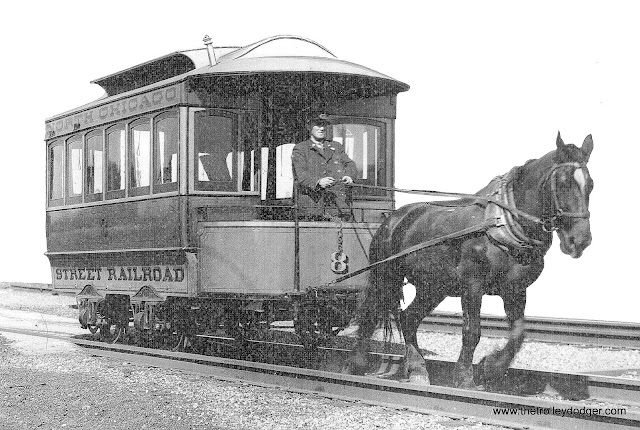
Starting in 1858, horse-drawn streetcars began to run lines on Clark, Wells, and Larrabee streets and across Chicago Avenue and Division Street, run by the Chicago City Railway Company and the North Chicago City Railway Company.
Although the Chicago Surface Lines built some replica vehicles in the 1930s, North Chicago City Railway Company's Street Railroad car № 8 is not among them. The original, built in 1859, we see it here in demonstration service during the 1948 and 1949 Chicago Railroad Fair (link includes both years' Official Guide Books in PDF) on the lakefront. This car № 8 is preserved at the Illinois Railway Museum.
Meanwhile, some small retail businesses were springing up on the streets near the river. 
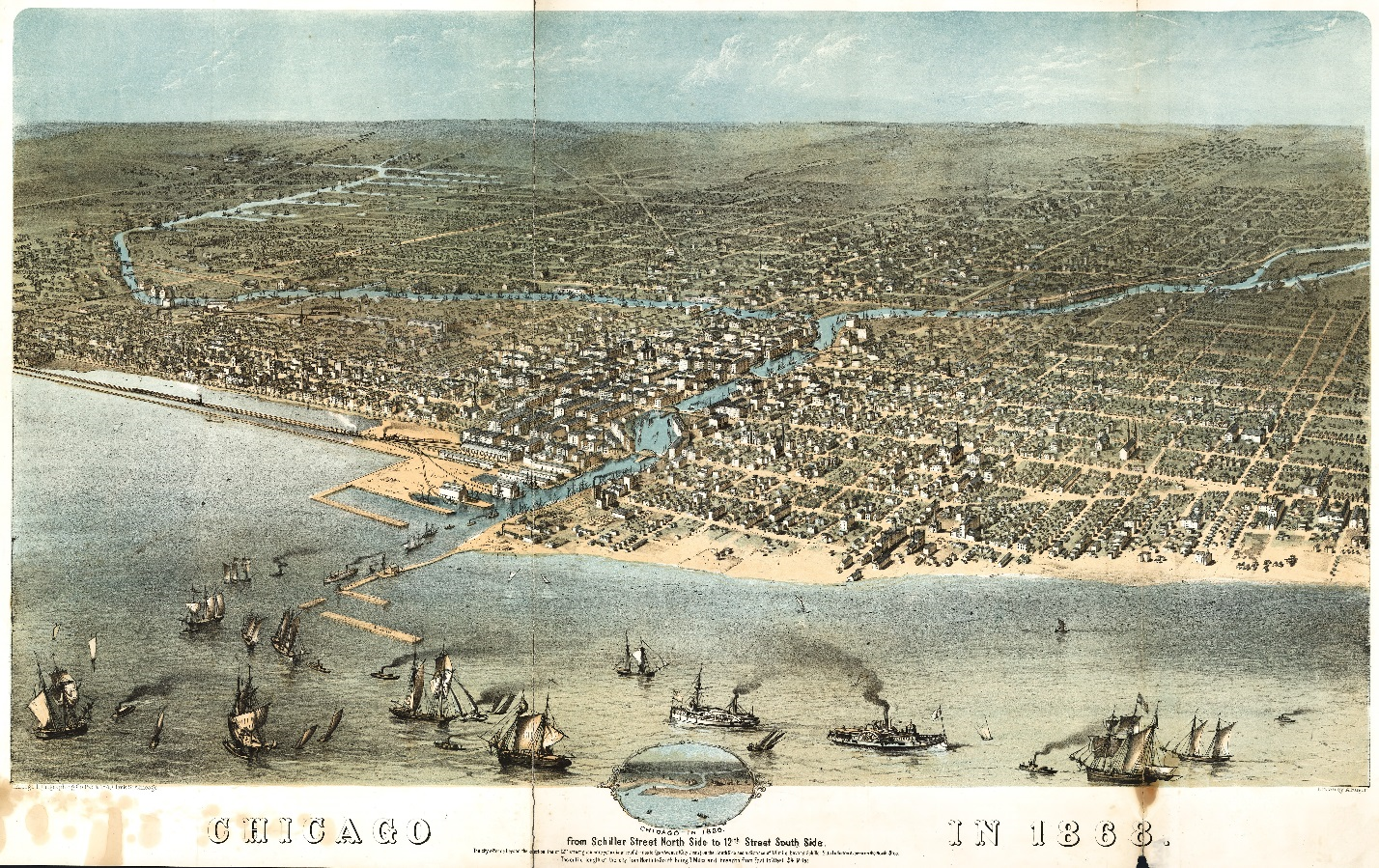
From Schiller Street North to 12th Street (Roosevelt Road) South Side. 1868
CLICK FOR A FULL-SIZE MAP.
The tendency to segregate the segregation of population on the basis of race, nationality, and economic status, which is an inevitable accompaniment of the growth of the city, was becoming evident at this early date. The more well-to-do and fashionable element, the Irish and German immigrants, the laboring population, and a small group of riff-raff and transients, were beginning to live in groups to themselves and to characterize certain streets, sections, and divisions of the North Side. 

The Near North Side has always been, more or less, the fashionable residence district. In the 1860s, the fashionable and aristocratic residence section of Chicago on the North Side was in the district from Chicago Avenue south to Michigan Street (Hubbard Street), and from Clark Street east to Cass Street (Wabash Avenue). Residences on Ohio, Ontario, Erie, Superior, Rush, Cass, Pine (Michigan Avenue), Dearborn, and North State streets appear frequently in the "society columns" and Chicago directories of the 1860s. On these streets, the leading families of the early settlers and the early aristocracy lived, with South Michigan Boulevard the fashionable street of the day. It was not until the 1890s that Lake Shore Drive became 'the' place to live.

One of these early aristocracy writes:

The North Side was "home," and a lovely, homelike place it was. The large grounds and beautiful shade-trees about so many residences gave a sense of space, rest, flowers, sunshine and shadows, that hardly belongs nowadays to the idea of a city. There was great friendliness, and much simple, charming living.
 Over between Clark, Illinois, Dearborn, and Indiana streets stood the old North Side Market, where the men of the families often took their market-baskets in the morning, while the "virtuous woman" stayed at home "and looked well to the ways of her household." 

Another institution of our day was the custom of sitting on the front steps though even then there were those who rather scorned that democratic meeting place. But for those of us who did not rejoice in porches and large grounds, they had their joys…. In fact, it was even possible for unconventional people like ourselves to carry out chairs and sit on the board platforms built across the ditches that ran along each side of the street, and on which carriages drove up to the sidewalks. 

Of course there were "high teas," when our mothers and fathers were regaled with "pound to a pound" preserves, chicken salad, escalloped oysters, pound-cake, fruit-cake, and all other cakes known to womankind; and where they played old-fashioned whist and chess. 

...Parties usually began about half-past seven or eight o'clock, and "the ball broke" generally about eleven or twelve o'clock; where there was no dancing it ended at ten or eleven o'clock.
 Of course there was no "organized charity," as we know it nowadays, but there was much of that now despised "basket charity," when friendships were formed between rich and poor.
Between Clark and Wells Streets, south of Chicago Avenue, was a neighborhood of storekeepers and merchants, while west of Wells lived the laboring people. In this area, there were a number of laborers' boarding houses and cheap saloons. At this time, there was nothing but a sandy waste between Cass Street (Wabash Avenue) and the lakefront.

And there was an unsavory population on the sand flats at the mouth of the river and immediately along its banks, known as “Shanty Town,” and ruled over by the “Queen of the Sands,” Emma "Ma" Streeter. A memorable event of the decade was the raid on the “Sands” led by “Long John” Wentworth, then-mayor, when the police razed the Sands brothels amid the mingled cheers and hisses of the populace. 

The Irish had settled along the river, to the south and west. The settlement extended as far east as State Street immediately along the river, but most of the Irish lived between Kinzie and Erie, in the vicinity of old Market Street. 

In 1853, William B. Ogden, a Chicago real estate developer, built a channel to provide a more straightforward alternative to the Chicago River’s winding North Branch. The result was an island, the only island in Chicago. This river settlement along the North Branch was known as "Kilgubbin," or more often, as "the Patch". It quickly became a haven for Irish immigrants who were so poor they couldn’t afford proper housing. The island was dubbed Kilgubbin, after the area most of them were originally from. Taking a cue from the life they left behind in Europe, they built flimsy wooden homes with gardens and farms where they raised cabbage and vegetables and livestock. As the city grew around them, the island got a few factories, but other than that, it barely changed. Chicagoans came to see the residents as backward, treating them with a mixture of pity and mockery, so they called Kilgubbin “Goose Island.” 

The Irish were then mostly laborers, not having been in America long enough to have exploited their flair for politics. However, they were already displaying their love of a fight, and a solidly Irish regiment was recruited from Kilgubbin during the Civil War. Kilgubbin was a squatters’ village and contained within it a lawless element. In an article printed in the Chicago Times in August of 1865, some account is given of Kilgubbin and its population:
At the head of the list of the squatter villages of Chicago stands "Kilgubbin," the largest settlement within its limits. It has a varied history, having been the terror of constables, sheriffs, and policemen. It numbered several years ago many thousand inhabitants of all ages and habits, besides large droves of geese, goslings, pigs, and rats. It was a safe retreat for criminals, policemen not venturing to invade its precincts, or even cross the border, without having a strong reserve force.
The Germans, on the other hand, were gardeners rather than laborers. Very few went into business, though there were three breweries owned by Germans where the Chicago Water Tower's pumping station now stands. But the majority of the Germans lived north of Chicago Avenue and east of Clark Street, in cottages on small farms or gardens, and did truck farming. There were German families scattered along Clark, La Salle, and Wells streets. And the German element, for a time, found the center of its social activities in the vicinity of the German Theater, at the corner of Wells and Indiana Streets (Franklin Boulevard). This theater was supported by a German musical society, offered "the first purely musical entertainment ever presented in Chicago," and continued to present dramatic sketches in the German language for years.

The city limits extended at this time, 1860-70, to North Avenue. But until after the Great Chicago Fire in 1871, the area north of Division Street, and even north of Chicago Avenue to the west, was practically still the "country."

Compiled by Dr. Neil Gale, Ph.D.

Sunday, May 24, 2020

The Real Story of Minky's Bicycle Shops in Chicago.

Seymour (Shim) Nimerov (born in 1917) opened "Minky's Hobby & Sports Store," at 3330-32 West Roosevelt Road in 1938. His parents owned the large apartment building with retail stores on the ground floor including Minky's. Shim incorporated his business as "Seymour Nimerov and Company," but did business as (dba) "Minky's Hobby and Sports Store."

Milton (Minky) Nimerov (born in 1915) was Shim's older brother who 'pushed' the name of "Minky's" on Shim claiming Minky's was a catchy name and would be easily remembered. Shim obviously thought so too. Besides bicycles, they sold sporting goods, hobby and crafts merchandise, toys, and were a Lionel train dealer.  
Oil painting of Minky's Hobby & Sports Store at 3330-32 West Roosevelt Road, Chicago.
Sent to me by Shim's Granddaughter, Denise Kase-Nabat.
Shim was the business owner, Minky took care of new bicycle assembly and mechanical repairs, and Charley Nimerov assisted Shim in the sales and management of the Roosevelt Road store.
Minky's Hobby & Sports Store, 3330-32 West Roosevelt Road, Chicago, Illinois
You could rent a bicycle for 25¢ per day from Minky's.
Left to right: Unknown, Minky, Shim, and brother Charley (who helped Minky run the Roosevelt Road store).
Shim advertised to purchase stamps collections.
Chicago Tribune, January 16, 1944.
Shim opened a second Minky's Bicycles & Toy Store at 2840 West Devon Avenue around 1954.
Minky's Bicycles, 2840 West Devon Avenue, Chicago, Illinois
My sister and I bought our Matchbox cars from the Devon Avenue store, which Shim always had the newest models in stock, and would order any available Matchbox car models for customers. Minky's store had a large variety of kid pranks, i.e. whoopie-cushions, fake vomit, hand-buzzards, etc., and sold Spalding "Pinkie" high-bounce balls mostly used to play the game called "Pinners."
Chicago Tribune Ad, February 24, 1958.
Bicycles were shipped in boxes and assembled at the dealerships. Many bike shops around the country had their own head badges and would replace the manufacturer's head badges with their own.
Chicago Tribune Ad, May 29, 1958.
Minky's on Roosevelt Road was burned to the ground during the Chicago riots in 1968. On April 5, 1968, violence sparked because of Martin Luther King, Jr.'s assassination on the West side of Chicago, gradually expanding to consume a 28-block stretch of West Madison Street and leading to additional fire damage on Roosevelt Road. The riot was finally contained on April 7, 1968.
Chicago Tribune Ad, June 9, 1968
Chicago Tribune Ad October 7, 1972.
Proof to debunk that Minky owned the Minky's Bicycle shops. Shim thought 'Minky' had a memorable 'ring' to it. Eve Nimerov Obituary, Seymour's Wife.
Chicago Tribune, October 6, 1997.
Minky's Devon Avenue store was closed when Shim died in 1983Seymour Nimerov is buried at Waldheim Cemetery in Forest Park, Illinois.
Milton Nimerov died 26 years after his brother Seymour. Wouldn't you think that if Minky really owned the Bicycle shop, it would have remained open for some time longer? 

Copyright © 2020 Dr. Neil Gale, Ph.D. All rights reserved.


sidebar 
Minky's son, David Nimerov has maliciously lied about his dad, Milton Nimerov, being the owner of Minky's and has done so for years, as he must have thought there was no proof of ownership still in existence. 
After talking with Shim's family members, I did in-depth research to find out the truth.

During my written conversations with David Nimerov, he made these statements: "My Dad [Milton] Minky [Nimerov] was the owner. Shim was his younger brother and the salesperson." "There’s a reason the stores were named Minky’s Bicycles." "If I recall, my dad gave Eve (Shim's wife) $3,000 to walk away."

I don't know why he felt it necessary to propagate these lies for so many years. Perhaps just to be spiteful towards Shim's family. David's claiming Minky was the owner is like a person claiming to have served in the military but never did.  "Stolen Valor!"  A crime.
Both Seymour and Milton served honorably in WWII and I have a copy of both draft cards with service release stamps.
My Dad knew Shim and Minky from High School. We lived at Mozart and Arthur, one block north of Minky's on Devon. My Sister and I bought a lot more than we should have, of Matchbox Cars. 
I ousted David to set the record straight. David is still lying and it's just plain wrong. It's hurtful to his own family that I had personal contact with. In Yiddish, David is a Schmuck!
Seymour Nimerov's immediate family preapproved and condoned the information I wrote in the above note before I made this article public.

Saturday, May 23, 2020

1893 World's Columbian Exposition - Intramural Railway.

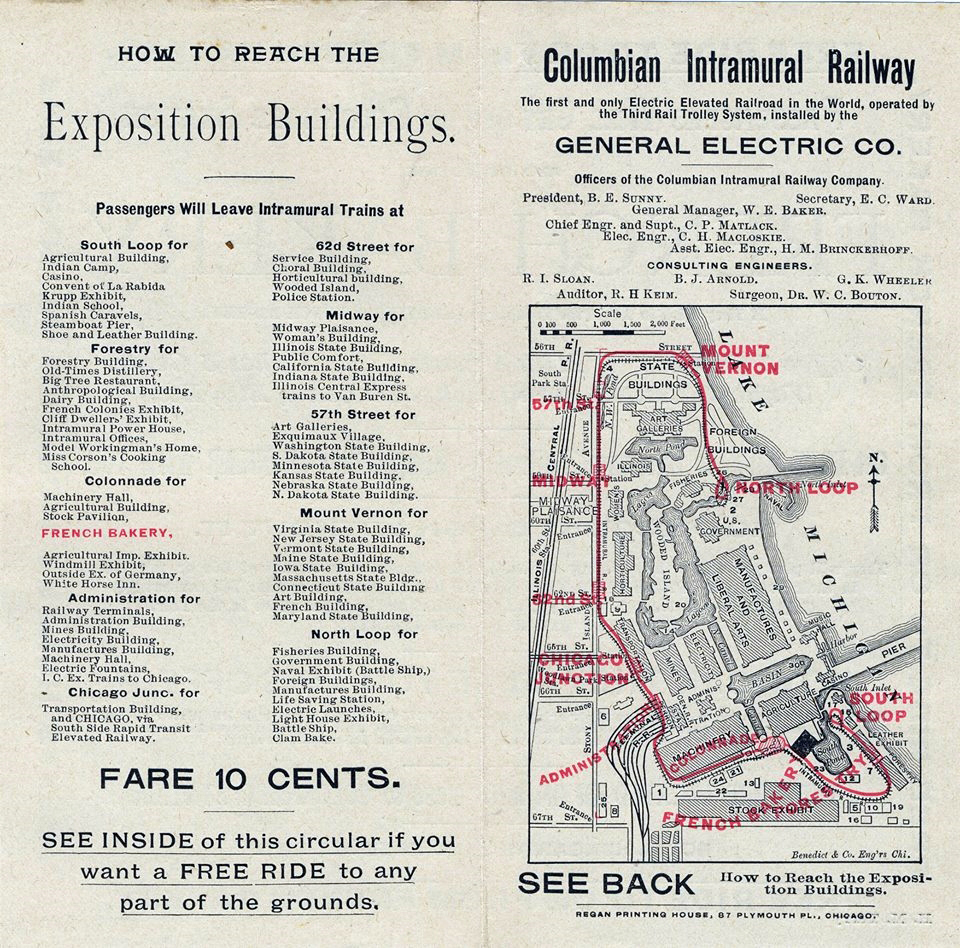
The Intramural Railway carried without serious hitch or accident nearly 6,000,000 passengers during the term of the Exposition. This is an elevated structure, the motive power of which is electricity. Its length, from end to end, is three and one-eighth miles, and its track is double all the way.
There are ten stations at convenient points. The road begins with a loop that encircles the Indian School. It runs southeast, circling the Anthropological Building, and then turns northwest. Passing between the colonnade and the Stock Pavilion, the road skirts the south side of the Machinery Building and Annex and then turns northward past its west end. It next crosses over the Perron of the Terminal Station roof, where the connection is made with all out-of-town railways.
The next station is on the roof of the Annex to the Transportation Building, called Chicago Junction. Here the connection is made on a level with the trains of the Elevated Railway, which run to the city. From here, turning to the western edge of the grounds, the road extends directly north to the northwest corner, passing Midway Plaisance, the California Building, and through the Esquimaux Village.

Here a turn is made east along the north fence. Upon reaching the Iowa Building, a curving course, among some other State structures, carries the tracks between the French  Building and the East Annex to the Art Gallery, through the Foreign Buildings, and past the Fisheries Building. Its terminus here is at the United States Government Building, where it makes a loop over the lagoon's waters and turns back on its course to retrace its way on the other track to the starting point.
CLICK THE MAP FOR A FULL-SIZE VIEW
The road is unique and substantial in construction and, in all its details, is a triumph of electrical engineering. Its use is indispensable to visitors who want to see the great Exposition quickly and comfortably. Each train makes the round trip in thirty-five minutes, attaining a speed of twenty to thirty miles per hour between stations.
From ten to fifteen trains are in operation every hour. Injury to passengers by accident has never occurred. The trains cannot be derailed, and the block signal system makes collisions impossible. One fare of ten cents entitles the passenger to transportation to either terminus of the road from the station where the train is taken. The Intramural Railway is one of the greatest exhibits of the Exposition. The enormous dynamo, or electrical generator, which furnishes the power for operating the road, is the world's largest machine of its kind and the largest piece of machinery on exhibition at the Fair. It supplies three thousand horse-power; it costs $100,000 ($2,880,750 today) and weighs 192 tons. It was on display in the powerhouse of the road near the Forestry Building.

Chicago's elevated tracks were the right choice, as subways were too expensive to consider. The first 'L' train (then Chicago and South Side Rapid Transit Railroad) was built in 1892, and its inaugural journey took place on June 6, 1892, spanning 3.6 miles in 14 minutes. Until then, the 'L' was just an ordinary steam-powered train on raised tracks.

Compiled by Dr. Neil Gale, Ph.D.

Wednesday, May 20, 2020

How an 'Ugly Law' stayed on Chicago's books for 93 years.

In 1881, Chicago Alderman James Peevey had a mission: to rid the city of "all street obstructions."

By street obstructions, Peevey didn't mean food carts, construction materials, roadblocks, or potholes.

He meant beggars, such as the ones described in the Tribune as "the one-legged individual who, with drooping eye and painfully lugubrious countenance, holds forth his hat for pennies" or "the fellows who yell 'ba-na-naas'" and "the woman with two sick children who were drawn through the carding-machine in a woolen mill, and who grinds 'Mollie Darling' incessantly on a hurdy-gurdy on a street corner."

The alderman took issue with people displaying their disabilities on the street for alms or change — so he took action. In May of that year, Peevey pushed an ordinance through the City Council that banned anyone who was "diseased, maimed, mutilated, or in any way deformed, to be an unsightly or disgusting object" from being in the "public view." Beggars were fined $1 to $50 — a hefty sum in the 1880s — or shipped off to the Cook County Poorhouse.

Peevey wasn't completely heartless, though: He tried to carve out an exemption for a one-legged, one-armed soldier. But overall, his ordinance made the streets of Chicago unfriendly to those who were blind, deaf, or disfigured.

Chicago was just one of several cities to pass an "unsightly beggar" ordinance — what came to be dubbed an "ugly law." The trend started in San Francisco in 1867, only two years after the end of the Civil War, and spread throughout cities in the West and Midwest from 1870 to 1880.

At the time, reformers viewed these laws as ways to better their communities. In his book "The Welfare Debate," Illinois Wesleyan University professor Greg Shaw explains that the county poorhouse model (think: Charles Dickens' "Oliver Twist") that was supposed to keep the poor off the streets and in work turned out to be too expensive and too corrupt to maintain.

In 1872, the Cook County Poorhouse — which shared the land with Dunning Insane Asylum, the county's psychiatric hospital — was dysfunctional enough to warrant a complete overhaul. Within 20 years, the place was labeled a "festering mass of moral corruption and official fraud" — again.

It isn't a surprise that the poor sometimes preferred the streets.

But fear spurred civic leaders to keep the streets clear. They worried that disfigured beggars would scare women. They were wary of the tensions between the lower and upper classes. They felt a sense of religious obligation to help the poor. Community leaders settled on an idiomatic solution: out of sight, out of mind.

The ugliest part of these laws came from the underlying mistrust of those who were poor and disabled. Throughout the 19th century, there was an ongoing debate over who was worthy of charity. According to Shaw, most felt that widows and orphans — victims of circumstances — warranted help from the state and the wealthy. At the same time, able-bodied paupers "were seen as chronically irresponsible and thus much less deserving of assistance."
Those with disabilities, however, were caught between "worthy" and "unworthy," and news stories gave people little reason to trust them. During an interview from 1880, the general superintendent of the Relief and Aid Society offered this advice to Tribune readers: "The fact is that nine out of ten of these street-beggars are either impostors or thieves, who come to spy out the houses and give 'pointers' to burglars. Nobody ought to give it unless the applicant is known to be worthy of relief."

When the ugly law was in its heyday, the Tribune featured reports of blind beggars who, when brought to court, could suddenly see and deaf beggars who could hear. Case in point this snippet is from a 1908 Tribune story about a deaf and blind beggar who had a hearing before a judge: "As if by magic the man's hearing and eyesight were restored, and he took $80 from one of his pockets and counted out the amount of his fine."

There were stories like the one of a blind organ grinder who, when arrested, was found with $710 on him and was said to treat his "lady friends" to car rides and cafe luncheons. Or the double-jointed 18-year-old who was put on probation for pretending to be disabled and begging for money. In 1902, the Tribune reported that the Chicago Police Department even declared war against a "beggar fraternity" that poured acid on their bodies so they'd cut a more pitiful figure.

Then came the first World War. Soldiers came home from battle, and their bodies were torn, limbs missing, minds addled. Attitudes toward people who were disabled started to change. In 1911, the CPD issued its edict "prohibiting blind mendicants, legless unfortunates and other seekers of alms from exhibiting their misfortunes to the public view." Still, no new ugly laws were passed after World War I ended in 1918. Instead, plans were made to help manage veterans' physical and mental care.

It was a slow process. The end of each subsequent war — World War II, the Korean War, the Vietnam War — and the work of activists on behalf of all people with disabilities shifted sentiments. Bans on jobs that were previously barred to disabled people — such as hotel clerks — were lifted. Mentions of Chicago police officers fining and arresting "ugly" beggars dropped off in the 1950s. The 1960s and 1970s saw laws drafted to protect the rights of the disabled and cities remade to be more accessible — and in 1990, the federal Americans with Disabilities Act was passed.
Policeman Stephen Schumack left and led a crippled man to a police wagon on July 22, 1954, from the skid row area in Chicago. (Photo: Luigi Mendicino / Chicago Tribune)
Somehow, Peevey's 1881 ordinance stayed on the books throughout that history. When the City Council finally voted to repeal it in 1974, a co-sponsor of the repeal, Ald. Paul T. Wigoda said simply, "It is cruel and insensitive. It is a throwback to the Dark Ages."

Chicago Tribune June 23, 2016
By Elizabeth Greiwe
Edited by Dr. Neil Gale, Ph.D.

Monday, May 18, 2020

The History of the Springfield Tank Natatorium at Beilfuss Park in Chicago.

The West Chicago Park Commission laid out Humboldt, Garfield, and Douglas Parks in 1869.

In the early 1900s, some of the independent Chicago Park Districts began building natatorium facilities with showers, indoor swimming pools, and gyms, to provide public bathing (Bath Houses) and recreational opportunities to the city's community parks with the quickly increasing number of residents. 

By 1915, Mayor Carter H. Harrison II and the West Chicago Park Commission had hit upon the idea of building natatoriums adjacent to city water pumping stations to take advantage of the excess steam generated there. The Springfield Avenue natatorium, nicknamed "The Springfield Tank," was adjacent to the pumping station in the Humboldt Park Community. It was one of three such facilities under construction that year. The others were the Roseland Natatorium (later Griffith Natatorium, in Block Park) and the Central Park Avenue (Jackson) Natatorium. 
The Springfield Tank at Beilfuss Park in Chicago
On March 29, 1915, at the suggestion of Mayor Harrison, the Special Park Commission named the new Humboldt Park facility in honor of late ten-term Republican Alderman, A.W. Beilfuss (1854-1914). A native of Germany and a printer by trade, Beilfuss was serving as Special Park Commission Chairman at the time of his death.

The current "Chicago Park District" was created in 1934 by the Illinois Legislature under the Park Consolidation Act. By provisions of that act, the Chicago Park District consolidated and superseded the then-existing 22 separate park districts in Chicago, the largest three of which were the Lincoln Park, West Park, and South Park Districts, all of which had been established in 1869.
Beilfuss Park, 1725 North Springfield Avenue, Chicago.
The Beilfuss Natatorium, located at 1725 North Springfield Avenue, was so popular that by 1935 it drew more than 300,000 patrons. During World War II, boys from Beilfuss Park began to publish a local-interest newsletter that was circulated to former patrons serving in the military around the world. During the same period, the Chicago Park District installed a playground adjacent to the natatorium, as well as an athletic field, that during the winter months, was flooded for ice skating.

The park district replaced the original play equipment with a new soft surface playground in 1992. In 1998, the out of date, 1915 natatorium was razed. 

Compiled by Dr. Neil Gale, Ph.D.