Monday, February 20, 2023

Chicago's Wilson Avenue Lighthouse & Water Crib History.

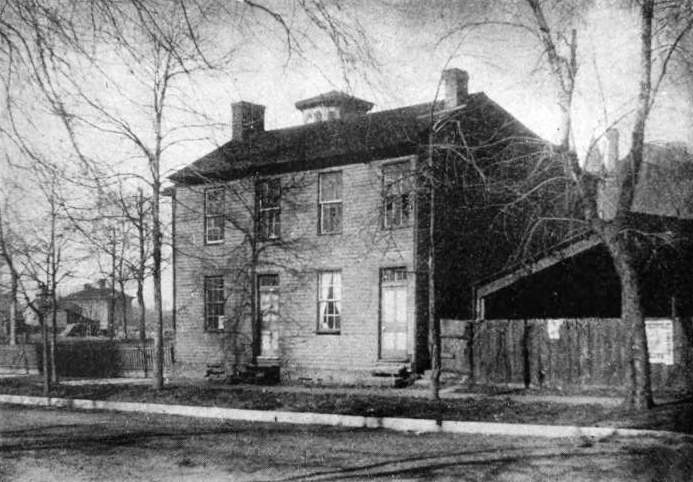
The Wilson Avenue Water Crib & Lighthouse, Lake Michigan, Chicago. Looking West.

The water cribs, aka "crib" in Chicago, supply the City of Chicago with drinking water from Lake Michigan. Water is collected and transported through a tunnel leading from the cribs to the filtration plant, which is close to 200 feet beneath the lake and varies in shape from circular to oval and in diameter from 10 to 20 feet. Lake water enters the cribs and flows through these tunnels to pumps at the Jardine Water Purification Plant (the world's largest) and the South Water Purification Plant, where the water is treated. From there, it is pumped to all parts of the city and 118 suburbs. There are six different cribs, the Two-Mile Crib, the Carter H. Harrison crib, the William E Dever crib, the Wilson Avenue crib, the Four-Mile crib, and the 68th street crib.

As the great city of Chicago grew, several additional water intake cribs and connecting tunnels to shore were built off the harbor. One of these structures was known as the Wilson Avenue intake crib due to its tulle system connecting to a new pumping station at the foot of Wilson Avenue. Work on crib began in 1915 with the sinking of a steel caisson with a ninety-foot diameter. Built using square-hewn granite blocks, the superstructure protected a forty-foot diameter inner well chamber. It housed the city employees who staffed the plant and tended the light erected at the center of its roof.


The Wilson Avenue Intake Crib supplied eight miles of water tunnels, which were hand-dug through the bedrock beneath Lake Michigan - a tremendous feat of engineering and back-breaking labor. This 1916 photograph shows the interior of one of these tunnels after completion.


When they were halfway through the Wilson Avenue intake crib construction in Chicago, the Engineers found that the caisson had settled, causing the superstructure to sit a few degrees from horizontal. Holes were bored beneath the low side of the caisson, and hydraulic cement was pumped into them, lifting the structure back to the correct orientation. This photograph, taken in 1916, shows one of the engineers on a platform erected in the center of the superstructure, using a theodolite to ensure the top surface of the granite walls had been brought back to horizontal.

Compiled by Dr. Neil Gale, Ph.D.

Saturday, February 18, 2023

The Smithsonian’s National Portrait Gallery; Abraham Lincoln

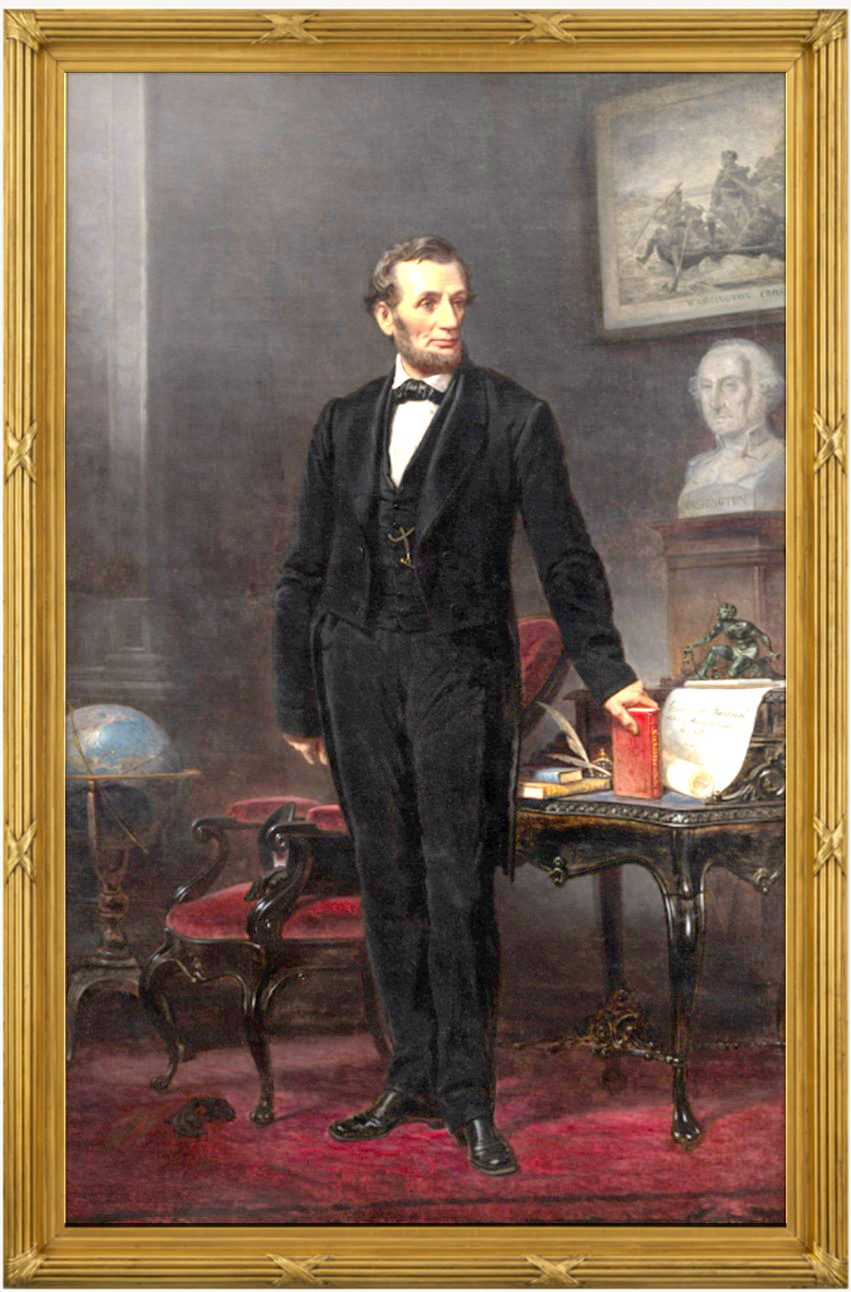
The Smithsonian’s National Portrait Gallery has announced the installation of a life-size painting of President Abraham Lincoln by artist W.F.K. Travers. Created from life in 1865, the 9-foot-tall oil on canvas is one of three known life-size paintings of the 16th president. The historic work comes to the National Portrait Gallery on long-term loan from the Hartley Dodge Foundation, whose founder, Geraldine Rockefeller Dodge, acquired the painting from her family in the 1930s. The Portrait Gallery will display the Travers painting in the museum’s ongoing exhibition “America’s Presidents” beginning February 10, 2023. 
Abraham Lincoln


National Portrait Gallery
The Smithsonian’s National Portrait Gallery tells the multifaceted story of the United States through the individuals who have shaped American culture. Spanning the visual arts, performing arts and new media, the Portrait Gallery portrays poets and presidents, visionaries and villains, actors and activists whose lives tell the nation’s story.

The National Portrait Gallery is located at Eighth and G streets N.W., Washington, D.C.

Compiled by Dr. Neil Gale, Ph.D.

Friday, February 17, 2023

Mary Todd Lincoln's Life, a Timeline Summary, (1818-1882).

1818
On December 13, Mary Ann Todd was born in Lexington, Kentucky. She was often called Molly. Her parents, Eliza and Robert Smith Todd were members of a socially and economically prominent Kentucky family. Robert Smith Todd had 16 children: seven with his first wife, Eliza Parker, and nine with his second wife, Elizabeth Humphreys.

1825
Mary's mother, Eliza, passed away on July 5.

1826
On November 1, Robert Todd married Betsy Humphreys. Mary entered Shelby Female Academy (aka John Ward's) located in Lexington. During nine of the next ten years, Mary attended school, first at Shelby and later at Madame Mentelle's. There she lived at school during the week and at home on weekends. The curriculum stressed the French language and the art of dancing. Mary excelled in school and was considered one of the best students in the class.

1832
On February 29, Mary's older sister Elizabeth married Ninian Wirt Edwards, the son of the man who had been Illinois' territorial governor, United States Senator, and later Governor of Illinois. At the time, Ninian was a student at Transylvania University in Lexington, Kentucky. Mary entered Madame Mentelle's boarding school for girls.

1833
Elizabeth and Ninian Edwards moved to Springfield, Illinois.

1836
Mary's sister, Frances, moved to Springfield.

1837
Mary spent three months in the summer visiting her sister Elizabeth in Springfield. Most likely, she did not meet Abraham Lincoln during this visit. In the fall, Mary returned to Ward's, not as a student but as an apprentice teacher helping Sarah Ward with the younger children.

1839
Mary went to Springfield, Illinois, to live with the Edwards family. Mary was clever and intelligent and soon became prominent in society. She met a rising lawyer/politician named Abraham Lincoln (most likely at a ball).

1840
In the summer, Mary traveled to Columbia, Missouri, to visit her uncle, Judge David Todd. She became a good friend of the judge's daughter, Ann. Mary became engaged to Abraham Lincoln.

1841
Mary and Abraham broke up on January 1. Mary started dating others, including a rising political star named Stephen A. Douglas. Rumors that she became engaged to Douglas were false, however.

1842
Mary and Abraham got back together again. On the rainy evening of November 4, Reverend Charles Dresser married them in the Edwards' home. Abraham placed a gold wedding ring on her finger, and the words "Love is Eternal" were engraved inside the ring. She wore this wedding band until the day she died. At first, the Lincolns boarded at the Globe Tavern in Springfield, from 1842-1844, for $4.00 a week.
The Globe Tavern, Springfield, Ill.


1843
The couple's first child, Robert Todd Lincoln, was born on August 1 at the Globe Tavern, and he was named after Mary's father. After Robert's birth, Lincoln sometimes called Mary "Mother." At times he called her "Molly." On occasion, he endearingly referred to her as his "child-wife." She often called him "Mr. Lincoln." Sometimes it was just "Father." (Rarely did she call him Abraham and never just "Abe.") The family moved and rented a three-room frame cottage at 214 South Fourth Street in Springfield late in the year.

1844
The Lincolns purchased (from Dr. Charles Dresser) a one-story house in Springfield for $1,500. It was located at the corner of Eighth and Jackson Streets, and this would prove to be the only house the Lincolns ever purchased.
1846
On March 10, the Lincolns' second child, Edward ("Eddie"), was born. The Lincolns had their first picture (a daguerreotype) taken by a photographer in Springfield.

1847
Mary and the children went to Washington, D.C., with Abraham, who was elected to the House of Representatives. In the fall, they stopped to visit the Todds in Lexington on the way (a three-week stay). In Washington, the Lincolns lived at Mrs. Ann G. Sprigg's boardinghouse. (The Library of Congress occupies this site today.)

1848
During the summer, Mary, Abraham, Robert, and Eddie traveled through New York State, visited Niagara Falls, and took a steamer from Buffalo across the Great Lakes. Mary did not return with Abraham to Washington for the 2nd session of the Thirtieth Congress, and she and the boys stayed in Springfield.

1849
Abraham's term in the House ended, and his political career stalled. The Lincolns once again were together in Springfield. Mary's father, Robert Smith Todd, died July 16, apparently of cholera.

1850
In January, Mrs. Eliza Parker, Mary's grandmother, passed away. The Lincolns' son, Eddie, died on February 1. The Lincolns' third child, William Wallace ("Willie"), was born December 21.

1851
Thomas Lincoln, Abraham's father, a man Mary never met, passed away.

1853
The Lincolns' last child, Thomas ("Tad"), was born on April 4.

1857
In September, the Lincolns traveled to New York. They toured New York City and revisited Niagara Falls and other points in the East.

1858
During the Lincoln-Douglas Debates, Mary did her "campaigning" in Springfield. To anyone who would listen, she called Stephen Douglas "a very little giant" beside "my tall Kentuckian." In mid-October, Mary traveled to Alton to hear the last of the debates (the only one of the seven she attended). Robert Lincoln also was present. At Alton, Mary witnessed one of Abraham's best performances during the debates. It was a cloudy, threatening day, and Douglas was hoarse, which helped Abraham.

1860
Abraham was elected president in the fall election. On Election Day, when the outcome was inevitable (which he heard at the Springfield telegraph office), Abraham immediately decided to go to his home. He said, "I guess there's a little lady at home who would like to hear this news." As he neared the Lincoln residence on 8th Street, he yelled, "Mary, Mary, we are elected."

1861
The Lincoln family traveled to Washington, D.C. and took up residence in the White House. Mary refurbished the White House but overspent Congress's appropriation money for this task.

1862
Willie died in the White House on February 20. Mary was never quite the same again. She ceased social activities until the following year. She never again entered the room in which Willie died. Mary's half-brother, Sam Todd, was killed fighting for the Confederacy in the Battle of Shiloh. Frequently with Tad at her side, Mary visited wounded soldiers in hospitals. She took them fruit and flowers and stopped at each bed for conversation. She helped in fundraising efforts for the wounded. Helping comfort the soldiers, they helped comfort her broken heart over Willie's death.

1863
On July 2, 1863, Mary was involved in a carriage accident in which she was thrown to the ground and hit her head hard on a rock. The wound became infected, and she required nursing care for three weeks. Mary's half-brother, Aleck Todd, was killed fighting for the Confederates at Baton Rouge. Another Confederate half-brother, David, was wounded at Vicksburg and died in 1867. The husband of one of Mary's younger half-sisters (Emilie), General Benjamin Hardin Helm, was killed at age 32 in the Battle of Chickamauga. Mary assisted in raising funds for the Contraband Relief Association.

1864
Mary began showing increasing signs of irrationality, especially in matters concerning money. She worried that her wild spending would be discovered if Abraham lost the Election of 1864. More time was spent in seances with mediums and clairvoyants. At least eight seances were held in the White House (during Mary's time as First Lady). Abraham was curious about the spiritualists but was not a believer.

1865
Mary and Abraham attended the play "Our American Cousin" at Ford's Theatre on April 14, and John Wilkes Booth shot Abraham. Mary entered a period of extreme grief.

1866
In January, the Congressional Committee on House Appropriations began investigating whether Mary had taken White House property such as bedding, utensils, china, table linen, etc. The investigation was terminated when no wrongdoing was discovered. Mary was depressed by a statement made by William Herndon, Abraham's former law partner, and Herndon claimed Ann Rutledge was the true love of Lincoln's life. Mary bought a home at 375 W. Washington Boulevard in Chicago for $17,000, and she moved out and rented it the following year.

1868
Mary and Tad traveled to Europe and spent much of the next three years in Frankfurt, Germany. Tad was a student at Dr. D. Hohagen's Institute near Frankfurt from October 1868 to April 1870. On September 24, 1868, Robert Lincoln married Mary Eunice Harlan.

1869
Mrs. Lincoln vacationed in Scotland during July and August.

1870
On July 14, Congress passed a bill granting Mary a $3,000 annual lifetime pension.

1871
The Lincolns returned to the United States. In Chicago, on July 15, Tad died of complications resulting from fluid in the lungs. Tad was at the Clifton House when he passed away. Services were held at his older brother's home on Wabash Avenue. Tad's remains were carried by train to Springfield for burial in the Lincoln Tomb.

1875
Mary's only surviving son, Robert, instigated a hearing in which Mary was declared insane by a jury of 12 men. The court admitted that "the disease was of unknown duration; the cause is unknown." (The night after the verdict, Mary may have tried to commit suicide.) Mary, now 56, spent several months in a private asylum in Batavia, Illinois, but she was released with the help of Myra Bradwell.

1876
After her release from Bellevue, Mary went to Springfield to live with her sister, Elizabeth Edwards. On June 15, a second court hearing reversed the insanity ruling of the first one. Mary was now a free woman again, free to make her own decisions. On June 19, she wrote a letter to Robert in which she unleashed all the resentment she had harbored against him for a long time. Worried that her friends would still regard her as a lunatic, Mary once again traveled to Europe and spent much of the next four years living in Pau, France.

1877
Mary visited Marseilles, Naples, and Sorrento.

1879
At age 60, in Pau, France, Mary fell from a stepladder and injured her spinal cord. In pain, she traveled to Nice, France.

1880
On October 16, Mary boarded a ship (l'Amerique) bound for New York City. On board the ship, she was about to take yet another fall down a steep stairway, but actress Sarah Bernhardt, another passenger on the ship, saved her. When Sarah told her she might have died, Mary replied, "Yes, but it was not God's will." Mary returned to Springfield and again began living in the home of her older sister, Elizabeth Edwards. Physically, she had a cataract in her right eye, her weight had declined to approximately 100 pounds, and her arthritis was getting worse.
Amerique, C.G.T. Compagnie Générale Transatlantique (French Line).


1881
A variety of physical ailments caused Mary's health to decline rapidly. She was nearly blind. On a Sunday in May, Robert and his daughter visited her. Mary traveled to the mineral baths at St. Catherine and then to New York. A doctor diagnosed her with kidney, eye, and spinal sclerosis. Some researchers feel she has had diabetes for years.

1882
In January, Congress raised Mary's annual pension from $3,000 to $5,000. They also voted for a donation to Mary of $15,000. Mary lived in a darkened room in Elizabeth's home with the shades always pulled. On July 15, the anniversary of Tad's death, she collapsed in her bedroom. Mary may have had a stroke. 

The next day, a Sunday, Mary passed away at 8:15 P.M. Thus, she died in the same home she was married in. Mary was still wearing her wedding ring with "Love is Eternal" engraved on the inside when she passed away. Her estate was worth $84,035 (mostly in bonds). She died without leaving a will (like Abraham). Mary was buried in a white silk dress that the Edwards family quickly ordered from Chicago. She was 63 years old at the time of her passing. The funeral was delayed until Robert, then Secretary of War could reach Springfield from Washington. Services were held at the First Presbyterian Church at 10:00 A.M. on Wednesday, July 19, with Reverend Dr. James Armstrong Reed presiding. The pallbearers included the governor of Illinois. Mary was buried in Oak Ridge Cemetery in Springfield, with all of the family members except Robert. 

Robert died in 1926 and was buried in Arlington National Cemetery.

Compiled by Dr. Neil Gale, Ph.D.

Thursday, February 16, 2023

The 1848 Francis Stupey Log Cabin, Highland Park, Illinois.

Date Unknown.


Highland Park’s oldest standing structure is located in Laurel Park between the Library and City Hall. The cabin, built in 1848, was given to the people of Highland Park as a Centennial gift in 1968 by Exmoor Country Club. The Historical Society moved, restored and furnished the cabin in the 1850s period.

THE HISTORIC PLAQUE READS:
This log cabin was built in 1848 by the Stupey Family, who received the Exmoor property as a government grant of 160 acres of virgin timber land. The building is made of hand-hewn logs from trees felled in clearing the land for farming. The cabin originally stood on the site of the Baker cottage. It was used as the Stupey home until about 1875 and then as a farm building until 1896. It was rebuilt in 1910 and used as the golf shop and was enlarged and removed to its present location in 1922 to serve as the caddy house.


Compiled by Dr. Neil Gale, Ph.D.

Saturday, February 11, 2023

A Primer about President Abraham Lincoln.

Abraham Lincoln is remembered for his vital role as the leader in preserving the Union during the Civil War and beginning the process (Emancipation Proclamation) that led to the end of slavery in the United States. He is also remembered for his character and leadership, his speeches and letters, and as a man of humble origins whose determination and perseverance led him to the nation's highest office.
1865


President Lincoln endured extraordinary pressures during the long Civil War. He carried on despite generals who weren't ready to fight, assassination threats, bickering among his Cabinet members, massive loss of life on the battlefields, and opposition from groups such as the Copperheads. However, Lincoln remained brave and persevered. He didn't give in to the pressures and ended the war early. He kept fighting until the Confederacy was defeated. A lesser man would have given in and stopped the war before the goals had been achieved. Lincoln did not do this.

The Emancipation Proclamation didn't immediately free any slaves because it only applied to territories, not under Lincoln's control. Legal freedom for all slaves in the United States did not come until the final passage of the Thirteenth Amendment in December 1865. Lincoln was a strong supporter of the amendment but was assassinated before its final enactment.

President Lincoln's domestic policies included support for the Homestead Act. This act allowed poor people in the East to obtain land in the West. He signed the Morrill Act, designed to aid in establishing agricultural and mechanical colleges in each state. Lincoln also signed the National Banking Act legislation, establishing a national currency and creating a national bank network. In addition, he signed tariff legislation that offered protection to American industry and a bill that chartered the first transcontinental railroad. Lincoln's foreign policy was preventing foreign intervention in the Civil War.

Lincoln's most famous speech was the Gettysburg Address, given while he suffered from a mild case of smallpox. Lincoln explained that our nation was fighting a Civil War to see if we could survive as a union. He stated it was proper to dedicate a portion of the Gettysburg battlefield to honor the men who had fought and died there. Lincoln said that the people still alive must commit to finishing the task that the soldiers who lost their lives had begun, saving the nation as a union of the North and South.

One crucial way Lincoln affects contemporary society is that we look back on his presidency as a role model for future generations. Lincoln's character affects us because we now compare all politicians to the example Lincoln set. Another effect of Lincoln is his sophisticated quotations. Politicians love to quote Abraham Lincoln because he is considered America's wisest, problem-solving president. Lincoln's primary effect on America today is simply through the good example he set regarding leadership and integrity. Many American politicians in our time tried to emulate his thinking by using Lincoln's quotes in their speeches.

Lincoln had a Charismatic leadership style (persuasiveness, charm and sympathy), Transformational (causes change), and Democratic leadership (run by the people) style, compared to an Oppressive (authoritarian) or Laissez-Faire (hands-off). 

When there was disagreement between advisors and himself, he often told a story demonstrating his point and influenced others to follow his lead. This method often worked, and people admired and respected Lincoln for it. He could virtually disarm his enemies with his highly moralistic debate and competent leadership. Lincoln possessed qualities of kindness and compassion combined with wisdom. One of his nicknames was "Father Abraham." Like George Washington (Indian tribes called President Washington "Father"), Lincoln demonstrated an extraordinary strength of character. 

Seven hundred professors, elected officials, historians, attorneys, authors, etc., participated in the poll and rated the presidents. Abraham Lincoln was ranked number one, Franklin Roosevelt was second, and George Washington finished third. The categories included leadership qualities, accomplishments, crisis management, political skill, party appointments, character and integrity. Lincoln was ranked first, second, or third in all categories, and his overall ranking was first among all American presidents.

A 2009 C-SPAN poll consisted of a survey of 65 Doctoral historians. The participants were asked to rank the presidents in ten categories ranging from public persuasion and economic management to international relations and moral authority. Abraham Lincoln finished number one, George Washington came in second, and Franklin Roosevelt was third.

Lincoln became successful through sheer ambition and hard work. He spent less than 1 year attending ABC schools as a youth growing up on the frontier. The lessons were taught orally, and schools thus got the nickname "blab" schools. Lincoln would read any book he got his hands on. Later when Lincoln moved to New Salem, Illinois, at 22 years old, he began to study law books in his spare time. In New Salem, he earned the nickname "Honest Abe," He was self-educated and became a lawyer in 1836, although he never attended college. Lincoln was a very successful attorney with extensive practice before his election as president in 1860. Additionally, Lincoln served four terms in the Illinois State House of Representatives and one term in Congress.

Lincoln's most significant action was his decision to fight to preserve the Union. Ultimately, this decision to fight the Civil War resulted in the USA remaining one nation rather than splitting into two separate countries or worse.

Although Lincoln was criticized for stepping over the traditional bounds of executive power, he faced the greatest threat to federal authority in the country's history. He felt his job was to protect the Union from disintegrating. Also, Lincoln's contribution to freedom for the enslaved people was significant, and he got the ball rolling with the Emancipation Proclamation. We honor Abraham Lincoln for preserving the Union and beginning the process of freedom for Negroes.

MAJOR ACCOMPLISHMENTS
  • Abraham Lincoln decided to fight to prevent the nation from splitting apart.
  • Abraham Lincoln was a resolute commander-in-chief during the Civil War, which preserved the United States as one nation.
  • Abraham Lincoln's foreign policy successfully prevented other countries from intervening in America's Civil War.
  • Abraham Lincoln issued the Emancipation Proclamation, which led to the end of slavery in the United States. He is also remembered for his character, which began the process of freedom for America's slaves. The document also allowed negro soldiers to fight for the Union.
  • Abraham Lincoln strongly supported the Thirteenth Amendment, formally ending slavery in the United States.
  • Legislation Abraham Lincoln signed into law included the Homestead Act, the Morrill Act, the National Banking Act, and a bill that chartered the first transcontinental railroad.
  • Abraham Lincoln set an example of strong character, leadership, and honesty, which succeeding presidents tried to emulate. Barack Obama stated during his presidential campaign that he would look to Lincoln as a role model.
  • Abraham Lincoln gave many great speeches before and during his presidency, including the House Divided Speech, the Cooper Union Address, the First Inaugural Address, the Gettysburg Address, and the Second Inaugural Address.
  • Abraham Lincoln wrote famous letters to Grace Bedell, Horace Greeley, Fanny McCullough, and Lydia Bixby.
  • Abraham Lincoln's quotes are among the most famous passages in the world. Unfounded Quotes Attributed to Abraham Lincoln.  
Compiled by Dr. Neil Gale, Ph.D.

Friday, February 10, 2023

The Drake Hotel, Chicago; A National Historic Place Since 1980.

"Aquila Non-Capit Muscas" literally means in Latin, "The Eagle Does Not Catch Flies," or in modern times, "A Noble or Important Person Does Not Deal with Insignificant Matters."
The Drake brothers were second-generation hoteliers. Their father, John Burroughs Drake, was one of America's most noteworthy hoteliers. A native of Lebanon, Ohio, he was born in 1826 and arrived in Chicago while not yet 30. He eventually became proprietor of the Tremont Hotel, which burnt in the Great Chicago Fire in 1871. Not one to wallow in his misfortune, he negotiated for the Michigan Avenue Hotel at Congress and Michigan while the fire was still burning. The panicked owner was only too happy to sell the hotel to Drake, who had the last laugh after correctly predicting that the fire would bypass the hotel. From this hotel, he re-christened the Tremont House. Drake then took control of the venerable Grand Pacific Hotel, where he presided for 20 years and gained an international reputation as a bon vivant, connoisseur, and popular host. Drake died in 1895, but his sons followed in his footsteps, establishing themselves as hoteliers and naming The Drake Hotel in their father's honor. 

Architect Benjamin Marshall conceptualized the Nation's first urban resort that came to fruition on the Magnificent Mile (Upper Michigan Avenue), financed by brothers John B. Drake and Tracy C. Drake in 1919. The Drake Hotel's location opposite Oak Street Beach at Lake Shore Drive & Upper Michigan Avenue allowed the hotel to be billed as one of the Nation's first urban resorts.

sidebar
The Drake's architect, Ben Marshall, inspired the hotel's design from the Italian palaces of High Renaissance Rome and Florence. Constructed of smooth limestone, the building is 14 stories high. It rises from a rectangular base, which changes at the third story to an H-shape. A distinctive feature of Italian Renaissance design found in The Drake is the "Piano Nobile," (the main story; the first floor of a large house containing the principal rooms). The base level of the hotel featured an arcade containing several services, such as a barber shop, beauty salon,  high-end  retailers,  and changing rooms so guests could freshen up from their journey to the hotel and look presentable before making their "grand entrance" onto the Piano Nobile.

Like Potter Palmer before the Marshall brothers and Earnest Stevens after them, the Drake brothers built upon their hotel knowledge to create a new structure that would inspire awe and emulation.

When Ben Marshall advanced the plans for The Drake in March 1919, The Economist, a real-estate trade journal of the period, reported that the structure would be "of unusual magnificence, nothing like it in appearance, arrangement or finishings having ever been attempted in this country." Marshall was so enthused about the project that he waved his architectural fees in exchange for an ownership share in the hotel. He remained involved in many aspects of the hotel after its construction, including interior design, entertainment, and the design of employee uniforms.

sidebar
Benjamin Marshall, the flamboyant self-taught architect of The Drake and many other notable Chicago structures, including the Blackstone Hotel, the Blackstone Theater, and the Edgewater Beach Hotel, Marshall was instrumental in all aspects of The Drake for 20 years. He initially served as vice president of The Drake's parent company, the Whitestone Company, and subsequently even served as the hotel's general manager and director of entertainment. A close friend of the legendary show business impresario Flo Ziegfield, Marshall had an appreciation of drama and theatrics that he put to excellent use in the events he orchestrated at The Drake.

The hotel cost $10 million ($172 million today), including land, building, and furnishings. Nine hundred employees served its original 800 guest rooms. The Drake opened officially on New Year's Eve 1920 with a gala dinner for 2,000 of Chicago's leading citizens.


Throughout the 1920s, the fame of The Drake spread first across the country and subsequently across the world. WGN's first radio station was perched on the top of The Drake, and it was from here where the famous "Amos and Andy" radio show originated and was broadcast live along with the big bands that performed at the hotel. In 1924, HRH the Prince of Wales (the Duke of Windsor) was a guest at The Drake, thus establishing the tradition of serving as the Chicago home to Britain's royal family. The Drake has always been their official headquarters in Chicago.
September 26, 1926.


The 1930s saw the parade of famous guests continue at The Drake. The onset of the decade, which coincided with the depths of the Great Depression (1929-1933), brought about a change in ownership at the hotel as the property was purchased by the Brashears family of Chicago, which formed a partnership with the ever-present Ben Marshall known as the National Reality and Investment Company.

The Coq d'Or bar (which means a Golden Cockerel or a Young Rooster) opened on December 6, 1933, following the repeal of Prohibition. The second establishment in Chicago to obtain a liquor license (the first being the Berghoff Restaurant). The patina of Coq d'Or blends rich wood paneling, leather accents, live weekend entertainment and a cozy glow to evoke a genuinely nostalgic vibe.

Here, pre-prohibition standbys, eight decades of iconic cocktails and new favorites are mixed, shaken or stirred to astonish the taste buds and amaze the eye. And for those who like it on the rocks or straight up, our branded Rye Whiskey, curated in conjunction with a few Spirits from an award-winning local distillery, is one of numerous batches and blends that will ignite and delight the palette of any whiskey connoisseur.

And the soup . . . is the perfect bowl of tradition. Bookbinders Red Snapper (replacing the snapping turtle meat) soup is named after the restaurant of its provenance, Bookbinders, which opened in 1865 in Philadelphia and has been served at The Drake since the 1930s. A tomato-and-roux-based soup with snapping turtle red snapper chunks and a crystal decanter of sherry for patrons to pour into the casserole became an authentic Chicago tradition among locals.

As the menu reads: "The lines were so long that our bartenders only had time to pour whiskey at 40¢ a glass. Along with the rest of the city, we were ready, however, with an excess of 200,000 gallons of whiskey for the celebration that lasted until dawn." Allegedly, bartenders started serving patrons before the official 8:30 PM repeal.

Coq d'Or transformed by installing one of the first televisions in a Chicago bar. By then, the bar was already a favorite haunt of the Streeterville neighborhood residents, reporters, politicians, and entertainers. The leather-backed chairs and warm wood paneling evoked the feeling of a bygone "gentleman's drinking pub."
The Drake Hotel's Main Entrance is at 140 East Walton Place.


In 1937, Edward L. Brashears Sr., then President of The Drake, leased the hotel to the Kirkeby Brother's Hotel Group, which ran the hotel for nearly a decade until Edwin L. Brashears Sr. returned from World War II military service in 1946

sidebar
The Drake Hotel's a-la-carte menu dates back to the 1940s. It is always interesting to note how culinary tastes have changed over the decades. The menu offered such favorites of the period as "Boned Pigs Feet in Jelly," "Tongue Sandwiches," "Sardine Sandwiches," "Mutton Chops," "Welsh Rarebit," "Clear Green Turtle Soup," "Beets in Butter," and a special of "Braised Larded Calf's Sweetbreads (the thymus; throat, gullet, or neck, or the pancreas; stomach, belly or gut, typically from a calf or lamb)," Needless to say these delicacies are long gone from restaurant menus.

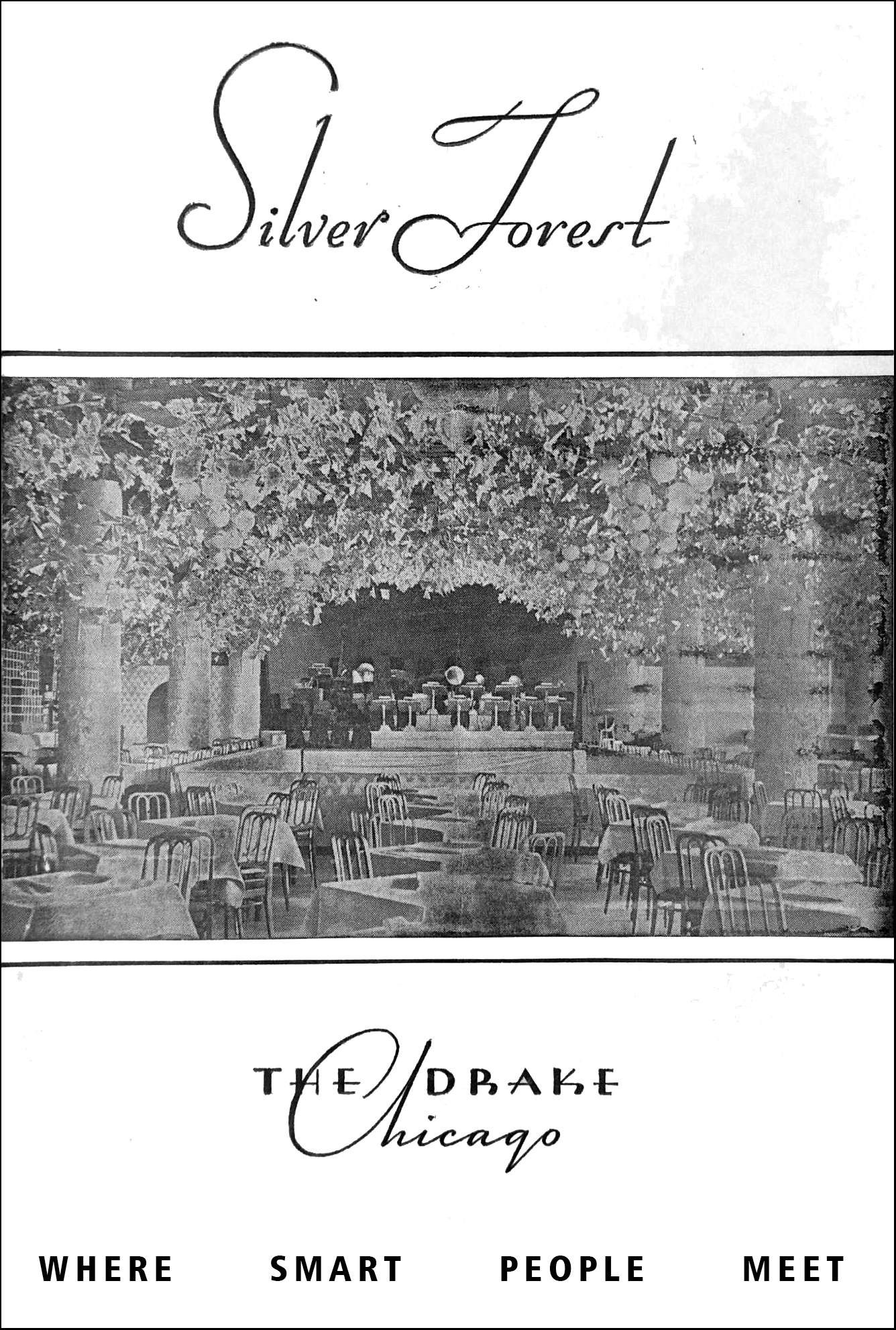
In 1940, the larger Gold Coast/Silver Forest room was vacated in favor of the adjacent but smaller Camellia House. 

Here, more intimate shows, usually featuring a chanteuse (female nightclub singer of popular songs), were presented nightly among the fresh white camellias (flowers) and black banquettes (extended bench seating along a wall), and smaller orchestras were used for the floor shows and dancing. Blade had his own NBC radio talk and live music program from Chicago for eight years at The Drake Hotel's Camellia House supper club. 


The orchestra of the pianist-leader-arranger James "Jimmy" P. Blade holds the record for playing the longest engagement at the Camellia House: sixteen years, from 1951 to 1967. Blade died in August 1974. Bill Snyder, another Chicago pianist-leader famous for his 1950 hit record, "♫ Bewitched, ♪" succeeded Blade and remained until 1970, when the Camellia House ended its show policy.

The room went through several revivals, with the local bandleader Dick Judson playing for seven seasons. Paul Meeker and his group also played in the room. Then, in 1975, Victor Lombardo, Guy Lombardo's youngest brother, brought his small group into the room for the season to play for dancing and a small floor show.
Syracuse China dinnerware was designed by Dorothy Draper for the Camellia House restaurant in Chicago's Drake Hotel. First produced in 1940, this beautiful pattern was made with different color ring accents. Postcards of the Camellia House from the 1960s show this pattern on tables. The Drake Hotel retired Draper's China in the late 1960s.


By the mid-1940s, the skyline surrounding The Drake had changed markedly. The Drake Towers apartment building rose to the east of the hotel at 179 East Lake Shore Drive on the inter-drive. At this time, Drake's landmark sign was installed on the hotel's roof.


In the late 1940s, the Brashears family set out to re-establish The Drake as the premiere luxury hotel in Chicago. By 1950, it was the first hotel in Chicago to have air-conditioned guest rooms, and it was the first to have color televisions in all its guest rooms. 

But some seeming anachronisms remained at The Drake simply because it was believed they resulted in better guest service. For example, The Drake was the last Chicago hotel to go to direct dial telephones because it was thought that an operator could do more for the guest at the onset of the 1970s. The Drake was the only hotel in Chicago that still retained elevator operators. In addition, The Drake was the only hotel in Chicago that still made its own ice cubes until 1967, refusing to go to ice machines until the quality of the product that the ice machines produced was deemed comparable to the "handmade cubes."

The hotel's Cape Cod Room was one of the city's most famous themed restaurants that opened in 1933 for Chicago's Century of Progress World's Fair. 
 The Cape Cod Room in the 1930s.


An early brochure highlighting the hotel's dining options describes the restaurant as follows: "When you step into the Cape Cod Room . . . you enter the atmosphere of the New England Coast. Here you find Chicago's finest, freshest and most unusual seafood restaurant." Upon its closing in 2016, little had changed. It was dimly lit, adorned with nautical paraphernalia, exposed wood beams, hanging copper pots, and stuffed sailfish, all tastefully done.
The Cape Cod Room is Fully illuminated. 2004.

Its Coq d'Or was one of Chicago's best-loved bars, and its private "Club International" enjoyed a waiting list for membership. But the decade of the 1960s saw many longtime Chicagoans and regular patrons of The Drake begin to leave the city for the suburbs. 

Noting this trend, the Brashears family, which owned The Drake, decided to build another Drake hotel in the burgeoning western suburb of Oak Brook in 1962, which resulted in the famous Drake Oak Brook.

The downtown Drake could easily afford the financial opportunity for a sister hotel in the suburbs. According to an October 1970 article in Hospitality magazine, between 1963 and 1966, while the average occupancy for Chicago hovered between 63 and 64 percent, The Drake ran an even 80 percent.

In the 1970s, The Drake's occupancy was aided by North Michigan Avenue overtaking State Street as the premier shopping street in Chicago. The "obscure" location for the hotel selected by Ben Marshall was reaping handsome dividends half a century later when the city's downtown indeed "caught up" to The Drake.
 
author's note
Saturday, January 13, 1973, was my Bar Mitzvah party catered by The Drake at the Drake Hotel. The 270 guests chose from fresh Walleyed Pike, Flounder, Chicken Kiev, or an aged 10-ounce Filet Mignon steak. For the adults, there was an open bar with hand-served appetizers, an extra large dessert table with an entire cake of Cashew Halva, and lots of dancing to live music until 1am. What made the evening so special, was my Mom's childhood friend's birthday was also on the 13th. We had the pastery chef make a special birthday cake and when it was brought out of the kitchen, the lights were dimmed and the band played "Happy Birthday" to Mrs. Kerstein. She was floored and cried tears of joy. When a gift-wrapped box (a pendant and gold chain imported from Israel) was delivered to Mrs. Kerstein, all she could muster was to place her head in her hands and cry. It was the pinnacle of my party!

After participating in the Friday night Shabbat service, in Hebrew, which signifies becoming a full-fledged member of the Jewish community with the responsibilities that come with it; in other words . . . at 13, I became a man. 

We had three adjoining rooms at The Drake, and mine was the corner entertainment suite with a sunken living room, a kitchenette/bar, a bedroom, a full-size soaking tub, and a north view up Lake Shore Drive at Oak Street Beach from the 12th floor. How gracious were my parents to give me the suite? Well, it was my Bar Mitzvah, after all. It was an affair so classy that I'll never forget it.

As such, the hotel continued to attract a host of world leaders in the 70s, including H.M. Emperor Hirohito of Japan in 1975 and H.R.H Prince Charles of the United Kingdom in 1977. In 1979, the prestige of The Drake was still such that John Cardinal Cody, head of the Chicago Archdioceses and official host to Pope John Paul II when he visited Chicago that year, requested that they cater the official dinners for Pope John Paul II, which were held at the Cardinal's residence. The Drake obliged, and the Pope was served the hotel's famous Bookbinders Soup, the club's international salad, the tail of whitefish, and California wines. Despite these notable successes, by the end of the 1970s, many venues in The Drake looked highly dated and needed considerable refurbishment. 

Sadly, the 1970s forced changes in dining preferences in menu offerings and was the beginning of the end for supper clubs (Comedy Clubs also served dinner but didn't fall out of favor). The Camellia House closed in 1977.

In 1979, the Brashears partnership created a ground lease for The Drake whereby the family would continue to own the land on which the hotel sits but would lease The Drake building itself to a "tenant" who would own the physical hotel for the duration of the lease. The new owners of the hotel were financiers Jerold Wexler and Edward Ross.

sidebar
The Drake Hotel was honored with the placement on the National Register of Historic Places List on May 8, 1980.

On January 1, 1981, United Kingdom-based Hilton International, then operating in the United States as Vista Hotels, was brought in as the management company for The Drake. Hilton International pledged to the City of Chicago to return the hotel to its previous splendor and embarked on a multi-year renovation that cost over $40 million. In May of 1981, the 61-year-old Drake Hotel was honored to be included on the National Register of Historic Places, joining other landmark structures in Chicago, such as the old Water Tower structure and Louis Sullivan's Carson Pirie Scott building.

With Hilton International restoring The Drake to its traditional grandeur, the hotel became a set for several popular movies, including The Blues Brothers, Risky Business, My Best Friends Wedding, and Hero, among others. 

In 1996, Hilton International acquired the lease interest on The Drake from a venture controlled by Edward Ross. Also in 1996, The Drake was front and center during one of the most high-profile visits ever bestowed on Chicago when the late Princess Diana came to the city for three memorable days in June to help raise money for cancer research. 
People Weekly Magazine, July 17, 1996, Cover: DI WOWS CHICAGO.


Like generations of British Royals and family before her, she made The Drake her residence in Chicago.

sidebar
Drake Hotel, Chicago, Restaurants: 
The Fountain Court (1920-1940) 
changed to The Palm Court (1940-)
The Cape Cod Room (1932-2016)
Coq d’Or (1933-)
The Camellia House (1940-1977)

Perhaps no other hotel in Chicago inspires more loyalty than The Drake, where different generations of the same family routinely come to continue the traditions their forefathers began so many decades ago.

Compiled by Dr. Neil Gale, Ph.D.
Contributor, The Drake Hotel

Wednesday, February 8, 2023

Highlights of Abraham Lincoln's Legal Career.

Abraham Lincoln, who attended school in 1815 for less than a year, became a lawyer under an Illinois law enacted in 1833. This law stated that to be a lawyer, someone had to "obtain a certificate procured from the court of an Illinois county certifying to the applicant's good moral character." Lincoln actually went to the Illinois Supreme Court to get his certificate. On September 9, 1836, two of the justices of the Illinois Supreme Court issued a license to practice law to Abraham Lincoln. Later, in a more formal session, on March 1, 1837, Lincoln appeared before the clerk of the Illinois Supreme Court and took an oath to support the Constitution of the United States and of Illinois. Lincoln swore he would "in all things faithfully execute the duties of Attorney and Counselor at Law." Lincoln was then formally enrolled as an attorney licensed to practice law in all the courts of the state of Illinois.
Lincoln always had a law partner. In order, his law partners were: (1) John Todd Stuart, 1837 to 1841; (2) Stephen Trigg Logan, 1841 to 1843; and (3) William "Billy" Henry Herndon, 1844 to 1854. Lincoln's offices with all his partners were always in Springfield, Illinois.

Lincoln's greatest asset as a lawyer was his ability to simplify cases. He was able to reduce even complex cases to a few key points. He put legal disputes into simple focus. He had a gift for brevity and clarity. Lincoln's unique talent was a logical oral argument rather than legal research. He had an uncanny ability to 'read' juries and influence them with his persuasive arguments.

Lincoln was a "jack-of-all-trades" when it came to his law practice. Generally speaking, he would accept any case (whether civil or criminal) brought before him. Lincoln accepted cases from farmers arguing over cow ownership up to corporate railroad cases. Many of his cases were related to breach of contract and debt collection, as those were the substance of a high percentage of court cases at that time. In all, Lincoln and his partners handled 5,173 cases, per the "Papers of Abraham Lincoln" project maintains a database on Lincoln's law practice.

Twice a year, Lincoln departed Springfield and traveled the Eighth Judicial Circuit. Although the border of the circuit shifted over time, it was located in central Illinois and included as many as 14 counties. Along with a small group of attorneys and a judge, Lincoln traveled to the various county seats to try any ready case. In essence, they were bringing the court to the people. The small group often traveled from town to town by horseback and would spend at least a few days, sometimes more than a week, in each county seat trying cases. The group completed the 400-500 mile loop in roughly 11 weeks.

Lincoln argued several hundred cases before the Illinois Supreme Court, and he made his one and only United States Supreme Court appearance in 1849 in the case of Lewis v. Lewis. The case was about the construction of the Illinois statute of limitations in its application to a suit brought by a non-resident plaintiff. Lincoln argued on behalf of Thomas Lewis. The court decided against Lincoln and his client, and the majority opinion was rendered by Chief Justice Roger B. Taney. Justice John McLean wrote a lengthy dissenting opinion which he held in accordance with Lincoln's contentions.

Lincoln's fees were usually in the $5 to $20 range, but he once charged $5,000. Lincoln represented the Illinois Central Railroad throughout the 1850s. In the 1853 McLean County Tax case, a case Lincoln won for the railroad, he charged his largest fee of $5,000 ($192,725 today). The case was called Illinois Central Railroad v. McLean County. The Illinois Central Railroad owned 118 acres of land in McLean County, Illinois, and the county assessor levied a tax of $428.57 on the railroad's property. The railroad argued that the Illinois General Assembly act incorporating the railroad exempted the railroad from taxes. The railroad hired Lincoln and sued McLean County for an injunction to stop the county from selling railroad land to pay taxes. The parties reached an agreement in which the court would dismiss the bill, thus ruling for McLean County. The railroad would appeal the case to the Illinois Supreme Court, where the only question would be whether the county had a lawful right to tax the Illinois Central Railroad property. Lincoln continued to represent the railroad in court. The Illinois Supreme Court reversed the judgment. Walter B. Scates, who was chief justice, ruled that the legislature could exempt property from taxation. Therefore, the charter of the Illinois Central Railroad was constitutional. Lincoln received $5,000 for his legal services but sued the railroad to collect his money.

Other Lincoln cases of note include the "Chicken Bone" case, the "Effie Afton" case, the Trailor Murder case, and the famous 1857 trial of William 'Duff' Armstrong ("the Almanac Case").

In 1861 when Lincoln was about to depart Springfield and travel to the White House, he pointed to the sign hanging from his law office, which said "Lincoln and Herndon." He told Herndon, "Let it hang there undisturbed." He promised Herndon that should he return to Springfield after his term, they would go right on practicing law "as if nothing had ever happened."

Compiled by Dr. Neil Gale, Ph.D.
Wednesday, February 1, 2023

Celebrating the First Day of Black History Month, February 2023 — The Obama Kissing Rock, Chicago, Illinois.


Sitting in front of a Subway sandwich franchise at 53rd and South Dorchester in Chicago is a straightforward rock with a metallic plaque installed in it. It may not seem like the most romantic place in the country, but it is where President Barack Obama first planted one on his wife, Michelle. 
East 53rd Street and South Dorchester Avenue, in Chicago's Hyde Park Community.


While today it is a tiny little green space with flowers and a flagpole, the "Obama Kissing Rock" was once the site of a Baskin-Robbins ice cream shop. Future-president Barack and future-first-lady Michelle visited the Hyde Park franchise on their first date in the summer of 1989 and shared more than just two scoops on the curb outside the store, namely their first kiss.

The plaque is attached to a 3,000-pound (1.5-ton) boulder installed on the corner of the strip mall in 2012.
I find it disgusting that there can't be a landmark plaque celebrating African Americans without racists defacing it.


It tells the sweetest story straight from Barack's lips:
"On our first date, I treated her to the finest ice cream Baskin-Robbins had to offer, our dinner table doubling as the curb. I kissed her, and it tasted like chocolate." President Barack Obama from an interview in "O," The Oprah Magazine, February 2007.


Most presidential monuments are devoted to wars or politics, but this one celebrates the first couple as people. People who still seem to share an unshakable love to this day.

Before You Visit: The Baskin-Robbins Ice Cream Shop has since been replaced by a Subway restaurant, and is now co-located inside the Dunkin Donuts shop, in the same strip mall.

Compiled by Dr. Neil Gale, Ph.D.