Sunday, December 29, 2019

Watchtower (Amusement) Park, Rock Island, Illinois. (1882-1927)

In 1882 the Watchtower Park was opened on the bluff above the Rock River at Rock Island, Illinois, now the site of Black Hawk State Park. Until 1927 Watchtower Park provided enjoyment for tens of thousands of people annually.
Watchtower Park, named for its commanding view of the Rock River Valley, was the first and largest amusement park west of Chicago. It was an end-of-the-line amusement park, built at the end of the trolley line to encourage ridership. Admission to the park was included in the cost of the streetcar fare, an arrangement that tied the fortunes of two enterprises together.

Watchtower Park was the brainchild of Bailey Davenport, a local businessman who owned the land on which the park was built. In 1882 Davenport became owner and superintendent of the Rock Island and Milan Steam and Horse Railway Company. He bought a trolley and built up his interurban line. It's not clear which came first, the trolley line or the park.
Davenport developed the Watchtower into a "public pleasure spot and health resort." He built an open summer pavilion on the crest of the bluff, installed picnic benches and established walking trails. A spring located in the limestone bluff was advertised as a "health-giving spring" and the water as the "best medicinally north of Kentucky." Families could board the streetcar, ride to the park, and enjoy a day of picnicking and hiking.
In April 1891 Watchtower Park was purchased for $7,000 ($198,000 today) by D.H. Lauderbach, managing director of the Davenport-Rock Island Street Car Company, a business formed when several independent streetcar lines were bought out by Chicago businessmen and merged into one. Horse-drawn cars were phased out as electric [train] cars came increasingly into use. Lauderbach, who managed the company from Chicago, intended to expand the park and promote the railway. By September electric cars on the newly christened "Tower Line" were running every hour.

A flurry of construction followed during the period 1891 through 1896 as the park's popularity increased. Excursion parties from outlying communities frequently rode the train into Rock Island, transferred to the streetcar line and went on to the park. The park was so popular that by 1897 cars ran to the park every ten minutes. Round-trip fare, which included admittance to the park and to some attractions, was 25¢ for adults and 10¢ for children.
Entrance to Black Hawk Watchtower and Inn, Rock Island, Ill.
During the "amusement season" (May 15 to September 15) visitors could take advantage of the park's tennis courts, croquet grounds, billiard tables, and walking trails. One could also have his fortune told, attend Summer Theater and opera, delight at the vaudeville and sideshow acts, listen to band and orchestra concerts and view balloon ascensions. A magnificent inn on the crest of the hill - Black Hawk's Watchtower Inn - offered fine dining and dancing. The Queen Anne structure, completed at a cost of $10,000, was officially opened on July 15, 1892. It housed a dining room, cafe, ice cream parlor, and ballroom.
In 1895 work began on a stage with an amphitheater capable of seating one thousand people. The stage was used for theater productions, vaudeville troupes, and side-show acts. Acts were booked for seven to ten-day stints, and shows were given every evening during the season with matinees on Wednesdays, Saturdays, and Sundays. Attractions for the 1895 season, according to a park press release, included “The remarkable midget Rossow Brother... The famous Hardin and Ah Sid with their acrobatic pantomimic acts... Calini’s troop of educated dogs and monkeys... Capitane the Aerialist... (and) Caleedo, The king of the Wire.” There was culture offered too in the appearance of “Princess Lilly Dolgornsky, the greatest of lady violinists.” The famous One-and-a-Half Harringtons were also booked for the season. According to the newspaper account “Mr. Harrington is six feet and three inches tall while his partner the “Collar button” is three feet and six inches tall and a more comical pair of comedians never stepped upon the stage. Their act is simply irresistible. One can only imagine! 
The crowds attending the park’s summer performances were not reluctant to express their feelings. In 1896 the Cherry Sisters sang to a disappointed crowd, causing one journalist to note: "No one seemed to want to throw any cabbages or eggs, though one ear of corn did travel toward the stage, the desire to yell, in a sort of chorus, possessed all hands and this rhythmical eruption was about as musical as the songs from the stage and maybe accounted a triumph of sound."

Theater troupes from Chicago performed plays and operas. Shakespeare's “As You Like It” was a tremendous success. Gilbert and Sullivan’s “H.M.S. Pinafore” and the “Mikado” were presented in 1895, and a year later the park began booking serious opera. Coupon books entitling the subscriber to twelve performances sold in advance for four dollars, while tickets at the door were 50¢ and 75¢. 
Orchestras booked in the bandshell performed free. The Royal Hungarian Band appeared in native costume in 1895, and Albert Peterson’s Orchestra performed two concerts in 1897 that included works of Strauss, Rossini, and Sousa. John Philip Sousa himself conducted the Great Lakes Orchestra at the Park in 1917.
The most popular attractions, however, were the amusement rides. There was a tunnel of love, a merry-go-round, shooting gallery, bowling alley, and roller coaster. The first roller coaster was constructed in the mid-1890s and collapsed with no one aboard in 1898. The second, known as “The Figure Eight,” was constructed in 1905. It had four loops (one was a thousand feet long) and rose to a dizzying height of sixty feet. Rides cost 5¢.
The most famous ride and certainly the most popular was the toboggan slide or “Shoot the Chutes.” The toboggan slide was invented by J. P. Newberg of Rock Island in 1884, and the “Chutes” at the Watchtower was the first such attraction in America. Soon the toboggan slides were being built throughout the country. The Chutes were located west of the Inn and ran from the top of the bluff down to the river, a drop of one hundred feet.
The slide consisted of a greased double-track built of oak. The flat-bottom boats slid down the track and as the boats reached the bottom the bow lifted and the boat skimmed out over the water. The conductor, who rode standing up all the way down, then poled the boat back to the base of the slide. The boat and its occupants were hauled to the top via an electric cable powered by the streetcar line. It cost 10¢ to ride the Chutes and it was worth every penny. 
That exciting ride made such an impression that those who rode the Chutes as small children today vividly recall their first ride. That the ride was thrilling leaves no doubt.  In the exciting words of a contemporary journalist: ...here you start in a boat on an inclined plane five hundred feet from the water. The boat runs in a greased track and you commence to descend. The speed increased and the wind whistled past like a tornado. You hang to the boat with one hand and grasp your hat with the other and hold your breath to prevent its getting away from you. Then you strike the water and the boat gives a big jump, landing twenty-five to fifty feet distant right side up...
The Bowling Alley.
Independence Day or the Fourth of July was an exceptionally special day. Families packed their picnic hampers, boarded the trolley, and rode out to spend the entire day at the park. The park management made special bookings and entertainment arrangements in honor of the holiday. In 1896 Sam Lockhart and his “wonderful quintet of performing elephants” began a ten-day stint on the Fourth. In 1897 the circus appeared, and for a 10¢ entrance fee visitors were entertained by trained animals, trapeze artists, and slack wire artists. More than fifteen thousand visitors jammed Watchtower Park that day. Every Fourth of July, free of charge, afternoon displays of fireworks imported directly from Japan were given for the crowds' pleasure. A river carnival was held in the evening.
Shooting the "chutes" is taking a toboggan chute slide down an incline five hundred feet into the water and returning to the starting point by electricity; a duplicate of Paul Boyton's great "chutes" in Chicago that has created such enthusiasm among pleasure seekers.
In the western part of the grounds is a first-class museum, a regular "old curiosity shop," where the visitor may see thousands of relics, freaks, curiosities, animals, birds, and wonders from every part of the world.

A thoroughly competent lecturer entertains and explains the multitude of interesting objects to be seen. New features are being added to this collection constantly.

Adjoining the Watchtower grounds on the west is the beautiful and picturesque "Mount Lookout Place," where furnished rooms for summer tourists and camping grounds and carriage yards accommodate the public.

July 4, 1896, was a bittersweet day. The previous day the Watchtower Inn had caught fire, probably due to faulty wiring, and burned to the ground. Undaunted, crowds jammed the park as plans for a new inn were announced. The second Watchtower Inn, built for twenty thousand dollars, officially opened June 25, 1897. Five thousand people attended the grand opening and were entertained by Albert Peterson’s Orchestra. At dusk, hundreds of lanterns hanging in the trees were lit, giving the park a fairyland appearance.

The new inn, which reigned over the Park’s heyday, 1897-1916, was a three-story clapboard-sided structure. A double veranda encircled the striking salmon-colored building. The kitchen and manager’s quarters were located in the basement and the first floor housed the ice-cream parlor and dining room. Dining facilities were also available on the open veranda. The Watchtower was noted for its superb meals. At an 1898 banquet, the menu included such delicacies as baked Columbia River salmon and roast blue-wing teal duck. The second-floor ballroom featured bands on Saturday nights for the enjoyment of dancers. The first inn at Watchtower park to be open year-round, it served as a magnet to area residents and out of town visitors. Sadly, the twenty-year-old inn burned to the ground in 1916. 

Undaunted, the park management ordered the construction of another inn. The Classical Revival building was completed in sixty days at a cost of sixty thousand dollars. It too had dining facilities on the first floor and a ballroom on the second. The frame and stucco structure was heated with steam and had “fully modern plumbing.” Times changed and the park’s popularity declined. The First World War wrought a tremendous change in the tenor of American life. Henry Ford’s mass production of the Model T suddenly made automobiles affordable. The auto, in turn, changed the face of America and revolutionized leisure time. No longer were people dependent on the electric streetcar for transportation. New vistas were opened and with that, the tastes of Americans changed. Many visitors to Watchtower Park drove or rode bicycles and with the park financially dependent on revenues from street-car fares it soon went bankrupt and closed its gates.

In 1927 the Illinois state legislature appropriated two hundred thousand dollars for the purchase of Watchtower Park, renaming it Black Hawk State Park. The Chutes, roller coaster, shooting gallery, bowling alley, and other concessions were demolished and in 1936 the Watchtower Inn was razed to make way for the present lodge, as seen below.
Compiled by Neil Gale, Ph.D.

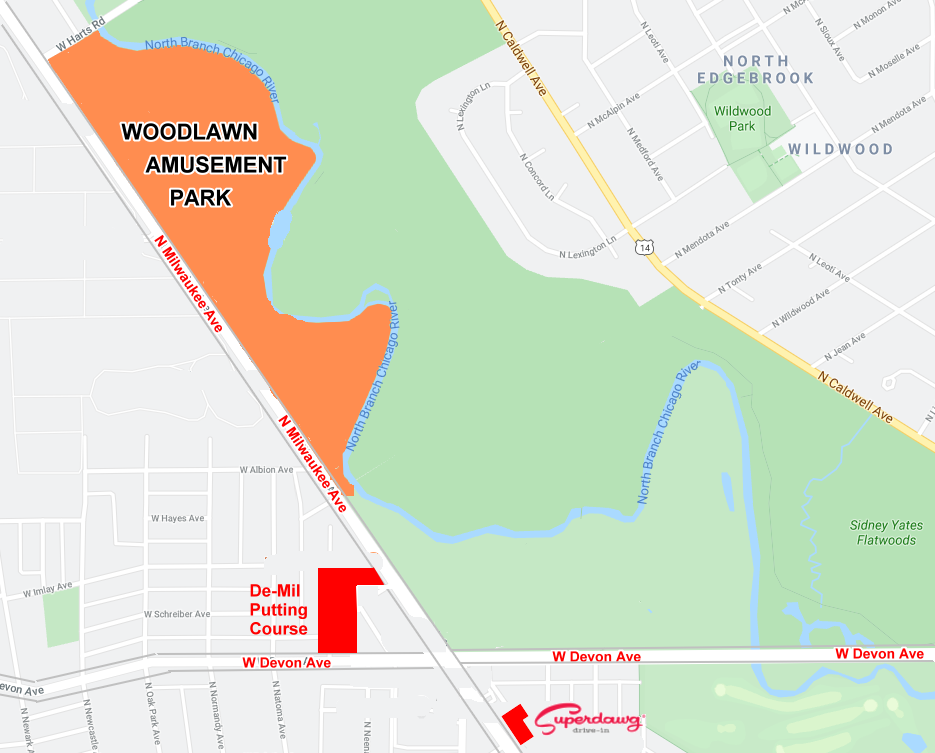
Woodlawn Amusement Park, Chicago, Illinois.

Paul W. Cooper, a  concessionaire and promoter for "Riverview Sharpshooter Park" (the "Sharpshooter Park" part of the name was dropped in 1905). Riverview's opening day was on Sunday, July 3, 1904.

Cooper owned a water ride called "Shooting the Rapids," a Shoot-the-Chutes ride, but not at Riverview. 


William M. Johnson, a lawyer and the project's funder, was also a promoter for Riverview Park. Somehow, Johnson and Cooper gained control of Riverview from Wilhelm Schmidt, and Schmidt owned the (pre-Riverview) park called Schuetzen Park, then "Sharpshooters Park," from 1879. Of course, they grew animosity until Schmidt finally regained control and forced Cooper and Johnson out. 

Cooper had a successful amusement concession at Municipal Pier (today's Navy Pier) in the 1920 & 1921 seasons.
Woodlawn Amusement Park Newspaper Notice
January 31, 1921.
Chicago, Ill. — The Woodlawn Amusement Company, ℅ Architect Ralph C. Harris, 190 North State Street, Chicago, Ill., will receive bids until Monday, February 28, 1921, for an amusement park to include about 30 buildings on Milwaukee and Devon Avenues in Chicago, the estimated value of $1,000,000 ($17M today).
                                                                                     The Economist, Monday, January 1921.

The new Woodlawn Amusement Park was dedicated on Tuesday, February 1, 1921. William M. Johnson turned the first spadeful of earth, and Mrs. Johnson christened the park by breaking a bottle of fine wine. Fifteen automobile loads of friends attended the ceremony. Afterward, there was a banquet at the Chicago Press Club with music supplied by Paul Cooper's Municipal Pier dance orchestra.
Superdawg and De-Mil Putting Course (added to aid in visualizing location).
CLICK TO ENLARGE
A few weeks later, William M. Johnson suffered what Billboard trade magazine called "a nervous breakdown." Plans for Woodlawn Amusement Park ground to a sudden halt, never to be built."

Chicago, Ill. — The Woodlawn Amusement Park Company, Paul W. Cooper, president, has abandoned the amusement park at Milwaukee and Devon Avenues for which Architect Ralph C. Harris made plans.              The Economist, Saturday, April 16, 1921.

Given this, Woodlawn was their attempt to become the big, new Chicago Amusement Park. If it had been built, it might have outlived Riverview.

So why wasn't Woodlawn Amusement Park built? Here are my thoughts. In the late 1910s, Chicago's population expanded in all directions as Chicago's population exploded. Chicago's northwest side was a prime amusement park location because little was there. The area experienced a building boom and was perfect for a giant-sized amusement park.
 
After WWII, Riverview began to feel the effects of its customer base moving away; and not coming back once or twice a season, if at all. Instead, these families found new kiddie amusement parks, which began popping up like dandelions in the 1950s suburbs. These new parks had plenty of parking, picnic areas, and rides for kids and toddlers. 

They took their Baby Boomer kids to these kiddie amusement parks:

Woodlawn would have been closer to the new suburbs. With the area around Woodlawn still undeveloped in the 1920s and the Great Depression starting in 1929, they might have secured enough land for future expansion to install 1960s and 70s theme park rides. Riverview needed more room for a miniature railroad, water rides, the 80s, 90s, and 2000s style steel and loop coasters, etc.

Woodlawn could have been a Chicago-style Kennywood Park, a Riverview-style amusement park in Pittsburgh, Pennsylvania, founded in 1898 and still running.

Also, at the corner of Devon and Milwaukee Avenues:

1) De-Mil Putting, a Miniature Golf Course at Devon and Milwaukee Avenues, Chicago.
2) Superdawg at Devon and Milwaukee Avenues, Chicago. A 1950s Car-Hop Drive-in.


Copyright © 2013  Dr. Neil Gale, Ph.D.  All Rights Reserved.

Wednesday, December 25, 2019

During the Civil War, General Ulysses S. Grant Began Expelling Southern Jews - Until President Lincoln Stepped In.


In historical writing and analysis, PRESENTISM introduces present-day ideas and perspectives into depictions or interpretations of the past. Presentism is a form of cultural bias that creates a distorted understanding of the subject matter. Reading modern notions of morality into the past is committing the error of presentism. Historical accounts are written by people and can be slanted, so I try my hardest to present fact-based and well-researched articles.

Facts don't require one's approval or acceptance.

I present [PG-13] articles without regard to race, color, political party, or religious beliefs, including Atheism, national origin, citizenship status, gender, LGBTQ+ status, disability, military status, or educational level. What I present are facts — NOT Alternative Facts — about the subject. You won't find articles or readers' comments that spread rumors, lies, hateful statements, and people instigating arguments or fights.

FOR HISTORICAL CLARITY
When I write about the INDIGENOUS PEOPLE, I follow this historical terminology:
  • The use of old commonly used terms, disrespectful today, i.e., REDMAN or REDMEN, SAVAGES, and HALF-BREED are explained in this article.
Writing about AFRICAN-AMERICAN history, I follow these race terms:
  • "NEGRO" was the term used until the mid-1960s.
  • "BLACK" started being used in the mid-1960s.
  • "AFRICAN-AMERICAN" [Afro-American] began usage in the late 1980s.

— PLEASE PRACTICE HISTORICISM 
THE INTERPRETATION OF THE PAST IN ITS OWN CONTEXT.


By 1860, there were an estimated 200,000 Jewish people in the United States (est. 34,000 Jews, about 2% of 1.72 million, in Illinois), up from 15,000 in 1840. That dramatic rise was the result of poverty and discrimination in Germany and Central Europe, where Jewish people were often excluded from trade, prevented from marrying, and subject to pogroms (organized massacres) and other violence.

The United States offered the promise of economic and social freedom. However, Jewish immigrants were not always welcomed into their new communities, especially in the North. New Jewish enclaves in American cities were viewed with suspicion by those who recognized neither their language nor their religion. Once the Civil War broke out, things got even worse.

In the North, popular newspapers disparaged Jews as secessionists and rebels and blamed them for destroying the national credit. And though some Jews occupied high-ranking roles within the Confederacy, anti-Semitism was widespread in the South as well.

As soon as the war began, illegal trade and smuggling between the North and South started. Though the Union blockaded Southern ports, goods still made their way over the border, and profiteers continued their trade illicitly, especially as the price of cotton rose due to the embargo. Not only did illicit trading flout Union rules, but it threatened the war effort itself.

When cotton came from Confederate territory, there was always the danger that it would be paid for in supplies or munitions. The black market was everywhere, and it frustrated both governments. And there was a seemingly perfect scapegoat: Jews, who had been stereotyped in the press as avaricious and opportunistic.

This restriction drove cotton prices from 10¢ per pound ($2.80 today) in 1860 to 68¢ per pound ($19 today) just two years later.
Ulysses Grant and his family arrived in Galena, Illinois, in the spring of 1860 after a 15-year military career that ended in 1854. In 1861, at the outbreak of the Civil War, Grant left Galena to join the U.S. Army, ending his seven-year hiatus from the military. He was commissioned as Colonel of the 21st Illinois Volunteer Infantry Regiment and was promoted to progressively significant commands of Union forces. 
General [Hiram] Ulysses S. Grant, one of the Union Army's most influential officials, was infuriated by the cotton smuggling that damaged the Union's ability to squeeze the South economically. The Civil War created a huge cotton market for uniforms needed on both sides. In his eyes, the perpetrators were all Jews. This wasn't borne out by evidence—though Jewish people were active as peddlers, merchants, and traders, and some undoubtedly made money speculating on cotton, they would only make up a minuscule percentage of black marketeers.

In August of 1862, Ulysses became the commander of the Army of the Tennessee. As Grant was preparing the Union Army to take Vicksburg, Mississippi, he commanded his men to examine the baggage of all speculators, giving "special attention" to Jews. In November, he told his subordinates to refuse to let Jews receive permits to travel south of Jackson, Mississippi, or travel southward on the railroads.

For Grant, prejudice against Jews mingled with personal animosity. He began his crackdown after discovering his father, Jesse R. Grant, and his two Jewish partners, Henry and Abraham Mack, were involved in a scheme to get a legal cotton trading permit in Cincinnati, Ohio.

THE BACKSTORY OF ULYSSES S. GRANT, HIS FATHER JESSE, AND JEWS.
During the Civil War, Jesse Root Grant (1794-1873) resided in Covington, Kentucky, which remained neutral during the war. Jesse's son Simpson died of tuberculosis in September of 1861. His son Ulysses brought his children to stay with Jesse, believing they would be safer there.

Jesse followed the continuing successes of Ulysses as he advanced in rank and assumed command of major campaigns. When controversial stories appeared in newspapers about the heavy casualties suffered under Generals Prentiss and McClernand at the Battle of Shiloh in Tennessee under the command of Ulysses, Jesse defended his son and responded with numerous editorials in rebuttal in various Cincinnati newspapers in such a manner as to suggest he was speaking for his son the General. Jesse also wrote a heated letter to Governor Tod of Ohio, blaming the "five thousand cowards" who threw down their arms and fled for the high casualties that occurred at the battle. Jesse's letters became so frequent that General Grant, who had much distrust for newspapers and their coverage of the war, had to step in and forbid him from writing to the newspapers.
 
sidebar
In a letter to his father, Ulysses wrote, "My worst enemy could do me no more injury than you are doing."

As the war caused the price of cotton to escalate, it invited many speculators, moving about in the midst of a major and prolonged military campaign against Vicksburg, Mississippi, causing many problems for the Union Army.  Traveling from Ohio, they arrived unexpectedly at General Grant's headquarters in northern Mississippi while he was busy with commanding a major campaign. 

Grant had already received reports from William Tecumseh Sherman (1820-1891), the United States Secretary of War, and other Jewish merchants who were "highly visible" in the trading that was occurring by both northern and southern interests, often without permits. 

In December of 1862, Jesse and the Mack brothers struck a deal. Jesse signed a contract promising to use his influence with his son to obtain a special permit that would allow the Macks to trade with the Confederacy. The Macks, in return, promised to provide the money and to share one-fourth of their profits from the trade with Jesse. Jesse wrote to and visited Ulysses in an effort to fulfill his part of the bargain. One of the Macks also reportedly visited the general. Jesse arrived at Grant's headquarters in northern Mississippi while he was busy commanding a major campaign. 

When Grant refused to sign a permit, the Macks withdrew from the agreement. Jesse responded by suing them for breach of contract. The Cincinnati courts ruled in favor of the defendants.

By the time Jesse and his two partners arrived with a request for permits to operate, they were immediately rebuffed by Ulysses, angered for presuming on the Army and his patience. 
 
The incident had been indicative of the problem with cotton speculators, in general, who often collaborated with Union Officers, much to the frustration of General Grant. It's believed that Jesse's arrival with two prominent Jewish cotton speculators is largely what led Grant in 1862 to issue General Order №.11, expelling all Jews from his district. Jesse and the Mack Bros. were instructed to leave the district on the next train going north. 

This incident proved to be an embarrassment for Grant, which once again placed his father and himself on opposing sides of a serious issue.

On December 17, 1862, Grant went even further. That's when he issued an official order expelling Jews from the Department of the Tennessee, a massive administrative division under his command that included parts of Kentucky, Mississippi, and Tennessee. He called the Jews "a class violating every regulation of trade established by the Treasury Department and also department orders" and gave them 24 hours to get out.

The order targeted Jews as a group, singling them out based on their religion. And though news of the order was hindered by Confederate raids and was not well-enforced, it slowly trickled out to Jews in and beyond the affected area.

News of the order horrified Jewish Americans. Among them were the approximately 30 Jewish merchants of Paducah, all of whom were expelled from the city along with their wives and children. Two of the men being banished were former Union soldiers.


On December 17, 1862, as the Civil War entered its second winter, General Ulysses S. Grant issued the most anti-Jewish order in American history. The letter was short, but its meaning was clear—and devastating. "You are hereby ordered to leave the city of Paducah, Kentucky, within twenty-four hours." General Order №.11 decreed as follows:
  • The Jews, as a class violating every regulation of trade established by the Treasury Department and also department orders, are hereby expelled from the Department [of Tennessee] within twenty-four hours from the receipt of this order.
  • Post commanders will see to it that this class of people will be furnished passes and required to leave. Anyone returning after such notification will be arrested and held in confinement until an opportunity occurs to send them out as prisoners unless furnished with a permit from headquarters.
  • No passes will be given to these people to visit headquarters to make personal applications for trade permits.
In a letter of the same date sent to Christopher Wolcott, the United States Assistant Secretary of War, Grant explained his reasoning:
Sir,
I have long since believed that in spite of all the vigilance that can be infused into Post Commanders, that the Specie 
(money in the form of coins rather than paper notes) regulations of the Treasury Department, have been violated, and that mostly by Jews and other unprincipled traders. So well satisfied of this have I been at this that I instructed the Commanding Officer at Columbus [Kentucky] to refuse all permits to Jews to come south, and frequently have had them expelled from the Department [of the Tennessee]. But they come in with their carpet sacks in spite of all that can be done to prevent it. The Jews seem to be a privileged class that can travel any where. They will land at any wood yard or landing on the river and make their way through the country. If not permitted to buy cotton themselves they will act as agents for someone else who will be at a Military post, with a Treasury permit to receive cotton and pay for it in Treasury notes which the Jew will buy up at an agreed rate, paying gold.
There is but one way that I know of to reach this case. That is for Government to buy all the Cotton at a fixed rate and send it to Cairo [Illinois] St. Louis [Missouri] or some other point to be sold. Then all traders, they are a curse to the Army, might be expelled.
Less than 72 hours after the order was issued, Grant's forces at Holly Springs, Mississippi, were raided, knocking out rail and telegraph lines and disrupting major lines of communication for weeks. As a result, news of Grant's orders spread slowly and did not reach company commanders and army headquarters in Washington in a timely fashion. Many Jews who might otherwise have been banished were spared.

A copy of General Grant's orders finally reached Paducah, Kentucky—a city occupied by Grant's forces—11 days after it was issued.

On December 29, Cesar J. Kaskel, a staunch union supporter, as well as all the other known Jews in Paducah, were handed papers ordering them "to leave the city of Paducah, Kentucky, within twenty-four hours." Kaskel couldn't believe it. He had emigrated to the United States after leaving Prussia, where he was discriminated against and financially ruined because he was Jewish. Now, the Union Army was telling him he was expelled from his new home and business for the same reason. 

As they prepared to abandon their homes, Kaskel and several other Jews dashed off a telegram to President Abraham Lincoln describing their plight.
Cesar J. Kaskel was a Jew who was, with other Jews in Paducah, Kentucky, rounded up and shipped to Cincinnati, Ohio, by General U.S. Grant under General Order Number Eleven.
As they prepared to abandon their homes, Kaskel and several other Jews dashed off a telegram to President Abraham Lincoln describing their plight.
Paducah, Kentucky, December 29, 1862.
Hon. Abraham Lincoln, President of the United States.
 
General Order №.11 issued by General Grant at Oxford, Mississippi, December the 17th, commands all post commanders to expel all Jews without distinction within twenty-four hours from his entire Department. The undersigned good and loyal citizens of the United States and residents of this town, for many years engaged in legitimate business as merchants, feel greatly insulted and outraged by this inhuman order; the carrying out of which would be the grossest violation of the Constitution and our rights as good citizens under it and would place us, besides a large number of other Jewish families of this town, as outlaws before the world. We respectfully ask your immediate attention to this enormous outrage on all law and humanity and pray for your effectual and immediate interposition. We would especially refer you to the post commander and post adjutant as to our loyalty, and to all respectable citizens of this community as to our standing as citizens and merchants. We respectfully ask for immediate instructions to be sent to the Commander of this Post.
D. WOLFF & BROTHERS.
C.F. KASKEL
J.W. KASKEL
Though the 1862 orders were aimed at cotton speculators, they gave all Jews—speculators or not—just 24 hours to leave their homes, businesses, and lives behind. It was the culmination of a wave of anti-Semitism that swept through the United States in the year before the Civil War (1861-1865), and a decision that would haunt Grant for the rest of his life.

After their forced departure, Kaskel went to Washington to protest the order in person. He approached Congressman John A. Gurley of Ohio, who agreed to accompany him to the White House. The men hurried to President Lincoln.

But though an increasing number of people were learning of Grant's orders in the South, the breakdown in communications meant that Lincoln had not previously heard about his general's decision to expel Jewish people from the Department of the Tennessee. 

Lincoln, in all likelihood, never saw that telegram. He was busy preparing to issue the Emancipation Proclamation. He was so shocked by the order that he immediately asked his staff for confirmation, which was confirmed as accurate.

Lincoln did instantly instruct the general-in-chief of the Army, Henry Halleck, to countermand General Orders №.11. Two days later, several urgent telegrams went out from Grant's headquarters in obedience to that demand: "By direction of the General in Chief of the Army at Washington," they read, "the General Order from these Head Quarters expelling Jews from this Department is hereby revoked."

News of the order continued to spread, and though some editorials sided with Grant, most condemned its targeting of Jews. "Men cannot be condemned and punished as a class, without gross violence to our free institutions," wrote the New York Times a month after the order. But even that editorial spread anti-Semitic tropes about Jews, comparing them to Shylocks[1] and complaining about the potentially destructive power of wealthy Jews. Grant's order helped stir up an ugly undertone of American life that isolated and damaged Jews who had come to the United States in search of elusive equality.

In a follow-up meeting with Jewish leaders, Lincoln reaffirmed that he knew "of no distinction between Jew and Gentile." "To condemn a class," he emphatically declared, "is, to say the least, to wrong the good with the bad. I do not like to hear a class or nationality condemned on account of a few sinners." In short order, attention returned to the battlefield, where Grant's victory at Vicksburg, Mississippi, within a year, elevated him to the status of a national hero.

The discriminatory order was quickly squelched, but the general never forgot it. In fact, he spent a lifetime trying to atone for it. When he ran for President in 1868, he confessed that the order "was issued and sent without reflection and thinking." In office, he named more Jews to public office than ever before. He promoted the human rights of Jewish people abroad, protesting pogroms in Romania and sending a Jewish diplomat to object.

During his administration, Jews moved from outsider to insider status in the United States and from weakness to strength. But though Grant did what he could to atone for his discriminatory order, he doubtless contributed to the anti-Semitism of the 19th century.

Read about "The Redemption of Ulysses S. Grant" by Jonathan D. Sarna.

Compiled by Dr. Neil Gale, Ph.D.


[1] Shylock is a character in William Shakespeare's play "The Merchant of Venice" (circa 1600). A Venetian Jewish moneylender, Shylock is the play's principal antagonist. His defeat and conversion to Christianity form the climax of the story.