Wednesday, June 26, 2019

Theater History in Chicago in the Nineteenth Century.

The first public, professional performance in Chicago took place in 1834, one year after Chicago was incorporated as a town. It cost 50¢ for adults, 25¢ for children, and was staged by a Mr. Bowers, who promised to eat "fire-balls, burning sealing wax, live coals of fire and melted lead." Somehow, he also did ventriloquism. Other traveling showmen passed through over the next two years; the first traveling circus pitched its tent on Lake Street in the fall of 1836. 
The Sauganash Hotel. The log building on the left was Chicago's first drugstore.
The Eagle Exchange Tavern (later the Sauganash Hotel) is Chicago's first hotel and restaurant. Built in 1829 by Mark Beaubien, it was located at Wolf Point, the intersection of the north, south, and main branches of the Chicago River, at Lake and Market Streets (North Wacker Drive). The addition of the frame building became the Sauganash Hotel in 1831.

Wolf Point Tavern opened in December of 1828.
Eagle Exchange Tavern opened in 1829 - Sauganash Hotel opened in 1831 
The Green Tree Tavern wasn't built until 1833.

The Sauganash Hotel changed proprietors often in its twenty-year existence. It was named after Billy Caldwell "Sauganash," an interpreter in the British Indian Department. 

sidebar
Billy Caldwell's history was mainly fabricated, which you can read about by clicking the link in this paragraph. 

When Harry Isherwood, co-manager of this pioneering ensemble, arrived in Chicago in 1837, he said: "It was the most God-forsaken looking place it had ever been my misfortune to see." Then he went on to say: "The mud was knee-deep. No sidewalks except a small piece here and there. No hall that could be used to any advantage for theatrical presentation." A sign, he thought, that Chicago was not yet ready for culture.

However, the following morning he began to inspect every building that might be turned into something for his purpose. He finally decided on the abandoned dining room of the Sauganash Hotel. John Murphy, the proprietor of that pioneer habitation, had just opened a new and more commodious place to care for weary visitors to the new city and was glad to have a part of the building occupied.

Isherwood, who was not only a capable actor but a scenic artist as well (In fact, every company traveling in those days had someone that could and did paint scenery.), and his partner, Alexander McKinzie (who took care of bookings and logistics), nevertheless obtained an amusement license from the city council for $125.00 ($2,800 today). On Monday, October 23, 1837, they began offering plays, the first being James Sheridan Knowles' "The Hunchback." Other play titles included The Idiot Witness, The Stranger, and The Carpenter of Rouen. The bill changed every night, and the season lasted about six weeks, after which the company went on tour.

By 1839, the Sauganash returned to service as a hotel but was destroyed by fire on March 4, 1851, and subsequently torn down. The Wigwam 
(an Indian word meaning "temporary shelter") was built in its place nine years later.

When they returned to Chicago in the spring of 1838, Isherwood and McKinzie set up the company in an old wooden auction house called the Rialto. There was opposition to their presence: a formal petition cited fire risk; moral objections were also made. Even so, the city council voted to grant the troupe a new license. On September 3, 1839, two Chicago Theater shows — The Warlock of the Glen and The Midnight Hour — became the subjects of Chicago's first published theater review.

The ensemble members included Joseph and Cornelia Jefferson and their nine-year-old son Joseph Jr. The child sang comic songs, filled out crowd scenes, and played the Duke of York. He grew up to become one of the iconic performers of his time, a stage comedian widely, intensely, and fondly identified with several roles, especially Rip van Winkle. His connection with Chicago is memorialized in the Joseph Jefferson Awards, given annually for outstanding work in local professional Theater.

The Chicago Theater did not outlast its 1839 season, and Chicagoans went back to relying, for the most part, on touring shows and circuses. According to the story, a nonprofessional Thespian Society was formed by local men in 1842 and flourished — until somebody stole their sets.

The next great leap occurred in 1847, when John B. Rice, newly arrived from Buffalo, New York, contracted with a local alderman to build a theater near the corner of Randolph and Dearborn Streets. Rice's Theater opened on June 28 with a comedy called The Four Sisters, in which Mrs. Henry Hunt (later known as Louisa Lane Drew, a founder of the Barrymore dynasty) played all the title roles. According to newspaper accounts, the play and the place were enthusiastically received. Rice's Theater attracted major stars of the time, including Edwin Forrest and Junius Brutus Booth. Built of wood, it burned during the summer of 1850 but was replaced within six months by a new brick structure. John Rice sold his Theater in 1857 and began a successful political career, serving as mayor of Chicago from 1865 to 1869.

1857 was also the year McVicker's Theatre opened under the management of James H. McVicker, an actor and former employee of Rice's who owned a chain of theaters in cities around the United States.

McVicker's Theater, on Madison Street between State and Dearborn Streets, was built by Chicago actor and producer James H. McVicker in 1857. Photograph from 1863.

The sign on the building at the left says; Frank Munroes Green Room - Sands Pale Cream Ale. J.J. Sands' "Columbian Brewery," on the corner of Pine Street (N. Michigan Avenue) and E. Pearson Street, was built in 1855 and rivaled Lill & Diversy Brewery, Chicago's first commercial brewery. Both breweries produced pale or cream ale and were leveled in 1871 by the Great Chicago Fire.
As for everyone else, the Great Chicago Fire of 1871 was devastating and opportune for the Chicago theater community. James McVicker, as did David Henderson, took a leading role in the rebuilding. A Scottish-born newspaperman turned entrepreneur, Henderson built the Chicago Opera House, ran several other theaters, and produced a series of musicals with exotic Levantine settings (The Arabian Nights, Sinbad the Sailor, Ali Baba) that not only revived the Chicago stage but earned the city a reputation as an American theatrical hub into the 1900s.

If the affluent downtown crowds were looking for exotica and the new immigrants in the neighborhoods were longing for something familiar — and found it in their own theaters.

Lydia Thompson (1838-1908) introduced Victorian burlesque to America with her troupe, the "British Blondes," in 1868 and brought burlesque to Chicago in 1869

Lydia Thompson and the British Blondes, featuring Pauline Markham, Ada Harland, Lisa Weber, Olive, and Kate Logan.
Thompson's success inspired extraordinary reactions, including charges that her blonde hair was a wig and newspaper columns calling her an "English prostitute." Vehement protest swelled into a "war upon the blondes" that Lydia Thompson and Pauline Markham brought to a climax by horsewhipping Wilbur Storey, the Chicago Times editor, on the city's streets in 1869. Put on trial, the ladies were required to pay $100 damages ($1,900 today) each to Storey. They could not have purchased the ensuing publicity for ten times the fine amount. Thompson would enjoy six lucrative years in America before returning to England to reinstall herself in English theater. 

A German-language company was operating as early as 1852. Others followed quickly.

A Yiddish theater scene developed at the turn of the century and even produced a few mainstream stars. The best-known was Muni Weisenfreund, who became Paul Muni on Broadway and Hollywood. Muni first appeared onstage in 1908, at the age of 13, in the Metropolitan Theatre at Jefferson Street and 12th Street (today, Roosevelt Road), a theater his parents operated about a block away from the Maxwell Street Market. It differs from the Metropolitan Theatre at 4644 South Parkway (today, Martin Luther King, Jr. Drive), Chicago.

Compiled by Dr. 
Neil Gale, Ph.D. 

Tuesday, June 25, 2019

The History of Chicago's "Wigwam" Buildings.

The Eagle Exchange Tavern (later the Sauganash Hotel) is regarded as the first hotel, restaurant, and grocery store in Chicago. Built in 1829 by Mark Beaubien, it was located at Wolf Point, the intersection of the north, south, and the main branches of the Chicago River, at Lake and Market Streets (today Wacker Drive). The addition of the frame building became the Sauganash Hotel in 1831.
  1. Wolf Point Tavern opened in December of 1828.
  2. Eagle Exchange Tavern opened in 1829 - Sauganash Hotel opened in 1831 
  3. The Green Tree Tavern wasn't built until 1833.
sidebar
The Sauganash Hotel was named after Billy Caldwell, whose personal history was mostly fabricated.

The Sauganash Hotel was Chicago's first hotel. The log building on the left was Chicago's first drugstore.
The newly formed Incorporated town of Chicago elected its first town trustees in 1833 in the hotel's dining room. The building briefly served as Chicago's first theater, hosting the first Chicago Theatre company in 1837 in the abandoned dining room. 

Unfortunately, the hotel was destroyed by fire on March 4, 1851, and the Wigwam (an Indian word meaning "temporary shelter") was built in its place nine years later.
The Old Site of the Sauganash Hotel / The Wigwam Building.
The next Wigwam building was two stories. It was built in 1860 by Chicago business leaders to attract the 1860 Republican National Convention. (The Whig Party was founded in 1834 and dissolved in 1860.) It was constructed of plain pine boards, and the characteristics of a log cabin and a government building were conserved in some respects. It was built as a temporary structure in just over a month and could accommodate 10–12,000 people. The Antebellum [1] custom was to call a political campaign headquarters a Wigwam. Wigwam is also an Indian word for "temporary shelter."
1860 Republican National Convention in the Wigwam.


The 1860 Republican National Convention was eventful for its nomination of Abraham Lincoln. During the convention, backroom dealing and political scheming played a role in the outcome. Nevertheless, Lincoln, who had stayed in Springfield during the convention, received vehement support and carried the nomination.

sidebar
David Berg started producing his hot dogs in 1860 and sold them at the Convention.

Chicago has hosted the most United States presidential nominating conventions; 14 Republican National Conventions and 11 Democratic National Conventions, in addition to one notable Progressive Party assembly. The 1860 Republican National Convention (the second Republican National Convention) was held at the Wigwam.
Illustration of the Wigwam interior during the 1860 nominating convention. The structure could hold 10-12,000 people. Note the second-story gallery and curved ceiling structure to allow for better acoustics.
The 1864 Democratic National Convention was hosted in a different "Wigwam" built for the convention as a semicircular roofed amphitheater. These were the first Chicago visits for each party's national convention. The 1868 Republican National Convention returned to Chicago, but it was located at the Crosby Opera House.

The building was used for political and patriotic meetings during the Civil War. The Wigwam also served as a retail space until its demolition, sometime between 1867 and 1871.

Following the Great Chicago Fire of 1871, another "Wigwam" building at Washington (one city block south of Lake) and Market Streets served as the temporary home for the Chicago Board of Trade.

The 1892 Democratic National Convention convened in a temporary "Wigwam" in Lake Park for Grover Cleveland's third nomination.

Today, the corner of Lake Street and Wacker Drive bears the address "191 North Wacker." This address is in the West Loop neighborhood of the Loop community in Chicago. The 516-foot high, 37-story office tower was designed by Kohn Pedersen Fox and built in 2002.
In 2017, the city rededicated plaques gifted in the early 20th century by the Daughters of the American Revolution to commemorate Lincoln's nomination at the Wigwam and the Sauganash Hotel.

Compiled by Dr. Neil Gale, Ph.D.


[1] The antebellum period refers to the years after the War of 1812 (1812-15) and before the Civil War (1861-65). The development of separate northern and southern economies, the westward expansion of the nation, and a spirit of reform marked the era. These issues created an unstable and explosive political environment that eventually led to the Civil War.

Fence Laws of Frontier Illinois.

In the frontier days of farming in Illinois, there was a huge debate amongst the farmers about fencing. Illinois was a closed grazing state so fences were required and those "cowcatchers" on old locomotives weren't just decorative.
John Bull Locomotive with a cowcatcher.

Illinois settlers needed to keep their livestock away from their crops and the railroad tracks. On the prairie, trees were scarce and wood was a precious commodity. Building fencing to contain cattle was an expensive proposition. Split rail fences were expensive, $500 ($12,000 today) per mile. A prairie fire would easily destroy the costly fencing, sending all a farmer’s hard work and money up in smoke. Wire fencing at the time was brittle, not galvanized, causing the wire to rust and easily break. In the early 1840’s, a movement to use these thorny trees as fencing began. Illinois was the first of the prairie states that introduced the Osage orange as a living fence. Young trees and new growth on trees have sharp ½ to 1 inch thorns. Thorns, its dense growth when pruned, and its ability to survive extreme conditions are the reasons this tree came to the prairie.

An example of the Osage Orange or hedge apple tree fencing.
In fact, one of the relatively few requirements for the new "township" system of government enabled by the Illinois Property Line and Fence Laws [1] in the 1848 Illinois Constitution was the requirement that Townships appoint Fence Inspectors. 

By the 1850s there was widespread acceptance of the thorny and dense-growing Osage orange (Maclura pomifera) or "hedge apple." 
A dead hedge fence. Note the trained trunks to keep the growth close to the ground.
Although economic and effective barbed wire had largely taken over by the 1880s, many of the hedge apple fences were used and maintained into the 1940s, Among the 400 parcels totaling over 40,000 acres of agricultural land in Will County that were purchased by the Army in 1940 for the Joliet Arsenal, hedge fences, often allowed to have grown into trees, were everywhere.
Osage hedges on both sides of an old farm road that were neglected and had grown into trees.
Surely some diligent nineteenth-century farmer lost one of his Osage bushes and took the two or three years to train the hinge cut into something that covered the gap in his fence. One of the amazing things that still stand as subtle testimony to life frontier Illinois so long ago.

Compiled by Neil Gale, Ph.D.


[1] Illinois Property Line and Fence Laws. A summary of key Illinois laws relevant to the property line and fence disputes.

Lawful Fence - IL ST CH 765 § 130/2
  • Must be 4.5 feet high.
  • In good repair.
  • Constructed from rails, timber boards, stone, hedges, barb wire, woven wire or whatever the fence viewers of the town or precinct state is appropriate.
  • It must be sufficient to prevent cattle, horses, sheep, hogs and other stock from getting on the adjoining lands of another.
Responsibility to Maintain a Division Fence - IL ST CH 765 § 130/3
  • A division fence is one separating the land of 2 or more persons.
  • Each person must make and maintain a "just portion" of the fence.
  • A hedge fence cannot be more than 5 feet high.
Fence Dispute Settlement - IL ST CH 765 § 130/7
  • Two official Fence Viewers will define the portion of the fence to be built or maintained by each.
  • In counties under township organization, the board of trustees will serve as fence viewers in their respective towns.
  • In counties not under township organization the presiding officer of the county board, three fence viewers in each precinct.
Wrongful Tree Trimming Act - IL ST CH 740 § 185/2
  • It is a violation to cut or cause to be cut any tree unless you have full legal title.
  • Violators of the act will be liable for three times the value of the tree.
  • Utility providers have a right to cut any tree that interferes with service.

Monday, June 24, 2019

The History of the Smith Stained Glass Museum at Navy Pier in Chicago, Illinois, from 2000-2014.

The Smith Stained Glass Museum opened in February of 2000 and is the first museum in the United States dedicated solely to stained glass windows. The exhibit opened under a 10-year art loan agreement signed in 1997 and then was extended with a series of one-year agreements.
A detailed view of the Field of Lilies (c.1910) window, one of 18 windows unveiled at the Smith Museum of Stained Glass Windows at Navy Pier which including 15 windows by Louis Comfort Tiffany.
The collection was donated by Maureen Dwyer Smith and Edward Byron Smith Jr., whose family founded Illinois Tool Works and Northern Trust.
Museum Visit - Phillip McCullough, of Mississippi, visits the Smith Museum of Stained Glass at Navy Pier.
The exhibit was open year round and was free to all Navy Pier visitors and had 143 stained glass panels/windows on display featuring both secular and religious art. The windows were divided into four categories: Victorian, Prairie, Modern, and Contemporary. Local, national, and international artists designed the windows, including Louis Comfort Tiffany, John LaFarge, Ed Paschke and Roger Brown.
Tiffany Windows - from left: Pair of Poppies (c.1890) and Field of Lilies (c.1910).
Debbie Carithers, of Table Grove, Illinois, looks at Pair of Poppies (c.1890) during an unveiling of 18 new pieces at the Smith Museum of Stained Glass Windows at Navy Pier.
From 1870 to the present, the windows depict landscapes, nursery rhymes, and historic moments.They represent an era of intense urban revision that featured the development, decline and revitalization of neighborhoods, the development of commercial and cultural institutions, the evolution of artistic styles, and the response of various ethnic groups to these changes.
A detail view of Bacchanalia (c.1900) at the Smith Museum of Stained Glass Windows.
The religious windows reveal the national and ethnic styles of Chicago’s European immigrants, while the residential windows display the history of architecture and decorative art styles.
Carpenter Liam Stewart works on the installation of this large stained glass piece, Printer's History, (c.1914), at the Smith Museum of Stained Glass Windows.
The museum also displayed unique contemporary pieces including stained glass portraits of Dr. Martin Luther King, Jr., and Michael Jordan as well as several pieces of Tiffany stained glass dating as far back as 1890. The museum contained the largest public display of Tiffany windows in the world!
Glass Cleaning - Brian Selke, assistant conservator with Restoration Division, LLC, cleans an American stained and painted glass window that will be boxed up at Navy Pier. The piece is by designers Elizabeth Parsons, Edith Blake Brown and Ethyl Isadore Brown for the 1893 Chicago World's Columbian Exposition.
The collection was on display in an unconventional space that snakes along Navy Pier's lower level, and can appear at first glance more like a well-decorated hallway than a museum. The 800-foot-long central corridor at the east end of the pier is visited by art aficionados — and tourists seeking a restroom.
Movers from Aaron's Reliable Inc. move a window from the 1893 Chicago World's Fair from The Smith Museum of Stained Glass Windows. The windows are being moved to other sites, including the Macy's Pedway and Terminal 5 at Chicago O'Hare International Airport.
Ready to be Moved - Jim Freeman, left, associate conservator, and Pamela Olson, conservation technician, both with Restoration Division LLC, prepare to wrap a (c.1900) American stained and painted glass window to be moved from The Smith Museum of Stained Glass Windows.
The Smith Stained Glass Museum closed in October of 2014.

Compiled by Neil Gale, Ph.D. 


The Driehaus Gallery of Stained Glass Windows at Navy Pier from 2001-2017.
Chicago Skyline – Tiffany Studio
The adjacent Richard H. Driehaus Gallery of Stained Glass Windows opened in 2001 and closed in September of 2017. It was devoted to ecclesiastical and secular windows by Louis Comfort Tiffany and interrelated businesses between 1890 and 1930.
Ecclesiastical Angels - Tiffany Glass & Decorating Company, (c.1890).
The windows were from the extensive Tiffany collection of Chicago businessman Richard H. Driehaus. There were 11 Tiffany windows on display in the Driehaus Gallery, along with a Tiffany Studios fire screen.
Tiffany Studios fire screen has four sections, each 16" wide, with simple bronze frames and scrolled bronze feet supporting center curtains of Tiffany Chain Mail with glass tiles of white and bluish opalescent glass. The screen is topped with white lightly iridescent balls within a bronze ring. The bronze is finished in rich brown patina with strong green highlights. Signed "Tiffany Studios New York." SIZE: 64" w x 36" tall to top of glass ball decoration. Sold at auction for $95,000.

Compiled by Dr. Neil Gale, Ph.D. 

Sunday, June 23, 2019

The History of D.B. Kaplan's, the legendary Chicago Delicatessen & Restaurant. (1976-1995)

In 1976, brothers Larry and Mark Levy opened D.B. Kaplan's Delicatessen with a third partner, Donald Berton Kaplan, on the 7th floor of Chicago's Water Tower Place at 835 North Michigan Avenue.
Eadie Levy had her work cut out for her in 1978 when her sons, Larry and Mark, called her in her native city of St. Louis, Missouri, for help. They had to. Patrons at their first restaurant were making comments like, “Are you trying to kill me with that food?” The matzo balls were as hard as a new, finger-breaking Chicago 16" Clincher softball. The chopped liver was made from beef instead of chicken. Oy vey!

CLICK FOR A FULL-SIZE 1990 MENU
Mrs. Levy traveled to Chicago armed with treasured family recipes for chicken soup, potato salad, and blintzes. The kitchen turnaround was dramatic. Within two weeks after my mom arrived, people said, ‘Wow!’ This food is great. D.B. Kaplan's diners couldn’t get enough of her noshes. And they loved how she remembered their names, asked about their families and gave advice.

Employees found they could always go to Mrs. Levy with a problem. Quietly, she did good deeds. A woman struggled to keep a job, and Mrs. Levy paid for her dental reconstruction because she thought that might be the problem. The lively D.B. Kaplan's offered more than 100 sandwich creations, all bearing groan-worthy, punny names, like the Lake Shore Chive, with roast beef and cream cheese with chives on black bread, and the Studs Turkey for radio journalist Studs Terkel, with beef tongue, hot turkey breast, Canadian bacon, cranberry sauce and shredded lettuce on French bread. National celebrities were not spared either. The Hammy Davis, Jr. was ham salad on a BLT with mayo on whole-wheat toast.

D.B. Kaplan's Deli won the 1977 Great Menu Award from the National Restaurant Association.

In January of 1990, D.B . Kaplan's Deli introduced their jazzy new menu, naming many sandwiches after sports figures; Ham Dunk; The Mike Ditka Show (lots of tongue and always hot); Rye Sandburg (good lookin'); William "Refrigerator" Perry )three-foot, triple-decker); McMahonwich (still a Chicago favorite); Wayne Gretzky (guaranteed to make you score), or Mike McCaskey (beef and turkey). See many crazy dish names on the menu I linked in this article.  CLICK MENU ─►

It was a more innocent, sillier, and arguably more fun time for creative restaurateurs. Sadly, D.B. Kaplan's closed in 1995. Kaplan's "lost their lease," meaning that Water Tower Tower tried to raise the rent, the percentage of sales they get, or both.

In 1986 Larry and Mark Levy opened "Mrs. Levy's Deli," named after mama Levy, in what was then named the Sears Tower. After D.B. Kaplan's closed in 1995. Mrs. Levy's Deli closed in 2006.

In 2016, Levy Restaurants launched Mrs. Levy's Deli at the United Center as part of the culinary upgrade of the stadium in Chicago's Near West Side. The kiosk offered huge variations on the Reuben, including The High Rise ($15) with corned beef, Swiss cheese, sauerkraut, and Russian dressing on dark rye.

THE BACKGROUND OF THE LEVY BROTHERS THRU D.B. KAPLAN'S
The Levy brothers began their involvement in the restaurant business in Chicago, where they built the core of their food service business around a faltering delicatessen during the late 1970s. In the months before going into business together, Larry and Mark Levy had established careers independent of one another. Although both had relocated from St. Louis to Chicago, they had made the journey separately and, upon arrival, had begun working for different companies. Mark joined the insurance business, and Larry delved into real estate, accumulating enough financial wherewithal to open a delicatessen named D.B. Kaplan's with a third partner in 1976. 

Initially, the business was intended as a sideline venture for each brother. Said Larry: "I had always loved deli food and thought there was no good deli food in Chicago. I found a backer to do it, and I thought I would continue at my other company." However, closer, hands-on involvement was required in a matter of months. The operation of the delicatessen and its 285-item menu quickly proved too much an undertaking for the Levys' third partner, prompting Larry and Mark to fire him. Mark quit his insurance job and, along with his wife, took on the responsibility of D.B. Kaplan's daily operation. 

Immediately afterward, according to the brothers, the delicatessen showed strong signs of improvement, transforming from a money-loser to a profitable enterprise under the direct stewardship of Mark Levy. Two years later, in 1978, Larry quit his job as well and joined his brother in the restaurant business, embarking on a career that allowed his natural talents to flower.

At an early age, Larry Levy showed himself to be an entrepreneur at heart. Before he was ten years old, Levy sold magazine subscriptions and handmade potholders door to door. During high school, he developed a discount card for his fellow students to buy merchandise from selected merchants. While attending the Kellogg School of Management at Northwestern University during the late 1960s, Levy shuttled through the dormitories selling sandwiches and charter airline tickets to Europe, making extra money while he earned his M.B.A. degree. "I've always been an entrepreneur," Levy explained years after D.B. Kaplan's success spawned a small empire of restaurant properties. "When I found the restaurant business," he said, "my entrepreneurial skills met passion. It's something I truly love doing."

A second D.B. Kaplan's opened in Minneapolis, Minnesota.

After Levy left his real estate job in 1978, he and his brother formed Levy Restaurants and the Levy Organization, a commercial real estate company. With the establishment of these two companies, the corporate vehicles for expansion were in place, but the success of the delicatessen did not give birth to a chain of D.B. Kaplan's clones. Instead, the two brothers developed new restaurant concepts, pursuing a strategy that would lead to a heterogeneous patchwork of restaurants all owned by Levy Restaurants. During the first years of Levy Restaurants, the Levys developed several major restaurants in Water Tower Place, one of Chicago's premier high-rise shopping malls. One restaurant in Water Tower Place was Chestnut Street Grill, a grilled seafood restaurant that quickly became highly popular. It was one of the first Chicago restaurants to feature grilled seafood.


Compiled by Dr. Neil Gale, Ph.D. 
#JewishThemed #JewishLife

Thursday, June 20, 2019

The History of the Paleo-Indian migration to North America and the Jesse Ready Site/Lincoln Hills Site in Jersey County, Illinois.

The first people in North America arrived at least 14,000 years ago. Archaeologists call this period of North American history Paleo-Indian, meaning ancient Indian. Paleo-Indian people left distinctive spear points and stone tools at Illinois campsites behind.
A Paleo-Indian spear point; many have been found in Fulton County, Illinois.
Archaeologists have yet to find charcoal from which they could get an absolute date for these campsites, but spear points have been found in other parts of North America in 10,000 to 12,000-year-old deposits.

The Paleo-Indians arrived near the end of the Pleistocene epoch (2,600,000 BC to 11,700 BC), which is also known as the Ice Age. Archaeologists believe the first people crossed into North America when it was connected to Asia by land.

Geologists estimate that ocean levels were at least 280 feet lower during the late Ice Age. When the sea level fell, sections of the ocean floor became dry land. For example, large parts of the continental shelf were exposed along the coasts of North America and land-linked Asia and North America.

The earth's climate was colder during the ice age than it is today. During the ice age, the snow made up much of the earth's precipitation. Thick layers of snow slowly accumulated at higher latitudes and higher elevations. As snow accumulated, the bottom layers were compressed and transformed into ice and eventually glaciers, slow-moving masses of ice. In North America, glaciers once stretched from the Arctic to southern Illinois. As more and more of the earth's water was transformed into snow and ice, ocean levels fell, exposing large sections of the ocean bottom.
Map of Asia and North America showing 'Bering Sea Land Bridge' called the 'Beringia' and the possible route of Paleo-Indian people.
Asian people walked across this Asia-America "land bridge," perhaps while hunting animals like the Woolly Mammoth. Archaeologists call the land bridge "Beringia." About 12,000 years ago, rising seawater submerged Beringia, which lies beneath the Bering Sea today. When the earth's climate became warmer, glacial ice melted, sea level rose and submerged land along the edges of continents.

For many years, anthropologists believed that Indians were from Siberia. New evidence suggests that people from other Asian groups also came to North America at different times. Scientists who study the shape and size of skeletal remains are known as osteologists. Osteologists study human remains to learn about health, disease, and ancestry. Based on a recent study of Asian and Indian skeletons, osteologists believe that Indian ancestry includes more than one Asian group. Archaeologists have not found skeletal remains of Paleo-Indian people in Illinois. At present, we do not know much about the appearance of these people, how tall they were, how long they lived, or anything about their overall health.


During the Ice Age, complicated interactions between the earth's atmosphere and its oceans caused extensive glaciation. Mile-thick masses of glacial ice extended into Illinois, moving colossal amounts of rock and earth. When the ice retreated, it left broad, flat plains, some rolling topography, and gently flowing streams. Ice's power, weight, and movement shaped much of the Illinois landscape.

By the time Paleo-Indian people arrived in Illinois, the midcontinental glaciers had retreated northward into the upper Great Lakes and Canada. The glacial ice had begun to melt due to a slight increase in temperature, but the climate in Illinois was still cooler than today. Compared to our weather, the growing season (Spring and Summer) in a typical Paleo-Indian year may have been up to one month shorter; the annual snowfall was greater, and the mean July temperature may have been as much as 5° cooler than it is today.


In a large part, climate determines the plants and animals found in Illinois. Even slight changes in climate can result in major differences in the abundance and distribution of species. As the Ice Age ended, Illinois' landscape was transformed from tundra to spruce (Picea) and black ash (Fraxinus nigra) woodlands mixed with meadows. The annual average temperature continued to rise, and, by 11,000 years ago, a thick deciduous (shedding its broad leaves annually) forest of oak (Quercus), elm (Ulmus), ash (Fraxinus), and hickory (Carya), like that found in Illinois today.

Ice Age animals in Illinois included species such as mastodon (Mammut americanum), mammoth (Mammuthus), flat-headed peccary (Platygonus compressus), giant beaver (Castoroides ohioensis), long-horned bison (Bison latifrons), and giant stag-moose (Cervalces scotti). Paleo-Indian people saw some, if not all, of these animals, all of which would soon become extinct because of climate change and/or human hunting. They also saw and may have hunted caribou (Rangifer tarandus) and muskox (Bootherium bombifrons), forms of which still exist, but now in more northerly latitudes such as Canada and Alaska. With a warmer climate came species that are now common in Illinois, such as white-tailed deer (Odocoileus virginianus), squirrel (Sciurus), and woodchuck (Marmota monax).

The Paleo-Indian economy was based on hunting and gathering resources whose availability was largely influenced by the season of the year and geographic distribution. The availability of plants and animals depends on the season, especially the growing season during which plants produce fruits, seeds, and nuts. The distribution of plants and animals is also affected by the availability of water and by topography. Resources such as stones suitable for tool making were also not available everywhere. The hunter-gatherer economy is a matter of being at the right place to take advantage of a desirable resource at the right time.

Paleo-Indian people depended on foods available seasonally but may have supplemented their winter diet with dried foods. Research says they did not cultivate plants yet. Archaeologists have yet to find a Paleo-Indian site in Illinois with evidence of their food choices, but they did make an important discovery in eastern Missouri just south of St. Louis in 1979. While unearthing the pelvis of a mastodon at the Mastodon State Park - Kimmswick Site, a team of archaeologists and paleontologists discovered a Paleo-Indian spear point. The position of the point suggests that it was lodged in the mastodon's leg muscle. The discovery of the spear point with the leg bone is evidence that Paleo-Indian people hunted this mastodon. There is also evidence that they hunted white-tailed deer and smaller animals. They also may have fished, and they probably gathered a variety of seasonally available foods such as fruits, seeds, and nuts, but we have yet to find evidence for these foods in Illinois or at the Kimmswick Site in Missouri.

Paleo-Indian tools have been found that are made of stone found elsewhere, sometimes hundreds of miles away. At present, archaeologists believe the Paleo-Indian people obtained the stone by traveling to its source rather than trading for it. It may be that trade requires at least some permanent settlements, and Paleo-Indian groups moved from place to place too frequently.

Paleo-Indian technology was based on stone, bone, wood, and other natural materials. Many tools were fashioned by shaping stone using techniques like percussion--removing the unwanted stone by striking it with a hammerstone or hard bone baton--and pressure--applying pressure with a bone tool to carefully shape the edge of a knife. Most, if not all, Paleo-Indian technology was portable--personal possessions were often moved from camp to camp depending on the season and the availability of essential resources. And most, if not all, Paleo-Indian technology was flexible--with a limited number of tools, each tool was designed to be used for different tasks. A study of technology includes making a tool and construction that required tools to build, such as shelter.

Archaeologists find few artifacts at most Paleo- Indian sites. The artifacts generally consist of hunting tools such as stone spear points, scrapers, and flakes of stone produced in the production or repair of spear points and other tools. It is also likely that Paleo-Indian people made a variety of wooden and bone tools that have not survived for archaeologists to discover.

We have no evidence of Paleo-Indian containers like jars, pots, and bowls. They could have used animal skins, plant fiber, and wood to construct containers for carrying and storing material, but these materials are not readily preserved like bone and wood.

Stone spear points have been found at most Paleo-Indian sites in Illinois. Large spear points fastened to wooden shafts were effective hunting weapons and were also used as knives. They may have used antler, bone or wooden weapons, but archaeologists have yet to find them preserved. Paleo-Indian spear points have a distinctive flute or groove made by removing one or more flakes from the base of the point to improve their attachment to a wooden or bone foreshaft or handle.
Clovis point was found in St. Clair County, Illinois.

Like the native people living in the tundra today, Paleo-Indians may have lived in skin tents, which they could easily transport. When they arrived at a suitable location, they probably supported the skins with wood poles and branches collected from trees.

Paleo-Indians probably traveled by foot and transported most of their belongings in packs, which they carried, not having animals to do so. They may have left certain tools and containers at locations they repeatedly visited. Based on the small size of these camps and the small number of artifacts, archaeologists believe Paleo-Indian groups consisted of an extended family, parents, children, grandchildren, and perhaps aunts and uncles.

Archaeologists have yet to discover objects that can be attributed to Paleo-Indian beliefs. We can make educated inferences about their beliefs. Throughout the world, most hunters and gatherers believe in a spirit-filled world. Their lives include a variety of rituals to give respect to spirits and to learn from them.

Jesse Ready Site / Lincoln Hills Site, Jersey County, Illinois.
Most Paleo-Indian sites in Illinois represent small, temporary, and rarely revisited camps, based on the small number of artifacts found at these sites.

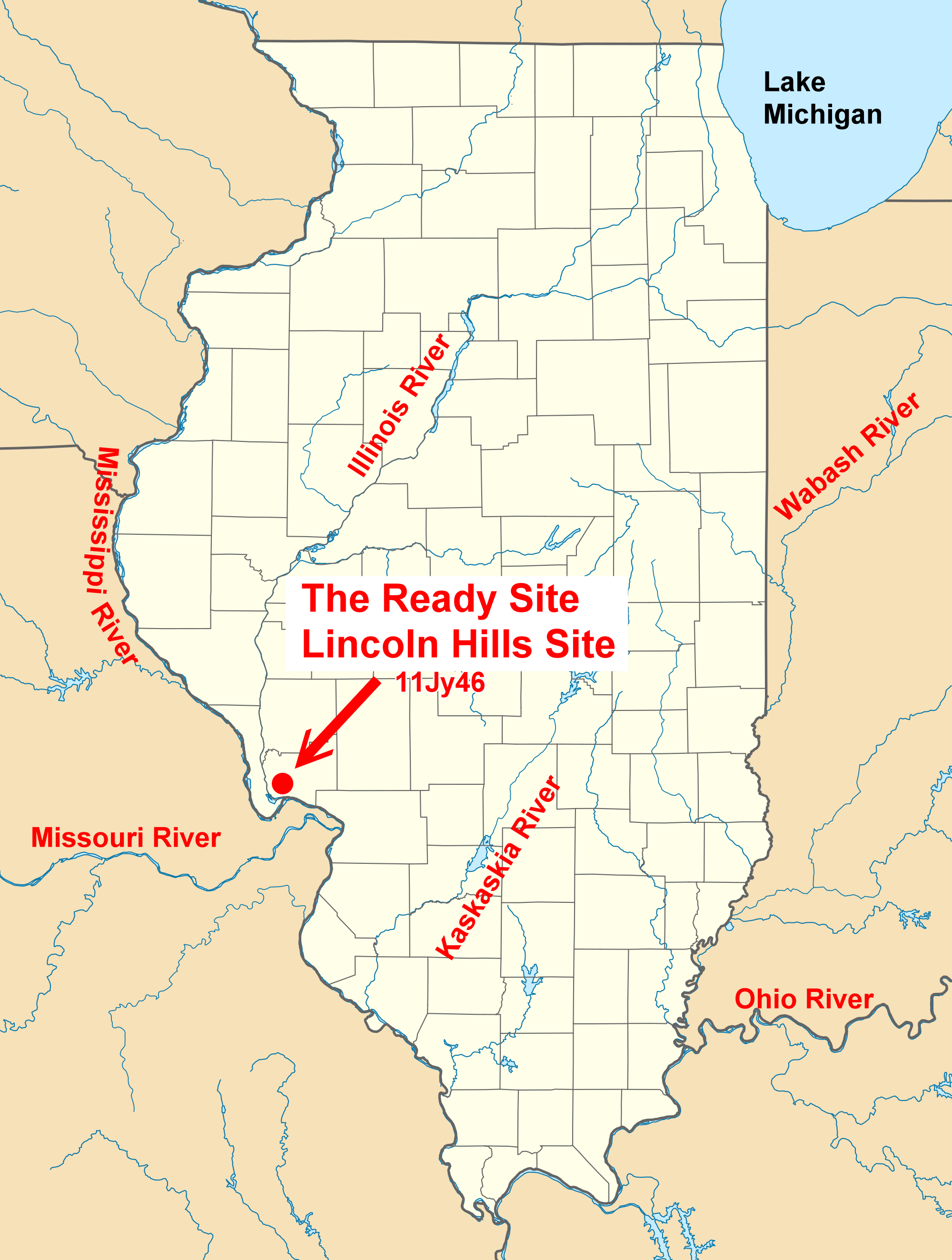
In contrast, the Ready/Lincoln Hills Site, located along the Mississippi River in Jersey County, Illinois, covers a large area and appears to have been visited many times and, perhaps, occupied for longer periods of time. Called the Ready Site because Jesse Ready discovered the site and surface collected there for many years, the site is best known locally as the Ready site.
Jesse Ready Site - Lincoln Hills Site location.
This location was attractive because stones used to make tools were readily available nearby. The surface of the site is littered with flakes of stone left from making spear points, scrapers, and other tools. Occasionally broken and used tools are found at the site. These were replaced with newly made tools. After a group repaired or replaced their tools, they moved on to another location that provided different resources. When they needed stone for tool making, they would return to Lincoln Hills or another location where the stone was available.

Compiled by Dr. Neil Gale, Ph.D.

America's First Automobile Race Occured in Chicago, Illinois, in 1895.

Henry Ford receives most of the credit for developing the car in the U.S. However, he did not produce the first American motorcar. This distinction goes to the Duryea brothers—Charles and Frank—who created their first gasoline-powered "horseless carriage" in 1893. Like the Wright brothers, the Duryeas were bicycle mechanics passionate about speed and innovation.

Founded by Charles Duryea, born in Canton, Illinois in 1861, and his brother James "Frank" Duryea,  born in Washburn, Illinois in 1869, the Duryea Motor Wagon Company built their first Motor Wagon, a one-cylinder four horsepower car, first demonstrated on September 21, 1893, in Springfield, Massachusetts. It is considered the first successful gas-engine vehicle built in America.
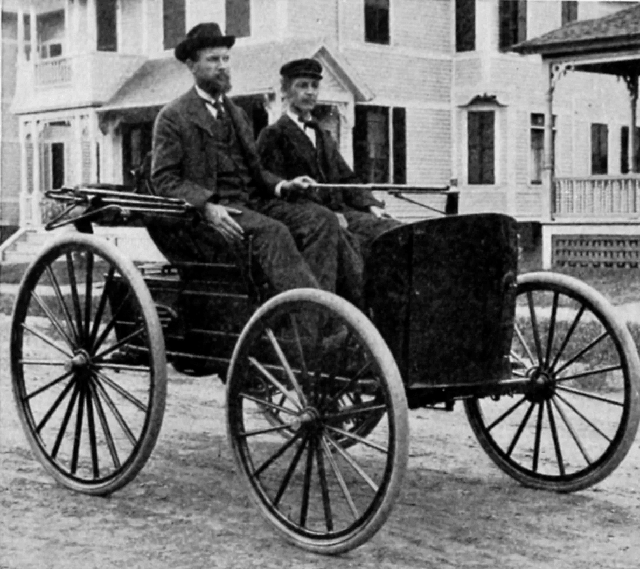
Charles E. Duryea (left) and J. Frank Duryea, 1895.
The race, a 54-mile course from downtown Chicago to Evanston and back, was scheduled to start on November 2, 1895.

The original field featured 83 entries in the race, but 76 never made it to the race. The high dropout rate seemed primarily due to most cars needing to be finished in time for the contest, and organizers postponed the event for a week.

If the new technology wasn't already tricky enough, dealing with the local authorities was worse. Before pre-race favorite Elwood Haynes and the Benz driver could even get into town, they were stopped by the cops. Their infraction? The police said they had no right to drive their vehicles on the city streets, and the competitors had to requisition horses to pull the cars. Haynes had to drop out when his vehicle was damaged en route and was unable to compete.

Naturally, the editors of the Times-Herald flipped out. They postponed the event again until they could convince the city leaders to pass an ordinance allowing the newfangled vehicles to travel on the streets of Chicago. By this time, the race day had slipped to November 28, Thanksgiving Day.

Frank Duryea described his experience in his autobiography: 
"I started with draftsmen on plans for a new motor wagon (the second Duryea vehicle, a two-cylinder vehicle built in 1894) of which I had, from time to time, been making rough sketches during the past summer. But my work was interrupted by the necessity of preparing a motor wagon for the race promoted by H.H. Kohlsaat of the Chicago Times-Herald.

 
This race was set for November 2nd, and as driver, the Company sent me out to Chicago with the motor wagon on that date. Only the Mueller Benz and the Duryea cars were present and ready to start, so the race was postponed until the 28th. Thanksgiving Day, when it arrived, found me again in Chicago with my motor wagon."
Heavy snow had fallen during the night (and 30° at the start of the race), and we experienced hard going as we drove out to Jackson Park from our quarters on Sixteenth Street.

Only six contestants lined up to the start line of nearly a hundred entries. Of these six, two were electric vehicles entered by Morris and Salom of Philadelphia and Sturgis of Chicago. Each came from the four gasoline-engined cars, H. Mueller & Go. of Decatur, Illinois, R.H. Macy & Co. of New York, and The De la Vergne Refrigerating Machine Co. of New York, to the start with an imported German Benz. The Duryea Motor Wagon Company's entry was the only American-made gasoline vehicle to start.
The word 'GO' was given at 8:55 AM, and the Duryea was the first vehicle (№ 5) away.
With me as umpire was Mr. Arthur W. White. The machine made good going of the soft unpacked snow in Jackson Park, but when we came to the busier part of the city, the street surface consisted of ruts and ice hummocks (a hump or ridge in an ice field), in which the car slewed badly from side to side.
While still in the lead, the left front wheel struck a bad rut at such an angle that the steering arm was broken off. This arm had been threaded and screwed firmly to a shoulder, and it was a problem to extract the broken-off threaded part of the arm. When this was finally accomplished, we, fortunately, located a blacksmith shop where we forged down, threaded and replaced the arm. While thus delayed, the Macy Benz passed us and held the lead as far as Evanston, where we regained it.

Having made the turn at Evanston, elated at being in the lead again, we started on the home trip.

We had not yet come to Humboldt Park when one of the two cylinders ceased firing.

This repair was completed in fifty-five minutes and we got going, feeling that the Macy Benz must surely be ahead of us, but learned later that the Macy did not get that far. Breaking the way through the snow in Humboldt and Garfield Parks proved to be heavy work for the motor, but also indicated that all competitors were behind us.

After a stop for gasoline, and a four-minute wait for a passing train at a railroad crossing, we continued on to the finish in Jackson Park, arriving at 7:18 PM.

The motor had at all times shown ample power, and at no time were we compelled to get out and push.

After receiving congratulations from the small group still remaining at the finish line, among whom were the Duryea Motor Wagon Company party, I turned the motor wagon and drove it back to its quarters on Sixteenth Street.

The Mueller Benz, the only other machine to finish, was driven across the line at 8:53 PM by the umpire, Mr. Charles B. King, Mr. Mueller having collapsed from fatigue and the frigid cold."
Shortly after the start, depending on whom you believe, either two of the vehicles argued over the same section of road, or a Benz ran into a horsecart or was forced off the road by the horse cart. Whatever caused it, one Benz was in a ditch and out of the race, and another Benz dropped out.

Frank Duryea traveled 54 miles at an average of 7.5 mph in 10 hours and 23 minutes (including repair time), marking the first U.S. auto race where any entrants finished. 

The winner earned $2,000 ($61,000 today), the enthusiast from the crowd. The person who gave the horseless vehicles the new name of "motorcycles" won $500. The Chicago Times-Herald Newspaper that sponsored the race wrote, "Persons inclined to decry the development of the horseless carriage will be forced to recognize it as an admitted mechanical achievement, highly adapted to some of the most urgent needs of our civilization."

That same year, the brothers began commercial production in 1895, with thirteen cars sold by the end of 1896. Their first ten production vehicles were the first automobiles sold in the United States.

Compiled by Dr. Neil Gale, Ph.D.