Tuesday, June 4, 2019

The German Turnverein "gymnastics" movement in Chicago began in 1852.

Chicago’s Forgotten Turner Halls: Turnverein Vorwaerts
At 2431 West Roosevelt Road in Chicago is Vorwaerts (Vorwärts = 'Forward' in German) Turner Hall, a castle-like structure that stands as one of the few remnants of a former German neighborhood on the Near West Side. There were once dozens of Turner Halls all over Chicago, but Vorwaerts is one of only two that remain in the city. This mysterious looking building is a living artifact of a group that began in Chicago in 1852 and continues the same traditions today.
Vorwaerts Turner Hall at 2431 West Roosevelt Road was given Chicago Landmark status on November 18, 2009.

Birth of a Movement
The Turnverein (German for “gymnastic union”) is a gymnastic movement founded in Germany during the time of Napoleon’s occupation. The founder of the movement, Friedrich Ludwig Jahn, believed that the key to resisting and defeating Napoleon was a physically fit and disciplined fighting force. He served as a commander of a volunteer force that was instrumental in defeating Napoleon’s army. After the war, he continued efforts to increase discipline and physical fitness in the German population. He would later invent fixtures of gymnastics still in use today: the balance beam, the horse, rings, parallel bars, and the horizontal bar.

The Turnverein and Failed Revolution
There were very few German immigrants in Chicago’s early history, until the German revolution of 1848. The liberal and middle classes (including large numbers of Turnverein) fought against the aristocracy for workers’ rights and reduced taxation and censorship. Their attempt was unsuccessful, and the result greatly impacted the demographics of Chicago and the country. The failed revolution led to an influx of educated and skilled immigration to America, particularly the Midwest. The national Turnverein formed in Cincinnati in the same year as the revolution (1848). The first Chicago Turnverein formed a few years later in 1852. Though they embraced their German history with words and song, they were deeply patriotic for their new home in America.

Turnverein helped Abraham Lincoln get elected president. They proudly served in the Union Army in the United States during the Civil War (1861-1865). They also served as bodyguards for Lincoln during his inauguration, and later during his funeral.

Early Rise of Turnverein Vorwaerts
The First Turnverein Vorwaerts Hall and the 1877 Riot
Riot after police raid furniture workers meeting in first Vorwaerts Hall.
August 18, 1877, Harper’s Weekly.
Like many social clubs, the Turnverein formed in local chapters. The Turnverein Vorwaerts (“Forward Turners”) first formed in 1867, and within the same year occupied a building on 12th Street (now Roosevelt). That building no longer stands, but an interior illustration of it was included in the August 18, 1877 issue of Harper’s Weekly. A meeting of furniture workers at the hall erupted into a riot with police after the latter claimed they were provoked. According to the Chicago Historical Society (now Chicago History Museum), this was part of the backdrop of events leading up to the Haymarket Riot:
One eyewitness described the police as “a uniformed mob.” The raid led to a successful lawsuit by the furniture workers’ union that resulted in the condemnation of the police and the affirmation of workers’ right to peaceful assembly. The bad feelings generated by this incident became another cause of the mutual distrust that was part of the backdrop of Haymarket. Chicago Historical Society
A New Hall for Turnverein Vorwaerts
In the 1880s another wave of German immigrants arrived in Chicago, many the result of an Anti-Socialist Law. This led to a swelling in the ranks of Turners across the city, including the hall on 12th Street. In October 1896, it was announced in the Chicago Daily Tribune that a new building would be constructed for this growing movement. The building’s architect was George L. Pfeiffer, also a member and president of the Turnverein Vorwaerts.
WILL DEDICATE THEIR HALL.Turnverein Vorwaerts Arrange a Program.
The Turnverein Vorwaerts, one of the oldest and strongest German=American organizations in Chicago, will dedicate their new hall Sunday. The gymnasium is at 1164-68 West Twelfth Street, near Western Avenue. The new gymnasium is fitted with the best and most modern apparatus, two bowling alleys, built according to the rules of the American Bowling League, and eight shower baths. All turning organizations in Chicago, as well as singing societies and sither clubs, will take part in the dedication exercises. The exercises will consist of all kinds of gymnastic performances and songs rendered by different singing societies. Hon. Harry Rubens, one of the oldest members of the Turnverein Vorwaerts, will make the dedication speech. Extra streetcars will run on Ogden Avenue, Western Avenue, and Twelfth Street all day, and extra night cars on Twelfth Street in the evening, to accommodate visitors. --January 16, 1897, Chicago Inter Ocean
The Vorwaerts Turner Hall consisted of three buildings in one; two adjacent structures and a gymnasium in the rear that had 40-foot ceilings and a capacity of 1,000 people.

Good Health
The extra-large front gable is rich in artistry and symbolism. It also features a cartouche with letters representing “Healthy, Upright, Strong, True.”
The phrase "Gut Heil," translates as good health.
The face appearing in the relief is Friedrich Ludwig Jahn, founder of the Turner Movement. Its early roots were focused on creating a population able to resist Napoleon’s occupying army, but over time evolved to promote general health and well-being among its members and the neighborhoods in which they lived. The fruits of their early efforts in Chicago are evident today, in the form of physical education:
In 1884, Turner members of the Illinois District were responsible for introducing physical education classes into the Chicago Public Schools and provided the first instructors for these classes. In 1895, these Illinois Turners established the first playground in Chicago in Douglas Park and for many years the Turners provided the supervisors and directors for all the playgrounds in the Chicago parks. One of the parks located on the north side of Chicago is named in honor of Turner Theodore Gross who was the supervisor of the Chicago playgrounds for many years. Illinois District of American Turners
Health and Good Beer
Beyond their work to promote good health, facilities for leisure and recreation were part of the new building. The Turner Hall contained two bowling alleys, showers, two bars (one for members and one for the public), and a two-story residence for the building manager above the lower level.

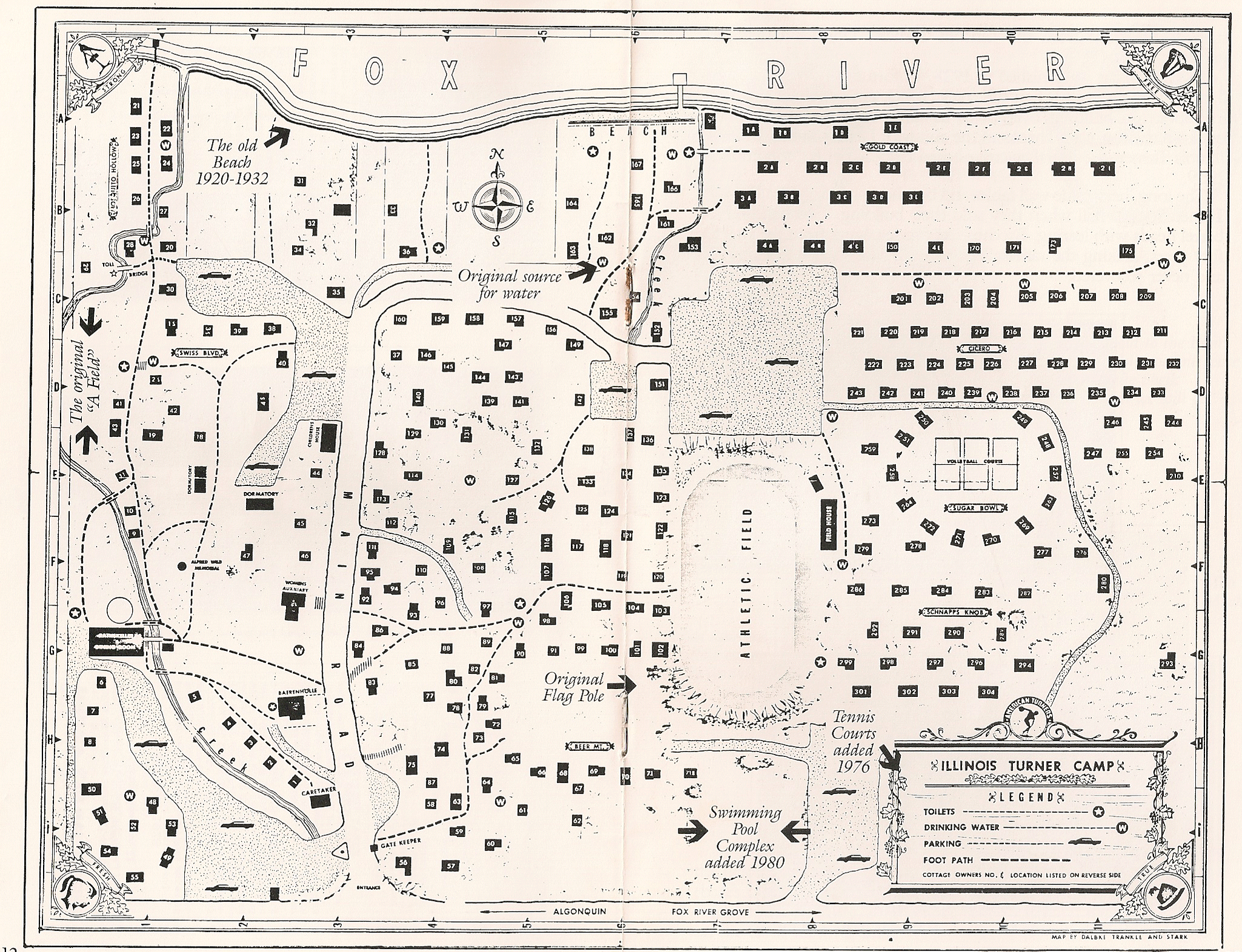
Establishment of Illinois Turner Camp
Construction of Illinois Turner Camp in Algonquin, Illinois. (circa 1915)
Around 1914, the Illinois Turner Camp at 1 North River Road, Algonquin, Illinois, opened to promote physical fitness and athletic instruction. The Turnverein Vorwaerts were one of the original founders of the new camp. 
Turner Camp Map. Illinois District Turners.
CLICK MAP FOR FULL-SIZE VIEW.
Gymnastics and physical fitness were central to the idea of Turner Camp, but it also served as a valuable retreat for Turners young and old. There are 267 cottages on the grounds, many of which have passed through generations of Turner families.
Mary Ann Aenbert and Alyce Vogel on the balance beam at Illinois Turner Camp, 1954.
Social Justice, Prohibition, and Immigrant Life During Wartime
The 1852 founding of Turnverein Vorwaerts was in part based on their staunch anti-slavery views, so it’s not surprising that the hall frequently hosted political activities that aligned with their liberal or socialist views. One group was the United Societies for Local Self-Government. In the 1920 article above, it is noted that a near-riot occurred during the meeting between that group and Congressman Britten over the topic of prohibition. An earlier declaration highlighted the cultural fault lines exposed by Southerners who pushed for prohibition and their negative feelings toward immigrants:
A meeting was called by the United Society for Local Self Government, to establish the battle program for individual liberty. The propaganda made in the south by the Prohibitionists not only ruins the existence of the saloon-keepers and clubs associations, but menaces the activities of all immigrants, especially the Germans.
This manifested again in World War Two when in 1938 a band of vigilantes stormed the hall expecting to find Nazi sympathizers. Instead, they found people playing a basketball game.
POLICE DISPERSE ANTI-NAZI CROWD AT TURNER HALL.
Find a Ball Game Instead of Hitler Partisans.

More than 100 young men, supposed members of an anti-Nazi vigilante organization, invaded the Vorwaerts Turner hall at 2431 Roosevelt Road last night. They found only a basketball game instead of the Silver Shirt Legion meeting they were looking for, and departed without starting any battles.

Policemen who were summoned said that a crowd was milling about in front of the hall when they arrived. Its members dispersed, however, at the police command. It is believed the invading group, which by that time had mixed with the crowd, were the same men who precipitated a riot Monday evening at a Silver Shirt meeting at 5825 Irving Park Road.

Opposed to Foreign "isms."

Henry Eisholz, who conducts a saloon on the first floor of the Vorwaerts hall, said he assured the invaders that the hall was never used for pro-Nazi gatherings; that the association directors had forbidden such use, and were opposed to the promotion of any foreign "isms."

"There were fifty to 100 carloads of men in the crowd," Eisholz declared, "and they acted plenty tough until they were convinced I was telling the truth." --Chicago Daily Tribune, November 30, 1938
The Turners used the opportunity to state they were opposed to any foreign ideologies, and those pro-Nazi gatherings were forbidden. A long-held tenet of American Turnverein is integration into local society, and citizenship a requirement for membership. After the war, the Turnverein Vorwaerts changed their name to the English version of their name, Forward Turners.

Neighborhood Changes as the Turners Move On
The Decline of Vorwaerts Turner Hall and Surrounding German Population
Turner Hall some time prior to 1939.
As a result of WWII, German immigration stopped and earlier residents moved out of the Near West Side communities. Membership in societies and clubs also declined rapidly, and the West Side Turner Hall saw fewer patrons and gatherings. By the mid-1940s, Turner Hall neighborhoods were deteriorating. Several attempts were made to merge the Turner societies located on the north and west sides of Chicago.

In March 1945 the Forward Turners sold their Turner Hall at 2431 W. Roosevelt Road and rented the gymnasium and hall facilities at the Olympic Building located at 6100 West Cermak Road in Cicero, Illinois.

The Swiss Turners were forced to abandon their gym program at the Swiss Clubhouse, 635 West Webster Street, because of the huge amount of rent they were asked to pay for only a few classes. These developments, among others, led to the Illinois District of the American Turners forming an 'amalgamation committee' in November 1948, attended by delegates of the five north side Turner societies, namely; Chicago, Forward, Lincoln, Social, and Swiss. 

What’s Left of the Former West Side German Community
The Near West Side was once home to some of the earliest German immigrant communities, and this rapid influx of educated and skilled people created a bustling commercial district with ornately designed buildings. But today few architectural artifacts remain. Decades of neglect, segregation, and few employment opportunities contributed to the loss of commercial and residential infrastructure.
Vorwaerts Turner Hall once had a gymnasium behind the front two structures. The gymnasium was demolished in 2007.
Demolition of buildings on the Near West Side left wide swaths of vacant lots. But the area close to downtown is rapidly changing as the area redevelops with new construction. New development near Vorwaerts Turner Hall appeared with a sign advertising “luxury homes.”

The Forward Turners Move to Cicero
Sokol Slavsky/Olympic Theatre
The Forward Turners (as they became known then) sold the building in 1945. Without a permanent space, they rented facilities at 6100 West Cermak Road in Cicero. The building in Cicero was built for Sokol Slavsky in 1924. 
Social Turner Hall at Belmont and Paulina in 1956, no longer extant.
Sokols are a Czech youth and gymnastics movement with activities and traditions very similar to Turners. Sokol Slavsky lost the building during the Great Depression and after served as a ballroom and theater, and rented out space to groups like the Forward Turners. Though space was well suited for the Forward Turners, it was only a temporary home.

Social, Swiss, and Forward Turners Unite
The 1950s were a time of upheaval for many social and fraternal organizations, especially for Turner Societies. Children and grandchildren of immigrants that formed these groups were leaving the old neighborhoods and shared less interest in being a member of a Turner Hall. In 1954, the Forward Turners and other Turner groups held a series of meetings to discuss merging and a location for a new building. During this time, the City of Chicago notified the Social Turners of plans to condemn their building at Belmont and Paulina (above) in order to build a parking facility. In the same year, the Forward, Social, and Swiss Turners officially merged and became American Turners-Northwest Chicago, holding their first meeting at the Social Turner Hall which would soon be demolished.
In February 1956,  the Forward Turners changed its name to 'American Turners-Northwest Chicago' and the Social and Swiss Turners merged with this new society (the old Forward Turners).

The American Turners–Northwest Chicago purchased land at Belmont and Natoma in 1956 and built a modern facility to host events, gymnastics, and various social gatherings.


The Rise and Fall of Bowling
Like most social organizations, the Turners sought a revenue stream for the building and other operational expenses. The Northwest Turners achieved this by incorporating a large bowling alley into the facility. The 1960s and 1970s were the golden eras of professional bowling, and revenue from the bowling alley was initially successful at subsidizing operations for the Northwest Turners. Unfortunately, the midcentury modern building with low ceilings wasn’t well suited for banquet halls or wedding receptions, limiting the use of the space for other purposes. Coupled with the sharp decline in bowling as professional and hobby sport in the 1980s and 1990s, the Turners were left without their once-thriving revenue stream. The Turners later ran a weekly bingo game to fund operations, which was successful for a while. But with few revenue-generating events and an aging building with increasingly high maintenance and repair costs, keeping the building functional became an overwhelming challenge. The Northwest Turners sold the building at Belmont and Natoma in 2005. It was later demolished and replaced with residential buildings.

The Northwest Turners Today
The Move to Schiller Park
Current location of American Turners in Schiller Park, Illinois, a suburb of Chicago.
Whenever a social organization leaves a neighborhood building that served generations of people, the impact is deep. The new Turner Hall near O’Hare Airport in Schiller Park wasn’t far from the previous location, but far enough to lose some members and effectively end a few lifelong friendships that formed around a commonplace. Despite the strife and difficulty associated with losing a meeting place, Northwest Turners kept the gymnastics program and evolved with changing times, as well as strengthen ties to other Illinois Turner Societies.

Continuing the Tradition of Sound Mind in a Sound Body
Though the Northwest Turners have relocated and rebranded a few times over the course of their 150+ year history in Chicago, the organization remains committed to many of the same ideologies that date to its founding. The facility in Schiller Park hosts cheerleading class programs and has a gymnastics team that recently won a series of medals in the Illinois State Gymnastics Championship. The Northwest Turners are also active in the now 102-year old Turner Camp, which today features a bar, restaurant, pool, and continuing education and physical fitness programs.

Compiled by Dr. Neil Gale, Ph.D. 

Monday, June 3, 2019

The History of the Andy Frain Usher Service.

Chicagoan Andrew T. Frain began his career at 14 years old, after graduating 8th grade, his highest level of formal education. He started renting seat cushions, at 10¢ per game, to patrons of Comiskey Park during White Sox baseball games. Andy further added to his income by retrieving empty pop bottles and returning them for the deposit.
Andrew T. Frain
Andy Frain Services was started by Andrew T. Frain in 1924, born in Chicago's "Back of the Yards" neighborhood of the "New City" community. Family legend is that he learned the art of crowd engineering (as Andy coined) by directing his 16 siblings in and out of the family’s single bathroom.

Frain started the usher service as a way for owners to end the gate-crashing and usher-bribing that was rampant at sports venues in those days.

He rounded up some burly friends from the neighborhood and convinced the White Sox that he could do better with his honest, unbribable ushers.

Four years later, Andy won Wrigley Field’s business, too. William Wrigley Jr. advanced him the cash to buy the blue uniforms with gold braid trim that became a Frain hallmark.

Pretty soon, Andy Frain ushers became an institution themselves. If anything was happening or if anyone of note was in Chicago, an Andy Frain usher was there. Frain, who barely finished grade school, eventually expanded the business across the country.
Frain ran the company with military discipline. Most of his ushers were high school or college students, 6 feet tall or more, with white teeth, short haircuts, clean-shaven, wore white gloves, and gleaming shoes. Their uniforms were snappy blue and gold, colors Frain selected because they were the same as his favorite team's, Notre Dame. When he began hiring female ushers, Frain said he hired women who used “soap and water, not paint and powder.” Ushers were required to use polite language and not allowed to slouch, smoke, chew gum, eat or drink in front of spectators. Many former ushers attributed success later in life to the training they received as Andy Frain ushers.
Andy Frain Service at a Beatles concert.
Andy Frain's family carries on Dad's business at Comiskey Park in May 7, 1964.
And their expertise extended beyond crowd control. Andy Frain ushers would get hired as drivers, parking attendants, pallbearers, even emergency prom dates for jilted girls.  At hockey games, an Andy Frain usher would sometimes be dispatched to sit in the penalty box between players who had been fighting on the ice. Frain said in an interview that he even offered professional criers to show up at funerals.
Vintage, Iconic Andy Frain Cap made by Maier Lavaty Co.,
on Adams Street in Chicago. (circa 1950)
Chicago Cubs Wrigley Field Andy Frain Coat (circa 1970)
Andy Frain died of a heart attack on March 25, 1964, in Rochester, Minnesota. His three sons successfully took over the business until they sold it to investors in 1982. After that, the company went through a string of bankruptcies and ownership changes until 1996, when the trade name was purchased by the new owners, who have offered security services under the Andy Frain name ever since.

Compiled by Dr. Neil Gale, Ph.D.

Sunday, June 2, 2019

Potter Palmer is responsible for Chicago's State Street as a business district.

Potter Palmer (1826-1902)
Potter Palmer was born on May 20, 1826, in Albany County, New York. Palmer began his interest in retail while working as a manager in a dry-goods store in Durham, New York. While employed, Potter paid close attention to the ethics of business. By 1848, 22-year-old Palmer opened his own dry-goods store in Lockport, New York. However, Palmer had his eye set on the west.

In 1852, Palmer's ambition directed him to Chicago. With the small amount of money he raised from his business in New York, along with a small family loan,  totaling $5,000 in gold and banknotes, he opened a retail dry goods store, P. Palmer & Company, at 137 Lake Street, and he soon expanded into an adjoining store. In 1857, Palmer added a wholesale department to 112, 114, and 116 Lake Street, the establishment just vacated by his long-time friend, Marshall Field, and his company, Field, Leiter & Co. 

Here, with increased room and added facilities, his business rapidly increased until within twelve years after beginning here with a capital of $5,000, the energy, perseverance, and fair dealing of Potter Palmer had made him the largest dry goods house in Chicago.

Palmer, at 38, was a millionaire many times over, not just from his dry goods business but also from well-thought-out investments in real estate. Unfortunately, his hard-driven lifestyle had taken a toll on his health, and his doctor urged him to slow down. Instead, he'd been buying up real estate at a fast pace.

He envisioned a new retail district, convenient to the railroad depots and farther removed from the foul-smelling Chicago River. The perfect location, he believed, was along State Street. State Street was an unlikely spot to build new businesses in most people's eyes, and many of his contemporaries openly mocked his grand plan. Although it was a main north-south thoroughfare, it was a slum district lined with cheap boardinghouses, butcher shops, saloons, and assorted shanties. The narrow street was muddy and rutted, and the only streetcar line was a "bobtail" car pulled by horses along a single rail. It frequently jumped the track in the mud, leaving passengers to wade through the muck to their destination.
Chicago's first one-horse-drawn streetcar ran along State Street from Randolph Street to 12th Street (today's Roosevelt Road) in 1859. The streetcar was called a Bobtail because it had no rear platform.
While property on Lak Street, the "street of merchants," was selling for up to $2,000 a linear foot for frontage, State Street land could be had for a song. The most expensive, at the corner of State and Madison, ran about $500 a front foot in 1867, but farther south on State Street, some properties sold for as little as $60 per front foot.

Palmer was not swayed by his critics. He was convinced that Lake Street was doomed to fail. Wedged in between the railroad and the sewage-filled river, it had no room to grow. The new Illinois Central Railroad and streetcar lines all converged at State Street, making it a convenient place to reach from any metropolis area. It only needed someone with a vision to make it happen, and Potter Palmer was nothing less than a visionary. 
Great Central Station (aka Great Central Depot) was an intercity train station in downtown Chicago, owned by the Illinois Central Railroad. It opened in 1856 at South Water Street (now Wacker Drive) and Michigan Avenue.
So Palmer bought every lot he could until he held title to most of the frontage property on State Street between Lake Street on the north and Quincy Avenue to the south, a distance of three-quarters of a mile. His first move was to tear down or set back each building he owned and persuade his remaining neighbors to do the same so that the once-narrow street was now over 100 feet wide. State Street now had aspirations to become a magnificent boulevard instead of a cramped and grimy country lane.

Next, Palmer tore down all the shacks on the south end of his properties and began construction on a majestic hotel, at the corner of State and Quincy, as a wedding gift to his new bride, Bertha Honore. The hotel opened its doors to the public on September 26, 1871, only to burn to the ground thirteen days later in the Great Chicago Fire on October 8, 1871. Palmer, undeterred, immediately started construction on a new and even grander hotel, this time built of brick and iron and later advertised as "The World's Only Fireproof Hotel."

While his first hotel was still being built to the south, Palmer began construction on a huge new retail palace on the north end of his property holdings, at the northeast corner of State and Washington Streets. The limestone and marble building towered six stories above the street, and the facade featured dramatic white Corinthian columns reaching toward the sky.
"Palmer's Place" first tenant, Field, Leiter & Company's, opened in 1868. This store burned in the Great Chicago Fire of 1871. Note the "Vault Lights" in the sidewalks around the building.
By this point, Palmer had spent over $2 million ($38,113,000 today) funding his dream of a new business district on State Street. All he needed were the proper tenants, and he knew exactly where to look for them.

When Palmer approached Field and Leiter about the grand store he was building, they were more than willing to listen. Palmer never steered them wrong, and besides, the store on Lake Street was uncomfortably cramped and confining. Worse yet, despite their best efforts to maintain high standards, Lake Street itself was growing more crowded and dirty by the day. Although Palmer was asking a veritable fortune for rent -- $50,000 per year ($953,000 today) -- the chance to escape the ailing business district and forge new ground held an undeniable appeal. After a short deliberation, Field, Leiter & Co. agreed to lead the pack and move to "Palmer's Place." The State Street store grand opening was scheduled for Monday, October 12, 1868. Field, Leiter & Co. decided to keep their Lake Street store open until the last possible moment.

Additional Reading:
Raising Chicago Streets Out of the Mud in 1858.

Marshall "Field, Leiter & Company" Department Store Fire of November 14, 1877.

Lake Shore Drive's origins date back to Potter Palmer, who coerced the City of Chicago to build the street adjacent to his lakefront property in 1882.

Compiled by Dr. Neil Gale, Ph.D.

Saturday, June 1, 2019

Illinois Central Railroad Company vs. the State of Illinois. (1892)

The Supreme Court decision in Illinois Central Railroad v. Illinois, 146 U.S. 387 (1892), reaffirmed that each state in its sovereign capacity holds permanent title to all submerged lands within its borders and holds these lands in public trust. This is a foundational case for the public trust doctrine. The Supreme Court held a four to three split decision that the State of Illinois did not possess the authority to grant fee title to submerged lands held in the public trust as navigable waters.
President Abraham Lincoln's funeral train seen as it slowly moves along Chicago's lakefront train trestle in 1865.
Background
In the mid-19th century, Chicago was growing rapidly and was becoming increasingly interested in creating an outer harbor at the junction of Lake Michigan and the Chicago River because local currents often resulted in either the formation of sandbars or areas of erosion, increasing congestion and complicating navigation.

Then, in 1851, the Illinois Central Railroad Company made an offer to the City of Chicago that in exchange for allowing tracks to be laid along the lakefront, the railroad company would pay for and build a breakwater to protect the harbor. Illinois then officially granted 3 million acres of shoreline along Lake Michigan to create a north-south railroad under the state charter titled "An Act to Incorporate the Illinois Central Railroad Company." This charter gave Illinois Central the authority to "enter upon and take possession of, and use all and singular any lands, streams, and materials of every kind."
Looking southwest at the Chicago lakefront in the late 1850s as seen from the Illinois Central Railroad Station near Randolph Street. Note the railroad trestle is between Lake Michigan and the basin which is lined with railcars on its west side. Further west is Michigan Boulevard.
To further confirm their rights to this area, the railroad lobbied the state, and in 1869, the State of Illinois passed the Lake Front Act, granting Illinois Central "appropriation, occupancy, use and control" of a large portion of the harbor. The legislature’s goal in passing the act was to bring a new train depot, an outer harbor, and better parks to the residents of Chicago. The portion of land stretched from West Randolph Street south to Twelfth Street (Roosevelt Road), and from South Michigan Avenue east into Lake Michigan.

However, due to political controversy and poor public opinion of the railroad company, the legislature repealed the Lake Front Act in 1873. Both before and after the repeal, Illinois Central continued to construct tracks, piers, and other facilities along the lakefront. This construction also included filling in several hundred feet into Lake Michigan to provide land for these new facilities.
On the morning of May 1st, 1865, the Lincoln Funeral Train arrived in Chicago across the Lake Michigan trestle. It was operated as a Michigan Central train, originating in Michigan City and using Illinois Central trackage rights between Kensington Junction and downtown Chicago.
On March 1, 1883, the Illinois Attorney General filed suit against Illinois Central in order to stop construction on the land known as Lake Park.

Procedural history
In 1883, Illinois filed suit in state court against the Illinois Central Railroad Company, asking the court to determine who possessed title to submerged lands under Lake Michigan adjacent to the Chicago shoreline. Illinois also sought a court order to remove structures the railroad company had constructed over the lakebed, as well as an injunction against Illinois Central continuing this construction. Upon motion, the case was removed to the Federal Circuit Court for the Northern District of Illinois. Justice Harlan, then a circuit court judge, ruled that the state held title to the submerged lands, and therefore had the right to revoke the license granted to Illinois Central in the Act, which Illinois Central had contested. This decision also established that the City of Chicago held title to the land of Lake Park (present-day Grant ParkMillennium Park). Illinois Central appealed to the Supreme Court.

Parties
The petitioners were Illinois Central Railroad Company, a corporation created by an act of the Illinois State legislature and the city of Chicago, which was added as a party at trial because of its interest in the case. The respondent was the state of Illinois.

Issues
  1. Whether the state of Illinois possessed the authority to grant title to its lands submerged by navigable waters.
  2. Whether Illinois Central Railroad Company acquired riparian rights to the lake bed immediately adjacent to the lakefront property to which it possessed title.
Arguments
Illinois Central’s arguments
Illinois Central Railroad asserted three arguments in support of their claim on a portion of the lakebed under Lake Michigan. First, Illinois Central argued it had been granted by the state and by city ordinance a 200-foot wide corridor into the lake to construct a raised railway track, pier, and warehouses. Second, Illinois Central argued that they had acquired riparian rights by virtue of their ownership of lands surrounding the lake. Third, the railroad company argued they had received title to a bounded parcel of submerged lakebed from the State of Illinois in 1869.

State of Illinois’s argument
In seeking to enjoin the railroad, the state claimed "title to the bed of Lake Michigan, and exclusive right to develop and improve the harbor of Chicago by the construction of docks, wharves, piers, and other improvements..."

Decision
Majority Opinion of the Court
Writing for the majority, Justice Field affirmed the lower court’s holding that the state held title to the lakebed. Field found that Illinois lacked the authority to grant title to submerged lands held in the public trust with two exceptions – for grants not impairing the public interest and grants that actually improved the public trust. But neither exception was found to apply in this case and therefore the railroad did not possess title.

Justice Field expressed the doctrine of public trust as follows:
"It is the settled law of this country that the ownership of and dominion and sovereignty over lands covered by tidewaters, within the limits of the several states, belong to the respective states within which they are found, with the consequent right to use or dispose of any portion thereof, when that can be done without substantial impairment of the interest of the public in the waters, and subject always to the paramount right of congress to control their navigation so far as may be necessary for the regulation of commerce with foreign nations and among the states"
Justice Field determined that the public trust doctrine applies to the Great Lakes, despite the fact that they are not subject to the ebb and flow of the tides. Initially, the United States adopted English Common law which limited the definition of navigable waters to those that were subject to the ebb and flow of the tides. In the United States, the tidal requirement was removed because many rivers can be navigated for great distances by large commercial vessels. Great Lakes, while not subject to the tides, are the conduit of a great deal of transnational and interstate commerce, and it was this value the common law sought to protect in the public trust doctrine. The public trust doctrine limits private property rights to lands submerged by navigable waters. The Great Lakes are owned in common to be preserved for the common good, and no private encroachment is allowed.

Justice Field argued that the 1869 grant Illinois made to Illinois Central Railroad was merely a grant of the right to lay track, not a transfer of title to a portion of the lakebed. The grant was expressly limited to this purpose and is particularly limited the transfer of a right of way across the lake so as not to interrupt the navigation of streams.

Justice Field agreed with Illinois Central that title to land bordering navigable waters carries with it the right to access these waters and to develop a pier for personal or public use. However, this right extends only to the "navigable point" of the water. Since no evidence had been presented indicating that the railroad’s pier and docks extended that far, Justice Field remanded this particular issue back to the lower court.

The 1869 act establishing the Illinois Central Railroad Company, granted the company title to a section of the submerged lakebed of Lake Michigan. The state legislature later repealed this piece of legislation. Justice Field posed the question of whether the legislature was authorized to transfer title to the submerged lake bed in the first place. It is up to courts to determine on a case-by-case basis whether a state legislature’s transfer of rights to submerged lands sufficiently protects the public interest.

In this case, Illinois Central was granted unrestricted rights to an enormous, 1,000-acre section of submerged land, which occupied the entire aquatic area bordering the Chicago harbor. Justice Field found the state can never permanently transfer authority over these submerged lands, but only grant revocable permissions to them. Therefore, the Illinois state legislature’s original grant had no effect on the state of Illinois’s ultimate authority over the submerged land.

Justice Shiras' Dissenting Opinion
Justice Shiras agreed that ownership of state lands extends to those lands submerged under its navigable waters; however, Shiras argued that the grant of the submerged lands by the state legislature functioned like any land transfer contract and effectively transferred title to Illinois Central. Shiras pointed out that the act granting the submerged lands expressly denied Illinois Central the rights to resell or transfer the lands or to impair the public right to navigation. Shiras makes it clear that this dissenting opinion does not contradict the point that states cannot transfer control of the public’s rights to navigable waters, however, these rights are only violated once Illinois Central acts to obstruct them. To otherwise empower the legislature to revoke legislative acts granting property rights would offend "the right of the citizens to the free enjoyment of their property legally acquired."

Compiled by Dr. Neil Gale, Ph.D.

1910 Postcard of the Baseball Grounds at Lincoln Park in Chicago, Illinois.

One may enjoy almost any kind of sport in Lincoln Park. In addition to the two golf courses, there are 70 grass and clay tennis courts, 33 baseball diamonds, 7 football gridirons, and 12 horseshoe courts. There are roquet courts for followers of that gentle sport.

The equestrian will find the five and a half miles of bridle path greatly to his/her liking. In one of the sequestered lagoons, the fly-caster may prove his skill. Ample lawns provide space for archery ranges. The Lincoln Park Trap Shooting Club has its headquarters on one of the new extensions on the lakefront, and the traps are open to the public. 

The two main lagoons are loaded with boating parties in the summer and with skaters in the winter. The sailing of toy yachts is a sport that has become increasingly popular among the younger set. The Lincoln Park Boat Club is provided with a fine course for its racing shells.

Compiled by Neil Gale, Ph.D. 

Friday, May 31, 2019

1839 Illustration of the Future site of Marshall Field & Company Store, Chicago.

Illustration: "Future site of Marshall Field & Company Store in 1839." Looking northeast from the future corner of State and Washington Streets in Chicago.
A LITTLE MARSHALL FIELD'S BUSINESS BACKGROUND
Potter Palmer, plagued by ailing health, was looking to dispose of his thriving business, so on January 4, 1865, Field and Leiter entered into a partnership with him and his brother Milton Palmer. So the firm of P. Palmer & Company became Field, Palmer, Leiter & Company, with Palmer financing much of their initial capital and his own contribution. After Field and Leiter's immediate success enabled them to pay him back, Palmer withdrew two years later from the partnership in 1867 to focus on his own growing real-estate interests on one of the burgeoning city's important thoroughfares, State Street. His brother, Milton Palmer, left at this time as well. The store was renamed Field, Leiter & Company, sometimes called "Field & Leiter."

The buyout, however, did not bring an end to Potter Palmer's association with the firm. In 1868, Palmer convinced Field and Leiter to lease a new, six-story edifice he had just built at the northeast corner of State and Washington Streets. The store was soon referred to as the "Marble Palace" owing to its costly marble stone face.

Two years after the 1871 Great Chicago Fire, in October of 1873, Field and Leiter returned to State Street at Washington, opening a new five-story store at the old location they now leased from the Singer Sewing Machine Company, Palmer, having sold the land site to finance his own rebuilding activities. The Field, Leiter & Company Department Store was expanded in 1876, only to be destroyed by fire again on November 14, 1877.

Ever tenacious, Field and Leiter had a new temporary store opened by the end of the month at the Interstate Industrial Exposition Building on Michigan Avenue at Adams Street that they leased temporarily from the city. The Expo building was located where the Art Institute of Chicago is now.
Interstate Industrial Exposition Building on Michigan Avenue at Adams Street looking northeast.
Meanwhile, the Singer company had speculatively built a new, even larger, six-story building on the ruins of their old 1873 store, which, after some contention, was personally bought by Field and Leiter. Field, Leiter & Company now reclaimed their traditional location at the northeast corner of State and Washington Streets for the last time in April of 1879.

In January 1881, Marshall Field, with the support of his junior partners, bought out Levi Z. Leiter, renaming the business "Marshall Field & Company."

Continue Reading: Field, Leiter & Company Department Store Fire of November 14, 1877.


Compiled by Dr. Neil Gale, Ph.D. 

Field, Leiter & Company Department Store Fire of November 14, 1877.

Field, Leiter & Company (Marshall Field and Levi Leiter) moved their store from 112, 114 and 116 Lake Street to the just built "Palmer's Place," on State and Washington Streets holding the grand opening on Monday, October 12, 1868. The Great Chicago Fire leveled the new store on October 8, 1871.

For the second time in its history, the great department store of Field, Leiter & Company burned to the ground on November 14, 1877.
Field, Leiter & Company's new store opened on October 12, 1868 on State & Washington Streets. This store burned in the Great Chicago Fire of 1871. Note the "Vault Lights" on the sidewalks around the building.
Chicago Daily Tribune, November 15, 1877 - Morning Edition
In a pouring rain with every fire engine in the city at work, “It seemed as if the entire city had come downtown to witness the terrible scene.” The first alarm is turned in at 8:04 p.m. after someone sees a fire in the fifth story of the building at the corner of State and Washington Streets. Flames are found in a four-foot space at the top of the building that surrounds the central skylight between the north and south elevator shafts. It does not take long for the fire to spread to the grease on the elevator wheels and pulleys and from there into the elevator shafts themselves, moving downward, floor by floor. Sixteen minutes after the alarm is turned in, a 2-11 alarm is sounded, but the streams of water from the fire hoses cannot reach the top floor of the building.  Firefighters are forced to run hoses directly into the interior of the great store, which at its center has an atrium, 40 feet by 90 feet, that extends all the way to the roof.  Hoses are dragged up to the third and fourth floors and from those points of attack “the brave firemen played upon the heat and fury of the fire until either stricken down by falling plaster and rafters, suffocated by the smoke, or driven from their positions by the heat.”  It isn’t until 3:00 a.m. on the 15th that the fire is finally brought under control. Two firefighters die in the effort to extinguish the blaze.
Chicago Daily Tribune, November 15, 1877 - Evening Edition
“The destruction of such an amount of property could not but be regarded as a dire calamity at such a time as this, and so, as the news flew around, people left their firesides, their theatres, their billiard-tables, and everything, to get to the scene of action.”
Men are put to work by November 18th, bracing the fourth floor, which looked “as though it might come down at any time in a huge avalanche, and bury anybody who might be so unfortunate as to be within reach of even its shadow.” 
Field, Leiter & Company store that burned in 1877.
The insurance companies enlist over 200 men in salvage work, and on the sidewalks of State and Washington Streets there began a massive “fortification, made of cords upon cords of cotton, flannel, silk, white goods, mattresses, dress goods, parasols, kid gloves, and umbrellas.” In places, the pile reaches six feet high and over 15 feet wide. 
Interstate Industrial Exposition Building on Michigan Avenue at Adams Street looking east.
The huge mass of goods is carted two blocks to the northern part of the Interstate Industrial Exposition Building on Michigan Avenue at Adams Street, located at what is now the site of the present Art Institute of Chicago. The insurance adjusters estimate that from $175,000 to $200,000 ($4,765,000 today) worth of goods were saved.
Field, Leiter & Company store that opened in 1879.
In 1879 Field and Leiter opened their fourth store in the same location, and in 1881 Marshall Field bought out Levi Leiter and renamed the firm Marshall Field and Company.

Read the brief business background of Marshall Field with an 1839 Illustration of the future site of the Marshall Field & Company Store.


Compiled by Neil Gale, Ph.D. 

Thursday, May 30, 2019

A Google Maps mystery. What does the location "1980 Stat Boundary" in Chicago and other larger U.S. cities mean?

While searching Chicago Google Maps, I found an L-shaped street labelled "1980 Stat Boundary" running north from the 2800 block of West Fulton Street and then turning west until it meets Francisco Avenue.
It turns out that "1980 Stat Boundary" is nothing more than an alley. The photo below shows the portion which goes north from the 2800 block of Fulton.
Please... use the link at the bottom of this article (yellow section) to comment if you know the meaning of "1980 Stat Boundary."

Compiled by Neil Gale, Ph.D. 

The new Gymnasium and Natatorium at Douglas Park, Chicago. (1896)

Along with bicycling, many other forms of “active recreation” were on the rise in late 19th century Chicago. Douglas Park was the smaller of the three great parks, Garfield Park, and Humboldt Park, of the West Park District and governed by West Park Commission.
“New Gymnasium and Natatorium at Douglas Park,” Chicago Daily Tribune, August 1896.
At the time, Germans accounted for the city’s largest ethnic population, and many were enthusiastic members of clubs that encouraged physical and moral fitness called Turnverein. In 1895, the Turnverein Vorwaerts, a Turners club located at West 12th Street (now Roosevelt Road) and South Western Avenue, petitioned the West Park Commissioners for an “outdoor gymnasium and public swimming bath” in Douglas Park.

Agreeing to the request, the commissioners soon hired Bohemian immigrant architect Frank Randak (1861-1926) to design the facility. He produced a brick natatorium with turrets, pitched roofs, and open courtyards that had separate outdoor pools for men and women. Randak’s complex included a quarter-mile-long running track with gymnastics apparatus—parallel and horizontal bars, trapezes, swings, vaulting horses, and ladders in the center of the oval.
With separate pools for men and women, the 1896 Douglas Park natatorium was the first swimming facility in a Chicago park. Douglas Park Men's pool. (1900)
This photo of the women’s pool dates from 1914.
In celebration of the natatorium’s opening, the West Park Commission held an extensive dedication ceremony. The event included a parade from Union Park to Douglas Park in which members of numerous Turners clubs marched alongside Polish and Bohemian athletic club members and representatives of trade unions. Towards the rear of the procession, members of the Chicago Bicycle Club rode past cheering crowds.

The impact of changing recreational trends accelerated over the course of the 20th century.

Compiled by Neil Gale, Ph.D.

Sheridan Road (now Lake Shore Drive), north of Belmont Avenue, includes an early Chicago lakefront bicycle path.

This stretch of Sheridan Road (now Lake Shore Drive), north of Belmont Avenue, includes an early Chicago lakefront bicycle path. The path is the small roadway next to Lake Michigan, then to the west is a pedestrian path and further to the west, and the largest of the 3 roadways is for vehicles; horses, wagons, and motorcar traffic. (c.1900)

The Red Hot Ranch at 3114 West Devon Avenue, Chicago, Illinois.

In 1952, Isabel & Al Deutch opened the Red Hot Ranch (1952-1985) on Devon Avenue between Albany Avenue and Troy Street in Chicago's West Rogers Park neighborhood of the West Ridge community. 

Little did they know they were creating a hot dog legend that would be remembered for over 70 years.
"The Red Hot Ranch" watercolor by William Rubin. 1974
This one-of-a-kind painting was Rubin's creation for my sister.
Isabel hired many neighborhood kids. She was like a second mom to all. Mailmen started and ended their routes there, grabbing a cup of coffee in the morning and a hot dog, burger, or other items for lunch. Those were the days of Vienna hot dogs in a natural casing, which I didn't like for some reason. Isabel would peal the casing off of the hot dog, then serve it to me.

Al was a chemical engineer who gladly worked the stand during the late shift, often going past midnight and wrapping those Vienna hot dogs and fries together. It was the hangout best remembered for its vitality as a happening little shack and the center of the neighborhood activity for many years.

The Ranch's seating consisted of no-back stools around three of the walls in the front, perhaps 20-24 spots. Special customers, three at a time, could sit out of the way in the back corner of the kitchen. Isabel, a kind soul, would give kids from Green School (K-6) a cup of soup on freezing days. The non-carbonated NEDLOG (Golden spelled backward) Grape and Orange brand drinks were special to the Ranch.

The Ranch is gone now but will always be a part of Chicago's north side and suburban cultures. 

Vienna Beef inducted the Red Hot Ranch on September 24, 2010.


Copyright © 2019 by Dr. Neil Gale, Ph.D. All rights reserved.