Aldine Square.Cleaverville.Conley's Patch.Hyde Park Township.Lee's Place / Hardscrabble a Chicago Community.Little Sicily "Little Hell" Neighborhood.Mopetown, a Chicago Neighborhood.Shanty Town, District of Lake Michigan, and Streeterville.Swede Town Neighborhood.Towertown Neighborhood.Town of Austin forced annexation to Chicago in 1899.Town of Lake.Village of Jefferson. - Township of Jefferson.Village of Pennock.
Saturday, January 28, 2023
LOST COMMUNITIES OF CHICAGO
Living History of Illinois and Chicago®
Lost Communities of Chicago
Lost Communities of Chicago - Aldine Square Neighborhood, 1874-1938.
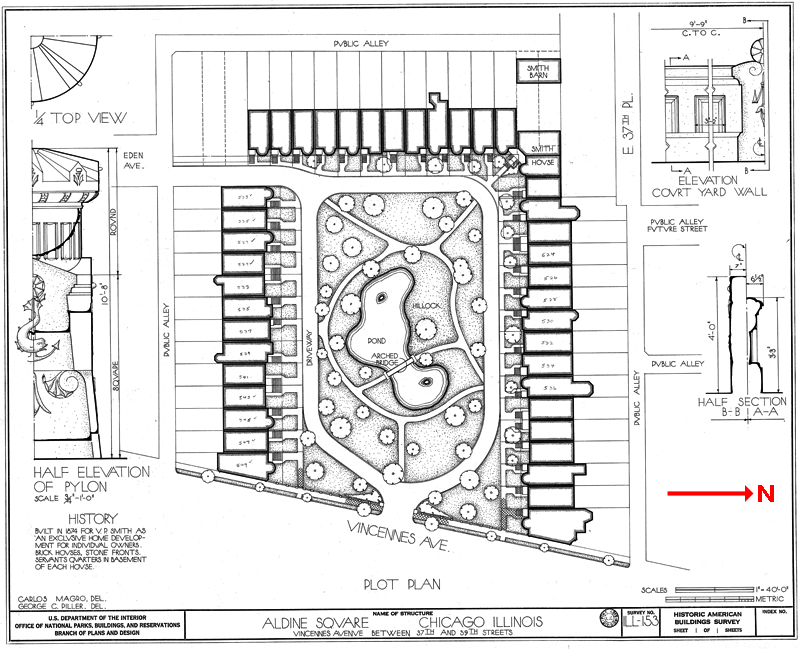
Aldine Square was built on untouched prairie land on the South Side of Chicago.
Since the onset of the 20th century, Aldine Square has been one of the city's most fashionable neighborhoods for a few decades. Its big brick and limestone townhomes surrounded a wooded park with a lake and footbridge.
Built in 1874 between 37th Place and 38th Street, bounded by Vincennes Avenue (entrance) to the east and Eden Avenue (entrance) - no longer exists) to the west.
Aldine Square was where judges, attorneys, and folk in society lived. In 1877, the Chicago Tribune called it "the most charming of all the beautiful places of residence in the city." It consisted of 42 houses built of brick and limestone that surrounded a park with a pond and was initially paved with Belgian Woodblock. Homes in the neighborhood carried an "Aldine Square" address.
![]() |
| Looking westward shows the Aldine Square main entrance on Vincennes, marked by two enormous stone pylons. Ragtime giant Jelly Roll Morton lived at 545 Aldine in 1918. |
Towards the end-of-life of Aldine Square, near the Eden Street entrance, was a dumping ground over which a sign read, "No Dumping Here."
But by 1938, Aldine Square was gone, razed to build the now-demolished Ida B. Wells public housing project, and is all but forgotten. Fortunately, just before Aldine Square was demolished, the federal government sent photographers Joseph Hill and Robert Tufts to document the site. Their photographs, taken between 1934 and 1936, are among the few visual records of this spectacular Place that looked impressive even in its final days.
So, what happened to Aldine Square? When black migrants from the South began settling in the Chicago area beginning in the 1920s, the white residents of Aldine Square and the surrounding neighborhoods moved away.
The onset of the Great Depression in 1929 further exacerbated economic conditions, and the area quickly became slum housing.
![]() |
| Here you can tell the still-stately homes have seen better days. The simple wooden footbridge in the foreground replaced the more elaborate iron and wood original one. |
The Chicago Tribune documented this in a 1929 story about a neighborhood reunion held by Aldine Square's original families. The article said the gathering was held at a downtown hotel by residents who "moved away from the path of the advancing Negro district."
That Negro district had some of the most substandard housing in the city, and the big, new, modern Ida B. Wells public housing project was supposed to fix those ills. Aldine Square, which occupied a small portion of the future public housing site, was in the path of progress.
Ironically, the Ida B. Wells homes have been demolished and replaced by upscale housing in the newly gentrified neighborhood.
Compiled by Dr. Neil Gale, Ph.D.
Living History of Illinois and Chicago®
Chicago,
Famous,
Lost Communities of Chicago,
Maps and Plats
Friday, January 27, 2023
Lincoln College and the City of Lincoln, Illinois
THE CITY OF LINCOLN, ILLINOIS
In 1852 Logan County was a popular place for settlers. Logan County was so popular because of the easy access to the waterways (Kickapoo, Salt, and Sugar creeks) and the abundance of wildlife.
The City of Lincoln was founded in February of 1853 by three men: Virgil Hickcox, a railroad director; John D. Gillett, a cattle rancher known as "Cattle King of the World" in future years; and Robert B. Latham, the Sheriff of Logan County.
However, what made Lincoln so desirable was the future railroad. When the government wanted to connect Springfield to Bloomington, they encountered a small problem. Springfield and Bloomington were nearly 60 miles apart, and the steam trains of the day required a water stop point every 30 miles, along with the railroad that also required a passenger depot every 30 miles. This water point and passenger depot would be in Lincoln.
When realizing Lincoln would be the railroad stop, people quickly realized this would be a great opportunity. Seizing this opportunity became the goal of the three businessmen. These businessmen created a business venture called the Town Site Company. These three men were Virgil Hickcox, a railroad director. John D. Gillett, a cattle raiser known as "Cattle King of the World" in future years and a landowner in Cornland, and Robert B. Latham, the Sheriff of Logan County. The first step in creating Lincoln was obtaining the rights to the land. The venture needed to purchase the land that Isaac and Joseph B. Loose owned. Sheriff Latham traveled to Franklin County, Pennsylvania, where Isaac Loose lived to purchase the land. On February 3, 1853, Sheriff Latham purchased the land from Isaac and Joseph B. Loose for $1,350. To continue the development of Lincoln's new town, the Town Site Company realized that it needed some legal assistance. So Virgil Hickcox called on his friend and neighbor to help with the legal matters. The attorney's name was Abraham Lincoln. Then a week and a half later, after purchasing the land, the proposed town of Lincoln became the new county seat after a bill was passed to move the county seat from Mt. Pulaski to the City of Lincoln.
The next step in the process was to design the City of Lincoln. The County Surveyor, Conway Pence, created the City of Lincoln around the railroad. All the streets ran parallel and perpendicular to the railroad. In addition, he designed four blocks that were for the county. In these four blocks were two parks, one court house and one jail. Now that the city was planned, it was time to bring in the people. On August 24, 1853, the men of the Town Site Company met with Abraham Lincoln at his law office. Sheriff Latham was appointed the representative, and it was announced that the new town would be named Lincoln. There is controversy over who had the original idea to name the town Lincoln. Sheriff Latham claims that he had the idea. However, John Gillett's daughter insists it was her mother's idea. Unfortunately, no one knows who named the town Lincoln, but Lincoln will always be the first town named after Abraham Lincoln before he became president.
On August 27, 1853, lots for the town went up for sale. On that day, over ninety lots were sold, with prices ranging from forty to one hundred and fifty dollars. The Town Site Company's proceeds were over six thousand dollars. The same day after the sale, Abraham Lincoln christened the town using watermelon juice from a nearby wagonload of melons. There is a watermelon statue near the railroad depot commemorating where Abraham Lincoln christened the town. You will find it near the corner of Broadway and Sangamon streets.
LINCOLN COLLEGE IN LINCOLN, ILLINOIS
Lincoln College was established in 1865 to fill the need for an institution of higher learning in central Illinois. Commissioners investigated several sites and, in December 1864, selected Lincoln, Illinois. On February 6, 1865, the Illinois General Assembly secured a charter for the new university. The ground was broken for University Hall, the first college building, just six days after Abraham Lincoln's birthday.
By September 1866, the foundation had been completed, and the cornerstone was laid. In November 1866, instruction for men and women began. The first commencement in 1868 honored three graduates. Thus Lincoln College took its place among the pioneer educational institutions of Midwest America.
On March 30, 2022, after 156 years of history, the school's president, David Gerlach, announced Lincoln College's permanent closure.
Compiled by Dr. Neil Gale, Ph.D.

Living History of Illinois and Chicago®
Government,
IL West Central
Subscribe to:
Comments (Atom)