Saturday, May 18, 2024

MUSEUMS

SMALL CHICAGO MUSEUMS
Chicago's small museums hold a unique place in the city's cultural tapestry. They offer niche collections and intimate experiences that complement the offerings of larger institutions. While some have long-established histories, others have emerged more recently, adding to the diversity of Chicago's cultural landscape.

A Rich Museum History
The History of Dime Museums in Early 20th-century Chicago, Illinois. Harry Houdini performed at Dime Museums so often that he got the nickname "Dime Museum Harry." Dime Museums were one of the lowest rungs on the showbiz ladder, sometimes not much more than a storefront with a mix of sideshow acts, macabre curios, and freaks.

The history of small museums in Chicago dates back to the late 19th and early 20th centuries, a period when the city experienced rapid growth and industrialization. As the city's population expanded and diversified, so did its cultural interests. This led to the establishment of numerous small museums dedicated to specific topics or communities.

The Dime Museum's social trend peaked during the Progressive era (ca. 1890–1920)

One of the earliest examples is the Institute for the Study of Ancient Cultures Museum, located at 1155 East 58th Street in Chicago. Founded in 1919 at the University of Chicago, the museum initially served as a research institution focused on ancient Near Eastern civilizations. It soon opened its doors to the public, showcasing artifacts from Mesopotamia, Egypt, and other regions. The museum's collection continued to grow throughout the 20th century and remains a significant resource for scholars and enthusiasts.

Another early example is the DuSable Black History Museum and Education Center, founded in 1961. Located in the city's South Side, it became the first institution in the United States dedicated to preserving and interpreting African American history and culture. The museum's collection comprises artifacts, documents, and works of art that chronicle the contributions of African Americans to society. It's in Washington Park, 740 E. 56th Pl., Chicago.


Griffin Museum of Science and Industry:

Evolution and Expansion
In the following decades, Chicago's small museum scene continued to evolve and expand. The city's diverse neighborhoods became home to museums dedicated to specific ethnic groups, such as the Polish Museum of America and the National Museum of Mexican Art. These institutions celebrated the cultural heritage of their respective communities and served as centers for education and community engagement.

Chicago also saw the emergence of institutions dedicated to specific interests or topics. The International Museum of Surgical Science, founded in 1954, houses a collection of medical artifacts and instruments that trace the history of surgery. The Busy Beaver Button Museum, established in 2005, is a quirky and unique institution that celebrates the history and artistry of pinback buttons.

The 21st Century and Beyond
In recent years, Chicago's small museum scene has continued to thrive, with new institutions opening their doors and established ones finding innovative ways to engage audiences. The American Writers Museum, founded in 2017, features interactive exhibits that delve into the lives and works of American authors. The National Veterans Art Museum, founded in 1981, provides a platform for veterans to express their experiences through art. The Art Institute of Chicago, founded in 1879, was established as both a museum and a school for the fine arts, marking a critical era in Chicago's history as civic energies were devoted to rebuilding the metropolis that had been destroyed by the Great Fire of 1871.


Compiled by Dr. Neil Gale, Ph.D.

SOCIAL CLUBS AND GROUPS

Forward
 
Shadows, Spotlights, and Smoke Rings.
The Social Pulse of Illinois.

From the backwoods of Southern Illinois to the neon-lit corners of Chicago’s Rush Street, the social clubs and gathering places of Illinois have long mirrored the state’s contradictions: camaraderie and conflict, elegance and edge, rebellion and ritual. This section dives into the layered history of Illinois’s social groups—not just as places of leisure, but as battlegrounds of identity, politics, and cultural transformation.

We begin in 1875, when the Ku Klux Klan cast a chilling shadow over seven counties in Southern Illinois. Their reign of terror—masked riders, midnight whippings, and the lynching of Isaac Vancil—was a grim reminder that social organization could just as easily serve violence as fellowship. Yet even amid fear, resistance stirred. Communities rallied, journalists exposed, and eventually, the Klan’s grip loosened—until its resurgence decades later.

Fast forward to Chicago’s lakefront, where the Lincoln Park Gun Club offered a very different kind of social ritual. Founded in 1912 by magnates like Oscar Mayer and P.K. Wrigley, the club became a playground for the elite, firing clay pigeons over Lake Michigan while John Philip Sousa’s band played at its dedication. But by the 1990s, environmental concerns and shifting public sentiment led to its dramatic closure, transforming the site from a symbol of privilege to a public community center.

Meanwhile, mid-20th-century Chicago pulsed with nightlife that was anything but tame. Mister Kelly’s, London House, and the Blue Note weren’t just clubs—they were crucibles of American culture. Barbra Streisand, Ella Fitzgerald, Mort Sahl, and Woody Allen all found their footing under the smoky spotlights of these venues. These clubs blurred racial and social boundaries, offering integrated stages and audiences in a city still wrestling with segregation.

And then there’s Rogers Park’s beloved No Exit Café, a beatnik haven born in 1958 and reborn across decades. From folk legends like Steve Goodman and Michael Smith to Jazz afternoons and improv theater, No Exit became a sanctuary for artists, thinkers, and misfits. Its mismatched mugs, burlap walls, and armadillo décor weren’t just quirks—they were declarations of authenticity in a city often polished to perfection.

Together, these stories reveal how Illinois’s social clubs have been more than places to gather—they’ve been stages for transformation, resistance, and reinvention. Whether cloaked in white robes or velvet curtains, these groups shaped the state’s soul. 

Step inside. The doors are open.

Friday, May 17, 2024

The Rehabilitation Institute of Chicago was renamed The Shirley Ryan AbilityLab.

A Chicago institution's most recent name change is the Shirley Ryan AbilityLab, previously known as the "Rehabilitation Institute of Chicago." The name change occurred in 2017, and the lab was renamed to recognize Shirley Ryan's philanthropic contributions to the organization.

The Rehabilitation Institute of Chicago (RIC), 345 East Superior Street, Chicago, was founded in 1954 and has a rich history as a pioneer and global leader in physical medicine and rehabilitation. It quickly gained recognition for its innovative approach to patient care, focusing on restoring function and maximizing independence for individuals with complex conditions such as traumatic brain injury, spinal cord injury, stroke, and amputation.

RIC's interdisciplinary team of experts developed groundbreaking therapies and rehabilitation programs, pushing the boundaries of what was possible in the field. The institute's commitment to research and education further solidified its reputation as a center of excellence, attracting top talent and fostering collaboration among doctors, clinicians, scientists, and engineers.

In 2016, Shirley Ryan and her husband, Patrick G. Ryan, made a record donation to the Rehabilitation Institute of Chicago. The donation amount was not disclosed, but it was the largest in the organization's 63-year history. Rumors suggest it was over $1.5 million.

In 2017, RIC underwent a transformative change in its name and facilities. The newly christened "Shirley Ryan AbilityLab," a state-of-the-art, 1.2-million-square-foot facility, opened its doors, representing a new era in rehabilitation medicine. The name change honored the remarkable contributions of Shirley Ryan, a tireless advocate for people with disabilities and a driving force behind the institute's growth and success.

sidebar
Shirley Ryan's connection to the Rehabilitation Institute of Chicago began with a personal tragedy. In 1961, her then 13-year-old son, Patrick Ryan, sustained a severe brain injury during a swimming accident. This life-changing event led Shirley Ryan to seek the best possible care and rehabilitation for her son, ultimately bringing her to the Rehabilitation Institute of Chicago.

Inspired by Patrick's transformative care at RIC, Shirley Ryan became a passionate advocate for individuals with disabilities and their families. She recognized the critical need for comprehensive rehabilitation services and cutting-edge research to improve outcomes for those with complex conditions.

In the following years, Shirley Ryan became deeply involved in RIC, dedicating her time, energy, and resources to advancing its mission. She served on the RIC Foundation Board of Directors for over 35 years, including 14 years as its chair. During her tenure, she spearheaded numerous fundraising campaigns, securing millions of dollars to support research, education, and patient care programs.

Shirley Ryan'Ryan'son extended beyond financial support. She played a pivotal role in shaping RIC's strategic direction, advocating for innovative approaches to rehabilitation and pushing for the development of new therapies and technologies. Her unwavering commitment to excellence and deep understanding of patients' families helped establish RIC as a global physical medicine and rehabilitation leader.

This life-changing event fueled her passion for improving the lives of individuals with disabilities and their families. She became a tireless fundraiser, advocate, and visionary leader, pivotal in securing the resources and support needed to build the world-class facility that now bears her name.

The Shirley Ryan AbilityLab represents a culmination of RIC's legacy and Shirley Ryan's unwavering commitment to advancing the field of rehabilitation. The facility's design integrates research, education, and patient care, reflecting a new model for delivering comprehensive and personalized rehabilitation services.
The Patrick and Shirley Ryan Family made Northwestern University's largest single gift, $480 million, in 2021. The gift will accelerate biomedical, economic, and business research breakthroughs, enabling the University to redevelop Ryan Field and construct a best-in-class venue for the Northwestern community.

Beyond its cutting-edge facilities, the Shirley Ryan AbilityLab upholds RIC's tradition of excellence in research and education. The institute's scientists and clinicians are at the forefront of developing new therapies and technologies to improve outcomes for patients with complex conditions. Through its educational programs, the AbilityLab trains the next generation of rehabilitation professionals, ensuring that the field continues to evolve and innovate.

Extensive landscaping and green space at the street level and throughout the upper spaces afford access to gardens. A green roof system tops the building. These features promote a healing environment and provide practical benefits, such as the absorption of heat on the roof and the diversion of rainwater from entering the city sewers.

With an average stay of 24 days, inpatient rooms were designed to provide visual access to restrooms, places for personal keepsakes, and sweeping views of the city oriented to encourage movement and progress. What a beautiful single room.


Water therapy has a specially equipped swimming pool and waterproof wheelchairs and equipment.

Each of the five ability labs — 1) "Think + Speak," 2) "Legs + Walking Lab," 3) "Arms + Hands Lab," 4) "Strength" Endurance Lab," and "5) "Pediatric Lab" — provide for both active and visible "front" stage" patient work with clinicians and researchers, as well as private, heads-down "backstage" space for analysis and planning.

An innovative "Wet Lab" allows researchers to study diseases, conditions, and injuries that can only be solved at the cellular level. Scientists can increase the number and speed of discoveries because they are co-located with clinical teams and patients.

In summary, the Rehabilitation Institute of Chicago, now the Shirley Ryan AbilityLab, has a storied history of innovation, leadership, and unwavering commitment to improving the lives of individuals with disabilities. The institute honors Shirley Ryan's conRyan'sions, whose tireless advocacy, visionary leadership, and management abilities have shaped its trajectory. The Shirley Ryan AbilityLab is a testament to the power of collaboration, innovation, and unwavering dedication to a noble cause.

Compiled by Dr. Neil Gale, Ph.D. 

Thursday, May 16, 2024

The Museum of Science and Industry has been renamed the Kenneth C. Griffin Museum of Science and Industry, Chicago.

The Griffin Museum of Science and Industry, Chicago
In a move that will forever etch the name of a visionary philanthropist into the annals of Chicago's revered cultural institutions, the Museum of Science and Industry (Museum of Science and Industry.) is set to undergo a transformative rechristening, paying tribute to Kenneth C. Griffin's generosity and foresight. 

This esteemed recognition follows a historic $125 million donation by Ken C. Griffin, the founder and CEO of Citadel, a leading global investment firm, and Founder of Griffin Catalyst, which encompasses Griffin's philanthropic and community impact efforts, focusing on identifying critical areas of need and delivering meaningful and scalable results that transform lives and better communities. 

The donation in 2019 is the largest in the museum's history. To celebrate its first official day as the Griffin Museum of Science and Industry, the Museum will offer free admission on Sunday, May 19, 2024.
The Museum of Science and Industry changed its name to honor the philanthropist Kenneth C. Griffin.


Griffin's remarkable contribution is a testament to his unwavering commitment to advancing science, technology, engineering, and mathematics (STEM) education. 

sidebar
STEM education is an interdisciplinary approach to learning that focuses on the fields of Science, Technology, Engineering, and Mathematics. It aims to equip students with the knowledge and skills to succeed in the 21st-century workforce and solve complex, real-world problems.

STEM education will profoundly impact the museum's ability to inspire future generations of innovators, thinkers, inventors, and leaders. This landmark donation will enable Museum of Science and Industry. to expand its reach, enhance its exhibits, and foster a culture of curiosity and discovery, cementing its position as a premier destination for scientific exploration and learning.

In recognition of Griffin's extraordinary philanthropy, the museum will henceforth be known as the Kenneth C. Griffin Museum of Science and Industry, a fitting tribute to a champion of education, innovation, and progress. This naming honor acknowledges Griffin's transformative gift and serves as a lasting reminder of his dedication to empowering individuals and communities through the power of science and education.

sidebar
"We are incredibly grateful to Ken Griffin for his historic and generous investment in our Museum, our mission, and our long-term future," said Dr. Chevy Humphrey, President and CEO of the Griffin MSI. "This gift helps us create exhibits of the future geared toward the next generation of scientists and leaders; it allows us to dig our heels in deeper to support science education in local schools and neighborhoods in new, more profound ways; and it enables us to carry out our mission to inspire the inventive genius in all of us."

As the Kenneth C. Griffin Museum of Science and Industry embarks on this exciting new chapter, it does so with a renewed sense of purpose and a deepened commitment to its mission of inspiring and educating the public about the wonders of science and technology. Griffin's generosity will have a lasting impact on the museum's ability to spark imagination, fuel curiosity, and shape the minds of tomorrow's leaders, ensuring that the museum remains a beacon of innovation and discovery for generations to come.

The donation has helped the institution launch several new immersive experiences, including the Griffin Studio, a one-of-a-kind digital space. It also aided the renovation of the Henry Crown Space Center.

The gift supported a new home for the SpaceX Dragon Spacecraft. This mission-flown Dragon spacecraft undertook two missions to deliver cargo and scientific experiments to the International Space Station (ISS)
in 2017 and 2019.
"The renaming provides an opportunity for us to celebrate the Museum's legacy and embrace its future," said David Vitale, Griffin Museum of Science and Industry. Board Chairman.

Kenneth C. Griffin - Chicago Philanthropy.
  • Griffin had contributed millions to the Art Institute of Chicago, public education, the Children's Memorial Hospital in Chicago, the Chicago Public Library, and the Chicago Symphony Orchestra. Griffin also contributed to the Museum of Contemporary Art, the "Evolving Planet" at the Field Museum of Natural History, and endowed professorships at the University of Chicago. 
  • In October 2006, the Griffins and the Bill and Melinda Gates Foundation funded and supported the opening of Woodlawn High School, a new charter school in Chicago.
  • In 2007, Griffin donated to the Art Institute of Chicago a $19 million addition designed by Renzo Piano.
  • In October 2009, Griffin and his wife founded the Kenneth and Anne Griffin Foundation. The foundation's contributions include $10 million for the Chicago Heights Early Childhood Center, $16 million for Children's Memorial Hospital, and total funding for the University of Chicago's Early Childhood Center.
  • In December 2016, Griffin gave $12 million to the Chicago Park District to help fund separate paths for cyclists and pedestrians along the city's 18-mile lakefront.
  • In November 2017, the Kenneth C. Griffin Charitable Fund made a new $125 million gift to support the Department of Economics of the University of Chicago, which he was honored with the department being renamed the Kenneth C. Griffin Department of Economics.
  • A $16.5 million donation allowed the Field Museum to purchase a cast of the largest dinosaur ever discovered in 2018, a 122-foot-long Argentinian titanosaur named Máximo.
  • In October 2019, the Kenneth C. Griffin Charitable Fund announced a $125 million gift to the Museum of Science and Industry in Chicago, the largest gift in the museum's history. The museum intends to change its name to the Kenneth C. Griffin Museum of Science and Industry. 
  • In 2024, Kenneth C. Griffin donated $125 million to the Museum of Science and Industry. The museum's name was changed to Kenneth C. Griffin Museum of Science and Industry.
Compiled by Dr. Neil Gale, Ph.D.

Wednesday, May 15, 2024

The Fortnightly Club of Chicago, for Women, was founded in 1873.

The Fortnightly Club of Chicago is a venerable and esteemed private women's club, founded in the year 1873 by Kate Newell Doggett (1828–1884) was an American botanist and suffragist, with the express purpose of providing a convivial and intellectually stimulating environment for women to engage in academic discussions, cultural enrichment, and community service. The club's nomenclature, "Fortnightly," is a nod to its original meeting schedule, which took place every fourteen days, or fortnightly, hence the name. It is the oldest women's association in Chicago. The club aims to enrich the intellectual and social lives of its members. In 1874, Doggett translated the French book The Grammar of Painting and Engraving into English.

Throughout its illustrious history, the club has been a bastion of intellectual and artistic pursuits, attracting a membership comprising some of Chicago's most accomplished, discerning, and philanthropically inclined women. The club's activities foster a sense of community, camaraderie, and cultural sophistication among its members, who gather regularly to engage in lively discussions, lectures, performances, and other events that showcase the city's rich cultural heritage.

Literary reviews and discussions are a hallmark of the club's programming, with members delving into the works of celebrated authors, poets, and playwrights, both past and present. Additionally, the club features lectures on various subjects, including art, history, science, and technology, delivered by experts in their respective fields. Musical performances, concerts, and recitals are also an integral part of the club's cultural offerings, showcasing the talents of local and international artists.

Philanthropy and community service are core components of the club's mission. Members actively support local arts organizations, educational initiatives, and social service projects that benefit the greater Chicago community. The club's commitment to giving back is reflected in its numerous charitable endeavors, impacting countless individuals and families throughout the city.

Membership in The Fortnightly Club of Chicago is by invitation only, extended to women who share the club's values, interests, and passion for lifelong learning. Members include professionals, artists, writers, and community leaders who are united by their desire to engage in stimulating conversations, expand their knowledge, and contribute to the betterment of society.

The club's clubhouse in the heart of Chicago is a warm and welcoming gathering place for members who share ideas, exchange perspectives, and forge lasting friendships. With its rich history, vibrant culture, and dedication to community service, The Fortnightly Club of Chicago remains a beloved and respected institution cherished by its members and the community at large.

Notable members Included Jane Addams, founder of Hull House and the first Juvenile Court in the nation; Bertha (Mrs. Potter) Palmer, society figure, art collector, and head of the Board of Lady Managers at the World's Columbian Exposition of 1893; and Dr. Sarah Hackett Stevenson, the first female member of the American Medical Association. 

The Fortnightly owns and meets in this stately landmarked Helen and Bryan Lathrop House at
120 E. Bellevue Place in Chicago's Gold Coast community. FortNightlyChicago.org

The club's activities include:
  • Literary reviews and discussions
  • Lectures on art, history, and science
  • Musical performances and concerts
  • Philanthropic activities and community service
The Fortnightly Club of Chicago is very active today. Its focus is on fostering a sense of community and intellectual exploration among its members.

Membership:
Membership is by invitation only and is extended to women who share the club's values and interests. Members include professionals, artists, writers, and community leaders.

Meetings:
The club meets regularly at its clubhouse in Chicago, with meetings often featuring guest speakers, performances, or discussions on topics of interest to members.

Philanthropy:
The club is involved in various philanthropic activities, including supporting local arts organizations, educational initiatives, and community service projects.

Compiled by Dr. Neil Gale, Ph.D.

Monday, May 6, 2024

The Noose Coffee Shop in Chicago supplied last meals for death row inmates of Cook County Jail in the 1920s.

In the early 1900s, when Cook County Jail was on Dearborn and Hubbard Streets, a nearby restaurant would supply 25 to 50 meals daily to inmates who could afford them. 

The eatery was known as the "Noose Coffee Shop," located at 66 West Hubbard Street, across the alley from the Criminal Courts Building and Cook County Jail. The Noose was the popular lunch spot and hangout for reporters, attorneys, and other habitués of the Criminal Courts Building in the 1920s.
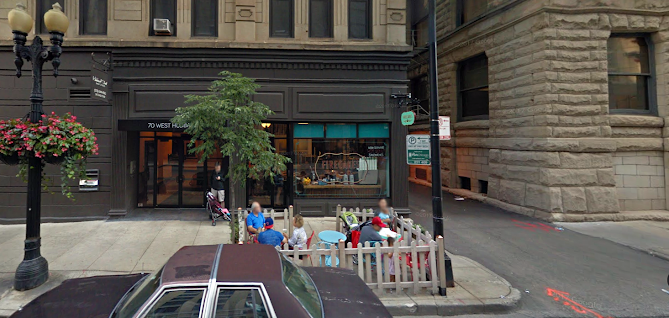
You can see the Noose Coffee Shop's location next to the Criminal Courts Building. A Google Street Maps Image.


Restaurant owner Joe Stein supplied condemned prisoners with their last meal eaten in their death cell on the evening before their hanging. The County Jail reciprocated with photographs, some autographed, of famous local and national criminals. Joe lined the restaurant's walls with those photographs and soon got the nickname Joe's 'Gallery of Crime.' Criminals were hung in the alley between the courthouse and the adjacent Cook County Jail. 

FROM THE GALLERY OF CRIME, MY FAVORITE CRIME STORIES.
The photographs below are not the pictures from Joe Stein's Restaurant.

Among the hundreds of original photographs on the restaurant walls was a picture of the tough prosecutor, Assistant State's Attorney William H. McSwiggin. By the age of 26, he had won seven death penalties in under eight months. Despite prohibition and McSwiggin's lawman status, on April 27, 1926, McSwiggin and his friend Tom "Red" Duffy went for a drink at "The Pony Inn," 5613 West Roosevelt Road in Cicero. Other mobsters were present at the tavern. A car stopped nearby, and occupants got out and sprayed them and other gangsters with machine gunfire. McSwiggin, Duffy, and a gangster named Jim Doherty were hit. Gang leader William "Klondike" O'Donnell's car sped McSwiggin & Doherty to the hospital, but both died en route.
William McSwiggin presented his plea in court to hang Anselmi and Scalise.


Al Capone's gang was suspected, but O'Donnell's and Capone's gang were at odds with each other then, so McSwiggin was thought to be a mere bystander.


"Terrible Tommy" O'Connor escaped from the Criminal Courts Building in December 1921, only a day before he was to have been executed by hanging.
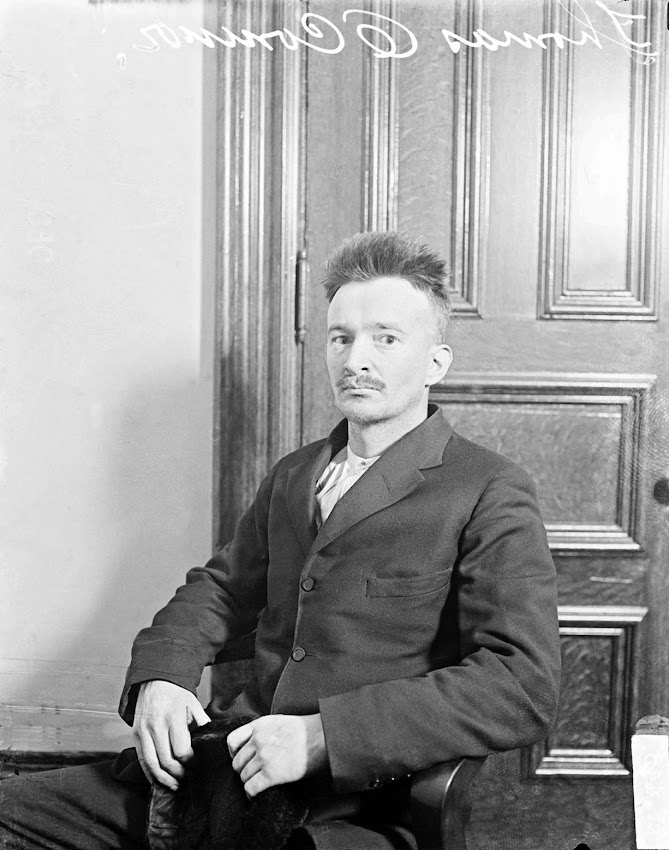
"Terrible Tommy" O'Connor
O'Connor flew under the police radar for several years. He was up to no good in those early years; he just never got caught. Jimmy Cherin and a fellow partner in crime hung around a saloon operated by Jimmy's father, Dominick. The bar was a place where stolen goods could be fenced and was the favorite watering hole for some of Chicago's criminals.

Here, Tommy and Jimmy learned how to steal cars and commit other crimes. Tommy was known to have an explosive temper. On one occasion, he believed his mother was overcharged for some meat, so he chopped off the butcher's thumb. Tommy soon developed a reputation as a "cold-blooded killer" and acquired the moniker "terrible."

O'Connor was arrested for murder in 1921. Numerous accounts then refer to unspecified "shady court dealings" that saw O'Connor released. Chicago in the 1920s was notoriously corrupt. Police, judges, and politicians were on the take, so the notion of an accused murderer dodging justice was an unremarkable occurrence.

But O'Connor's freedom was short-lived. Somebody thought justice had been perverted and dispatched detective Patrick O'Neill to arrest O'Connor at his sister's Washtenaw Avenue house. There was an exchange of gunfire, and Officer O'Neill was hit and later died of his wounds.

O'Connor escaped out of the back of the house but was later arrested in St. Paul, Minnesota, after making a drunken nuisance of himself. He was hauled back to Chicago, tried, and found guilty of killing the police officer. The sentence was death by hanging, to be carried out in the middle of December 1921.

Four days before his date with the executioner, a prison guard was walking past O'Connor's cell when the inmate called him over. O'Connor's cellmate reached through the bars and put a headlock on the guard while Tommy took his keys and gun. They bound and gagged the guard, ran into the prison yard, and climbed over a 20-foot wall.

Another version of the breakout is that O'Connor got a gun that was smuggled into the prison hidden in a sandwich. This version has O'Connor and four or five other prisoners overpowering several guards before escaping.

Whatever the correct story, this is when the legendary Chicago lawyer Harry J. Busch met Terrible Tommy. At the time, a law school student, Busch, was driving in the neighborhood of the Cook County Jail. More than 70 years later, Busch recalled what happened after a man jumped onto his car's running board: "Suddenly the isinglass (heavy plastic) is ripped open and in comes Tommy with his cannon. He said, 'Drive like hell, you SOB, or I'll blow your brains out! I'm Tommy O'Connor!' I drove!"

Busch deliberately crashed his car into a factory wall. O'Connor scrambled out of the wreckage and was last seen legging it down the street. And that was literally the last time he was seen.

A $3,000 reward ($46,600 today) was offered for information leading to O'Connor's arrest, but it was not enough to shake loose any tips. Hundreds of police searched for the fugitive, but he was never found.

Stories appeared frequently about sightings. He was in California; no, it was Texas. He had joined the Irish Republican Army and been killed in a shootout; no, he'd died of tuberculosis. He was robbing banks in Canada; no, he had bought a pub in Limerick, Ireland.

There is a headstone in Worth, Illinois, a suburb of Chicago, with the name Tommy O'Connor on it. The date of death is given as 1951.


Chicago's famous Timothy "Big Tim" D. Murphy, a popular labor leader in 1921, was charged with organizing the theft of $400,000 ($6,211,000 today) from a Pullman mail train at Chicago's Union Station in August 1920. Although he was released on a $30,000 bond ($417,000 today). Judge Kenesaw Mountain Landis eventually convicted and sentenced Murphy to seven years in Leavenworth Penitentiary in Kansas. 

Murphy was involved with armed robberies, labor racketeering, he had control of the railroad, laundry, and dye workers unions. His murder was never solved, though there were plenty of suspects. Some believed that the gunmen were associated with the rival, Mossy Enright, who was behind it; others believed Murray "The Camel" Humphreys was behind it, while others thought John "Dingbat" O'Berta could have been the culprit.

On May 6, 1922, Murphy, Cornelius Shea, and six other labor leaders were arrested and charged with the murder of a Chicago police officer. On May 24, the state asked for nolle prosequi ("to be unwilling to pursue"), and the court agreed to withdraw the indictments. A new indictment was returned against Murphy and the others in August, but the state also withdrew this second indictment.
(L to R) Murphy, Fred Mader, John Miller, and Cornelius Shea during their murder trial in 1922.


Big Tim was a mentor to another politician/mobster, John "Dingbat" O'Berta. O'Berta married Big Tim's wife some months after his death. O'Berta himself was killed in one of Frank McErlane's oneway rides. In a twist of fate, O'Berta was buried near Big Tim, and when their wife Flo died, she was buried in a grave between them.

When Murphy answered his front doorbell at 2525 West Morse Avenue, Chicago, on the night of June 26, 1928, there was nobody there. Just as he stepped out to look down the street, a gunman blasted him in the head with a shotgun from a car. He died instantly. 


On April 3, 1924, 23-year-old Beulah May Annan, Chicago's "prettiest slayer," shot her lover and coworker, Harry Kalstedt, in her South Side apartment at 817 East 46th Street, Chicago, while her husband, Al, was at work. 


According to the report published in the Chicago Daily News the following day, Annan told Assistant State's Attorney Roy Woods she "danced to the tune of jazz records a passionate death dance, with the body of the man she had shot and killed."

The dramatic crime and subsequent press coverage that focused on Annan's "most striking appearance" turned her into a celebrity — and later an inspiration. Chicago Tribune crime reporter Maurine Watkins, who covered Annan and other women accused of murder in 1924, adapted her experiences into the play and later the musical "Chicago." Annan inspired the character Roxie Hart.

Much of the report came directly from Annan herself. She held court at the Harrison Street Police Station, answering all questions and waxing poetic about love.

"I didn't love Harry so much — but he brought me wine, made a fuss over me, and thought I was pretty," she told reporters. "I don't think I ever loved anybody very much. You know how it is — you keep looking and looking all the time for someone you can really love."

Kalstedt, who worked with Annan at a laundromat, invited himself and two quarts of wine over to Annan's apartment around 12:30 pm, she said.

"We drank all of it and began to quarrel. I taunted Harry with the fact that he had been in jail once, and he said something nasty back to me. Seems like we just wanted to make each other mad — and to hurt each other," Annan said.

In her rage, Annan called Kalstedt a name, her "magnolia-white skin flushing and paling as she recited her narrative of death," the paper reported. Kalstedt told her, "You won't call me a name like that," and he headed straight for the bedroom.

According to Annan, Kalstedt could only be going after one thing: a gun. Though usually tucked under a pillow, the gun sat on the bed in plain sight.

"I ran, and as he reached out to pick the gun up off the bed, I reached around him and grabbed it. Then I shot. They say I shot him in the back, but it must have been sort of under the arm," she recalled.

Kalstedt fell back against the wall. The record playing "Hula Lou" came to a stop "as the man in the bedroom breathed his last," the paper said.
Hula Lou

Annan told reporters she couldn't stand the silence and restarted the record. After washing the blood off her hands, she took a washcloth to Kalstedt's face and kissed him. "Then I went back and started the record over again."

The shot, the paper said, was fired around 2 pm, but Annan didn't call for help until after 5 pm. "I just kept going back and forth between the living room and the bedroom, where Harry's body lay, and playing the phonograph," she said.

It wasn't until Annan's husband returned home that the police were finally called — and the media circus began.

Maurine Watkins, a Tribune reporter, was sent to the coroner's inquest at a South Side funeral home. Watkins painted a picture for Tribune readers:
"They say she's the prettiest woman ever accused of murder in Chicago — young, slender, with bobbed auburn hair; wide-set, appealing blue eyes; tip-tilted nose; translucent skin, faintly, very faintly, rouged, an ingenuous smile; refined features, intelligent expression — an 'awfully nice girl' and more than usually pretty."
Her lawyer, W.W. O'Brien, stated that self-defense would be her plea. The statements made at the police station would be repudiated as having been made under duress when intoxicated.

On May 24, 1924, a verdict of not guilty was recorded.

NOTE: Only twenty-one days from the crime to a court case decision.  

A day after Beulah's acquittal, Al Annan, who had stood by his wife throughout the trial and who had spent a significant amount of money on her defense, got the news that his wife was leaving him. "He is too slow," Beulah explained.

Beulah May Annan died of tuberculosis in a Chicago sanatorium in 1928, four years after her acquittal on charges of murder.


The Drake Hotel Bandits. Fifty-year-old Frank Rodkey was shot to death at 3:30 pm in the Chicago's Drake Hotel office by one of five bandits who held up the place with shotguns. Eric Nelson and Ted "Tex" Court, two of the bandits, were killed by Lincoln Park Police Officers. Two others, Joseph W. Holmes, 25, and Jack (J.W.) Wood was captured and, on August 1, 1925, turned over to the sheriff on indictment. The fifth bandit, Wm. Wasil Marks (aka Mulenchuck, Melney) escaped the 28th district police station on October 10, 1925, and was at large until August 12, 1938, when he was arrested in Santa Barbara, California. Judge Hopkins sentenced Holmes and Woods to hang on December 11, 1925. Holmes and Woods were hanged at Cook County Jail on February 13, 1926.
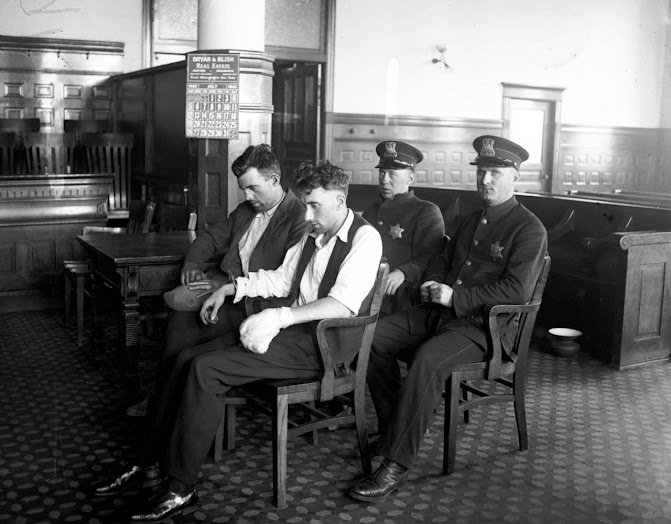
Drake Hotel Bandits Joseph Holmes, 25, left, and Jack Wood wearing a vest in 1925. Both Holmes and Wood confessed their involvement in the July 29, 1925, daylight holdup of the Gold Coast neighborhood's Hotel.


On May 21, 1924, a 14-year-old boy, Robert Emanuel "Bobby" Franks, was murdered by two young men, Nathan Leopold and Richard Loeb, both from wealthy and socially established Jewish families, simply to commit the perfect crime.
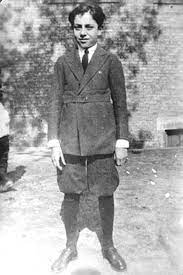
Robert Emanuel "Bobby" Franks
At their trial, the famous Clarence Darrow conducted a defense based on psychological testimony and captured the nation's attention.

The two were indicted on June 5, 1924.

With the Leopold and Loeb case, the attention of the nation and world was once again focused on Chicago because of a murder. The circumstances of the crime involved the murder of a young boy, Bobby Franks, by Nathan Leopold and Richard Loeb, young men from wealthy Jewish families who said they killed their 14-year-old victim, whom they didn't know, because they wanted to commit the perfect, motiveless crime. The case quickly became internationally famous.

Although their plans to conceal their identities and collect a hefty ransom of $10,000 ($162,500 today) were elaborate and intricate, Leopold and Loeb were caught almost immediately because Nathan Leopold dropped a pair of glasses near to where the body of Bobby Franks had been left. 
Nathan Leopold's Glasses


The glasses had a special patented spring for the expensive horned rim frame and were only sold in one place in Chicago. It was found that only three people, including Nathan Leopold, purchased these glasses. Once in custody, Leopold and Loeb showed no remorse and confessed in great detail to the crime, both to the authorities and the press.
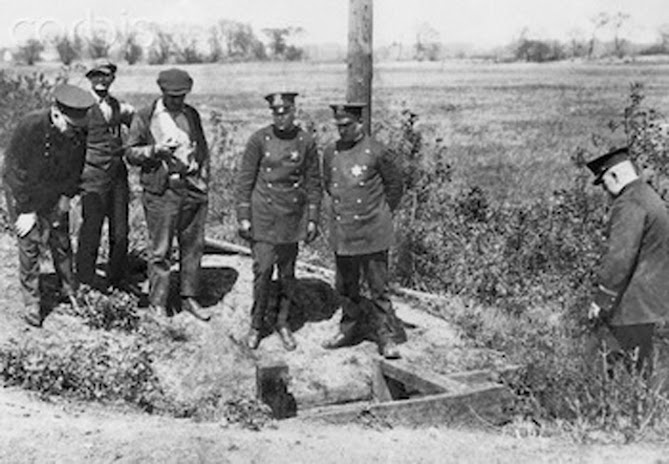
Bobby Franks was found beneath the culvert at 121st Street and the Pennsylvania Railroad tracks. Bobby was the son of millionaire Jacob Franks of 5052 South Ellis Avenue, Chicago.


Their separate confessions (Leopold and Loeb) are consistent in their description of the details of the crime, except that each claimed the other actually committed the blows that killed Bobby Franks. In addition to their confessions to authorities, Leopold and Loeb made many incriminating statements to the press. They described their plans to commit this crime and their elaborate self-justifications for the murder, including the invocation of German philosophers, such as Friederich Neitzche. 

Their friendship had been marked by fantasies and delusions of grandeur, highly ritualized games with elaborate plots and counterplots, and the planning and carrying out of previous criminal activities together. Their friendship also had overtones of homosexuality. Several books have been written about the case, and at least four feature films have been based on the circumstances of the crime.

Both were sentenced on September 10, 1924, to life in the Joliet Penitentiary in Illinois. In 1925, when the new Stateville Correctional Center, a maximum-security state prison for men in Crest Hill, Illinois, opened in 1925, Leopold and Loeb were transferred. Leopold and Loeb founded the Stateville Correspondence School. Richard Loeb was killed by another inmate.


Being Sicilians, Alberto Anselmi and Giovanni Scalise find employment with the gangs at Taylor Street, the area known as Little Sicily. The Genna Family ran the roost at the time on Taylor Street. They are in constant battle with the Northsiders, making and peddling rotgut booze, run by the formidable Dean O'Banion. Anselmi and Scalise make an odd couple at that. Scalise has one eye that deviates from the other, and Anselmi is almost twice Scalise's age. They both share a common trade, as both are cold-blooded Sicilian hitmen. 
Alberto Anselmi and Giovanni Scalise


On June 13, 1925, Anselmi, Salise, and Mike Genna are being driven around by another unknown hood in a big, flashy automobile. They had moments earlier been in a shootout with the Northsiders and had injured Moran and Drucci.

Police also out on the cruise got wind of the gang fight, immediately identified Mike "The Devil" Genna, and followed the gangster car. Police also think they recognized the fourth man in the car at the wheel, and this man was possibly identified as Samuel Amatuna, "the Beau Brummel" of gangland.

The driver of the gangster car becomes aware of the pursuit and guns the engine. The police also press on the gas. At this moment, Mike talks loudly in Sicilian and gives instructions for what will happen. He tells Anselmi and Scalise to grab the weapons on the car's floor. They consisted of two repeating shotguns and four sawed-off shotguns.

Anselmi and Scalise were tired of Amatuna and the Genna gang and received attractive offers elsewhere.

The police following them were Policemen Charles B. Walsh, Harold F. Olsen, Michael J. Conway, and Willam Sweeney.

The gangster car was now going 73 miles an hour at 59th street when a truck swerved in front of them, causing Genna's driver to hit the brakes, causing a spin, and slam his car into a lamp post. Police get out, exclaiming, "Hey, what's the idea?"

The Genna party answers their questions with a volley of gunshots from a repeating shotgun.

Policeman Olsen is hit in the jaw by the slugs and crumples to the floor. Patrolman Walsh is the next hit in the chest by buckshot. Sweeney and Conway return fire at Genna, Anselmi, and Scalise. Mike Genna's gun jams.

Genna, the unknown driver, Scalise, and Anselmi make a run for it. The unidentified fourth man is gone. Genna, Scalise, and Anselmi run into an alley running north and south between Western and Artesian Avenues. Scalise and Anselmi turn into a passageway of a house at 5941 South Artesian Avenue. Genna, tired of running, stops, turns to face Sweeney, levels his shotgun, pulls the trigger, and "Click," no bullet. Sweeney returns fire and fatally hits Genna in the leg, causing him to stumble after his companions. 

Genna jumps through the basement window of a nearby home. Officer Sweeney follows, and two policemen (one retired) join Sweeney. They enter the basement and fire at Genna lying on the floor. He has a blue steel Spanish .38 in his hands. He fires before falling back. He has a severed artery in the leg from the first bullet by Sweeney. Before he dies, Mike Genna kicks the ambulance driver sent to take him to Englewood hospital in the face exclaiming, "Take that, you son of a bitch."

Police Officers Olsen and Walsh die from their wounds. Anselmi and Scalise ducked into a store but were later captured by police. Anselmi and Scalise are roughed up by the police, who are angered at the murders of their brethren. Slain police officer Harold Olsen's brother (John Olsen), also a policeman, goes to the station and wants to kill his brother's murderer, but he is talked out of it.

Three trials, first headed by McSwiggin, the hanging prosecutor, are achieved to try and hang or imprison Anselmi and Scalise.

Anselmi talked with his hands through an interpreter during the trials; he speaks no English. John Scalise spoke in broken English. All claim that they would never have been shot if they knew they were policemen. Then Scalise puts the blame on the death of Mike Genna as being the one who fired first.

The first trial was for the murder of policeman Olsen, and they were both sentenced to 14 years for manslaughter.

During their time in prison, Scalise and Anselmi feared for their lives. They are beaten up, and Scalise is almost poisoned. He finds the food tastes a little off and tells the guard. They send the food to be analyzed by a chemist and discover cyanide, enough to kill a couple of men in his spaghetti and beans.  

In the second trial for the murder of policeman Walsh, they were both acquitted.

The Supreme Court later orders a new trial on the killing of Policeman Olsen. Scalise and Anselmi are both found not guilty and are immediately set free.

Their lawyer's defense was, in essence, that "If a policeman tries to kill you, you can, in turn, kill him in self-defense."


By Rupert John Taylor
Edited by Dr. Neil Gale, Ph.D.

Monday, April 29, 2024

Carl Sandburg Village, 1355 N Sandburg Terrace, Chicago, Promoted Social Changes.

The History of Carl Sandburg Village
Carl Sandburg Village was built as an urban renewal project—intended to spur redevelopment of the diminishing near north side from its dilapidation. Sandburg Village emerged from the post-World War II urban renewal era in American cities. In the 1950s and early 1960s, Chicago's Near North Side, particularly the Old Town neighborhood, faced concerns about aging infrastructure and potential encroachment from nearby low-income communities. City planners, seeking to revitalize Old Town and shield the affluent Gold Coast neighborhood, envisioned a large-scale renewal project. This led to Carl Sandburg Village, named after the celebrated poet, intended as a mixed-income housing development. Its creation, however, came at the cost of displacing a vibrant Puerto Rican community.
Carl Sandburg Village Arial Photo.


The architectural firm Solomon Cordwell Buenz designed Sandburg Village in a modernist style, emphasizing clean lines and functional spaces. The complex includes towering residential high-rises, clusters of townhomes, and a centralized commercial district, aiming to create a self-contained community within Chicago's urban fabric.

The construction of Carl Sandburg Village had a profound impact. The displacement of Puerto Rican residents sparked controversy and ignited a debate about social justice and the priorities of urban renewal. These residents primarily relocated north to Lincoln Park and west to Humboldt Park.
Carl Sandburg Village Sales Model.


This displacement fueled significant social and political changes. The Young Lords Organization, previously a street gang, emerged from this displaced community. They transformed into a powerful human rights movement dedicated to Puerto Rican empowerment and opposing the urban renewal practices that had uprooted them in 1968.

sidebar
The ranks of the new Young Lords included former gang members, community residents, and activists. The Young Lords actively created change while serving poor and destressed communities. They notably utilized a church to offer basic services—such as health care, daycare, and lunch programs—to Black and Latino people. By 1969, Jiménez and the Young Lords had joined with Fred Hampton, leader of the Chicago Black Panthers, and other ethnically diverse groups to form the Rainbow Coalition. 

Carl Sandburg Village shifted from its initial affordable housing model to condominium ownership. While still somewhat affordable within the Gold Coast context, continued gentrification trends in Chicago have impacted the Village, influencing demographics and affordability in 1979.

Sandburg Village Today.
Despite its complex history, Sandburg Village retains a distinct appeal. Its green spaces, swimming pools, tennis courts, and prime location attract residents. The Village embodies a blend of the past and present – mid-century urban planning intersected with contemporary urban living trends and evolving neighborhood identities. Its walkability to grocery stores, nightlife, the lakefront, Lincoln Park, and Old Town's attractions adds to its appeal with 
charming experiences of unique boutiques, bistros, restaurants, entertainment like the Second City Comedy Club, Live Music Venues at bars and pubs, Steppenwolf Theatre Company, historic homes on picturesque streets, and the long-running Old Town Art Fair, founded in 1950.

Compiled by Dr. Neil Gale, Ph.D.