Wednesday, April 29, 2020

The Lincolnwood, Illinois Motor Speedway (1932-1936)

The Lincolnwood Motor Speedway was also known as Evanston Motor Speedway, Tessville Motor Speedway, and the Chicago Midget Speedway. Prior to 1936, Lincolnwood was known as Tessville.
The track was located in what is now Lincolnwood. The race track property was bordered by Touhy Avenue to the north, by Pratt Avenue to the south, by railroad tracks to the northwest, and by McCormick Boulevard / North Shore Channel to the east.
Tet Tetterton driving car #3.
Various computer aerial images show the track located north of Pratt Ave. with the entrance to the speedway roughly at Pratt and St. Louis Avenues. The actual track ran east and west and was bordered by today's Central Park Avenue on the west and Christiana Avenue on the east with the main straightway north of the current street, Northeast Parkway.
Some early newspaper stories, ads, and race programs said the location was at Lincoln and Devon Avenues and McCormick Boulevard.
Compiled by Neil Gale, Ph.D.

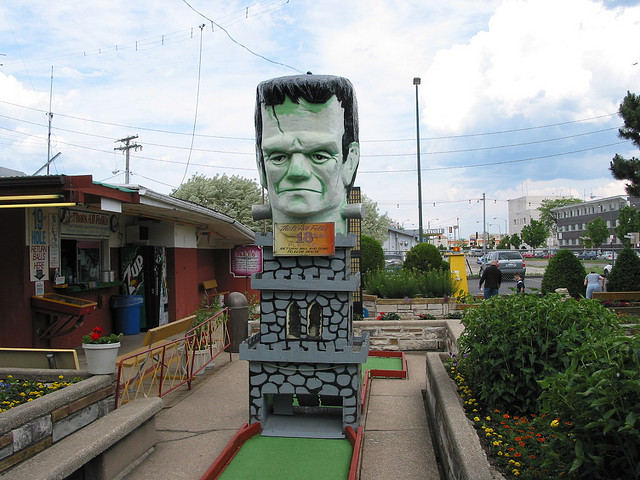
Novelty Golf and Games in Lincolnwood, Illinois.

Founded in 1949, Novelty Golf at 3650 West Devon Avenue in Lincolnwood, is still operating, hosting two-18 hole miniature golf courses. 
1980s Novelty Golf TV Commercial
I lived about 2 miles from Novelty Golf and my friends and I would play either one of the courses often. The 19th hole was actually a golf ball return, in a one-hole pinball style game. From the hundreds of golf games I played, I won a free game only one time. 
The ball return game is partially seen in the bottom left of this picture.
We'd spend almost all of our money in the game room. It was lit perfectly for a game room, with dim, indirect lighting. The "L" shaped room helped to keep the game noise down.
They had all the newest games, Asteroids, Space Invaders, Pac Man, Missile Command, Centipede, and a few Pinball machines. Later came more great games like Pole Position, Zaxxon, and Dragon's Lair which was the first arcade game to use cartoon footage.
Dragon's Lair Arcade Game - Full Play
Want to try Dragon's Lair? Click to download the Android game from Google Play. It is the original. What was your favorite arcade game? 
After we were done, it was off to the Bunny Hutch, which is next door and shares a parking lot, for a Hot Dog and fries.
By Dr. Neil Gale, Ph.D.

Sunday, April 26, 2020

Remembering Lums Restaurants in Illinois

Lums was a casual restaurant chain known for its hot dogs steamed in beer and tantalizing Ollieburgers. Stuart and Clifford Perlman started Lums in 1956 in Miami Beach, and the brothers had four restaurants by 1961 and began aggressively expanding and franchising the company. The Florida-based chain peaked at about 400 restaurants nationwide, and the last one closed in 2017 in Bellevue, Nebraska.

Lums Restaurant's busiest Chicago location was in the Old Town neighborhood on the southwest corner of North Avenue and Wells Street.
Standard Lums Stand-A-Lone Building
Lums restaurants were in Bloomington, Chicago, on Touhy Avenue west of Caldwell Avenue and in Old Town, Chicago Heights, Des Plaines at Oakton (Rt 83) and Elmhurst Road, Glenwood on Halsted, Hill CrestKankakee, Niles, Oak Lawn at 87th & Cicero, Ottawa, Pekin in the Pekin Mall on Court Street, Peoria, Rockford, Rolling Meadows on Algonquin Road west of Wilkie Road, Schaumburg outside of Woodfield Mall, Tinley Park, Urbana, Villa Park at St. Charles and Euclid, and Wheeling.
A Standard Interior View
Lums offered Hot Dogs steamed in beer with Sherry-flavored sauerkraut and their famous chopped sirloin Lumburgers. Their huge Grilled Cheese sandwich was on a fluffy poppy-seed bun injected with American cheese and melty cheese slices between the bun for 45¢. Their $1.55 freshly breaded fried clam dinner was a best seller. Lums offered over 20 brands of beer, some on tap and others in bottles, but all served in ice-cold frosted glasses.


It was a sad day when the Miami-based Lums filed for bankruptcy and closed permanently in 1983.

Naugles 24-Hour Mexican Fast Food Restaurants of Illinois.

Naugles Sign - Location Unknown
The fresh-made food at Naugles set them apart from other fast-food Mexican restaurants in addition to the drive-thru being open 24 hours. 

The Southern California chain was founded in 1970, closed in 1995, and was rebooted in 2015 when the original trademark expired.

There was a Naugles on the southeast corner Western and Addison in Chicago across the street from Lane Tech High School along with other Chicago stores. There were other restaurants in Orland Park, Addison, Hoffman Estates, Palatine, Joliet, Bolingbrook, Glen Ellyn, Elmhurst, Aurora, and one in southern Illinois in Belleville.

My sister managed the Orland Park Naugles from 1982 to 1984. Although the brownies were packaged, they were the best and in my opinion, the best item Naugles sold.

It was bought out by Del Taco in 1988. After the buyout, all the Naugles restaurants were co-branded as Del Taco/Naugles restaurants for a few months before eventually becoming only Del Tacos.

There is one original "Naugles Tacos" still in business at; 18471 Mt. Langley Street, Fountain Valley, CA. 

If you have any info on other Illinois locations or just a story about Naugles, please comment below.

INDEX TO MY ILLINOIS AND CHICAGO FOOD & RESTAURANT ARTICLES.

Compiled by Dr. Neil Gale, Ph.D.

Friday, April 24, 2020

Why the North-South Chicago Streets Don't Align at North Avenue.

Chicagoans know that the north-south streets swerve abruptly on crossing North Avenue (1600N) from Kedzie Avenue (3200W) on the east to Oak Park Avenue (6800W) to the west, a distance of 4½ miles.
CLICK FOR A FULL-SIZE MAP
THE MYTH
Chicago's streets are a grid pattern that is then overlaid on a spherical map of the Earth. All grids overlaid on spheres create an issue. They converge as the meridian's lines (north/south) approach the poles.

A surveyor laying out a grid has two choices. Either let the streets get closer together as they head towards the North Pole, meaning the building lots get smaller and thus would be sold for less money, or readjust the grid at intervals so that the lots and the profits don't shrink.

Chicago opted for the second choice. The abrupt readjustment, or so the story has it, is manifested most conspicuously at North Boulevard, which was at one time the northern boundary for the City of Chicago.
Looking North on Pulaski Road (Crawford Avenue) towards North Avenue, Chicago - 1947
MYTH DEBUNKED
Different people surveyed the townships to the north and south of North Avenue at different times.

The surveyors who laid out the city south of North Avenue were inaccurate. Harlem Avenue, the city's western border at that time, is 1/16 miles west of where it should be at Madison Street. That's 330 feet. If one had to hide a 330-foot mistake, they might parcel it out in small increments along the 5-mile width.

It's not like this is the only surveyor's error in Chicago. The whole city is 1.3° off true north. As a result, it doesn't square with the survey grid between the Wisconsin border and Central Street in Evanston, which was laid out independently.

EVIDENCE
Central and Golf Road are supposed to be parallel. However, if you follow the lines in a Street map or atlas, you'll find Central and Golf are 1½ miles apart in Hoffman Estates but only ½ mile apart in Evanston.

Who cared about such a slight difference at the time of the survey? They thought they were surveying farm property lines. They couldn't have imagined what the future would bring.

THE HISTORY OF TRUE NORTH VS. MAGNETIC NORTH
U.S. surveyors in 1800 did not know that the magnetic North Pole moves constantly. While there were observations of compass deviations from true north throughout history, the concept of a continuously moving magnetic pole wasn't widely understood or accepted until the late 19th century.

English seafarers observed discrepancies between geographic and magnetic north in the 16th century.

Edmund Halley observed that the magnetic pole wasn't fixed and proposed its movement over time in the 17th century.

By the 18th century, scientists had observed that the compass needle didn't always point directly to the true north. This deviation, known as magnetic declination, varied depending on location and was attributed to local magnetic anomalies.

Scientific data on the magnetic North Pole's movement was still limited and largely based on single expeditions by 1800. Many surveyors and scientists believed the magnetic pole had a fixed location or followed a circular path. Surveyors in the 1800s primarily relied on compasses and declination tables to adjust for local variations without necessarily factoring in long-term movement.

U.S. surveyors in 1800 observed discrepancies between magnetic and geographic north but lacked a complete understanding of the cause. The concept of the magnetic North Pole's movement was still emerging and not widely accepted during their time.

Increased data from expeditions and more precise instruments started to solidify the evidence of the magnetic pole's continuous movement in the Mid-19th century.

The concepts of "secular variation" (long-term movement) and "diurnal variation" (short-term changes) gained wider acceptance in the late 19th century.

Carl Friedrich Gauss (1777-1855), the renowned mathematician, made significant contributions to our understanding of Earth's magnetic field, particularly regarding the location of magnetic north. In the 1830s, Gauss participated in the first global survey of Earth's magnetic field. This required accurate measurements, which led him to invent the magnetometer, a device to measure the direction and strength of magnetic fields. Gauss recognized that the location of the magnetic north is not fixed but drifts over time. Gauss's work on Earth's magnetism extended beyond just the north pole. He also studied magnetic declination, the angle between true north and magnetic north, and its variations across the globe.

ADDITIONAL READING: Chicago's Eastside Begins at North Boulevard (1600N)

Compiled by Dr. Neil Gale, Ph.D.

Thursday, April 23, 2020

The History of the Irving Park Settlement.

Major Noble purchased a 160-acre tract of land from Christopher L. Ward and started farming in the 1840s. The boundaries of Noble's farm today would be Montrose to the north, Irving Park to the south, Pulaski to the east, and Kostner to the west.

Noble sold his land to a New York family (Charles T. Race and four other relatives that comprised the Irving Park Land and Building Company) and moved to McHenry County to farm in 1869. 

With the land so close to the Chicago & North Western (C&NW) railroad, Race realized there would be more profit in beginning a settlement instead of overusing the land for farming and began building houses. 

The original name chosen for the new suburb was "Irvington" after the author Washington Irving. It was discovered that Irvington was a village in Washington County, Illinois, had already used the name first, so the name Irving Park was adopted. After Race paid for a depot, C&NW agreed to stop at the settlement, which was soon renamed Irving Park.
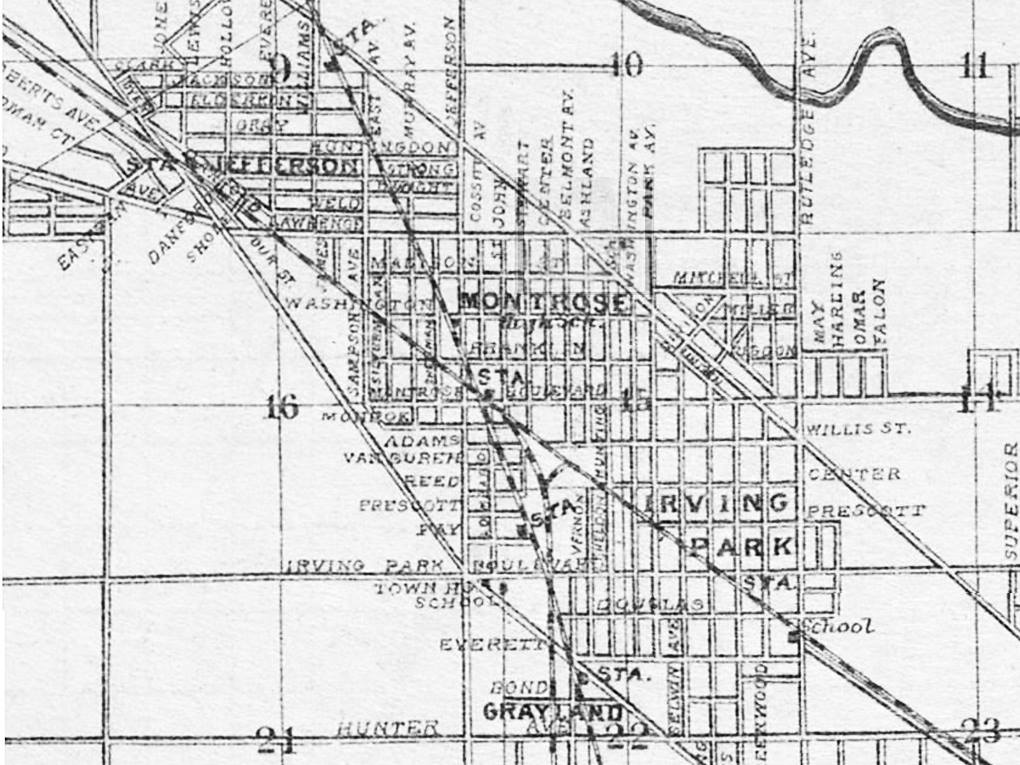
An 1888 Rufus Blanchard map showing Irving Park before annexed to Chicago in 1889. The easternmost streets cropped in this map were Irving Avenue (Keeler), St. Charles Avenue (Kedvale), and Greenwood Avenue (Keystone). These original names were used until the City of Chicago renamed and renumbered the streets in 1909.
Race built himself a three-story brick house with a basement and “French roof.” Joined by associates, he organized the Irving Park Land Company, bought additional land, and subdivided it into lots. Advertisements promoted the area's easy access to downtown via hourly trains. Boasting an idyllic setting comparable to that of suburbs such as Evanston and Oak Park, the ad pointed to Irving Park’s “shady streets, fine schools, churches and stores,” and homes of varied designs. The Irving Park subdivision was followed by Grayland, Montrose, and Mayfair subdivisions.

Grayland, a suburb of Chicago annexed in 1889, was created by subdividing John Gray's 80-acre farm. Gray deeded the land that he had already built a depot (the second one) on the Chicago, Milwaukee & St. Paul Railroad line. In return for the property, the R.R. promised to maintain and service the depot, thus ensuring that the inhabitants of Gray's subdivision would have easy transport to Chicago and back. The station was opened in 1873 to service Grayland.

The commuter suburb attracted many wealthy residents who sought larger homes of between seven and ten rooms and amenities that included closets and drinking water from artesian wells. Race and his associates garnered a 600% profit on the land. Other residents who were less affluent came to the area to remove their families from the dangers of the city. Rich or middle-class, the population of Irving Park was generally native-born, Protestant, and white-collar. They participated in community events and activities of a literary and musical nature. Both men and women were active in neighborhood organizations. The Irving Park Woman's Club was formed in 1888 with an agenda of cultural and reform activities.

Suburban paradise was not without problems, however. In the 1880s, heavy rains produced floods, and poor drainage turned unpaved streets into mud. In 1881 complaints were heard of raw sewage floating down Irving Park Road from the Cook County Poor House and Insane Asylum in Dunning.
The Irving Park Tea Store at 3613 Irving Park Road in Chicago. 1910
Although the annexation of Irving Park into the city of Chicago as part of Jefferson Township occurred in 1889, in the 1890s, streets were still unpaved and unlighted. As improvements were added, the main thoroughfare became a construction zone; streets were updated, and public transportation was created. A residential boom between 1895 and 1914 added more than 5,000 new buildings, of which 1,200 were multifamily residences. New structures changed the housing composition of the area, leading to concerns about community standards.

Irving Park was annexed to Chicago in 1889.
Germans and Swedes had begun arriving around the turn of the century but, in the 1920s, were largely replaced by Poles and Russians. The population peaked at 66,783 in 1930, and commercial interests sprang up along the major roads, but until 1940, construction was mainly residential. Most notable architecturally were the bungalows of the Villa District; Old Irving Park with Queen Anne, Victorian, and Italianate houses, farmhouses, and bungalows; and Independence Park with many homes of turn-of-the-century vintage.

Compiled by Dr. Neil Gale, Ph.D.

Tuesday, April 21, 2020

The Story of Chicago's "Walking Man." Joseph "Joe" Kromelis. (1947-Dec 11, 2022)

UPDATED MONDAY, DECEMBER 12, 2022.
Joseph "Joe" Kromelis is known in Chicago as "The Walking Man" or "The Walking Dude. Kromelis moved to Chicago with his family from Lithuania or Germany as a kid and grew up above the bar his parents ran on Halsted. It was near a ballpark which is still a mystery. His parents sold the tavern and moved to southwest Michigan when he was about 19. But Kromelis stuck around in Chicago. He tried a factory job but didn't like it. He got a peddler's license and sold jewelry on the street. That's when he began wandering the Loop. 
To most of his fellow downtown pedestrians, he was just "Walking Man" or "Walking Dude," a familiar, tall, mustachioed guy who wandered around town in a V-neck T-shirt and a kerchief tucked in the breast pocket of his suit jacket, going who knows where. Occasionally, he'd stop to comb his flamboyant hair. 

"There's nothing wrong with him, and he's not mentally ill, and he just likes walking. It's that simple. My husband couldn't figure it out, but he accepted it. That's Joe. He loves the city," his sister-in-law, Linda Kromelis said.
He lived in an efficiency apartment or an SRO (single-room occupancy) building in Lincoln Park for about 30 years until he had to leave because it was turned into condos in 2012. He never married and had no children.
Joseph Kromelis, second from left, stands with his now-deceased siblings in a family photo. From the left are John, Joe, Pete, Bruno, and Irene. (Photo provided by family.)
Kromelis had been a fixture in downtown street life. Walking north near the Hancock Center, south near the Sears [Willis] Tower, on the Riverwalk, and across the bridges, occasionally in more far-flung areas. He was often seen patiently browsing inside stores on the Magnificent Mile and in Streeterville. He liked peddling jewelry on the streets and preferred to keep to himself. Joe walked the city every day and in every kind of weather.
When he was attacked, Joseph Kromelis was walking around 11 AM on Tuesday, May 24, 2016. He told police he was on Lower Wacker and said hello to someone he passed. That man began punching and hitting him with a bat, Chicago police said. A police officer responding to a battery call saw the attacker straddled over Kromelis, struggling with the bat, according to a police report. A witness told the sergeant the suspect also tried to throw Kromelis over a railing to the pavement about 20 feet below. Kromelis was taken by ambulance to Northwestern Memorial Hospital to be treated for several injuries, including severe cuts to both eyes, according to the report. He also suffered leg injuries from being hit with the bat. He was listed in fair condition.
September 19, 2019
Rich Kolar writes: I ran into him today. Joe Kromelis is doing fine. We talked for a minute or so in front of the Cultural Center. He was a nice, intelligent man who graciously let me take his photo.

Chicago's 'Walking Man' lit on fire, suffering burns to half his body in a second brutal attack in 6 years: 'To single him out for this kind of abuse is shocking and inhuman.'
                                                                         —Chicago Tribune, Wednesday, May 25, 2022

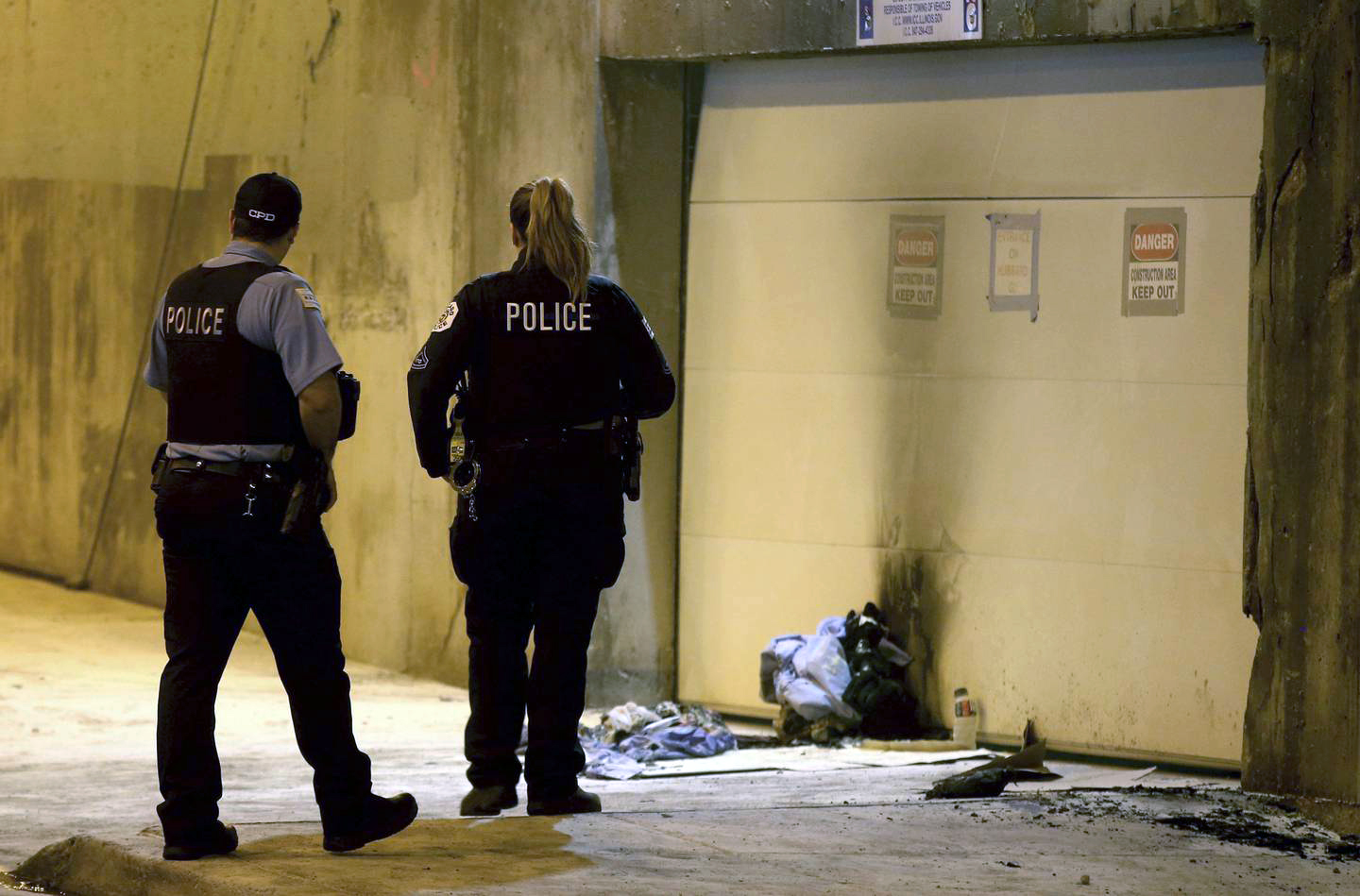
Chicago police officers look at the scene where a 75-year-old man was left in critical condition after being doused with a flammable liquid and set on fire in the 400 block of North Wabash Avenue early Wednesday morning. (Antonio Perez / Chicago Tribune)


A 75-year-old man known affectionately to Chicagoans as the “Walking Man,” was in critical condition early Wednesday after someone doused him in flammable liquid and lit him on fire as he lay on the ground overnight on Lower Wacker Drive, according to Chicago police.

Joseph "Joe" Kromelis, who once told the Tribune he “roams as a way of life,” had been resting or sleeping when a man he didn’t know came up to him in the 400 block of North Lower Wabash Avenue about 2:50 a.m., police said.

The stranger doused him with lighter fluid and “then proceeded to ignite the victim before fleeing the scene,” according to a media statement from police.

A security officer working at a nearby building in the Near North neighborhood saw the man engulfed in flames and rushed over with a fire extinguisher, which he used to put the fire out, police said.

Paramedics took him to Northwestern Memorial Hospital, where the man was listed in critical condition. Authorities said he suffered burns “to nearly half his body.” He was scheduled to be transferred to Stroger’s burn unit.

The attacker, who is wanted on suspicion of aggravated battery and arson, took off running west and into the Blue Line CTA tunnel after setting the man on fire.

The attacker, of an unknown race, had a thin build and was wearing a baseball hat, black pants, a black and white hooded “Hoodrich” sweatshirt, and gray sandals, police said in a community alert.

Police have not suggested a motive for the attack but are reviewing security footage.

In May 2016, also along Lower Wacker Drive, Kromelis was beaten by an attacker wielding a baseball bat. He spent several weeks hospitalized and he rallied back.

Back in 2016, Janice Riggs started a GoFundMe account for Kromelis. Reached on Wednesday, Riggs was appalled.

“I’m crushed. I think this is a horrible thing to attack someone who is nothing more than a friend to everyone around Chicago,” Riggs said. “He’s is a totally harmless individual. To single him out for this kind of abuse is shocking and inhuman.”

Strangers, who for decades recognized him by his distinctive long, wavy hair, mustache, and sport coat as he wandered downtown streets, were so moved by his plight in 2016 that they donated more than $33,000 to the GoFundMe account. Well-wishers spent another $5,500 on charity T-shirts bearing the slogan “Walk on, Dude.”

Kromelis has been a fixture in downtown street life, often seen browsing inside stores and walking the streets of the Magnificent Mile and Streeterville. He has been featured in news stories and videos, including a YouTube feature titled “Dudementary.” A few years ago, someone created a Facebook page where people post sightings.

Kromelis once joked: “I’m like the Kardashians — I’m famous for doing nothing.”

Riggs saw him most recently in Millennium Park near the skating rink about three months ago.

She decided against striking up a conversation because she didn’t want to jolt him out of his routine. But he seemed happy and healthy.

When she would stop and briefly chat with him after the attack, he never really “made the connection” that she was the person who had instigated the GoFundMe, which was later taken over by Kromelis’ relatives.

He’s always been tough and obviously in very good shape but after the beating, there were “long lapses” where she would not see him, and then, the pandemic.

He “didn’t engage” as much as he used to, and moved much slower, Riggs said. “He was more isolated with himself.”

“He used to be the fastest man in Chicago. I would see him in Palos Heights and then a half a day later see him in Edgewater or near Wrigley Field,” Riggs said.

“He was everywhere.”

When people on the street talk to him and ask how he is doing, he would respond but was never very forthcoming.

“It wasn’t like he was isolated on the street. He was always very polite and was very reticent about discussing himself. He would talk about anything in the world but not himself.”

No arrests had been made as of Wednesday afternoon and no description of the attacker had been released by police.
 
27-year-old Joseph Guardia from Melrose Park was charged with arson and attempted murder for setting fire to homeless 75-year-old Joe Kromelis, who suffered critical burns on over 50% of his body. He was well known to locals as "The Walking Man. All the high-end Michigan Avenue "Magnificent Mile" stores knew Joe and never had a problem.                                     — WGN News, Sunday, May 29, 2022
Melrose Park man charged with setting Chicago's 'Walking Man' on fire.
WGN News, Sunday, May 29, 2022.

Chicago's 'Walking Man' heads to a rehab facility nearly 4 months after being set on fire downtown. 

Joseph Kromelis, known as “The Walking Man, " was released from the hospital after he was set on fire while sleeping on Lower Wabash Avenue.

Doctors initially said the 75-year-old was not expected to recover after he was lit on fire for nearly three minutes the night of May 25. His upper body was engulfed in flames, and he suffered third-degree burns on over 65% of his body.

As of Friday, September 23, 2022, Kromelis had been discharged from Stroger Hospital, but will continue to recover at a rehab facility and will have to undergo additional surgeries.

“He is grateful for everyone’s concern and asks that his privacy be respected,” according to a statement from Cook County Health.

Kromelis, a homeless man, known for walking the streets of the Loop, was sleeping under blankets in the 400 block of North Lower Wabash Avenue when surveillance cameras captured Joseph Guardia, 27, walking up and standing over him silently for 16 seconds, prosecutors said in a court hearing in May.

The video allegedly shows Guardia walking to a nearby intersection then returning and pouring gasoline over Kromelis’ uncovered head and igniting it.

Guardia provided no other motive than “being an angry person, and claimed he wanted to burn trash but did not realize there was a person there.”

Six years ago, on May 24, 2016, Kromelis was brutally beaten by someone with a baseball bat in the 400 block of East Lower Wacker Drive. The two were struggling over the bat when police arrived. 
                                                                — Chicago Sun-Times, Friday, September 23, 2022

Chicago’s ‘Walking Man,’ Joseph Kromelis, 75, died Sunday afternoon, December 11, 2022, several months after he was set on fire as he slept on Lower Wabash Avenue.

"May God Bless Joe's Soul. May God give us the strength to bear this irreparable loss!"
Compiled by Dr. Neil Gale, Ph.D.

Friday, April 17, 2020

Riverview Park Built the Pike Walkway parallel to the Chicago River in 1904.

The Pike Walkway was Riverview's answer to the 1893 World's Fair Midway Plaisance. In 1907, Riverview began constructing the new Marine Causeway, also known as the River Walk, with new attractions.
Today it's the North Branch Riverwalk which is marked in red on the map. 
This postcard shows the early attractions at Riverview Sharpshooter Park (1904-1908) that would be renamed to Riverview Park. In this postcard, you can see the Katzenjammer Castle. Next to that is the Kansas Cyclone Show. Next to that is the Electric Theatre, and next to the Electric Theatre is the Serendipity Jubilee.
The Katzenjammer Castle. The tickets cost 10¢ each. Visitors would ascend via a moving stairway and be conveyed to the upper floor of the building, which was dark and narrow passages, moving, springing and suspended floors, dark rooms with images of goblins, heads of ferocious beasts with lighted eyes, many kinds of weird and fantastic figures, all so arranged in connections with the noises made, as to produce an effect upon the nerves of the visitors. Having passed through this section of the floor they came to the exit, claimed by the plaintiff to be the only exit from this part of the castle. This consisted of a chute or slide. The chute extended from the outside of the upper story of the building to from, eighteen inches to two and one-half feet from the ground, and was at an angle or pitch of thirty-five or forty degrees.

The Kansas Cyclone was located on the Pike walkway. It was built in 1904 and razed in 1907 to make way for new amusement park rides. The Kansas Cyclone gives visitors a very realistic and safe view of the damage done by a sudden tornado or 'twister.' It is a real storm produced by electricity. Heavy rainfall and a thunderstorm proceed with the windstorm.

The Electric Theatre showed moving pictures (silent films), and was the second most popular attraction at Riverview by box-office receipt at $16,000 ($461,000 today) in 1906.

The Serendipity Jubilee, as best as I could deduce, was a dance show.

Compiled by Dr. Neil Gale, Ph.D.

The Real Story Behind the Igorrotes Village at Riverview Park in Chicago, 1906.


In historical writing and analysis, PRESENTISM introduces present-day ideas and perspectives into depictions or interpretations of the past. Presentism is a form of cultural bias that creates a distorted understanding of the subject matter. Reading modern notions of morality into the past is committing the error of presentism. Historical accounts are written by people and can be slanted, so I try my hardest to present fact-based and well-researched articles.

Facts don't require one's approval or acceptance.

I present [PG-13] articles without regard to race, color, political party, or religious beliefs, including Atheism, national origin, citizenship status, gender, LGBTQ+ status, disability, military status, or educational level. What I present are facts — NOT Alternative Facts — about the subject. You won't find articles or readers' comments that spread rumors, lies, hateful statements, and people instigating arguments or fights.

FOR HISTORICAL CLARITY
When I write about the INDIGENOUS PEOPLE, I follow this historical terminology:
  • The use of old commonly used terms, disrespectful today, i.e., REDMAN or REDMEN, SAVAGES, and HALF-BREED are explained in this article.
Writing about AFRICAN-AMERICAN history, I follow these race terms:
  • "NEGRO" was the term used until the mid-1960s.
  • "BLACK" started being used in the mid-1960s.
  • "AFRICAN-AMERICAN" [Afro-American] began usage in the late 1980s.

— PLEASE PRACTICE HISTORICISM 
THE INTERPRETATION OF THE PAST IN ITS OWN CONTEXT.


A group of tribespeople danced with jerky movements as a man, barefoot and wearing only a g-string cloth, dragged a dog by a rope. The mutt snapped and snarled. Then with one deft stroke, the man slit the animal’s throat before chopping its lifeless body into pieces and throwing it into a communal pot. This was the Igorrote Village at Coney Island, and in 1905, it was the talk of America.
The Igorrotes on show at Coney Island, New York, in the summer of 1905.
The Igorrotes, or Bontoc Igorrotes to use their full tribal name, were from a remote region in the far north of the Philippines named Bontoc. 

Truman Hunt, an opportunistic former medical doctor turned showman, envisioned transporting 50 Igorrotes to America and putting them on display in a mocked-up tribal village at Coney Island.

In early 1905, Truman Hunt traveled to Bontoc and made the Bontoc Igorrotes an audacious offer. If they agreed to leave their family and friends behind for a year and journey with him to the United States to put on a show of their native customs, he would pay them each $15 a month in wages.

Before long, the Igorrotes had made Hunt a fortune.

But he was spending money as quickly as the Igorrotes earned it. He had no desire to share his lucrative trade with anyone. But, hot on Hunt’s heels, another group of Igorrotes arrived in America. They were traveling with Richard Schneidewind, another Spanish-American war veteran and a former cigar salesman.

The two men could not have been more different. Hunt was a charming risk-taker and regarded the tribespeople as a commodity. Schneidewind, who had been married to a Philippine woman who died giving birth to their first son, treated “his” tribespeople like family. He invited them to his home to meet his son and to eat dinner with them. 

Schneidewind took his Igorrote exhibition group to the 1905 Lewis and Clark Centennial Exposition in Portland, Oregon, then on to Chutes Park in Los Angeles, where they were a huge hit.

Hunt was furious. He split his tribespeople into several troupes to maximize his profits. Hunt’s groups toured the country, making dozens of stops lasting from a few days to several weeks.

The rivalry between Hunt and Schneidewind was intense. In May of 1906, Hunt and Schneidewind ended up at a competing park, Riverview Park in Chicago. There the two showmen did everything they could to undermine each other’s exhibits.
Hunt rubbished Schneidewind’s reputation with his newspaper friends. Schneidewind and his business partner, Edmund Felder, wrote to the head of the Bureau of Insular Affairs, the U.S. government agency located within that War Department charged with administering the nation’s newly acquired territories. Their letter reported that the village Hunt and his associates operated at Sans Souci Park in Chicago was in terrible condition. They wrote that the 18 men and women in Hunt’s group were crammed into three small A-frame tents in a muddy scrap of the land beneath the roller coaster. Though arguably motivated more by business rivalry than concern for their fellow human beings, their description was accurate.

A member of the public -- possibly put up to it by Schneidewind and Felder -- wrote to the Bureau complaining that the Bontoc Igorrotes were living in squalor. There were further rumors that Hunt had stolen the tribe’s wages, that two men in the group had died on the road, and that the showman had failed to bury their bodies.

Both Hunt and Schneidewind had brought their Igorrote groups into America with permission from the U.S. government, an entity with a clear incentive to portray the people of the Philippines as primitive. How could such a society govern itself if it was filled with citizens as “backward” as the Igorrotes?  If it was true that Hunt was mistreating the Igorrotes, the government could hardly afford to be engulfed in a major scandal that could turn public opinion even further against a permanent presence in the Philippines.

Alarmed, the chief of the Bureau of Insular Affairs, Clarence Edwards, and his deputy, Frank McIntyre, called in one of their agents, Frederick Barker, and asked him to investigate the claims.

When Hunt received a tip-off that the Bureau was sending a man to examine his Igorrote enterprise, he fled town. He went on the run, taking some of the tribespeople with him.

A manhunt followed as Pinkerton detectives, the government agent, creditors and a woman who accused Hunt of bigamy pursued the showman across America and Canada. Hunt proved himself to be a slippery opponent. Finally, in October 1906, he was arrested on multiple charges of stealing from the Igorrotes and sentenced to 18 months in the state workhouse after a sensational trial in Memphis.

With his rival out of the way, Schneidewind emerged as the leading showman in the Igorrote exhibition trade. In the winter of 1906, Schneidewind returned to the Philippines to collect another Igorrote group and embarked on a second tour of America. A third U.S. tour followed in 1908.

In 1911, despite vociferous opposition from Bontoc tribal elders and officials of nearby towns, Schneidewind was permitted to take a group of 55 Igorrotes to Europe, where they exhibited in France, Scotland, England, the Netherlands, and Belgium.

Schneidewind and his associates were unfamiliar with the European entertainment business, and in 1913, after two years on the road, they ran into serious financial difficulties. What happened next was alarmingly reminiscent of Truman Hunt’s tour. According to American newspaper reports, in the winter of 1913, a group of starving Igorrotes was found wandering the streets of Ghent, Belgium. The group’s interpreters, Ellis Tongai and James Amok, wrote to President Woodrow Wilson begging for his assistance. In their letter, they complained that they had not been paid for many months and reported the deaths of nine members of their group, including five children.

Schneidewind told the Igorrotes that if they stayed on and continued working for him until the 1915 San Francisco Exposition, they would earn a handsome wage, allowing them to return home rich. Despite the hardships they had endured, about half of the group wished to stay in Europe, perhaps a sign that Schneidewind’s troubles owed more to incompetence than cruelty or a lack of compassion for the Filipinos.

But, fearing another scandal, the U.S. government was unwilling to give Schneidewind another chance and decided they must intervene. In December 1913, the U.S. consul in Ghent escorted the tribespeople to Marseilles to catch a boat back to Manila.

This disastrous venture did little to help the image of the Igorrote show trade. The Philippine Assembly took action and, in 1914, passed legislation that banned the exhibition of groups of Filipino tribespeople abroad. As a measure of the seriousness with which the Philippine lawmakers regarded the subject, the ban was included as an amendment to a new Anti-Slavery Act.

Schneidewind, like Truman before him, exited the Igorrote show trade. For a full decade, starting in 1905, the Igorrotes had been the greatest show in town, thrilling and scandalizing the American public and filling the nation’s newspapers. But in the intervening period, they disappeared from the public consciousness.

Compiled by Dr. Neil Gale, Ph.D.