Tuesday, May 7, 2019

The Old Baptist Church on the corner of 3rd and Main Streets in Kewanee, Illinois.

This congregation was organized at Wethersfield, and on May 9, 1856, it was decided by a vote of its members to move their place of holding services to Kewanee. There were at that time over 100 members. They worshipped for some time in different halls, and in some of the other local churches. 
On Dec. 21, 1865, a building committee was appointed, and steps taken toward the erection of a suitable church building. This was completed and occupied on July 7, 1867, and the cost, including the property, was over $8,000.

The church building does not exist any longer.

Compiled by Neil Gale, Ph.D.

Monday, May 6, 2019

Montgomery Ward fights to keep Chicago's lakefront “open, clear and free” and protect the Public Trust Doctrine.

Aaron Montgomery Ward is probably best remembered as the merchant who invented the mail order catalog sales business in 1872, just after the Great Chicago Fire of 1871, which enabled thousands of residents in young, rural America to obtain the latest merchandise with a "Cash-on-Delivery" policy. This unique idea of catalog sales helped the country to grow and prosper and made the Montgomery Ward Company one of the largest retail firms in the nation.

But lesser known is that Montgomery Ward fought to preserve Chicago's "forever open, clear and free" lakefront park system, making Chicago one of the most beautiful cities in the world.

Humble Beginnings, Great Aspirations, Tremendous Results
Aaron Montgomery Ward
Aaron Montgomery Ward was born in Chatham, New York, on February 17, 1844. Ward's family moved to Niles, Michigan, when he was 9, but life was always challenging. His father was a cobbler of modest means, and too often, the family had difficulty making ends meet. Ward left home at age 14 and tried his hand at many trades, including making barrels and as a stockboy at a general store in Street  Joseph.

After moving to Chicago and working for Mashall Field for two years, he became a road salesman for a St. Louis wholesaler. When he was on the road, talking to struggling farmers, he hit on the idea of developing a mail-order catalog business, selling directly to rural customers for cash. Ward returned to Chicago and published his first catalog on a one-page sheet in 1872, quickly seeing tremendous growth with his company. (Richard Warren Sears started a mail-order watch  business in Minneapolis, Minnesota, in 1886, named "R.W. Sears Watch Company," the predecessor to Sears, Roebuck, and Company.)

Ward was known for standing behind his products. Montgomery Ward coined the phrase "Satisfaction Guaranteed or your Money Back," which became the standard for retailers nationwide. The company's slogan, "You Can't Go Wrong When You Deal With Montgomery Ward," transformed him into a symbol of trustworthiness to millions in rural America. Ward was known for treating his customers like family, seeking their ideas on the type of products they would like listed in his catalog. He wrote countless personal letters and received many warm responses and sound advice from his customers. By 1904, over 3 million catalogs weighing 4 pounds each were being sent to households all across America.

Montgomery Ward was also extremely private, avoiding the social scene and shunning public attention. He was also very charitable, making many anonymous gifts of food and coal to the poor, insisting that he should receive no recognition for his generosity.

Lakefront Preservation and the Makings of a Park
Chicago had long had a tradition of protecting its lakefront. In 1836, after the decommissioning of Fort Dearborn, citizens petitioned the federal government to set aside 20 acres of Fort Dearborn's land for a public square. About that same time, Commissioners of the proposed Illinois and Michigan Canal plotted lots near the new Canal and wrote a proviso that land east of what became Michigan Avenue (to the Lake) and south of Randolph Street to 12th Street should remain "Public Ground – A Common to Remain Forever Open, Clear and Free of Any Buildings, or Other Obstructions whatever." (The Private Rights in Public Lands; The Chicago Lakefront, Montgomery Ward, and the Public Trust Doctrine. pdf)
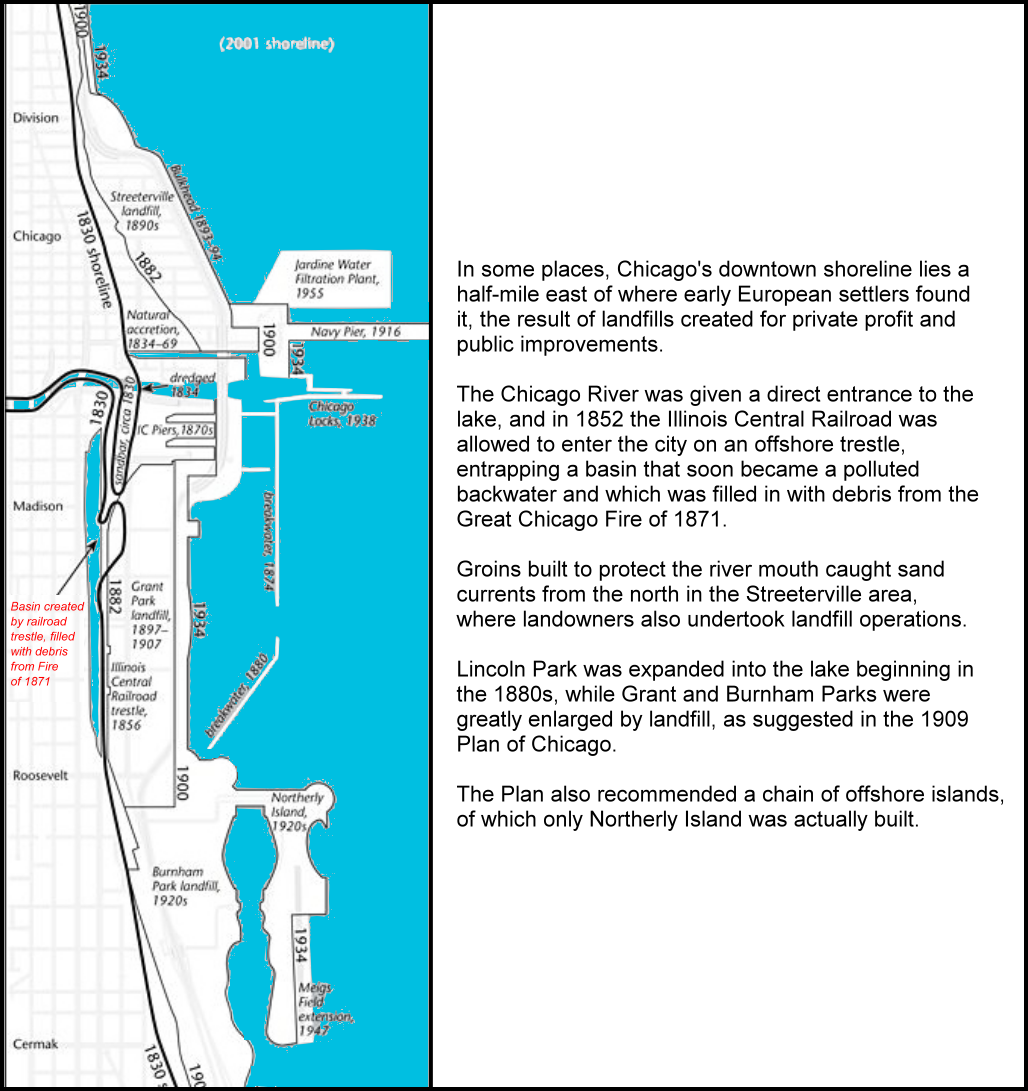
The Chicago lakefront in the late 1850s was seen from the Illinois Central Station near Randolph Street. Note the railroad trestle between Lake Michigan and the basin, lined with railcars on its west side.
Lake Park (today's Grant Park) "Rowhouses along Michigan Boulevard overlooking river and factories, looking north from Harrison Street, 1865."
After the Great Chicago Fire of 1871, much of the debris from the city's ruins was dumped along the lakefront at the Illinois Central railroad tracks, creating a new landfill. By 1890, the prime real estate was still a muddy mess, but "progress," in the name of new buildings, was being proposed by civic boosters for this site.
CLICK THE IMAGE FOR A FULL-SIZE VIEW.
Mayor Cregier and the City Council wanted to build a civic center on the landfill, a new city hall, a post office, a police station, a power plant, and stables for city garbage wagons and horses.

Montgomery Ward, who had just built his company's stately headquarters building on the northwest side of Michigan and Madison Avenue, gazed out from his office at this expanse and saw the potential for a great city park, which had been ordained by the canal commissioners in 1836. He spent the next 20 years and a small fortune fighting to preserve this land from commercial development.

The Fight for the Lakefront
Over the next 20 years, Ward took the city to court to prevent the construction of any buildings east of Michigan Avenue. His efforts to stop this unbridled development incurred the enmity of many civic leaders, businessmen, politicians, and the Chicago Tribune, which saw his steadfast stance as an impediment to Chicago's growth. He was called "stubborn . . .  undemocratic . . . a persistent enemy of real parks . . . [and] a human icicle, shinning and shunned in all but business relations."

Undaunted, Ward filed suit four times in the Illinois State Supreme Court. Ward won all four cases, preserving the open lakefront from Randolph Street south to 12th Street. Compromises, such as the Art Institute, were eventually constructed, but without question, his efforts saved Lake Park from private development and sprawl. 

Ward always felt he was doing the city a favor with his steadfast struggle and never understood why he was not appreciated for his vision and efforts. In 1909, he granted an interview to the Chicago Tribune, the only interview he ever gave in his life:

"Had I known in 1890 how long it would take me to preserve a park for the people against their will, I doubt I would have undertaken it. I think there is not another man in Chicago who would have spent the money I have spent in this fight with certainty that gratitude would be denied as interest . . . I fought for the poor people of Chicago . . . not the millionaires . . . Here is park frontage on the lake, comparing favorably with the Bay of Naples, which city officials would crowd with buildings, transforming the breathing spot for the poor into a showground of the educated rich. I do not think it is right."

I may yet see the public appreciate my efforts. But I doubt it.

The toll of the fight and an accident (which broke his arm and shoulder blade) significantly weakened Montgomery Ward's health. Shortly after a fall resulting in a broken hip, he developed pneumonia and died on December 7, 1913, at 69.

Ironically, just as the great man died, the city awakened to his magnificent contribution. A letter to the Chicago Tribune by J.J. Wallace put it best:
Who shall set a value on his service? The present generation, I believe, hardly appreciates what has been given them, but those who come later, as they avail themselves of the breathing spot, will realize it.
The Montgomery Ward Gardens
For nearly a century, no park was named to honor this great civic leader. Through the efforts of Friends of the Parks on October 14, 1993, that section of Grant Park along Michigan Avenue between Randolph and Monroe Streets was officially named the Montgomery Ward Company, a bust and historical plaque were placed at the site, stating:
Aaron Montgomery Ward had a vision for Chicago’s lakefront that set him apart from many of his contemporaries. For two decades (1890-1910) he fought tirelessly to preserve Chicago’s shoreline for recreational use and to assure that the city’s “front yard” would remain free of industry. Lake Park is his legacy to the city he loved . . . his gift to the future.
In 1999, the Ward Gardens and plaque were removed to make way for the construction of Millennium Park. In 2005, thanks to a grant from the Montgomery Ward Foundation, a new Montgomery Ward Gardens stood at the corner of Michigan Avenue and 11th Street , a glorious part of his beloved lakefront park.

Today, these Gardens are a living tribute to Montgomery Ward: a man of vision and conviction, a selfless and tireless advocate for the people and parks of Chicago.

The Obama Presidential Centers' Ability to Thwart Wards Plan.
The Chicago City Council unanimously approved the new proposals for the Obama Presidential Center on October 31, 2018. The center was met with some opposition from residents, City and State Republicans [1], who believed that it would damage Jackson Park and negate Montgomery Wards "forever open, clear and free." 

The benefits to the deteriorating community won out. The Obama Presidential Center cost was estimated at $700 million to build and would revitalize the community. Construction on the Obama Presidential Center was completed in August 2021. The center is expected to open in 2025.

Compiled by Dr. Neil Gale, Ph.D.


FACTUAL DATA
[1] Illinois State Congress Republicans had many complaints about the building of the Obama Presidential Center. Some of their complaints, racially and partisan motivated, included:

Project costs were estimated to be $700 million [a]. Republicans argued that this was too much money to spend on a presidential library, especially considering that the Obamas had already received a $10 million book deal and were likely to earn millions more from speaking engagements and other ventures.

The project's location was on the South Side of Chicago. Republicans argued that this was not a good location for a presidential library, as it was not easily accessible to tourists and would not generate much economic activity. They said of project's design was too modern and would not fit in with the surrounding neighborhood.

The fact that the project was not open to public bidding, which Republicans said, gave the Obama Foundation an unfair advantage.

In addition to these specific complaints, Republicans argued that building a presidential library for a Democrat, particularly one they believed was not a natural-born American. They felt "No Drama Obama" had been a divisive figure in American politics and would not be a neutral and objective representation of his presidency. 

Republicans also argued that the center would be a waste of taxpayer money and that it would not be worth the cost, and that the Obama Presidential Center would be a partisan monument that would only serve to further divide the country.

[a] The 2023 cost estimate for the Obama Presidential Center in Chicago is $830 million. This includes the cost of construction, exhibits, and operating costs for the first year.

Here is a breakdown of the costs: 
Construction: $700 million
Exhibits: $90 million
Operating costs: $40 million

The Obama Foundation has raised about $700 million of the $830 million needed to fund the center. The remaining $130 million is expected to be raised through donations and fundraising.

Saturday, May 4, 2019

The 150 year mystery of the exterior color of President Lincoln's funeral train car... Solved!

After being shot on April 14 at Ford’s Theatre by the actor and rabid Southern sympathizer John Wilkes Booth, he was transported to a boarding house across the street from the theater, where he died early the next morning. His body lay in state at the White House and the rotunda of the Capitol building before being loaded into the railroad car, which had been modified to transport Lincoln’s coffin and the coffin of his young son Willie, who had died of typhoid fever in 1862. Willie had been buried in Georgetown’s Oak Hill Cemetery, but after his father’s assassination his coffin was removed and placed aboard the funeral train. The exterior sides bore a large painted crest of the United States. 
Lincoln's Funeral Train - 150 Year Memorial on May 02, 2015 - Car Medallion.
Lincoln's Funeral Train - 150 Year Memorial on May 02, 2015 - Train Wheel Trucks.
The special car, built to transport a living Lincoln and his cabinet, was one of the most elaborately appointed railroad vehicles ever made. The U.S. Military Railroads built the car and delivered it to the president in early 1865. It had upholstered walls, etched-glass windows, 16 wheels (adaptable to both standard and five-foot-gauge tracks) to ensure a smooth ride, and rooms for working and relaxation.
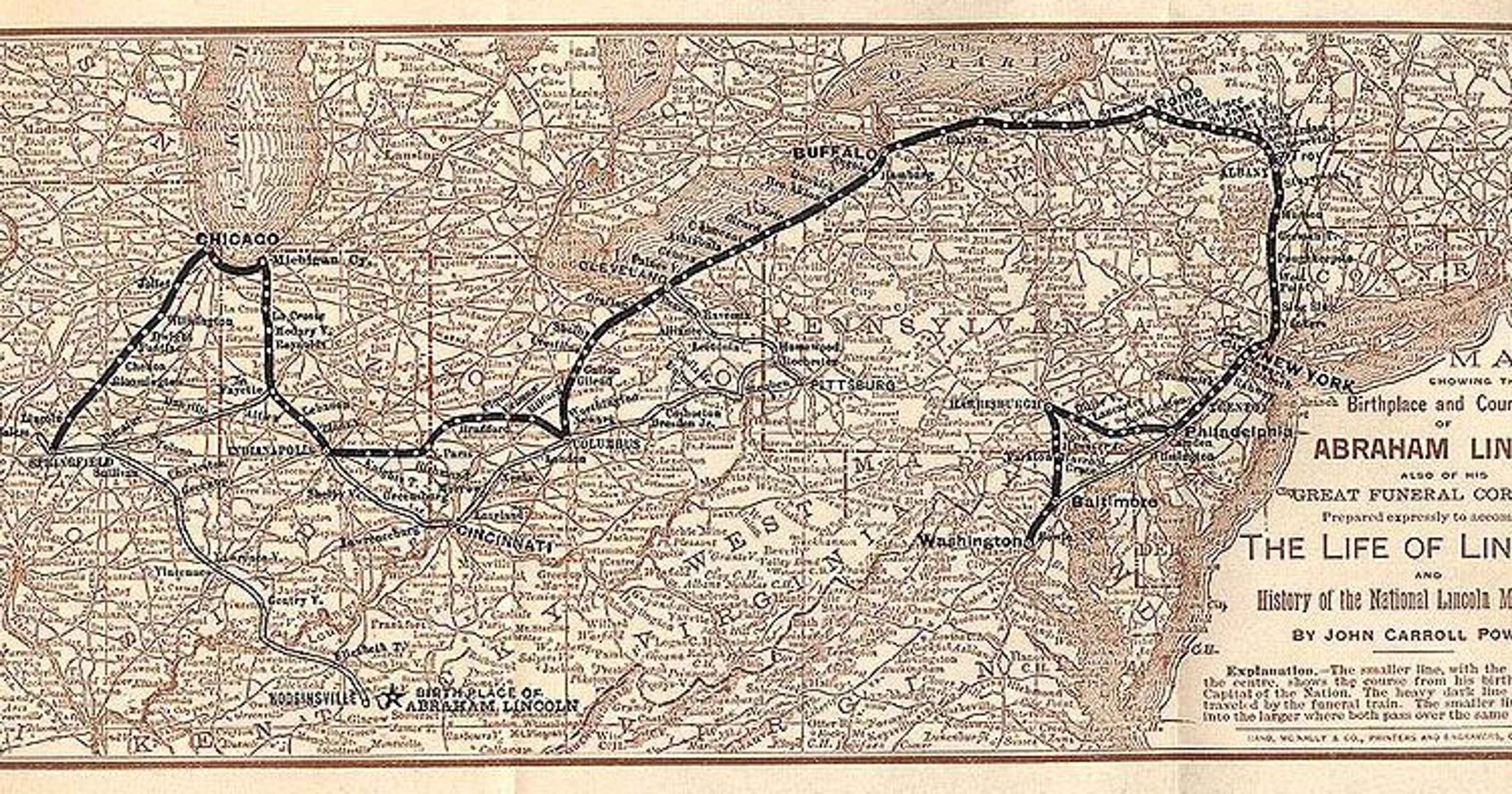
Some of the major stops on route from Washington D.C. to Springfield, Illinois.
[CLICK MAP FOR FULL SIZE]
Interestingly, Lincoln’s funeral car was originally intended to be the official presidential railroad car—the equivalent of Air Force One today. The U.S. Military Railroads built the car and delivered it to the president in early 1865. Tragically, Lincoln never rode in it until his death.
President Abraham Lincoln's funeral car in Alexandria, Virginia.
President Lincoln's funeral train in Philadelphia, Pennsylvania.
By military order, Lincoln’s funeral procession consisted of no fewer than nine cars, including the funeral car, officers’ car, six passenger cars and one baggage car. The procession left Washington on April 21, 1865, and proceeded across the Northern states, stopping for formal funeral ceremonies in 12 major cities. Smaller communities organized numerous other memorial services along the train’s route. According to a contemporary newspaper report, during the 12-day journey, there were no accidents—an unusual distinction for such a long journey in a time when trains lacked many of today’s safety features.
President Abraham Lincoln's funeral car in Chicago, Illinois, which arrived in Chicago on May 3, 1865, then continued on to Illinois' state capitol.
After being passed between the military and a couple railroad companies, Twin City Rapid Transit Company President Thomas Lowry bought it in 1905. Lowry's intention was to fully rehabilitate the car and find a place to display it so that people could finally visit this car and see it in all of its former splendor. Lowry died before he could restore the car and it was passed to the Minnesota Federation of Women's Clubs which kept it in Columbia Heights near the intersection of 37th Ave NE and Jackson St.

In 1911, the Federation planned to move it for exhibit. Months before the move, a grass fire erupted on March 18, 1911 and engulfed the car.
Lincoln's Funeral Car after the 1911 Fire.
Though many details are known about the car, its color was believed to be lost to history. As no color photographs, lithographs or contemporary paintings of the car exist.

Some accounts (written long after the Civil War) described it as “chocolate brown,” others as closer to a claret, or red-wine color. As Wesolowski points out, chocolate bars didn’t exist at the time of the procession, so chocolate brown at the time would have referred more to Dutch chocolate, which was more reddish brown in color than the chocolate we think of today. It was said that historians were able to salvage only a metal coupling from the ashes, but a man from Minnesota was located who had inherited part of the original railcar’s window frame, perhaps one of the only pieces that survived the 1911 fire. 
Researchers analyzed a small piece of the window trim under high-powered microscopes, then scraped away microscopic flecks of paint and compared them with pigment records and national color standards of the time. Through this painstaking process, they managed to identify the color as a brownish-red; describes as “dark maroon.”

Compiled by Neil Gale, Ph.D.

Friday, May 3, 2019

The “Peoria War” of 1813 was a big part of the elimination of Indians in Illinois.

A nearly forgotten series of small skirmishes that became known as the “Peoria War” made up a big part of the elimination of Indians in Illinois. The tribe of the Peoria was not involved in this conflict.

In October 1812, Illinois’ territorial Gov. Ninian Edwards launched attacks against Kickapoo and Potawatomi villages in and around the wide area of the Illinois River dubbed Lake Pimiteoui. Some said the assaults — with companies of soldiers and irregulars (militia) destroying the homes and killing dozens of inhabitants — were in retaliation for the Potawatomi victory at Chicago's Fort Dearborn (An in-depth account of the Fort Dearborn Massacre).

Returning to the Peoria area, Black Partridge changed his conciliatory relations with the U.S. military. In his absence, the Americans’ attacks resulted in the destruction of the Potawatomi leader’s home and the deaths of his daughter and grandchild. That caused Black Partridge to renounce his allegiance and take up arms with other resisting Indian forces.

It’s impossible to say what would have happened had the assault on Peoria-area villages not occurred, of course. However, if Black Partridge and other Indian forces had had more resources from the British, with whom they’d been allied since the United States declared war against Great Britain on June 18, 1812, settlers’ westward expansion might have been stopped at the Illinois-Indiana border.

Instead, treachery in treaties and policies, clumsy betrayals, and shifting alliances linked the Peoria War to Tecumseh’s War and the War of 1812 and led to the eradication of Indian villages and their ultimate displacement.

Ties to the Tecumseh War and the War of 1812 started in 1811 and extended to the Treaty of Ghent, where American and British diplomats on Christmas Eve 1814 settled disputes — and abandoned Indians to the changing whims of settlers, troops, and governments.

Tecumseh’s War was a war of resistance against “the children of the Evil Spirit” after the Shawnee chief assembled a coalition of different tribes following the Treaty of Fort Wayne. That pact was supposedly decided on September 29, 1809, when Indian leaders agreed to relinquish 3 million acres in Indiana and Illinois, and although Black Partridge signed, many Indian leaders refused and some declared it a fraud, sparking the Tecumseh War. That armed conflict continued until Tecumseh’s death at the Battle of the Thames in southern Canada on October 5, 1813.

Meanwhile, the War of 1812 had four causes, historians agree upon Britain seizing Americans to forcibly serve on British ships, British trade restrictions, occasional British support for Indians, and a desire by some U.S. leaders to seize Canada from British control.

The Indian population in Illinois had increased after 1811 when Tecumseh’s forces were defeated at a battle at Tippecanoe in Indiana, but there were few U.S. troops or garrisons.

Still, a month after Black Partridge’s home and family were wiped out, another punitive attack came from troops coming to the Peoria area from Fort Knox in Kentucky. Despite the Indian villages having many “neutral” Potawatomi and Kickapoo warriors setting wild grass ablaze to stop the soldiers, troops destroyed villages and killed inhabitants who’d fled into a swamp. Even indecisive Indian villages then rallied against the troops and settlers to fight with the British and Tecumseh’s ragtag confederacy of tribes.
Fort Clark Illustration
About a year later, Tecumseh was killed at the Battle of the Thames east of Detroit in southern Ontario, and a few weeks later, fewer than 200 Potawatomi and Kickapoo warriors led by Black Partridge were beaten back by more than 1,000 soldiers who’d arrived from St. Louis to bolster forces at the newly built Fort Clark (constructed in 1813) on the riverfront near where Liberty Street is now, named for Revolutionary War hero George Rogers Clark. That winter, Black Partridge met in St. Louis with Missouri’s Territorial Gov. William Clark (of the Lewis and Clark Expedition and brother of George Rogers Clark), ending the Peoria War.

Black Partridge died in 1815, but he was one of several area Indian leaders, men who answered to the names Gomo, Senachwine, Shabbona, Main Poc of the Kankakee, and Black Hawk of the Sauk ("Life of Black Hawk" as dictated by himself). Some had supported the French against Great Britain and colonists in the French and Indian War; some backed colonists in the American Revolution.

Elsewhere, remaining Indian fighters including Kickapoo, Sauk, and Fox defeated troops in two related actions in the area where the Quad Cities are today: the Battle of Rock Island (July 1814) and the Battle of Credit Island (September 1814). But such victories were few.

Edwards, who served from 1809-1818, went on to again order attacks against Indians during the Winnebago War in southern Wisconsin in the 1820s when the U.S. government started setting aside “reservation” land farther west. Also, 5 million acres of land in western Illinois in May 1812 was offered to people who were serving in the War of 1812 — about one-eighth of the current state’s area, and where many Indians still lived. So new settlers and land speculators stepped up efforts to push Indians from the Midwest to Oklahoma, where the Potawatomi Nation survives.

Later, the Black Hawk War, lasting four months in 1832, was the Indians’ last, unsuccessful attempt to preserve their homes in Illinois and Wisconsin.

Pokagon of the Potawatomi in the late 1800s said, “Often in the stillness of the night, when all nature seems asleep about me, there comes a gentle rapping at the door of my heart. I open it; a voice inquires, ‘Pokagon, what of your people? What will their future be?’ My answer is: ‘Mortal man has not the power to draw aside the veil of unborn time. That gift belongs to the Divine. But it is given to him to closely judge the future by the present and the past.’”

Compiled by Dr. Neil Gale, Ph.D. 

Tuesday, April 30, 2019

The Biography of Potawatomi Chief Senachwine (Difficult Current). 1744-1831

In April 1812, Chief Senachwine and other Potawatomi chieftains met with Governor Ninian Edwards at Cahokia to discuss relations between the Potawatomi and the United States. Although opposed to offensive war, Senachwine sided with Black Partridge during the Peoria War and commanded a sizable force during the conflict. Senachwine later accompanied the Potawatomi peace delegation, who were escorted by Colonel George Davenport to sign the 1816 Treaty of St. Louis.

Around 1814, a mysterious Baptist preacher and missionary known by Wigby lived in his village. Wigby was allowed to baptize him and later converted Senachwine to Christianity. However, despite Wigby's attempts to dissuade him, Senachwine refused to give up polygamy and retained his several wives. After Wigby's death, he was buried on a high bluff overlooking Senachwine's village.

Senachwine succeeded his brother Gomo as head chieftain of the Illinois River band and was a signatory of several treaties between the Potawatomi and the United States during the 1810s and 1820s. He and Black Partridge would remain the leading chieftains of the Potawatomi for over a decade before their positions of authority and influence were assumed by Shabbona. A year before his death, Senachwine believed that the Potawatomi nation, and eventually all Indians, would eventually become extinct. His son, Kaltoo (or Young Senachwine), succeeded him as chieftain after his death in the summer of 1831.
Monument to Potawatomi Chief Senachwine near Putnam (an unincorporated village) in Putnam County, Illinois.
He was buried on a high bluff overlooking the village, like the missionary Wigby years before, and a wooden monument was placed on his grave. A black flag was also flown from a high pole next to the monument and could be seen from the gravesite for several years afterward. Two years later, his band was removed to the Indian Territory and eventually settled in western Kansas.
In the summer of 1835, twenty-three Potawatomi warriors traveled over 500 miles to visit the gravesite of Senachwine. Their faces blackened, and their heads wrapped in blankets, they performed a ritual invoking the Great Spirit to protect the gravesite and remains of the chieftain. According to a local resident observing the ceremony, the warriors spent several hours knelt around the gravesite as "their wails and lamentations were heard far away." The following morning they performed the "dance of the dead," which continued for several days before departing.

A short time after, Senachwine's grave was robbed of its valuables, including his tomahawk, rifle, several medals, and other personal effects. The chieftain's bones had also been scattered around the site. Members of his band returned to the site to rebury his remains and again placed a wooden monument over his grave. James R. Taliaferro, who had been present at the reburial, later built a cabin near the gravesite and claimed that "Indians from the west at different times made a pilgrimage to the grave."
Gary Wiskigeamatyuk (from left), his son Senachwine, his wife Rosewita, and daughter Kayla visit Chief Senachwine's grave overlooking Senachwine Valley near Putnam. Wiskigeamatyuk is the fifth great-grandson of the legendary Potawatomi chief.
The Sons of the American Revolution chapter in Peoria, Illinois, placed a bronze memorial plaque engraved with his speech to Black Hawk pleading for peace before the Black Hawk War at the supposed burial spot of Senachwine north of present-day Putnam County, Illinois, on June 13, 1937. During the ceremony, an address was given by author P.G. Rennick. Five tribal members of the Potawatomi from Kansas were also in attendance during the ceremony.
Senachwine Indian Mounds. Burial stone monument circled in yellow.
The Putnam village is located west of Senachwine Lake along Route 29, north of Henry, Illinois. The village of some 100 people was originally called Senachwine.
Putnam is the only village in Putnam County on the west side of the Illinois River.
Compiled by Dr. Neil Gale, Ph.D. 

Saturday, April 27, 2019

The History of Baer's Treasure Chest, Downtown Chicago's Arcade and Magic Shop.

In November of 1949, Bobby Baer opened his magic store, "Baer's Treasure Chest," at 19 West Randolph Street, across the street from the Oriental Theater in downtown Chicago.
A two-story-high, chase-lighted marquee out front heralded the arrival of Baer's "Treasure Chest" and home of "Chicago's Magic Center." The Treasure Chest front entrance circa 1950.
Inside were rows of skee-ball games, a shooting gallery, many flashing pinball games and coin-consuming mechanical arcade machines. 

In the 1960s & '70s, the Treasure Chest was a hang-out for Navy Cadets on a pass from Fort Sheridan, just north of Highland Park, about an hour's train ride away.
The Illinois General Assembly made "mechanical gambling devices" illegal in 1895. It wasn't until 1942 that the Illinois Supreme Court ruled that pinball machines that awarded free replays would fall under this same category. Because of a bit of political gamesmanship known only to Bobby Baer and certain city councilmen, the new amusement palace was the only arcade licensed within Chicago's Loop, thus allowing pinball machinesThe Illinois pinball machine ban was finally overturned in Chicago in early 1977.
Magician Marshall Brodien demonstrating at the Treasure Chest's Magic Center, the upstairs shop that catered to the pros.
Brodien began making semi-regular guest appearances on Bozo's Circus, in which he frequently interacted with the clowns, he began appearing as a wizard character in an Arabian Nights-inspired costume in 1968, and by the early 1970s he evolved into "Wizzo the Wizard."
Marshall Brodien played Wizzo the Wizard on 'The Bozo Show.'
Brodien's TV Magic Cards were first released in November of 1969. TV Magic Show was released in 1972.
The Marshall Brodien Magic Shop in Old Chicago Shopping Mall and Amusement Park in Bolingbrook, Illinois.
Brodien was diagnosed with Alzheimer's disease in 2007. Brodien died on March 8, 2019, in Geneva, Illinois, at 84.

When you entered the front door and walked past the counter on the right side, there were stairs leading to an upstairs shop on the right. The entrance had a velvet rope across it and a small sign saying "Abbott's Pro Shop." The rope barrier was to keep out the idly curious. You needed permission from an employee to go upstairs. 

Although the upstairs Pro Shop had professional, high-quality, and expensive magic, the downstairs area had a magic area that sold some professional tricks. 

Further down on the right side were the gag gifts; fake vomit, doggie poop, itching powder, plastic ice cube with a fly inside (my favorite prank), Pepper or Garlic Gum, hand buzzer shockers, and tons more cheap but fun gags.

On the left side, as you entered, were counters and shelving full of jewelry, watches, transistor radios, tape recorders, switchblade combs, and other kinds of "general merchandise." You could get your headline printed on the front page of a faux newspaper, i.e., "Dr. Smith Survives a Flood, Asteroid Strike, and Airplane Crash."
1974 Midway Chopper helicopter coin-operated flying arcade game. It was touchy business making a toy helicopter to fly in slow circles and brush electric contacts with spring feelers before the timer ran out. My personal favorite mechanical game.
Skee-Ball Machines... Win tickets and turn them in at the counter for a cheesy toy.
Examples of the type of pinball games. Not a Treasure Chest photo.
In the back half of the store were all the amusement games, taking up every inch of available floor space: Pinball, mechanical games, and a row of skee-ball machines. Later, they added coin-operated video games but kept some of the money-making vintage games. Lunchtime, 11 AM-1 PM, was also hectic with 'suits' playing games.
In the 1960s, they were open 7 days a week until midnight. A 1960s Tribune Ad shows a second location at 9252 Milwaukee Avenue in Niles.

By 1980, the hours were changed to 9 AM-10 PM Monday through Thursday, 9 AM-midnight on Friday & Saturday, and 12 PM-10 PM on Sunday.
In the 1970s, some people thought the name of the Treasure Chest was "Fun City" because the sign over the door read: "Entrance to FUN CITY." Note that the length of the front windows was at some point elongated from about 5' to the door in the 1950s photo above to approximately 15' to get in the door. All the merchandise in the windows drew you in like a magnet.
Baer's Treasure Chest closed sometime in 1985 after a fire in the 17-19 W. Randolph building.

Compiled by Dr. Neil Gale, Ph.D.

Friday, April 26, 2019

Illinois' Negro World War I Regiment; The Forgotten Story.


In historical writing and analysis, PRESENTISM introduces present-day ideas and perspectives into depictions or interpretations of the past. Presentism is a form of cultural bias that creates a distorted understanding of the subject matter. Reading modern notions of morality into the past is committing the error of presentism. Historical accounts are written by people and can be slanted, so I try my hardest to present fact-based and well-researched articles.

Facts don't require one's approval or acceptance.

I present [PG-13] articles without regard to race, color, political party, or religious beliefs, including Atheism, national origin, citizenship status, gender, LGBTQ+ status, disability, military status, or educational level. What I present are facts — NOT Alternative Facts — about the subject. You won't find articles or readers' comments that spread rumors, lies, hateful statements, and people instigating arguments or fights.

FOR HISTORICAL CLARITY
When I write about the INDIGENOUS PEOPLE, I follow this historical terminology:
  • The use of old commonly used terms, disrespectful today, i.e., REDMAN or REDMEN, SAVAGES, and HALF-BREED are explained in this article.
Writing about AFRICAN-AMERICAN history, I follow these race terms:
  • "NEGRO" was the term used until the mid-1960s.
  • "BLACK" started being used in the mid-1960s.
  • "AFRICAN-AMERICAN" [Afro-American] began usage in the late 1980s.

— PLEASE PRACTICE HISTORICISM 
THE INTERPRETATION OF THE PAST IN ITS OWN CONTEXT.


It’s a history that has been largely forgotten, even though some monumental physical traces remain. The 8th Illinois National Guard Regiment, which during the great war (WWI 1914-1918) came to be known as the 370th U.S. Infantry, was the only regiment in the entire United States Army that was called into service with almost a complete complement of Negro officers from the highest rank of Colonel to the lowest rank of Corporal. Yet few people know about this unit of young Negro men from Illinois who fought for a country that beat, lynched, and discriminated against them and people who looked like them.
The regiment reported at the various Illinois rendezvous on July 25, 1917, as follows:
  1. At Chicago, Illinois-Headquarters, Headquarters Company, Machine Gun Company, Supply Company, Detachment Medical Department, and Companies A, B, C, D, E, F, G, and H.
  2. At Springfield, Illinois---Company I.
  3. At Peoria, Illinois---Company K.
  4. At Danville, Illinois---Company L.
  5. At Metropolis, Illinois---Company M.
The United States Army so disrespected the men of the 370th and other Negro regiments such as the 369th New York National Guard Regiment, which was popularly known as “The Harlem Hellfighters,” that it would not allow them into combat alongside their white American comrades. Instead, the Negro regiments joined French forces, using French weapons and rations. The only equipment that distinguished them as part of the American force was their uniform.
“The American army didn’t want to have anything to do with them,” says Mario Tharpe, the director, writer, and producer of Fighting on Both Fronts: The Story of the 370th. Many Negro soldiers never saw combat, instead of being assigned positions as laborers. “Anthony Powell, a historian from San Jose, puts it well,” says Tharpe. “He says that for the Negro soldiers that came from down South, to join the army was leaving one hell to go to another form of hell, but one in which they wouldn’t be beaten or lynched.”
The French Croix de Guerre Medal
In the face of such discrimination, both at home and at war, some of the soldiers in the 370th and other regiments that did fight in combat decided to stay in the more tolerant France after the war ended. During the war, Tharpe says, “The 369th and 370th brought jazz to Europe – they were known for having amazing jazz bands.” Some of the soldiers that made their home in France continued to share that American art form with Europeans, working as jazz musicians in the postwar period. France was not only more accepting but also more thankful than America: it awarded 71 Croix de Guerre medals to Negro soldiers before the United States offered any recognition of the honor.

Negro soldiers that returned to America found a country just as racist as before. In fact, the situation was in many ways worse. Many soldiers in the 370th were from the cultural hotbed Bronzeville neighborhood in the Douglas community of Chicago, which had swelled in population from the Great Migration. More people meant less economic opportunities for the returning soldiers, and also helped bring simmering racial tension in the city to a boil.

Soon after the 370th came home, the 1919 Chicago Race Riots broke out, resulting in the deaths of 38 people and the injury of hundreds more. Having fought to defend their country in Europe, Chicago Negro soldiers now fought to defend their community from hatred in their country. “These soldiers went off to war, where they knew they wouldn’t be respected, and represented Bronzeville,” Tharpe says. “They fought for rights and democracy by going to war, and then didn’t get justice or their due when they came home.”
Tharpe says that they therefore became the first wave of the Civil Rights movement, albeit a forgotten one. They advocated for recognition of their service in the war and eventually achieved it with the construction of the Victory Monument at 35th Street and King Drive. 

sidebar
The 370th also fought in World War II (1939-1945).

But even that symbol has lost much of its significance. “Even though I lived in Bronzeville and drove past the Victory Monument nearly every day, I was absolutely not familiar with the 370th,” Tharpe says.
Victory Monument at 35th Street and Martin Luther King Jr. Drive, Chicago.
He did know that the nearby Eighth Regiment Armory, at 3533 S. Giles Avenue, had housed a Negro regiment, but that was about it. Before the war, the 370th had been the 8th Infantry Regiment of the Illinois National Guard, and the Armory was built for them in 1914. It now houses the Chicago Military Academy, a high school, and is listed both as a Chicago Landmark and on the National Register of Historic Places. 

sidebar
The General  Richard L. Jones Armory at 52nd Street and Cottage Grove Avenue is named for an officer of the 370th, General Jones, who managed both the Chicago Defender and the Chicago Bee Newspapers, and later was appointed U.S. Ambassador to Liberia.
The General Richard L. Jones Armory at 52nd Street and Cottage Grove Avenue, Chicago
The Victory Monument and the Armory are the main physical remnants of the 370th. Few oral histories or photos survive. “People didn’t hold on to the memories of it because they didn’t realize the value,” says Tharpe. “Many people knew only that their father fought in the war, and that was it.” But the 370th’s significance and legacy live on.
VIDEO
Compiled by Dr. Neil Gale, Ph.D. 

National Trailways Bus Depot, 20 East Randolph Street, Chicago, Illinois.

Downtown National Trailways Bus Depot, 20 East Randolph Street, Chicago. ca.1950s
From 1936 until 1987, the various Trailways companies used this downtown terminal, across the street from the Marshall Field store. Trailways never had the major presence in Chicago that Greyhound did, and its terminal was accessed via regular downtown streets.

Compiled by Dr. Neil Gale, Ph.D. 

Thursday, April 25, 2019

Market Days in Niles Centre (Skokie), Illinois. (1880-1920)

The small settlement of Niles Centre (Incorporated 1888), Americanized to Niles Center 1910 and renamed Skokie 1940, comprised just 57 households in 1880, although the township had a population of just over 2,500. It was, however, fast becoming a vital area marketplace around that time, the keystone of which was the area's first farmer's market.
Market Days in Niles Centre (Skokie). circa 1880s. West side of Lincoln Avenue north of Oakton Street; Blameuser Building on the far left.
For four decades beginning in 1880, the first Tuesday and third Thursday of each month were established as market days, and merchants from as far away as Chicago, as well as McHenry and Kane counties, came to meet with area farmers and purchase their produce. Pigs, poultry, horses and a variety of vegetables were offered for sale in large numbers on market days.

The idea for the market seems to have originated with Peter Blameuser, Jr., who had billboards printed advertising the earliest events. A description of the colorful Market Days:
“The market reached from the intersection of Lincoln and Oakton [north] to the fork at St. Peter’s Catholic Church. A major attraction for the children of the community, market day also attracted beggars, gypsy fortune tellers and thieves, who proved to be a challenge for the local law enforcers. Horse trading was a vigorous activity. A dispute regarding the merits of a pair of horses would most likely be settled by a horse race through town. The usual stakes were a round of drinks paid for by the loser. Wives often accompanied their husbands into town on market days to make sure the ‘pig money got home safely. After selling their stock, the farmers often decided to have a little fun in town before returning home. They had little trouble getting home; their horses knew the way!”
The soft farmlands of the area were ideal for Chicago workhorses made lame by the Chicago Street Paver Bricks. In the country fields, they would remain functional for years. They were a part of village life in the late 1800s, not only in labor and commerce but also in recreation. In addition to the races, the horses were sometimes pitted against one another in pulling contests, in which pairs of horses were harnessed to wagons loaded with gravel, their rear wheels locked by a board placed between the spokes.

Gypsies usually arrived at the edge of the settlement in caravans of wagons, where they camped for an evening or two. The outdoor market brought hundreds of other strangers to the area, too, including many merchants from Chicago, establishing Niles Centre as a true center of commerce.

Skokie runs a "Farmers Market," beginning around 1990, every Sunday, from June through October. The market is in the Skokie Public Library's parking lot on Oakton, just west of Lincoln Avenue.
Compiled by Dr. Neil Gale, Ph.D.