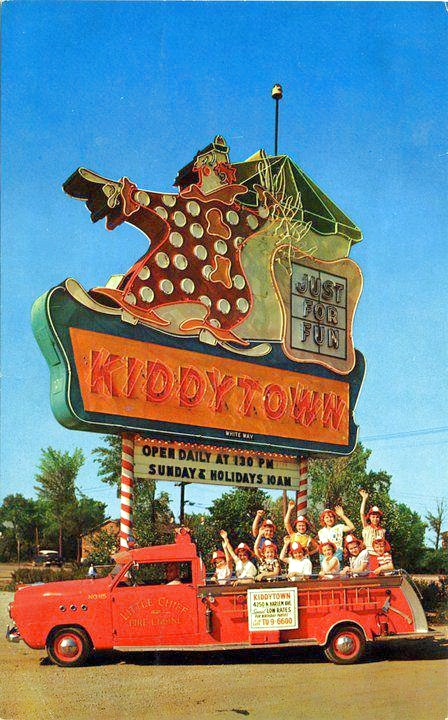
KiddyTown opened in the summer of 1953 and was located on the north side of the future Harlem Irving Shopping Center (opened in 1955) in Norridge, Illinois.
An aerial view of KiddyTown looking north. Harlem Avenue is on the right, with part of the Harlem Irving Plaza (The HIP) at the bottom. Long gone Howard Johnson's is shown at the bottom right. At the top right is the 35-foot electric Kiddy Town sign at the intersection of Cullom and Harlem Avenues. The sign had a clown pointing towards the 450 parking space area with his other arm-waving patrons in by way of flashing neon lights. This photo was taken in the off-season sometime in the late 1950s.
Some of the rides were the Tilt-a-Whirl, an AllanHerschell Co. Merry-Go-Round, Philadelphia Toboggan Co. Little Dipper (purchased for $6,000 and installed in 1956), Mangels Co. Whip, Boats, and Sky Fighter, Herschell Kiddie Tanks, Eyerly Co. Midge-O-Racer, Handcars, Gasoline-powered Cars, a Tractor ride, a 5 car Ferris Wheel, and a Miniature Train with twin diesel engines. Pony rides were also available at the 5-acre park.
The kiddie train had a 150-foot curved tunnel, bridge, and elaborate depot for the 2,000-foot miniature railroad. The Ferris Wheel was "kiddie-sized," with the riders locked into cages for the duration of the ride. The Handcars were self-propelled cars on little train tracks; a rider would sit on the car with their leg stretched forwards and hand-crank the car around the track.
This is an ad for Bowman Dairy Company for customers to save 4 Bowman bottle caps or carton tops, which entitles you to a 4-ride ticket for 25¢, except Sundays and holidays at the following parks; Fun Fair in Skokie; Kiddytown 95th & Stony Island, Chicago;Fairyland in Lyons; Lincoln Park Zoo in Chicago; Kiddytown, Harlem and Irving Park Road, Chicago; and Sauzer's Kiddyland in Dyer, Indiana. —Chicago Tribune May 15, 1956.
On the weekends, sometimes a small red fire engine with "KiddyTown" written on its side would sound its loud siren telling all the children in the neighborhood that some lucky kid is having a birthday party and they're all going to KiddyTown. Their first ride, of course, would be in the fire truck.
Like many other Chicagoland "Kiddie Parks," KiddyTown had a fire truck to pick up birthday party guests at their homes and deliver them to the amusement park. When the truck wasn't picking up partygoers, it was used as a ride in the park.
In early 1964, KiddyTown closed down and sold all the rides. The unofficial reason was diminishing revenues and offers to buy the property to develop a retail strip mall.
KiddyTown was replaced by the Unity Saving Bank and its parking lot. The location is a Panera, Chipotle, Forever Yogurt, Red Robin Sports Authority, X-sport Fitness, and Mattress Firm. Hillcrest (Amusement) Park in Lemont, Illinois, purchased the "Little Dipper" wooden roller coaster for $6,000.00, but it cost them $66,000.00 to move it. It reopened in 1967 in Hillcrest Park, where it thrilled youngsters until that park closed in 2003. The "Little Dipper" was bought and moved to a small amusement park in Marshall, Wisconsin called Little Amerricka Amusement Park (formerly Little A-Merrick-A; owned by a family named Merrick when Hillcrest Park was closed in 2003. The Little Amerricka Amusement Park is still open. The "Little Dipper" was renamed the "Meteor" and was operational for their 2007 season.
VIDEO
Take a ride on the "Little Dipper" roller coaster, now named the "Meteor," at Little Amerricka Amusement Park in Marshall, Wisconsin.
Ride the "Meteor" in the first-person point of view.
Each year in September, the Bakers Club of Chicago organization would rent the whole park and treat as many as 500 orphaned children to a day at the park. Besides the rides and hot dogs, the children would receive specially baked cakes and cookies. Photo from September 7, 1957.
April 2021; D.B. emails me the following with photographs:
Dear Neil,
"In a barn in the Upper Michigan Peninsula in December 2019, I found the original Santa Fe train from Kiddy Town in Norridge. A lot of money, lighter and two trailers of train cars later, I brought them home to Greenville, IL, to the American Farm Heritage Museum, where the train is now undergoing restoration. I am desperately seeking photographs of the train, and I only know of the one in your history blog."
April 2021 Photograph
April 2021 Photograph
Photo by Carol Houfek.
Photo by Walter Rieger.
Photo by Carol Houfek.
The Little Dipper Roller Coaster. Photo by Walter Rieger.
This photo was taken after KiddyTown's final season from the roof of the Wieboldt's Department Store in the Harlem Irving Plaza (The HIP). The last ride to be moved was the Little Dipper roller coaster, and the Little Dipper was a mirror image of the Little Dipper at Kiddieland in Melrose Park, Illinois. Across Harlem Avenue, at the top of the picture, you can see Stark's Warehouse (open 7 days a week). Stark's had a warehouse of army surplus stuff to sell.
The last ride to be taken down and moved was the Little Dipper roller coaster in 1966. Hillcrest (Amusement) Park in Lemont, Illinois, purchased it for $6,000.00, but it cost them $66,000.00 to move it.
The Rosenberg Fountain is of the Greek goddesses of Mount Olympus "Hebe," sculpted by artist Franz Machtl.
{Hebe is the daughter of Zeus and Hera. She is a cupbearer to the gods, and myth holds that Apollo dismissed her after she indecently exposed her breasts while serving drinks.
Zeus is the sky and thunder god in ancient Greek mythology and religion who ruled as King of the Gods of Mount Olympus. Hera is the goddess of women and marriage in Greek mythology and religion. She is the daughter of the Titans Cronus and Rhea. Hera is married to her brother Zeus and is titled as the Queen of Heaven.}
While working as a newsboy in Chicago, Joseph Rosenberg (1848-1891) could never convince local merchants to spare him a drink of water. He vowed that if he were ever to become wealthy, he would create a fountain where newsboys could get a drink on a hot day. Joseph Rosenberg was the son of Jacob Rosenberg, co-founder of Michael Reese Hospital and of Chicago’s first Jewish congregation, KAM Temple. After leaving Chicago and making his fortune in San Francisco, he left a $10,000 bequest for an ornamental drinking fountain to be erected on a prominent corner somewhere on the South Side of Chicago.
The miniature Greek temple with fluted Doric columns was designed by Chicago-based architects Bauer & Hill serves as the base for the figure Hebe. It originally housed an illuminated fountain. The inscription reads, “Presented by Joseph Rosenberg San Francisco, Cal.” Rosenberg’s fountain was installed in 1893, two years after his death. The South Park Commissioners installed the fountain sculptor near Rosenberg’s childhood home close to Grant Park at the intersection of Michigan Avenue and East 11th Street.
The original conception for the sculpture was to depict Hebe in the nude. The executors of the will, however, were worried that some visitors might be offended, and they did not want to tarnish to the memory of Joseph Rosenberg. They thus decided to present the goddess in draped clothing. The female figure holds a cup in one hand and pitcher in the other - a pose consistent with many other neoclassical depictions of Hebe. In 2004, the Chicago Park District restored the fountain and the sculpture that was cast in Munich, Germany. Artist Franz Machtl’s design features an 11-foot tall bronze figure depicting Hebe, daughter of Zeus and Hera. She is the Goddess of Youth and the Cupbearer to the Gods symbolizing rejuvenation. Today, this monument functions as an ornamental fountain, but no longer provides drinking water. The "Goddess of Youth" fountain in the Lincoln Park Conservatory also depicts the goddess Hebe. Compiled by Neil Gale, Ph.D.
Science, Illinois was a community in LaSalle County, Illinois, located along the bottomlands of the Illinois River, just south of modern day Utica. The Village of North Utica is the proper name of what is more commonly referred to as Utica. The earliest reference to Science, Illinois is in 1822 when plans for the development of the I & M Canal were conceived.
The canal survey nine years later moved the canal terminus from Utica to Peru and then later to LaSalle. The relocation of the canal terminus away from Utica not only limited water and rail transportation but also the general growth of the community. In November of 1836, the Deputy County Surveyor filed a plat map for Utica at the recorder’s office in LaSalle County with Science, Illinois being included.
Simon Crosiar’s sawmill, carding machine, warehouse, store, and dock were among the first business establishments. Other business establishments in the 1830s included Thomas Brown’s store (1836); George Armstrong’s tavern (1836); four frame buildings containing two stores, a warehouse, and tavern; and Norton and Steele’s cement plant (1838). The cement plant primarily manufactured cement used in the construction of the I & M Canal. Construction of the canal was temporarily suspended in 1841, and as a result, the cement company closed.
The cement plant was reopened in 1845 under the ownership of James Clark. The James Clark Cement Company was later changed to Utica Hydraulic Cement Company. In 1848, James Clark constructed a stone warehouse to store grain. Clark’s stone warehouse also served as a post office, general store, livery, and at the turn of the century, as a motorcar wash. It is unclear when North Utica annexed Science, Illinois, but by 1950s Utica maps, Science is nowhere to be found. Compiled by Neil Gale, Ph.D.
The Nymph Fountain was installed in June of 1899, under the darkness of night, on the south lawn of the Art Institute by students of Lorado Taft, Chicago’s foremost sculptor in that time period.
Lorado Taft never built a permanent version of the Nymph Fountain because Chicagoans were "shocked" and vandalized the fountain.
The forty-foot-diameter fountain featured eight larger-than-life nude female figures in sensuous poses. The work was a class project, made of temporary materials, but Taft hoped to build it in “imperishable bronze.” Given the reception the work of art received, that would never happen. The Nymph Fountain created a stir and attracted crowds that at times required police to manage. It became the “talk of the town,” with politicians, editorialists, and religious figures weighing in. “The nymph is not an intellectual goddess... [and] stands for nothing related to high or noble intellectual accomplishments,” said the Women’s Christian Temperance Union. Such negative reactions left Chicagoans open to ridicule. The New York Times opined, “Preachers, or some of them, think the nymphs should have been provided with mackintoshes [raincoats], while even the most ultra of Chicago’s art cliques would not resent a shirtwaist as a sop to the prudish majority of the city’s population.” Not everyone in Chicago objected. Mayor Carter Harrison Jr. “trundled down to the lakefront on his bicycle... to take a look at the fountain” for himself and proclaimed it “not in any sense objectionable,” according to the Chicago Tribune. Nevertheless, the prevailing sentiment was shock. Within a few weeks, vandals had “practically ruined” the Nymph Fountain, the Boston Evening Transcript reported. “Nearly every figure in the fountain had been mutilated, and many nymphs had their hands and arms broken off.” The article did not specify whether upright or uptight citizens did the damage. No, nineteenth and twentieth century Chicago was not like Paris, despite Chicago's efforts to elevate itself out of the mud and burnish its reputation built on butchering hogs. In another instance, a fountain created in 1908 by Leonard Crunelle that featured a nude boy was initially welcomed as part of an art show in Humboldt Park organized by the Municipal Art League “to forward the beautification of the city.” The handsome sculpture was “set like a jewel” in Humboldt Park, said the Tribune. “It’s evident at a glance that the scene is improved by the statue, and that the statue is set off by the scenery without the slightest incongruity.” But after the exhibit, Crunelle’s piece was installed in an alcove on the north wall of the Sherman Park field house near 52nd and Throop streets, where it troubled the Felician Sisters who worked across the street at Saint John of God Church. They objected to the subject’s frontal nudity. The park district removed the sculpture, which has since disappeared. The alcove and basin are still there, the latter used as a planter. Similarly, in 1887 the commissioners of Lincoln Park ordered that the private parts of Storks at Play’s Merboys (Mermen are mythical male equivalents and counterparts of mermaids) be covered with fig leaves. The coverings were later removed. The original design of the 1893 Rosenberg Fountain in Grant Park portrayed the Greek goddess Hebe, topless. Hebe is a cupbearer to the gods, and myth holds that Apollo dismissed her after she indecently exposed her breasts while serving drinks. The fountain’s sculptor originally portrayed Hebe topless, but the executors of benefactor Rosenberg’s will selected a safer design out of deference to public taste. The fountain, which still stands at Michigan Avenue and 11th Street, depicts Hebe wearing a clinging diaphanous gown and exposing only one breast - a design the Tribune dubbed “Hebe the Second.” By Greg Borzo Edited by Neil Gale, Ph.D.
Dr. G. L. Williamson, who is always quick to take advantage of modern methods and the latest practical way of doing things, was the first subscriber to the White Telephone Exchange.
Homer, Illinois' First Telephone Exchange. Circa. 1900
The doctor took a phone first because he believed the telephone would be beneficial to his business. And now since he is receiving from one to five calls for professional services over the phone daily and as high as three in one night, he feels that he did not err in his judgment. What the telephone had done for the doctor, it will do for all other lines of business in Homer. The telephone is not only a great labor and time saver, but a business bringer as well. No business man should think of doing business without one. Homer Pilot, Homer, Illinois October 25, 1899