Sunday, December 11, 2016

Rush Medical College, Anatomy Dissection Lab, Chicago, Illinois. (1900)

Rush Medical College was one of the first medical colleges in the state of Illinois and was chartered in 1837, two days before the city of Chicago was chartered, and opened with 22 students on December 4, 1843. 
Its founder, Dr. Daniel Brainard, named the school in honor of Dr. Benjamin Rush, the only physician with medical school training to be a signatory of the Declaration of Independence. He later taught Meriwether Lewis the basic medical skills for his expedition with William Clark to the Pacific Northwest. Dr. Rush was also known as the "Father of American Psychiatry."

Compiled by Neil Gale, Ph.D.

Charter Oak School in Schuline, Illinois. A One-Room Octagon School.

Charter Oak School is located one mile east of the rural community of Schuline in Randolph County. The structure is one of the few remaining octagonal-shaped, one-room, school buildings in America. 

Classes were held in this building from 1873 until 1953 when it was closed due to consolidation. Charter Oak School was the third school to be built in the area. The first was a one-room log school and later a one-room frame building was constructed.
In the early 1870s a young teacher named Daniel Ling came to the Schuline community. Records show he was “educated in the East, was scholarly, could read Greek, and was a skilled architect.” Ling felt “an eight cornered building with windows on each side would offer improved lighting since light comes from all sides as nature intended, and would also offer better wind resistance to storms.” 
Blackboards painted on walls could be seen from any part of the room when lesson outlines were given. Ling convinced the local school board of directors and area residents that his architectural plan of an octagonal building was sound, and was chosen to supervise construction of the building. Construction by carpenters William Holcomb and Franklin Adams cost $1000 which was raised in a bond issue.
Up to this time, the names of Old Oak, Boyd School and District 7 were used locally to refer to the school. Residents and students were very proud of their new brick building and wanted a special name for it. A large, beautiful oak tree stood on the grounds. According to early residents, a student, Agnes Houston, suggested the name Charter Oak in honor of the famous Charter Oak of the Connecticut Colony.

School started in the new building in the fall of 1873 with Miss Avis Allen as teacher. Attendance varied throughout the years with a maximum of 46 pupils reported one year. The school also became a community center and was used for public and farm meetings, church and Sunday school, spelling bees, speaking contests, political rallies and other civic affairs.
Throughout the years, structural changes were made. Some of the changes were made for convenience and some to conform to State regulations. These included a bell, tuck-pointing, adding a vestibule, two additional windows and a door. Charter Oak was closed in 1953 when the need for the little one-room schools declined and the children were sent to larger consolidated schools.
The vacant school building deteriorated and became a target for vandalism. Later it was sold at public auction and a former teacher, Miss Nellie Ohms, purchased it for sentimental reasons. Because of its unique design and historical significance, the Randolph County Historical Society became interested in the building. Miss Ohms was contacted and was very receptive to its restoration. In 1960, it was sold to the Society for $600. Numerous fund raising events were held to pay for the building and for its restoration. The most famous of these was the Corn Fest, which has become an annual event, held on the first Saturday in August.
Major restoration was completed in 1968. Then in 1970, the site became an official Illinois State Historical Site and a historic plaque donated by that office was erected on the grounds. In 1978, the school was placed on the National Register of Historical Places. 

A board of directors supervises maintenance and upkeep of the grounds and building. The school is still being used on field trips where elementary school children spend a day experiencing what school was like in the past. 

Compiled by Neil Gale, Ph.D.

Saturday, December 10, 2016

Abraham Lincoln, the Only U.S. President to Hold a Patent.

Abraham Lincoln filed for a patent on March 10, 1849, and received Patent №. 6469 for his "Device for Buoying Vessels Over Shoals" on May 22, 1849, while a Congressman in Illinois.

Abraham Lincoln's patent is a patented invention to lift boats over shoals and obstructions in a river. It is the only United States patent ever registered to a President of the United States. Lincoln conceived the idea of inventing a mechanism that would lift a boat over shoals and obstructions when on two different occasions the boat on which he traveled got hung up on obstructions. Documentation of this patent was discovered in 1997.
This device was composed of large bellows attached to the sides of a boat that was expandable due to air chambers. His successful patent application led to his drafting and delivering two lectures on the subject of patents while he was President. Lincoln was at times a patent attorney and was familiar with the patent application process as well as patent lawsuit proceedings. Among his notable patent law experiences was litigation over the mechanical reaper.
CLICK TO READ ─► THE ACTUAL PATENT LETTER.
The invention stemmed from Lincoln's experiences ferrying travelers and carrying freight on the Great Lakes and some Midwestern rivers.
In 1860, Lincoln wrote his autobiography and recounted that while in his late teens he took a flatboat down the Ohio and Mississippi Rivers from his home in Indiana to New Orleans while employed as a hired hand. The son of the boat owner kept him company and the two went out on this new undertaking without any other helpers.

After moving to Macon County, Illinois, Lincoln made an additional trip a few years later on another flatboat that went from Beardstown, Illinois, to New Orleans. He, John D. Johnston (his stepmother's son), and John Hanks were hired as laborers by Denton Offutt to take a flatboat to New Orleans. They were to join Offutt at Springfield, Illinois. In early March 1831, the boys purchased a large canoe and traveled south on the Sangamon River. When they finally found him, they discovered Offutt had failed to secure a contract for a freight trip in Beardstown. Thus, purchasing a large canoe was an unnecessary expense. They then tried to cut their losses and worked for Offutt for twelve dollars per month cutting timber and building a boat at the Old Sangamon town (fifteen miles northwest of Springfield) on the Sangamon River. The new boat carried them to New Orleans based upon the original contract with Offutt.

As William Horman first wrote, "necessity is the mother of invention." Before Offutt's flatboat could reach the Illinois River, it got hung up on a milldam at the Old Sangamon town. As the boat was sinking, Lincoln took action, unloading some cargo to right the boat, then drilling a hole in the bow with a large auger borrowed from the local cooperage. After the water drained, he re-plugged the hole. With local help, he then portaged the empty boat over the dam and was able to complete the trip to New Orleans.

At the age of 23, Lincoln started his political career in New Salem. Near the top of his agenda was the improvement of navigation on the Sangamon River. Lincoln's law partner and biographer, William H. Herndon, also reports an additional incident at the time: a boat Lincoln was on got stranded on a shoal; the boat gradually swung clear and was dislodged after much manual exertion. This event, along with the Offutt's boat/milldam incident, prompted Lincoln to start thinking about how to lift vessels over river obstructions and shoals. He eventually came up with an idea for inflatable flotation. Patent №. 6469 was awarded to Abraham Lincoln on May 22, 1849, while still a Congressman in Illinois. Called "Buoying Vessels Over Shoals," Lincoln envisioned a system of waterproof fabric bladders that could be inflated when necessary to help ease a stuck ship over such obstacles. When crew members knew their ship was stuck, or at risk of hitting a shallow, Lincoln's invention could be activated, which would inflate the air chambers along the bottom of the watercraft to lift it above the water's surface, providing enough clearance to avoid a disaster. As part of the research process, Lincoln designed a scale model of a ship outfitted with the device. This model (built and assembled with the assistance of a Springfield, Ill., mechanic named Walter Davis) is on display at the Smithsonian Institution.

After reporting to Washington for his two-year term in Congress (beginning March 1847), Lincoln retained Zenas C. Robbins, a patent attorney. Robbins most probably had drawings done by Robert Washington Fenwick, his apprentice artist. Robbins processed the application, which became Patent №. 6469 on May 22, 1849. However, it was never produced for practical use. There are doubts as to whether it would have actually worked: It "likely would not have been practical," stated Paul Johnston, curator of maritime history at the National Museum of American History, "because you need a lot of force to get the buoyant chambers even two feet down into the water. My gut feeling is that it might have been made to work, but Lincoln's considerable talents lay elsewhere."

About that time, Lincoln took his son Robert Todd to the Old Patent Office Building model room to view the displays, sowing one of the youngster's fondest memories. Lincoln himself continued to have a special affinity for the site.
Abraham Lincoln's Patent.
CBS News Almanac.

Lincoln's invention was never manufactured and experts believed it would not have worked properly.
Abraham Lincoln had a strong attraction towards inventions and patents and as a lawyer was involved in patent-related litigation. Furthermore, he gave two famous speeches on inventions and patents.

The first speech (First Lecture on Discoveries and Inventions) was delivered on April 6, 1858, at the "Association of Young Men" in Bloomington, Illinois. The second speech, which would become the most popular one, was delivered on April 6, 1858, in Jacksonville, Illinois.  

The novel part begins by comparing the US youth at that time, which Lincoln calls “Young America” with the human beings of antiquity or “Old Fogy” represented by Adam, as the first man. According to Lincoln, the main difference between the “Young America” that had the world at its feet and the first human beings, who were at the mercy of nature, is the result of Discoveries, Inventions, and Improvements. These, in turn, are the result of observation, reflection, and experiment.”
Other Presidents have invented things too.
Thomas Jefferson was an inventor. Among Thomas Jefferson’s inventions were such devices as the macaroni machine that he invented in 1787, the swivel chair, the spherical sundial, the moldboard plow, and the cipher wheel, which was an ingenious way to allow people to code and decode messages. Jefferson’s cipher wheel was used until 1802, and then it was "reinvented" just prior to World War I and used by the US Army and other military services to send messages back and forth. Jefferson served as American minister to France in the 1780s and, as a result of his travels throughout Europe, was able to adapt some of the things he saw in Europe to benefit Americans as well.

Jefferson felt that all people should have access to new technology and, since he didn’t want others to be deprived of the benefits that new inventions bring, he never applied for a patent on any of his inventions. He considered patents to be an unfair monopoly. Several of Thomas Jefferson's inventions are still in use today; they deal mainly with agricultural and mechanical products. He also was responsible for introducing French fries into the United States.

President George Washington was also a successful inventor, and in 1772 he received a trademark for his brand of flour. 

But, Abraham Lincoln is the only President to hold a patent. 

Compiled by Neil Gale, Ph.D. 

The Italian Pharmacy in the Little Italy Neighborhood, Chicago. circa 1901

The Italian Pharmacy was located at Jefferson & Ewing Street (Ewing was renamed and renumbered in 1909), now Polk Street, which in 1901 was a part of the South Lawndale community and was in the Little Italy neighborhood.
The Italian pharmacy in the Little Italy Neighborhood, Chicago. circa 1901
The Little Italy neighborhood used to be larger, but like many other neighborhoods of Chicago was affected by the construction of new expressways. It lost a considerable chunk of land when the Eisenhower Expressway was built in the 1950s. It lost even more real estate when the University of Illinois-Chicago moved into the area in the 1960s.

The store across the street, Ronga Drugs, is listed in the "The Era Druggists' Directory, Volume 17," with an address of: 1031 W. Polk Street, Chicago. There seems to have been two Ewing Streets renamed in Chicago in 1909; one renamed to Polk Street, and the other renamed to Cabrini Street. Polk Street is ½ block north of Cabrini Street.

Reference: The Original Chicago Street Renaming Document of 1909
                   The Original Chicago Street Renumbering Document of 1909

Compiled by Neil Gale, Ph.D.

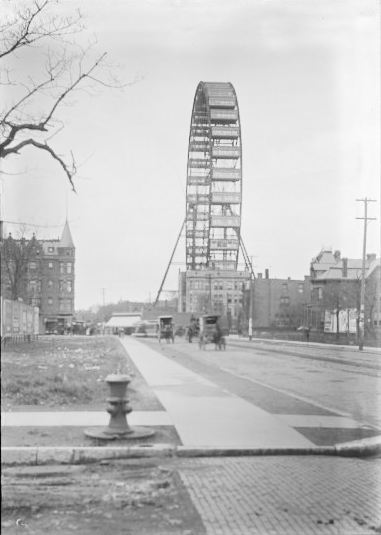
Ferris Wheel Park at the 1200 block of N. Clark St. (today, 2600 block of N. Clark St.), in Chicago, Illinois. (1896-1903)

Click the picture for a full-size image.
Though the Chicago World's Columbian Exposition closed on November 1, 1893, the Observation [Ferris] Wheel stood idle on the Midway until April 29, 1894, when a new site was found. It took 86 days and cost $14,833 (today $445,000) to dismantle it.

In 1895, the Wheel's inventor, George Washington Gale Ferris Jr., found a new site for the observation wheel on Chicago's North Side, in the Park West neighborhood of the Lincoln Park community and named it "Ferris Wheel Park." It was at Clark Street and Wrightwood Avenue, only 20 minutes by public transportation from the city's principal hotels and railway stations. There were very few motor vehicles during these early years.

The Directors sold bonds hoping to landscape the grounds, build a restaurant, a beer garden, a bandshell, a Vaudeville theater, and paint the wheel of its cars. Ferris' partner in the plan was Charles T. Yerkes, Jr. (whose involvement with the park is debatable), the transit magnate who owned streetcar lines adjacent to the site.

sidebar
The Duryea brothers created their first gasoline-powered "horseless carriage" in 1893. America's First Automobile Race took place in Chicago in 1895. 

Ferris chose the location of the “end of the line” and car barn (called the “Limits”) at Clark and Wrightwood exclusively to serve his proposed Ferris Wheel Amusement Park.
However, resistance to the project arose from the community and delayed but did not preclude its opening in the fall of that year. The community, nonetheless, could vote for the area closed to the sale of liquor, which doomed the planned beer garden.
Construction of the Ferris Wheel. The Second Church of Christ Scientist still stands at 2700 N Pine Grove Ave, Chicago.
An admission ticket for the ride confirms that a vaudeville program had been introduced as part of the attraction. Additionally, a photograph shows a sign advertising vaudeville shows. The address on the ticket, 1288 North Clark Street, is misleading on two counts regarding where the Wheel was actually located. 
In 1909, the city of Chicago undertook a street renaming and renumbering project. For instance, many of Hyde Park's streets obtained their modern names during this time. In this case, the street number "1288 North Clark" from the year 1896 translates to a location on the northeast side of the 2600 block of North Clark Street, near Wrightwood Avenue, after the renumbering process. 
Indeed, the whole strip of land from what is now 2619 to 2665 N. Clark was to be devoted to the enterprise.
FILM
.
Amazing footage of the Ferris Wheel running in 1896 at Clark and Wrightwood in Lincoln Park, Chicago. The vantage point here is looking from the southwest corner of Wrightwood, northeast across Clark Street. Filmed by the Lumiere Brothers and is one of the first films ever shot in Chicago.
The ride, which some have jocularly claimed drew more complaints and lawsuits than patrons, experienced financial problems and was seized by the Cook County Sheriff in November 1896, just before 37-year-old George Washington Gale Ferris' death from tuberculosis in November. Ferris Wheel Park continued to remain open for business. 
As a result, the community of Lake View lost the opportunity to the Park West neighborhood of the Lincoln Park community. Shortly thereafter, and with vocal citizen opposition from a newly formed civic group called the Improvement and Protection Organization (IPO), the owners of the new park, which was in receivership, had to file for bankruptcy in 1900 due to a lack of local community support and general city patronage.
sidebar
One non-stop revolution at 2.5 mph took approximately 2 minutes.
The lack of support for the park was due to its location within a residential subdivision, and the residents of both communities of Lincoln Park and Lake View were not fans of the new owner of the park, Charles Tyson Yerkes, Jr., who owned the Chicago Electric Street Railway that owned and operated streetcars on Evanston Avenue (now Broadway) and Clark Street. 


For years, Mr. Yerkes tried to circumvent property owners by trying, through the city government, to acquire property for his company without due process. 
Imagine trying to locate a Six Flags amusement park in the middle of an urban residential street. 

The wheel remained until 1903 when it was dismantled and transported to the site of what would be its last hurrah. The Ferris wheel was brought to St. Louis, Missouri, for the 1904 World's Fair. "The Louisiana Purchase Exposition" at the St. Louis World's Fair was opened to the public on April 30, 1904. 
View looking northwest from the lakefront at Fullerton, Chicago. 1895
After the St. Louis Fair, the Ferris wheel was sold for scrap when a sale to Coney Island amusement park failed to materialize. It was destroyed with 100 pounds of dynamite (after several attempts), and the parts were taken away for salvage. Local legend says the Ferris Wheel's axle was buried with the rest of the fair's rubble in makeshift landfills in Forest Park in St. Louis, Missouri.


Compiled by Dr. Neil Gale, Ph.D.