Thursday, November 3, 2022

The Authentic "Chicago Chop Suey" recipe and Chinese Chop Suey History.

The dish chop suey falls into the category of American Chinese cuisine, featuring meat (either chicken, fish, beef, shrimp, or pork), quickly cooked with vegetables like bean sprouts, bok choy, and celery, all mixed together in a gravy-like sauce and served over rice. If served over stir-fried noodles instead of rice, that's a variation on chow mein. 
This is the bastardized, thoroughly American version made with ground beef, macaroni, and tomato sauce, called American Style Chop Suey.


CHOP SUEY'S ORIGIN AND HISTORY
Much of what we know as typical Chinese food was brought over by immigrants from the Toisan region of China. It was a population of poor farmers who assembled dishes using their crops and livestock, mostly eating mixed vegetables and fried noodles, utilizing every part of the pigs and fowl they raised. According to historian Yu Reniu, the English phrase "chop suey" is borrowed from the Toisanese "Tsaap Slui" (雜碎 = 'Chop Suey' in Traditional Chinese), two characters that together refer to entrails and giblets.

Chinese immigrants first arrived in the United States in large numbers in the 1840s, heading to California during the gold rush only to be met with violent prejudice; many eventually settled in New York, where they still dealt with racism and xenophobia but were at least slightly more tolerated.

Chop suey was an early favorite, and it was first mentioned by a prominent Chinese-American journalist, Wong Chin Foo, in a list of typical dishes he thought might appeal to Western tastes. As he explained, "chop soly" would often be quite varied:

Each cook has his own recipe. The main features of it are pork, beef, chicken, mushroom, bamboo shoots, onion, and green pepper … accidental ingredients are duck, perfumed turnip, salted black beans, sliced yam, peas and string beans.

Yet that it could properly be called the 'national dish of China' was not in any doubt.

Chop Suey Restaurant on Clark Street, Chicago. Circa 1905.
In 1883, a Chinese grocer was accused of cooking dogs and cats. In 1885, a Chinese journalist and activist, Wong Chin Foo, wrote an article for a New York culinary magazine called "The Cook," dispelling rumors that Chinese immigrants were cooking kittens and puppies. 

The article sings the praises of Chinese cuisine, and in it, he lists "chop soly" as one of his favorite dishes, one that he explained every chef had their own personal recipe for, but at the core was that same Toisan principle of mixed vegetables and meats. The article was enough to inspire American journalist Allan Forman to visit New York City restaurant Mong Sing Wah, Atlas Obscura explains, and in his review of the place, pens the first description of chop suey as it came to be known in NYC Chinese restaurants. Soon the dish spread elsewhere, and every chef put their spin on it to suit their specific clientele's taste. Before long, it would become more representative of American cuisine than Chinese culture.

THE DECLINE OF CHOP SUEY
Chop Suey Matchbox Artwork, c.1935.
In the 1900s, chop suey was the "it" dish, and soon New York City was home to hundreds of Chinese restaurants selling it. Throughout the 1920s, the dish became ubiquitous, with recipes appearing in women's magazines and United States Army cookbooks.

In 1922, a white American University of Wisconsin graduate started the La Choy company with a Korean-American business partner to cash in on demand for "Asian" ingredients. In 1925, Louis Armstrong released the song "Cornet Chop Suey." Restaurants across the country started popping up to sell chop suey and advertised the dish with large, decorative signs with English lettering whose strokes mimicked those of Chinese characters (this font would later become known as "chop suey"). It seemed like chop suey couldn't fail. So what happened?

The shift began partly when chef Cecilia Chang opened "The Mandarin" in San Francisco in 1961. In 2015, Chang (who died in 2020 at 100 years old) told PBS, "I decided, well, since Chinatown the food is pretty bad, a lot of chop suey, I think I want to introduce real Chinese food to Americans."

Once Americans realized that people in China weren't actually eating chop suey, demand for the dish faltered. Suddenly, all they wanted was to taste authentic Chinese cuisine, even while other Americanized dishes, like General Tso's chicken, were quietly being invented in Manhattan. So why is General Tso's still so prevalent on menus while chop suey has fallen by the wayside? How do consumers decide which "non-authentic" Chinese dishes are acceptable in Chinese American cuisine and which aren't? There's no concrete answer, but perhaps it's because as the first to rise, chop suey also had to be the first to plummet. And the makeup of the dish is replicated in many other ways throughout other menu items; beef and broccoli are essentially a spin on chop suey, or at least embody the Toisan sensibility that bore chop suey.

sidebar
The Mystery of the "Chicago Chop Suey" Building.
This little restaurant building is in Guadalupe, California, about 220 miles south of Los Angeles. The signs on the windows say “Please do not lean your bicycles on the building. Thank you.” The sign on the fence replaces the word "building" with "fence." The building was constructed in 1926. According to a map showing the locations of Japanese American-owned businesses in 1940, this restaurant was originally named the "New York Chop Suey."


As chop suey was a traditional American-Chinese concoction, it’s interesting and confusing that it was owned by Japanese or American-Japanese people. The Japanese population was rounded-up and placed in internment camps in 1942. Few came back to Guadalupe. A couple of white allies tried to guard some of their buildings, particularly their Buddhist temple, but eventually ran out of town. After which, what wasn’t taken over was vandalized, often beyond repair.


Compiled by Dr. Neil Gale, Ph.D.


The Authentic Chicago Chop Suey Recipe.
12 servings
Preparation time: 45 minutes
Cooking time: 2 hours

INGREDIENTS
1 1/2 pounds of lean boneless pork cut into 1-inch cubes
1 1/2 pounds of beef (your choice) cut into 1-inch cubes
1/4 cup peanut oil
2 cups beef or chicken broth
1 teaspoon salt, or to taste
1/2 teaspoon pepper
2 to 4 tablespoons of peanut oil
1 pound of mushrooms, sliced
3 medium yellow onions, halved, thinly sliced through the stem ends
3 cups diagonally sliced celery
4 cups chopped bok choy
2 red bell peppers, seeded, diced
1 cup chopped green onions
1 package (6 ounces) of fresh trimmed Chinese pea pods, or thawed if frozen
3 1/2 tablespoons cornstarch
1/4 cup each: soy sauce, oriental bead molasses, water
1 cup frozen peas
1 pound fresh bean sprouts, rinsed
1 can (8 ounces) of sliced water chestnuts, drained
1 can (8 ounces) of sliced bamboo shoots, drained
Hot cooked rice

Optional: 
                 1 or 2 raw eggs, cooked in the Wok or pan just before serving
                 1 can (8 to 15 ounces) whole spear baby corn on the cob, drained
                 Chow Mein Noodles
                 Thinly Sliced Carrots                 

COOKING DIRECTIONS
1. Cook meat, in batches, in 1/4 cup hot oil in a Wok or Dutch oven until brown on all sides. Put all browned meat, broth, salt and pepper in a pan. Heat to boil; reduce heat; simmer, covered, until meat is tender, 1 to 1 1/2 hours. Reserve. (This can be done in advance.)

2. Heat a Wok or very large skillet until hot. Add 2 tablespoons oil. Add mushrooms and onions; stir-fry until limp. Add more oil to the pan if needed. Add celery, bok choy, red peppers, green onions and pea pods. Stir-fry until crisp-tender, 2 to 4 minutes.

3. Blend cornstarch, soy sauce, molasses and water until smooth. Stir into the meat. Cook, constantly stirring, until slightly thickened.

4. Stir cooked vegetables into the meat. Stir in peas, bean sprouts, water chestnuts and bamboo shoots. Cook just until heated through, about 2 minutes. 

5. Serve immediately with hot rice. 

Extra: Allow diners to add chow mein noodles to their dish so they keep their crispness.


Compiled by Dr. Neil Gale, Ph.D.

Wednesday, November 2, 2022

The Disappearance of Candy Lady, Helen Vorhees Brach, Unwrapped.

The name "Brach" conjures up thoughts of candy corn, caramels, chocolates, and various other delicious bagged confections and hard candies. 

However, in the annals of crime, the name Brach conjures up Helen Vorhees Brach, the wealthiest woman in the United States, to disappear and be presumed murdered.

Started in 1904, the E. J. Brach & Sons candy company at one time sold two-thirds of the bagged candy in the United States and operated the largest candy manufacturing plant in the world. In 1966, the founder's son, Frank Brach, sold the company to American Home Products Corp. for $136 million ($1.1 billion today).
The Candy Lady, Helen Vorhees Brach


Frank took his fortune and retired with his third wife, Helen Brach, a red-haired Appalachian hat-check girl he'd met at a Miami Beach country club. They were married in 1950. When Frank died in 1970, Helen's share of the Brach fortune totaled nearly 160 million in today's dollars. The millionaire widow spent her time socializing with female friends, riding in her pink and lavender Cadillac (Brach's brand colors), her Brach's Candy Purple Rolls Royce, and giving generously to the welfare of animals.

Brach was a dog lover and owned two, Candy and Sugar the Poodle. Both dogs are buried at the tomb.
Helen Brach owned this cool 1971 Rolls Royce Corniche finished in a special-order magenta color that Rolls Royce named "Brach Candy Purple."


In 1973, ubiquitous con man and gigolo Richard Bailey was introduced to Helen at a dinner party. The almost 20-year younger Bailey showered her with flowers, gentlemanly attention, and dancing. Helen enjoyed Bailey's company, and they became a regular pair in social circles. Still, Bailey couldn't resist swindling the Candy Lady, as he and his crooked buddies liked to call her. Bailey bought three rundown racehorses from his brother in 1975 for $18,000 and sold them to Helen for $98,000 (nearly $500,000 today). When Bailey tried to sell Helen more horses a year later, she grew suspicious and reportedly hired an independent appraiser who confirmed that her horses were essentially worthless. Helen detested being cheated on, especially by someone Helen dated. A friend suggested that she should go to the local district attorney. She told the friend that she'd take care of it when she returned from a checkup at the Mayo Clinic in Rochester, Minnesota.

After nearly a week of tests, a healthy Helen checked out of the Mayo Clinic. On her way out, she stopped at the clinic's Buckskin Shop to buy cosmetics. The cashier, Phyliss Redalen, recalled Helen saying: "Please hurry and finish wrapping. My houseman is waiting." Once Helen stepped outside that Thursday, February 17, she was never heard from again.

The houseman was John "Jack" Matlick, hired by Frank Brach in 1959 as a chauffeur and the handyman of his estate in Glenview, Illinois, just north of Chicago. Whether the Brachs knew that Matlick had been in prison for various offenses, including aggravated robbery and that he regularly beat his wife is doubtful. After Frank's death, Helen expanded Matlick's duties to running her Glenview estate.

Strangely, Matlick didn't report Helen's disappearance for two weeks. He told police he'd picked her up from Chicago's O'Hare International Airport on the 17th and drove her home, where she stayed all weekend. He said on the following Monday, he dropped Helen at O'Hare around six in the morning to travel to her recently purchased condo in Fort Lauderdale. After that, he never heard from her again, he said.

Helen's paramour, Richard Bailey, told police he'd been staying at The Colony Hotel in Palm Beach with a young woman. He said Matlick explained over the phone that Helen would arrive in Florida on Monday, the 21st, so he prepared to see her. When she didn't arrive in Fort Lauderdale on Monday, he called her house again, he claimed, but Matlick answered each time and told Bailey she wasn't in. Bailey told police he gave up inquiring about Helen because he thought she'd dropped him for another male admirer.

Unbelievably, that's where the investigation ended. The clues dried up, and no one pushed authorities to dig deeper. Helen's closest relative was a brother living a simple life in Ohio with absolutely no curiosity. A court declared Helen dead in 1984, and her friends, relatives, and charities moved on much wealthier than before. To this day, no one has been able to explain what happened to Helen Brach with any reliability. Though several theories have floated about, there are three that stand out above the rest:

The Butler Did It
John "Jack" Matlick
Jack Matlick said he picked up Helen at O'Hare; however, the Mayo Clinic clerk recalled Helen saying her houseman was waiting on her, presumably outside the clinic in Minnesota. No one saw Helen at the airport or on a plane. Matlick also said Helen stayed at her Glenview home for three days and four nights upon her return. Yet, Helen's friends didn't hear from her, calls to her home were answered only by Matlick, who told callers that Helen wasn't in, and the painters working inside the house that weekend didn't see her. Matlick said he took Helen to O'Hare at 6:00 a.m. to travel to Florida, but Helen hated mornings and the first flight for Ft. Lauderdale didn't leave until 9:00 a.m. Again, no one spotted Helen at the airport or on a plane. No friends in Chicago or Florida, particularly those who typically picked her up at the airport, had heard anything about her traveling to Florida.

Moreover, no airline ticket was purchased in Helen's name to fly to Florida or anywhere else. Helen's gardener chillingly explained to detectives that he'd seen Matlick with two strangers standing in Helen's house that weekend. One was a young woman wearing a baggy dress and a wig similar to Helen's. Police also found in Matlick's possession a receipt dated February 21 (the Monday he said he'd taken Helen to the airport) for a toll exit near a farm owned by Helen in distant Ohio. Later, Matlick was accused of forging more than $13,000 in checks on Helen's account that February and stealing currency worth $75,000 from her home (all totaling $375,000 today). Matlick signed an agreement with Helen's estate to forgo a $50,000 bequest in her last will and testament in exchange for no charges being brought over the forgeries and stolen currency. Astonishingly, authorities lost interest in Matlick as a suspect, and he was never arrested. He died in 2011 of natural causes.

The Boyfriend Did It
Richard Bailey
After Helen's disappearance, Richard Bailey continued selling worthless horses and separating wealthy women from their money. In 1989, however, federal prosecutors in Chicago reopened the Brach case. Although they never learned exactly what happened to Helen, they indicted Bailey on 29-charges of racketeering, mail and wire fraud, and money laundering under the federal RICO statute, typically used in organized crime and drug trafficking cases. Bailey also was charged with conspiring to murder Helen Brach. Authorities believed Bailey hired someone to kill Helen to avoid arrest for fraudulently selling worthless horses to her and others. 

Bailey knew, so the prosecution's theory went, that Helen had learned she'd been swindled, and with Helen's wealth and connections, the Chicago justice system would likely throw him under the bus. 

Bailey waived a jury trial and pleaded guilty to racketeering and fraud but maintained his innocence regarding Helen's disappearance. In a federal sentencing hearing, a judge can consider all "relevant conduct," even if it falls outside the guilty plea. 

In doing so, the judge listened as notorious con man Joe Plemmons told the judge that Bailey had offered him $5,000 to kill Helen just weeks before she disappeared. Feeling that Richard Bailey was not repentant for his life as a swindler, the judge sentenced Bailey to thirty years in federal prison (this was a sentencing hearing to a guilty plea only—Bailey was not found guilty of Helen's murder beyond a reasonable doubt). Bailey was released from a Florida prison in July 2019 at eighty-nine, still proclaiming that he had nothing to do with Helen Brach's disappearance.

Richard Bailey, 89, was released Thursday, July 25, 2019, from a federal prison in Florida after serving his time. Although her body has never been found, Brach was declared legally dead, and investigators suspect her remains were dissolved in a chemical vat or blast furnace in 1977 with help from the Chicago Outfit when she threatened to expose horse traders who had swindled her out of millions of dollars. He was sentenced to 30 years on the "preponderance of evidence" that he was actually her killer, a supposition that Bailey has always denied.

Everybody Did It
Silas Jayne, Horseman and Criminal
Joe Plemmons called detectives in 2004 to tell them yet another story about Helen's death. This time, he implicated eleven people, including Matlick, but not Bailey, whom he had testified against ten years earlier. He said Helen had been murdered at the direction of Silas Jayne, a notorious bad man in Chicago's horse world, while Jayne was in prison for conspiring to murder his brother, George. Jayne didn't want Helen Brach going to the district attorney since his farm had sold worthless horses to Bailey for years as part of a scheme to swindle wealthy buyers. According to Plemmons, Jayne's cronies beat Helen unconscious in her Glenview home, then Plemmons shot her twice and cremated her body in a furnace. Most rejected Plemmons' story, and no arrests resulted. Plemmons died in 2016.

So that leaves Helen Brach's disappearance in 1977 as convoluted as that of Jimmy Hoffa's abrupt departure two years earlier. It should be beyond dispute that Jack Matlick knew what happened to Helen Brach, but he died without telling. Perhaps he killed Helen in Minnesota or shortly after her return to Glenview and transported her body to Ohio, where he buried it on the Brach farm. The motive may have been simple robbery to repay his mounting gambling debts. Yet, based on the gardener's remarks, Matlick may not have acted alone. Was Jayne's horse mafia or con man Bailey working with Matlick? Possibly, but it's not crystal clear that Bailey was involved. It's also difficult to believe Plemmons' 2004 story that Jayne and ten others conspired to kill Helen. Though it's a flashy horse mafia story, Jayne would've had to kill half of Chicago to keep that story quiet.

In the end, Helen made the mistake of keeping a violent ex-convict as her houseman and dating a lifelong conman who cheated women without shame. The hat-check girl could never have imagined that her millions would make her a target for murder when she accepted Frank Brach's proposal, and it was the unfair price she ultimately paid for becoming the Candy Lady.

February 17, 1977, the day Helen Brach disappeared, is used as her date of death

By Philip Jett
Edited by Dr. Neil Gale, Ph.D.

Thursday, October 27, 2022

Autopsy Notes from President Lincoln on April 15, 1865.

Autopsy notes by Dr. Robert K. Stone, Lincoln's family physician. Autopsist, assistant surgeon, Lieutenant Colonel Joseph Janvier (J.J.) Woodward. Woodward performed and wrote reports on the autopsies of both Abraham Lincoln and John Wilkes Booth.

FINDING:
The shot entered 1 inch to the left of the median line traversing left lateral sinus upper edge - occipital bone touch edge of lateral sinus and lambdoid suture. The ball struck the posterior lobe traversing it in nearly a horizontal plane (passing forward), inclining to the right. In the orifice of the wound, a scale of lead 2-1/2", in track, piece of bone - 2nd piece of bone, about 4 inches in advance in the path of the ball - entered the left ventricle, behind, followed the course of ventricle accurately, inclining upwards and inwards - plowing through the upper part of thalamus Nervi Opticum and lodged in the cerebral matter, just above the corpus striatum of the left side. The brain track of the ball was in an entirely disintegrated state and both ventricles filled with blood.
The whole brain was engorged, and bloody points were more marked than usual - on severing the dura mater was displayed a long coagulum of blood - laid upon the right hemisphere of the brain - removing dura mater (no wound in which was found) was found the orbital plates of both sides, the seat of comminuted fracture - the fragments being forced, from within, outwards. The orbito ocular palpebral membrane (eyelid) and cavity were filled with blood origin, which we didn't seek. The right had been notably protruded and, afterward, sank back after death. 

Ecchymosis of left eye 1st and right eye 2nd - Great edema of serum and a little blood extravasated about the shot. Wound, clean cut, as if by a punch (2 feet off) - orbital plates, very thin. 

Compiled by Dr. Neil Gale, Ph.D.

Saturday, October 22, 2022

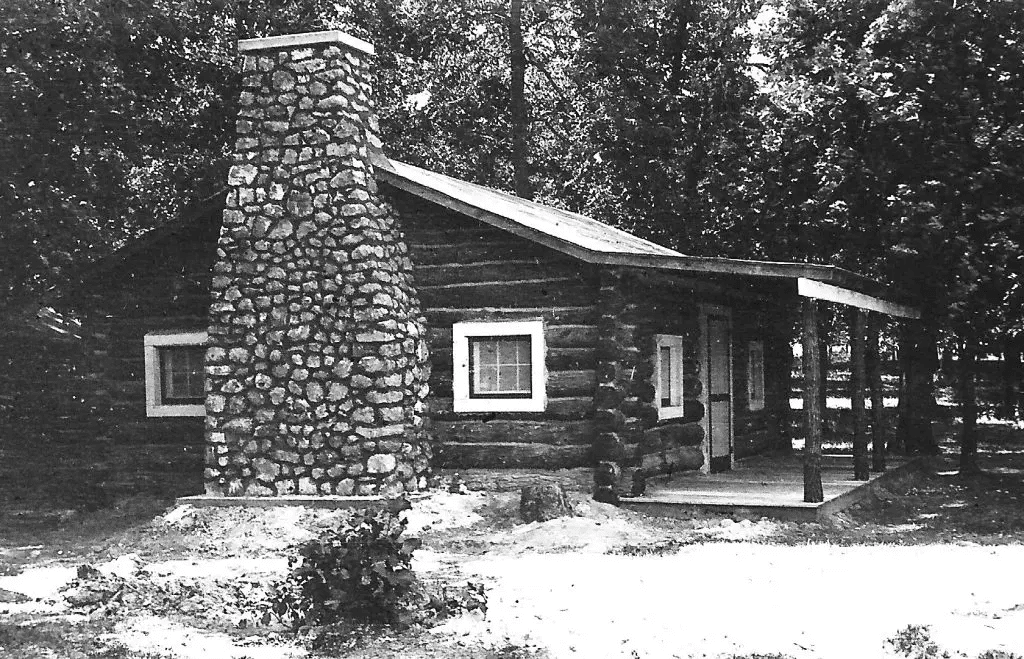
Boy & Girl Scout Camp Bemis in Bemis Woods South, Western Springs, Illinois. 1920s

The Boy and Girl scouts used the Camp Bemis Log Cabin in Bemis Woods in Western Springs, Illinois. Today Bemis Woods is in Westchester. The cabin and campgrounds were also rented by other groups. Camp Bemis was split into North and South by Salt Creek.

In 1920, the first Girl Scout troop in Western Springs was organized. Shortly afterward, an effort was made to have a Girl Scout campsite built in the Bemis Woods, directly north of the village. While the Forest Preserve District of Cook County had turned down eight similar requests from other groups, they agreed to allow a log cabin to be built in the Forest Preserve for the new troop.


According to news reports from that time period, the scouts found a spot in the Bemis Woods near Salt Creek, a half mile west of Wolf Road and north of Ogden Avenue, which they felt would be ideal for a campsite. The superintendent of the Cook County Forest Preserve District agreed, and soon, plans were underway for its construction. Best of all, the Forest Preserve District agreed to build the structure at no cost to the Girl Scouts.


The log cabin, used by the scouts for overnight campouts, had seven windows, two doors, and a fireplace constructed from stones gathered from the banks of the Salt Creek. The cabin was to be called “High Banks,” a reference to the banks of the nearby Salt Creek.

Newspaper reports described the cabin as being “… an exceedingly artistic structure, with a magnificent chimney and fireplace made of rough field stone.” The cabin also had an incinerator built of rough field stone for burning refuse, a log kitchen, a water well, and “… other necessary accommodations for both men and women.”


The Forest Preserve District even supplied an additional load of logs to construct a temporary dam near the cabin. This would raise the water level in Salt Creek by another three or four feet, thereby allowing the Girl Scouts to have better swimming and canoeing in the summer and ice skating in the winter. The Western Springs American Legion Post offered to construct the dam.

On October 15, 1921, the cabin was ready to be dedicated. And no fewer than five County Board Commissioners were in attendance, no doubt drawn by the promise of a fried chicken dinner served to them at noon in the new cabin.


At 2:15 pm, a train arrived in Western Springs carrying Girl Scouts from other western suburbs located along the Chicago, Burlington & Quincy Railroad, also known as the “Q.” After disembarking the train, they marched 1½ miles north to the new cabin.

At 3 pm, an American flag was raised, followed by a bugle call. The president of Western Springs, Henry Reeve, then spoke, welcoming everyone. After dedicating a bronze tablet, eight visiting Girl Scout troops sang a song, “Hail the Cabin,” which was written especially for the occasion:

On the high banks of Salt Creek, For the Girl Scouts of the “Q"
Stands a little red oak cabin, Built by foresters so true. 

To be shared by friends and neighbors, In our work and in our play,
So, to dedicate the cabin, We have gathered here today.

Hail the cabin, hail the cabin, To the Girl Scouts given free.
Hail the cabin, hail the cabin, Home of hospitality.

Grateful ever, may we never, Fail our duty to fulfill,
To make the spirit of the cabin, Be the spirit of Good Will.

Historical Society records indicate that the log cabin was used by Western Springs girls for several years thereafter. In addition, the cabin was often loaned to Girl Scout troops from other communities. It also served as a training center for Girl Scout leaders.


Unfortunately, because of what scout leaders termed “inadequate supervision for safe use of our girls,” ownership of the cabin was transferred back to the Forest Preserve District after a few years. However, the Girl Scouts continued to use the building for daytime outings until 1925 and for annual Christmas parties until 1926.

But what became of the cabin? Current aerial photographs of Bemis Woods show no trace of it, nor is there any mention of its eventual fate in Girl Scout records that were donated to the Historical Society.

THE LOCATION OF THE CABIN
Camp Bemis (north) 
West of Wolf Road, south of 31st Street and north of Salt Creek — three parking spaces — allowable picnic load, 5,000 (seven picnics) — two concrete dance platforms, one south of entrance drive and one west of upper parking space — two wells, third well one-half mile west of upper parking space on the trail — sanitary conveniences sixty-three table and bench combinations — open, level space for races and games — space available for Softball — fine woods, birds, wildflowers — bridge across Salt Creek — hiking and bridle trails — saddle stable west of Preserve — ideal for small group and family picnics.


Camp Bemis (south)
North side of Ogden Avenue, one-fourth mile west of Wolf Road, south of Salt Creek — three parking spaces, two cinders and one macadam [1] — allowable picnic load, 3,000 (two picnics only) — one type "A" picnic shelter with concrete floor and fireplace — two wells — sanitary conveniences — thirty table and bench combinations — open, level spaces for races and games — fine woods, birds, wildflowers — bridge across Salt Creek hiking and bridle trails.

The Boy & Girl Scout cabin is at the far north end.

Compiled by Dr. Neil Gale, Ph.D.
Contributor: The Western Springs Patch


[1] Macadam is a type of road construction pioneered by Scottish engineer John Loudon McAdam around 1820, in which crushed stone is placed in shallow, convex layers and compacted thoroughly.


The History of No Exit Café & Gallery, Rogers Park, Chicago, Illinois.

No Exit Café ● Gallery, at 6970 North Glenwood Avenue, Chicago, Illinois was a magical place that grabbed you by the scruff of your neck and wouldn't let go," said Owner Sue Kozin. (The CTA 'L' elevated tracks run down the middle of Glenwood Avenue. The Exit Café was on the west side of the 'L' tracks; between Lunt and Morse Avenues),

No Exit Café (aka No Exit, The Exit, and The Café) was started in Evanston in September 1958 by two Northwestern University students, Bill Harmon and Dick McKernan. Housed in a narrow storefront on Foster Street next to the Foster L station, The No Exit became the hangout for the beat-generation college student. Word is that Sorority girls could be depledged if they were seen in the Café. No Exit was called a beatnik coffeehouse, but the patrons noted economic and social status diversity.

About three months after the Café opened, Joseph "Joe" Greeley Moore was hired to run the No Exit Café. After nine months, Joe bought out Harmon and McKernon in 1959. 

Joining the college student crowd was the racing crowd, the writers like Frank Robinson and folk singers like Art Thieme, Dodi Kallack, and Judy Bright. In the following years, singers like Steve Goodman, Harry Wailer, Michael Smith, Claudia Schmidt, Christy Moore, Bluesman Jim Brewer, Pat Clinton, Couple a Fat Guys, Jim Craig, and so many more graced the stage.

sidebar
No Exit Café served coffee from several La Pavoni espresso machines.  The sweets were from a French pastry shop around Rush Street. The  Café served a few types of sandwiches and snacks. 

1960s La Pavoni [Pro] Europiccola
Brian Kozin started hanging out in 1961 during the hay day of the Joe Moore ownership. During the early 60s, the espresso was hot, and the Jazz was cool. Ira Sullivan led a jazz combo on Saturday afternoons. Brian also remembers one night after Jim Brewer finished his set, he needed a ride back to the west side. Brian offered to take him in Joe Moore's car. Joe asked if Brian could drive. "Sure, I can drive," Brian replied. Several months later, Brian entered No Exit and proudly showed off his new driver's license. "I thought you had a license," exclaimed Moore. "No, you asked if I could drive," was Kozin's retort.

When Northwestern University bought a large chunk of Evanston property, primarily to increase student housing in 1967, No Exit was forced to move. 

Moore started looking in Chicago's Rogers Park far north community for a new location.

No Exit opened on Glenwood Avenue (still has Chicago Paver Bricks from the 1910s) at Lunt Avenue on December 7, 1967. It was amazing how quickly new customers adopted the bar as a 'regular,' joining our friends who followed us from Evanston.

No Exit provided their extended neighborhood a smoky clubhouse full of friends and people looking for lively talk, playing games like chess, the game of GO (which was second to chess), and box games like Scrabble and Monopoly, or hoping that Moore would tell another of his stories.
Joe was politically active and a "talker," friends said, and in No Exit, which took its name from Jean-Paul Sartre's French drama, "No Exit" (the script), a 1944 existentialist play, he found both a profession and a second home. "He lived in the place, practically," said Sue Kozin, who, with her husband, Brian, owned the Café from 1977 to 2000.

"I moved up from the far south side town of Harvey because I was told of this great coffeehouse opening up," said Sue Kozin

"It took me a couple of months of peering in the door before I walked in." By spring, I was waiting tables on Thursday nights, and Steve Goodman was the entertainment. 1968 was a year of politics and demonstrations. The '68 Democratic convention and the protest riots against the Vietnam War became a hot topic around the regular's tables. 

No Exit was a polling place, and Rogers Park was then part of the Democratic 'machine.' The room became even more enriched with tie-dyed Hippies interspersed with the business types. No Exit settled into music, chess, and car racing; all was copacetic.

In 1972, Joe Moore and his wife Joanne decided to buy an old resort in Fort Atkinson, Wisconsin. He then sold No Exit to Peter Steinberg, his longtime manager. 
Peter Steinberg, the third No Exit Owner.
(received anonymously)
The first thing Steinberg did was to get rid of the racing crowd and throw a chair through the trophy case. It was Steinberg's gesture of freedom. The Japanese game of GO replaced chess. Mathematicians and computer programmers replaced the race car crowd. Folk music was still a staple part of the culture. Times were good, and many venues in Chicago for good music. No Exit prospered through the efforts of many artists who were working to their need to perform. Howard Berkman, Art Thieme, Dan Kedding, Roxanne Kedding, Mike Dougal, and Al Day became featured performers. The gallery space was also in use by new area artists. Ned Broderick and Pete Peterson, returning Vietnam War Veterans displayed works with humorous and grim views of life in the war.
Sue (and Brian) Kozin, No Exit's fourth owners from 1977 to 2000.
(received anonymously)
Brian and Sue Kozin purchased No Exit from Peter Steinberg in April 1977. For Sue, this realization was put into motion some seven years earlier. "The one thing Joe Moore did was to educate me in the right and wrong ways to run a coffeehouse." according to Sue. Brian seconded that statement. We took our time and returned the Café back to a vintage 50s and 60s coffeehouse. 

No Exit retained singers like Art Thieme and Howard Berkman. We added talents like Michael Smith, Suzy Boggus, Rosalie Sorels, Pat McDonald (who later headed the group Timbuk 3) and Andrew Calhoun to give a short list. Jazz was re-instituted on Saturday and Sunday afternoons with Bob Dogan, Jennie Lambert, Merle Boley, and Doug Lofstrom, and tradition was kept alive with Mike Finnerty and Mike Linn. Improv theatre was also instituted with Let's Have Lunch in the 80s and Bang Bang Spontaneous Theatre, now in its eighth year. Bang Bang was one of many springboards to send talent to Hollywood movies and TV land.

sidebar
“This is such a weird place,” says Sue Kozin, “which is why we haven’t run [away] screaming . . . yet. There are so many odd things about it that you don’t really see in the real world. Where else do the customers walk behind the counter to answer the phone? Sometimes [customers] made a pot of coffee,  paid for their cup, then top off customers cups. They make their own change [from the cash resgister]. We’ve had customers who would bring their own tea  in and then pay for it by the pot.”

The Kozins managed the coffeehouse and raised three kids in the process. According to Brian, they have met everyone from rocket scientists to murderers. "With our son David being the first, we have had some 23 children born to the regulars over the years," mentioned Sue. At the beginning of the holiday season, every year, No Exit hosted a Thanksgiving potluck dinner on the last Sunday of November. This allowed Brian and Sue to relax and spend time with the customers, musicians and friends around No Exit. This tradition lasted the whole 22 years of the Kozin ownership.
No Exit Entrance. (received anonymously)


The decor was as eclectic as its customers. There were too many plants, some were donated, or a person was moving and didn't need the Elk antlers. A painting of James Dean was left one day, and an Armadillo was a gift from a waitress. The library of textbooks came from many students, and the paperback book library rule was take-one, bring-one-back. A student was doing his Cultural Anthropology paper about No Exit and spent a week cataloging everything in the Café.

In 1983 a building was bought, and volunteers built a new and permanent No Exit Café. The building was an old gentlemen's card-playing club, "The Sherman Bridge Club." It was a 'No Women' allowed smoking club, where playing Bridge was last on the agenda.
EXTERIOR OF NO EXIT - Copyright © 2022, Sandra Cedrins (artist's work)
INTERIOR OF NO EXIT - Copyright © 2022, Sandra Cedrins (artist's work)
For several years after the 1983 move into the new spot, shiny black Cadillacs and Lincoln Continentals would slowly drive by looking for that bridge club. "We tried to change the decor and brighten up the place," according to Brian. "But the customers stayed away until the burlap and curios went back on the walls."

Like anything else you do for twenty years, there comes a time to stop. For the Kozins, it was the years of no vacations and the children growing up. It was time to pack it up. Lesley Kozin tried to keep the Café open one more year, but it proved too much for her. "We made it look too easy," said Sue. "There's so much that's not seen. Hiring and training, prep work, shopping, payroll, and bookkeeping are a few. It takes up a lot of time." They were burnt out. 

Brian and Sue decided to sell No Exit.

In January 2000, while Bill and Sue were looking for a buyer, this happened:  

Then one afternoon, a longtime regular, Cindy Olsen, was puttering around in the Café's kitchen. After a sojourn in Wicker Park, Olsen had just moved back to the neighborhood, and she told Brian how much she'd missed No Exit. Olsen has been a patron for 14 years. Like so many others, her introduction to No Exit came when she was a Northwestern University student and found No Exit a quiet place to study. A few years later, when she and a friend ran an antique store adjacent to the No Exit, she became a regular.

"Why don't you just rent the place from me, then?" Kozin asked, and he quoted her a price.

To Olsen's surprise, it sounded like a reasonable offer. She went home and called her boyfriend, John Kiolbasa. "I have something to ask you," she said.

Kiolbasa said it sounded like a great idea. That afternoon he'd run across "A Night in the Life of Jimmy Reardon" on cable and had been thinking how cool it would be to have a place like the No Exit. The next day, the couple called Kozin and discussed terms: two months' rent as a down payment and the option to buy the building in two or three years. They made a deal. 

Beginning May 1, 2000, Olsen and Kiolbasa ran No Exit Café.

No Exit Café permanently closed on New Year's Eve, 2006, after 47 years.

sidebar
No Exit Café Owners:
    1. Bill Harmon & Dick McKernan
    2. Joe & Joanne Moore
    3. Peter Steinberg
    4. Brian & Sue Kozin 
    5. Michael James & Katy Hogan (owned the Heartland Cafe)

Compiled and Edited by Dr. Neil Gale, Ph.D.
Contributor, Sue Kozin

The Abingdon Sanitary Manufacturing Company, Abingdon, Illinois.

The Abingdon Sanitary Manufacturing Company was founded in 1908 and produced vitreous (resembling glass) china plumbing fixtures. 


The company introduced the first colored plumbing fixtures in 1928 and made all the fixtures used at the 1933 Chicago Worlds Fair (a nice contract). To stay in business during the Great Depression, the company started producing artware in 1934 made out of the same material.
Abingdon Little Old Lady with Flower Basket Cookie Jar.
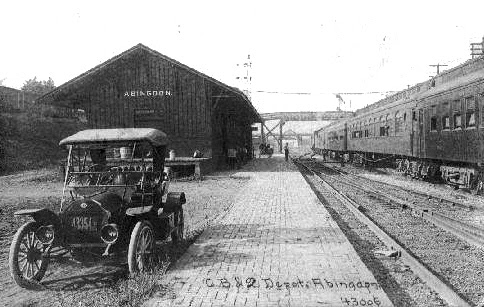
Abingdon Depot.


Between 1934 and 1950, millions of pieces were produced; over 80% of the pieces were sprayed, and 95% were made in a glossy glaze. Increased demand for plumbing fixtures caused the company to stop producing artware in 1950.
Stone Quarry near Abingdon, Ill.


The lead found at the Abingdon Pottery factory site most likely came from lead glazing, which gave the fixtures and pottery pieces their shine.

Compiled by Dr. Neil Gale, Ph.D.


BATHROOM FIXTURES

Thursday, October 20, 2022

The Midget Club at 4016 West 63rd Street, Chicago. (1948-1982)

The Midget [1] Club bar was owned by Chicago native Parnell St. Aubin, who’d played a Munchkin soldier in The Wizard of Oz. His wife, Mary Ellen Burbach, was a former Mae West impersonator with the vaudeville troupes Rose’s Parisian Midget Follies. Mary also performed with: Fred Roper & His Wonderful Midgets, Henry & Dolly Kramer Midget Troupe, and Nate Eagle’s Hollywood Midgets.

In 1934, at Chicago’s World Fair, ‘A Century of Progress,’ Mary was part of the cast of ‘Midget City,’ “a colony of Lilliputians, living in miniature houses, furnished with tiny furniture.” A year earlier, Parnell had appeared in the same Midget Village, playing ‘Little Elmer,’ the smallest Midget at the fair. Both shows cost 25¢ to enter.
1933 Chicago World Fair, Midget Village.


Eyes center on dainty Stella Royal performing in an outdoor theatre in the Midget Village, Century of Progress, Chicago, 1933.


The couple met in the Toy Department of Chicago’s State Street Goldblatt’s Department Store in 1932, where Mary Ellen worked as one of Santa’s elves during Christmas. 

Parnell had come to see the little people at Goldblatt’s. When Parnell laid eyes on Mary, attention was swift and mutual. They got engaged on St. Valentine’s Day, February 14, 1933, 49 days after their first meeting. Mary and Parnell were married on Tuesday, April 4, 1933.

And then came the bar. “We created the bar to fit our size,” said Mary in 2008. “It was custom-built. Pint-size, so we could easily maneuver around, tend bar and serve customers.”

The Chicago Reader recalls: “The club was built for people of small stature: the stools were miniature, and the pay phone was installed just feet above the floor. St. Aubin, who was three-foot-seven, would climb up on a stool to reach the cash register. A large mural of Munchkins marching along the yellow brick road was painted behind the bar.”
The Midget Club


Richard Reeder was 16 when he first visited the bar, delivering supplies for his uncle’s company, Veteran Supply, in 1962. “It blew my mind,” he recalls. “I remember photos of St. Aubin with Judy Garland and Ray Bolger. It was just so out of context and, like Oz, a place of wonder and fantasy.”

The bar welcomed patrons of any height, and they did not discriminate. “If I depended on the midget trade, Parnell said, “I’d starve.”

After Parnell died on December 4, 1987, Mary kept the Oz theme alive, becoming First Lady of the Oz Festival, an annual tribute event in Chesterton, Indiana.

Compiled by Dr. Neil Gale, Ph.D.


[1] Midget (from midge, a tiny biting insect) refers to a very short but normally proportioned person. While not a medical term, it has been applied to people of short stature, often with dwarfism. The word Midget has a history of association with the performance arts as little people were often employed by acts in the circus, vaudeville, etc. The term midget is now rarely used and is considered offensive. But its usage was very common until the end of the 20th century. 

"Dwarf" refers to an extremely short adult who is 4 feet 10 inches tall. The average adult height in dwarfism is four feet. Common complications include bowing of the legs, hunching of the back, and crowded teeth.