Saturday, September 14, 2019

Chicagoan Marie Connolly Owens, America's First Female Police Officer.

Marie Connolly Owens joined the Chicago Police Department in 1891 with the title of Detective Sergeant, full arrest powers, and a badge. She was on the department payroll and received a police pension when she retired in 1923 after 32 years on the force.

Marie Connolly was born the daughter of Irish famine immigrants in Bytown (later renamed Ottawa), on December 21, 1853. She married gas fitter Thomas Owens in 1879, and they moved to Chicago soon thereafter. Together they had five children before Thomas died of typhoid fever in 1888. Marie was widowed with five mouths to feed; her youngest was just a couple of years old. As she told the Chicago Daily Tribune in 1904, up until this point she had never "earned a penny" in her life.

She entered the workforce with a bang the next year. In 1889, the city of Chicago passed an ordinance prohibiting the employment of children under 14 years old unless they had extraordinary circumstances requiring them to work. To enforce the ordinance, the city hired five women as sanitary inspectors to monitor conditions in stores, factories, and tenements. Women, all of them married or widowed mothers, got the jobs because dealing with children was deemed to be in their natural purview. Mrs. Owens, Mrs. Byford Leonard, Mrs. J.R. Doolittle, Mrs. Ada Sullivan, and Mrs. Glennon formed the first board of sanitary inspectors in the country to be given official authority by the city. They reported to the Commissioner of Health and were paid salaries of $50 a month ($1,410 today).
Sanitary inspector Marie Owens dove into her work with a passion, removing illegally employed children from their workplaces, helping them find other means of support and even paying out of her own pocket to help their destitute families. She soon earned a reputation for zeal and effectiveness tempered by a diplomatic approach to parents, children, and business owners that made her as popular as someone in her role could be.

In 1891, the newly appointed Chief of Police, Major Robert Wilson McClaughrey—a tireless reformer with a particular interest in the rehabilitation of juvenile offenders—took notice of Mrs. Owens's efforts in tracking down wife deserters—men we now call deadbeat dads. Owens saw first-hand how many children were forced to seek employment to keep the family from starving after the father abandoned them. She was relentless in ferreting these men out and turning them in to the police, so much so that McClaughrey decided to employ Owens in the detective bureau.

Marie Owens was now Sergeant No. 97, with the rank, salary, badge, and arrest powers of any detective (although she made infrequent use of the latter two). She was detailed to the Board of Education where her brief was enforcing child labor, truancy, and compulsory education laws. She wrote for the July 28, 1901, issue of the Chicago Daily Tribune, Owens described her early days on the job:

The sights to be seen in the slums today can in no way compare with those of ten years ago and the suffering due to the inability of the older members of the family to work is, indeed, pitiable. Children were found working in factories all over the city, the frail little things in many cases being under 7. The pittance of 75 cents or $1 a week, however, helped to buy food for a sick mother, though it was at the cost of health and education.

When the work was first begun a woman wearing a police sergeant's star was a novelty. Manufacturers in some cases were not inclined to admit me to their workshops, but armed with the strong arm of the law and the will to do good, I soon found that in most cases the merchants met me halfway and rendered me great assistance. As a result, the children were gradually thinned out, and the employers became accustomed to asking for affidavits required by law before work was given to children. Mothers had to depose as to the children's ages, and with these papers, the latter were enabled to get employment in the larger factories and stores.

Owens, like Baldwin and Wells after her, made a point of differentiating what she did from the work of male police officers. In almost every contemporary news article about her, her success in law enforcement was subsumed under her femininity, maternal instinct, charitable nature, and kind heart. A 1906 story in the Chicago Daily Tribune assured its readers that this lady police sergeant "has lost none of her womanly attributes and other detectives in the central office lift their hats when they chance to meet her." If that wasn't relief enough for anyone concerned about the dangers of masculinized womanhood, the words of Sergeant No. 97 herself were sure to soothe:

"I like to do police work," said Mrs. Owens. "It gives me a chance to help women and children who need help. Of course, I know little about the kind of work the men do. I never go out looking for robbers or highwaymen. That is left for the men. My work is just a woman's work. In my sixteen years of experience, I have come across more suffering than ever is seen by any man detective. Why it has kept me poor giving in little amounts to those in want. I have yet the time to come across a hungry family that they were not given food."

Her superior officer, Captain O'Brien, gave her more credit than she gave herself in that article. "Give me men like she is a woman," he said, "and we will have the model detective bureau of the whole world."

Despite Owens's effectiveness, a woman wearing a police sergeant's star was supposed to remain a novelty. In 1895, Chicago adopted new civil service rules requiring all cops to pass the civil service exam (Owens scored a 99 percent) and allowing for appointment of women as regular factory, tenement, or child labor inspectors independent of the police force. Had those rules been in effect in 1891, Mrs. Owens would probably have been made a government inspector rather than a police detective. Because she was so great at her job and had an unblemished service record, she was kept on the police force after the new rules were in place instead of being transferred. In an article in the August 7, 1904, Chicago Daily Tribune, the new rules were assumed to have made women police officers obsolete. The civil service rules "will forever prevent the appointment of more feminine patrolmen. Mrs. Owens will undoubtedly remain as she has been for fifteen years, the only woman police officer in the world."

Compiled by Neil Gale, Ph.D.

The brief history of Chicago's 19th century public police force.

In 1825, prior to the creation of Cook County was in Putnam County. 
1825 Illinois County Map
Archibald Clybourn was appointed to be Constable of the area between the DuPage River and Lake Michigan. Clybourn went on to become an important citizen of the city, and the diagonal Clybourn Avenue is named after him. When the town of Chicago was incorporated to become a city in 1837, provisions were made to elect an officer called the High Constable. He, in turn, would appoint a Common Constable from each of the six city wards.

Before Chicago ever became a city, the town of Chicago was authorized by the General Assembly of Illinois to establish its own police force, which was set up a constabulary. Men wore civilian clothes adorned with a leather badge. They carried heavy canes by day and batons by night and were provided with “creakers,” a noisemaker device, with which to call for assistance in case of distress. The first “officers” were unpaid citizen volunteers that would patrol the urban city streets looking for drunkards and watching for fires.
Chicago Constable Star (Replica). In-Service; 1828 to about 1900.
After the town was incorporated as a City in 1837, the city Charter authorized the hiring of two constables who were paid through a fee system that was based on the number of warrants served, but citizens were largely responsible for protecting their own property.  Constables had a variety of non-law enforcement functions that they performed, including lighting and extinguishing street lamps, serving as land surveyors, and verifying the accuracy of weights and measures.
Chicago Leather Police Star (Replica). In-Service; March 10, 1857, to March 1, 1858. Then police used a Chicago Plain Brass Star from March 2, 1858 – March 5, 1860. Back to the Chicago Leather Police Star used from  March 6, 1860, to March 25, 1861.
If a crime was committed, the citizen would notify the constable who would obtain a warrant from the magistrate or justice of the peace and serve the criminal with a summons to appear before the court to answer the citizen's complaint. There was no organized system of crime detection or prevention. A Sheriff was the officer in charge of the court’s business and responsible for enforcement of criminal laws. But the sheriff and his deputies did not patrol or serve as night watchmen.

In 1839, Chicago established a night watch system, and a marshal was appointed to oversee them.  Though the general duties of the watchman were straightforward: They preserved order, which was broadly defined, and raised the “hue and cry” [1] if they discovered criminal offenses or discovered a fire; and, on occasion, they detained suspicious and disorderly persons, the implementation of those duties often proved unsatisfactory. The whole constabulary watch system was viewed as fragmented, inefficient, incompetent and corrupted. Moreover, the public police lacked the training and ability to prevent disorder, particularly civil unrest and riots, or control crime.
Patrolman Star. In-Service; March 26, 1861, to 1904
In 1855, the newly elected city council passed ordinances to formally establish the Chicago Police Department. Chicago was divided into three police precincts, each served by a station house. Station No. 1 was located in a building on State Street between Lake and Randolph streets. Station No. 2 was on West Randolph Street near Des Plaines Street. Station No. 3 was on Michigan Street (since then renamed Hubbard Street) near Clark Street. Political connections were important to joining the force; formal requirements were few, until 1895. After 1856, the department hired many foreign-born recruits, especially unskilled, but English-speaking, Irish immigrants.

In 1860, the detective forces were established to investigate and solve crimes. In 1861, the Illinois General Assembly passed a law creating a police board to become an executive department of Chicago autonomous of the mayor. The mayor was effectively stripped of his power to control the Chicago Police Department. Authority was given to three police commissioners. The commissioners created the office of the superintendent to be the chief of police. The title is again in use today.

The first African American officer was appointed in 1872, but black police were assigned to duty in plain clothes only, mainly in largely black neighborhoods. In 1875, the Illinois General Assembly found that the police commissioners were unable to control rampant corruption within the Chicago Police Department. The legislature passed a new law returning power over the police to the mayor. The mayor was allowed to appoint a single police commissioner with the advice and consent of the city council.

In 1896, the Lumière Bros. filmed one of the first Chicago films ever shot in Chicago. (Watch this 45 second Film.)

Women entered the force in 1885, as matrons, caring for female prisoners. Marie Connolly Owens is believed to have been the first female police officer in the U.S., joining the Chicago Police Department in 1891, retiring in 1923. Holding the rank of Sergeant, Owens enforced child labor and welfare laws.

Despite centralized policies and practices, the captains who ran the precincts or districts were relatively independent of headquarters, owing their jobs to neighborhood politicians. Decentralization meant that police could respond to local concerns, but graft often determined which concerns got the most attention. In 1895, Chicago adopted civil service procedures, and written tests became the basis for hiring and promotion. Standards for recruits rose, though policing remained political.

Compiled by Neil Gale, Ph.D.


[1] "Hue and cry" (adopted from England common law) is a process by which bystanders are summoned to assist in the apprehension of a criminal.

Thursday, September 12, 2019

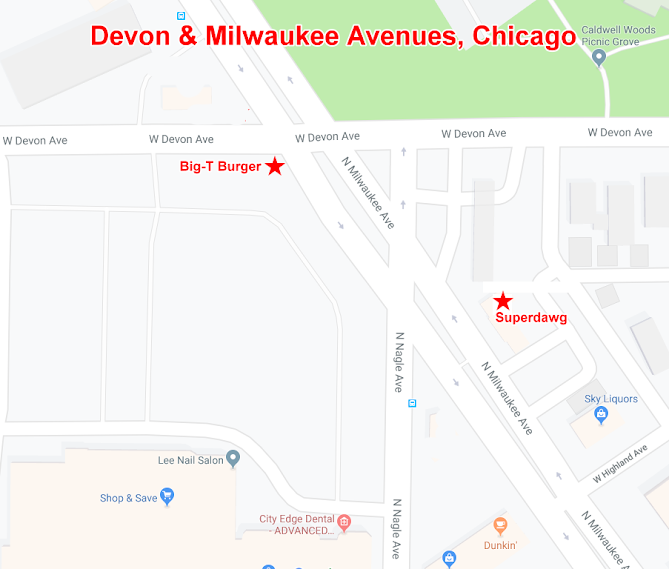
Big-T Burger, Devon and Milwaukee Avenues, Chicago.

Looking Northwest from Devon and Milwaukee Avenues. The late 1970s.
Charles "Chuck" Nichols ran a Tastee Freeze franchise (still serving the "Big Tee Burger"), which closed every winter when ice cream lost its appeal. Nichols renegotiated the lease with the building's owner and turned the space into a burger business to operate year-round. To attract teens from nearby Taft High School, he dubbed the restaurant "Big-T Burger." 


Nichols worked there seven days a week. He overcame competition from a nearby McDonald's, Burger King, and Superdawg across Milwaukee Avenue.

On the last day of business, before Nichols was forced to close Big-T Burger, he told his sons to be at their "very best." He adhered to the 'always do your best' philosophy and ingrained it in his employees. 

Nichols gave more than his time to the business. Homeless people often wandered into Big-T Burger, and Nichols knew everyone by name. He would give them a hot dog and a cup of coffee when they came in and let them warm up or cool off. 
 
Chuck Nichols of Park Ridge died on October 26, 2003, at 89 years old.


Compiled by Dr. Neil Gale, Ph.D.

Wednesday, August 28, 2019

The History of Chippewa Park in Chicago, Illinois.

Chippewa Park, 6758 North Sacramento Avenue (at Pratt Boulevard) in Chicago, was one of four parks created by the Ridge Avenue Park District, established in 1896. The park district's other properties were Indian Boundary Park, Pottawattomie Park, and Morse Park (now Matanky {Eugene} Park).

In 1931, the park district purchased the property in the southwest corner of the district, built a one-story brick fieldhouse designed by Clarence Hatzfeld, and designated the new park Chippewa.
The five-room fieldhouse, including a kitchen, sits on 3.26 acres with a new "ChicagoPlays!" playground, and a water spray feature.
Looking NW at the Chippewa Park Fieldhouse on Sacramento Avenue, with Pratt Boulevard just to the right, but out of the picture. (March 30, 1936)
The name recognized the Chippewa Indian tribe that lived in the Great Lakes region when Europeans arrived. Between 1600 and 1760, the Chippewas made their home along the northern shores of Lakes Michigan and Superior and numbered between 25,000 and 30,000. The Chippewa formed a loose confederacy with the Ottawa and the Potawatomi. By the 19th century, the three tribes were known as "the Three Fires." 

The name Chippewa is an adaption of the word Ojibway, "to roast till puckered up," a reference to the puckered seams of their moccasins.

Today, the park offers Interaction for toddlers. Classes for preschoolers include Early Childhood Recreation, as well as Playschool Activities.
Don't forget to feed the Bunnies!
Classes for youth include Arts & Crafts and Fun and Games. Choose from Soccer, T-ball, Flag Football, Snag Golf and Outdoor Tennis for multi-ages. Chippewa also offers a fun-filled day camp for ages 5-8, which runs for 6 weeks.

Compiled by Dr. Neil Gale, Ph.D.

Tuesday, August 13, 2019

A 3-Wheel Velocipede (Handcar) in Effingham, Illinois.

This velocipede[1] was built by the railroad for track inspectors whose job it was to check the tracks and fill the track signals with fuel which would last six to seven days.
Where the girl is riding is where the fuel was carried for filling the signals. The picture was taken in Southern Illinois. Man is George Frazer, who worked for C&EL Railroad, born in 1875 in St. Elmo and died in 1945 in Altamont, buried in Union Cemetery.

The lady is Marie (Sidwell) Frazer, who was born in 1882 in Sefton Township and died in 1956 in Altamont and is buried in Union Cemetery. She was a school teacher in Effingham, Illinois. In the picture, she is carrying a gun as she always did. Many ladies carried some form of protection in those days.

Compiled by Neil Gale, Ph.D.


[1] Velocipede: The term "velocipede" is today, however, mainly used as a collective term for the different forerunners of the monowheel (the unicycle), the bicycle, the dicycle, the tricycle and the quadracycle developed between 1817 and 1880.

Sunday, August 11, 2019

The history of the Chicago Fresh Air Hospital in the West Ridge community. (1912-ca.1960)

The Chicago Fresh Air Hospital was located at 2451 West Howard Street in Chicago (Tel: Rogers Park-0321). It was built in 1912 on 20 acres of the Peter Gouden Farm near the southwest corner of Howard Street between Maplewood and Western Avenues in the West Rogers Park neighborhood of the West Ridge Community.
The Chicago Fresh Air Hospital building's footprint is highlighted in green.
It was built by doctors from Augustana Hospital who wanted to build a sanitorium for tuberculosis patients. This was prompted because Augustana would not accept such patients at that time.
Photo courtesy of the Rogers Park West Ridge Historical Society.
The building was constructed at the cost of $126,000.
Tuberculosis is an infectious disease of the lungs and other organs. Once considered incurable, the disease caused its victims to slowly waste away, which was why it was called “consumption.” With a mortality rate of approximately 18 per 10,000 people, tuberculosis was a leading cause of death within the city of Chicago at the turn of the 20th century.

Early attempts at controlling tuberculosis in Chicago focused on home sanitation, public health education, and isolation of the patient. Private hospitals took in a few tuberculosis patients, but public facilities to care for the affected were not available.

In order to raise public awareness, the Visiting Nurses Association and physician Theodore Sachs spearheaded an antituberculosis movement in the early 1900s. This eventually resulted in the passage of state legislation, the Glackin Tuberculosis Law, in 1909, giving the city of Chicago the ability to raise funds for the treatment and control of tuberculosis through a special property tax.

In 1914, there were 10,000 registered cases of Tuberculosis (TB). The number of deaths due to TB in Chicago that year was 3, 384. Yet there were only 300 public beds available in the city for patients who could not afford to pay for treatment. In March 1915, the Municipal Tuberculosis Sanitarium opened its doors to citizens of Chicago suffering from tuberculosis. Treatment was free to residents of Chicago.
The Chicago Fresh Air Hospital later became known as Bethesda Hospital around 1960 and, at one time, was affiliated with Mount Sinai Hospital (today's Sinai Health System).

In 2005 a Korean-American gentleman named Park converted the former hospital into a condominium complex.

Compiled by Dr. Neil Gale, Ph.D.

Saturday, August 10, 2019

Fox River Picnic Grove (Amusement Park) in Fox River Grove, Illinois. (1900 to Mid-1970s)

In the 1850s and early 1860s, Indian tribes camped in the rolling hills south of the Fox River. The women traded beadwork and purses with local settlers, and the men trapped muskrat and mink and sold the pelts in nearby Barrington. The men also made fenceposts for local farmers in exchange for being allowed to camp on their land during the winter. When spring came, they packed up their belongings on sleds and traveled north on the frozen river to their summer lands in Wisconsin.

In 1869, Frank Opatrny purchased 80 acres of land on the southern shore of the Fox River. In the 1870s, city dwellers from Chicago began to discover the pleasures of hunting and fishing along the Fox River, and the region developed a reputation as an ideal vacation spot. Cottages and small resorts were built, and many people who came to the area during the summer enjoyed it so much that they became full-time residents.

Frank's son Eman Opatrny bought the land from his father in 1900. The area's resort trade was booming and country picnics were very much in fashion. Eman decided to transform the family homestead into a pleasant picnic area, and the Fox River Picnic Grove was born.

Eman Opatrny built several cottages and a restaurant near the shore. He installed boat docks, set up a picnic area with shelters, and planted 2,200 trees. He built a railroad spur track directly to the park, hired a promoter, and convinced the railroad to run special excursion trains from the city. 
   
In 1902, a luxury hotel was built on the hill. Known as the Castle Pavilion and Resort Hotel, this building featured windows displayed during Chicago's 1893 World's Columbian Exposition.
The Castle Pavilion and Resort Hotel.
It contained the area's first player piano, as well as a dance floor where dances were held regularly. According to a 1914 guidebook published by the Chicago & Northwestern Railroad, the Castle Pavilion had accommodations for 60 guests.
The Grove Dance Pavilion.
Many improvements were added to the picnic grove during the 1900s. They included a large restaurant, six bars, and numerous refreshment stands. Recreational items included a shooting gallery, dance platform, bowling alley, boathouse, photo gallery, rowboat rental, horse track, steam-powered excursion boat, and baseball fields. During the 1910s, motion pictures were shown in the Castle Pavilion. The 1900s were peak years for the picnic grove. It was a popular destination for company picnics and weekend visitors from the city. The spur track brought as many as 22 trainloads of visitors each weekend.

Many of the buildings in the Picnic Grove were destroyed by fire in 1918, but the Picnic Grove remained open through the 1920s and 1930s. The spur track was removed and with most of the attractions that visitors enjoyed in the early 1900s were no longer present, it remained a popular spot for picnics. During this time, the park was referred to as Opatrny's Woods and Opatrny's Grove.
Opatrny's Grove from the opposite shore. 
Built in 1923 and first known as the Fox River Grove Pavilion and Cernocky's Pavilion before finally being named the Crystal Ballroom was an eight-sided dance hall adorned with a flashing electric sign at the top, showing a golden pheasant with many colors.
The Crystal Ballroom at Fox River Grove.
The spur track was removed, and although most of the attractions that visitors enjoyed in the 1900s were no longer present, it was still a popular spot for picnics. Visitors also enjoyed swimming, boating, baseball, and dancing at the pavilion. Cottages were available for longer visits.

In 1939 a fire of suspicious origin broke out in the ballroom so a night watchman was placed on guard while the fire was being investigated. A week later, six men came during the night, and while four of them saturated the ballroom with kerosene, the other two abducted the night watchman and a visiting fire marshal at gunpoint. They fled in their cars and drove towards Barrington, Illinois while two bombs were detonated in the ballroom. The captives were released near Palatine, Illinois. The resulting fire from the explosions gutted the ballroom but didn't damage the roof or the adjoining shops. The interior of the ballroom was repaired, but the ballroom never reopened for dancing.
Motor Boats.
The Grove Belle.
In 1942, the Picnic Grove land was purchased by Louis, Jr., and Clara Cernocky. Louis was a successful local businessman and Clara was the daughter of Eman Opatrny. Cernocky improved the Picnic Grove with the addition of amenities including a dance pavilion and air-conditioned cocktail lounge, refreshment stands, outdoor fireplaces, a bathhouse, restrooms, a baseball diamond, and a 300-foot sand beach. Also added was a kiddie park called Funland, featuring a 10 seat Ferris wheel, their major attraction, and a handful of carnival-type kiddie rides. The "Tunnel of Love," was a favorite for couples of all ages. The "Krazy Movie Pop Corn Stand" also sold snacks and beverages. Louis dubbed the park "40 acres of paradise." 

In 1947, dances were held at the pavilion every Thursday, Friday, and Saturday night.
    
These images are from a circa 1960 brochure.
   
In the 1960s, the Grove Belle Showboat was available for excursions on the Fox River. Groups of 40 or more could hire the boat for private two-hour trips. Music, dancing, drinks, and food were optional.
Grove Belle Showboat.
Additional acreage was purchased in the early 1960s. A ski hill was established, complete with two rope tows, a vertical drop of 145 feet, and a ski shop. This came to be known as the Barberry Hills Ski Area. The two ropes and the ski shop are gone, but the hill is still a popular winter destination as a sledding hill.
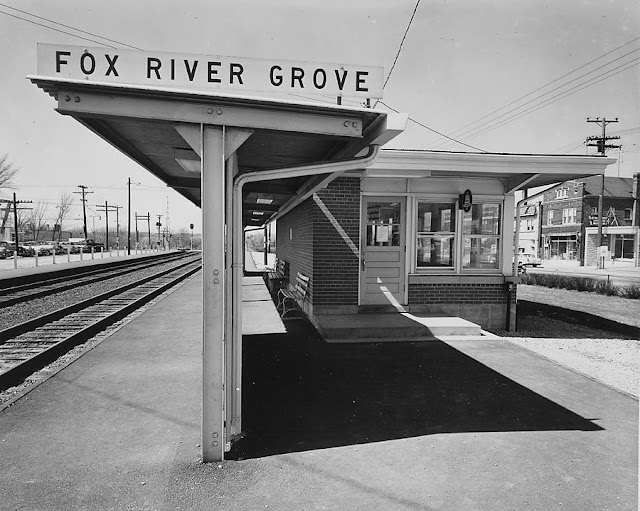
Fox River Grove, Illinois, Chicago & Northwestern R.R. Depot. 1961
The Grove Marina opened in 1961. This building featured a restaurant, cocktail lounge, live entertainment, boat launch, marine supplies, and boat slips for rent. Lifeguards were always on-duty.
Louis Cernocky retired from the picnic grove business in 1966. He entered into an agreement for deed with a developer doing business as Barberry Hills Inc. The park, ski hill, and marina retained their names and continued much as they had before. Operation of the Grove Marina lounge and restaurant was taken over by Wilbert Hanke and Eldon Chewning, who had recently opened the Branded Steak House in Crystal Lake.

The new developer planned to build a hotel on the property, and the agreement stipulated that a major hotel chain such as Hilton or Holiday Inn would make a suitable tenant. However, these plans fell through.

The ski hill and picnic grove remained open until the early 1970s when they fell into disuse. The Grove Marina stayed in business until being destroyed by fire in the mid-1970s.

The land changed hands several times between 1976 and 1993 but remained unused. In 1987, a proposal to build a Holiday Inn on the property and rename it Holiday On The Fox stalled when the developer passed away before plans could be completed.

In 1994, a state grant and an agreement with a new developer made it possible for the village of Fox River Grove to purchase 40 acres along the river. The rest of the land was sold to Picnic Grove LP and became the Picnic Grove Subdivision. The plat was recorded and the first lots were sold in 1995.

Today, the 40 acres owned by the village are known as Picnic Grove Park. It is one of the last remaining public areas on the Fox River. It contains a playground, picnic shelter, gazebo, boat docks, boat launch, grills, picnic tables, and a sledding hill. The only traces of the park's former life are the original roadways and a concrete slab where the Grove Marina once was located. 

Compiled by Dr. Neil Gale, Ph.D.
Contributor, Lisa Cummings

Saturday, August 3, 2019

The "Wingfoot Express" dirigible (zeppelin) crashed in Chicago's Loop on July 21, 1919.

On July 21, 1919, the Goodyear, Tire & Rubber Company's "Wingfoot Express" burned and crashed into the Illinois Trust and Savings Bank building. The next day, a Negro swimmer was murdered at a southside beach which triggered the 1919 Chicago Race Riots that shook the country.
The crowd scene at Illinois State Bank after the Wingfoot Express caught fire.
Eleven persons were killed and twenty-eight injured when a gigantic dirigible on its test flight caught fire and fell 1,200 feet, crashing through the skylight of the Illinois Trust and Savings Bank building at Jackson Boulevard and LaSalle Street, shortly before 5 o'clock in the afternoon.

Nine of the dead were employees of the bank, trapped and burned to death in a withering rain of fire caused by the explosion of the balloon's gasoline tanks as they hit the floor of the bank rotunda, where over 150 bookkeepers and clerks, nearly all girls, were working.
Wingfoot Express departing from Grant Park.
The blimp, known as the "Wing Foot Express" and owned by the Goodyear, Tire and Rubber Company of Akron, Ohio, had been flying above the city intermittently for several hours when the accident occurred. Thousands witnessed it.

At about 1,200 feet above the bank, a flame was shot out from the gasbag near the aircraft's center. The crowds gathered on the streets to watch the flight and witnessed the zeppelin buckle and quiver as it started on its fatal plunge.

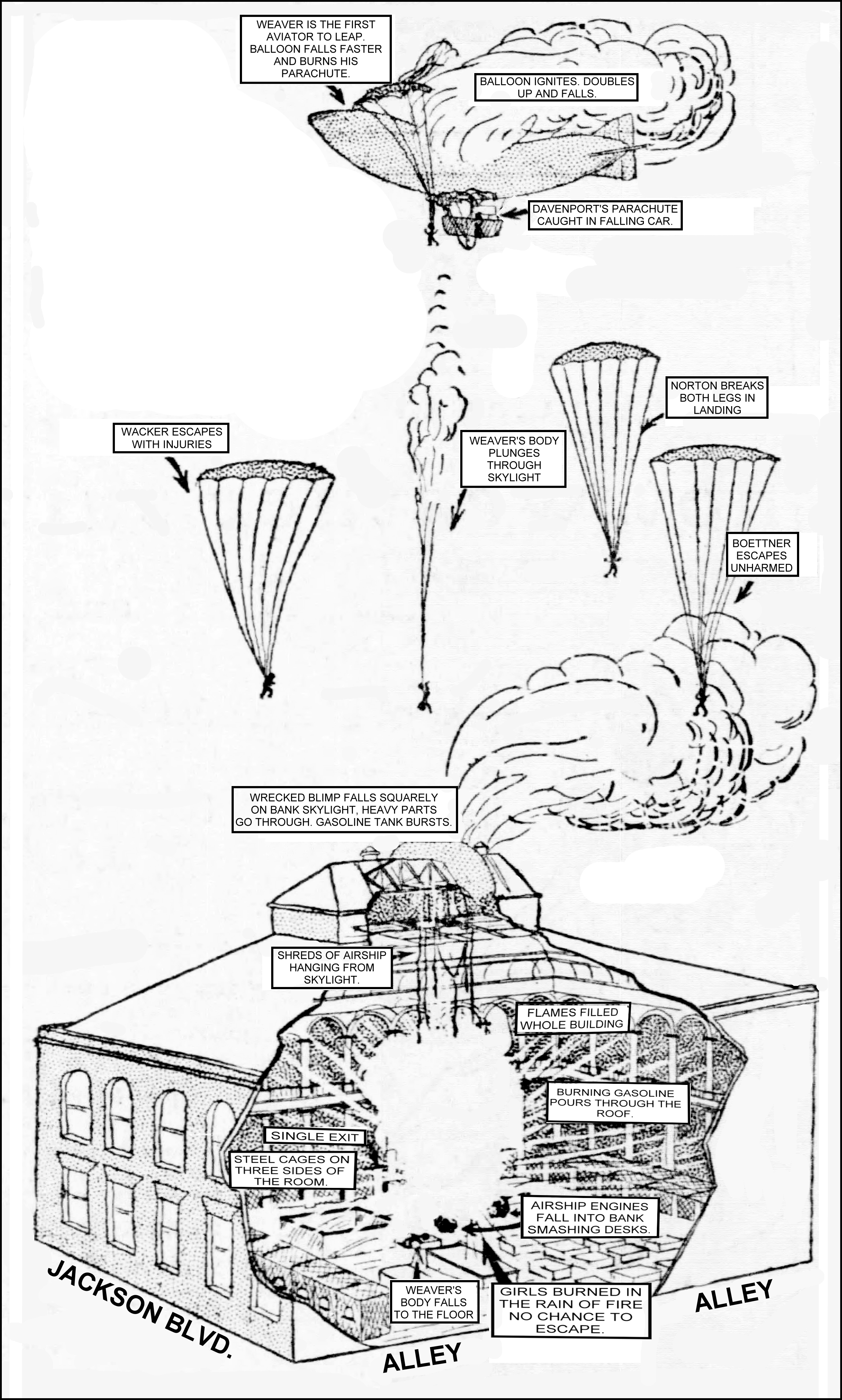
Four of its five occupants, wearing parachutes, jumped. The fifth, unable to get away, was caught in the flaming gasbag and burned and crushed to death on the bank roof. Another's parachute burst into flames and followed the balloon through the skylight, the man's body crashing to the bank floor. A third man broke both legs as he landed, and the other two experienced balloonists landed on a roof and one on LaSalle street. One of these escaped injuries, and the other was only slightly hurt.
CLICK FOR A FULL-SIZE ILLUSTRATION. 
There was nothing to warn the hundreds of the institution of the coming tragedy. A shadow passed over the marble rotunda, where 150 were busy, and a terrifying crash followed. The bank's closing hour for patrons had passed, but the clerks were still at work in various departments.
According to the survivors, it seemed as if the entire bank was on fire. Breaking through the iron supports holding the glass overhead, the fuselage of the blimp, with two heavy rotary engines and two gasoline tanks, cashed to the floor.

Instantly the tanks exploded, scattering a wave of flaming gasoline over the workers for a radius of fifty feet. A panic ensued. There were only two exits through which they could leave the wire cage surrounding the rotunda.

Men and girls with flaming clothing fought their way through the exits. Girls on the second floor ran screaming at the window, and several jumped into the street.

In an instant, the marble rotunda was deserted except for the dead, whose bodies were buried under the flaming mass, licked to a white heat by the gasoline blaze, and the dying, who crawled feebly away from the scorching fire, their clothes burning off.

The intense heat made rescue work impossible until after the fire department arrived and a four-eleven alarm call. Thirty minutes passed before the bodies under the craft could be dragged out, and some were burned beyond recognition.

Meanwhile, ambulances from every hospital and undertaking establishment near the city's center came, and the police threw a cordon about the place. Many people were found to have been seriously cut by the shower of glass that preceded the explosion.

The rescue work was watched by a crowd of 20,000 on LaSalle street and Jackson boulevard, while more had a good vantage point in nearby buildings. The cause of the fire, which brought the flaming gasbag down, is unknown. None of the crew could ascribe a definite reason. Several theories were offered, however. One was that a spark from the rotary motors, a dangerous type to be carried under the inflammable gasbag, set the gas afire. The second issue was that the gas-babbler was overcharged, and the sun's rays caused it to expand and burst. The fire that followed sparked in the gasoline lines to the motors. The third theory was that the gasbag had been smoldering since the dirigible left Grant Park ten minutes before the accident. Witnesses to the blimp's takeoff said that a mechanic had applied a blow torch to the propellers just before they started to burn off the oil from the propeller bearings.

It was intended to charge the bag with a mixture of hydrogen gas, which is not inflammable. It was conjectured, however, that a quantity of oxygen became mixed in the charging process, rendering a highly explosive combination.

When J. A. Boettner, an employee of the rubber company and pilot of the craft, saw the flicker of flame, he yelled a warning to the other passengers and jumped from the fuselage.

Carl Weaver, the mechanic, followed suit. His parachute caught fire, dropping like a shot through the skylight, his mangled body falling on the marble floor as the balloon engines and gas tanks struck. Earl H. Davenport, a publicity man for White City Amusement Park, tried to jump, but his parachute was held by the flaming bag, and he dropped with the wreck to the bank roof, where his body was found by firemen.

Milton G. Norton, a photographer for a morning newspaper, alighted on LaSalle street, but both of his legs were broken, and he received Internal injuries of a severe nature. Harry' Wacker, a mechanic, was slightly injured, and Boettner alighted safely.

The other dead were crushed and burned in the rotunda of the bank. The body of one, believed to have been that of Miss Evelyn Meyers, was caught under one of the heavy rotary engines and could not be dislodged until the fire was put out.

The central portion of the bank was wrecked. The fire spread through all of the desks in the rotunda and rendered them a huge charred pile.

Where the gasbag lit and burned, the roof caught fire, and it was nearly an hour before firemen could quench the flames.
Interior of the bank after Winged Foot Express crash.
The extent of the damage to the bank through the burning of its records is not known. It was declared by an official, however, that a package of $50,000 in government bonds was burned up. There was no attempt to loot the place, and tellers returned with the firemen to lock up thousands of dollars of currency in the huge vaults untouched by the blaze.

The bank set up triage to help bandage the dozens of employees with severe cuts first and to overcome the confusion. 

The stories of the crash were myriad. Yet practically all agreed. That of Miss Harriet Messinger, the telephone operator, who sat tending to her switch hoard on the balcony above the rotunda, was typical:
“There was a shadow and I looked up to the roof. Instantly a crash sent the glass flying on the heads of those below,” she said."

"The girls hesitated, many of them stunned by the glass or too frightened to run. Then the huge machine came through. It seemed to fill the bank with the flame that searched out every corner. The heavy part with its engines and tanks fell to the floor and exploded."

“I ran to a window and called for help. I started to jump, but no one made a move to catch me, so I ran to the street safely.”
Orris Herb of the Goodyear Tire and Rubber Company, a member of the crew, said:
"I was standing in Grant park ‘watching the machine when I saw it ‘take fire. The blaze seemed to start at the top of the bag, which makes the mystery of the accident more deep. Four of the five occupants jumped over the side. The fifth man, Davenport, did not jump. He went to his death with the dirigible."
Boettner, the pilot, was taken to the Chief of Police Garrity when he landed, practically unhurt. He told the following story:
"As we neared State street I felt the machine buckle and there was a tremor throughout the fusilage. I knew something had happened and saw the flames licking the bag. All over the top,’ I shouted. ‘Jump, or you’ll burn alive. I jumped. I landed the falling bag, but was not burned."
The accident occurred on the third flight of the new dirigible. At 9 a.m., it left the hangar at White City Amusement Park and made its way to Grant Park. Shortly after noon, a trial flight was made safely with several passengers. The third and fatal takeoff came after 4 p.m.

They had cruised intermittently over the city for several hours, the center of attention of hundreds of thousands of eyes when the accident happened.

According to E.E. Helm, publicity agent for the rubber company, W.C. Young, manager of the blimp, had asked the photographer and Davenport not to ride with them on the trip because the machine was a new one and untried.

"But they insisted on going, so we took them along," he said.

The machine, he said, was the property of the rubber company. It was a sister ship of the "A-4," which was in the army's service. It was 186 feet long and about fifty wide and carried a capable of holding ten persons, a crew of two and eight passengers.

It was the company's intention to later establish a passenger service," said Helm. "Our hangars at Akron are still In the hands of the army, and to make flights, we decided to use the hangars at White City Amusement Park, which are the best in the mid-west for our use.

"We shipped the balloon down three weeks ago. Our first flight was on July 21. The craft was not considered safe until it had been thoroughly tested, which was the flight's purpose. They left White City Amusement Park yesterday morning, flew around until noon and landed at Grant Park. Some army officers were passengers during the morning, and our intention was not to take anyone with us on the later flight. Still, the photographer and Mr. Davenport pleaded to go against our warnings, and we allowed them.

"The men at Grant Park who the flight said there was no sign of trouble until the flames broke out."

The scenes at the Central Undertaking company, the Iroquois Memorial, and the St. Luke's hospital were extremely pathetic. Here hundreds of relatives of persons employed in the bank and their friends gathered to find out whether their loved ones were dead or alive.

Dozens of injured employees returned to the bank to aid the uninjured in salvaging the institution's records. As soon as the fire abated, they dragged hundreds of books and letter files from the smoking pile.

These were taken to a point in the bank's entrance and piled up to be guarded by policemen. Water from the fire hoses also did considerable damage to the records.

Despite the damage to the bank, the loss was not more than $15,000, according to John J. Mitchell, president of the bank. He was reticent in discussing the property loss given the death of his employees, with all of whom he was acquainted with. He said the bank would be open as usual today.

"I don't see how we can blame anyone for this most regrettable accident," he said. "It was. one of those things that no one could have foreseen or forestalled."

"I am deeply hurt at the death of my employees, all of whom I have known personally. The property lost to the bank is negligible in the face of the loss of life. I should say that $15,000 will replace the equipment.

The Illinois Trust and Savings Bank, thanks to the courageous work of many of the employees, who remained on the job, and others who came back to work last night in bandages, will be open for business as usual today." The bank, one of the most beautiful in the city, was ruined throughout its center, while the portions protected by the balcony were untouched. The marble pillars supporting the roof and surrounding the rotunda were cracked and broken by the heat, and the marble floors were smashed and caved in where the engines fell.

Herbert A. Byfield, one of the owners of White City Amusement Park, denied Any liability on the part of the White City Amusement Park company for the accident. He gave a personal tribute to Davenport, who lost his life.

"The Goodyear company's airship, the 'Wing Foot Express,' was assembled at the Hangar building at White City Amusement Park. This historic building was the only available hangar in the United States when war broke out. In it, the Goodyear company built the first two airships used by Uncle Sam for the war and fourteen kite balloons.

With the war over, the White City Amusement Park planned to tear down the hangar and build a picnic grove. This building lying idle, was still the only airship hangar in Chicago and also was used by the Goodyear company in its ill-fated but earnest effort to stimulate and promote the airship industry in America.

Earl Davenport, publicity director, left White City Amusement Park while the airship was still circling overhead and was taken to Grant Park. What happened after that is unknown to the White City Amusement Park, but apparently, he entered the car as an invited guest of the Goodyear managers.

This is a terrible blow to me, as Earl Davenport was one of my closest friends years before he came to White City Amusement Park. He was the best-natured man and had the kindest heart of anyone I have ever known.

The White City Amusement Park was not a partner to the Goodyear company and was expressly released from all liability."

Compiled by Dr. Neil Gale, Ph.D.

Tuesday, July 30, 2019

New York Kosher at 2900 West Devon in Chicago. The history of this grocery store, deli, and their famous sign.

I was born, raised, and grew up 1 & ¼ blocks away. New York Kosher, or as my parents call it, Sinai 48. The West Ridge neighborhood has the unusual distinction of being the center of two types of Jewish communities at different times. Back in the 1950s and 60s, this was a heavily conservative/reformed Jewish neighborhood. Then it became the center of an orthodox Jewish community. Today, there are few remnants from the old neighborhood. 
Double-sided porcelain and neon sign from the 1950s.
One of them was the New York Kosher grocery and deli on the northwest corner of Devon and Francisco Avenues. Just off the northeast corner is Levinson's bakery and a block further west is the Tel-Avia Kosher Bakery, which falls into the same category.

The number 48 in the oval on the top of the sign refers to Best Kosher's Sinai 48 brand. Based in Chicago, Best Kosher Foods Corporation is a subsidiary of Sara Lee Corporation, specializing in the preparation of kosher meats, including all-beef frankfurters and sausage links, bagel dogs, deli meats, low-fat meats, meat snacks, and pickles. The company's brands include Best's Kosher and Sinai 48. 

Best Kosher was founded in Cincinnati in 1886 by a Jewish German immigrant named Isaac Oscherwitz, who opened a small butcher shop and began making kosher sausage. He offered a higher standard of glatt kosher meats with the Shofar and Sinai 48 Kosher labels for meats that were double inspected. 

Isaac Oscherwitz died in 1925, the same year that his youngest sons, Harry and Philip, moved to Chicago to establish a sister company called Best's Kosher Sausage Company. All Best Kosher products are made at the company's Chicago USDA-inspected plant.

The New York Kosher sign was removed when the owner received a letter from the City of Chicago to remove the sign because the size of the sign was not allowed to hang over the sidewalk, and the owner was forced to take it down. It had been hanging there for 40 years. 
The sign was removed after a documentary crew filmed the removal of the sign on November 4, 2011. It was sold to a large Chicagoland antique dealer specializing in large commercial signs.

Copyright © 2019 Neil Gale, Ph.D.
#JewishThemed #JewishLife

Friday, July 26, 2019

Memorials of the Fort Dearborn Massacre which occurred on August 15, 1812.

The site of the Fort Dearborn Massacre is claimed to be on the corner of 18th street and Prairie Avenue in modern-day Chicago.

The massacre site was marked, for over a century, by a large cottonwood tree. After the tree died, it as replaced by a bronze statue “Black Partridge Saving Mrs. Helm," commissioned by George Pullman in 1893 at a cost of $30,000 created by the artist Carl Rohl-Smith (1848-1900). 
Pullman wrote: 
”An enduring monument, which should serve not only to perpetuate and honor the memory of the brave man and women and innocent children — the pioneer settlers who suffered here — but should also stimulate a desire among us and those who are to come after us to know more of the struggles and sacrifices of those who laid the foundation of the greatness of this city.”
The monument, to the dismay of many, was removed in 1931. It was last seen stored in a City of Chicago garage below the overpass near Roosevelt Road and Wells Street.

The relief on Michigan Avenue Bridgehouse (renamed the 'DuSable Bridge' in 2010) in Chicago commemorating the Fort Dearborn Massacre. (built 1918-1920)
"Defense Relief" - Fort Dearborn stood almost on this spot. After a heroic defense in eighteen hundred and twelve, the garrison together with women and children was forced to evacuate the fort. Led forth by Captain Wells, they were brutally massacred by the Indians. They will be cherished as martyrs in our early history.
By Henry Hering. 1928
 
On Saturday, August 15, 2009, the Chicago Park District dedicated the site as “Battle of Fort Dearborn Park,” in some misguided attempt to be politically correct, somewhat sanitizing history, they renamed the event from “massacre” to “battle” naming it the “Site of Battle of Fort Dearborn.”
The plaque, somewhat historically suspect, reads:
Battle of Fort Dearborn - August 15, 1812
From roughly 1620 to 1820 the territory of the Potawatomi extended from what is now Green Bay, Wisconsin, to Detroit, Michigan and included the Chicago area. In 1803, the United States Government built Fort Dearborn at what is today Michigan Avenue and Wacker Drive, as a part of lucrative trading in the area from the British. During the War of 1812, between the United States and Great Britain, some Indian tribes allied with the British to stop the westward expansion of the United States and to regain lost Indian lands. On August 15, 1812, more than 50 US soldiers and 41 civilians, including 9 women and 18 children were ordered to evacuate Fort Dearborn. This group, almost the entire population of U.S. citizens in the Chicago area, marched south from Fort Dearborn, along Lake Michigan until they reached this approximate site, where they were attacked by about 500 Potawatomi. In the battle and aftermath, more than 60 of the evacuees and 15 native Americans were killed. The dead included Army Captain William Wells, who has come from Fort Wayne, with Miami Indians to assist in the evacuation, and Naunongee, Chief of the Village of Potawatomi, Ojibwe and Ottawa Indians known as the Three Fires Confederacy. In the 1830s the Potawatomi of Illinois were forcibly removed to lands west of Mississippi. Potawatomi Indian Nations continue to thrive in Michigan, Indiana, Wisconsin, Kansas, Oklahoma, and Canada, and more than 36,000 American Indians, from a variety of tribes, live in Chicago today.” 
Compiled by Neil Gale, Ph.D.
Some photos by Jyoti.