Friday, September 7, 2018

The History of Fort Beggs (1832) in Walkers' Grove, today's Plainfield, Illinois.


In historical writing and analysis, PRESENTISM introduces present-day ideas and perspectives into depictions or interpretations of the past. Presentism is a form of cultural bias that creates a distorted understanding of the subject matter. Reading modern notions of morality into the past is committing the error of presentism. Historical accounts are written by people and can be slanted, so I try my hardest to present fact-based and well-researched articles.

Facts don't require one's approval or acceptance.

I present [PG-13] articles without regard to race, color, political party, or religious beliefs, including Atheism, national origin, citizenship status, gender, LGBTQ+ status, disability, military status, or educational level. What I present are facts — NOT Alternative Facts — about the subject. You won't find articles or readers' comments that spread rumors, lies, hateful statements, and people instigating arguments or fights.

FOR HISTORICAL CLARITY
When I write about the INDIGENOUS PEOPLE, I follow this historical terminology:
  • The use of old commonly used terms, disrespectful today, i.e., REDMAN or REDMEN, SAVAGES, and HALF-BREED are explained in this article.
Writing about AFRICAN-AMERICAN history, I follow these race terms:
  • "NEGRO" was the term used until the mid-1960s.
  • "BLACK" started being used in the mid-1960s.
  • "AFRICAN-AMERICAN" [Afro-American] began usage in the late 1980s.

— PLEASE PRACTICE HISTORICISM 
THE INTERPRETATION OF THE PAST IN ITS OWN CONTEXT.


Fort Beggs in Walkers' Grove, Illinois (the Plainfield area was called Walkers' Grove until it was platted as Plainfield, Illinois, in 1841) was an impromptu fort used for one week in May during the 1832 Black Hawk War.

The appearance of the fugitives, some on foot, some on horseback, and some in wagons, some bareheaded and barefooted, and crying out "Indians! Indians!" was the first notice that the settlers at Walker's Grove and vicinity were in real danger. The consternation produced can better be imagined than described.


At this moment, they resolved to leave as soon as possible and were deciding whether to flee to Ottawa, Illinois or Chicago when James Walker urged them to wait until the rest of the men returned. During this wait, the settlers built a wall around the Fort out of old fencing and set it on fire so that they might see an attack coming during the night.

The leading men in the settlement hastily consulted as to the best course to adopt. Some were for flight in one direction or another. It was concluded that the best course, at present, was to get together and make a defense.


The cabin of Father Stephen R. Beggs in section 16 was thought the best one for the purpose, and accordingly, they gathered there and hastily put it into the best condition to resist attack. By common consent, Captain James Walker, a man of great energy and good judgment, was made Captain of the Militia on June 25, 1832. Barricades were erected by tearing down fences and out-buildings, and they soon had a stronghold that became known as "Fort Beggs." Father Beggs' cabin was converted to a fort on a Thursday.

Sketch of Fort Beggs. This picture was undoubtedly sketched by someone familiar with the old log house that was at one time Fort Beggs and gives something of the general shape of the building. The breastwork was a temporary affair, according to Beggs' history. The people stayed here a short time and then went to Fort Dearborn at Chicago and did not return until mid-summer and fall.
Beggs later explained their dire situation if attacked:
Everything that could be of service as a means of defense, such as axes, pitch-forks, etc., were collected and brought to the fort. The women made themselves useful in melting up their stock of pewterware, more valuable then than silverware now, and running musket balls. Only four guns, however, could be mustered that could be relied upon. Here they remained in anxious suspense for several days expecting every moment to hear the yells of savage foes coming to attack them.
The following families and persons were living in this vicinity at this time: Jesse Walker, the pioneer missionary, and family; James Walker and family; Reuben Flagg and family; Timothy B. Clark and family; Rev. Stephen R. Beggs and family; John Cooper and family; Chester Smith and family; Wm. Bradford and family; Peter Watkins and family; Samuel Shively and family; Thos. R. Covel and family; James Matthews and family; Mr. Elisha Fish and family; Rev. Wm. See and family; Chester Ingersol and family; James Gilson and family; Robert W. Chapman, James Turner, Orrin Turner, John Shurtleff and Jedediah Wooley, Sr.

With the fugitives from Fox River, these made the number, old and young, gathered in Fort Beggs one hundred and twenty-five. As you can imagine the cabin was uncomfortably full.


By Sunday, a group from Chicago composed of settlers and Indians had come to rescue them. According to most accounts, it consisted of twenty-five or thirty mounted men. Some accounts say it was under the command of Captain Joseph Naper of the Naper Settlement, next to Walkers' Grove. In contrast, others say it was commanded by Captain Sisson from the Yankee settlement, and in other accounts, it is spoken of as Captain Brown's company. All these persons were probably active men who were along and getting it up, and they were all captains. There is no other way to reconcile the different statements.


It is known from conversations with Mr. Sisson that he was with the company. At the same time, Lawton, above named, a man who had settled on the Desplanes River near the present village of Riverside, and who was well acquainted with the Indians, and had a squaw for a wife, with about the same number of friendly Indians accompanied the mounted rangers. They stayed the night of the 21st at Lawton's place, and on the following day, Lawton and his company started for the Big Woods (a forest property in Joliet, Illinois, home to Fort Le Pouz. Today, the park is called Pilcher Park, previously known as Higginbotham Woods, owned by early settler Henry D. Higginbotham. Before that, it was called the Big Woods) settlement, near the present town of Joliet, where there was an encampment of Potawatomi at the time. The Rangers struck for Holderman's. They agreed to meet at George Hollenbeck's cabin. The company arrived at Plainfield and stayed overnight. Then, it proceeded to Holderman's Grove. They met Cunningham and Hollenbeck on the way, who informed them of the destruction of their property and told them it was useless to go further.

Notwithstanding this, they went on to Holderman's and stopped overnight, from whence they sent an express to Ottawa to notify the settlers of the safety of their property. This express returned early the following day with the news of the massacre on Indian Creek. They then went to Ottawa and from thence to the scene of the bloody tragedy, where they collected and buried the remains. The scene presented was horrid beyond description. While the company was engaged in this painful duty, Lawton, after going to the Big Woods, had gone to the cabin of Hollenbeck, where, instead of meeting the rangers, he found himself in the company of a hundred hostile Indians, who took him prisoner and threatened to kill him. Still, his relations with and knowledge of Indian character served him a good purpose. He had old friends in the crowd who affected his liberation when he and his companions hastened with all speed for Fort Beggs, reaching it with the news as before stated. He supposed that the company of rangers had been all butchered.

The visit of Lawton greatly increased the excitement and consternation at the Fort. Father Beggs says: "The stoutest hearts failed them, and strong men turned pale, while women and children wept and fainted," The first impulse of most was to seek safety in flight. But this might be jumping out of the frying pan into the fire. Mrs. Flagg, a woman of great judgment and resolution, strongly supported those who thought it best to "hold the Fort." 

To this decision, most fortunately, they came. It was afterward ascertained that Indians were lying in wait for them. They made what preparations they could to meet the attack of the redskins. They built bonfires and kept them burning around the Fort all night so that the enemy's approach could be seen. On the second day after Lawton's visit, the rangers put in their appearance on their return, bringing the news of the Indian Creek massacre and other outrages. It was then unanimously concluded to go under the protection of the rangers to Chicago. A party of Indians was waiting for them at Flagg Creek, but, seeing they were so well protected, they did not venture to attack.

On Monday, the group had split up with some reconnoitering along the Fox River and the others (mostly Native Americans), led by Mr. Lorton (possibly David Lawton), going to meet up with General Brown, Colonel Hamilton and their men near Aurora, Illinois. This never happened because they were captured en route, but the Native Americans were "on good terms with Black Hawk" and were allowed to go free. Mr. Lorton, while on his way back to Chicago, briefly returned to Fort Beggs, told them what had happened and explained that an attack would come later that night. 

While here, expecting every hour to be attacked, their fears were greatly increased by the visit of Lawton, with some friendly Indians, who reported the country full of hostiles and advised the people in the Fort to leave at once for Chicago's Fort Dearborn, He made but a brief stop, he and his company hurrying on to that place.


Captain Naper returned with his men on Wednesday evening, brought word of a massacre on Indian Creek and advised them to leave immediately for either Ottawa or Chicago. The settlers chose to flee to Chicago, made preparations, and left the next day, on Thursday, for Fort Dearborn.
Fort Beggs was located on the DuPage River, and a monument was erected by the Will County Centennial Committee in 1936 to mark its location.
The location of the Fort is marked with a monument at the corner of Fort Beggs Drive and South James Street. Plainfield Central High School was built after the big 1990 Plainfield tornado.
Compiled by Dr. Neil Gale, Ph.D. 

The Daniel Dove Collins House in Collinsville, Illinois on Route 66 (built 1845).

The Collins House, now located at 703 West Main Street (both the Historic National Road {aka Cumberland Road} and Route 66 travel down Main Street), was the home to Daniel Dove Collins, the first President of the City of Collinsville. 
Built by D.D. Collins in 1845, the house is in Greek Revival style, a popular style between 1820 and 1850. The home was originally located at Main and Center Streets and moved to its second location a distance of six blocks to 621 West Main Street in the 1880s or early 1890s.

The house appears to be of post and beam construction. The porch spans the front of the house and has six Doric columns supporting the porch roof. The house has five openings on its front, 4 windows and a center entry door, each symmetrically between the columns. It's sided with a clapboard which is thought to be original. This home is one of the oldest in Collinsville and the only example of this architectural style in the area.
As the story goes, the main floor joist for the first floor may have been salvaged from a steamboat stranded on one of the Cahokia Mounds during the flood of 1844.
The original owner and builder of the house, Daniel Dove Collins, was a cousin of the Collins brothers who had founded the town. He came to Collinsville from Bangor, Maine, via Chicago. He served as the first village board president. He also served as an Associate Judge in Madison County and, for the rest of his life, was referred to as "Judge." He also served as the President of the Collinsville School Board and later as County Highway Commissioner. 

In 1998, the late Irving Dilliard purchased the D.D. Collins House, and donated it to the City of Collinsville. Mr. Dilliard's grandparents lived in the house at once, and he was interested in preserving the house. The City's Historic Preservation Commission (HPC) was tasked with restoring the Collins House. The HPC serves as the City's mechanism to identify and preserve distinctive architectural characteristics that represent the City's cultural, social, economic, political and architectural history.

Additionally, numerous individuals have generously contributed to the project. With Federal, State and local grants and private donations, the HPC has completed internal demolition, hazardous material abatement, required structural repairs, roof replacement, siding repair and replacement, exterior painting, and has opened original fireplaces. Exterior work has also included new guttering and door, window and shutter replacement.

The house was added to the National Register of Historic Places on November 21, 2002.
At the September 12, 2011, City Council meeting, the Council approved the expenditure of TIF funds for $150,000 to complete Phases I, II, and III of the renovations to the Collins House. With $58,000 remaining from a grant, these funds will be used to upgrade the HVAC system, install security and fire alarm systems, upgrade plumbing, remove and replace plaster walls and ceilings, paint the interior, and repair and refinish flooring. Additionally, the original fireplaces will be renovated, millwork completed, and an ADA-accessible restroom and ramp will be installed.


Plans also include the creation of an educational garden area. This will be the first historic home attraction for the City, and plans are to furnish it to the period of 1840-1860 and eventually have it open for public visitation and educational programs.

The Collins House was moved about 200 feet to the corner of Main and Combs Streets, now at 701 West Main Street.

A BRIEF HISTORY OF THE COLLINS HOUSE AND ITS OWNERS
In 1837, the first plat of the Town of Collinsville was executed and recorded by Elizabeth W. Collins (the widow of Willam B. Collins), Joseph Darrow, and Horace Look, all of the property owners.

On October 2, 1845, Elizabeth W. Collins, as guardian of the children/heirs of William B. Collins, sold and conveyed Lot 6, Block 1 of the Town of Collinsville, to Daniel D. Collins. This property was located on the northeast corner of Main Street and Center Street, 66 feet on Main Street and 148½ feet along Center Street, bordered on the rear by Wood Alley.

Upon this property, Daniel D. Collins built a house for himself and his new wife, Elizabeth Anderson Collins. The house was built on the rear portion of the property.

On March 17, 1849, Daniel D. Collins and his wife conveyed the property to Lewis Lancaster.

On April 1, 1856, Lewis Lancaster and his wife conveyed the property to Joseph Lemen Jr.

On July 22, 1856, Joseph Lemen Jr. and his wife conveyed the property to Andrew Edwards. In this transaction, he apparently financed this purchase by giving a mortgage to the seller, Joseph Lemen.

In October 1858, the property was purchased by the Chancery Court.

On May 8, 1860, the interest of Andrew Edwards and his wife was conveyed by a Master's Deed back to Joseph Lemen.

On December 2, 1861, Joseph Lemen and his wife conveyed the property to Oliver C. Look. During this time, Look may have built the building on the east 22 feet of Lot 6. An old photo exists of “D. W. Jones Candy and Confectionery Store” with the house on the west and set back from Main Street towards the rear of the building (as seen in the old photograph). Oliver lived on the property from 1861 to 1885.

On April 22, 1887, Oliver C. Look and his wife conveyed the property to James I. Dilliard (his son-in-law, married to their daughter Mary Look; Mary lived in the house as a child. James and Mary were the parents of Irving Dilliard, who purchased the house in 1998 and donated it to the City).

On April 29, 1887, James I. Dilliard conveyed the east 1/3 of Lot 6 Block One to David W. Jones.

On April 23, 1887, James I. Dilliard conveyed the west 2/3 of Lot 6 Block One to Charles Gindler.

On March 30, 1892, Charles Gindler conveyed to the State Bank of Collinsville the west 2/3 of Lot 6 Block One.

At that time, the west 2/3 of Lot 6 was vacant, except for the house, which had been constructed by Daniel D. Collins in 1845.

The Bank desired to build a larger commercial building to house the Bank on the first floor and other businesses on the second floor. This was when the house was moved seven blocks west to the 621 West Main Street location.

William and Agnes Bonn purchased the house about 1915, and the widow Agnes passed away in 1996, and in 1998 the house was to go to auction. Still, just before that happened, Irving Dilliard purchased the home and donated it to the City of Collinsville. It is the oldest surviving house in the City.

Compiled by Dr. Neil Gale, Ph.D. 

Saturday, September 1, 2018

Maxims Attributed to Abraham Lincoln were penned 50 years after Lincoln's death.

One of author Ralph Keyes’ axioms of misquotations is “Famous quotes need famous mouths,” and the fulfillment of that need has, for the last several decades, put on the lips of Abraham Lincoln words that were not written until fifty years after Lincoln’s death, penned by an obscure person whose name is unknown to most living Americans.

The Rev. William John Henry Boetcker was a Presbyterian minister and notable public speaker. He served as director of the pro-employer, "Citizens’ Industrial Alliance," a position he held when, in 1915, he produced the booklet "Something about the inside. 120 Gold Nuggets from the Boetcker Lectures (1915)," which included his maxims such as “We cannot strengthen the weak by weakening the strong” and “We cannot help the poor by kicking the rich.”
Boetcker’s collection of maxims[1] eventually crystallized as the list of ten now familiar entries (variously known as the “Industrial Decalogue,” the “Ten Don’ts,” the “Ten Cannots,” “Ten Things You Cannot Do,“ or the “American Charter”) reproduced above:

01) You cannot bring about prosperity by discouraging thrift.
02) You cannot strengthen the weak by weakening the strong.
03) You cannot help little men by tearing down big men.
04) You cannot lift the wage earner by pulling down the wage payer.
05) You cannot help the poor by destroying the rich.
06) You cannot establish sound security on borrowed money.
07) You cannot further the brotherhood of man by inciting class hatred.
08) You cannot keep out of trouble by spending more than you earn.
09) You cannot build character and courage by destroying men’s initiative and independence.
10) You cannot help men permanently by doing for them what they can and should do for themselves.

Sources differ on exactly how Boetcker’s decalogue eventually came to be attributed to Lincoln, but the generally accepted explanation is that someone published a leaflet with Boetcker’s list of “cannots” on one side and authentic Lincoln quotations on the other, leading to an inevitable mix-up which resulted in everything printed on both sides of the paper being attributed to Lincoln.

(The leaflet in question is usually claimed to be a 1942 publication by the Committee for Constitutional Government entitled “Lincoln on Limitations,” with the confusion in attribution coming about either because one version of the leaflet omitted Boetcker’s name, because the printed credits mistakenly switched Boetcker’s name with Lincoln’s, or because readers glossed over Boetcker’s unfamiliar name and mistakenly assumed all the material in the leaflet originated with the much more familiar figure of Abraham Lincoln.)

Once the runaway train of misattribution got rolling, there was no stopping it. As William Boetcker faded from public memory and Abraham Lincoln grew ever larger in American historical legend, few people had an interest or desire in setting the matter right — in accordance with another principle set forth by Keyes: “If words we like can’t be credited to someone we’ve heard of, they might as well not have been said at all.”

Any chance of genuine history winning out over the fake version in this case was probably set back at least a generation when another U.S. President, Ronald Reagan, stood before a nationwide audience at the 1992 Republican National Convention and delivered a speech in which he also erroneously attributed four of Boetcker’s maxims to Lincoln:
"I heard those speakers at that other convention saying 'We won the Cold War,'  — and I couldn’t help wondering, just who exactly do they mean by we?" said President Reagan.
"And to top it off, they even tried to portray themselves as sharing the same fundamental values of our party! What they truly don’t understand is the principle so eloquently stated by Abraham Lincoln: You cannot strengthen the weak by weakening the strong. You cannot help the wage-earner by pulling down the wage-payer. You cannot help the poor by destroying the rich. You cannot help men permanently by doing for them what they could and should do for themselves.
Compiled by Neil Gale, Ph.D. 


[1] Maxim; a short, pithy statement expressing a general truth or rule of conduct.

Thursday, August 30, 2018

Fort Nonsense, Will County, Joliet, Illinois (1832)

While the Black Hawk war was raging in 1832, the few settlers who remained to keep their homestead claims, built a fort in the present city limits of Joliet, which they called "Fort Nonsense." The fort was labeled “Fort Nonsense” because it was constructed without provision for obtaining basic necessities such as food, fuel, and fresh water.

The fort was built on the homestead of Mr. Jesse Cook, which stood on a bluff overlooking the west side of the Desplaines River in today's Joliet, near the current site of St. Peter’s Lutheran Church and School at 310 N. Broadway Street. The fort was near the “old settler’s cave,” used for protection against Indians in the early settlement of the area.
The fort was of the stockade order, approximately 100 square feet in size, with a blockhouse at the northeast corner and fenced in upright logs (vertically) set in the ground, and about eighteen feet high.
"The hill was the shape of a round knob; difficult to ascent in those days. The bluff at the right was broken and abrupt, and a silvery cascade during some seasons of the year, with a cedar lined dell, formed a picturesque background. The fort was of the stockade order, with a blockhouse at the northeast corner, projecting beyond the stockade, with portholes for downward as well as "straight-out" shooting. This was built by a part of the regiment which was sent to the relief of the settlers from Danville, through the efforts of Gurdon S. Hubbard, who was there at the time." (unknown author)

The fort was torn down soon after it was built, but ironically, the blockhouse of Fort Nonsense was used as one of Joliet’s first schoolhouses. The first school was taught in Mr. Reeds cabin in the winter of 1832. For the 1833 school year, Miss Persis Cleveland taught school in the Fort Nonsense blockhouse.

Compiled by Neil Gale, Ph.D. 

Monday, August 27, 2018

Fort Piggott, Piggott's Ferry and a brief history of James Piggott.

ABOUT JAMES PIGGOTT
James Piggott took the long view regarding the development of Illinois territory. Born in Connecticut, his fortunes took him further west throughout his life. He served in the Revolutionary War as a member of the Eighth Pennsylvania Regiment. After his military service he joined George Rogers Clark recruiting families to live in the proposed town of Clarksville, close to present day Wickliffe, Kentucky. Chickasaw Indians forced the abandonment of this endeavor in 1782. 

Piggott and family settled in Columbia, Illinois, in 1783. During that time, the area was swampy and uninhabited. To get to St. Louis from the Illinois side, you'd have to start from Cahokia and go North, up the Mississippi, against the current, to get to St. Louis. Piggott had a brilliant idea. He laid a planked road from Columbia to a low point on Cahokia Creek. Then he built a 150-foot wood bridge over the creek so goods could get to his ferry landing. 

Piggott and seventeen families built cabins and a blockhouse just west of modern day Columbia. 

FORT PIGGOTT (1783-c.1791)
Fort Piggott, or as it was sometimes called; Fort Big Run. (It was Piggott’s wish to change the name of the town to “Big Run.”) James Piggott erected this fort in 1783 at the foot of the bluff, one and one half miles west of Columbia.
A drawing of Fort Boonesboroug, Kentucky - Fort Piggott was yet another look-a-like. 
The fort was located on what was known as Carr Creek, which the French called "Grand Risseau" (literal translation: large gully). The creek was named for Lenard Carr, an early settler.

James Piggott fought with George Washington in the Battle of the Brandywine. As Indian depredations increased, the Fort became a safe-haven for the settlers. When word went out to summon the settlers to the fort it was said that even the children realized the danger. In 1783 there were forty six inhabitants living at Fort Piggott. Indian killings accelerated during 1789 and 1790; no one was safe. Indeed, one-tenth of the population was killed by the Indians.

Assenath Piggott, James Piggott's daughter, was born on January 17, 1791 within Fort Piggott, St. Clair County, Illinois.

PIGGOTT'S FERRY
The growth of St. Louis encouraged the development of the Illinois side of the Mississippi River. Demand to ferry to St. Louis increased. In 1795 Piggott opened a ferry service which quickly became a central point for travelers and goods. The ferry transported people, animals, carts, wagons, and goods directly to the St. Louis docks. The area around the dock, developed very quickly. Piggott faced competition from other entrepreneurs interested in capturing some of the ferry business.

Illinois Territorial Governor, Arthur St. Clair, made Piggott a Territorial Judge in 1790.
The location of Piggott's Ferry complex in 1795.
After James Piggott died in 1799, the ferry continued operation by his sons. The McKnight-Brady operation invested in Piggott's ferry. Eventually was sold to the Wiggins Ferry monopoly. They platted the land behind the Piggott ferry in 1818 and named it Illinoistown.

Compiled by Neil Gale, Ph.D. 

Thursday, August 23, 2018

Looking Northeast at the intersection of 107th and Halsted at an 1840s sod house in Chicago.

This photograph, shot sometime in the 1920s by a Daily News photographer, was known as a sod house.[1] More common than you might think, this house was probably built while homesteading in 1840s Chicago. Many families lived like this in the new frontier of the 1800s.

Compiled by Neil Gale, Ph.D.


[1] The sod house or "soddy" was a successor to the log cabin during frontier settlement of the United States. The prairie lacked standard building materials such as wood or stone; however, sod from thickly-rooted prairie grass was abundant. Prairie grass had a much thicker, tougher root structure than modern landscaping grass. Construction of a sod house involved cutting patches of sod in rectangles, often 2'×1'×6" and piling them into walls. Builders employed a variety of roofing methods. Sod houses accommodate normal doors and windows. The resulting structure was a well-insulated but damp dwelling that was very inexpensive. Sod houses required frequent maintenance and were vulnerable to rain damage. Stucco or wood panels often protected the outer walls. Canvas or plaster often lined the interior walls.

The Eleven Mile House Tavern at 92nd and State Streets in Chicago, 1879.

The Eleven Mile House Tavern was built in 1838 at 92nd and State Streets in Chicago. Photographed in 1879.

Riverview (Amusement) Park, Aurora, Illinois (1899-1910) - Fox River Park, Aurora, Illinois (1910-1925)

According to legend, Aurora's Senator Henry Evans wanted to build an interurban line from Aurora to Morris and connect with his friend's line, Senator McKinley's Illinois Traction System. Senator Evans was the man who had organized the Aurora City Railway Company in 1882 and began streetcar service with mule-drawn cars which were quickly converted to electric cars beginning in 1890. During the 1890's, he also built many buildings in Aurora. 

By the mid-1890's, streetcar lines in Aurora and Elgin were flourishing. Sections of interurban lines were being built to connect the two cities. There were rumors of a major interurban line to be built from Aurora to Chicago which would in later years become the Chicago Aurora & Elgin Railroad. By the late 1890's, "interurban fever" was gripping the Midwest, and during April of 1897, Senator Evans incorporated his line to run south from Aurora - the Aurora, Yorkville & Morris Railway Co. 

Within three months Senator Evans had secured the necessary franchises to run in and along the roads as far south as Montgomery and was buying land to continue south. However, there was "a hitch" in his plans. The best route from Montgomery to Oswego was through a particular farmer's field, and that farmer did not want to sell a narrow strip for a railroad to cut through the middle of his farm. After haggling with the farmer and threatening condemnation and lawsuits for nearly two years, Senator Evans finally gave up trying to buy just the narrow right of way and bought the whole farm! 

The next question was what to do with the land. It had open areas which could be turned into ball diamonds and campgrounds. The farm had a nice stand of trees along the Fox River and a bubbling clear water spring. The Fox River ran clearly and slowly by the banks and there was an island not too far off shore. What an ideal location for a park - Riverview Park! 

Construction began during the summer of 1899 on both the park and the interurban line running south out of Aurora. Senator Evans didn't order any cars for his new company, but he contracted for service with his Aurora Street Railway Co. 
The Riverview Park depot had room for several cars to load and unload passengers all at once. Here, car 103, a double-truck 12-bench open car built by the J. G. Brill Company in 1897, waits for returning passengers after a day of fun at the park.
The cars begin arriving at the raised platform depot at Riverview Park in this photo from 1900.
Rather than wait until the following spring, Riverview Park was opened when streetcars left Aurora to run as far south as the park. The day was Tuesday, November 7, 1899, and the first cars were operating at 1:00 p.m. Montgomery was decorated with flags and the people were out to welcome the first train. Four cars were running in each direction by 2:00 p.m. when about 500 people were present for the dedication of Riverview Park.


The transfer is almost complete as the streetcars are lined up on north Broadway in front of the CB&Q's roundhouse and shops waiting for the "go ahead" signal for the short trip to the park.
Senator Evans was disappointed that the brass band which had been hired for the occasion didn't show up, but - as the Aurora Daily Beacon story put it - "there was plenty of music in the air when the oratory was on." In a short talk, Mayor Howard said, "This beautiful spot is to be a prohibition park, and if anyone drinks liquor here, he will have to bring it in his clothes. It will be a credit to Aurora and Montgomery," he added. More addresses followed and later in the day, Goddard's string band furnished music for dancing. 
The midway was alive with people in this photo from about 1908. The 1907 consolidation and refurbishing had been completed and a new front had been added to the dance hall in the center, background. The entrances to the Figure 8 and Roller Coaster and other midway activities were behind the lighted facades to the right.
Riverview Park soon closed for the winter months, but it reopened with a gala grand opening in the early spring of 1900. The Aurora Daily News ran the banner headline: Great Crowds Take a Sunday Ride Down to Riverview Park to Attend the Formal Opening. "The weather was ideal and many people went on an outing. The first excursion cars were loaded and a general rush was made for the park. The electric car line was taxed to its utmost as three cars each way were kept busy until night with nearly every trip loaded to the guards - the record running over two thousand passengers. Carriages lined the roads and everyone enjoyed a happy time. The park did not look its prettiest because the trees had not yet leaved and the bare limbs shocked some of the more fastidious visitors; Senator Evans promised to have them clothed in a few weeks. A string orchestra furnished the music, Professor Greenough walked the tight rope and Amateur Banker made the grand balloon ascension and parachute drop in quite a professional manner.”

By early summer of 1900, the Aurora & Geneva Railway completed the final segment in the line from Elgin to Aurora, opening up more opportunities for direct streetcar connections to Riverview Park. A month later the Aurora, Yorkville & Morris R y. reached Oswego and by December had completed its line to Yorkville. This tapped a rural population that would ride the Interurbans to Riverview Park for picnics, boating, Chautauquas and other amusements. 

There were many special outings at the park each summer. According to the Aurora Daily News, employees of the Chicago Corset Company (Aurora) had everything "their own way" at Riverview Park when they enjoyed their second annual complimentary picnic. The company chartered ten special cars, besides all the smaller ones. The employees loaded on at the factory and were taken directly to the park. "All the privileges were leased exclusively for them and no one else was allowed to intrude, so they had the best kind of time. Dinner was a grand affair - when all spread out it was a grand picture. A fine literary and musical program was given by Mrs. Emma Skinner-Miller, Huen's full band furnished the band music, and a parade and dance representing all nations was an interesting feature. Barrels of lemonade were at several prominent places on the grounds; ice cream, sandwiches and other refreshments were served in great abundance for the evening lunch." 

The Aurora, Elgin & Chicago Railway began operating from Chicago to Aurora during August of 1902. This opened up the vast Chicagoland area to Riverview Park via a connection between the "Third Rail" interurban line and the Aurora streetcar line in downtown Aurora. 

No admission was charged and accommodations were provided for automobiles and other vehicles. A 5¢ fare was charged on the company's cars which ran every half hour from Aurora to the park. 

Special excursions were run to the park throughout the summer months. The Electric Railway Journal of 1913 reported that the AE&C provided 40 special cars to carry 2500 people from Chicago for a company picnic in August, 1913. To handle such large groups, passengers would board the AE&C's third-rail interurban cars in Chicago for the trip to Aurora where the riders would transfer to smaller city streetcars.

PHYSICAL FEATURES
Riverview Park had many attractions including a roller coaster, auditorium for theatrical and stage shows, a dance hall, restaurant, and a merry go round, to name a few. But the natural beauty of the area is what attracted the first visitors. 
A spacious park atmosphere greeted visitors as they walked through the main gate with the busy activity of the amusements in the background.
According to a brochure about the park, it was heavily wooded, and "from a high elevation slopes gradually down to the river, which at this point is very wide and is studded with several islands. Looking up the river towards Aurora is a splendid view, and opposite the park is a beautiful hill country.
In several places streams break through between the hills and trees making some picturesque spots. A fine drive on the east side of the river, following to the south, is well patronized on pleasant days, and strung all along the banks are parties fishing and picnicking, or indulging in the shade, enjoying the scenery and watching the sports going on about the river."
"To the south is probably the most beautiful scene - about a quarter of a mile down the river is spanned by the railroad bridge. The wooded islands in front and the grand old oaks, looking out from the park over and down the river, make a lovely picture worthy of the palette of the greatest master." From the west end on high ground of the park, farm lands, wooded timber lands, streams and pastures with cattle and sheep can be seen "as far as the eye can reach." 
"The scenery here at sunset is especially enchanting, looking over the rich farm country for several miles; and the sun setting between the trees adds to the scene, making it one of the beautiful spots of the park. Parties enjoy this quiet part for their evening lunch; tables and seats for various sized parties are arranged at almost every shaded nook, with electric lights for the evening adding greatly to the comfort of the evening visitors." 
There was an artesian spring on the grounds which furnished constantly flowing pure water. There was considerable talk of the water having medicinal qualities, and Senator Evans even promoted the establishment of a sanitarium nearby for the purpose of using the mineral water for "healthful and curative purposes". However, nothing ever came of the plan and special pipes were installed to bring up the water, under its own pressure, to a pleasant drinking fountain level. 
By the grand opening in the spring of 1900, several structures were completed. They included a three arch entrance, the station, a dance hall, refreshment hall, bandstand, Chute-the-Chutes, merry go round and swings for children, plus a baseball diamond.

The triple arch entrance was at the north end of the park because the vast majority of visitors traveled to the park from the north. The arched entryway was built of wood studs and siding and actually spanned the single track mainline of the Aurora-Oswego line. The western portal was fenced, while the eastern portal was a gate constructed of the same wooden fencing material. 
Fox River Park Dance Pavilion.
The station platform, raised about two feet off the ground, was constructed of wood and was well over 100 feet long - long enough to easily accommodate half a dozen cars. A portion of the platform was covered by a wooden canopy constructed to normal railroad waiting platform guidelines. Under the canopy were simple wooden benches capable of seating approximately fifty people. A single track stub spur was installed toward the south end of the park in front of the ballpark which could easily accommodate ten or more cars waiting for the end of a game or special outing. 
The original dance hall was constructed of wood and was 62' x 114', large enough to accommodate hundreds of dancers. A park brochure said, "the floors have been carefully laid and have that desirable elasticity that is a delight to those who trip the light fantastic." It was lighted at night by electric lights. In addition, portable seating could be brought in for special events. Although usually left open, the dance hall could be enclosed on the sides by means of drop shutters. 

The refreshment or dining hall was 50'6" wide by 113' long and was built entirely of wood. On the south end of the building were two bays which were enclosed for a kitchen and living quarters. Only a part of the rest of the building was enclosed. 

An eight-sided bandstand was built as part of the original compliment of buildings, but it was later removed to provide additional space for new buildings and to encourage customers to use the dance hall. A new bandstand was incorporated in the later remodeled dance hall.
The chutes, rather crude by modern standards, consisted of a double-track incline constructed of wood. A somewhat rectangular shaped flat-bottom boat was hauled to the top of the incline by a motor driven chain. The boat was moved over to the other sets of rails by an operator and the passengers, who had walked up steps to the top, were loaded into the boat. Once aboard, the operator's helper would climb in, too, and the boat would shoot off at an ever increasing speed into the river below. Once in the river, the boat had a tendency to float down river away from the park; the helper "poled" the boat back to the dock so that the now wet riders could get out.
The Riverview Park Shoot-the-Chutes were crude even for those days. A flat bottom boat was pulled up the right track, moved over to the left track and was sent splashing down to the river to the thrill of the riders.
One of the major amusements, "The Flying Dutchman", (merry-go-round) arrived in Aurora on March 30, 1903. The machine was so large that it required an extra-large freight car for the shipment of all the parts. The parts were quickly unloaded so that artists and painters were able to put the finishing touches on the merry-go-round to make it one of the finest in the country. A magnificent automatic organ, containing a program of some 20 pieces of up-to-date music, was a feature of the merry-go-round. 

THE AE&C REBUILDS 
All of the previously mentioned streetcar and interurban lines, plus Riverview Park, were consolidated into the Aurora, Elgin & Chicago Railroad Company in 1905. By 1907 the consolidation of the various companies had settled in and railroad operations were running smoothly. The management turned to thoughts of improving the park. The first step was the adoption of a comprehensive plan for development which would capitalize on the naturally attractive topographical features of the park. 

The main thoroughfare extended across the park from the entrance at the electric railway station to a bridge leading to a pavilion on a wooded island. The bridge to the island and the pavilion were proposed at the time of the map, but it seems that they never were built. 

All of the concessions and amusement features were arranged symmetrically on the thoroughfare. At the time of the reconstruction several of the buildings, already on the grounds, had to be moved at a cost of $1,000. 

In addition, a unifying theme was adopted, and the dining hall and dance hall were given entirely new entrances of 2"x6" studding and lathing covered with a stucco finish in the "mission" style of architecture. A new gateway was added which greeted visitors just as they got off the trolley cars and entered the grounds. They, too, were constructed of 2"x6" studding and covered with lathing and a stucco finish. They were adorned with a cluster of five lights within frosted spheres. 

Once within the gates, the visitor found several paths leading to a semi-circular thoroughfare around which the concessions were grouped. The plan of arranging the buildings in semi-circular form was chosen because it made the best impression on the incoming visitor. It was found to be desirable to keep the attractions grouped closely together because there was a tendency for a crowd to form and add to the enthusiasm. As new buildings were constructed from year to year, they were connected by an ornamental wall or peristyle of the same stucco finish. This was done so that the visitor, as he entered the park, was greeted by a complete semi-circle of amusement structures with ornamental connections. 

The great auditorium appears to have been built at this time since it was well planned and was the most solidly constructed building at Riverview Park. 

It had a steel frame, including latticed columns on concrete piers, steel trusses and purlins, wood roof sheathing, wood sash, and a shingled roof which was 135 feet in diameter. 

The sides of the auditorium were open to a height of 8½ feet, above which was wood lattice work. The entrance to the auditorium was constructed of wood, with its exterior walls covered with wood lath and cement plaster. At the east end of the auditorium were the stage and dressing rooms. The auditorium covered an area of 5,895 sq. ft. and had a seating capacity of 3,500 on a tanbark floor. 

The building housed a complete installation of theater properties, including dimmers and similar mechanisms for artificial lighting. 

By 1909 the following amusement features were operated from the semi-circle: Figure eight; Roller coaster - 3,000 feet long extending to the river bank and back to the circle; Dance hall; Restaurant; Auditorium; Merry Widow (swing); and Carousel. Other features included rental canoes and a paddle wheel boat ride on the Fox River. Most rides were 5¢ c and 10¢. 

At the south end of Riverview was the baseball park. From about 1907 to 1921, Riverview's ballpark was the scene of many exciting games played by the Wisconsin/Illinois League. The traction company furnished the field and stands and even money at times to help support the Aurora team. In the 1910-1915 era, the late Casey Stengel played with the Aurora team in the WI League. 

After the Fox & Illinois Union Railway was completed in 1915, special trains were operated from Morris for the baseball games. 

From the records available, it appears that the name of Riverview Park was changed to Fox River Park in 1910. This probably was done because of the rising prominence of Riverview Park in Chicago and to avoid the confusion that must have arisen. 

On December 13, 1912, Fox River Park was in danger of being destroyed by fire. High grass in the park had been set afire by tramps, and flames were spreading to the baseball area and other buildings in the park. 

Division Superintendent Moorman of the traction company was notified of the fire and appealed to the Aurora Fire Chief for aid. The Aurora Chief sent the Number 3 Automobile Truck Company to the park even though it was outside the city limits. Had it not been for the aid of the Aurora Department, the grandstands and bleachers in the ballpark and the buildings in the amusement area would have been destroyed. 

It appears that the years 1900-1915 were the best for Riverview Park and Fox River Park. Records show that as many as 40 special cars at a time would come to the park for special events hosting upwards of 5,000 people. 

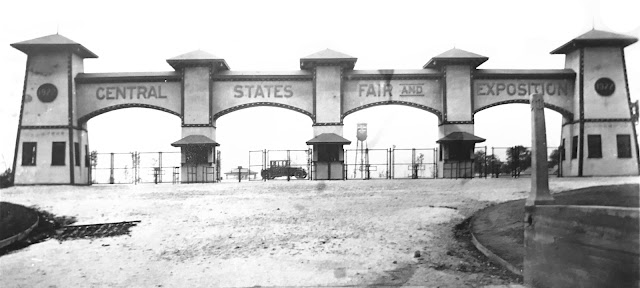
The decline came quickly after the war. Local people had their own automobiles. They could go longer distances for their entertainment. The opening in 1922 of the Central States Fair and Exposition (Exposition Park 1922-1931) in North Aurora was probably "the last nail in the coffin." Exposition Park featured a large swimming pool, many amusements and a race track. The ball fields at Exposition Park took away one of the major sources of revenue for Fox River Park. Finally, the interurban line to Yorkville was abandoned in January of 1925. It seems that Fox River Park was abandoned at the same time.

For several years after the close of the park, the old entrance light stands could be seen overgrown with weeds. The auditorium, the last building remaining on the property, was dismantled in the late 1920's. In addition, the old Fox River line city cars were scrapped on the siding in the late '20's. Even after the park was closed, Boy Scout outings were held on the campgrounds. 

The property was later sold. Part of it was subdivided and a large factory was built on a portion of the site. In recent years the factory has become the Montgomery plant of the Western Electric Company. The company has managed to maintain some of the beauty of the former wooded park along the banks of the Fox River. 

Compiled by Neil Gale, Ph.D. 

Exposition (Amusement) Park, Aurora, Illinois (1922-1931)

In 1921, Frank Thielen sold much of his investment in Aurora theaters and formed the Northern Illinois Fair Association, later to be known as the Central States Fair and Exposition Park. Founded on February 17, 1922, the 121 acre facility was located north of Aurora on North Lake Street Road (old Lincoln Highway). The facility grew to be one of the largest outdoor recreation centers in the Midwest.
The park operated from Easter until late fall, with the summer months being the busiest period; particularly the months of August and September, when the Central States Fair was held. The fair brought in as many as 75,000 persons during its usual nine day run. Agricultural exhibits and competition were the focuses of the fair, but fireworks, special band concerts, horse racing, auto racing, drum corps, balloon ascensions, and other attractions were added to the already long list of entertainment options available regularly at the park.
Front Entrance and Ticket Booth.

Fireworks, auto and airplane stunt shows, daredevils, locomotive collisions, and countless other unique forms of entertainment brought visitors in droves. The park also hosted sporting events such as baseball, wrestling, football, horse racing, auto racing and rodeos. Picnicking was always popular at the park.
Permanent offerings at Exposition Park included a 130 room hotel; the “world’s largest swimming pool,” measuring 320 feet by 160 feet; a race track with grand stand; a golf course; a beautiful pergola filled with imported flowers, birds and exotic animals; and a restaurant that later became a ballroom, roller skating rink and exhibit hall, situated in what was said to be the “world’s largest log cabin.” A “Kiddie Amusement Park” contained a roller coaster (the Exposition Flyer); tilt-a-whirl; Ferris wheel (the “Swooper”); a pony track; the House of Fun; “Monkey Island” with live monkeys; the “Ol’ Mill” boat rides; a penny arcade; “Leapin’ Leana” children’s playground; a miniature railroad (the “Exposition Limited’) and other attractions.
The largest crowds lasted throughout the 1920s, but depression years saw declining attendances. The Fair was ended after 1931, but the park remained opened on a limited scale until World War II. During the war, many of the buildings were used to house military goods. The merry-go-round and miniature railroad were sold to Chicago’s Riverview Park, and in 1957, the park was demolished to make room for new development. The Exposition park race track was revived as Aurora Downs but was not long lived.

Compiled by Neil Gale, Ph.D. 

Wednesday, August 22, 2018

The Southeast corner of Lake and LaSalle streets, Chicago

This is a balloon frame building on the Southeast  corner of Lake and LaSalle streets across from the Marine Bank building in 1856. The balloon frame structure built c.1845.

Abraham Lincoln Ribbons.

The above ribbon one is a Memoriam ribbon which was worn by people shortly after Lincoln’s assassination in April 1865; he was fifty-six years old.

The ribbon above was worn by people commemorating the 100th Anniversary of Abraham Lincoln’s birthdate of February 12, 1809.

Tuesday, August 21, 2018

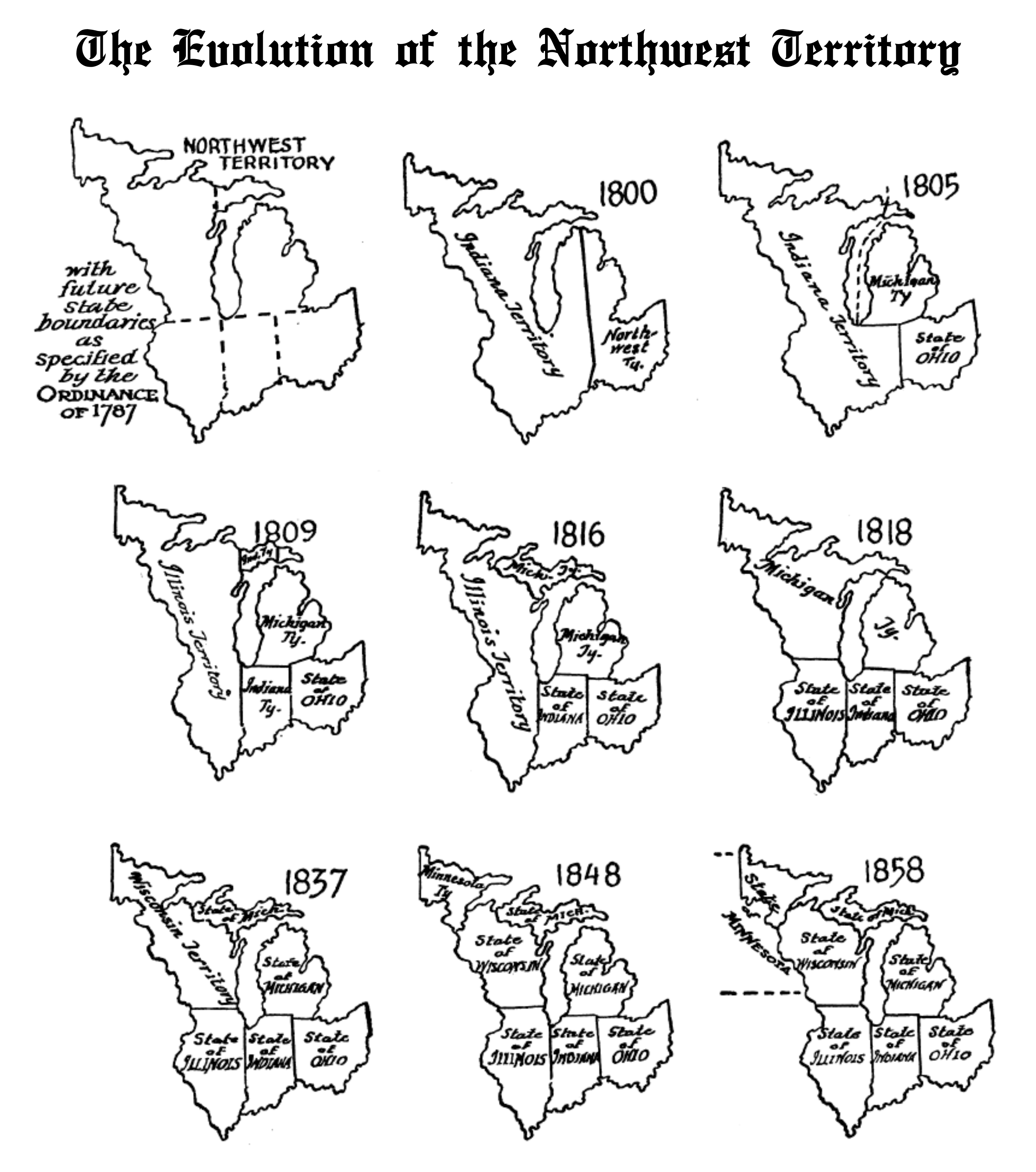
The Ordinance of 1787 and Old Northwest Territory.

CLICK IMAGE FOR A FULL SIZE VIEW
The Ordinance of 1787 and Old Northwest Territory. This series of maps gives a capsular explanation of the evolution of the old "Northwest Territory" into the six states of Ohio, Indiana, Illinois, Michigan, Wisconsin and Minnesota. 

Willard F. Myrick (1809-1889), a brief biography of a Chicagoan.

Willard F. Myrick arrived in Chicago in October of 1836 from the shores of Lake Champlain, Vermont, where he was born. Soon after his arrival in Chicago, he bought 70 acres on the lakefront between the present 35th and 43rd streets.
Myrick's stockyard on 28th Street is an ancestor of Union Stock Yards. He opened "Myrick's House" in 1839 which was a noted stop for drovers and cattlemen to buy food and drinks and enjoy shadier entertainments. Over the next few years, Myrick added a hotel, barrack style apartments, a betting parlor, and a racing track at 29th and Cottage Grove. All flourished in the rapidly growing city, often to the dismay of respectable citizens. 
The drawing depicts Myrick's operation in the mid-1840s.
Chicago's first census shows 398 dwellings, grocery [EXPLANATION], and provisions stores and 29 (green) groceries. Taverns outnumbered churches but not lawyers.

In 1854 John B. Sherman bought it and expanded the operation. All the local stockyards were eventually acquired by Sherman and consolidated to form the massive Union Stockyards in 1865.

Myrick Avenue, now Vernon Avenue, was named after Willard F. Myrick. Myrick is buried in the Oak Woods Cemetery, Chicago.

Compiled by Neil Gale, Ph.D.