Thursday, April 28, 2022

Camp River Dubois and the Lewis and Clark State Historic Site, Hartford, Illinois.

THE LEWIS & CLARK STATE HISTORIC SITE


The exact location of Meriwether Lewis and William Clark's Camp River Dubois (Dubois "wood" in French), their winter campsite, is unknown, and no physical evidence has been found. Guided by Journal entries, Clark's rough sketches, and maps, historians have deduced the look and general location of this historic camp.


The Lewis and Clark State Historic Site has been established south of the actual winter campsite of the Expedition in Hartford, Illinois. It is located on the east side of the Mississippi across from the present mouth of the Missouri River, as the original camp was. However, the rivers have altered their courses, making the actual site inaccessible and impossible to pinpoint.

The replica fort is about six miles from the mouth of River Dubois and has the same basic footprint as in Clark's rough sketches found in his field notes, including two detailed sketches with measurements. Journal entries described a collection of log huts that comprised the camp, similar to today's camp, and its relative position to the Missouri and Mississippi Rivers.

The reconstruction was completed with careful consideration of the raw materials and tools available to the men. Standard military construction techniques, styles, and other military forts of the era were studied, as well as time allocations and the men's level of craftsmanship. Layouts of the expedition's other two winter encampments at Forts Mandan and Clatsop were also considered. The replica is the best estimate of what the 1803-1804 camp looked like.


A BRIEF LEWIS & CLARK HISTORY
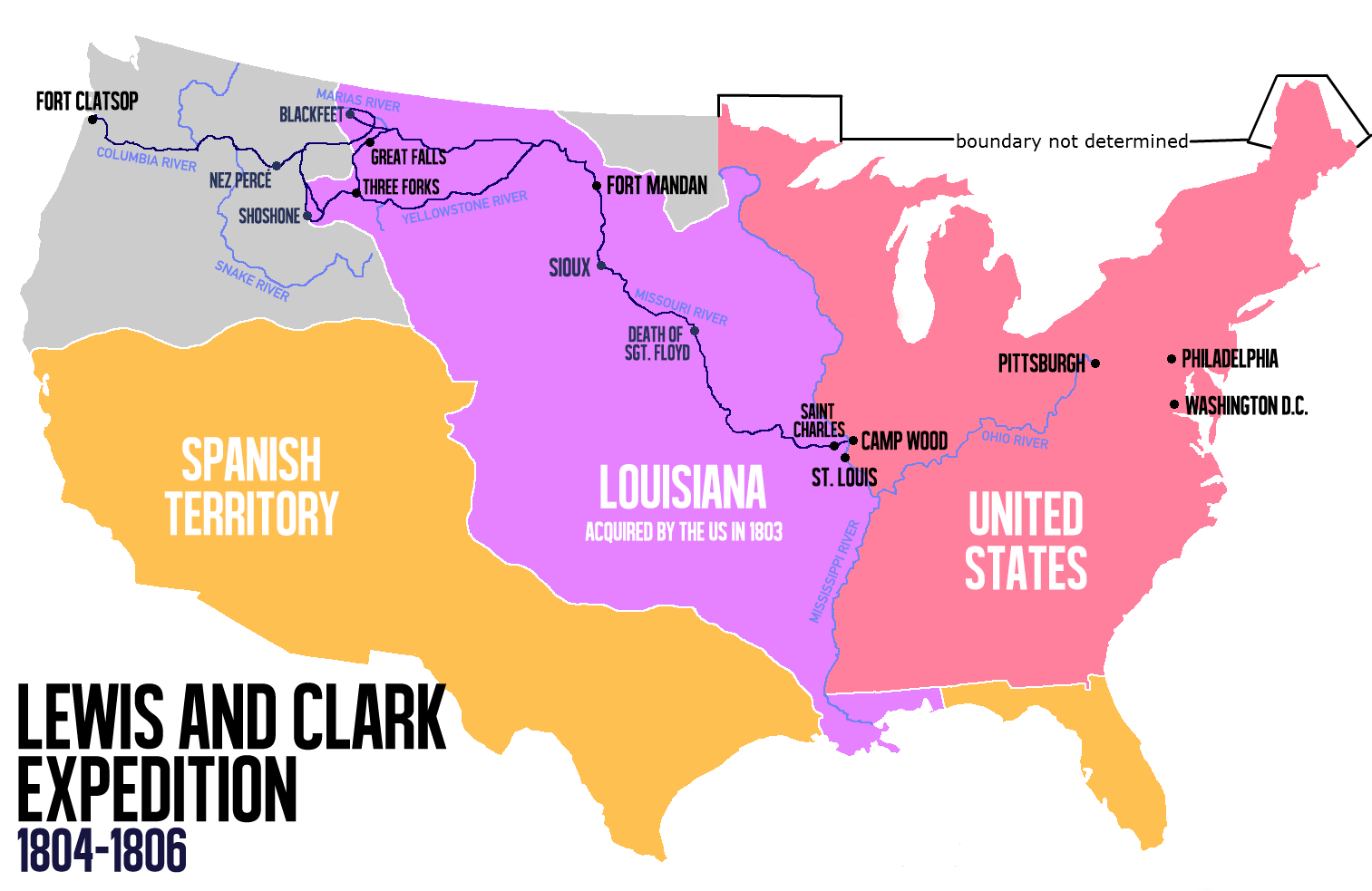
Camp River Dubois, near present-day Wood River, Illinois, served as the winter camp for the Lewis and Clark Expedition, also known as the Corps of Discovery Expedition, from December 12, 1803, to May 14, 1804.

Founded at the confluence, Rivière du Bois (Wood River), it was located on the east side of the Mississippi River, so it was still in United States territory. This was important because the transfer of the Louisiana Purchase to France from Spain did not occur until March 9, 1804, and then from France to the United States on March 10, 1804.

At Cahokia, Lewis and Clark had met a well-known French citizen, Nicholas Jarrot, who owned 400 acres on the du Bois, and he agreed to let them camp there. William Clark arrived at Camp Dubois first with a group of men that he recruited from Kaskaskia and Fort Massac on December 12, 1803. There, they constructed a frontier fort. Captain Meriwether Lewis joined the camp several weeks later after gathering information about Upper Louisiana and the west from Cahokia, Kaskaskia, St. Louis, and other locations. Also, during this time, Lewis took the opportunity to smooth relations with the Spanish authorities in St Louis to make the transfer of the Louisiana Purchase easier.

Camp Dubois was a fully operating military camp. Soldiers stationed at the camp were required to participate in training, maintain personal cleanliness, police the camp, and perform other duties spelled out by the United States military. They had inspections, marched, stood guard duty, and hunted to supplement their military rations. Sergeant John Ordway was in charge of the camp during periods in which Lewis and Clark were away.

On May 14, 1804, the Expedition, under Clark's command, left Camp River Dubois on the east side of the Mississippi River and sailed up the Missouri River. It was the first American expedition to cross what is now the western portion of the United States. The expedition returned again to the camp on their return journey on September 23, 1806.


WHAT IS A KEELBOAT?
Meriwether Lewis listed a "Keeled Boat" in his pre-expedition shopping list. After he finally got it, he and the other journalists of the Corps of Discovery simply called it "the boat" (190 times) or, less often (32 times), "the barge." The expedition used a 55-foot Keelboat, which could be sailed, rowed, poled like a raft, or cordelled (a towline especially used on keelboats).


In this historical context, "keelboat" refers to a boat used to carry cargo and/or passengers along narrow river waterways. The boat derives its name from its primary structural component: a long beam stretching along the body's bottom or hull. The feature serves two functions; providing a solid foundation for the boat's structure and helping guide the boat forward as it moves along waterways.
A Cutaway of the Lewis and Clark Keelboat.


Builders created a long, wide cigar-shaped boat that could easily navigate rivers, canals, and other tight water spaces. Its size allowed for bulk carrying, and the ease with which the boat was navigated also made it useful for traveling against the water flow.

Lewis and Clark utilized a keelboat for much of their adventure. Individuals who sought a settlement in different regions also found the vessels useful, and the arrival of a keelboat often signaled the beginning of the regional expansion. If a keelboat transported several people, it usually contained an onboard cabin. Otherwise, the deck was open.

Keelboats were not motorized and thus did not have electrical or other means of self-sufficient power. As a result, sails, poles, or oars were used to propel and navigate the boat. For this reason, the keelboat was often referred to as a "pole boat." As one might imagine, steering a boat that could be up to 80 feet long was often a challenge, and several individuals were usually needed to accomplish this task. In shallow waters, the men often tied ropes to the boat's bow and pulled it along from the shoreline.

Compiled by Dr. Neil Gale, Ph.D.

Wm. Pethick Murders a Young Mother and her 2 year old in 1915. Now, for the Rest of the Story.

On May 6, 1915, a 22-year-old man named William Russell Pethick worked as a deliveryman in Chicago when he delivered groceries to a home owned by the Coppersmith family. Ella Coppersmith, age 28, was home with her two-year-old son Jack. 

Ella attempted to pay Pethick with a ten-dollar bill, and a dispute arose over the change. At one point, Pethick reached for Ella’s blouse, and she hit him in the face. He fractured her skull with a hammer. Pethick grabbed a kitchen knife and stabbed her repeatedly. As she lay dying, her two-year-old son came into the kitchen. 


Thinking the boy could identify him, Pethick killed him by slashing the boy’s throat. Then this happened... Pethick, a necrophiliac, sexually abused Ella Coppersmith's corpse (from Clarence Seward Darrow's court docket; Pethick's lawyer).

The site of the murders at 7100 South Lowe Avenue in the Englewood community of Chicago is a well-maintained, empty lot.
May 20, 1915
NOTE: Clarence Seward Darrow followed the news about the murders and was fascinated by the case. He was convinced that Pethick was mentally ill. He offered to defend the accused, and Pethick’s father gladly accepted. Darrow knew that a jury would very likely convict his client instead of finding him not guilty by reason of insanity.
 
Darrow surprised the prosecution by having Pethick plead guilty on the first day of trial. Darrow then pleaded with the judge to take into account Pethick’s mental defects to mitigate punishment. He brought in experts to testify about Pethick’s mental problems. The prosecution tried to counter the defense’s testimony. In the end, the judge sentenced Pethick to life in Joliet prison instead of the death penalty.
 
In several ways, the case was a dress rehearsal for the Leopold and Loeb case in 1924. Pethick spent 47 years in prison before being paroled on December 21, 1962. According to a news account, Pethick was paroled to the Salvation Army and would live and work at the Men’s Social Service Station in Chicago.

Coppersmith is buried at Mount Olivet Catholic Cemetery, Chicago, Cook County, Illinois.


DOUBLE SLAYER OF COPPERSMITHS BELIEVED CAUGHT
Chicago Tribune, May 13, 1915

The murderer of Mrs. Ella Coppersmith and her 3-year-old son, who was slain in their residence at 7100 South Lowe Avenue a week ago today, is believed by the police to be in custody.

The suspect and two companions were arrested yesterday. Secrecy as to the man's identity is maintained by the detectives. The capture was of such importance that Chief Healey was informed of it.

A sore finger on the left hand of the suspect is one of the reasons for believing that he is the slayer of mother and son. A rag that had slipped, or was torn from the murderer's finger, was found on the kitchen floor of the Coppersmith house.

At what station the suspect and his two companions are locked up could not be learned. It was said, however, that they were arrested In a West Madison street "barrelhouse" and taken to an outlying station.

From a habitué of the saloon in which the three men were arrested, the detectives learned the trio robbed a clothing store in South Chicago on Monday night. Part of the proceeds of the burglary was peddled along "West Madison Street.

The police Informant overheard the three men discussing the clothing store "job," and they also mentioned the Coppersmith case.

One of the men - the one with the sore finger - was heard to say he was going to get out of town. "Wagon" and "alley" were words that were heard by the stool pigeon who "tipped" the police. It Is known that a wagon was In the alley at the rear of the Coppersmith home at the time of the murder.

"What are you getting scared about?" one of the men asked the man with the sore finger." The police have pinched three or four fellows for the job, and they don't know where they're at."

After further conversation, they planned to go to Gary, Indiana, last night to do a "job" there. The man who had overheard the talk notified a detective who had once befriended him. The arrest of the trio, all ex-convicts, followed.

Each of the prisoners was questioned about the Coppersmith murder, but all of them denied knowledge of the case except what they had read in the newspapers. The one suspected of the murder said he had been in this city only since last Saturday.


VICTIM'S MATE FIGHTS PAROLE FOR KILLER OF TWO
Chicago Daily Tribune, July 2, 1956

Rape Murderer Serving Life Since 1915. (41 years)

William Russell Pethick, now 62, who pleaded guilty to the 1915 knife slayings of a Chicago mother and her infant son, will seek his freedom from a life sentence in a hearing before the state parole and pardon board on July 10th at Stateville Prison (maximum security) in Crest Hill, Illinois.

The victims of the slayings were Mrs. Ella Coppersmith, 28, and her son, John Jr. They were killed in their home at 7100 South Lowe Avenue on May 6, 1915. Pethick was sentenced on September 28, 1915.

Mate Opposes Plea. Mrs. Coppersmith's husband, John now of Washington, Wisconsin, opposed Pethick's plea for freedom.

In a letter to the board, Coppersmith wrote that only the wiles of the late Clarence Darrow, who defended Pethick, saved Pethick from the hangmen. Coppersmith labeled the killings cruel and senseless.

Fingerprints, which at that time were not widely used as a method of identification, led to Pethick's capture and confession. A ruse was used to get Pethick's fingerprints, and police matched them to bloody ones found in the home.

Returns with Knife. Pethick, then 22, delivered a grocery order to the Coppersmith home. He told the young wife he didn't have change and would return in the afternoon. When he returned, he carried a butcher knife with which he slashed the woman s throat.

Pethick raped her as she lay bleeding on the floor. When the child entered the room, Pethick slashed his throat. He ransacked the home, stealing $100 and a gold wristwatch. Police later recovered the wristwatch from a drain in the shop where Pethick worked.

Compiled by Dr. Neil Gale, Ph.D.

Tuesday, April 26, 2022

Lincoln's Connection to Camp Kane, Civil War Training Camp, St. Charles, Illinois.


John Franklin Farnsworth was a resident of St. Charles. He was an attorney, founder of the Republican Party, congressman, as well as a personal friend of Abraham Lincoln. In 1858, he advised Lincoln during the famous Lincoln-Douglas debates, and in 1860 nominated Lincoln for president during the Republican Party Convention. Farnsworth was also called to the bedside of the dying President at the Petersen House after Lincoln was shot at Ford's Theatre in 1865. 
John Franklin Farnsworth


Without Farnsworth's influence, Camp Kane would not have been so successful. Farnsworth had no problems in fulfilling the 1,200-man quota. Approximately one in six men from St. Charles served in the regiments. Recruits also came from as far as Indiana, Iowa, and Michigan.

After the Civil War began, Farnsworth requested permission from his friend, President Lincoln, to commission a volunteer cavalry regiment and train them in St. Charles, Illinois, on property Farnsworth owned. The commission was approved on August 11, 1861. Abraham named the new regiment "Farnsworth's Big Abolitionist Regiment." Farnsworth was promoted to Colonel.

Camp Kane officially opened for training on September 18, 1861, with 1,164 men who mustered in. It was the only Civil War Training Camp in Kane County that became home to the 8th Illinois Cavalry and later the 17th Illinois Cavalry. 

In February 1864, extensive barracks were built on the Lovell property, in the north part of the city, which received the designation of Camp Kane, and in February 1864, these were temporarily occupied by the Fifty-second Regiment, then at home for a short time. The regiment received large accessions from the place on a redeparture for the front in March of the same year, and in the June following the One Hundred and Fortieth Illinois Volunteers, marched from Camp Kane. Elgin contributed two companies to the regiment. Besides these mentioned, Elgin contributed many soldiers to other organizations, and from the day, in the early spring of 1861, that the first company left it, until the happy midsummer, four years after, that the war's last veteran marched proudly home, Elgin was never derelict to the calls of the struggling, but at last victorious republic.

Colonel Farnsworth was close friends and political allies with Joseph Medill, Chicago Tribune Editor, and co-owner. Medill was also an abolitionist and used the Tribune for the cause. Once approval was granted to form the 8th Illinois Cavalry, Medill promoted recruiting in the Tribune. Even William Medill, Joseph's brother volunteered. 

Despite its size, St. Charles gave one of the largest quotas of troops in all of Kane County. St. Charles residents such as General Farnsworth, Captain Elliott, Major Van Patten, Major John Waite, Captain Beach, Captain McGuire, Colonel Gillett, Major (Judge) Barry, Lieutenant Durant, and Dr. Crawford all aided in the war effort. These names are among the most important in the history of St. Charles..
Following the war, men of the 8th Cavalry continued to serve their country. In April 1865, they took part in the search for Abraham Lincoln's assassin, John Wilkes Booth, and also guarded the President's body.
Located on the east bank of the Fox River, Camp Kane, Civil War Training Camp, St. Charles, Illinois.


The 8th Illinois Cavalry's honors included battles such as Mechanicsville, Antietam, Fredericksburg, and most notably Gettysburg, where it was the 8th Illinois Cavalry's Lt. Marcellus Jones who fired the first shot of the famous battle. Confederate Colonel John S. Mosby "The Grey Ghost" called the 8th Illinois Cavalry "The best cavalry regiment in the Army of the Potomac." On a more sorrowful note, the 8th Illinois Cavalry also had the disheartening yet distinguished honor of being the honor guards for  Lincoln's funeral train.  
A Reenactment Photograph.


General Farnsworth and Colonel John Beveridge commissioned the 17th Illinois Cavalry in early 1863. Most of their service was in Missouri. They trained at Camp Kane in the early months of 1863 and Camp Kane remained an active training camp until early 1864.

Visit Camp Kane at Langum Park at 999 South 7th Street, St Charles, Illinois.

Compiled by Dr. Neil Gale, Ph.D.

Monday, April 25, 2022

The History of the Western Electric Plant, Hawthorne Works, Cicero, Illinois.

THE HAWTHORNE WORKS
The Hawthorne Works was a large Western Electric Company factory complex in Cicero, Illinois. 

Cicero began as separate settlements that gradually expanded into one community. On June 23, 1857, a local government was organized for the district named "The Town of Cicero." Railroads, immigration, and the Civil War contributed to economic growth in the new township, which by 1867 incorporated the municipality and the Town of Cicero.

By 1889, Chicago had annexed more than half of the original Town. An 1899 referendum ceded the Austin neighborhood to Chicago, and in the following year, land containing a race track was transferred to Stickney Township. The Town of Cicero retained less than six of the 36 square miles carved out in 1849.

Cicero comprises eight neighborhoods, each with its own district names and characteristics. Two were named for businesses: Hawthorne for an 1850s quarry, the first industry in what later became Cicero, and Grant Works after an 1890 locomotive factory. The other six are Boulevard Manor, Clyde, Drezel, Morton Park, Parkholme, and Warren Park.
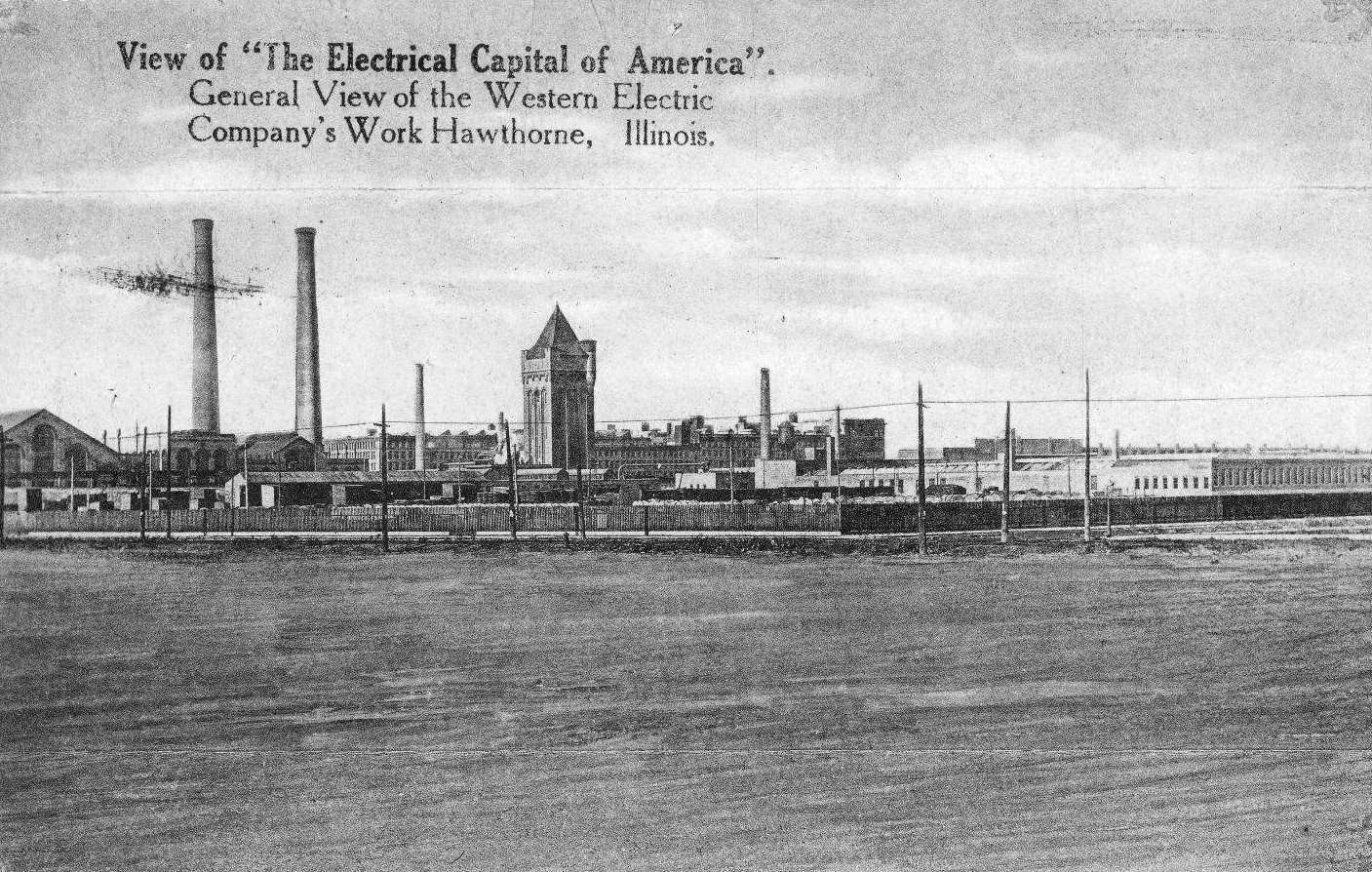
The grazing cow in the foreground is apparently undisturbed by the rapid expansion of Hawthorn Works nearby. This 1907 view from Cermak Road shows the first Telephone Apparatuses buildings shortly after completion, and the corner building with its distinctive water tower did not start until 1912.


1920
1925
The Hawthorne Works complex was built at Cicero Avenue and Cermak Road. The facility consisted of several buildings and contained a private railroad, "Manufacturers Junction Railroad," to move shipments through the plant to the nearby Chicago, Burlington, and Quincy Railroad freight depot. In the first decades, the factory complex was significantly expanded.

Charles M. Prchal was born in 1896 in Golcuv Jenikov, a small town southeast of Prague, then part of the Austro-Hungarian Empire, now in the Czech Republic. In August 1911, he journeyed alone to America and settled in Chicago, furthers his education at night school, finds employment at Western Electric’s Hawthorne Works, and builds a lifelong career there. It’s a scenario repeated thousands of times at General Electric's Hawthorne Works, but it’s backed by fact, not legend. 
Charles M. Prchal
Prchal joined Western Electric in 1918, just as the Hawthorne Works launched another of its frequent expansion projects. He worked days while studying architectural drafting and structural engineering at night school. 

His first big assignment was the design of the seven-story tower at the northwest corner of the Works complex. The 183-foot-tall red-brick spire housed the elegant executive offices on its top floor. At its dedication in 1919, Western Electric president Charles DuBois proclaimed the structure the symbol of Hawthorne’s past and future, created by “hard work of hand and brain, and square dealing with everyone.” At the Works Silver Jubilee in 1978, Prchal agreed that the tower had “always been a symbol of the promise of sixty years ago—the promise of a great manufacturing plant and its thousands of employees producing important equipment.”

Later in his career, Prchal designed the Tivoli Theater in Downers Grove and the domed mausoleum at Chicago’s Bohemian National Cemetery. He also served for thirty-two years as the president of the American Sokol, an organization dedicated to preserving Bohemian culture and providing guidance to youth through social and athletic programs. After a forty-three-year career, Prchal retired from Western Electric but remained active as a lecturer, author, and member of many social and fraternal societies until he died in 1980.

Although his most impressive design has been gone since 1987, the image of Mr. Prchal’s tower still represents the Hawthorne Works to everyone who recalls its glory days. And his life story illustrates the accomplishments of the many humbly-born immigrants who found an outlet for their potential during America’s industrial golden age.

In 1915, Western Electric was associated with one of the worst accidents in Chicago's history. The SS Eastland, a boat filled with Hawthorne Works employees and family members attending the company's annual outing, capsized at its dock in the Chicago River, killing over 800 people.
A view of the hospital and gas plant in a garden setting.


Researchers at the Hawthorne Works pioneered new technologies such as the high-vacuum tube, the condenser microphone, and airplane radio systems during the 1910s.

By 1917, the Hawthorne Works facility employed 25,000 people, many Cicero residents of Czech and Polish descent, who produced telephone, cable, and every major telephone switching system in the country. In 1900, 676,733 Bell Telephone stations were owned and connected in the country. By 1910, three years after Hawthorne Works opened, these 25,000 employees produced 5,142,699 telephones, and by 1920, 11,795,747 Bell telephones. Over 14,000 different types of apparatus were manufactured at the plant to provide the telecommunications infrastructure for this exponential growth. During the plant's early years into the 1920s, Western Electric was also a major producer of household appliances.

During the Great Depression (1929-1933), the company laid off thousands of workers, but business recovered during World War II. During the war years, when it was subject to federal rules for government contracts, the company began to employ negroes for the first time.

On the eve of World War II (1939-1942), roughly 90% of demand for Western Electric's products came from one customer, the Bell System. By mid-1941, 85% of the demand for products came from the federal government, for which the company provided more than 30% of all electronic gear for war, including radar equipment.

When World War II (1939-1942) started, the U.S. government called on Hawthorne Works to engineer and manufacture mass quantities of the most modern and capable communications and radar equipment.
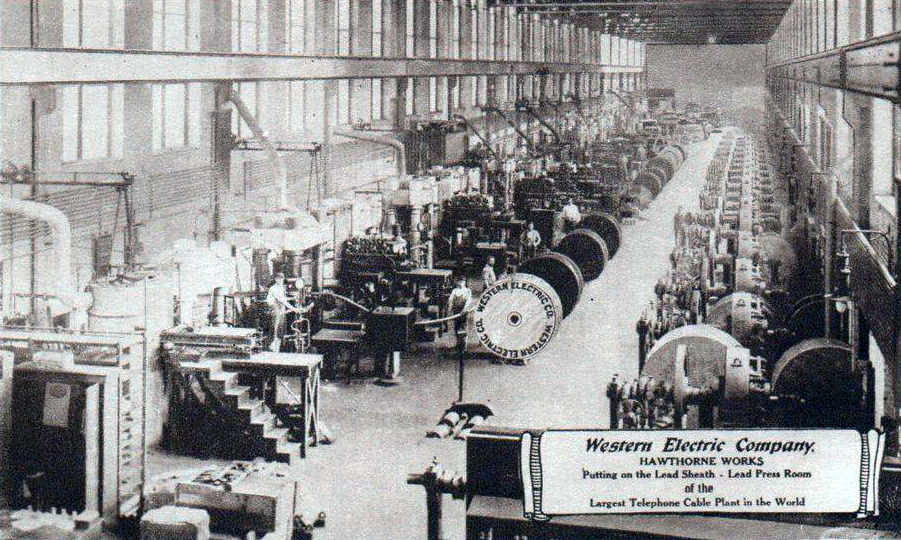
The area where lead sheaths were placed around the cord.

Employees rolling the telephone wires.


The Hawthorne Works produced a large output of telephone equipment. In addition, Western Electric produced various consumer products and electrical equipment, including refrigerators and electric fans. 

The works employed up to 45,000 employees at the height of operations in WW II. Workers regularly used bicycles for transit within the plant.


WESTERN ELECTRIC PERKS LEAD TO EMPLOYMENT LONGEVITY
Hawthorne Works benefited greatly by keeping workers happy. There were company-owned, not-for-profit restaurants and cafeterias within the complex. Employees of all statures could have quality hot breakfasts and lunches at drastically reduced prices. 

Other perks included a hospital and numerous "first-aid" rooms spread around the complex; a shoe store; eye care, glasses, and repairs; a store that carried items like men's ties, greeting cards, sundries, snacks, and even women's nylons.

Hawthorne recognized individual milestones in employment with service pins and a dinner. Retirement celebrations were quite elaborate. The entire department would be invited to a fancy dinner, a boutonnière for the retiree, and a corsage and beautiful flower arrangement for the retiree's wife.

THE HAWTHORNE CLUB
    • Club Evening School offered over 60 subjects, i.e., English, Languages, First Aid, Drafting, Accounting, Telephony, and more.
    • Health Appearance Personality course, free of charge for women only.
    • Hawthorne Club Library est. 1940.
    • Athletic Activities: Baseball, Basketball, the Albright Gymnasium, Tennis, Golf for Men and Women, Bowling for Men and Women, Horseshoe Courts, and the Rifle Club.
    • The Club's services included a Notary Service, Classified Ads, Young Men's Activities, Theater Bureau, and a Travel Bureau.
As a means of providing outlets for the many Hawthorne Works employees who have interests or hobbies in common, a number of associated clubs have been formed; the Boot and Saddle Club, Camera Club, Chess and Checker Club, Coin Club, Excursion Club, Flower and Garden Club, The Forum, Players Club, Hunting Club, Fishing Club, Male Chorus, Mixed Chorus, Science Club, Stamp Club, and the Flying Club.

BOOKLET: The Hawthorne Club was founded for Fellowship. 

Western Electric Hawthorne Works Albright Gymnasium and outdoor track at Cermak & 52nd Avenue. (1930s)


But the pièce de résistance was the yearly "Hello Charley Girl" contest.

The Origin of 'Hello Charley.'
Newcomers were often confused during the Merrimack Valley Works, North Andover, Massachusetts (opened 1953), "WE Valley Girl" Contest by long term employees referring to the Queen as the "Hello Charley Girl."

Originally a vacation queen contest. The winner took the name of the greeting that Western Electric employees used when discovering a fellow "Westerner" on vacation. 

Why "Hello Charley" and not Phillip? 
 
The greeting grew from an incident involving Charley Drucker, a benefits serviceman in the old days of the Hawthorne Works in Cicero, Illinois. A pensioner whom he had visited wrote him a letter addressed "Charley, Western Electric." Since the retiree had not remembered Charley's last name, the letter made the rounds until finding the right Charley. 

Since this letter people began addressing each other as "Charley Western." Soon the greeting spread throughout the company. Every location nationwide has its vacation queen.
The "Hello Charley Girl" being crowned the winner in 1948, posing for a formal portrait.
THE DEATH OF THE HAWTHORNE WORKS
The Hawthorne Works announced its closing in 1983 because most of its operations had been distributed to more modern facilities around the country. In 1986, the shutdown was completed. The Foundry and most Telephone Apparatus buildings were demolished between 1975 and 1983. The remaining Telephone Apparatus buildings and the Executive Tower were razed in 1986 and 1987. The rest of the Hawthorne Works was demolished in 1994.

The only survivors are the Water Tower and the Cable building at 4545 West Cermak Road.

The property was purchased in the mid-1980s by the late Donald L. Shoemaker and replaced with a shopping center.


Due to Hawthorne's significance in industrial manufacturing in the United States, the Hawthorne Works was the site of well-known industrial studies.

THE HAWTHORNE EFFECT
The Hawthorne effect is named for the Hawthorne Works. North American Quality pioneer Joseph Juran referred to the Hawthorne Works as "the seedbed of the Quality Revolution." The career arcs of other notable quality professionals, such as Walter Shewhart and Edwards Deming, also intersected at the Hawthorne Works.

The term "Hawthorne effect" refers to reactivity in which individuals modify an aspect of their behavior in response to their awareness of being observed. The industrial psychology series of experiments began in 1924. It was first observed in data from the Hawthorne Works collected by psychologist Elton Mayo and later reinterpreted by Henry A. Landsberger, who coined the term in 1958.

This well-known and remarkable effect was discovered in research conducted at the Western Electric Hawthorne Works plant. However, some scholars feel the descriptions are apocryphal (of doubtful authenticity, although widely circulated as accurate).

The original research involved workers who made electrical relays at the Hawthorne Works. Between 1924 and 1927, a famous lighting study was conducted. Workers experienced a series of lighting changes in which productivity was said to increase with almost any change in the lighting. This turned out not to be true. In the study associated with Elton Mayo, which ran from 1928 to 1932, five women implemented work structure changes (i.e., rest periods). However, this methodologically poor, uncontrolled study did not permit any firm conclusions.

One of the later interpretations by Landsberger suggested that the novelty of being research subjects and the increased attention from such could lead to temporary increases in workers' productivity. This interpretation was dubbed "the Hawthorne effect."

RELAY ASSEMBLY EXPERIMENTS
In one of the studies, researchers chose two women as test subjects and asked them to choose four other workers to join the test group. The women assembled telephone relays in a separate room for over five years (1927-1932).

Output was measured mechanically by counting how many finished relays each worker dropped down a chute. This measuring began in secret two weeks before moving the women to an experiment room and continued throughout the study. In the experiment room, they had a supervisor who discussed changes in their productivity. Some of the variables were:
  • Given two 5-minute breaks (after discussing the best length of time), then changed to two 10-minute breaks (not their preference). Productivity increased, but they disliked it and reduced output when they received six 5-minute rests.
  • Providing food during the breaks.
  • Shortening the day by 30 minutes (output went up); trimming it more (output per hour went up, but overall production decreased); returning to the first condition (where output peaked).
Changing a variable usually increases productivity, even if the variable was just a change to the original condition. However, it is said that this is the natural process of the human being adapting to the environment without knowing the objective of the experiment. Researchers concluded that the workers worked harder because they thought they were being monitored individually.

Researchers hypothesized that choosing one's coworkers, working as a group, being treated as unique (as evidenced by working in a separate room), and having a sympathetic supervisor were the real reasons for the productivity increase. One interpretation, mainly due to Elton Mayo, was that "the six individuals became a team, and the team gave itself wholeheartedly and spontaneously to cooperation in the experiment." (There was a second relay assembly test room study with less significant results than the first experiment.)

BANK WIRING ROOM EXPERIMENTS
The purpose of the following study was to find out how payment incentives would affect productivity. The surprising result was that productivity decreased, and workers apparently had become suspicious that their productivity may have been boosted to justify firing some workers later. 

The study was conducted by Elton Mayo and W. Lloyd Warner between 1931 and 1932 on a group of fourteen men who put together telephone switching equipment. The researchers found that although the workers were paid according to individual productivity, productivity decreased because the men feared the company would lower the base rate.

Detailed observation of the men revealed the existence of informal groups or "cliques" within the formal groups. These cliques developed relaxed rules of behavior and mechanisms to enforce them. The cliques served to control group members and manage bosses. Clique members gave the same responses when bosses asked questions, even if they were untrue. These results show that workers were more responsive to the social force of their peer groups than to the control and incentives of management.

INTERPRETATIONS
Possible explanations for the Hawthorne effect include the impact of feedback and motivation toward the experimenter. Receiving feedback on their performance may improve their skills when an experiment provides this feedback for the first time. Research on the demand effect also suggests that people may be motivated to please the experimenter if it does not conflict with any other motive. They may also be suspicious of the purpose of the experimenter. Therefore, the Hawthorne effect may only occur when there is useable feedback or a change in motivation.

Elton Mayo contended that the effect was due to the workers reacting to the sympathy and interest of the observers. He did discuss the study as demonstrating an experimenter effect but as a management effect: how management can make workers perform differently because they feel differently. He suggested that much of the Hawthorne effect concerned the workers feeling free and in control as a group rather than as being supervised. The experimental manipulations were influential in convincing the workers to feel this way, that conditions in the particular five-person workgroup were really different from the conditions on the shop floor. 

Harry Braverman pointed out that the Hawthorne tests were based on industrial psychology, and the researchers involved were investigating whether workers' performance could be predicted by pre-hire testing. The Hawthorne study showed "that workers' performance had little relation to their ability and, in fact, often bore an inverse relation to test scores." Braverman argued that the studies showed that the workplace was not "a system of a formal bureaucratic organization on the Weberian model, nor a system of informal group relations, as in the interpretation of Elton Mayo and his followers, but rather a system of power and antagonisms." This discovery was a blow to those hoping to apply the behavioral sciences to manipulate workers in management's interest.

Greenwood, Bolton, and Greenwood (1983) interviewed some of the employees in the experiments and found that the participants were paid significantly better.


Compiled by Dr. Neil Gale, Ph.D.

J.C. Reuter’s General Store, later, the Buchlitz Bakery, Freeburg, Illinois.

The "Fancy Goods" building was first owned by John C. Reuter who operated the general store on Main Street in Freeburg. Reuter also taught school from 1879 to 1885 in a one-room schoolhouse that opened in 1871. 
The "Fancy Goods" general store on Main Street in Freeburg. The Reichert Milling Company smokestack can be seen in the background.


In 1904, Paul Buchlitz purchased the building and turned the store into a bakery, and called it "Buchlitz Bakery." He had been a baker in St. Louis, Missouri, for some time. There is a very interesting story about Paul Buchlitz. Somewhat sad and yet, very mysterious.

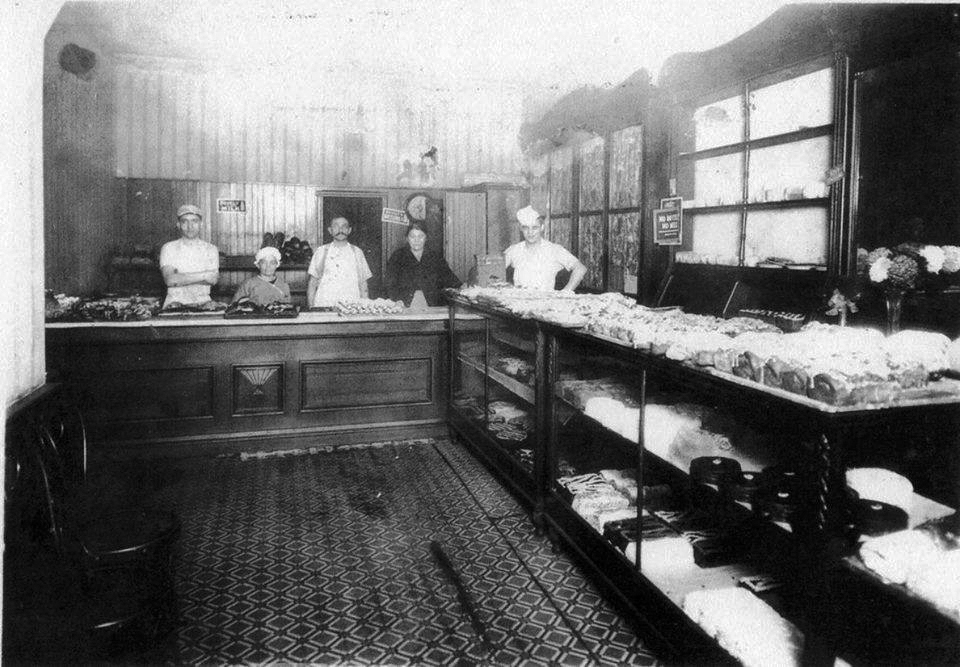
Buchlitz Bakery. Date unknown.
In January 1906, Mrs. Buchlitz suddenly died after a mysterious illness of only a few days. Her death was listed as an "Inflammation of the Bowels." In June 1906, Buchlitz married a woman that he had been bringing to his house from his supply trips to St. Louis. She came there to care for the children and act as a housekeeper, especially during the time his wife was ill. 

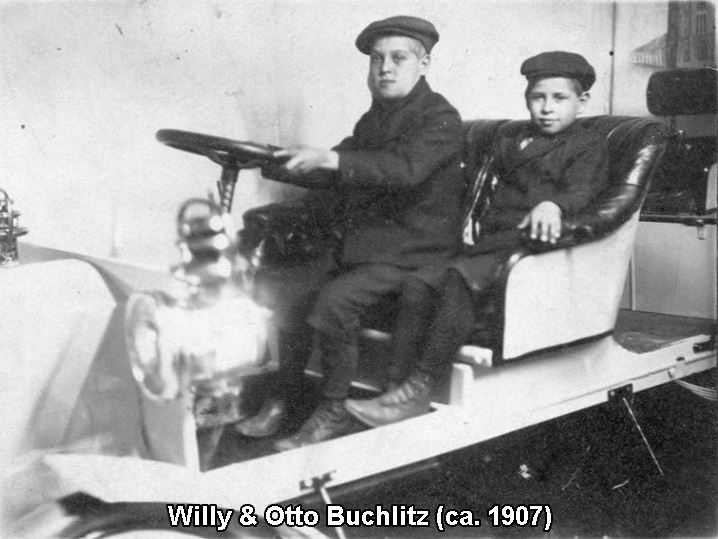
Buchlitz's daughter, Paula, died suddenly at the home after a sudden and quick illness In October 1908 from something stomach-related.


In December 1908, Buchlitz's son, Willy, suddenly died from an apparent growth on his neck.

The last remaining son, Otto Buchlitz, suddenly died in December 1908 of peritonitis (inflammation of the tissue that lines the belly or abdomen) believed to have come about from eating green apples. 

In 1913, Buchlitz was granted a divorce from his second wife Clara, whom he married shortly after the death of his first wife. In 1914, Buchlitz was arrested for a statutory offense after a married woman (Mary) was coming to his home from Belleville, bringing her 8-year-old son with her. Her husband filed charges and both were arrested. It's unknown the outcome of the arrests.

Buchlitz and Mary were married in Waterloo, Illinois in 1919.

In 1921, Buchlitz was charged with violation of the child labor law for employing a girl who was only 14 years of age. 

Mary legally changed her 18-year-old son's last name to Buchlitz in 1923. He would operate this bakery for 26 years. 

In December 1930, Harry Borger purchased the property and business from Buchlitz. He would later move the business to a building across from the village square in the center of town. Buchlitz continued to live in the Main Street residence until 1951 when Mack Gabriel, owner, and founder of the Gabriel Motel north of town, purchased the building. 


It still stands today on the corner of Main and St. Clair Streets, Freeburg, Illinois.

Compiled by Dr. Neil Gale, Ph.D.