Friday, April 22, 2022

History of the Hotel Galt, (Miami Hotel) Sterling, Illinois.

The Hotel Galt in Sterling, Illinois, was completed in 1890. It was also called the Miami Hotel because it housed the Miami cocktail lounge. The Miami Lounge was a popular mob hangout. The building burned down in December 1971.
The Hotel Galt in 1890.
The Hotel Galt in the 1940s.


Firefighter Arlyn Oetting recounted the day he got the alarm call:
The 1971 fire that destroyed the former Miami Hotel of Sterling was one of his most memorable firesThe hotel was across the street from the former Sears building downtown.

As the captain turned the corner, all he said was, “Get some help!” Oetting recalled.

“The fire was coming out the front doors of the hotel, as far out as the parking meters on the sidewalk,” he said. “When they got there, they laid a big hose line and started attacking that fire. My lieutenant and I dropped some hoses in front of the door and went down and hooked up to a hydrant there.”

Because the hotel had been remodeled numerous times, he said, the ceilings had been dropped. “The fire got into hidden spots and just ran rampant,” he said. “It went up and it started spreading.”

Oetting was stationed there most of the night and into the next day. Twenty-seven departments responded, he said. They fought the fire for more than 24 hours.

Amazingly, no one was injured.
Compiled by Dr. Neil Gale, Ph.D.

Wilson Avenue Theater, 1052 West Wilson Avenue, Chicago. (1909-1919)

On July 19, 1909, the Wilson Avenue Theater opened at 1052 West Wilson Avenue, Chicago.
It was one of the first large entertainment venues in the Uptown neighborhood, showing two vaudeville performances nightly. It was designed by Henry L. Ottenheimer and built for $50,000 ($1.6 million today) for the Jones, Linick, and Shaefer circuit. 
Wilson and Evanston (renamed to Broadway in 1913) Avenues Theater, Chicago, "High-Class Vaudeville," 1909 postcard. Note: "Theater" not theatre is the correct spelling; the postcard picture shows the correct spelling on the building twice.


The Theater had 600 seats on the main floor and 300 seats in the balcony. The interior was described as pretty, in 'buff' and 'gold' colors. There was a ceiling mural over the proscenium (the part of a theater stage in front of the curtain). The opening night show was not such a pretty sight. Acts from the American Music Hall in the Loop frequently performed there.
The Wilson Avenue Theater, 1909.


In 1919 it was converted to Fidelity Bank bank. Later, it became the Uptown State Bank, the Federal Trust, and Savings Bank, the Bank of Chicago, and finally, a TCF Bank.
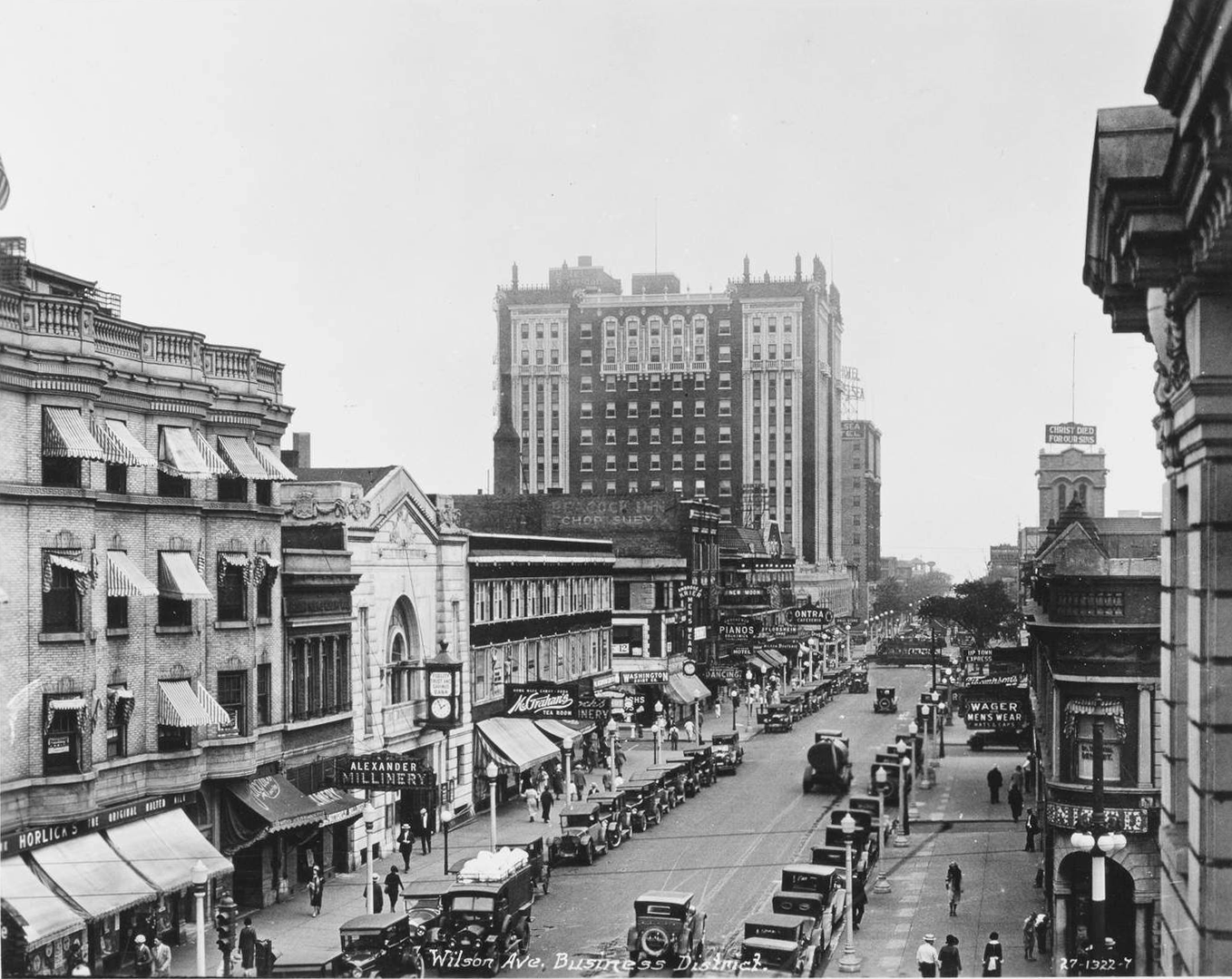
Wilson Avenue Business District 1920s.


The building has a mural visible from the El on one side and a trompe-l'œil (French: deceives the eye; highly illusionist) mural on the other side. The interior still looks like a cross between a theater and a bank.
The Wilson Avenue Theater Building Today.


In November 2018, plans were announced to convert the building into a live music venue. After 23 years in business, the beloved Double Door rock club was evicted from its longtime Wicker Park location. The Double Door is working toward a debut this year (2022) in its new Uptown home. Because Double Door’s new location was most recently a bank, a downstairs vault is being transformed into a “mini venue lounge” that will host smaller acts daily.

Compiled by Dr. Neil Gale, Ph.D.

Wednesday, April 20, 2022

Cosmo Theatre, 7938 South Halsted Street, Chicago, Illinois.

"The Cosmopolitan Theatre," seating 1,181, opened September 6, 1913, in the North Englewood neighborhood on South Halsted Street between 79th and 80th Streets. It was originally built for the Ascher Brothers circuit. It was later operated as part of the Cooney Brothers, and still later, the Warner Brothers and Stanley-Warner chains.


An article about the Ascher Bros circuit in the March 10, 1917 issue of Moving Picture World had this critique about the Cosmopolitan Theatre:
“A good deal of credit is due Bruce Goshaw for the success of the Cosmopolitan Theatre, Halsted and Seventy-ninth streets, which was the first thousand-seat house to be erected for the Ascher Bros. 

Manager Godshaw enjoyed the distinction of having managed this movie house since its opening on Saturday, September 6, 1913. This fine modern structure is situated in the suburb of Auburn Park far out in the southwest end of town and is strictly a neighborhood theater. Although in its fifth season, some of the ‘opening night’ patrons can still be seen in the audience. The foyer of the theatre is finished in marble and the general color scheme is 'old rose' and 'blue.' The equipment is modern in every detail from the box office to the operating room. Feature films are exhibited both afternoons and evenings, at an admission price of 10¢."
The Cosmo Theater as it was known in its later years, operated at least into the 1950s. 

In the 1960s it became a nightclub called "The Sunset Club." The building was demolished in 1982.

Today, a "Save a Lot" grocery store sits on the site of the old Cosmo Theater.

Compiled by Dr. Neil Gale, Ph.D.

Bowlium, 4365 North Sheridan Road, Chicago, Illinois.

December 21, 1941 - Bowlium Holds Formal Grand Opening for Four Days.


The Bowlium, Chicago's newest half-million-dollar bowling enterprise, holds its formal opening this week, starting with two singles matches tomorrow night and continuing with a program thru Friday. One of the most ornate in Chicago, the establishment is located at Sheridan road and Montrose avenue. It features 30 bowling alleys in-line and without a post to mar the view of spectators. The alleys are open 24 hours a day, and the pin boys made 11¢ a lane working behind the alleys.

Bowlium has been in operation since October, but (Frank & Bill) Helsing's Vodvil Lounge (a restaurant & burlesque night club), to be run in conjunction with the bowling establishment, has just been made ready. The lounge capacity was 325 people with drinks starting at 50¢. It was also called "Time-In Vodvil Lounge" in later years.
Bowlium already has 23 leagues operating, newest of which is the Owl circut, begun two weeks ago and already has a membership of eight teams.
Compiled by Dr. Neil Gale, Ph.D.

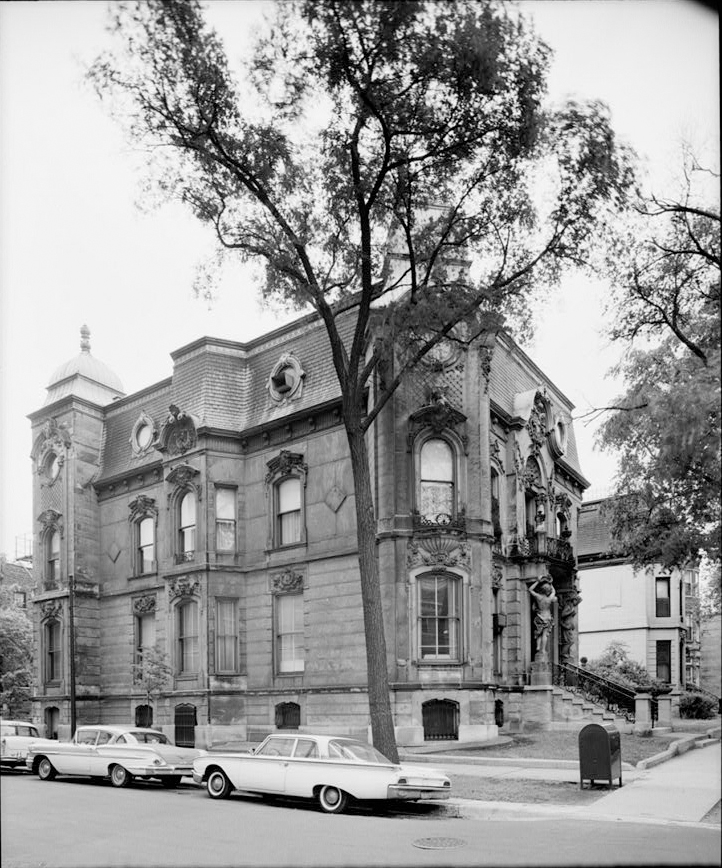
The Francis J. Dewes House, 503 West Wrightwood Avenue, Chicago, Illinois.

Francis Dewes, a Chicago brewer and millionaire, had the most elaborate home in the Lincoln Park neighborhood built. Architects Adolph Cudell and Arthur Hercz designed the Dewes mansion. It was completed in 1896. Hercz was originally from Hungary, and Cudell was no stranger to building grand residences for Chicago's wealthy elite. In 1879 Cudell also designed the Rush Street mansion of prominent businessman Cyrus Hall McCormick.
The Dewes mansion was built for Francis J. Dewes, a brewer. Dewes was born in Prussia in 1845, the son of a brewer and member of the German parliament. In 1868 Francis Dewes emigrated to Chicago and found employment as a bookkeeper for established brewing companies such as Rehm and Bartholomae and the Busch and Brand Brewing Company. He rose through the ranks, and in 1882 he founded his own successful brewing firm. His mansion was built to reflect his own Prussian background and European tastes.
Taken as a whole, the building is an unusual example of a German-inspired style, influenced by the neo-Baroque architecture of Ecole des Beaux-Arts in Paris at the end of the 19th century. The exterior of this lavish graystone is decorated with carved stonework and ornamental cornices and lintels. The entrance to the mansion is flanked by caryatids, tall figures acting as columns, supporting a balcony over the doorway.
According to the 1923 Sanborn Fire Insurance map, this building was occupied by the Swedish Engineers Society of Chicago.

The home was designated a Chicago Landmark on June 12, 1974, and added to the National Register of Historic Places on August 14, 1973.

Compiled by Dr. Neil Gale, Ph.D.