Monday, December 26, 2016

The History of Prairie du Rocher, Illinois.

One of the oldest towns in Illinois, Prairie du Rocher was one of the French colonial settlements in what is now Illinois that stretched from Kaskaskia in the south to Cahokia in the north. Prairie du Rocher was located on the first road in Illinois. The Kaskaskia-Cahokia trail linked all the French colonial villages in the Illinois Country, a route that Illinois Rt. 3 roughly follow today.
The village was founded in 1722, shortly after the Fort de Chartres was constructed nearby in 1720 to protect French colonial possessions on the Mississippi. Prairie du Rocher is French for "the rock prairie," an apt name as it was built on a prairie leading up to the rocky bluffs. Most of the early settlers came from the region of Normandy.
The French government was convinced that its lands along the Mississippi possessed the same mineral wealth that the Spaniards had found in their colonial possessions. A French Company of the West representative, Philip Francois Renault, brought dozens of skilled miners from France and slaves bought from St. Domingo to search the bluffs for the promised riches. Although unsuccessful in that respect, they found a very prosperous farming community that drew its wealth from the rich soil and sent surplus crops down to New Orleans and other French settlements.
Prairie du Rocher had an extensive village commons where the settlers grazed their cattle brought from Canada and Arabian horses bought from the Spanish in the southwest. The villagers grew wheat milled in the Prairie du Rocher Creek fields. They graced their dinner tables with wine from their grapes and fruits from the cherry, plum, peach, and apple trees in their yards.
In 1743, the territorial government granted the Prairie du Rocher Common (land used by all the villagers) to the village; the common was used until 1852. The villagers had plots for cultivation defined in typical French fashion: long, narrow lots that reached back from the riverfront through the common. The villagers kept the plots open within the common and built a fence around it to keep out livestock. A school existed as early as the 1760s; students boarded with local families.
Because habitats did not practice fertilization, the soil became exhausted. In addition, an increase in population meant insufficient land for everyone. Some villagers moved to the west side of the Mississippi and founded Ste. Genevieve, about 1750, in present-day Missouri. They quickly created an agricultural community with characteristics similar to Prairie du Rocher.

Since 1722, the village has celebrated La Guiannee, a French-style New Year's celebration. A group of revelers with a fiddle pass from house to house, singing merry songs and enjoying good food, spirits, and camaraderie from the master of each home. 
The French would have told many stories to amuse themselves; some would have been about loup-garou, the French version of the werewolf. Although most did not really believe in Loup-garou, many of these early settlers would have believed in witchcraft, which would have only been reinforced by the fact that some African slaves that they brought to Illinois Country probably practiced voodoo. Many of these French settlers believed that some slaves had special powers, and there are reports that several slaves were executed in Cahokia for witchcraft.
The first Street  Joseph's Catholic Church was built in 1765, where the cemetery is today just south of town. The church moved to its present location in the southeastern city in 1858. Today, Prairie du Rocher remains a small Illinois farming community that treasures its unique French heritage.
A 1908 hand-drawn map of the Village of Prairie du Rocher, Illinois


Compiled by Dr. Neil Gale, Ph.D.

Chicago, Illinois, the Silent Movie Capital of the World. The Essanay and Selig Companies History.

The Essanay Film Company
During the early era of silent films, Chicago was the movie-making capital of the world.
One-fifth of the silent films produced in America were produced at the Essanay Film Company, an outfit that expanded from a one-room studio at 496 N. Wells Street (renumbered to the 1300 block of North Wells Street) to its final location at Western Avenue and Irving Park Road, Chicago.

The studio was founded in 1907 as the Peerless Film Company. On August 10, 1907, the name was changed to the Essanay Film Company, which reflected the initials of its founders, George K. Spoor and Gilbert M. Anderson (S&A).

The success of the studio allowed them to move to 1333-45 W. Argyle Street in 1908, where the 72,000 square foot building remains today. The Chicago studio produced about 200 films.

As the popularity of Essanay's movies increased, Spoor and Anderson undertook the construction of the large Argyle Street studio. 

The complex is comprised of several one- and two-story, common brick buildings housing the various activities necessary for film-making. The street elevations of the four buildings fronting on Argyle Street conform to designs for light manufacturing and warehouse buildings of the period. Each facade is divided into six structural bays articulated by brick piers and is capped by a simple parapet with a stone coping. 

With the exception of the two-story westernmost building, the structures are one story in height. Construction of the first of the buildings was begun in November 1908, and the erection of the other structures occurred intermittently through 1915.
The cast and crew of Chicago's Essanay Film Manufacturing Company in 1912.
The utilitarian character of the building designs is offset by the decorative entrance on the westernmost building. The doorway projects from the building and is formed of glazed white terra cotta. It has a pediment overhead with "ESSANAY" in the tympanum, and on the blocks flanking the entrance are two Indian head profiles. 
The Indian head, which was the Essanay trademark, was designed by Spoor's sister when she was a student at the School of the Art Institute. The trademark was visible in every frame of an Essany film. It was stuck under a chair or some other inconspicuous place. This was a common practice for the studios to help stop print piracy.

Essanay attracted a quality roster of stars including Ben Turpin, Francis Bushman, Wallace Berry, Charlie Chaplin, and Gloria Swanson. Mr. Anderson, himself, was an actor, known as "Bronco Billy." Charlie Chaplin's first and only movie made entirely in Chicago was His New Job. Spoor and Anderson seemed to lack the ability to spot talent. In 1908 a mother brought her young daughter, and out of work Broadway performer, to the studio, but left without a contract. Her name was Mary Pickford (1892-1979).
The stage door and fire escape on the rear of a building on the Essanay Studios.
Essanay made over 2,000 films, with most being produced in their west coast studio located in Niles, California. The 200-foot long studio opened on June 11, 1913. On February 16, 1916, the Essanay Film Company in Niles closed its doors. Changes in the movie industry, the defection of Chaplin as the company's star performer, and disputes between Anderson and his co-founder led to the collapse of the company in 1917.
Filming Sets at the Essanay Studios.
 

The Selig Polyscope Company
The Selig Polyscope Company was an American motion picture company founded in 1896 by William Selig in Chicago, Illinois. The Chicago General Office and Sales Rooms were located at 45-47-49 E. Randolph Street, Chicago, while the Laboratory and Works were located at 3900 N. Claremont (block bordered by Irving Park Road, Western Avenue, Byron Street, and Claremont Street), Chicago.

Selig Polyscope is noted for establishing Southern California's first permanent movie studio, in the historic Edendale district of Los Angeles. The company produced hundreds of early, widely distributed commercial moving pictures, including the first films starring Tom Mix, Harold Lloyd, Colleen Moore, and Roscoe 'Fatty' Arbuckle. The business gradually became a struggling zoo attraction in East Los Angeles, having ended film production in 1918. 

Described by one film historian as "not a Colonel of the U.S. Army, but a tent-showman colonel." Selig was born in Chicago in 1864 but moved west and founded a minstrel troupe in California. He returned to Chicago in the mid-1890s. Exposure to the Kinetoscope and similar devices apparently broadened Selig's interest in entertainment ventures, and he set up a film supply business on Peck Court. By the end of 1896, Selig was selling not only the Selig Standard Camera and the Selia Polyscope 9 projector but had gone a step further than Spoor by producing his own films.

The careers of two other prominent film executives had their beginnings in Chicago. George Kleine was perhaps the most influential movie executive of his day for his role in attempting to mediate the patent wars that entangled filmmakers at the turn of the century. Kleine's initial contact with the industry had been in the mid-1890s with the founding of the Kleine Optical Company, a movie and equipment supply business. He subsequently organized a large film distribution operation, and, with two other partners, founded the Kalem film studio. In 1906, Carl Laemmle, Sr., left his position with a clothing company in Oshkosh, Wisconsin to come to Chicago where he opened a nickelodeon on Milwaukee Avenue near Ashland. Six years later, he formed Universal Pictures, supposedly in Chicago, though it never operated here, and with Irving Thalberg, he made that company into an industry giant.

One of the last two Selig films was Pioneer Days, based on the Fort Dearborn Massacre. It was filmed on location in Wilmette, Illinois.

Compiled by Dr. Neil Gale, Ph.D.

A list of many of the movies filmed or made (in all or in part) in Chicago between 1896 and 1919. The companies that produced them are followed in parentheses.

1896
Tramp and the Dog (Selig Polyscope)

1897
Corner Madison and State Streets, Chicago (Edison Mfg)

1898
A Chicago Street (American Muroscope)
Illinois Central Terminal (American Muroscope)
Soldiers at Play (Selig Polyscope)

1900
Lincoln Park (American Muroscope & Biograph)

1901
Chicago Police Parade (Selig Polyscope)
Dewey Parade (Selig Polyscope)
Gans-McGovern Fight (Selig Polyscope)

1903
A Hottime on a Bathing Beach (Selig Polyscope)
Business Rivalry (Selig Polyscope)
Chicago Fire Run (Selig Polyscope)
Chicago Firecats on Parade (Selig Polyscope)
The Girl in Blue (Selig Polyscope)
Trip Around the Union Loop (Selig Polyscope)
View of State Street (Selig Polyscope)

1904
Humpty Dumpty (Selig Polyscope)
The Tramp Dog (Selig Polyscope)

1906
The Tramp and the Dog (Selig Polyscope)

1907
An Awful Skate or The Hobo on Rollers (Essanay)
The Dancing Nig (Essanay)
The Grafter (Selig)

1908
Gotch-Hackenschmidt Wrestling Match (W.W. Wittig)
The Baseball Fan (Essanay)
The Confession (Essanay)
The Count of Monte Cristo (Selig)

1909
Hunting Big Game in Africa (Selig Polyscope)
Ten Nights in a Barroom (Essanay)
The Magic Melody (Essanay)

1910
A Voice from the Fireplace (Essanay)
C-H-I-C-K-E-N Spells Chicken (Essanay)
Gotch-Zyyszko World's Championship Wrestling Match (Essanay)
Hank and Lack: Lifesavers (Essanay)
Henry's Package (Essanay)
Levi's Dilemma (Essanay)
The Squaw and the Man (American Film Mfg.)
The Wizard of Oz (Selig Polyscope)
World's Championship Series (Essanay) (Cubs vs. Phil Athletics)

1911
The Coming of Columbus (Selig Polyscope)
Winning an Heiress (Essanay)

1912
Brotherhood of Man (Selig Polyscope)
Nebata the Greek Singer (Essanay)
The Starbucks (American Film Mfg.)

1913
Famous Illinois Canyons and Starved Rock (American Film Mfg.)

1914
Chicago Herald Movies (Chicago Herald News)
Golf Champion 'Chick' Evans Links with Sweede (Essanay)
Joliet Prison, Joliet, IL (Industrial Moving Picture, Abo Feature Film)
The Adventures of Kathlyn (Serial from Selig Polyscope)
The Jungle (All Star Feature Co.)
The Pit (Wm. A. Brady Picture Plays, World Film)

1915
A Black Sheep (Selig Polyscope)
Dreamy Dud: A Visit to Uncle Dudley's Farm (Essanay
Dreamy Dud: At the Old Swimmin' Hole (Essanay)
Dreamy Dud: Cowboy (Essanay)
Dreamy Dud: Dud Visits the Zoo (Essanay)
Dreamy Dud: He Goes Bear Hunting (Essanay)
Dreamy Dud: He Sees Charlie Chaplin (Essanay)
Dreamy Dud: His New Job (Essanay)
Dreamy Dud: In King Koo Koo's Kingdom (Essanay)
Dreamy Dud: In Lost in the Jungle (Essanay)
Dreamy Dud: Resolves Not to Smoke (Essanay)
Dreamy Dud: Up in the Air (Essanay)
Dreamy Dud: Visits the Zoo (Essanay)
Graustark (Essanay)
In the Palace of the King (Essanay)
Should a Woman Divorce (Ivan Film Productions)
The Crimson Wing (Essanay)
The End of the Road (American Film Mfg.)
The House of a Thousand Candles (Selig Polyscope)
The Whirl of Life (Cort Film Corp.)

1916
Cousin Jim (Van Dee Producing Co. of Chicago)
Dreamy Dud: Has a Laugh on the Boss (Essanay)
Dreamy Dud: In the African War Zone (Essanay)
Dreamy Dud: Joyriding with Princess Zlim (Essanay)
Dreamy Dud: Lost at Sea (Essanay)
Power (Essanay)
The Little Girl Next Door (Essanay/State Rights)
The Misleading Lady (Essanay)
The Right to Live (United Photo Plays)
The Sting of Victory (Essanay)
The Truant Soul (Essanay)
Three Pals (American Film Co./Mutual Films)
Two Knights in Vaudeville (Ebony Pictures)
Uncle Sam Awake (Laurence Rubel/Imperial Film Mfg.)
Vernon Howard Bailey's Sketch Book of Chicago (Essanay)

1917
Cracked Ice (Essanay)
Ghosts (Ebony Pictures)
Some Baby (Ebony Pictures)
The Baseball Revue of 1917 (Athletic Feature Films)
The Frozen Warning (Commonwealth Pictures)
The Penny Philanthropist (Wholesome Films)
The Porters (Ebony Pictures)
The Small Town Guy (Essanay/Perfection Pictures)
Wrong All Around (Ebony Pictures)

1918
A Busted Romance (Ebony Pictures)
A Milk Fed Hero (Ebony Pictures)
A Reckless Rover (Ebony Pictures)
And the Children Play (Veritas Photoplay)
Are Working Girls Safe? (Ebony Pictures)
Barnacle Bill (Ebony Pictures)
Billy the Janitor (Ebony Pictures)
Black Sherlock Holmes (Ebony Pictures)
Fixing the Faker (Ebony Pictures)
Good Luck in Old Clothes (Ebony Pictures)
Mercy, the Mummy Mumbled (Ebony Pictures)
Movie Marionettes (Essanay/General Film)
Spooks (Ebony Pictures)
Spying the Spy (Ebony Pictures)
The Birth of a Race (Photoplay)
The Bully (Ebony Pictures)
The City of Purple Dreams (Selig Polyscope)
The Comeback of Barnacle Bill (Ebony Pictures)
The Painters (Ebony Pictures)
When You Hit, Hit Hard (Ebony Pictures)
When You're Scared, Run (Ebony Pictures)

1919
Breed of Men (Wm. S. Hart Productions/Artcraft)
The Challenge of Chance (Continental Pictures)
The Homesteader (Micheaux Film Corp.)
Through Hell and Back With the Men of Illinois (U.S. War Dept.)
Where Mary? (Essanay/Syndicate)

The Impact of World War I on the German Residence of Chicago and Illinois.


In historical writing and analysis, PRESENTISM introduces present-day ideas and perspectives into depictions or interpretations of the past. Presentism is a form of cultural bias that creates a distorted understanding of the subject matter. Reading modern notions of morality into the past is committing the error of presentism. Historical accounts are written by people and can be slanted, so I try my hardest to present fact-based and well-researched articles.

Facts don't require one's approval or acceptance.

I present [PG-13] articles without regard to race, color, political party, or religious beliefs, including Atheism, national origin, citizenship status, gender, LGBTQ+ status, disability, military status, or educational level. What I present are facts — NOT Alternative Facts — about the subject. You won't find articles or readers' comments that spread rumors, lies, hateful statements, and people instigating arguments or fights.

FOR HISTORICAL CLARITY
When I write about the INDIGENOUS PEOPLE, I follow this historical terminology:
  • The use of old commonly used terms, disrespectful today, i.e., REDMAN or REDMEN, SAVAGES, and HALF-BREED are explained in this article.
Writing about AFRICAN-AMERICAN history, I follow these race terms:
  • "NEGRO" was the term used until the mid-1960s.
  • "BLACK" started being used in the mid-1960s.
  • "AFRICAN-AMERICAN" [Afro-American] began usage in the late 1980s.

— PLEASE PRACTICE HISTORICISM 
THE INTERPRETATION OF THE PAST IN ITS OWN CONTEXT.


World War I (1914–1918) profoundly impacted Chicago both before and after the American war declaration on April 6, 1917. Illinois provided more than 300,000 recruits for the United States military during the war. Several thousand recruits from Chicago and elsewhere were trained at the officers’ training camp at Fort Sheridan and the Great Lakes Naval Training Station, located north of Chicago along Lake Michigan.
Children standing in front of an anti-German sign posted in the Edison Park neighborhood, 1917.
The war inflamed and altered Chicago’s ethnic landscape. The city’s large German and Irish communities tended to sympathize with the Central Powers, Germany, Austria-Hungary, Turkey, and Bulgaria, or at least favored American neutrality. Chicago’s Germans, the city’s largest immigrant group, vociferously opposed Washington’s growing sympathy for the Entente powers: Great Britain, France, and Russia. Prominent Chicago German Americans, such as meat-packer Oscar Mayer, city plan commission member Charles Wacker, and Chicago Symphony Orchestra director Frederick Stock, as well as the Germanophile Irish American congressman Fred Britten, were well-placed, and vocal opponents of an American alliance with the Entente.

German Americans, however, failed to keep the United States neutral. German attacks on American shipping and revelations of a German initiative to secure a Mexican alliance in return for a promise of returned territory in the Southwest silenced many opponents to war with Germany. Once the United States entered the war, German Americans, as well as their culture, fell under growing suspicion. German-sounding foods were renamed: sauerkraut became “liberty cabbage,” and frankfurters became “hot dogs.” Chicago institutions were anglicized as well, with the Germania Club becoming the Lincoln Club and the Bismarck Hotel the Hotel Randolph. Frederick Stock took a brief leave of absence from the Chicago Symphony Orchestra to apply for naturalization. Zealous to ensure domestic security, private organizations such as the American Protective League monitored Chicago’s Germans and detained draft dodgers in occasional “slacker” drives.

The war also insinuated itself into Chicago politics. Mayor William Thompson plied German and Irish voters by advocating American neutrality and courted Chicago antiwar Progressives such as settlement house worker Jane Addams and University of Chicago professor Charles Merriam. Following the declaration of war, Thompson allowed antiwar groups such as the People’s Council of America for Democracy and Terms of Peace to meet in the city. The mayor drew further attention by spurning the visiting Marshal Joseph Joffre of the Entente forces and by his cold reception of Liberty Bond salesmen at the beginning of the first war loan drive. Thompson’s dubious patriotism was a factor in his 1918 loss to Congressman Medill McCormick in the Illinois Republican primary for the United States Senate. The same election also witnessed future mayor Anton Cermak’s defeat in the race for Cook County Sheriff after he ran on a stoutly anti-German platform in a county dominated by heavily German Chicago.

WWI’s most significant long-term impact on Chicago involved economic adjustments, especially in the labor force. The war shut off immigration and siphoned native-born labor into the war effort. Many Chicago employers turned to women and African Americans, hiring them for jobs previously reserved for white men. These new opportunities, mainly in heavy industry, stimulated the Great Migration of African Americans from the South to Chicago and other northern cities. Some German Americans reacted by overtly defending their loyalty to the United States. Others changed the names of their businesses, and sometimes even their own, to conceal German ties and disappear into mainstream America. Ironically, and contrary to Wilson's opinion about divided loyalties, thousands of German Americans fought to defend America in World War I, led by German American John J. Pershing, whose family had long before changed their name from Pfoerschin.
Billboard sign at the Great Lakes Naval Training Station in North Chicago that reads: "Damn the Torpedoes - Go Ahead!" Camp Farragut, 1917. The sign features an American flag and a flag with four stars.
Anti-German sentiment was prevalent across the Midwest, places where Germans had come in great numbers starting in the middle of the 19th century. Similar stories may be found concerning St. Louis, Milwaukee, Cincinnati, and elsewhere. In southwestern Illinois, a particularly popular place for immigrants from German-speaking Europe, the culture created by these immigrants faded fast with the onset of WWI. One example is in Belleville (St. Clair County), all three German-language newspapers folded within months of the outbreak of war in 1914. The public schools stopped teaching German. Plenty of names changed: Brauns became Brown, Muellers became Miller, and so on. One thing, however, that didn't change was the Belleville Turnverein. Renamed the Belleville Turners, this organization continued its cultural and athletic activities into the 1950s.

Fifteen years later, the shadows of a new war brought another surge in immigration. When Germany's Nazi party came to power in 1933, it triggered a significant exodus of artists, scholars, and scientists as Germans and other Europeans fled the coming storm. Most eminent among this group was a pacifist Jewish scientist named Albert Einstein.

Anti-German feelings arose again during World War II, but they were not as powerful as they had been during the First World War. The loyalty of German Americans was not questioned as virulently. Dwight Eisenhower, a descendant of the Pennsylvania Dutch and future president of the United States, commanded U.S. troops in Europe. Two other German Americans, Admiral Chester Nimitz of the United States Navy and General Carl Spaatz of the Army Air Corps, were by Eisenhower's side and played key roles in the struggle against Nazi Germany.

World War II, industrial expansion, and Americanization efforts reinforced the cultural assimilation of many German Americans. After the war, one more surge of German immigrants arrived in the United States as survivors of the conflict sought to escape its grim aftermath. These new arrivals were extremely diverse in their political viewpoints, financial status, and religious beliefs and settled throughout the U.S.

German immigration to the United States continues to this day, though at a slower pace than in the past, carrying on a tradition of cultural enrichment over 400 years old—a tradition that has helped shape much of what we today consider to be quintessentially American.

Compiled by Dr. Neil Gale, Ph.D. 

Sunday, December 25, 2016

Lost Towns of Illinois - Half Day, Illinois.

Half Day was an unincorporated town in Lake County, Illinois, in the northeastern region. It was about 30 miles northwest of Chicago.

The historic town of Half Day claims many firsts in the annals of Lake County history - the first post office (1836), the first school (1836) was taught by Laura Sprague in her family's log cabin, and the county's first non-native settler, Captain Daniel Wright.

Wright's wife and seven children arrived from Mt. Vernon, Illinois, their former home; a son died, and three days later, his wife died, presumably from the hardships of the trip. Local historians have concluded that Captain Wright was from Mt. Vernon, so he suggested the township be named Vernon.

sidebar
Contrary to modern urban legend, Half Day was not named because it took one-half day to get there from Chicago by horse or stagecoach. The 30-mile trip would have taken about 6 hours, at a 5 mile-per-hour average, depending upon trail and weather conditions.

The town's actual name was Halfda or Hafda in honor of the Indian Chief whose name Aptakisic's [pronounced: Op-ta-gu-shick] (also spelled Aptegizhek) was translated to English as "Center of the Sky," "Sun at Meridian," or "Sun at Half Day." An early cartographer misspelled "Halfda" as "Half Day," so it remained.

Aptakisic was known to the settlers as Half Day. Both Daniel Wright (1778-1873) and Henry Blodgett (1821-1905), who knew Aptakisic, documented that he was "known as Half Day." Wright went on to say that the village took its name from Aptakisic. Blodgett had met Aptakisic in 1832, during the Black Hawk War, when Aptakisic protected the settlers in Downers Grove from an impending attack. Wright became acquainted with Aptakisic and his tribe of Potawatomi in 1833, and he lived with them until he built a log cabin near the Des Plaines River.

The Wright's daughter, Carolina, became Lake County's first bride, marrying another "first settler," William Wigham. Hiram Kennicott officiated. He, along with Wigham, came to Lake County in 1834. The Wighams had two children. William Wigham, Jr. resided on the Wright farm for many years.

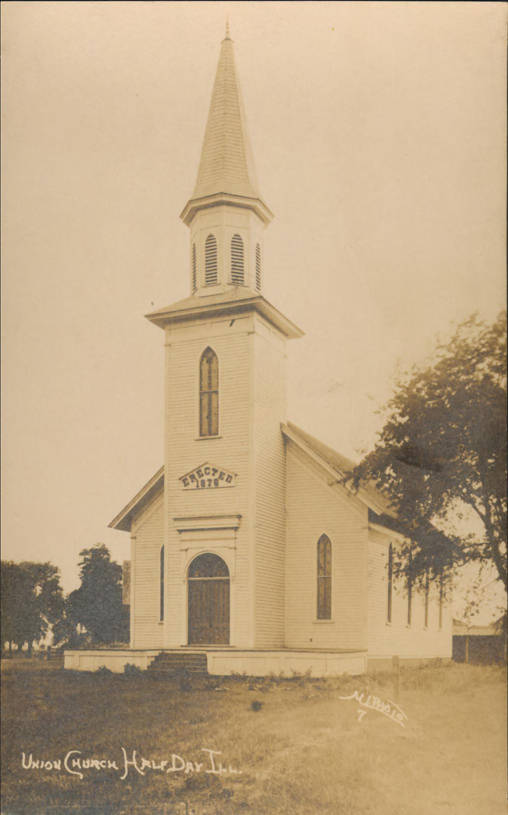
Union Church, Half Day, IL. (1910)
1834 saw the arrival of William Cooley and Theron Parson. They settled in the Wright neighborhood; Parson opened a tavern in Half Day, and Cooley dealt in cattle buying and selling, but tired of pioneer life, he left the area.

Hiram Kennicott built a sawmill and grist mill near the Luther Bridge, which spanned the Des Plaines River. He opened a store in Half Day and later one in Libertyville. He had studied law and was the first Justice of the Peace in Lake County. John Kennicott was a riding circuit doctor and was highly respected.

In 1835, more settlers came to Lake County, and among those settling in Vernon Township were Matthias Mason, William Easton, Moses Putnery, B.F. Washburn, Ashabel Talcott, Henry Wells, John Gridley, sons John A. Mills, James Chambers, Erastus Bailey, Matthew Hoffman, and Thomas Bradwell.

Seth Washburn was the first postmaster in Lake County, appointed in 1836. He built the first sawmill near Wright's homestead. His family later donated the land for Washburn Congregational Church and the Half Day School. Matthias Mason opened a blacksmith shop. He was appointed the first county treasurer.

Wright remembered: "When I stuck my stake in the banks of the Aux Plain River, I was surrounded by the native tribes of Potawatomi. They helped me raise my first rude cabin, the first house built in the county." These native people also assisted Wright in planting crops and tending to his family when they became ill.
Wagon Bridge over Indian Creek, Half Day, Illinois - 1904
According to James A. Clifton in his book, The Prairie People: Continuity and Change in Potawatomi Indian Culture 1665-1965, Aptakisic was present at the negotiations for the Treaty of Chicago, which took place in September of 1833. "Apparently wearing Meteya's [Mettawa's] moccasins, Aptegizhek stood and informed Commissioners Porter and Owen that the Potawatomi had no wish to consider moving west of the Mississippi until they had been allowed to inspect the country. He insisted the Potawatomi had assembled merely to enjoy their Great Father's beneficence and liberality. Could the annuities due to the Potawatomi be distributed quickly so they might return to their villages to tend their gardens?"

Ultimately, the treaty was signed by Aptakisic (twice!) and other leaders of the United Chippewa, Ottawa, and Potawatomi Indian Tribes on September 26, 1833.
General Store, Half Day, Illinois - 1910
In 1918, the students of Half Day School wrote a history of their school and community. In it, they recounted that "Half Day was named so in honor of an Indian chief, Hefda, who some people say is buried in this locality." They said Half Day was a "halfway station" between Chicago and the northern part of Lake County.
Half Day Hotel, Half Day, Illinois - 1910
Interior view of Chief's Tavern in Erickson Home, Half Day, Illinois - 1915
The confusion may have been started by visitors to Half Day, possibly as early as the 1840s. The Half Day Inn was established on Chicago and Milwaukee Road (today's Route 21) as a Frink & Walker's General Stage Coach stop In 1843. The rutted and muddy road would have made for slow travel, leading travelers to surmise the town's name came from its distance from Chicago.
The Stagecoach wasn't as glamorous as the movies made them out to be.
In 1886, train service was available on the Wisconsin Central Railroad to Prairie View, several miles west of Half Day. That trip would have taken at least two hours and then a buggy ride over to Half Day, again leaving visitors to believe the name was a matter of travel time. Even with the advent of the automobile, travel was slow until roads were paved in the 1930s. Travelers who do not know the true origin of the name have adopted a new meaning. As the people who knew Aptakisic died and generations passed, the connection to Aptakisic faded, and the new tradition took root with no one around to contradict it.

In a letter written late in his life, Henry Blodgett once again recalled his friend, Aptakisic: "In the fall of 1837, Aptakisic's band was removed to a reservation on the west side of the Missouri River near the mouth of the Platte and later were moved into what is now a portion of the state of Kansas, south of the Kansas River. I well remember the sad face of the old chief as he came to bid our family goodbye. We all shed tears of genuine sorrow... his generous kindness to my parents has given me a higher idea of the red man's genuine worth." Henry Blodgett was a young man in 1850.

Aptakisic's legacy continued in the names of Aptakisic Road, Aptakisic Creek, and the former community of Aptakisic located in today's Buffalo Grove. Aptakisic was a railroad stop on the Wisconsin Central line at Aptakisic Road (west of Route 21) and had its own post office from 1889-1904.
Public School, Half Day, Illinois - 1910
Road House, Half Day, Illinois - 1910
Solomon Brothers, Half Day, Illinois - 1910
Vernon Cemetery, Half Day, Illinois - 1910
The town was forcibly annexed by the village of Vernon Hills in 1993. The following month, the village of Lincolnshire also attempted to annex a portion of Half Day. The two villages entered a legal battle, filing lawsuits against each other. Eventually, this resulted in the Vernon Hills annexation being approved and Lincolnshire's being denied.

Compiled by Dr. Neil Gale, Ph.D.
Contributor:
 Diana Dretske | Lake County Discovery Museum

Wayne County Illinois Courthouses located in Fairfield, the county seat.

Wayne County Illinois Courthouses located in the city of Fairfield, the county seat since the founding of the county in 1819.

The first courthouse was built in 1821. It was a log building, 18 feet square, with planked floors. It is believed that the county jail was a separate building.

The second courthouse was a large two-story brick building, square in shape, with Federal-style doorways and a central cupola on the roof. It was built in 1836 to replace the previous log structure. This was the courthouse that Abraham Lincoln visited and, on at least one occasion, plead a legal case.
On the evening of November 17, 1886 a Fairfield resident decided he would like a new courthouse and thus set fire to the courthouse building assuring a new building would be built. Besides destroying all of the legal documents and records of Wayne County in storage at in the building, the residence of the county had their taxes raised to pay for the new construction.

Compiled by Neil Gale, Ph.D.