Wednesday, February 5, 2020

The Jack Spratt Coffee House Civil Rights Sit-In on May 15, 1943, Chicago.

The Jack Spratt Coffee House in the Kenwood neighborhood on Chicago's South Side played an early, unsung role in the civil rights movement.
THE INCIDENT 
One afternoon in 1942, after a Congress of Racial Equality (CORE) meeting, a few members decided to continue their discussion at a local coffee shop called Jack Spratt's. Upon entering, James Farmer was refused service by the manager for being Negro. Fellow white CORE member Jimmy Robinson calmly but sternly explained to the manager that he violated the Illinois Civil Rights Act of 1885. The manager reluctantly served both men. The CORE group returned two days later to further test Jack Spratt's policy. The members were served without incident. They left their payment on the table and exited. Moments later, the manager ran out, threw their money into the street, and screamed, "Take your money and get out! We don't want it!" In reaction to these encounters, CORE decided that Jack Spratt's should be the site of their first nonviolent direct action campaign. As part of their "Action Discipline" method (modified Gandhian methods by which the CORE operated), Farmer sought to negotiate with the manager, first by phone and then via letter. Both attempts were fruitless. 

Thus, on May 15, 1943, at 4:30 PM, Chicago CORE conducted one of American history's earliest civil rights sit-ins. Twenty-eight people entered Jack Spratt's in groups of 2, 3, or 4. Each group had at least one Negro person. In each group, the whites were served while the negroes were refused service. The whites would either pass their food to the negroes in their group or would refuse to eat until everyone in the group was served. Other customers in the coffee house also joined the sit-in.

Eventually, the manager told Jimmy Robinson (speaking only to the white guy) that if the "colored people" would move to the basement, they could be served there. James Farmer replied that they would not eat in the basement. The manager told Robinson (again ignoring Farmer) that they could serve the blacks in the back corner. Again, Farmer politely refused. The manager then called the police.
Jack Spratt Coffee House Exterior. 
Photograph by Hedrich-Blessing, March 28, 1941.
Jack Spratt Coffee House Interior. 
Photograph by Hedrich-Blessing, March 28, 1941.
Unbeknownst to the manager, the group had already informed the police of their plans. Though the police did arrive, they refused to do anything and told the manager that she would either have to serve the patrons or find another acceptable solution as no laws were broken. Everyone ended up being served, albeit hours after they first arrived. Subsequent test visits over the next several weeks confirmed that the CORE sit-in had successfully changed Jack Spratt's policy.

Farmer explains what happened in his own words:
"We went in with a group of about twenty-five—this was a small place that seats thirty or thirty-five comfortably at the counter and in the booths—and occupied just about all of the available seats and waited for service. The woman was in charge again [the manager they had encountered on a previous visit]. She ordered the waitress to serve two whites who were seated at the counter, and she served them. Then she told the blacks, ‘I'm sorry, we can't serve you, you'll have to leave.’ And they, of course, declined to leave and continued to sit there. By this time the other customers who were in there were aware of what was going on and were watching, and most of these were university people, University of Chicago, who were more or less sympathetic with us. And they stopped eating and the two people at the counter she had served and those whites in the booth she had served were not eating. There was no turnover. People were coming in and standing around for a few minutes and walking out. There were no seats available."
THE REST OF THE STORY
Farmer changed how Jack Spratt did business – almost twenty years before the famed lunch counter sit-ins of the civil rights era focused the nation's attention on racial discrimination.

At the time, the world took little notice. "If we were lucky, there might be a small paragraph on a back page of the Chicago Tribune saying, in effect, that a few nuts and crackpots sat in a restaurant until they were served, or thrown out, or the place closed for the night — whichever came first," James Farmer recalled in his 1985 memoir, "Lay Bare the Heart."

Farmer was an organizer for the Fellowship of Reconciliation with a hunch that the organization's pacifist commitment to turning a cheek in the face of violence could be a weapon with which to combat segregation. The U.S. said it was fighting World War II to save democracy abroad, even as Negroes were denied equal rights at home by Southern laws and Northern customs.

To test his idea, Farmer and 27 others, many of whom lived around the University of Chicago campus, went to the nearby Jack Spratt Coffee House, known to be unfriendly to Negroes. As expected, whites were served, and Negros were not. All rejected the management's proposal that they dine in the basement. The police refused to remove Farmer and his friends, saying they hadn't broken any Illinois laws. Jack Spratt quietly dropped its anti-Negro policies afterward.

Eighteen years later, a group of college students struggling to desegregate a Woolworth's lunch counter in Greensboro, N.C., sought advice from CORE, born during the civil rights campaign on 47th Street. In the South in 1960, police and whites were hardly the nonpartisan bystanders their Chicago counterparts had been. Food was dumped on protesters, who were also beaten and arrested.

But the students persevered, and their tactics quickly spread to other cities. In August, student leaders came to Chicago to explain their motivation to an audience at the Corpus Christi Center in the South Side ghetto.

"Down there, you felt all alone," said Ezell Blair, who participated in one of the first Greensboro sit-ins. "You feel very timid. But it is just about the time that you think you are going to break that you say to yourself, 'No, I'll stay right here.'"

Between the time of the Chicago sit-in and the one in Greensboro, Negroes won a milestone victory with 1954's Brown vs. Board of Education Supreme Court ruling that separate schools for whites and Negroes were unconstitutional. But with many states stalling on actually desegregating, Negroes were frustrated with the lawsuit route to equality. Farmer and his Chicago friends had come to that conclusion long before.

Along with their campaign to desegregate restaurants, CORE members in 1949 confronted White City Roller Skating Rink, a remnant of the famous 63rd Street amusement park, which was off-limits to Negroes. After being repeatedly turned away — always with the explanation that there was a private party — Farmer filed complaints against several employees. But at the trial, an assistant state's attorney entered the tank. In summation, he said: "We have failed to prove that they discriminated, and as a prosecutor for the state, I can make but one recommendation, namely that you find these defendants from the White City Roller Skating Rink not guilty." The judge reluctantly complied.

In the aftermath of the North Carolina sit-ins, CORE's Chicago experience and the eagerness of Southern students to combat Jim Crow came together with the civil rights movement's adoption of Farmer's brainchild: nonviolent resistance. The tactic gained a national audience during the 1955-56 Montgomery bus boycott thanks to the Rev. Martin Luther King Jr. "No longer did we have to explain nonviolence to people," Farmer said. "Thanks to Martin Luther King, it was a household word."

In 1961, with Farmer as its director, CORE sent Freedom Riders to integrate buses in Dixie. Again, there was violence and arrests. Attorney General Robert Kennedy wanted the Freedom Rides halted. As it often did during this time, the Tribune attributed the demand for change to subversives with a headline "Freedom Rides Traced To Red Inspired Plot." But it also reported how volunteers from Illinois were screened according to the protocol set during the early Chicago sit-ins. "We look for persons who sincerely want to improve race relations — persons who want to abide by dictates of passive resistance rather than those who want to fight back," a CORE recruiter told a Trib reporter.
James Farmer of the Congress of Racial Equality (CORE).
A federal judge in Alabama ordered the Freedom Rides and attendant violence to stop. "If there are any more occurrences of this sort of thing, I am going to put some Klansmen, city officials, policemen, and Negro preachers in the penitentiary," the judge said, according to the Trib's account. Yet the Freedom Riders kept coming, and in September, the Interstate Commerce Commission ordered an end to segregated transportation.

In the years that followed, Farmer split with CORE, which had tilted toward Negro separatism and militant philosophy incompatible with Farmer's pacifism. "Negroes and whites have contributed too much to CORE for it to degenerate like this," he told the Tribune in 1978.

He briefly joined the Nixon administration in 1969. Farmer, who, with King, Roy Wilkins, Whitney Young, A. Philip Randolph, and John Lewis, was considered a significant force in the civil rights movement — had been largely forgotten when President Bill Clinton awarded him the Presidential Medal of Freedom in 1998, a year before he died.

He left a bittersweet evaluation of the faith that inspired that sit-in on 47th Street.

"We too, in the early years of CORE, believed that truth alone, the transparent justice of our demands, would convert the segregationists," he wrote in 1965 in "Freedom — When?" "We were very young and idealistic."

Compiled by Dr. Neil Gale, Ph.D.

Tuesday, February 4, 2020

Milwaukee Avenue and Waukegan Road as dirt roads around 1900.

Looking north on Milwaukee Avenue and Waukegan Road begins on the right in Niles, Illinois. (c.1900)

Waukegan Road was known as "North Branch Road," which ended at Park Ridge Road, now Touhy Avenue. That is why there is a slight jog just North of Touhy Avenue when getting on to Waukegan Road from Milwaukee Avenue.
The same view today.

Tuesday, January 28, 2020

The History of Clark Street in the Rogers Park Community of Chicago, Illinois.

Long before Illinois statehood, the glacial ridge that is now Clark Street was only seasonably navigable north of today's Peterson Avenue. The original inhabitants of this area that is now Rogers Park and West Ridge included: the Chickasaw tribe, the Dakota Sioux tribe, the Ho-Chunk tribe (Winnebago), the Miami tribe, the Shawnee tribe, and the Illinois tribe (Illiniwek).
The Illiniwek [aka Illini, and the Illinois (pronounced as plural: Illinois')], were a Confederacy of Indian tribes consisted of the Kaskaskia, Cahokia, Peoria, Tamaroa, Moingwena, Michigamea, Chepoussa, Chinkoa, Coiracoentanon, Espeminkia, Maroa, and Tapouara tribes that were all part of the Algonquin family.
The tribes used the higher glacial ridge, now Ridge Boulevard, for travel to and from their villages south of Chicago to hunting grounds in upper Minnesota and Wisconsin, called the Green Bay Trail, aka "Old Jambeau Trail,"  way before it was named Chicago Avenue.

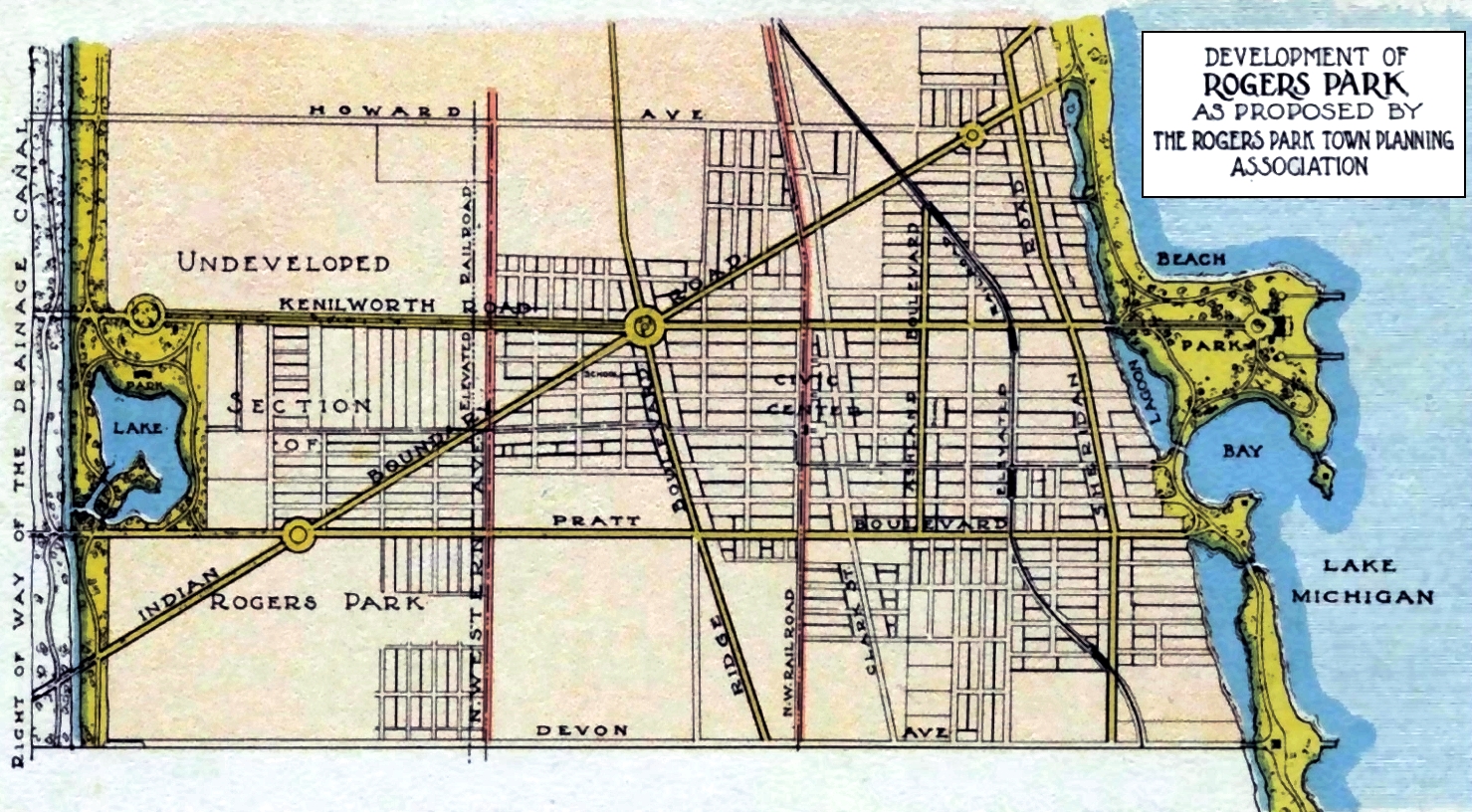
The Treaty of St. Louis signed in 1816 between the United States and area tribes (Potawatomi, Ottawa, the Chippewa) involved the United States obtaining a 20-mile strip of land known as “The Indian Boundary” connecting Lake Michigan to the Illinois River.

Indian Boundary Park in Chicago's West Ridge Community is named after this event. The 1833 Treaty of Chicago following the 1832 Black Hawk War, evicted the Indian tribes from the area.
CLICK MAP FOR ENLARGED VIEW
Map of the Rogers Park and West Ridge communities of Chicago showing Indian Boundary Road. - Interested in the 'LAKE' at Pratt and Kedzie?
Phillip Rogers began buying land from the government in the 1830s, and by the time of his death in 1856, Rogers owned 1,600 acres of government land, part of which formed the basis of Rogers Park. In the beginning, Clark Street, known then as Chicago Avenue, was a mere path connecting the growing settlement of Chicago to the cluster of Ridgevill farms and homes. The growth of the railroad and canals contributed to the development of Chicago and the surrounding communities.

In the mid-1850s, landowners sold right of way to the Chicago and Milwaukee Railroad, and shortly thereafter a commercial rail line was built, roughly paralleling what is now Clark Street. For its first 15 years of operation, there were no stations on this line in Rogers Park; but there are oral histories that state farmers on the Ridge had worked out a signal with the train engineers to create an informal stop for pickup and delivery of fresh produce and supplies to the Water Street Market (now Wacker Drive). Temperance would also define Rogers Park, as the 1853 charter for Northwestern University established a four-mile alcohol-free zone within the radius of the school. 
In 1869 a tollgate was installed at Rogers and Clark to profit from people traveling to Calvary Cemetery. 1884 Illustration. rpwrhs
With the railroad firmly in Rogers Park, around 1873 the Chicago and Milwaukee Railroad opened its Rogers Park station. An economic center emerged between Lunt and Greenleaf, extending to Clark Street, centered around the new stop on the Chicago and Northwest Rail Line near the location of the modern Metra station. By 1910 the tracks were elevated and a new station was built.

The early structures were wood frame with wooden sidewalks elevated above unpaved and often muddy streets. These were mostly two-story buildings with the storefronts on the bottom, with tenants or the store owners living above. The early businesses on Clark were catering to the new homeowners that were mainly white-collar workers commuting to downtown Chicago offices or railway workers.
Clark and Greenleaf, 1875. rpwrhs
The Great Chicago Fire of 1871 created a housing boom in Rogers Park, leading to denser settlement as well as an increase in economic activity. With a broader tax base and settlement, the Village of Rogers Park was formed in 1878. During this time the western portion of Rogers Park was still dominated by farmland while the eastern side was still undeveloped marsh.

In 1881, a three-story “brick building was erected on the southeast corner of Clark Street and Estes Avenue to serve as the Village Hall.” It also functioned as the police department, jail, and fire department. The first Rogers Park library was on Clark Street.

The oldest dairy that served Rogers Park existed between Rogers and Birchwood, east of Clark, founded by John Francis Ure in 1887 on his grandfather's, John Calder Ure's property. Ure obtained his milk supply from nearby Wilmette and eventually sold his business to the Bowman Dairy Company of Chicago in the early 1920s. 

John donated the right-of-way for Howard Avenue. Howard J. Ure was actually born John James Ure on January 13, 1896, at 5138 N. Clark Street (today, 7527 N. Clark Street). Howard, a banker, became a director of the Howard Avenue Trust and Savings Bank at the early age of 26. The Ure family had a heavy hand in developing the Howard Street district, which is named after Howard Ure (1896-1984) as is the Howard (Ure) Beach, Park.
The John Ure Dairy, 1914. rpwrhs
In 1888, the Weimeschkirch family opened a funeral home at 4861 N. Clark Street, (today, 7066-68 N. Clark Street). At some point, they Americanized their last name to Weimeskirch. They would be open for about 100 years serving the community with caskets and embalming, as well as a funeral hearse and ambulance needs. 
P. Weimeschkirch Undertaker at 4861 N. Clark Street, (today, 7066-68 N. Clark Street). rpwrhs
In 1891, Clark Street was finally paved between Devon and Chase. The 1893 World Columbia Exposition excited Rogers Park residents and some reported “growing support in favor of annexation,” thinking it would improve economic prospects. 
From the Evanston, Rogers Park and Wilmette Directory, 1892.
Weimeschirch funeral home closed in 1988. rpwrhs
In 1893 Rogers Park and the neighboring community of West Ridge were officially annexed to Chicago. The annexation improved infrastructure: streets were paved, gas and electric service were provided, and better sewers were installed, allowing the area east of the original Rogers Park subdivision to be drained and subdivided into parcels for development. Fire and Police services also improved.

A year after annexation into Chicago, Rogers Park had a major fire on August 8, 1894. At 9:30am an entire block of Rogers Park was wiped-out by fire. The Town Hall, Livery Stable, John Lindley's Store, Phillips Mill, Sharp Bros' Store, Drug Store, and Foote's Grocery, along with factories and dwellings, fourteen in all, while ten families were driven out homeless. 
As a product of the fire, stricter building codes were enforced and brick construction was mandated. The fire also illustrated a need to have a dependable water supply and better water infrastructure.  The rest of the decade was marked by a national economic depression; called "The Panic of 1893." In 1896, street light posts and fire hydrants were installed.

A 1901 business directory reflected “the addition of service providers to make goods needed by the new families, as well as support for the growing new housing market."

Residential housing begins to shift during this time from single-family to multi-unit dwellings as “the neighborhood’s suburban qualities faded.” Today you can still spot evidence of these important neighborhood buildings along Clark Street; they are still evolving to suit the community needs.
The Doland Block Building was built in 1900 at 7000 N. Clark Street. It was used as a Masonic Hall and was the original location of the Rogers Park Women’s Club. It became the first Rogers Park Library in 1905 when the Chicago Public Library took over and created a circulating library and deposit station.
By 1900 the population and commercial district were centered around the train station at Greenleaf and Clark.  By 1910 the railroad was elevated.
Railroad Station Greenleaf and Lunt, 1910. rpwrhs
Part of the population boom discussed during this period also had to do with the Northwestern Elevated Railroad (now-CTA Red Line) opening up a Howard Street Station in 1908. Development allowed for more people to easily commute downtown and helped make the far North Side a desirable place to live. The commercial areas near the station stops remain vital to the business community today as well.

Between the 1870s and 1930s local commercial district buildings were between two and three floors. Retail businesses would occupy commercial space on the ground floor while offices or apartments would be above. It was noted that “these buildings should be tightly spaced to maximize square footage. Quality materials and ornamentation were reserved for street elevations. The storefronts themselves were basically large panes of fixed glass supported by wood or metal mullions with a center-of-side entrance.

By 1920, the neighborhood had a population of 27,000 and was upper-middle class. Historians credit the 1920s period in Rogers Park for creating a building boom not matched for the next 80 years. The entertainment district developed on Howard Street around this time which became a hub of nightlife for the entire North Shore. Meanwhile, shops on Clark Street catered to residents, while also complementing the high-end entertainment and social needs of the area. Clark Street continued to be the main shopping district of Rogers Park. Moreover, it contained important institutions such as the police station, post office, and library. 

The Clark Devon Hardware at 6401 North Clark Street opened in 1924, the first of five Clark Street locations, by founder, William Walchak. The building had been at various times, a theater, a dance hall, an indoor soccer stadium, and a film production studio before it became a hardware store. The store moved from the corner to Clark and Wallen. From there it moved to 6339 North Clark Street. Then came the move to Clark and Highland, 6333 North Clark. In 1984, third-generation owners, Ken and Ed Walchak orchestrated the store’s move, back to the corner where it started and the store’s name once again matched its location and remains a local iconic store.
A 2-ton, lighted, stainless steel clock, added in 2012, on the building's southwest corner has already become a neighborhood icon.
The Rogers Park Chicago Library branch location was opened in 1917 at 6957 North Clark Street and lasted until 1922 when a more suitable location was built at 1731 West Greenleaf. The Greenleaf location would eventually be destroyed in a fire in 1951.
The Rogers Park Library at 6957 N. Clark Street. A Prudential Insurance office is on the second floor. rpwrhs
The number of people using public transportation through Clark Street remained a stabilizing force for local businesses. In 1910 the Chicago and North Western rail bed was elevated and a new station was built above street level.  This embankment cut off the retail activity on Market Street and divided Ravenswood into a light industrial area on the East and residential on the West. Another change to local transportation occurred in 1913 when the electric streetcars that ran along Clark were consolidated into the Chicago Surface Lanes.

The Devon Avenue car barn located at 6454-64 North Clark, was built in 1901 and housed the streetcars that cruised through Rogers Park. These streetcars housed the Clark #22, Broadway #36, and Western #49B lines. In 1922, a major fire devastated the building destroying a large part of the fleet. The facility was closed in 1957, and the site is now occupied by the 24th District Police Department. The Clark #22 bus is still an active line that connects Rogers Park to downtown Chicago.
Bus Barn, 6454-64 N. Clark Street, 1930. rpwrhs
As Rogers Park was growing into a wealthy community, residents had disposable income to spend on entertainment. While Howard Street was the official entertainment district, Clark Street had two movie houses. These were the Casino Theater 7053 North Clark, and the Adelphi Theater, 7074 North Clark at Estes. The Casino Theater (1915-1918), was the oldest motion picture theater in Rogers Park. Local historian Larry Shure mentions “for a small admission you could enter and stay as long as you like. A typical nickelodeon might show short features 16 hours a day, from 8 a.m. until midnight."

By 1918 the nickelodeon-type “Photo Play” was going out of style as real “Movie Palaces” started to appear. The death of the Casino Theater was the beginning of the construction of the luxurious  Adelphi Theater which was built at Estes and Clark in 1917, 14 years after the deadly Iroquois Theater fireThe original owners of the Adelphi theater were the Ascher Brothers who operated the theater between 1917-1927. A bowling alley would occupy the second floor from 1922-1927. The Adelphi would be torn down in 2006.
Adelphi Theater, 1917. rpwrhs
Adelphi Theater Interior, 1917. rpwrhs
Resident Edward Mogul reflected on the Adelphi Theater in the 1940s and 50s:
“I went to the Adelphi with my neighbors on a regular basis, usually arriving early on Saturday  morning. We would spend hours there watching thirty cartoons in a row and then Flash Gordon and Superman and we would come out of the theater with our eyes crossed.”
Chicago theaters designed by J. E. O. Pridmore (1867-1940):
  • National Theater (1904)
  • College Theater (1907)
  • Oak Theater (1910)
  • Columbia Theater (1911)
  • The Victoria Theater (1912)
  • Lexington Theatre (1912)
  • Empress Theater (1913)
  • Adelphi Theater (1917)
  • Sheridan Theatre (1927)
  • Nortown Theater (1931)
  • Evanston Theater (1937)
ADDITIONAL READING: Chicago's Rogers Park and West Ridge Communities Movie Theaters History.

Resident Edward Mogul reflected on the Adelphi Theater in the 1940s and 50s:
“I went to the Adelphi with my neighbors on a regular basis, usually arriving early on Saturday  morning. We would spend hours there watching thirty cartoons in a row and then Flash Gordon and Superman and we would come out of the theater with our eyes crossed.”
After the Second World War, a housing shortage created a residential building boom that wouldn’t taper off until the 1960s. This housing shortage was not only local — it was a part of a national trend that led to the rapid rise of suburbs. The white flight also resulted in many urban whites moving into the new suburban areas.

Rogers Park saw an influx of Russian and Eastern European immigrants which added to the local mix of stores and restaurants. By the 1960s Jews were the largest ethnic group in Rogers Park. Clark Street incorporated these new immigrants and remained an essential economic stretch of land. At the same time, redlining started to creep into the neighborhood, making bank financing inaccessible particularly for blacks.

The Romanian Kosher Sausage Company opened in 1957 at 7200 North Clark Street. Prior to its existence as a butcher shop, the location was an A&P grocery store. A&P started closing locations in the 1950s because they were failing to compete with the larger more modern supermarkets. 
Romanian Kosher Sausage opened when the Jewish population of Rogers Park was at its height. It remains a neighborhood icon today, serving the large Jewish population that resides in neighboring West Ridge,  Skokie, and surrounding suburbs.

Compiled by Dr. Neil Gale, Ph.D.
Rogers Park/West Ridge Historical Society, Contributor.