Sunday, December 17, 2023

SCHUETZEN PARK TO RIVERVIEW PARK; FROM CRADLE TO GRAVE.

Schützen Park, Chicago. (1879-1903)
Compiled by Dr. Neil Gale, Ph.D.

Schützen Park, also known as Sharpshooters' Park, was located on the banks of the Chicago River between Belmont Avenue and Roscoe Street, with the main entrance on Western Avenue in Chicago, Illinois.
Sanborn Fire Map from 1894 - Western Avenue was the western border between former Jefferson Township and the City of Lake View - both annexed to Chicago in 1889.
Details of Schützen Park/Sharpshooters' Park Sanborn Fire Map from 1894.
German veterans from the Franco-Prussian War, who served in Fredrich the Great's "Jaeger Rifle Corps." held target practice there every Sunday afternoon using paper targets and toasting the winners with steins of beer.

It all started with a man named Wilhelm A. Schmidt who, during the late 1800s, wanted nothing more than to open a modest "Sharpshooters' Park." Schützen Park (Schützenverein in German: Shooting Club) did well until 1903, when Schmidt’s son, George, returned from school. Upon returning from Europe, George told stories of the parks he had seen, which boasted fantastic Ferris Wheels, Carousels, and more. He argued that these rides would attract people from all over. With monetary help from a lawyer named William Johnson and a banker, Joseph McQuade, his vision quickly became a reality. After that point, the park became known as “Riverview Sharpshooters' Park” and was home to three rides. 

Legend has it that the wives complained about being left behind with the children in the scorching heat of the summer. Soon, families packed picnic baskets and went to the park with their husbands. To occupy the family's time, a shaded area had benches and tables set up, and free band concerts were played. Rifle practice was soon discontinued, though rifle ranges and shooting galleries (with real bullets) later became a permanent part of Riverview Park.

George Goldman and William Schmidt purchased the 22 acres of land after Schmidt sold his Sedgewick Street Bakery and his invention of the soda cracker to the National Biscuit Company in 1903. By 1903, there were 500 miles of streetcar tracks crisscrossing the city, making public access to the park possible from every point in Chicago for 5¢. A beer garden and some small food concession stands were soon added. Music, parades, band compositions, political rallies, games, and shows kept the park a lively center for cultural entertainment.

The children complained that there was nothing for them to do. So, the owners opened a free playground. There were now many things to do - a slide, a teeter-totter, and a wading pool. Soon, they added one large restaurant, a large bandstand, a Rhine wine bar, five other taverns, a large 100-foot by 50-foot dance hall, an ice house, more chairs, tables, and benches.

Riverview Sharpshooters' Park, Chicago. (1904-1908)

In 1904, there were 25 major picnics held at Sharpshooters' Park, ranging in attendance from 5,000 to 35,000 people. Riverview opened that year with the Sharpshooters' name. Ponies and goat carts were added to the park for the enjoyment of picnickers' children. The need for speed eventually made them obsolete. They were originally in the main area but later moved to an area they called “Kiddy Land”. Many concessions and games of skill became a part of the park, such as pop (soda pop) and ice cream stands, a shooting gallery, ball-throwing, cane games, and pony rides.

Riverview Sharpshooters' Park's competition was the White City Amusement Park and San Souci Amusement Park, both located on the south side of the city. Rides and attractions were being introduced at Luna Park, Coney Island, and other East Coast locations with great success. George convinced his father to lease six acres of land fronting on Western Avenue to two Eastern amusement park representatives for $7,600 a year for a ten-year contract.

The park opened on July 3, 1904, to the public with only three rides (owned by the Eastern representatives) plus some other concessions, all under tents. The use of electricity in illumination and spectacular shows attracted 32,000 people on opening day. The park closed the 1904 season with a profit of $63,000 with only 70 days of operation. All of the concessionaires made a nice profit.

The Riverview Sharpshooters' Park Company (the "Sharpshooters' Park" part of the name was dropped in 1905) was formed, but competition became fierce when a fence between the two areas was removed. (The park had expanded to 140 acres and blossomed with 100 attractions by 1910.) When the 10-year lease expired, the Schmidt family gained full control of the park. The family kept Riverview Park one of the most successful in the industry despite economic trials and tough times like the great depression.

FIRST RIDE
The "Figure 8" was the first roller coaster at Riverview Sharpshooters' Park. The ride has 12 cars on a trough-like track on a timber frame. A steam engine carried the cars up an incline, and gravity brought riders back to the starting point. The cars were guided by side-friction wheels and propelled on four swivel casters. The coaster has a few mild four-foot drops on a short track and went six miles an hour it cost $16,000 to build.

SECOND RIDE
The Merry-Go-Round was second in popularity to the Figure 8 roller coaster. It was a concession at Riverview Sharpshooters' Park, owned by the Eastern group. The "Morris Carousel" was described by the owner as having "very handsome figures in an octagon pavilion 100 feet across and 45 feet high." The cost of a ride was 5¢. (The larger "Fairyland Carousel" did not arrive until 1908) In the foreground is a glass etching souvenir booth.

THIRD RIDE
The "Thousand Islands" was the third ride in the park when it opened as Riverview Sharpshooters' Park. It was composed of 1,000 feet of canals with a 28-foot high chute. The boats passed through the canals at a slow speed, then were brought to the top of the incline, where they rapidly descended into a pool of water. The boats returned to the starting point. A large outdoor water wheel operated by a motor concealed behind scenery kept the water flowing in the canals. Dark tunnels and scenes to startle the riders were added. The ride was nicknamed Old Mill, Mill on the Floss, Tunnel of Love. and The Mill. For 10¢, riders could steal a kiss.

Riverview Amusement Park, Chicago. (1904-1908)

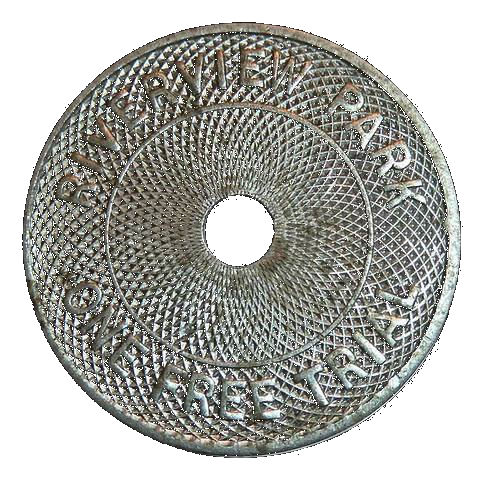
Riverview Park was an amusement park in Chicago, Illinois, which operated from 1904 to 1967. 

William Schmidt, owner of Riverview, looks out over the park in 1967, the last season.

Looking north on Western Avenue, June 10, 1956.
Located on 74 acres in an area bound on the south and east by Belmont and Western Avenues, respectively, on the north by Lane Technical High School and on the west by the north branch of the Chicago River.
Unlike other parks, admission was close to free, and you paid separately for each ride. This approach appealed to the working class of Chicago and kept the park doing well for quite some time. 

In 1906 the park saw a noteworthy increase in space, adding 50 acres and about 500,000 dollars worth of rides. Riverview was growing from a humble family-owned park to the kind of place kids swooned over. 

In 1907, a new front gate was erected, followed by the addition of the Velvet Coaster, the Pikes Peak Scenic Railway, a racetrack, and a whole new section of the park called Fairyland.
Velvet Coaster.
In 1908, they introduced two new attractions, which stunned and amazed park-goers. The first was the Battle of the Monitor and Merrimac, a recreation of the Civil War naval battle. The second was a 70-foot carousel, admired greatly for being hand-carved and painted by a group of Swiss and Italian craftsmen.
The Merry-Go-Round, installed in 1904, was a concession at Riverview Sharpshooters' Park owned by the Eastern group. It was second in popularity to the Figure 8 roller coaster. The "Morris Merry-Go-Round" was described by the owner as having "very handsome figures in an octagon pavilion 100 feet across and 45 feet high." The cost of a ride was 5¢. In the foreground is a glass etching souvenir booth. The larger E. Joy-Morris "Fairyland Carousel" did not arrive until 1908.
Riverview Sharpshooters' Park Merry-Go-Round.
Riverview's original E. Joy-Morris' new Carousel was installed in 1908. It was one of the largest ever built, holding five rows of 70 large hand-carved and painted horses by Swiss and Italian woodcarvers from the Philadelphia Toboggan Coaster Company. It was located just inside the main gate.
This wooden carousel horse was hand-carved and painted by Leo Zoller. The horse is black and white with a sculpted gray mane and tail and glass eyes. Sculpted feathers with red and blue tips are around his neck. A sculpted golden-yellow lion pelt with a head, legs and tail makes the saddle. Brown leather strap/reins attached at the mouth with metal hardware. The horse is in galloping pose with legs bent up towards the body (Height: 51 in; Width: 17.5 in; Depth: 70 in) 1908. The last horse was donated to the Chicago History Museum.
Winter saw the addition of a roller rink and ballroom often filled with jubilant jazz and courting couples. At this point, the park had grown to 102 acres and continued adding eateries, games, shows, and more. 

In 1909 once again, the park's name changed to "Riverview Exposition Park" and became a household name. The addition of new rides continued ever strong, introducing The Tickler, Expo Whirl, and Witching Waves in 1910 and the Metrodome in 1911. In 1913, there was yet another name change – and the final one   where the name was simplified to Riverview Park.
The Big Dipper, in the 1920s
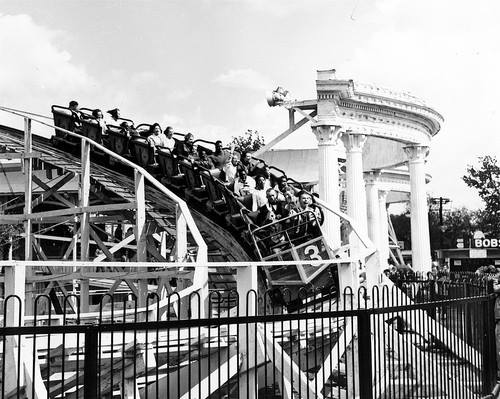
During the time of prohibition in the 1920s, Riverview was known as a speak-easy, as you could still find beer and liquor. Throughout the course of the decade, they continued adding more rides, including the most popular "The Bobs," with a nearly 90-foot drop.
That wasn't the only thing breaking records. George Schmidt also invented the famous foot-long hot dog around this time to be filling and inexpensive when things became hard during the Depression. During this time period, Riverview adopted the motto "Laugh Your Troubles Away at Riverview!"

Riverview saw prosperity throughout the 1950s, becoming a favorite to the returning servicemen of WWII. The late 50s also brought a new slogan, "Riverview Park - Just for Fun.
Riverview Park hosted a live radio show with Buddy Black called "Riverview Funtime" that aired on WGN-AM 720 in the 1950s.
The early 1960s were good years for the baby boomer generation. 
The intersection of  Belmont, Western, and Claybourn Avenues, looking west on Belmont. Note the Riverview sign. 1960
At the end of the 1967 season, Riverview Park advertised its opening date for 1968. Shortly after the end of the season, the park announced on October 3, 1967, that it would not reopen. There was much speculation about why. The park had been profitable until it closed. It was rumored that escalating racial tensions and de facto segregation in Chicago in the 1960s made the owners uncomfortable and less willing to keep the park open. 

In truth, however, Riverview Park likely closed for economic reasons. While it was profitable, the $6.5 million sales price was too good to pass up, and within a few months, Riverview Park was no more.

What Became of Riverview’s Rides and Attractions?
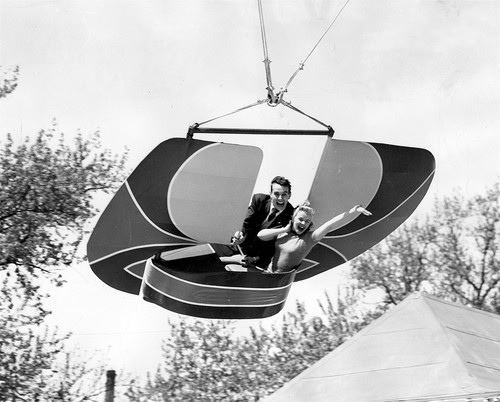
Unfortunately, most were smashed into oblivion shortly after Riverview Park in Chicago closed its doors for the final time.  Although the park’s owners held an auction just after closing, none of the 50 bidders wanted such attractions as the Pair-O-Chute Jump, the Space Ride, the Flash High Ride or even the world-famous Bobs roller coaster.
1967 Riverview Park Ride Auction Advertisement.
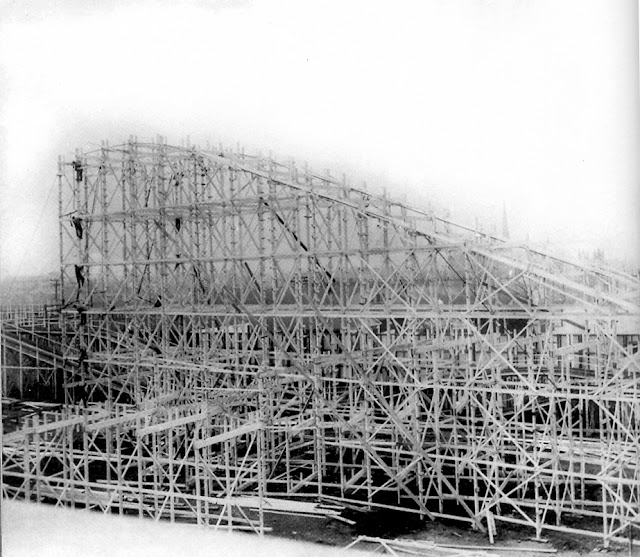
In its day, the Bobs was billed as the world’s fastest roller coaster, attaining a top speed of more than 60 miles per hour.  According to a 1953 article in the Chicago American, the Bobs was the most thrilling ride in America.

The Chicago Sun-Times recalled the Bobs in a feature article not long ago: “It was a mind-numbing, body-bruising, 120-second dash through twisted metal and rickety white wood; when it was over, you’d be battered and breathless.”

Nonetheless, it was unwanted at the auction, and shortly thereafter, it was demolished and sold for scrap, along with Riverview’s five other roller coasters — the Fireball, the Wild Mouse, the Silver Streak, the Comet and the Greyhound.  Chute the Chutes was also demolished, as was the giant genie’s head that grimaced above the entrance to Aladdin’s Castle.

Many of the smaller rides, like the Ferris wheel and miniature train, were sold to carnivals in different parts of the country.  A Chicagoan bought four children’s rides — The Whip, Kiddy Merry-Go-Round, Kiddy Bug and Kiddy Boat — for $2,800.

The only Riverview Park ride that survives to this day is the Carousel. It was restored by Six Flags over Georgia, just west of Atlanta, and was listed on the National Register of Historic Places in 1995.


Amusement Park Name History:
● Schützen (also: Schüetzen) Park aka Sharpshooters' Park, Chicago, IL. (1879-1903)              [Schützenverein (German: Shooting Club)]
● Riverview Sharpshooters' Park, Chicago, IL. (1904-1908)
● Riverview Exposition Park, Chicago, IL. (1909-1912)
● Riverview Park, Chicago, IL. (1913-1967)

Riverview Roller Coaster History:
NOTE: Riverview was known to rename a roller coaster after an accident occurred. 
">" = "Renamed to"

Aerial Coaster (1908-1910)
Big Dipper (1920) > Zepher (1936) > Comet (1940-1967)
Blue Streak [The Original] (1911-1923)
Bobs (1924-1967)
Cannon Ball (1919-1925)
Derby Racer (1909-1932)
Fireball (1959-1967)
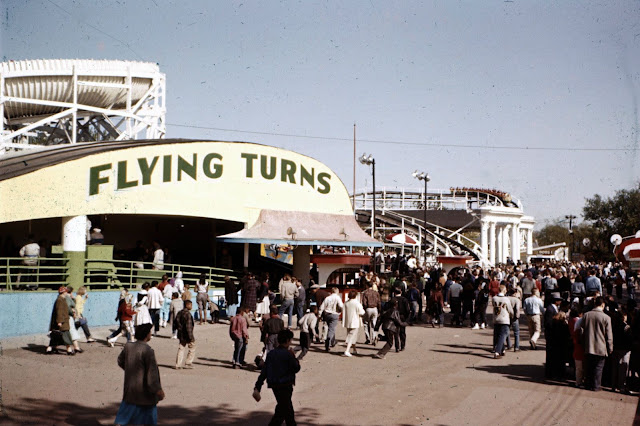
Flying Turns (1935-1967) [purchased after the 1933-34 World's Fair closed]
Gee Wiz (1912) > Greyhound (1913-1965) > Jetstream (1965-1967)
Jack Rabbit (1915-1919)
Kiddie Bobs (1926-1934)
Pikes Peak Scenic Railway (1907-1911)
Pippin (1921) > Silver Streak (1938) > Silver Flash (19??) {Shortened to} Flash (1961-1967)
Royal Gorge Scenic Railway (1908-1920)
Skyrocket (1923) > Blue Streak (1936-1958)
Tickler (1906-????)
Top (1907-1916)
Velvet Coaster (1909-1919)
White Flyer (1904-1920s)
Wild Mouse (1958-1967)


VIDEOS
Flying Cars 1954

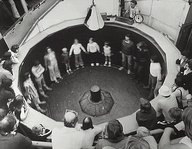
The Flying Cars was a German-made ride built for Chicago's great Riverview Park in 1954. Riders were strapped into a small car inside a large rotating barrel. The barrel had a track inside for the cars to ride freewheeling. The cars were held onto the drum by a rail and floating clamp system. As the drum spins, the 1 person's car follows the track and eventually begins to go upside down. 
The drum steadily increases its speed, and the cars let it roll beneath their wheels as they follow the track. The cars' brakes are then applied to cause them to quickly accelerate up to the speed of the drum's surface, which is around 30 mph causing the cars to go 360°. The operator of Flying Cars would spin the drum for two minutes and then release the brakes causing the cars to come to a complete stop while the drum also slows to a halt. It sounds like fun! Unfortunately, someone failed to fasten their safety belt properly and was killed after falling out. That was the end of the Flying Cars.

Riverview Remembered by WGN
The Bobs Roller Coaster at Riverview 
Riverview Amusement Park (circa 1952)

RIVERVIEW PHOTO ALBUM.


On the left: The tower ride was called "Expo-Whirl," which was installed in 1909 as a large swing ride.
The "Expo-Whirl" Cars of the large tower swing ride.


Deirdre Capone personally sent me this photograph of herself at Riverview in 1956. She is Al Capone's Grand Neice. The twin Ferris wheels, the Dodgem station, and the Flash roller coaster tracks are in the background. Deirdre personally told me how much she loved going to Riverview.
ARTICLE: Removal of the "African Dip" Dunk Tank Game from Riverview Park in Chicago, Illinois.


Saturday, December 16, 2023

A Summary of French Influence in Illinois.

Forward

French Illinois—Where Empire Met Elegance
Long before Illinois became a state, it was the beating heart of a French colonial dream known as le Pays des Illinois. This section explores the legacy of French explorers, traders, and settlers who carved out a distinct cultural corridor along the Mississippi—one that still whispers through limestone ruins, vertical log homes, and the fleur-de-lis etched into local lore.

What Set the French Apart? Unlike other colonial powers, the French didn’t just conquer—they connected. They forged alliances with Native nations through diplomacy, trade, and kinship rituals, such as the calumet ceremony. Their settlements, such as Cahokia (1699) and Kaskaskia (1703), became hubs of multicultural exchange, blending French, Native, and African traditions into a unique frontier society.

Architectural Flair & Urban Planning French homes featured poteaux-sur-sol construction—upright hewn logs on sills—with wraparound porches that offered shade and sociability. Their villages were laid out with central churches, artisan workshops, and communal spaces, reflecting a sense of civic order and aesthetic grace that stood in contrast to the rugged utilitarianism of British and American settlements.

Strategic Strongholds & River Networks: The French built forts like Fort de Chartres and Fort Massac, not just for defense, but also as administrative centers and supply stations that linked Canada to New Orleans. Their mastery of river navigation turned Illinois into a vital artery of empire, with outposts like Prairie du Rocher and St. Philippe anchoring trade and governance.

Culture, Craft, and Celebration, French Illinois was alive with festivals, music, and skilled craftsmanship. Despite restrictions on local industry, settlers imported fine goods and cultivated a community of skilled artisans, including blacksmiths, stonemasons, and carpenters. Church life and recreation flourished side by side, painting a picture of frontier life that was both industrious and joyful.

A Legacy That Endures Though floods and wars erased many physical traces, the spirit of French Illinois survives in restored sites, historic trails, and cultural initiatives like the French Creole Corridor. From the vertical logs of the Cahokia Courthouse to the limestone walls of Fort de Chartres, these remnants invite us to rediscover a chapter of Illinois history where diplomacy, design, and diversity reigned supreme.

sidebar
The state of Illinois became Païs des Illinois (Country of Illinois), when Virginia ceded their County territory in 1778.

While Cahokia was undoubtedly a significant center of French colonial life in early Illinois, several other villages and settlements thrived beyond its shadow, each with its own unique story and contributions to the state's rich history.

French explorers ventured into the Illinois county of Virginia as early as the 17th century, lured by tales of fertile lands and abundant resources. By the late 1600s, permanent settlements began to take root, driven by the fur trade, missionary zeal, and the quest for agricultural and mineral wealth.

Early French Settlements
The town of Kaskaskia, Illinois, was founded in 1703. The Jesuits established the village as a missionary outpost and later developed it into a French trading post and farming community. Kaskaskia became the capital of French Illinois and a bustling hub for fur trade and agriculture. Jesuit missionaries established a strong presence, and the town boasted a vibrant cultural scene, featuring music, theater, and numerous celebrations.

The village of Prairie du Rocher was founded in 1722; nestled along the Mississippi River, it became known for its skilled farmers and artisans. Residents cultivated wheat, corn, and tobacco and crafted furniture, tools, and other goods. The community also played a vital role in the salt trade.
Prairie du Rocher Cemetery. Note the Iron Crosses Grave Markers.

Fort de Chartres was constructed in 1718 between Kaskaskia and Cahokia. This fort served as the French military and administrative center in the region. It played a crucial role in defending against British incursions and overseeing trade routes. The nearby village of St. Anne, established in 1720, grew in tandem with the fort, with French residents supporting the military by engaging in farming and fur trading.
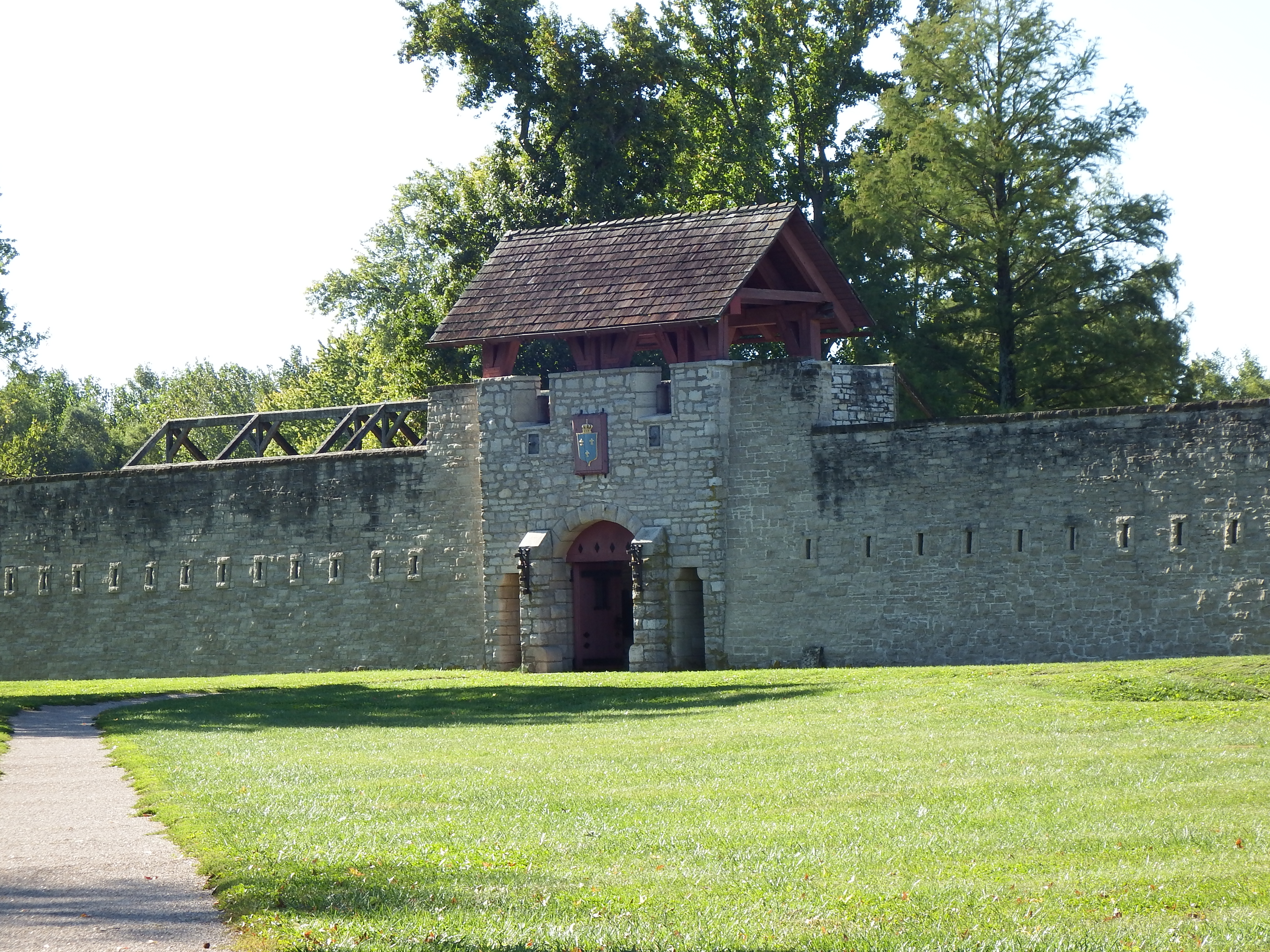
Fort de Chartres Gatehouse. Climbing the 18-foot-high gatehouse provided a panoramic view of the surrounding area.


Village Life and Culture
French colonial architecture had a different building process. Homes were typically built with poteaux-sur-sol (post-on-sill) construction, featuring square-hewn logs and covered porches. This style contrasted with the standard unhewn log cabins among American settlers.

Examples of Poteaux-Sur-Sol Construction:

French villagers relied heavily on farming, cultivating crops such as wheat, corn, and vegetables. They also kept livestock, hunted, and fished, ensuring a degree of self-sufficiency. They engaged in lively trade, exchanging goods with Native American tribes and other European settlements. The fur trade was significant, with furs shipped to New Orleans via the Mississippi River.

Strong Community Bonds
The Catholic faith played a central role in village life, with churches serving as social and cultural centers. Residents celebrated holidays and festivals together, fostering a strong sense of community.

Challenges and Transformations
The outcome of the French and Indian War (1754-1763) led to the cession of French territory east of the Mississippi to Britain, significantly impacting French village life in Illinois. Many residents relocated to Spanish Missouri, while others adapted to British rule.

The American victory in the Revolutionary War in 1783 marked another significant transition, as Illinois became part of the United States. French villagers gradually integrated into American society, preserving their cultural traditions while adapting to the new political and social realities.

The French Legacy
The legacy of French village life in Illinois continues to be celebrated and preserved through Historic sites. Many French villages, like Kaskaskia and Prairie du Rocher, are designated historic landmarks, showcasing their original architecture and way of life. Festivals and celebrations, such as the Prairie French Festival in Prairie du Rocher, keep French traditions alive through music, dance, and food.

Compiled by Dr. Neil Gale, Ph.D.

Friday, December 15, 2023

The City of Chicago's First Foot Steps.

James Thompson surveyed Chicago, filing the plat on August 4, 1830, the official recognition of Chicago's location. Chicago was incorporated as a town on August 12, 1833, with a population of about 350.

The City is bounded on the South and West by a prairie, varying from ten to twelve miles in width, some portion of which is high and of a very superior quality. It is surrounded in every direction by a country the most productive in the world, already brought into a state of successful cultivation, and sending to its market annually a vast amount of produce of every description for sale, exchange for goods, or shipment, as the case may be. The climate is healthy and salubrious, as much so as any in the West. With a population of 4,170, the town of Chicago filed new Incorporation documents on March 4, 1837, becoming the City of Chicago.

The City is divided into six Wards. The first and second Wards, divided by Clark Street, are bounded by Chicago River's South Branch and the Lake, the first Ward lying East and the second West of Clark Street. 

The third and fourth Wards, divided by Randolph Street, are situated on the West side of the North and South Branches, the third South, and the fourth North of Randolph Street. 

The fifth and sixth Wards, divided by Clark Street, are bounded by the North Branch, Chicago River, and the Lake, the fifth being West, and the sixth East of Clark Street.

The Fort Dearborn Reservation was incorporated within the city limits in 1839,

Compiled by Dr. Neil Gale, Ph.D.

Tuesday, November 28, 2023

The Chicago Home Insurance Building: The Pioneer of Skyscraper Architecture in 1885.

Standing tall and proud amidst the bustling streets of Chicago, the Home Insurance Building etched its name in the annals of architectural history as the world's first true skyscraper.

Designed by the visionary architect William Le Baron Jenney, this impressive 138-foot-tall, 10-story structure revolutionized how buildings were conceived and constructed, paving the way for modern skyscrapers that dominate cities worldwide. Construction of the Home Insurance Building began in 1884 at the Northeast corner of LaSalle and Adams Streets and was completed in 1885.

sidebar
Two additional stories were added to the Chicago Home Insurance Building in 1890. This increased the building to 12 stories and its height to 180 feet.

CONCEPTION, DESIGN AND CONSTRUCTION
In the late 19th century, Chicago was booming, its population swelling and its businesses expanding. The demand for office space was surging, and traditional masonry construction methods were proving inadequate to meet the growing needs. 
During Construction
The Home Insurance Building's origins can be traced back to the late 1870s when the Home Insurance Company of New York sought to establish a branch office in Chicago. The company's management envisioned a grand and imposing structure reflecting its prominence in the insurance industry. In 1884, they approached Jenney, a respected architect known for his innovative designs and use of fireproof construction. Jenney faced the challenge of creating a tall, fire-resistant building that could withstand Chicago's harsh weather conditions.

PIONEERING CONSTRUCTION TECHNIQUES
Interior Views
Note the full-size windows.
Jenney's solution was a 10-story, 138-foot-tall building with a frame made of wrought and cast iron, along with Bessemer rolled steel beams (steel), a revolutionary concept at the time. Before this, buildings were primarily constructed using masonry walls, limiting their height and fire resistance. The steel frame provided the strength and support needed to build taller buildings, allowing for thinner walls and larger windows hung on the steel frame. It could withstand the weight of its walls and floors. The building also featured fireproofing measures, including fireproof terra cotta cladding and hollow tiles filled with concrete.

This revolutionary design enabled the building to reach an unprecedented height of 138 feet and set a precedent for future skyscrapers.

IMPACT AND LEGACY
The Home Insurance Building was a testament to Jenney's architectural ingenuity and marked a turning point in skyscraper design. Its innovative use of a steel skeleton frame and other features established the foundation for modern skyscrapers, paving the way for taller, safer, and more efficient buildings.
The "I WILL" Postcard Series № 186C: Home Insurance Building, Chicago. From the private collection of Dr. Neil Gale. Chicago Postcard Museum.
The building's impact was immediate and far-reaching. It inspired a wave of skyscraper construction in Chicago and other cities, transforming urban landscapes and ushering in a new era of vertical architecture.

The building's impact extended beyond its structural innovations, influencing the aesthetic of skyscrapers. Its exterior, clad in terracotta panels, reflected a transition away from the heavy ornamentation of Victorian architecture towards a more streamlined and modern aesthetic.

While the Home Insurance Building was demolished in 1931 to make way for the Field Building, another skyscraper, its impact on architecture and urban development remains profound. It stands as a symbol of innovation and ingenuity, forever etched in the history of skyscrapers and the evolution of modern cities.
Architect and Engineer William LeBaron Jenney was born on September 25, 1832. He died in Los Angeles, California, on June 14, 1907, at the age of 74.

Compiled by Dr. Neil Gale, Ph.D.

Friday, November 17, 2023

The History of Chicago's Treasure Island Grocery Store Chain.

Treasure Island Foods was founded in 1963 by Christ Kamberos and his brothers. Christ Kamberos was born in Chicago to Greek immigrants. His father sold produce from a push cart, and this early exposure to the food business sparked an interest in Christ that never waned. 

He grew up to become a grocery innovator, traveling the world to bring unusual and organic produce to Chicagoans. His stores were known for their wide selection of specialty products, and Julia Child once referred to Treasure Island as "America's most European supermarket."
Treasure Island's first store at 1639 North Wells Street, Chicago
Treasure Island's first store was opened at 1639 North Wells Street in the Old Town Triangle, Chicago, in 1964. The chain quickly expanded to include over 20 stores in the Chicago area. The Wells Street store was one of the most popular locations, and it was known for its convenient location in the Old Town Triangle and its wide selection of specialty foods.

The Treasure Island chain filed for bankruptcy in 2018, closing all stores. The Wells Street store was sold to a developer in 2019.

Christ Kamberos died on October 27, 2009. He is buried in Memorial Park Cemetery, Skokie, Illinois.

A timeline of the Treasure Island Grocery stores:
  • 1963: The Treasure Island brand was founded by Christ Kamberos.
  • 1964: The first store on Wells Street opens.
  • 1980s-2010s: The Treasure Island chain expands to over 20 stores in the Chicago area.
  • 2009: Christ Kamberos died.
  • 2018: The Treasure Island chain files for bankruptcy, closing all its stores.
  • 2019: The Wells Street store location was sold to a real estate developer.
Christ Kamberos (1926-2009)
Christ Kamberos (1926-2009), chief executive officer and President of Treasure Island Foods, offered selections from around the world. The store met approval in Chicagoland, a market with a diverse ethnic population that appreciated his mixture of exotic foods, fresh produce and flair. 

Mr. Kamberos won numerous awards from Fancy Food and Specialty Foods magazines for his innovative merchandising and creative food presentation. He was born on the West Side of Chicago in 1926, one of three brothers and three sisters of Greek immigrants. He served in the military during World War II. 

His business life began after the War. The Kamberos family opened the grocery chain Sure Save and sold the group of 10 stores to the National Food Supermarkets in 1961. In 1963, Mr. Kamberos and his brothers formed Treasure Island Foods.

Compiled by Dr. Neil Gale, Ph.D.

Thursday, November 16, 2023

Dr. Bertha Van Hoosen, the first woman to head a medical division at a coeducational university, Loyola University Medical School.

Born on March 26, 1863, Bertha Van Hoosen spent her early years on her parents' farm in Stony Creek Village, Michigan. Free to roam about and observe the life cycle of the animals on the farm, she later recalled that the toughness of farm life gave her a practical, realistic outlook. As a young girl, she attended several public schools close to her home before graduating from high school in Pontiac, Michigan, at age 17. Following the example of her older sister Alice, she enrolled in the literary department at the University of Michigan in 1880. She met two women who had decided to study medicine here, and their enthusiasm inspired her to follow in their footsteps. Despite her parents' refusal to finance her education, she enrolled in Michigan's medical department after receiving her bachelor's degree in 1884. To pay her way, she earned money teaching calisthenics at a high school, serving as an obstetrical nurse and teacher, and demonstrating anatomy. Four years later, she graduated with her doctor of medicine degree.

Dr. Van Hoosen accepted a series of residencies, first at the Woman's Hospital in Detroit, then at the Kalamazoo, Michigan, State Hospital for the Insane, and finally at the New England Hospital for Women and Children in Boston. She felt ready to begin private practice after four years of additional hospital training.

With money saved from her previous jobs, young Dr. Van Hoosen opened a private clinic in Chicago in late 1892. Like most new practices, hers grew slowly. To keep the practice afloat, she taught courses in anatomy and embryology at the Woman's Medical School of Northwestern University. At the same time, she continued her postgraduate training, accepting a clinical assistantship in gynecology at the Columbia Dispensary in Chicago (later reorganized as the Charity Hospital and Dispensary), where she received further instruction in surgery and obstetrics. As her medical expertise grew, Dr. Van Hoosen's private practice flourished, and she was in great demand as a teacher. 
Dr. Bertha Van Hoosen
In 1902, though her appointment was opposed by the male faculty, she was made a professor of clinical gynecology at the Illinois University Medical School, a position she held until 1912.

In 1913, Dr. Van Hoosen was appointed head of the gynecological staff at the Cook County Hospital, thus becoming one of the first women in the United States to receive a civil service appointment. In 1918, she was awarded a prestigious post as head of obstetrics at Loyola University Medical School, making her the first woman to head a medical division at a coeducational university. Dr. Van Hoosen continued to maintain her private practice and to serve as an attending physician at several additional Chicago hospitals.

Dr. Van Hoosen devoted herself to treating women and children throughout her career. In addition to helping develop better methods of prenatal care, she lectured widely on sex education as a member of the Chicago Woman's Club Committee on Social Purity. In addition, she pioneered the use of scopolamine-morphine anesthesia during childbirth. Popularly known as "twilight sleep," this form of anesthesia rendered patients unconscious without inhibiting their reflexes. Dr. Van Hoosen delivered thousands of healthy babies and published a book and several articles detailing her research.
Dr. Bertha Van Hoosen's Surgical Training.


An outspoken feminist, Dr. Bertha Van Hoosen grew increasingly vocal over the medical establishment's discriminatory treatment of women. Barred from membership in the Chicago Gynecological and Obstetrical Society and discouraged by her isolation within the American Medical Association, she called for a meeting of medical women in Chicago. Their panel led to the formation of the American Medical Women's Association in 1915, with Van Hoosen as the organization's first President.

In 1947, Bertha Van Hoosen, M.D., published an autobiography detailing her pioneering role in medicine and her abiding interest in women's health issues. After more than sixty years, she had done much to advance the position of women in medicine—training physicians, fostering closer ties among her women peers, and serving as a model for those striving to enter fields previously closed to women. In addition, Dr. Van Hoosen could reflect on a rewarding career teaching and practicing obstetrics.

Throughout her career, Dr. Van Hoosen trained several dozen women surgeons. She maintained close ties to her female colleagues, offering surgical assistance to her female peers throughout the United States and her travels through Europe and Asia. 

After retiring from practice in 1951 at age 88, she died of a stroke on June 7, 1952. She is buried at Old Stoney Creek Cemetery in Rochester Hills, Michigan.
Dr. Bertha Van Hoosen's Illinois State Historical Society marker is located in the
South Lobby of the Fine Arts Building at 410 South Michigan Avenue, Chicago.

GOOGLE MAP
Compiled by Dr. Neil Gale, Ph.D.

Saturday, November 4, 2023

Grant Park Stadium was renamed Soldier Field at the urging of Chicago’s Gold Star Mothers on November 11, 1925.


Opened on October 9, 1924, Grant Park Stadium was designed by the architecture firm of Holabird & Roche. Neo-classical in style, the design pays homage to the ancient Roman Colosseum, creating a venue that exudes strength, resilience, and a sense of grandeur. The original configuration was shaped like a U, with the structure's opening facing the Field Museum. This allowed for easy access to the field and a direct view of the Field Museum for spectators.

sidebar
According to the Chicago History Museum, the stadium was never officially known as Municipal Grant Park Stadium. The name was used in some news articles and promotional materials, but it was never officially adopted by the city or the Chicago Park District (founded on July 1, 1934).

Not originally intended to be a football stadium, the idea was to create a space to host various events, including sports, military drills, concerts, exhibitions, and community gatherings, while also serving as a place of remembrance. The design was inspired by classical architecture, featuring a colonnade facade with Doric columns that encircled the stadium. The seating bowl of the stadium was initially built using a wooden grandstand, which could accommodate around 45,000 spectators.

On November 11, 1925, the stadium was renamed Soldier Field to honor the city's World War I veterans. The name change was officially dedicated on November 27, 1926, during a football game between Army and Navy.

sidebar
In 1968, Soldier Field hosted the first Special Olympics. The City of Chicago changed the address of Soldier Field to 1410 Special Olympics Drive on June 24, 2018. This was done to commemorate the 55th anniversary of the Special Olympics and to recognize the stadium's role as the birthplace of the movement.

The stadium became the permanent home of the Chicago Bears of the National Football League (NFL) in 1971.

In 1978, the plank seats were replaced with individual seats. To offer fans a better view, seats were moved closer to the field, increasing the stadium seating capacity to nearly 57,000. 


Throughout the mid-20th century, Soldier Field underwent renovations, including the construction of a grandstand in the open end of the U, the replacement of plank seating with individual seats in 1978, seats were moved closer to the field, a new press box, and the addition of more than 100 skyboxes. This increased spectator capacity to more than 66,000.

sidebar
Early  years hosted events included:
  • The 1926 Army-Navy Football Game. 
  • The second Dempsey-Tunney World Championship boxing match. 
  • The University of Notre Dame has played 13 football games at Soldier Field, including. Notre Dame defeated Northwestern 13-6 on November 22. 
  • Opening day Century of Progress ceremonies were held in Soldier Field on May 27, 1933. 
Ticket № 3. Opening Day World Fair Ceremonies at Soldier Field.

Major sporting events at Soldier Field include:
  • The January 5, 1986, NFL Divisional playoffs and the January 12 Championship games were held at Soldier Field, leading to the Chicago Bears winning Super Bowl XX against New England Patriots, 46 to 10, in the Louisiana Superdome on January 26, 1986.
  • Three 1994 FIFA World Cup Games Held at Soldier Field: 
    • June 17, 1994: The opening ceremony, emceed by Oprah Winfrey, and the opening game, featuring defending champion Germany.
    • June 21, 1994: Germany vs. Spain.
    • July 2, 1994: Germany vs. Belgium; Brazil won the 1994 FIFA World Cup.
However, the most controversial chapter in Soldier Field's architectural journey occurred in the early 2000s when the stadium underwent a major renovation. The Chicago Park District, which owns the property, faced substantial criticism when it announced plans to alter the stadium with a design by Benjamin T. Wood and Carlos Zapata of Wood & Zapata in Boston. The stadium grounds were reconfigured by local architecture firm Lohan Associates, led by architect Dirk Lohan, grandson of Mies van der Rohe.


The renovation aimed to modernize Soldier Field while preserving its historic façade. Completed in 2003, the updated Soldier Field retained its classic colonnade while incorporating a bold and contemporary design. Adding a glass and steel structure, known as the "Grand Concourse," brought a jolt of modernity to the stadium, while the two elliptical seating structures on either side of the original colonnades are striking additions to the structure.

While the innovative design allowed for enhanced amenities, increased seating capacity, and improved accessibility for fans, many preservationists, architecture critics and residents were not thrilled about the renovation. The modern additions were seen as incongruous with the stadium's neoclassical origins. "It looks like a spaceship landed." Debates about the design of the stadium continue today.

Despite the controversy, Soldier Field attracts hundreds of thousands of spectators for NFL games, athletic events, concerts and more. As the Chicago Bears look to move their home field to another location, the future of the iconic field by the lake is yet to be determined.

Compiled by Dr. Neil Gale, Ph.D.

Friday, November 3, 2023

Jesse W. Fell was a successful businessman, advocate for education, and close friend of Abraham Lincoln.

Jesse W. Fell played a significant role in the development of Illinois in the early 1800s. He was born in Chester County, Pennsylvania, on November 10, 1808, and moved to Illinois in 1831. He initially settled in Bloomington, where he opened the first law office in the city.
Jesse W. Fell
In the early 1830s, Fell was appointed Commissioner of Schools in McLean County. This position introduced him to buying and selling land, which he enjoyed much more than being a teacher or a lawyer. He also developed a love of plants and trees, and he became known as "The Tree Planter" for his efforts to beautify the area.

Jesse Fell and Abraham Lincoln first met in 1834 while attending a session of the Illinois state legislature at Vandalia. Fell was a lobbyist for his newly adopted McLean County, while Lincoln was a legislature member. The two men quickly became friends, and their paths would cross frequently over the years, as they were both involved in politics and the law.

John T. Stuart was a prominent lawyer and politician in Springfield, Illinois, in the 1830s. He was also active in politics. In 1837, Stuart formed a law partnership with Abraham Lincoln. The two men became close friends and worked together for several years. Stuart was a mentor to Lincoln and helped him to develop his legal skills. Stuart and Lincoln were both at that time members of the legislature from Sangamon County. The two men roomed together in the winter of 1834-35, and Jesse Fell lived in the same house. Lincoln and Stuart fascinated Fell, who noted the sharp contrast between Stuart's attractive person and polished manners and Lincoln's big-boned, angular, wrinkled face and direct ways. Stuart introduced Fell to Lincoln, and the two became almost at once great friends. Their friendship transcended all differences of creed, education or destiny. 

In the late 1830s, Fell was especially active during the Illinois land boom. He co-founded the town of Clinton, Illinois, with James Allin and worked to create DeWitt County. He also established Livingston County.

Fell and Lincoln worked together on several projects. Fell was involved in the founding of several towns in Central Illinois, including Clinton, Pontiac, and Normal.

He was active in the Whig Party in the 1840s. Fell became very involved in politics during the mid to late 1850s and helped to organize the Illinois Republican Party in 1856.

Fell played an essential role in Lincoln's political career, and he urged Lincoln to challenge Stephen A. Douglas to the famous series of debates in 1858. He also played a crucial role in managing Lincoln's presidential campaign.

In addition to his business interests, Fell was a strong advocate for education. He was instrumental in the founding of Illinois State Normal University, which opened in 1857. Its name was changed to Illinois State University in 1967. He donated land for the campus and served on the board of trustees for many years.
Illinois State Normal University


After the Civil War, Fell continued to be involved in business and civic affairs. He died on February 25, 1887, at the age of 78. He is buried in Evergreen Memorial Cemetery, located at 302 East Miller Street, Bloomington, Illinois, 61701.


Copyright © 2023 Dr. Neil Gale, Ph.D. All rights reserved.

The Newberry Library and Walter Loomis Newberry's History.

Walter Loomis Newberry died on November 6, 1868, during a return trip from France for medical treatment. His bequest of $2.1 million ($46 million today) would eventually result in the foundation of the Newberry Library on July 1, 1887.

Walter Newberry was a businessman and philanthropist who was a prominent figure in the early development of Chicago, Illinois. He was born in East Windsor, Connecticut, on September 18, 1804, and moved to Chicago in 1833. 
Walter Loomis Newberry (1804-1868)
Newberry quickly established himself as a successful businessman with interests in land development, banking, shipping, and railroads. He was also a civic leader, serving as an alderman on the Chicago Common Council and President (1863-1863) of the Chicago Board of Education.

Newberry was a generous philanthropist, and he donated large sums of money to support education, culture, and social welfare causes. In 1887, his will established the Newberry Library, a research library that is one of the leading independent research libraries in the Nation. 
Postcard of the Newberry Library in Chicago from Washington Square (aka Bughouse Square) c.1910 from the "I Will" series of postcards, Acmegraph Company, Chicago, ca.1910.


Today, the Newberry Library, at 60 West Walton Street, Chicago, stores tens of thousands of digital files from its collection, which consists of over 1.6 million books, 600,000 maps, and 1,300 distinct archival collections containing approximately 5 million manuscript pages. The number of digital image files stored by the Newberry Library is not publicly disclosed, but it will likely be in the millions.
Early Interior of the Newberry Library, Chicago.


Newberry was also a patron of the arts and sciences. He was a founding member of the Chicago Historical Society and the Chicago Academy of Sciences. He also donated money to support the construction of several public buildings in Chicago, including the old Chicago Main Public Library and the Chicago Art Institute. 

Newberry was one of the founders of the First Chicago Bank, which morphed into (The First National Bank of Chicago in the 1860s, which financed the Civil War; Union National Bank in 1900; Metropolitan National Bank in 1902); and today it is the Chase Bank.

The Newberry Library was designated a National Historic Landmark in 1965.

Newberry died at the age of 64. He is buried in Graceland Cemetery, 4001 North Clark Street in Chicago.

Newberry's legacy continues to benefit the city of Chicago and the world. The Newberry Library is a vital resource for scholars, students, and the general public.

Compiled by Dr. Neil Gale, Ph.D.

Thursday, November 2, 2023

The Great Kiss-Off at Woodfield Mall, Schaumburg, Illinois. 1974

June 8, 1974, the rock group KISS made an appearance at the Woodfield Shopping Center in Schaumburg, Illinois, to promote the “Great KISS Off” kissing competition.


The contest began June 8 at noon, with 11 couples from across the country competing. These couples had already participated in a preliminary round for radio stations near their homes and were ready to win the big prize. At stake was an eight-day cruise to Acapulco and a place in the Guinness Book of World Records.

After more than 114 hours, Woodfield Mall finally had a winning couple. Vinnie Torro and Louise Heath, the kissing couple, successfully locked lips as part of the Great Kiss Off of 1974—and the rock band KISS, for whom the event was named, was happy to play their part.

Each couple was given a five-minute break every hour. They were also incentivized with a big kickoff for the event led by WCFL’s superjock, Larry Lujack. 

Compiled by Dr. Neil Gale, Ph.D.