
Sunday, September 18, 2022

Lost Towns of Illinois - Indian Creek Village, Illinois.

Indian Creek Village is within today's DeKalb County's Shabbona Lake State Park, located north of Ottawa and approximately 6 miles west of Illinois Route 23. The settlement was the site of the Indian Creek Massacre during the 1832 Black Hawk War. There are no residents.


During the Black Hawk War (1832), the Shabbona area, including Indian Creek Village, was in LaSalle County, Illinois. DeKalb County, Illinois, was founded on March 4, 1837.
A cropped image from the 1836 "County Map of the States of Ohio, Indiana, Illinois,
and the Michigan Territory,"
showing the entire La Salle County area.

View the Library of Congress 1836 Map.


The Indian Creek Massacre occurred on May 21, 1832, when a group of United States settlers in LaSalle County, Illinois, were attacked by a party of Indians. The massacre was sparked by the outbreak of the Black Hawk War, but it was not directly related to Sauk leader Black Hawk's conflict with the United States. Instead, the incident stemmed from a settler's refusal to remove a dam that jeopardized a food source for a nearby Potawatomi village. After the Black Hawk War began, between 40 and 80, Potawatomi and three Sauks attacked the settlement. Fifteen settlers, including women and children, were killed. Two young women kidnapped by the raiders were ransomed and released unharmed about two weeks later.

In the aftermath of the massacre, white settlers fled their homes for the safety of frontier forts and the protection of the militia. After the war ended, three Native men were arrested for the murders, but the charges were dropped after witnesses could not confirm that they had taken part in the massacre. Today, the site of the massacre is marked by memorials in Shabbona County Park in LaSalle County, about 14 miles north of Ottawa, Illinois.

The Indian Creek massacre stemmed from a dispute between U.S. settlers and a Potawatomi Native American village along Indian Creek in LaSalle County, Illinois. In the spring of 1832, a blacksmith named William Davis dammed the creek to provide power for his sawmill. 

Meaueus, the principal chief of the small Potawatomi village, protested to Davis that the dam prevented fish from reaching the village. Davis ignored the protests and assaulted a Potawatomi man who tried dismantling the dam. The villagers wanted to retaliate, but Potawatomi chiefs Shabbona and Waubonsie managed to keep the peace, convincing the villagers to fish below the dam.

Meanwhile, in April 1832, the Sauk leader named Black Hawk (The "Life of Black Hawk" as dictated by himself.") led a group of Sauks, Meskwakis, and Kickapoos known as the "British Band" across the Mississippi River into the U.S. state of Illinois. Black Hawk's motives were ambiguous, but he hoped to avoid bloodshed while settling on land ceded to the United States in a disputed 1804 treaty.

Black Hawk hoped that the Potawatomi people in Illinois would support him. In February 1832, he invited the Potawatomi to join him in a coalition against the United States. Although Potawatomi had grievances stemming from the expansion of the United States into Indian land, Potawatomi leaders feared that the United States had become too powerful to oppose by force. Potawatomi chiefs urged their people to stay neutral in the coming conflict, but, as in other tribes, chiefs did not have the authority or power to compel compliance. Potawatomi leaders worried that the tribe would be punished by supporting Black Hawk. At a council outside Chicago on May 1, 1832, Potawatomi leaders, including Billy Caldwell, "passed a resolution declaring any Potawatomi who supported Black Hawk, a traitor to his tribe." In mid-May, Potawatomi leaders told Black Hawk they would not aid him.

Hostilities in the Black Hawk War began on May 14, 1832, when Black Hawk's warriors soundly defeated Illinois militiamen at the Battle of Stillman's Run. Potawatomi chief Shabbona worried that Black Hawk's success would encourage Native attacks on American settlements and that Potawatomi would be held responsible. Soon after the battle, Shabbona, his son, and his nephew rode out to warn nearby American settlers that they were in danger. Many people heeded the warnings and fled to Ottawa for safety, but William Davis, the settler who had built the controversial dam, decided to stay. Davis convinced some of his neighbors that danger was not imminent. Twenty-three people remained at the Davis settlement, including the Davis family, the Hall family, the Pettigrew family, and several other men.

On May 21, 1832, a party of about forty to eighty Potawatomi attacked the Davis house. Three Sauks from Black Hawk's Band accompanied the Potawatomi. It was late afternoon when the inhabitants at the settlement saw the group of Native American warriors approach the cabin, vault the fence and sprint forward to attack. Several men and boys worked in the fields and the blacksmith's shop when the attack began. Several men who rushed to the house during the attack were killed, but six young men escaped the slaughter by fleeing. In all, fifteen settlers were killed and scalped. "The men and children were chopped to pieces," writes historian Kerry Trask, "and the dead women were hung by their feet," and their bodies mutilated in ways too gruesome for contemporary observers to record in writing.

Most modern scholars do not name the leader of this attack. According to historian Patrick Jung, the attack was led by the Potawatomi man who had been assaulted at the dam by Davis. Still, Jung did not identify this Potawatomi by name. Historians Kerry Trask and John Hall identified the man who had been assaulted as Keewassee. Still, they did not specifically describe him as taking part in the attack, nor did they name a leader of the attack. Historian David Edmunds wrote that the attack was led by Toquame and Comee, two Potawatomi warriors. According to Jung, however, Keewasse, Toquame, and Comee were three Sauk warriors who accompanied the Potawatomi during the attack.

In 1872, amateur historian Nehemiah Matson wrote that the raid was led by a man named Mike Girty, supposedly a mixed-race son of Simon Girty. But a 1960 profile of Matson stated, "Because of his indiscriminate mixing of fact and legend, however, scholars generally discount his books as valid sources." In a 1903 book, Frank E. Stevens dismissed Matson's story, writing, "The statement by Matson that one Mike Girty was connected with the Indian Creek massacre is incorrect." Modern scholarly accounts of the Black Hawk War and the Indian Creek massacre were mentioned by Mike Girty.

Two young women from the settlement, Sylvia Hall (19) and Rachel Hall (17), were spared by the attackers and taken northwards. At one point, Sylvia fainted when she recognized that one of the warriors carried her mother's scalp. After an arduous journey of about 80 miles, they arrived at Black Hawk's camp. The Hall sisters were held for eleven days at Black Hawk's camp, where they were treated well. Black Hawk insisted that the three Sauks with the Potawatomi had saved the Hall sisters' lives in his memoirs dictated after the war. Black Hawk recounted:

They were brought to our encampment, and a messenger sent to the Winnebago, as they were friendly on both sides, to come and get them, and carry them to the whites. If these young men belonging to my Band had not gone with the Potawatomi, the two young squaws would have shared the same fate as their friends.

A Ho-Chunk chief named White Crow negotiated their release. Like some other area Ho-Chunks, White Crow was trying to placate the Americans while clandestinely aiding the British Band. U.S. Indian agent Henry Gratiot paid a ransom for the girls of ten horses, wampum, and corn. The Hall sisters were released on June 1, 1832.

The Indian Creek massacre was one of the Black Hawk War's most famous and well-publicized incidents. The killings triggered panic in the white population nearby, and people abandoned settlements and sought refuge inside frontier forts, such as Fort Dearborn in Chicago.

On May 21 or 22, the people in Chicago, including those who had fled, dispatched a company of militia scouts to ascertain the situation along the Chicago-Ottawa trail. The detachment, under the command of Captain Jesse B. Brown, came upon the mangled remains of the 15 victims at Indian Creek on May 22. They buried the dead and continued to Ottawa, where they reported their gruesome discovery. As a result, the Illinois militia used the event to draw more recruits from Illinois and Kentucky.

After the war, three Indians were charged with murder for the Indian Creek massacre and warrants were issued at the LaSalle County Courthouse for Keewasee, Toquame, and Comee. The charges were dropped when the Hall sisters could not identify the three men as part of the attacking party. In 1833, the Illinois General Assembly passed a law granting both Hall sisters 80 acres of land each along the Illinois and Michigan Canal as compensation and recognition for their hardships.

In 1877, William Munson, who had married Rachel Hall, erected a monument where the massacre's victims were buried. The memorial, located 14 miles north of Ottawa, Illinois, cost $700 to erect. In 1902, the area was designated as Shabbona Park, and $5,000 was appropriated by the Illinois legislature for the erection and maintenance of a new monument. On August 29, 1906, a 16-foot granite monument was dedicated in a ceremony attended by four thousand people. Shabbona County Park, separate from Shabbona Lake State Park in DeKalb County, is located in northern LaSalle County, west of Illinois Route 23.


Compiled by Dr. Neil Gale, Ph.D.

Lost Towns of Illinois - Evans, Illinois.

Evans (aka Evans Point) was in Marshall County, Illinois, on the old Chicago & Alton railroad grade. 


Evans Township is traversed by two railroads; the Illinois Central extends most of the way along its eastern border and the Chicago & Alton through the center of the southern half. The crossing of the two railroads was selected for a station. At that point, the planned rail station was amidst an immense prairie with not a settler or house for miles.

On section 28 of Evans township was a railroad station on the Chicago & Alton railroad, which took the name of "Evans." It was quite a busy shipping point for grain and livestock. Evans had a general store and a blacksmith shop. The post office opened in 1873 but was discontinued in 1905 because of the advent of Rural Free Delivery (RFD). 

Evans did not improve, according to the expectations of its founders, and returned to the beginning; an "Evans Point" rail station for shipping and not much else. Its most prominent characteristic was its claim of the highest point between the Illinois and Wabash Rivers.

The local Post Office in Wenona, Illinois, a Chicago & Alton railroad town, said there was absolutely nothing left of Evans, Illinois.

Compiled by Dr. Neil Gale, Ph.D.

Lost Towns of Illinois - Greenridge, Illinois.

Greenridge is located in Nilwood Township, Macoupin County, on Rt 4, two miles north-north-east of Nilwood.


It was right next to a railroad that is no longer in use, which is probably why Greenridge, like other towns, became a ghost town. Residents moved to other nearby locations. There was one house left close to where downtown was.

Compiled by Dr. Neil Gale, Ph.D.

Lost Towns of Illinois - Stachnikville, Illinois.

The exact location is unknown, but I believe it is very close to Peoria, Illinois.
Stacknikville is a desolate ghost town in Tazewell County, Illinois, founded in 1856 as a small coal mining settlement. 

It reached its peak in 1873 and then began a steep decline. Coal miners fell on hard times in the late 19th century. The town was ridden by poverty and sickness as people fought to keep their families together as their main source of income dwindled. A rebound began when an underground spring was discovered but didn't make much of a difference.

The population diminished rather quickly as the surrounding towns became more popular and the coal mining industry dried up in this area. The only thing that still remains is the Hillman Street Barn. 

The original town had been leveled, and the property was returned to cultivable land. 

Compiled by Dr. Neil Gale, Ph.D.

Saturday, September 17, 2022

Lost Towns of Illinois - Ledford, Illinois.

Ledford was an unincorporated community in the Harrisburg Township, Saline County, Illinois.


Ledford was located just south of Harrisburg, Illinois, on US 45. It was named after a well-known Ledford family in the area. In the late 19th and early 20th centuries, the peak of the coal boom in Saline County, it was a thriving mining center home to more than 1,000 people.

At one time, it had a population of 1,100 to 1,400 people. According to an early edition of the Harrisburg Daily Register, there was a time during the first 10 years of the 20th century when the population of Ledford was larger than that of Harrisburg, the county seat. In 1905, Saline County had numerous small slope mines and 15 major shaft mines. Thirteen of these larger mines were along the Big Four Railway; "The Cleveland, Cincinnati, Chicago and St. Louis Railway Company" [CCC&StL], (1889-1930), that traveled through Ledford.

At some point, Ledford was annexed to Harrisburg, Illinois. Almost all signs of the mining industry are gone. The mines’ air shafts and fans are gone, along with the many coal tipples[1] and mine ponds that dotted the area. The smokestacks are missing, and the air is clean. Gone are the sounds of the tipples hoisting coal, the steam whistles signaling the men, and the occasional snorts of a steam locomotive or the groaning of a streetcar motor. 

Ledford is now one of Harrisburg's ten neighborhoods; Buena Vista, Dorris Heights, Dorrisville, Garden Heights, Gaskins City, Ledford, Liberty, Old Harrisburg Village, and the Wilmoth Addition.

Compiled by Dr. Neil Gale, Ph.D.


[1] A tipple is a structure used at a mine to load the extracted coal or ores for transport, typically into railroad hopper cars.

Lost Towns of Illinois - Horace, Illinois.

Horace has suffered the ultimate indignity: its name is misspelled on Illinois maps as "Harris." It appears to have been a small farming hamlet.


Horace was located in Edgar County, about one mile west of Illinois Route 1 and five miles north of Paris, Illinois. The Edgar County Airport is where the location of Horace, Illinois, was located.

The major remnant is an old brick mercantile building, although there are some other abandoned buildings in the area.

Compiled by Dr. Neil Gale, Ph.D.

Lost Towns of Illinois - Fillmore, Illinois.

Fillmore is a ghost town in Bourbon Township, Douglas County, Illinois, that was located one mile northeast of Chesterville.


Compiled by Dr. Neil Gale, Ph.D.

Lost Towns of Illinois - Bourbonais, Illinois.

Bourbonais is a former settlement in Bureau County, Illinois, United States. Bourbonais was located in Concord Township, along the Burlington railroad line southwest of Wyanet and northeast of Buda. 


It was platted in 1864 and named for a man of mixed French and Indian ancestry who had settled in this general area in 1820.

Compiled by Dr. Neil Gale, Ph.D.

Lost Towns of Illinois - Wilson, Illinois.

Wilson was an unincorporated community in southern Warren Township, Lake County, Illinois, United States. The community was located along Illinois Route 120 (Belvidere Road) and is now part of the cities of Waukegan and Park City and the village of Gurnee.


The community in southern Warren Township was originally known as "Warrenton". In 1873, the Milwaukee and St. Paul Railroad (predecessor to the Milwaukee Road) built a railroad depot in Warrenton, and the following year, Warrenton School was organized. 

In the early 20th century, entrepreneur Thomas E. Wilson purchased 2,000 acres of land in the area, which became known as the Edellyn Farms estate. The depot, post office and school were eventually renamed "Wilson" in his honor.

After World War II, Wilson's identity slowly began to disappear. In 1954, Wilson School was sold for use as a private residence. It was eventually razed to make room for the expansion of Belvidere Road.

In 1958, other parts of the area were incorporated into Park City to avoid annexation by Waukegan. In 1959, the Milwaukee Road Depot was abandoned and eventually razed. The nearby communities of Gurnee and Waukegan expanded, incorporating large parts of Wilson into their borders. 

In 1968, several hundred acres of Edellyn Farms were sold to the city of Waukegan for development as the (now defunct) Lakehurst Mall. 

Very little of the Wilson area remains unincorporated today, though the name still appears on topographic maps.

Compiled by Dr. Neil Gale, Ph.D.

Lost Towns of Illinois - Whistleville, Illinois.

Although the Big Creek upper watershed is open space now, it was one of the first points settled by Euro-Americans in the 1820s in what became Macon County. Today, the settlement site is closest to Decatur, Illinois.


The settlers found mature oaks and hickories here, looking for wooded land on the unforested prairie. The first settlers named their pioneer settlement Whistleville. Soon a stagecoach route made the settlement a port of call between Indiana and Central Illinois.

Early settlers were mostly from the American South. The settlement was identified as a location of Southern sympathizers during the American Civil War. 

After the Civil War, Whistleville dwindled and disappeared into ghost town status.

Compiled by Dr. Neil Gale, Ph.D.
Lost Towns of Illinois - Tracy, Illinois.

Tracy is a ghost town in Essex Township, Kankakee County, Illinois.


Tracy was a relatively small settlement, amounting to about a dozen buildings, which housed coal miners exploiting a nearby coal seam in the 1800s. It disappeared quickly around 1900 when the seam ran dry. 

According to the 1892 Map of the Illinois Central Railroad, Tracy was located just northwest of Buckingham and served as a major Illinois Central Railroad spur.

Compiled by Dr. Neil Gale, Ph.D.

Lost Towns of Illinois - Totten Prairie, Illinois.

When the Indians were sporting over the prairies of Illinois and wolves were prowling through the forests, William Totten placed his family and effects in a one-horse cart in Ohio and found his way to Kentucky, then to Indiana, and finally to Fulton County, Illinois, where he settled in 1823. Mr. Totten was remarkable for retaining peace with the Indians. When on the warpath, they would visit him, trade and sport with him and leave peaceably. 

Totten Prairie (aka Totten's Prairie) was a small settlement in Cass Township, Fulton County, Illinois, just to the southeast of the present Smithfield, Illinois. It was named after William Totten, who was the first to settle here in 1823. He settled upon the southwest quarter of section 27.


By an act of the State of Illinois legislature approved on January 28, 1823, Fulton county was given authority to organize. A commission consisting of Hugh R. Colter, John Totten and Stephen Chase was appointed to locate the county seat. In the same year, William Totten was appointed as a Constable.

The Sheriff was ordered to summon persons to compose the first grand jury "for the next term of the Circuit Court," which was to have been held at the courthouse on the second Monday of October 1823. From the Circuit Court records, it is evident that no Court was held until the following spring, when another jury was summoned, which was composed of almost the same men. Totten was on that list as a Grand Jurist.

Totten and others built a fortified blockhouse on Totten's prairie during the Winnebago troubles in 1827 [1]. 

Black Hawk (Ma-Ka-Tai-Me-She-Kia-Kiak) was very friendly to the Totten's and would not allow his braves to disturb them, even during the Black Hawk War of 1832. He often visited the Totten's, and they shot at targets as a pastime. 

A small cemetery, called Totten Cemetery or Old Totten's Prairie Cemetery, still exists in Smithfield, Illinois.


Compiled by Dr. Neil Gale, Ph.D.


[1] The Winnebago War was a brief conflict that took place in 1827 in the Upper Mississippi River region of the United States, primarily in what is now the state of Wisconsin and the northern portion of Illinois. Not quite a war, the hostilities were limited to a few attacks on American civilians by a portion of the Winnebago (or Ho-Chunk) Indian tribe. The Ho-Chunks were reacting to a wave of lead miners trespassing on their lands and to false rumors that the United States Government had sent two Ho-Chunk prisoners to a rival tribe for execution.

Lost Towns of Illinois - Tedens, Illinois.

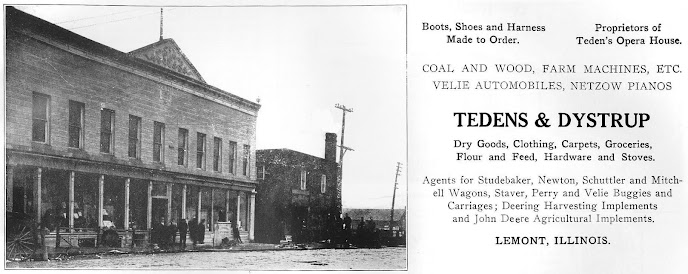
Tedens is a ghost town in Lemont, Downers Grove Township, DuPage County, Illinois.


John Henry Tedens (1833-1899) operated a department store at 106 Stephen Street in Lemont beginning in 1862. In the late-1890s, the business changed to Tedens Hardware Store. Tedens Opera House opened on the second floor in 1896.
Newspaper advertisement for the John Tedens and Alderman Dystrip's Department Store. Look at the store's offerings.

Compiled by Dr. Neil Gale, Ph.D.

Friday, September 16, 2022

Lost Towns of Illinois - Tacaogane, Illinois.

Tacaogane was a former settlement in Massac County, Illinois.


It was shown on the 1684 map of Louisiana by Jean-Baptiste-Louis Franquelin, who placed the settlement near the confluence of the Ohio and Tennessee Rivers, though the exact location of the settlement is undocumented.

"Tacaogane" may be a corruption of an Algonqian or Iroquoian word referring to speakers of another language, though it isn't clear which group this may refer to. Despite its apparent proximity to Kincaid Mounds, it is unlikely that Tacaogane refers to a surviving Mississippian settlement from the late 17th century.

Compiled by Dr. Neil Gale, Ph.D.

Lost Towns of Illinois - Sylvan, Illinois.

Sylvan was a former settlement in Cass County, Illinois, located two and one-half miles west-southwest of Newmansville. 


A few old farmhouses still stand. The town was populated during the mid-19th century mostly by Irish immigrants. There is one cemetery there.

Compiled by Dr. Neil Gale, Ph.D.
Lost Towns of Illinois - Schoper, Illinois.

Located about eight miles from Carlinville, the town of Schoper (aka Standard City) was originally Thomas Schoper’s 500-acre family farm. 

After a coal shortage in 1917, Standard Oil Company wanted a reliable coal supply. In 1918, Standard Oil of Indiana bought the farm (literally) from Mr. Schoper.

After completing several geological surveys (commissioned by Standard Oil), it was discovered that there was a seven-foot tall seam of coal in the ground at Schoper. The property was conveniently situated near the Chicago and Alton railroad, which was centrally located between the refineries in Wood River (near St. Louis) and Whiting, Indiana (near Chicago). 

In 1918, Standard Oil placed a $1 million order (for 192 houses) with Sears Roebuck and Company for 192 Sears Honor-Bilt homes. The houses were purchased for employees in Carlinville, Wood River and Schoper, Illinois. One hundred and fifty-six of the houses were built in Carlinville (152 of the original 156 homes still stand in a nine-block neighborhood), 12 were built in Schoper and 24 went to Wood River.

Twelve Sears Modern houses were built at Schoper for mine supervisors. There were also boarding houses and dorms built at Schoper for the miners. Standard Oil purchased the farm from Mr. Schoper and sank two mines there, Berry and Schoper. The town of Schoper, aka Standard City, sprang up around the mines.

At its peak, Schoper was the largest coal mine in Illinois, employing 650 men and hoisting up to 4,000 tons of coal daily. About 450 men also worked at the Berry Mine, producing about 2,000 tons of coal per day. The times were good. In the early 1920s, Schoper miners worked about 298 days per year, while nationwide, most coal miners worked about 200 days yearly. 
Schoper circa 1919. At the foot of the sidewalk is a 12-bay garage shared by the occupants of the 12 Sears Houses. The Power House is shown in the background near Schoper Lake. The Whitehall, Gladstone and Warrenton models are shown in the foreground. Click here for Sears model plans and costs.


By the mid-1920s, the boom at Schoper had gone bust. The price of coal dropped after The Great War (1918), and Standard Oil could now buy their coal cheaper from mines in Kentucky (which did not have unions) than they could mine it in Macoupin County.

In July 1925, a small column on the bottom page of the Macoupin County Enquirer sadly announced that the mine was permanently closed.

Nine of the 12 little Sears Houses were painstakingly disassembled and left Schoper the same way they came in: on boxcars, headed off to unknown destinations.

Two of the Sears Homes were moved intact to sites just outside of Standard City. The last Sears House at Schoper (The Sears Gladstone) was home to John McMillan and his wife, a supervisor with the mine. After the mine closed, he became a caretaker charged with myriad tasks, such as making sure the powerful fans down in the mine kept the methane down to acceptable levels. McMillan’s little Gladstone eventually became rental property and burned down sometime in the mid-1990s. 

The last remnant at the site was the Schoper Powerhouse and Mine Offices, a massive concrete Federalist structure which was torn down in Summer 2003.

Today, Schoper is a ghost town.

Compiled by Dr. Neil Gale, Ph.D.
Lost Towns of Illinois - Sugarville, Illinois.

Sugarville was a community near Put Creek in Fulton County, Illinois, five miles west of Canton.  It once had several houses, a blacksmith shop, and a general store. It no longer exists today.


Compiled by Dr. Neil Gale, Ph.D.

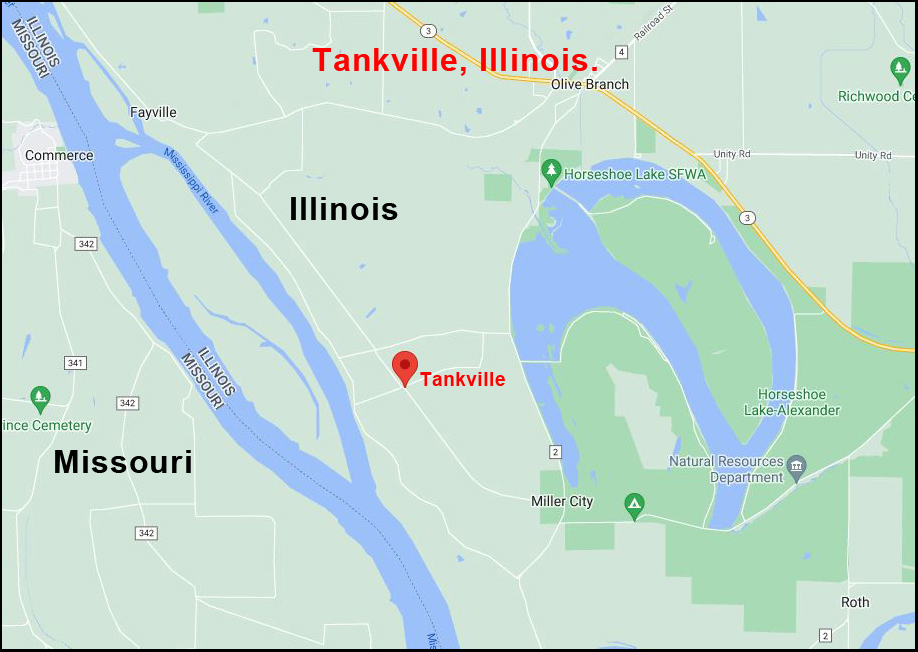
Lost Towns of Illinois - Tankville, Illinois.

Tankville was an unincorporated community in Alexander County, Illinois, located along the Mississippi River west of Horseshoe Lake.


Compiled by Dr. Neil Gale, Ph.D.

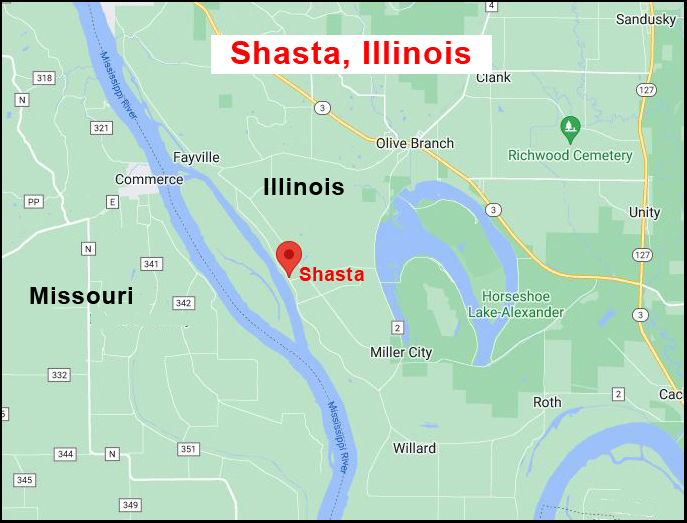
Lost Towns of Illinois - Shasta, Illinois.

Shasta is a former settlement in Alexander County, Illinois. Shasta was located along the Mississippi River northwest of Tankville.


Compiled by Dr. Neil Gale, Ph.D.

Lost Towns of Illinois - Reeds Crossing, Illinois.

Reeds Crossing was a former settlement in Boone County, Illinois. It was three miles south-southeast of Belvidere.


Compiled by Dr. Neil Gale, Ph.D.