Friday, April 17, 2020

The Reasons Why Harwood Heights and Norridge Aren't Part of the City of Chicago.

The Norridge and Harwood Heights villages are surrounded by the City of Chicago, like islands. For at least half a century, the canoe-shaped hole in the city's Northwest Side has been a source of wonder and frustration for anyone who's ever squinted at an old city street map.

But the situation was no accident. The self-sustaining villages of Norridge and Harwood Heights owe their independence to a combination of stubborn farmers, wary city bureaucrats and determined neighbors who wanted their own shot at governing.
The Norridge and Harwood Heights villages are surrounded by the City of Chicago.
Some homeowners had made a fleeting effort in 1928 to get the city to annex the territory, hoping they could access Chicago's water and police protection that their urban counterparts took for granted. However, they ran into resistance from the dominant farming population.

The homesteaders in the area did not need paved streets, sidewalks or street lighting and weren't willing to pay taxes.

Just north of the area, the city's boundaries were creeping out to swallow the industrial and commercial corridors of Milwaukee Avenue and Northwest Highway. And to its south, a community called Dunning was forming around the Cook County Poor House and Insane Asylum.

That left a hole in the city grid with a sparse population and even less infrastructure. In the 1930s, Norridge and Harwood Heights were little more than open prairie, low-lying forest and seasonal swamps, interspersed with some farms and dirt roads.
In 1947, residents near Lawrence and Harlem avenues, led by a Navy veteran named Herbert Huening, made a second, more serious effort to join the city.

At the end of WWII, the residents wanted what citizens of established communities had lighted and paved streets, police and fire protection, an adequate water source and storm sewers.

The City of Chicago believed that the area residents wanted to avoid paying to fix their water system or building their own sewers. Being annexed to Chicago would be a quick fix, and Chicago would pay for all those upgrades.

Rejected by city leaders, Huening convinced his neighbors that they could run the show themselves. They drew up articles of incorporation for the village of Harwood Heights, which had a population of 400 people.

Months later, another contingent of residents just south of Montrose Avenue prepared their own push to join the city. Calling themselves the "Annexation Improvement Club," the group scored audiences with 48 of the city's 50 aldermen to make their pitch. They even got tentative approval from the City Council, officially joining the city briefly.

But after just 30 days, the Annexation Improvement Club member Joseph Sieb suggested they secede and plant their own flag, just like Harwood Heights had done. Borrowing their name from Norwood Park and Park Ridge, the village of Norridge was incorporated on December 4, 1948.

sidebar
When Chicago began annexing land parcels between it and the airport, Norridge and Harwood Heights stood directly in this northwest route. So the city had to annex all the land around them to ensure that the airport would be in the city`s domain.

Ascending to Village Board President in 1951, Sieb rallied the new government to pave the roads and dig the sewer lines the area had long begged for. They founded a police department, created a park district and wooed developers with cheaper land and looser building restrictions than could be found in the city.

Norridge shared some public services with Harwood Heights, merging their school district and fire departments. The massive Eisenhower Library was built in 1973 and is accessible to residents of both villages today.

The "island" might have been too isolated to attract much fanfare in the early 20th century, but it proved a ripe target for the car-centric building boom of the 1950s. Vast tracts of fresh-built bungalows promised transplanted city residents "room to breathe."

Family entertainment businesses began popping up, fueling the building boom even more. 

The Harlem Outdoor Theater opened in 1946 at the intersection of Harlem Avenue and Irving Park Road, with a capacity for 1,030 cars. It was the second drive-in theater to open in Chicagoland.
The Hub Roller Rink opened on Harlem Avenue in October of 1950. Kiddie Park opened in the summer of 1938 at the north end of the future Harlem-Irving Plaza. KiddyTown Amusement Park opened in 1953 at the same spot.
Suddenly, people realized they didn't need to move to Arlington Heights for a 20-foot driveway and a two-car garage. And the best part was that you never had to worry about city bureaucracy — you could just walk to the Village Hall and sort your problem out.

In 1955, Sieb convened business leaders and encouraged them to build a shopping center at Harlem Avenue and Irving Park Road on a former livestock farm site. If open spaces didn't attract outsiders to Norridge, the Harlem-Irving Plaza (the HIP) opened in 1956 certainly would, with original anchor stores; Kroger, Walgreens, Wieboldt's, W.T. Grant, Woolworth, and Fannie May Candies.

By the early 1960s, the tables had turned on the city leaders who had spurned the neighbors' pleas for annexation. Instead of sinking their tax dollars into expressways and Downtown high-rises in Chicago, citizens of Norridge and Harwood Heights got to carve out a retail empire exclusively for their own benefit.

sidebar
Chicago Tribune, Sunday, January 3, 1971


Rumor had it that Sieb — who served as mayor until his death in 1998, making him the longest-serving municipal leader in state history — often boasted of calls he got from Mayor Daley, asking, "Are you ready to join the city yet?" As the story goes, Sieb just hung up the phone.

It was a formula that village leaders drew up by necessity.

Today, thanks in part to the sales tax raked in through Harlem-Irving Plaza, a megamall now anchored by a Target and packed with ritzy department stores and quality restaurants, the village hardly needs to collect any property taxes to keep public services running.

sidebar
Chicago Townships: Hyde Park, Jefferson, Lake, Lakeview, North Chicago, Rogers Park, South Chicago, and West Chicago. 

Norwood Park Township is one of 29 townships in Cook County, Illinois which consists of Norridge, Harwood Heights, Park Ridge and an unincorporated area.


Approximately 4.5%, of the 26,385 residents live in an unincorporated residential area within Norwood Park Township. Norwood Park Township is not a contiguous Township. It is essentially divided into three sections as a result of previous annexations by the City of Chicago. There is only one unincorporated residential neighborhood in Norwood Park Township with approximately 330 single-family homes and is wholly surrounded by the City of Chicago, but within the boundaries of Norwood Park Township. 

The housing in the unincorporated residential area is a mixture of old and new frame and brick single-family homes and is similar in age and architectural style of the housing in the neighboring municipalities of Chicago and Norridge. The Village of Norridge provides water to some of the unincorporated residents at the same rate as for residents. The unincorporated residential neighborhood does not have a uniform network of sidewalks or streetlights. The area has a substandard curb and gutter system to manage stormwater, when compared to the neighboring municipalities. Fire protection services are provided to the unincorporated residents through the Norwood Park Fire Protection District, which is funded through a general property tax on property owners within the District. The unincorporated residents of Norwood Park are not part of a public library district or park district.

Compiled by Dr. Neil Gale, Ph.D.

Tuesday, April 14, 2020

President Abraham Lincoln's funeral procession on May 1, 1865, in Chicago, Illinois.

Lincoln's funeral procession passing under an ornamental arch at Grant Park on Michigan Boulevard (renamed Michigan Avenue in 1871) and 12th Street (renamed Roosevelt Road in 1919) in Chicago, Illinois. May 1, 1865 
The funeral and lying-in-state at the Old County Court House were scheduled from 5:00pm until the body was returned in procession to the train on the following morning for departure to Springfield at 9:30am. 
Cook County Court House (left) Facing North on Randolph Street, Chicago 1865.
Funeral of Abraham Lincoln; his body Lying-in-State in the Court House.
The lakeshore was only pilings at that time with no beach or sand and water came within 300 feet of Michigan Boulevard.

The train arrived at 11:00 am with a procession in the early afternoon. Rather than pull into the main depot, however, the train stopped on a trestle built a short distance into Lake Michigan.
Lincoln’s Funeral Parade. The procession is seen here proceeding east on Lake Street from the corner of Clark Street.
The officers wearing a sash are with the special military honor guard. The President's funeral car was named "The United States." It was newly built and delivered by the U.S. Military Railroad. 

The body of his youngest son "Willie" who had died in 1862 had been disinterred in Washington and was accompanying his father's body on the car to be buried during the same rites in Springfield. 
Guarding Lincoln’s Funeral Car on the Illinois Central tracks by Lake Michigan. The car was auctioned off to a private party but was destroyed by a fire in 1911.
The train remained still, with only its bell tolling its arrival.
The Funeral train stopped on a trestle that carried the tracks out into Lake Michigan in Chicago.
The triple memorial arch was designed, constructed, and decorated under the supervision of the well-known architect, W. W. Boyington.
Railroad equipment can be seen in the distance behind the cortege. The train had come through Indianapolis and then Michigan City, Indiana on the Chicago Indianapolis & Louisville Railroad, the "Monon" and was going to Springfield on the Illinois Central Railroad. The total route was 1654 miles retracing the route of his first journey from Springfield to Washington D.C. in 1861.

Compiled by Dr. Neil Gale, Ph.D.

Mailing Children by U.S. Parcel Post.

Because of Rural Free Delivery (RFD) service, which began in 1896, mail was delivered directly to farm families. Before RFD, rural inhabitants had to pick up their mail themselves, sometimes at distant post offices, or pay private express companies for delivery.

On January 1, 1913, the U. S. Post Office began parcel post service for shipping packages throughout the country. Pretty much anything could be mailed that wasn’t dangerous or posed a threat to other pieces of mail.

The new service took off right away – almost two million packages were shipped in the first week of operations alone. A mortuary in St. Louis mailed human ashes to Illinois for burial, while a mother in St. Paul, Indiana, sent lunch to her son, who worked in Indianapolis. There were a few snags: a package of skunk hides prompted the evacuation of the post office in Decatur, Illinois.

On January 22, 1913, a woman requested rates for mailing herself from Elgin, Illinois to Washington, D.C.
Just a few weeks after Parcel Post began in January of 1913, Jesse and Mathilda Beagle “mailed” their 8-month-old son James to his grandmother, who lived a few miles away near Batavia, Ohio. Baby Beagle weighed 10¾ pounds, just within the 11-pound weight limit for parcels. The postage was 15¢, and the “parcel” was insured for $50 ($1,300 today). Rural Carrier Vernon Lytle picked up baby Beagle from his parent’s house and transported him in his mail wagon, delivering the boy safely to the address on the attached card, that of the boy’s grandmother, Mrs. Louis Beagle, who lived a little over a mile away. 

Although it was against postal regulations (it was never legal), many children traveled via U.S. Mail in the early years of Parcel Post. Initially, the only animals that were allowed in the mail were bees and bugs. In 1918, day-old chicks were allowed in the mail. In 1919, some additional “harmless live animals” were permitted, but children did not fall into this category.
One of the most famous images of a postman carrying baby mail. In fact, there are no photographs of real incidents of children being posted, with all contemporary images being staged for publicity.
The quirky story soon made newspapers, and for the next few years, stories about children being mailed through rural routes would crop up from time to time as people pushed the limits of what could be sent through Parcel Post.

The practice became affectionately known by letter carriers of the day as "baby mail."

In one famous case, on February 19, 1914, a four-year-old girl named Charlotte "May" Pierstorff was “mailed” via train from her home in Grangeville, Idaho, to her grandparent's house about 73 miles away. The postage was 15¢ ($15 today), with stamps attached to her coat, and the “parcel” was insured for $50 ($1,500 today).
Charlotte "May" Pierstorff was mailed via the US Postal System.
Luckily, little May wasn’t unceremoniously shoved into a canvas sack along with the other packages. As it turns out, she was accompanied on her trip by her mother’s cousin, who worked as a clerk for the railway mail service, Lynch says. It’s likely that his influence (and his willingness to chaperone his young cousin) is what convinced local officials to send the little girl along with the mail.

In 1914, a mother going through a divorce shipped her baby from Stillwell, Indiana, to its father in South Bend, Indiana. The child traveled 28 miles in a container marked “Live Baby” for only 17¢.

In 1914, Mrs. E. H. Staley of Wellington, Kansas, received her two-year-old nephew by parcel post from his grandmother in Stratford, Oklahoma, where he had been visiting for three weeks. The boy wore a tag around his neck showing it had cost 18¢ to send him through the mail. He was transported 25 miles by rural route before reaching the railroad. His grandma packed enough food to share with the mail clerks he rode with. He arrived in good condition after the 200-mile one-way trip.

The longest trip taken by a “mailed” child took place in 1915 when a six-year-old girl traveled from her mother’s home in Pensacola, Florida, to her father’s home in Christiansburg, Virginia. The nearly 50-pound girl made the 721-mile trip on a mail train for just 15¢ in parcel post stamps. The postage was much cheaper than a train ticket.

These stories continued to pop up as parents occasionally managed to slip their children through the mail, thanks to rural workers willing to let it slide.

Finally, on June 14, 1913, several newspapers, including the Washington Post, the New York Times, and the Los Angeles Times, all ran stories stating the postmaster had officially decreed that children could no longer be sent through the mail. But while this announcement seems to have stemmed the trickle of tots traveling via post, Lynch says the story wasn’t entirely accurate.

“According to the regulations at that point, the only animals that were allowed in the mail were bees and bugs,” Lynch says. “There’s an account of Charlotte May Pierstorff being mailed under the chicken rate, but actually, chicks weren’t allowed until 1918.”

But while the odd practice of sometimes slipping kids into the mail might be seen as incompetence or negligence on the part of the mail carriers, Lynch sees it more as an example of just how much rural communities relied on and trusted local postal workers.

“Mail carriers were trusted servants, and that goes to prove it,” Lynch says. “There are stories of rural carriers delivering babies and taking care of the sick. Even now, they’ll save lives because they’re sometimes the only persons that visit a remote household every day.”

The Post Office Department officially put a stop to “baby mail” in 1915, after postal regulations barring the mailing of human beings enacted the year before were finally enforced.

On June 13, 1920, the headline in the Washington Herald read: “CAN’T MAIL KIDDIES – DANGEROUS ANIMALS." The Post Office, in its wisdom, had finally ruled that children were not “harmless animals” and, because of their potentiality for danger, may not be mailed as parcel post. “By no stretch of imagination or language,” said the ruling, “can children be classified as harmless, live animals that do not require food or water.”

Luckily, there are more travel options for children traveling alone these days than pinning some postage to their shirts and sending them off with the mailman.

Compiled by Dr. Neil Gale, Ph.D.


This is the email response I received from an inquiry to the official Historian of the United States Postal Service.

Partial Email Header:
Received: from EAGNMNSXMB60.usa.dce.usps.gov (EAGNMNSXMB60.usa.dce.usps.gov [56.207.244.38]) by mailrelay-c1i.usps.gov (Symantec Messaging Gateway) with SMTP id 0D.0F.17582.03C949E5; Mon, 13 Apr 2020 12:06:56 -0500 (CDT)
Mon. April 13, 2020 at 12:06 PM

Hi Dr. Gale!
There are several newspaper accounts of children being “mailed” following the introduction of Parcel Post in January 1913. We share one such story on page 38 of "The United States Postal Service: An American History."

I hope this is helpful.

Jenny Lynch,
Historian and Corporate Information Services Manager
United States Postal Service

Tuesday, April 7, 2020

A Brief History of the Dutch Mill Candy Company, Chicago, Illinois.

Dutch Mill Candy Company was established in 1927 at 2222 Diversey Parkway in Chicago. Barnet L. Stein was the company's President. Dutch Mill opened its 50th Chicago-area shop in 1946, selling candy, ice cream, and lunch.
Dutch Mill had an appealing "Old-world" aura and specialized in Dutch-processed chocolate (chocolate treated with an alkalizing agent), which was said to yield a richer, creamier taste. Slogan: "The Finest Candy This Side of Heaven." 
Randhurst Mall in Mount Prospect, Illinois.
Downtown Chicago Store.
Dutch Mill closed in 1988.


Compiled by Dr. Neil Gale, Ph.D.

Monday, April 6, 2020

Radium Poisoning Killed Perhaps Hundreds of "Ghost Girls" in Ottawa, Illinois.

A BRIEF BACKGROUND OF RADIUM
In 1898, Marie and Pierre Curie, two of the most prominent pioneers in the research of radioactivity, discovered the element radium. Radium was particularly intriguing because it glowed in the dark, and as Marie noted, “These gleamings seemed suspended in the darkness and stirred us with ever-new emotion and enchantment.” Soon enough, the radium craze was on. After it was observed that radium could treat cancer, many people mistakenly believed it could also be used to treat other diseases.
Pierre and Marie Curie in the laboratory, demonstrating the experimental apparatus used to detect the ionization of air, and hence the radioactivity, of samples of purified ore, which enabled their discovery of radium. Marie is operating the apparatus.
Around this time, American inventor William J. Hammer went to Paris and obtained a sample of radium salt crystals from the Curies. Hammer discovered that by mixing the radium with glue and zinc sulfide, he could make glow-in-the-dark paint. His discovery would soon be used by the U.S. Radium Corporation to manufacture wristwatches with radium-painted dials. 
Employees of the U.S. Radium Corp. paint numbers on the faces of wristwatches using dangerous radioactive paint. Dozens of these women later died of radium poisoning.
Advertisements for the product, which they called "Undark," boasted that it was "made possible by the magic of radium!" U.S. Radium would also receive government contracts during World War I to produce watches and airplane instruments for American soldiers.
Before long, radium was widely considered a “miracle” substance, sold in pharmacies for all kinds of ailments. It was also widely believed that radium could prevent aging, and companies sold radium toothpaste, radium cosmetics, and even radium water.
New York Tribune ad for Radior Toilet Requisites, 1918.
Marie Skłodowska Curie was a Polish and naturalized-French physicist and chemist who conducted pioneering research on radioactivity. She was the first woman to win a Nobel Prize, the first person and the only woman to win the Nobel Prize twice, and the only person to win the Nobel Prize in two different scientific fields.
RADIUM POISONING TOOK THE LIVES OF THOUSANDS OF FEMALE FACTORY WORKERS DURING THE 20th CENTURY.
On August 25, 1959, Beatrice Workman died of radium poisoning. The 54-year-old Park Ridge, Illinois, resident had worked in the 1920s at Radium Dial Company in Ottawa, Illinois, which hired women to paint watch and clock dials with radium-laced, glow-in-the-dark paint. 
Workman first experienced pain in 1936, but doctors told her it was arthritis. "The real source of her trouble wasn't found until she was examined at Presbyterian-St. Luke's Hospital," on August 27, 1959, reported by the Rockford Register-Republic newspaper. That was 23 years after her first medical examination.

There were likely thousands of dial painters who died from radium poisoning, although there's no definite number. Besides the Ottawa plant, the old Elgin Watch factory in Elgin, Illinois, used radium on watch dials. Women had worked at radium companies in New York, Connecticut, and New Jersey. Most died young, decades before Workman.

That included many women in Illinois. Some of the Ottawa painters, despite their long, agonizing illnesses with crippling sarcomas (cancer that grows in connective tissue that connects other kinds of tissue in your body), crumbling jawbones, crushed spines, amputated limbs, and other infections, were among the luckier ones. Due to Illinois' progressive workers' compensation laws, some of the Radium Dial workers received financial compensation.

Illinois was one of the earliest states to adopt workers' compensation laws in 1911. The final state to adopt it was Mississippi in 1948. Illinois' law led to the creation of the Illinois Industrial Commission in 1917, and it was this body that sided with one of Ottawa's most well-known dial painters in 1938. Although dial painters in other states sought retribution for their fatal illnesses, those in Ottawa were the only ones to win state-sanctioned compensation for radium poisoning.

1920s № 579 Rolex
Sterling Silver Tank Style
In the 1920s, watch advertisements touted the excellent radium-dial watches that allowed owners to tell the time in the dark. They became top sellers, and production ramped up. Radium Dial hired women, girls mostly — some as young as 11 years old, according to Moore's book — to paint the watch dials. 

Precision was key, so the girls were taught to create a fine point with the paintbrush bristles by using their lips. With each lick, they ingested radium.

Their bosses said the paint wouldn't hurt them. They told the girls it would make them beautiful. The radium became a toy.

Darlene Halm's aunt, Margaret "Peg" Looney, was one of the first Ottawa painters to die from radium poisoning. Looney started working at Radium Dial when she was 17. She was the oldest sister in a family of 10. "I can remember my family talking about my aunt bringing home the little vials (of radium paint)," says Halm, who still lives in Ottawa. "They would go into their bedroom with the lights off and paint their fingernails, their eyelids, their lips, and then they'd laugh at each other because they glowed in the dark." Looney wasn't alone. During their breaks at work, many of the painters did the same thing, according to Moore. Some even wore their party dresses to work so they would glow.

Six years later, Looney became sick. Problems had begun much earlier when she had a tooth removed, and the site never healed. She was anemic, couldn't walk from hip pain, and her teeth and bits of jawbone were falling out. Her fiancé "used to pull her around the neighborhood in a wagon when she was too ill to walk," says Halm. "She collapsed at work one day, and they sent her to a company hospital. My grandparents and her siblings had no say about her going to the company hospital and were not allowed to visit. They were told she had diphtheria and was quarantined." Looney died in the hospital. She was 24.

"The company wanted to bury her right away," according to Halm. "Several family members were at the hospital when she died, although they weren't allowed to see her. (One of them) refused to allow the company to bury her and insisted she have a Catholic funeral." Radium Dial agreed to autopsy her body and to have the Looneys' doctor present for it. But when their doctor arrived, the autopsy was finished, Halm says.

The Looneys were suspicious. They attempted to find an attorney to investigate Peg's case. No one would take it.

Radium Dial knew what was wrong with Looney; it had known for years. Halms says the family learned this later and found out the company had hired doctors to examine the painters starting in 1925. "They told (Looney) she was very healthy," says Halm. "They never told her she had tested positive for radiation."

"There is evidence, particularly in Illinois, that the executives at the Radium Dial Company... had the knowledge that the radium was poisoning the women," says Moore. "They deliberately lied to the women."

Another one of those women was Catherine Donohue. She started feeling ill in 1925 and limped from the pain. In 1931, Radium Dial fired her "because my limping was causing much talk," Donohue said, according to the July 27, 1938, Rockford Register-Republic. By this time, other dial painters in New Jersey and Illinois had also become sick and died.

Donohue's maladies increased and worsened. She lost half of her body weight. Parts of her jaw fell out. She couldn't eat and became nearly bedridden. A local doctor couldn't diagnose her but denied that Donohue had radium poisoning. Later, a Chicago doctor confirmed she did. Donohue and some of the other ailing dial painters (one had her arm amputated) decided to sue. They became known as "the society of the living dead," reported on April 6, 1938, in the Springfield, Illinois State Journal. Their first effort failed. Then, Illinois passed the Illinois Occupational Disease Act because of the women, according to Moore.  

The "society" tried again but had trouble getting a lawyer. Eventually, they found Leonard Grossman in Chicago. "My father had been working in the area of workers' comp for some time," says Leonard Grossman Jr., Grossman's son and a retired attorney in River Forest. "Workers' rights were a major issue for him. He was asked, from what I understand, to take the case by Clarence Darrow, who was one of his heroes." 

Grossman Sr. took the case to the Illinois Industrial Commission. His clients were "quite poor, that was one reason they were suing," so he handled their case for free, according to his son. During the trial, the "emaciated" Donohue, as of February 11, 1938, Rockford Register-Republic called the young wife and mother of two, learned from a doctor that her condition was fatal, and collapsed. The trial was continued at her home because she was too weak to travel. In his closing brief, Grossman Sr. said Radium Dial had denied the women's requests to see their physical examination results, had produced no witnesses to contradict the workers' testimony, and had admitted that radium was a poison, then denied it. He called the company a "predator" and said the radium would "bombard through Donohue's very casket like it wrecked and destroyed her jawbone and her hip."

The women won. But "at great personal cost," says Moore, who spent a month in Ottawa talking to locals and doing research. "The town didn't really want to acknowledge what had happened. That was certainly true in the time the women were prosecuting the case. There's evidence I've seen in their letters that their neighbors, the clergy, and business people kind of shunned them." It was the Great Depression, and Radium Dial was providing well-paying jobs. Locals kind of wanted the women to put up and shut up," she says.

Although they won, the women's individual financial awards were small. "The company only had to pay $10,000 to the women, collectively, because it fled the state and started a business in New York," Moore says. "There was no way the Illinois Industrial Commission could reach across state lines and grab those assets." Some of the women got nothing. Radium Dial unsuccessfully appealed the decision many times, up to the U.S. Supreme Court. Donohue died before the appeals were finished. "She weighed less than 60 pounds," Moore wrote.

Radium Dial's president, Joseph Kelly, was ousted in 1934. He opened another company to produce radium clock dials. Halm says he called it "Luminous Processes" and located it in Ottawa, just a "few blocks away" from Radium Dial. "They hired a lot of the same girls." Radium Dial went out of business.

Luminous hummed along for decades, until 1976, according to Clark's book. The Nuclear Regulatory Commission fined it that year for having radiation levels "1,666 times" the allowable amount. After failing to make the necessary improvements, Luminous closed its doors. On April 2, 1984, a United Press International article, which called the company a "death factory," reported that former workers were suing the company; cancer ran high among the former dial painters. "To escape financial liability for environmental pollution and industrial diseases, Luminous Processes shuffled corporate assets into other holdings, in much the same way that Radium Dial had in the 1930s," Clark wrote.

In 1978, the same year Luminous Processes closed in Ottawa, Peg Looney's body was exhumed. Earlier, when the Cold War threatened nuclear attacks, the U.S. Atomic Energy Commission began to study radiation's effects on humans. Dial painters, living and dead, were perfect study subjects. Looney's family gave permission for her body to be exhumed and researched by Argonne National Laboratory near Lemont for the study. "The family was told that they brought her body back encased in lead because she was still so radioactive," Halm says. Halm's mother had saved one of Looney's white gloves that Halm liked to try on occasionally. "She threw it away. She was afraid it was contaminated."

Looney and the other ill-fated dial painters had helped start a "movement that ultimately led, not until 1971, to the adoption of the federal OSHA (Occupational Safety and Health Administration) Act, which was the big change in having federal workers' safety laws," Grossman Jr. says. He worked for the U.S. Department of Labor for 30 years on workers' rights cases.

He adds that the dial painter's case was critical to his father. "He talked about the frailty, particularly of Catherine Donohue, and the strength of the other girls in supporting her. One of the girls gave him a small piece of wood that resembled a chess pawn, with a band of radium painted around it. It was so tiny it wasn't dangerous, but it still had a faint glow when I was a kid."

Grossman Jr. believes their case has lessons for today: "In my work with the Department of Labor, employers make the same kinds of arguments that they made in the Radium Dial case. They say, 'We would never harm our employees. This process is not harmful…' The battle has to keep being won over and over and over."

"It's so easy in our day, 100 years on from the time when the radium girls' story first started happening, to say our health and safety (are) just red tape, bureaucracy, getting in the way of companies' profits," says Moore. "The radium girls' story is a kind of warning call from history that lest we forget, we will repeat the same mistakes."

One day, long ago, Grossman Jr. recalls getting a call out of the blue. "The voice on the other end said, 'Is this attorney, Grossman?' I said, 'That was my father.' She said, 'Well, I'm one of the descendants of Catherine Donohue, and I just wanted to thank him.'"
In 2011, thanks to an idea from local high schooler Madeline Piller, Ottawa erected a sculpture to honor its radium girls.
Compiled by Dr. Neil Gale, Ph.D.
Contributor Tara McClellan McAndrew

Friday, April 3, 2020

The History of Chicago Boarding Houses.

Forward
 
Behind the Doors of Chicago’s Boarding Houses

Before skyscrapers defined the skyline and condos dotted every block, Chicago pulsed with a different kind of housing rhythm—one shaped by the humble, bustling boarding house. This section invites you into the intimate, often overlooked world of shared meals, rented rooms, and surrogate families that once formed the backbone of urban life.

From the early taverns of Fort Dearborn to the industrial crescendos of the 1880s, boarding houses offered more than shelter—they were lifelines for immigrants, single workers, and women seeking financial independence. You’ll discover how married women, widows, and mature singles turned their homes into economic engines, hosting boarders who became part of their daily lives. Reformers praised these spaces for their moral influence, while newcomers found cultural havens where native tongues and familiar customs softened the shock of migration.

This section also explores the evolution of boarding—from cozy parlors and communal dinners to the rise of rooming houses and SROs (single-room occupancy hotels). As Chicago’s population exploded, so did the diversity of its housing: from “hot beds” shared in shifts to elegant residential hotels, each with its own rhythm and rules. And while postwar prosperity and suburban flight nearly erased the boarding house from memory, today’s co-living trends hint at a quiet revival.

So pull up a chair in the parlor, and let’s revisit the spaces where strangers became family, and where the city’s heartbeat could be heard in every clatter of dishes and creak of floorboards. The story of Chicago’s boarding houses is one of adaptation, resilience, and the enduring human need for connection.

Chicago Boarding House, 1890s.
A Chronology of Early Chicago Area Hotels.

Residential boarding arrangements in the Chicago area are at least as old as the Fort Dearborn trading settlement taverns. During Chicago's early boom years, when housing facilities struggled to keep pace with population growth, many visitors and newcomers found lodging and meals in the homes of private citizens.

By the 1880s, boarding was an established way of life. Private boarding houses typically consisted of a married couple (with or without children) who kept several boarders, generally single, unrelated individuals. While married couples occasionally boarded, families with children rarely lived in boarding houses.

Women usually took primary responsibility for the borders. For many women, keeping boarders and lodgers was a readily available way to earn money that permitted a flexible schedule and was compatible with caring for children. A married woman's income from boarding was often more reliable than her husband's income and could be the primary source of income for the household. Keeping borders was also a source of income for some widows and mature single women.

For many landlords and boarders, the household intimacy of boarding was part of its appeal. Boarders took their meals within the household and often participated in family activities. Boarding house residents met daily in the shared dining room and parlor spaces. Late-nineteenth-century reformers approved the family environment of boarding houses, which they felt was a welcome social restraint on boarders.

Native-born white and negro Americans often lived in boarding houses when they were single and new to the city. After the 1880s, an increasing number of single young women and men were employed in clerical jobs in the new skyscrapers, and many resided in boarding houses.
H.H. Holmes Murder Castle (the arrow is the front entrance), circa 1893.

Boarding was more prevalent among immigrants than native-born in early twentieth-century Chicago and other large cities. Boarding provided a cultural haven for homesick new immigrants who sought out households where they could speak their native tongues. Housing arrangements were often made through informal networks rather than public advertising.
The Transit House, 43rd and Halsted, Chicago, (1868). This boarding house served the visitors and patrons of the Union Stock Yards.


Larger and more commercial boarding houses existed in outlying industrial areas, such as near suburban railroad stops. Workers shared bedding in some more crowded arrangements and slept in shifts in a "hotbed." In some working-class boarding houses, each boarder's food was purchased and cooked separately. In other situations, residents took turns cooking for themselves.
Notice the building's main entrance has been moved to the second floor because Chicago raised the street level to improve water drainage, raising the streets out of the mud in 1858.

Well before 1900, other arrangements began to replace boarding. Many tenants preferred to lodge without common meals or to live in larger, more anonymous rooming houses, where a "light housekeeping room" included a gas fixture for cooking on a single burner. Residents could keep their own hours in a rooming house, enjoy greater privacy, and entertain guests more easily.
Packingtown (Back of the Yards Neighborhood), Chicago.

Landlords, too, could prefer lodgers to boarders for many of the same reasons. Boardinghouse families began to desire their privacy over the affective ties of an extensive surrogate family. 

The decline of boarding could be seen as a parallel to the transformation of the semipublic "parlor" or front room (frunchroom in Chicagoese) into the twentieth-century private "living room."

Compiled by Dr. Neil Gale, Ph.D. 

Wednesday, April 1, 2020

The Pullman Building at Michigan and Adams Tip Top Inn and Black Cat Inn Restaurants, Chicago.


In historical writing and analysis, PRESENTISM introduces present-day ideas and perspectives into depictions or interpretations of the past. Presentism is a form of cultural bias that creates a distorted understanding of the subject matter. Reading modern notions of morality into the past is committing the error of presentism. Historical accounts are written by people and can be slanted, so I try my hardest to present fact-based and well-researched articles.

Facts don't require one's approval or acceptance.

I present [PG-13] articles without regard to race, color, political party, or religious beliefs, including Atheism, national origin, citizenship status, gender, LGBTQ+ status, disability, military status, or educational level. What I present are facts — NOT Alternative Facts — about the subject. You won't find articles or readers' comments that spread rumors, lies, hateful statements, and people instigating arguments or fights.

FOR HISTORICAL CLARITY
When I write about the INDIGENOUS PEOPLE, I follow this historical terminology:
  • The use of old commonly used terms, disrespectful today, i.e., REDMAN or REDMEN, SAVAGES, and HALF-BREED are explained in this article.
Writing about AFRICAN-AMERICAN history, I follow these race terms:
  • "NEGRO" was the term used until the mid-1960s.
  • "BLACK" started being used in the mid-1960s.
  • "AFRICAN-AMERICAN" [Afro-American] began usage in the late 1980s.

— PLEASE PRACTICE HISTORICISM 
THE INTERPRETATION OF THE PAST IN ITS OWN CONTEXT.


As the massively solid Pullman Building at 79 East Adams Street was under construction on Michigan Avenue in 1884, Adolph Hieronymus traveled to Chicago from his native Germany. Within a few years, he would run a renowned restaurant on the building’s top floor.

The Pullman Palace Car Company (established in 1862) was first located in the Tremont House at 92 Lake Street in February of 1867. The firm moved in 1868 to offices at Randolph and the Lake, a fortuitous move. The building was close to the rail lines running along the lakefront, and a rail siding ran next to the building. 

The day after the Great Chicago Fire, Pullman quickly moved what he could save to stables at 18th Street, where business presumably carried on via the Illinois Central tracks. Between 1871 and 1884, Pullman's primary offices were located on the east side of Michigan Avenue south of 18th Street and later in the old Peoples Gas building at 122 South Michigan Avenue, the site which is still the site of the Peoples Gas building.

A new fire-proof building was built as the new headquarters of the Pullman Palace Car Company. It was completed in 1885 at the southwest corner of Michigan Avenue and Adams Street. 

When owner George Pullman died in 1897, Robert Todd Lincoln, Abraham's son, filled in as the acting president. His role transformed into a permanent one in 1901. He resigned in 1911, citing health concerns. Lincoln remained involved as the chairman of the board, a position he held until 1922.

The Pullman Company was renamed on December 30, 1899, several years after the death of George Mortimore Pullman (1831-1897), and the headquarters remained in the Pullman Building until 1948, after which offices were moved to the Merchandise Mart.

When the imposing building was completed, the company occupied two and a one-half of its nine floors. At the same time, the rest of the space was rented for 125 offices and 75 apartments, which were known as “bachelor apartments,” probably because it lacked anything but the most rudimentary cooking facilities.
George Pullman's office was located on the ninth floor, just below the flag-pole-topped corner turret. The offices of the company were located elsewhere in the building.
The Pullman company ran its own restaurant, "The Albion, " for the first few years," on the 9th floor. It was considered advanced, at the time, to locate restaurants on top floors so that cooking odors would not drift throughout the building. In addition, diners at The Albion, and later the Tip Top Inn restaurant, had excellent views of Lake Michigan.
The Corner of Michigan Avenue and Adams Street, Chicago.
During the World's Columbian Exposition in 1893, Adolph Hieronymus left his job as the chef at the Palmer House. He took over the Pullman building restaurant, renaming it the Tip Top Inn. Under his management, it became one of Chicago’s best gourmet restaurants, hosting society figures and professional organizations. Until the Pullman company expanded its offices onto all eight floors below the restaurant, the men living in the 75 apartments on the upper floors were also steady customers of the Inn, often having meals sent down to them.

The space occupied by the Tip Top Inn was divided into a bewildering number of rooms, at least five and maybe more at once. Each had its own decorating scheme. Over the years – but surely not simultaneously — there were the Colonial Room, the Nursery, the Whist Room, the Charles Dickens Corner, the Flemish Room, the French Room, the Italian Room, the Garden Room, and the Grill Room. The Whist Room was decorated with enlarged playing cards and lanterns with spades, hearts, diamonds, and clubs. The lantern and suits also decorated the Inn’s china and menus.
The Colonial Room
The Whist Room
The French Room
Mr. Hieronymus employs negro waiters, and many people wonder how he gives such good service to negroes. In reply to this subject, Hieronymus said:
“I have tried to be a friend of the negro in this business. and have always employed them. It is in the Palmer House and The Tip Top Inn that the negro has held his position all these years in Chicago. I have their work systematized. Each waiter knows his station and what he has to do, arid each station has its captain, who is my representative, and I am always accessible. There is discipline, but no bad language. Every employee must be self-respecting and a credit to the establishment. The waiters appreciate the treatment and are loyal. It is the same way with the cooks; they are loyal, and have time and again given evidence of it. The policy here is to minimize waste. The high cost of living today is due in a large measure to waste, not alone in material, but in time."
Hieronymus was employee-centric and compensated his entire staff better than other local fine-dining restaurants. The meals were expensive for the time period, and the waiters made an excellent living on tips.

A single tenant who had a meal sent down to his apartment might order; Tomato Crab Cumbo soup, Allice Salad, Fillet of Sea Bass, Peach a la Bellevue, and French Drip Coffee paid $2.95  in 1920 ($40.25
 today).
Tip Top Inn Partial Menu - In 1920, $1 = $13.65 today.
Perhaps to attract new customers, Hieronymus created an associated restaurant on the 9th floor called "The Black Cat Inn," with somewhat lower prices than the Tip Top Inn and a menu featuring prix fixe meals (fixed price).

The Tip Top Inn and The Black Cat Inn occupy the entire top floor of the Pullman Building. The Black Cat Restaurant takes the west wing of the building and is operated with less overhead for service than The Tip Top Inn; consequently, the bill-of-fare prices are lower. 

There was a new departure in service in the Black Cat Inn in that negro waitresses were employed. These young women had been carefully trained, serving a sort of apprenticeship as bus girls for some months before advanced to waiters. They are intelligent, respectful, clean, and work side by side with the negro waiters. Hieronymus watched them work for half an hour, and they gave satisfactory service. 
The Black Cat Inn. (c.1910)
Negro waitresses served in restaurants far less often than negro men. The Tip Top Inn, just like the Albion and the Pullman dining cars, had always been staffed with negro waiters, some of whom worked there for decades. It was said that anyone who worked at the Tip Top could find employment in any restaurant across the country. 

In the book “Black Bolshevik,” author Harry Haywood (the son of former slaves who became a leading member of the Communist Party and a pioneering theoretician on the negro struggle. Originally published in 1978) wrote in his autobiography that he quickly worked his way up from Tip Top Inn busboy to a waiter and then landed jobs on the ultra-modern Twentieth-Century Limited train and with Chicago’s Sherman Hotel and Palmer House.

By 1931 when the Tip Top Inn restaurant closed, it was regarded as an old-fashioned holdover from a previous era. Its extensive menu of specialties, such as Stuffed Whitefish with Crabmeat, Suzettes Tip Top, and Alice Salad[1], some of the more than 100 dishes created by Hieronymus, was no longer in vogue. 

The outlawing of alcoholic beverages proved challenging to the Tip Top Inn, as it did to other leading Chicago restaurants of the pre-Prohibition era, such as Rector’s, the Edelweiss, and the Hofbrau, all of which would go under before the ban on selling alcohol ended. 

Aside from Prohibition (1920-1933), Hieronymus attributed the restaurant’s demise to the death of gourmet dining. Hieronymus died in 1932, but he and his restaurant were remembered by Chicagoans for decades. 

The Pullman Building was demolished in 1956.

INDEX TO MY ILLINOIS AND CHICAGO FOOD & RESTAURANT ARTICLES.

Compiled by Dr. Neil Gale, Ph.D.


[1] Salade Alice (Alice Salad) Recipe:
Ingredients: 
  • Medium-sized red dessert (sweet) apples
  • Lemon juice
  • Apple balls cut with a very small vegetable ball-cutter
  • Redcurrants
  • Almonds or walnuts
  • Salt
  • Cream
  • Lettuce
Directions:
  • Cut the apples into 4 or 6 wedges and remove some of the fruit, making a bowl. 
  • Rub the inside of the apple with lemon juice to prevent it from discoloring. 
  • Mix the apple balls, redcurrants, and chopped nuts. 
  • Sprinkle with salt and lemon juice and bind with the cream. 
  • Fill the apple bowls and serve on bibb lettuce. 

Monday, March 30, 2020

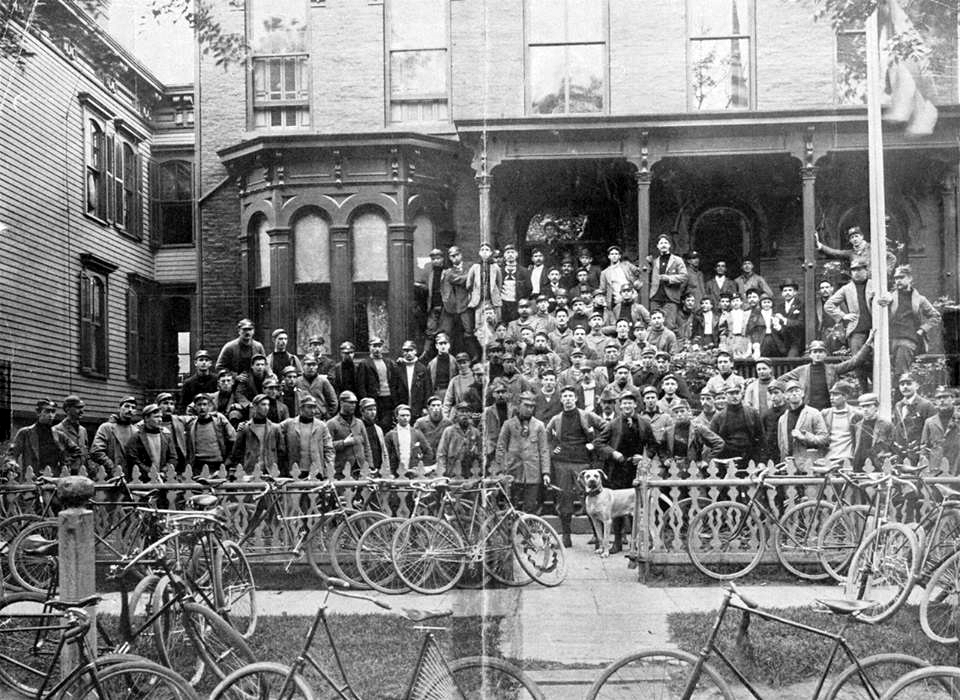
Lake View Cycling Club of Chicago in the 1890s.

CLICK THE PICTURE TO ENLARGE
The Lake View Cycling Club in front of its clubhouse at 401-403 North Orchard Street, Chicago (today, 2224-2226 North Orchard Street) in the 1890s.
I personally spoke with Mary, the owner of the 2-flat at 2222 N. Orchard that was next to the Lake View Cycling Clubhouse. Mary and her husband ran a book business out of their 2-flat called Orchard Books, Inc. They have a framed copy of the Lake View Cycling Club hanging in their foyer.

Mary told me that the new condo building was built in 1998. The 2-story Mary owns was originally built-in 1890. It's the building on the right, the 3-story condominium, was the location of the Lake View Cycling Clubhouse, which of course, was demolished. 

Mary's 2-story building was razed between August of 2018 and July of 2019.

Copyright © 2016, Neil Gale, Ph.D.