Saturday, October 12, 2019

Buddy Ebsen's Swimming School in Belleville, Illinois.

Buddy Ebsen (born Christian Ludolf Ebsen Jr.), in 1908 in Belleville, Illinois. He grew up at 805 Lebanon Avenue in Belleville, Illinois. Before there was a 'cee-ment' pond behind the family home, there was a real pond. 
Note the misspelling of the name.
Buddy's father, Christian Ludolf Ebsen Sr., taught swimming lessons in the Ebsen’s Pond behind their house, later the property was transformed into the Belleville Municipal Swimming Pool, which was then demolished in 2015. Christian managed a natatorium for the local school district. 
Everybody ought to learn how to swim.
His father also taught dance lessons, and young Buddy took lessons in town, and after the family moved to Florida.

The Ebsens left Belleville when Buddy was 10 years old and moved to Florida for his mother’s health. Buddy continued dance lessons after the family moved to Florida.

Ebsen became embroiled in a contract dispute with MGM that left him idle for long periods. He took up sailing and became so proficient in seamanship that he taught the subject to naval officer candidates during World War II.
Buddy Ebsen famously played "Jed Clampett" in the TV show "The Beverly Hillbillies" (1962–1971).
Ebsen was also in the Belleville area in 1977, when he went sailing at Carlyle Lake. Besides strolling downtown and touring his family home, Ebsen visited the News-Democrat offices. Newsroom staffers remember the visit, particularly because Ebsen did a little soft-shoe routine across the newsroom.

Buddy again came to visit Belleville in 1992. He then surprised a group of preschool teachers when he took a walk downtown.

"Hi! I'm Buddy Ebsen. I grew up here in Belleville," Ebsen said to a small child in a News-Democrat article from 1992. One of the children's teachers recognized him instantly as the sometimes cantankerous Jed Clampett from the Beverly Hillbillies.

Ebsen died of respiratory failure in 2003 at age 95. His ashes were sprinkled into the Pacific Ocean.

Compiled by Dr. Neil Gale, Ph.D.

Energy, Illinois' Calaboose History.

On Route 148, right in the middle of Energy, Illinois, there was a squat, concrete, empty Calaboose (prison).
The Old Calaboose.
The heavy metal door was on rusty hinges, and the two small cells were bare. There were no signs of the colorful history of prisoners or escapes - only a few scrawlings were found on the walls, including a faded 'J.R. loves' [somebody], written in lipstick.

There is a history. It goes way back before the little jail was built. There was an older jail, one made of two-by-fours.

The history of jails is the history of Energy, a quiet town - the residents called it the quietest and friendliest town in Southern Illinois. The concrete jail had only been used three times in 37 years.

But there was a time when Energy and its jail were a total of rowdy, drinking and cursing men. Back then, the Energy calaboose, less than 200 feet from the nearest saloon, was the center of town activity every night from 6 PM until 10 PM. It was back in the early 1900s.

At 5 PM, the miners from Carterville, Herrin and Marion would begin to pile into the four noisy saloons that lined the streetcar line that brought them to Energy. They would be in a hurry because they had only four hours to drink, argue, fight, and cuss before taking the last streetcar out at 10 PM. They had to drink their fill-in Energy because it was dry back home in Carterville and Marion.

At about 8 PM, Charley Perrin, Henry Range or other policemen would begin filling the Energy jail. And just about 10 PM, the prisoners would break out of this first frail jail so that Ben Walker and some other streetcar operators could get them back home on the 10 PM run.

The first Energy jail was built by Marion Kood for $1 a day to the city. The jail later turned into a coal shed, remembered for the tales about those who escaped.

Two area rowdies were more familiar with the inside of the Energy Calaboose than anyone else. One was a roamer who lived in Happy Hollow. He was taller than most people and skinnier, too. After drinking in one of the saloons, he would get in trouble, and they would toss him in jail. He was so thin he'd squeeze out through the chimney flue.

There was another little man from Carterville. He weighed just a little over 100 pounds. It was said he was a mean little guy, and no sooner would they throw him in jail than he would pry loose a floorboard, escape, and beat up the arresting officer. They finally left him alone.

In fact, the only person ever locked in the old Calaboose they knew of who didn't get out one way or another was "an old fightin' woman." She would get wild - kicking and screaming, and they'd throw her in jail.

The city saw the need for a better jail. In 1908, Price Watson built the concrete jail in the center of Energy. He threw in the construction of the jail and all the city sidewalks for $1,000. He did a good job, too. No one ever escaped.
The 2nd Calaboose is built from concrete.
After the new jail was built, they put the old one up for public auction.

The new concrete jail was not used for long. New city and federal laws put the saloons out of business, and when the saloons were gone, the need for a city jail was gone, and Energy became a quiet little town.

One oldtimer said, "We traded four saloons and a calaboose for two fine churches, a good school, and peace of mind."

The concrete jail was torn down in 1964 to make way for a new 874-square-foot post office on the corner of Ward Street and Route 148.

The town of Energy got its name from Herb Taylor Sr., who called the coal mined at Taylor 1 & Taylor 2 mines "Energy Coal."

Compiled by Dr. Neil Gale, Ph.D. 

Friday, October 11, 2019

White City (Amusement) Park, Herrin, Illinois. (1924-1957)

White City Park, a $300,000 amusement park ($4,466,000 today), was located at 621 North 17th Street at East Polk Street, in Herrin. 
Grand Opening 1/4 page Newspaper Advertisement for May 30, 1924.
It opened on Memorial Day of 1924 with over 5,000 electric lights. Over 10,000 people attended the opening day. Their tag-line or slogan was: "The Whitest Spot in Egypt." (Southern Illinois is also known as "Little Egypt.")
Main Entrance
The purchased property was cleared of residences and built substantially, artistically, and conveniently for recreational and fun purposes.
Location
Mr. John D. Marlow had been in the amusement and hotel business all his life. He was President of the Marlow Parks Corp., which operated White City Park amusement center in Herrin for 32 years with partners, George Marlow, James Marlow, and Paul Colombo. Marlow Parks Corp. owned White City Park, the Ly-Mar Hotel in Herrin, and several theaters. The park was open from Memorial Day until Labor Day.
An average of 12,000 people attended on weekends. The park's main feature was the 100x200 foot saltwater swimming pool, one of the largest in the country. Marlow purchased more than $4,000 ($60,000 today) worth of bathing suits and over 1,000 lockers.
Swimming Pool
Swimming Pool Slide
Swimming Pool Steel Diving Tower
The pool was equipped with two children's slides, two large slides, a 10 and 20-foot steel diving towers with diving boards. A spectator's balcony was provided for those who do not wish to swim. The water in the swimming pool was changed daily by pumping water from six deep artesian saltwater wells, thus ensuring a freshwater supply. The pool was also equipped with a chlorinating apparatus that constantly purifies the water with a solution of liquid chlorine gas, thereby destroying all bacterial growth and all water insects. 

A change came for the 1927 season. The entire park was only open on Saturdays (at 6:00 pm), Sundays, and Holidays (at 2:00 pm), although the saltwater swimming pool was open daily.
Ballroom
Ballroom
Attractions also included a roller skating rink, a bowling alley, a penny arcade, a funhouse, the African Dip, skeeball, a large shooting gallery, a puzzle bungalow, strike-'em-out, and a few mechanical carnival-type rides too; the Caterpillar, the Whip, a Merry-Go-Round, Teeter Coaster, the Mixup, and others. Lots of free acts like tumblers and high-wire acts were common on weekends along with spectacular fireworks shows.
Merry-Go-Round
The Caterpillar
The Caterpillar
The Whip, offseason
For those who enjoyed stage attractions and movies, they found a large, 2,500 seat, cool open-air theater, protected in case of rain by an arched steel-constructed roof, with sides arranged so that they can be lowered in case of rain. The shelter held 15,000 people.
Teeter Coaster
Teeter Coaster
There were numerous concession stands, confectionery, and a restaurant. The park was equipped to handle all kinds of food and beverages. A complete electrical refrigerating plant for keeping meat, bottled drinks, and ice cream had been installed. There were a number of electric and gas cooking devices of different kinds, including a novelty Hot Dog roaster, a Tater-Flakes (potato chips) machine, roasted popcorn, and a machine to make sugar wafers.

After the Great Depression began in 1929, the concessions and rides were sold. The theater disappeared, but the ballroom remained open.

The ballroom was originally on the 2nd floor but later was moved to the first floor. It seated 1680 people with standing room for another 600. The dance floor would hold 500 couples at once. The ballroom alone drew 50,000 to 60,000 persons a year during its peak period.

Ballroom Ticket
Many of the nation's top dance bands and big-name musicians played at the White City Park ballroom; Vaughn Monroe, Tommy & Jimmy Dorsey, Duke Ellington, Wayne King, Stan Kenton, Guy Lombardo, Lawrence Welk, Paul Whiteman, and Count Basie among many, many others, including popular local talent. The ballroom continued operation until 1957 when the building was sold and became a grocery warehouse market. The landmark building became a fire hazard and was torn down in 1978.

Summarizing his reasons for closing White City in 1957, Marlow said, "The days of the big bands in the big ballrooms are gone."

Compiled by Dr. Neil Gale. Ph.D.

Thursday, October 10, 2019

White City (Amusement) Park, Belleville, Illinois, formerly "Priester’s Park.” (1899-1919)

In 1899, Frank M. Priester, a 46-year-old German immigrant, used 88 acres near what today is roughly 6000 West Main Street, for "Priester's Park," a relaxing amusement escape for city residents. The area was situated in "Lenz Station," four miles west of Belleville proper. The sprawling property would have baseball, football, golf, tennis and cricket fields along with gymnastic apparatus, bowling alleys, a dance pavilion, rifle range, and a restaurant.

"Everything calculated to make the park the most thoroughly equipped and pleasant resort in St. Clair County has been provided for, including a large lake for fishing and boating," according to a front-page story on January 20, 1899, Belleville Daily Advocate. "The entire place will be lighted with electric lights (powered by an on-site generator). Belleville societies and clubs will be royally entertained whenever they go there."
Lake, Priester's Park, Near Belleville, Illinois.
In 1902, a bolt of lightning sparked a fire that destroyed a barn, bowling alleys, and pavilion. Tragedy struck again in 1905 when two St. Louis men drowned.

By the fall of 1905, Priester already was eager to try something different, so on November 3, he announced his plan to turn the amusement park into Priester's Park Driving and Country Club open to members only. In addition to all of the previous attractions, Priester spent another $20,000 to build a half-mile driving track for horse and auto races, and a movie theater. The idea was to make the club, valued at $100,000 (perhaps $3 million in today's money), a "popular place for gentlemen who appreciate true sportsmanship" while providing special days for women and children. By the following spring, memberships numbered 650 with another 212 offered. The new concept had its informal opening on May 12, 1906.

"A tour of the park and inspection of the buildings will be a pleasant surprise to the admirers of comfort, nature and all that goes to make life worth living," the Advocate gushed.

The bar, for example, featured an extensive buffet served in elegant surroundings with 16th-century trappings. Also new were private club rooms for both men and women, four private dining rooms in Priester's own on-site home — and a hotel.
Priester's Park Hotel.
"There can be no question but that the preserves of the club are the most spacious, up-to-date and finest equipped in the Central West," the Advocate writer concluded.

But all the gold and glitter could not buy the club's success. In the fall of 1907, another fire left $45,000 in damage, prompting another change of plans for Priester. On April 8, 1908, several thousand people enjoyed riding the 2,000-foot roller coaster at what was now called "Priester's White City," where admission was 10 cents to all. Tickets included the lastest rage — a motion picture theater.

Neither the new name nor new events like motorcycle races could save Priester's dream. By 1913, he was embroiled in lawsuits with Star Brewery, from whom he leased land for the park. Priester was eventually awarded roughly $10,000 in damages in two suits. He soon sold the park, but it had even less success in the hands of Peter Schwartz. In July 1917, Belleville ordered the park closed when a sheriff's deputy was slugged while trying to calm an unruly patron. The closure was rescinded the next month, but the city ordered that while liquor and music would be allowed, dancing would be banned, adding to the park's miseries.

For a time in 1916, Belleville discussed buying the place for its first city park, and organizations began donating money. But the West Side Improvement Association claimed it was too far from town and would turn into a costly boondoggle, so the idea died.

Finally, in 1919, the park's roller-coaster history came to an end when Bishop Henry Althoff bought the park for educational purposes. To celebrate New Year's Day 1925, Althoff announced that the Oblate Fathers of Mary would establish a Misson and Retreat House on the property. On October 4, 1926, St. Henry Prep Seminary welcomed 13 students through its doors, the first of nearly 3,000 who would study there until it, too, closed in May 1984.

Compiled by Dr. Neil Gale, Ph.D.

Columbia Park, Central City, (1896-1905); White City (Amusement) Park, Central City. (1906-1926)

White City Park was originally called Columbia Park.

Columbia Park
Columbia Park in Central City, Illinois, operated from 1906 to 1926. It was owned by the Central City Traction Company, which was chartered in 1906 for 99 years. The park had a dance hall, a roller coaster, a swimming pool, and other attractions. It was a popular destination for people from Centralia and the surrounding area. The park closed in 1926 due to financial difficulties. The land was eventually sold and developed into a housing subdivision. 

White City Park
White City Park was located near Crooked Creek in Central City. It was the focal point for Centralians.
Crooked Creek, near Centralia, Ill.
The park contained such attractions as a swimming pool, a baseball stadium, a skating rink, a dance hall, bandstand for vaudeville shows and concerts. 

Central City Traction Company furnished transportation for Centralians to White City Park in the pre-auto era around the turn of the 20th century. The park was well known for its white picket fences and brightly painted signs.
Centralia  Evening Sentinel's Free Children's Excursion to the White City. July 10, 1907.
Thousands of people made the excursion to White City daily to take advantage of its recreation facilities. The swimming pool was the most popular attraction. It was made from concrete and holds 200,000 gallons of water. 

People flocked to White City to beat the summer heat, and after a week, more than 50 women learned to swim. In 28 days, 10,000 patrons paid to swim in the pool.
White City Park Swimming Pool.
Management created special days for swimmers. A water polo team was formed, and matches were well attended. 

A greased pole with a ham on top was another attraction that kept swimmers busy on hot days. 

A promise of a season's swimming pass was offered to anyone who could sit on a 300-pound block of ice floating in the pool. On a woman's chattering teeth, managed eight minutes, and the management magnanimously gave her the pass anyway.
White City Park Entrance.
As baseball became a major Sunday entertainment, White City took over. A modern grandstand was built, and top teams were drawn to Centralia to meet the powerful, local, minor-league White Sox team.
The White City Ball Park.
Centralians also watched a mock stagecoach robbery at White City when hard-riding "robbers," complete with masks and guns, stopped a stagecoach and relieved the driver of his money box.

World War I was the beginning of the end for White City Park as the automobile eliminated the "Oregon Short Line" and opened new doors of entertainment for residents. 
The Oregon Short Line at the White City Trolley Station.
Compiled by Dr. Neil Gale, Ph.D. 

Thursday, October 3, 2019

Museum of Science and Industry changing name to "Julius Rosenwald Industrial Museum."

The Museum of Science and Industry will now be called the "Kenneth C. Griffin Museum of Science and Industry" following a donation of $125 million from the Chicago billionaire. The museum's board honored Ken Griffin by amending his name to the museum.

It's the most significant single gift in the museum's history, which opened in 1933.
The museum was incorporated as the Julius Rosenwald Industrial Museum but renamed the Museum of Science and Industry in 1928—five years before it opened—because Rosenwald did not want his name on the museum.

"This incredibly generous gift helps ensure Museum of Science and Industry. Remains a vital resource for science learning well into the 21st century," the museum announced on its website. It explained that renaming the museum "was the most appropriate way to convey our gratitude for this gift." Griffin is the wealthiest man in Illinois.
The museum also insisted its mission will not change as a result of the donation, part of which will go toward a new "Pixel Studio," which is called "a state-of-the-art digital gallery and performance space that will be the only experience of its kind in North America.

"The purpose of this gift is to allow us to continue the great work we do to support our mission and vision," the museum's statement said. "MSI's mission will remain the same as it has always been: to inspire the inventive genius in everyone, and we are grateful for this gift, which will help ensure the Museum remains a vital resource for science learning well into the 21st century."

Private support for the museum 2018 totaled $19 million, up $3 million from the previous year.

By Mitch Dudek, Chicago Sun-Times, October 3, 2019
Edited by Dr. Neil Gale, Ph.D.


Kenneth C. Griffin - Chicago Philanthropy
  • Griffin had contributed millions to the Art Institute of Chicago, public education, the Children's Memorial Hospital in Chicago, the Chicago Public Library, and the Chicago Symphony Orchestra. Griffin also contributed to the Museum of Contemporary Art, the "Evolving Planet" at the Field Museum of Natural History, and endowed professorships at the University of Chicago. 
  • In October 2006, the Griffins and the Bill and Melinda Gates Foundation funded and supported the opening of Woodlawn High School, a new charter school in Chicago.
  • In 2007, Griffin donated a $19 million addition designed by Renzo Piano to the Art Institute of Chicago.
  • In October 2009, Griffin and his wife founded the Kenneth and Anne Griffin Foundation. The foundation's contributions include $10 million for the Chicago Heights Early Childhood Center, $16 million for Children's Memorial Hospital, and total funding for the University of Chicago's Early Childhood Center.
  • In December 2016, Griffin gave $12 million to the Chicago Park District to help fund separate paths for cyclists and pedestrians along the city's 18-mile lakefront.
  • In November 2017, the Kenneth C. Griffin Charitable Fund made a new $125 million gift to support the Department of Economics of the University of Chicago, which he was honored with the department being renamed the Kenneth C. Griffin Department of Economics.
  • A $16.5 million donation allowed the Field Museum to purchase a cast of the largest dinosaur ever discovered in 2018, a 122-foot-long Argentinian titanosaur named Máximo.
  • In October 2019, the Kenneth C. Griffin Charitable Fund announced a $125 million gift to the Museum of Science and Industry in Chicago, the largest gift in the museum's history. The museum intends to change its name to the Kenneth C. Griffin Museum of Science and Industry. 
  • In 2024, Kenneth C. Griffin donated $125 million to the Museum of Science and Industry. The museum's name was changed to Kenneth C. Griffin Museum of Science and Industry.

Wednesday, October 2, 2019

When the Mayor of Chicago fired all the cops. For eight hours in 1861, Chicago had no police force.

An easy exercise in local tourism would be to walk by a local police station and contemplate the night that the mayor fired the entire police force on March 22, 1861.

The state of Illinois authorized a three-man police force for Chicago early in 1835 when it was only a town, population 3,200. When it was incorporated as a city on March 4, 1837, the same three men served.

An ordinance issued on May 17, 1851, assigned the city marshal the role of the acting police chief, while the mayor was the head of the police force. The mayor could appoint officers and issue orders. In 1855 the department was overhauled and expanded the number of police to nearly 20.

Elected as a reformer against the "Red-Light" vice district in 1857, Chicago mayor John "Long John" Wentworth, an educated man from the New England area and a former newspaper editor, stood an imposing six-foot-six and weighed 300 pounds. He seized the opportunity to use his powers as the head of police.
Chicago Mayor John "Long John" Wentworth.
That April 20th, he led 30 policemen on a raid of the Sands, known today as the Streeterville neighborhood, which was a red-light district.

On April 20, 1857, William Ogden, who had been Mayor before Wentworth, and who was now an important businessman in the city, managed to purchase several properties in the Sands. He immediately ordered the squatters living in these properties out, but when they refused to budge, he begged Mayor Wentworth for help, who was only too happy to see an opportunity to eliminate the hated "Red Light" vice district. Wentworth organized and advertised a major horse race at a Chicago race track. Most of the male residents of the Sands were habitual gamblers, so the event attracted the substantial majority of their population. While the men were gone, Wentworth and Ogden crossed over to the Sands, accompanied by a team of horses. After serving prior eviction notices, the horse team was hitched to the foundations of several of the shanties, and each was pulled down. The destruction led to a small riot, with the remaining residents of the Sands running into the streets, looting their neighbors' properties, and destroying most of the rest of the district in the process. A few hours later, what was left went up in flames. 

The next day's Chicago Tribune reported a fanciful hope:
This congregation of the vilest haunts of the most depraved and degraded creatures in our city has been literally "wiped out," and the miserable beings who swarmed there driven away. Hereafter, we hope the Sands will be the abode of the honest and industrious, and that efficient measures will be taken to prevent any other portion of the city from becoming the abode of another such gathering of vile and vicious persons.
Claiming budget concerns during his second term in 1861, Wentworth reduced the police force and imposed a midnight curfew. Outraged voters prompted the state of Illinois to become active in Chicago's police politics again. On February 15, 1861, the state legislature established a Board of Police Commissioners in the city. It would be composed of three commissioners, one for each of the three districts—north, south, and west—divided by the Chicago River. The initial commissioners would be appointed by the governor and the successors would be elected.

Wentworth did not cozy to these terms. At 2 AM on March 22nd, he called all 60 or so of the city's police officers to City Hall (then on a block bound by LaSalle, Washington, Clark, and Randolph) and pulled off something of a coup. 
Chicago City Hall #4 – City Hall-County Building. In 1853, a new city hall building was constructed on the block bounded by LaSalle, Washington, Clark, and Randolph Streets. 
Chicago City Hall #4 – City Hall-County Building. As the city grew rapidly through the 1850s, the City Hall-County Building was expanded with several additions, including a third floor, a dome, and east and west wings. The Great Chicago Fire of 1871 destroyed this building.
Wentworth spoke out against the Illinois state legislature's decision to establish a board of police commissioners. Governor Richard Yates wanted the police force under the jurisdiction of state government, while Wentworth wanted the police to remain a municipal force. Wentworth then fired the entire police force. From 2 to 10 AM, Chicago had no police.

The mass firing was largely a show. Few people would have known that there was no active police force. The officers were reappointed later that day. Wentworth claimed that the move would allow the Board of Commissioners to have a clean slate to begin appointing police. Instead of a city marshall, there would be a general superintendent of police.

In the hours of lawlessness, the only reported crimes were two burglaries.

Compiled by Dr. Neil Gale, Ph.D.

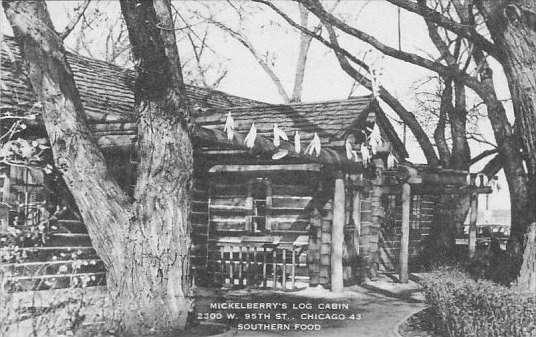
The Brief History of Mickelberry's Log Cabin Restaurant (1933-1967) including restaurant bombing in 1964.

Mickelberry's Log Cabin restaurant first opened in 1933. The original restaurant design was based on the Mickelberry plantation home built in Spaulding County, Georgia, in the 1830s. The restaurant was divided into three rooms - the "Main Dining Room," the "Lincoln Room," and the cozy little "Blue Room."
Campbell Wallace Mickelberry and his oldest brother Charles and Jay Adler were partners in the restaurant. Adler was a horse lover-owner, a true Civil War buff, an authority on Indian history, and an antique collector. Mrs. Mickelberry ran the restaurant along with Mr. Adler for several years after Campbell and Charles died in the 1940s. 
They served dishes like buckwheat cakes, fresh-made sausages, home-made bread, southern fried chicken, bar-b-cued pit spare ribs, veal and lamb chops, fresh seafood, true old-French Quarter style Jambalaya, and hominy grits. Mickelberry's made their own salad dressings and ice creams.
They also packaged the sausages and sold them to restaurant customers. After dinner, they had fresh-from-the-oven fruit pies and custards. Mickelberry's was a true family restaurant because there were no alcoholic beverages served. The Mickelberry's brought their old family recipes with them to Chicago from Georgia in the 1890s. 
Much of the Confederate artifacts were Mickelberry family possessions brought north from Georgia. Mr. Adler was responsible for contributing most of the incredible pictures, etc., from the "Old West," where he must have lived at one time. It is believed that most of the items were sold at auction after the restaurant closed.

Mystery Blasts Baffle Chicago 46 in the Area in 18 Months
None Has Been Solved.
The New York Times - August 2, 1964.

CHICAGO, Saturday, August 1, 1964 — Four bombings this week raised to 46 the number of bomb or arson attacks on Chicago area businesses in the last 18 months. Twenty‐two of the targets has been restaurants. Two restaurants were bombed last weekend, the damage at one estimated at $40,000. The third bombing in a 24-hour period occurred at an automobile plating plant. The fourth bombing in three days was at a trucking terminal.

None of the crimes has been solved, and all of those concerned—the victims and the authorities—profess to have no idea of either the motive or the possible identity of the perpetrators. Law enforcement agents and insurance investigators say they wish they knew.

William J. Cowhey, the Illinois State Fire Marshal, who investigates all such incidents outside of the city, where most of them have occurred, said: “There's just no rhyme or reason for them. I wouldn’t know what the motives are.” He suggested, as possible motives, extortion, insurance, competition, business failure. But he acknowledged that he was only guessing.

Chicago Detective Sergeant Edward Neville, who investigated the recent bombing of Mickelberry's Log Cabin Restaurant on Chicago's Southside, said: “There doesn’t seem to be any motive at all.” He said the manager of the restaurant insisted he had had no trouble with unions, customers, suppliers or competition.

Sgt. Drew Brown, who heads the Chicago police bomb and arson detail, suggested that the bombers “are just picking these places at random.”

Robert May, chief special agent in charge of the Chicago office of the National Board of Fire Underwriters, said he doubted if there was any single motive for the bombings and arson fires.

“We’ve found a few that may be fraud and insurance fires,” he said. “But they were very few. Most of them were not. I have no idea what's behind them.”

While law enforcement investigators reported repeatedly that owners of places bombed or burned could give no reason for the attacks, at least a dozen restaurateurs interviewed by newsmen expressed fear that the wave of restaurant bombings might be the prelude to a campaign of extortion and terrorism by crime syndicate hoodlums.

The owners, who asked that their names and establishments not be identified for fear that “something might happen,” expressed belief the bombings are “a message to get others inline” to pay protection money to syndicate extortionists or to force the sale of products and supplies from hoodlum‐owned purveying firms.
The bombing resulted in extensive damage to the entrance of the restaurant, but it was limited, and the restaurant continued to operate for another 3 years. Mickelberry's Log Cabin restaurant was razed in 1967.


Compiled by Dr. Neil Gale, Ph.D.

Tom Howard Jr., Chicago Tribune photographer, took one of the most famous photos in newspaper history. The shocking story behind Ruth Snyder's execution.

During the 1920s, a daily newspaper would go to outlandish lengths to top its rivals. If you were the first one with the big story, you sold more papers. Ditto if you had an exclusive story—a “scoop.”  Ditto again if you had an exclusive photo.

Thomas James "Tom" Howard Jr. was part of this milieu. In 1928 the young Chicago Tribune photographer took one of the most famous photos in newspaper history. And it all began with a scruffy little murder in Queens, New York.

Who Was Ruth Snyder?
Ruth Snyder
Ruth Snyder knew she wanted to kill her husband almost from the moment she met him.

Albert Snyder seemed to be continuously and hopelessly devoted to his late fiancee Jessie Guishard. Even after marrying Ruth, he proclaimed Guishard (who had been dead for 10 years) to be the finest woman he had ever met. At one point, he hung a picture of her on the wall of their home and then insisted upon naming his boat after her.

So Ruth, shunned by a man in love with a dead woman, took a lover by the name of Henry Judd Gray. Gray was a corset salesman who lived in Queens Village, where the Snyders made their home, and the two had met in town. Shortly after meeting, the two began to plot Albert’s murder.

First, Ruth persuaded Albert to purchase life insurance, a $48,000 policy ($704,000 today) that had a double indemnity clause, meaning that even if Albert died from an unexpected act of violence (say, murder), Ruth would still get her money. Then, Ruth and Gray began to plot.

According to testimony Gray gave after he was arrested, the couple tried to kill Albert seven times before they actually succeeded. Finally, on March 20, 1927, they managed to kill him. After garrotting him, and stuffing his nose with chloroform-soaked rags, they staged his death and the home to appear as if it had been burgled.

The police quickly saw through her lies, after a hastily constructed tale of the so-called burglary fell through. A few days after Albert’s death, both Gray and Ruth were arrested. Though Ruth maintained her silence throughout questioning, Gray folded almost immediately under pressure, fessing up to the entire crime. Upon hearing Gray had confessed, Ruth turned on him, claiming it was his idea from the start.

Both of them were found guilty and sentenced to die in the electric chair at the New York State prison, Sing Sing, in Ossining, New York.

The press coverage of Ruth Snyder’s trial had been covered by the biggest names in crime reporting, such as James M. Cain. Cain would later write a novella that would be turned into the film “Double Indemnity,” which loosely mirrors the Snyder case.

The attention given to the case by reporters had successfully turned it from a small town murder into a sensational nationwide crime. As soon as the people heard there would be an execution, the first woman’s in 30 years, everyone wanted a piece of the action.

However, when the police heard that everyone wanted coverage, they shut it down. While photography was usually prohibited in executions, Sing Sing guards took it especially seriously in Ruth’s case. No member of the media would get in with a camera, that much the guards were sure of.

Little did they know what Tom Howard had up his sleeve – or up his pant leg, to be exact.

The New York Daily News was a tabloid that had built its reputation on sensational news photos. Ruth Snyder was going to be the first woman executed in several years, and publisher Joseph Medill Patterson wanted a picture of the execution. Trouble was, photographing an execution was not allowed, and prison authorities knew all of the Daily News photographers. So Patterson phoned his cousin, Chicago Tribune publisher Robert R. McCormick who agreed to lend Tom Howard to the Daily News. In New York, Howard obtained press credentials to attend the executions as a writer.

On January 12, 1928, he arrived at the prison with a miniature single-shot camera strapped to his ankle. A wire attached to the shutter ran up his trouser leg to a trigger release concealed in his coat.
Tom Howard’s ankle camera.
Howard waited while Henry Judd Gray was executed. Then came Ruth Snyder’s turn. Howard edged forward. As the current surged through her body, Howard squeezed the trigger release. Then it was over, and he rushed back to the Daily News offices in Manhattan. The photo he took was angled slightly and blurry, but nonetheless priceless. Despite not being able to even see what he was taking a photo of, and having to guess his aim by using the toe of his shoe as a pointer, the photo was ultimately a good one. 

Howard had no way of knowing if the plan had worked until the photographic plate was actually developed. But it had worked. Four hours after Ruth Snyder’s execution, Daily News extras were on the street, the entire front page filled with Howard’s photo of her death throes. The headline simply read “DEAD!
The front page of the New York Daily News the day after Ruth Snyder’s execution.
Tom Howard Jr. was paid $100 ($1,500 today) extra for his photograph.

Prison officials were outraged by the picture. They talked about bringing charges against Howard and the Daily News. But since no laws had actually been broken, the matter was dropped. Still, in the decades since, anyone admitted to an execution site undergoes a thorough search for concealed cameras.

The photo was instantly hailed as the most famous tabloid photo of the decade, and indeed, it was. The photo itself — as hazy it was — was shocking. The image of Ruth Snyder’s fingers curled around the arms of the electric chair haunted audiences for years.
The camera Howard used to snap the shot is part of the collection of the Smithsonian National Museum of American History.

Tom Howard returned to his career in Chicago. When he died in 1961, he was the chief photographer at the Chicago Sun-Times Newspaper.

Compiled by Dr. Neil Gale, Ph.D. 

Thursday, September 26, 2019

The sad demise of a 20-foot tall bronze statue of Christopher Columbus after Chicago's 1893 World's Columbian Exposition.

This $50,000 ($1,330,000 today) monument to Christopher Columbus was made for the 1893 World's Columbian Exposition by sculptor Howard Kretschmar of Chicago. It was originally placed in Lake Front Park (today's Grant Park) at the "Gateway to the Exposition," at Michigan Avenue and Congress Street.

The statue, in bronze, was twenty feet high, surmounting a granite pedestal thirty feet tall. Columbus' left hand was held to the chest, his right hand extended at his side, and his legs astride. The monument formed the design for souvenirs of the Exposition. The profits from sales were to be used to pay back the borrowed $50,000.
This 1902 photo shows the Christopher Columbus statue lying on the ground, waiting to be melted and reused.
The reaction from the public was immediate and adverse. There are numerous articles in the Chicago Tribune newspaper archives denouncing the statue. The concession never happened, and no money was ever paid back.

The statue was removed and placed in storage in June of 1897. 

In September of 1902, a proposal was put forth to recycle the metal from the Christopher Columbus statue. The metal would be used to make for a figure to honor President McKinley, who was assassinated in 1901.  

That, in fact, was done!

Compiled by Dr. Neil Gale, Ph.D.

Sunday, September 22, 2019

The De-Mil Putting [Golf] Course was at the north-west corner of Devon and Milwaukee Avenues in Chicago.

The De-Mil Putting Course was located at 6422 North Milwaukee Avenue (north-west corner), at DEvon and MILwaukee Avenues, was owned by Mr. and Mrs. DolatowskiBefore the Kentucky Fried Chicken opened on the corner, there was a City Service gas station there. The golf course wrapped around the back of the business with land facing both Devon and Milwaukee Avenues.
This photo of the De-Mil Putting Course was shot in 1979.
This was a pretty simple layout for a putting. The course greens were topped with a very fine crushed stone rather than carpet or astroturf. The stone was hand-sifted to make sure the greens had the smallest/finest stone for covering the surface. They hosed-down the greens once or twice a day to keep them level and maintain dust control.

The trick to the lowest score on the course was playing the ball off of the sideboards. There were certain locations on the sideboards of each hole that when hit at the correct speed would generate a hole-in-one. 

The course had a small hot dog & refreshment stand that was run by Mrs. Dolatowski

It was known that Mr. and Mrs. Dolatowski’s teenage son, Bill, would regularly play the eighteen holes in 30 strokes or less.

The course was open from Memorial Day to Labor Day, 7-days a week. After Labor Day, it was open weekends until Halloween. In the winter Mr. Dolatowski, taught violin and sometimes drove a cab.

There’s an apartment building on the site today with a "Blaze-N-Grill" restaurant on the corner.

Compiled by Neil Gale, Ph.D.
A special "Thank You" to Bob Rogan, for adding some details about De-Mil.