
Friday, March 1, 2019

Exploring Seventeenth Century "Païs des Illinois," the Illinois Country.

In the late seventeenth century, Pere (Father) Jacques Marquette and Louis Jolliet explored what would become, a century and a half later, the state of Illinois. Entering the Mississippi River at the mouth of the Wisconsin River, they traveled downstream by canoe along the entire length of Illinois. At the mouth of the Des Moines River, they found a village of the Peoria, one of the tribes that spoke the Illinois language.
Map of western New France, including the Illinois Country, by Vincenzo Coronelli, 1688.
Continuing downstream, they reached the mouth of the Arkansas River. Then, they retraced their route to the confluence of the Mississippi and Illinois Rivers, where they decided to return to Lake Michigan via the Illinois River. Near Starved Rock, on the river's upper reach, Marquette and Jolliet encountered the Kaskaskia, another tribe that spoke the Illinois language. After a visit, the French pushed on to Lake Michigan.

Jolliet lost his journal of the trip when his canoe overturned in the Rapids of La Chine above Montreal, and Marquette's accounts were vague and incomplete. The records of Marquette, Jolliet, and other French explorers provide much of what we know about seventeenth-century Illinois. Still, we can draw upon other evidence about this time and place to create a more detailed picture of the past.

There are many paths to the past—anthropology and archaeology, folklore, history, and natural history—each with a distinctive perspective, but they provide the most complete picture used together. A multidisciplinary approach to the past is beneficial when our destination lies at the frontier of history, where written accounts are sketchy and incomplete.
French Map of North America 1700 (Covens and Mortier ed. 1708)
"PAÏS DE ILINOIS," near the center.
History is the most frequently traveled path to seventeenth-century Illinois. Journals, maps, and other written documents provide firsthand accounts of places, people, and events. Historical accounts are often rich with information and details unavailable from different sources. In this context, folklore is part of history.

Archaeology is a less-traveled path to seventeenth-century Illinois, which is the best means to explore the past without documents or to supplement written records. Such records frequently guide archaeologists to seventeenth-century sites, but it is clear that objects often bear witness to events not otherwise recorded. An archaeologist "reads" objects to create an incomplete record of the past—and usually the only one.

The least-traveled path to seventeenth-century Illinois is natural history, studying past environments. Nature influences Life, and the work of geologists, biologists, and climatologists, among others, provides information about the environment at a particular time and place that allows us to study environmental change over time.

To arrive at the best vista of seventeenth-century Illinois, we must follow each path so our journey begins. The year is A.D. 1600, more than seven decades before Pere Marquette and Louis Jolliet recorded their exploration of the Illinois Country.

The Place: Païs de Illinois, the Illinois Country
Seventeenth-century Illinois would be familiar to us from a distance, but look more closely, and you will see some significant differences. Using historical records such as European crop production reports, botanical studies of pollen deposited in lake-bottom sediment, and other sources of information, Climatologists have identified a period of colder weather worldwide called the "Little Ice Age." Between 550 and 150 years ago, annual average temperatures dropped one to two degrees centigrade, enough to shorten the growing season and cause more severe winters.
Païs de Ilinois (Illinois Country) in 1717 French map.
Based on plant and animal remains discovered during archaeological excavations, the characteristics and distribution of certain soils, and later historical accounts, prairie— mostly wet prairie—dominated the flat lands of seventeenth-century Illinois. Forests persisted in areas of more topographic relief and, spurred by cooler weather, probably expanded their distribution, though enormous fires that periodically raced across the landscape impeded this expansion.

Walking across the state three centuries ago, a traveler would have seen bison, elk, bear, wolf, white-tailed deer, and many other species of animals. However, by the beginning of the nineteenth century, the large mammals were forced to find refuge elsewhere as increasing numbers of Europeans and then Americans settled here and eventually cultivated vast tracts of land.

The People: Indians in the Illinois Country
Historians and archaeologists are often asked, which tribes lived in Illinois before the arrival of the French? This is a simple question but difficult to answer. Without historical documents, archaeologists depend on their ability to recognize artifacts typical of a particular group or culture. For example, Marquette and Jolliet report finding the Kaskaskia tribe near Starved Rock in 1673.

In the late 1940s, based on French documents and maps, archaeologists from the University of Chicago and the Illinois State Museum located the Grand Village of the Kaskaskia, where Marquette and Jolliet had stopped in 1673. While excavating the site, archaeologists found examples of pre-contact artifacts, especially pottery, that they hoped would enable them to locate other Illinois villages that existed before the arrival of the French. They have yet to find late-sixteenth and early-seventeenth-century villages, which generally do not have artifacts comparable to those discovered at the Grand Village. Thus, it is unclear if artifacts found at older sites can be attributed to the Illinois' or another tribe. In short, archaeologists have been unable to link particular artifacts to specific tribes. Thus, we do not clearly understand which tribes lived in Illinois in the early seventeenth century, let alone earlier. In fact, growing evidence suggests that the Illinois tribes had not long been residents of the Illinois Country.

We recognize Marquette and Jolliet as the first Europeans in Illinois, but artifacts provide evidence of direct or indirect European contact before their arrival. Marquette noticed some French trade goods at the Peoria Village on the Mississippi River in 1673. Archaeologists found French trade goods at the Grand Village of Kaskaskia but are still determining whether they predate Marquette and Jolliet. Farther south, near the mouth of the Wabash River, European artifacts have been found on sites occupied during the late 1500s and early 1600s.

In the Chicago suburb of LaGrange, Illinois, the discovery of a 1669 French jeton may be evidence of earlier exploration or trade. Still, it is also possible that the coin was carried for many years before being lost. Nevertheless, these are among the few tantalizing bits of evidence that suggest Indian contacts with Europeans in Illinois are not recorded in historical documents.

sidebar
Jetons are tokens or coin-like medals produced across Europe from the 13th through the 17th centuries. They were produced as counters for use in calculation on a counting board or a lined board similar to an abacus.

The Event: French Exploration of the Illinois Country
Archaeological evidence suggests that nearly 150 years before they saw a European, native inhabitants of Illinois were affected by spreading European technology and culture. From the 1490s to the mid-1600s, diseases, changing economic relationships, and a few traded tools and ornaments began an inexorable change in the lives of the Indians. The first recorded contact between French traders and Indians in the Great Lakes region occurred in the 1630s. The first Frenchman who passed over the old trails of southern Illinois in 1673 was a poacher. The Illinois Country, more insular, would soon be recognized as the crossroad of the continent.

Trade is the best context in which to understand early Illinois history. In addition to French documents about trade with Indians, trade goods—glass beads, metal tools, containers, and textiles, among others—are readily identifiable in artifact assemblages from Indian sites.

As trade expanded, Indian tribes in Illinois soon became more important. Based on archaeological research, Indians in Illinois sustained themselves through hunting, gathering, and farming before the arrival of French explorers. Their importance increased because they controlled a part of the continent where all the largest inland waterways converged, thus trade routes. The French called the land "Païs de Illinois," meaning "Country of Illinois." Farming, waterways, and trade routes defined the Illinois Country and its people, then and now.

Exploration offered trading opportunities. Although several European nations established trade colonies on the coasts of North America, only the French built trading posts and, later, more permanent settlements in the middle of the continent.

In the 1500s, the French explored the St. Lawrence River, the northeastern entrance to North America, while the Spanish approached the interior from the south. The search for trade routes to the Far East and Treasure motivated exploration. By the early 1600s, the French had organized Indian trading partners; they built settlements along the St. Lawrence River and called this place New France.

Although New France's trade radiated in all directions, it concentrated in the Great Lakes region. The Great Lakes appeared particularly attractive, with cold lands to the north and English and Dutch colonies to the south. Before the 1650s, Indians carried French trade goods far to the west and returned furs. Some tribes, such as the Iroquois, maintained their importance by preventing French traders from independently exploring the Great Lakes. The poorly known western lands became known as the "Upper Country," from whence flotillas of Indian canoes traveled "down" to New France to obtain goods.

Eventually, the reach of French trade extended to the land of the Illinois tribes. Soon, French traders were aware of a warmer land with large rivers and avenues of trade. These rivers promised the possibility of extending trade even further west, perhaps to the western sea and beyond to Asia.

French policy on expanding its settlements further inland swayed back and forth. The lure of fur trade fortunes and land was at odds with the government's desire to establish a strong colony before expansion. But what if other nations gained control of the interior? Although forbidden to trade in the interior, Canadians found resisting the opportunity for extraordinary profit difficult. In the end, profits won, and by the 1660s, the French had taken up residence in the western Great Lakes. The Illinois Country would be the next frontier.

Illegal French traders may have traversed the Illinois Country in the 1650s, but the expedition of Marquette and Jolliet in 1673 marked a commitment to colonize the area. Jolliet requested permission to establish a settlement, but politics favored René-Robert Cavelier, Sieur de La Salle (Sieur de La Salle being a title only). La Salle obtained permission to build trading posts, make land grants to followers, and explore the mouth of the Mississippi River. Arriving late in 1679 following setbacks and near disasters, La Salle's party soon established trade on the upper reach of the Illinois River. European artifacts found at Indian villages at Starved Rock and the Grand Village of the Kaskaskia, on the river's opposite bank, mark the beginning of this period of more intensive trade.

French trade expanded in the Great Lakes and Illinois Country during the next two decades. The French built military posts and Catholic missions at Starved Rock, present-day Peoria (where archaeologists continue to search for evidence of French occupation), and elsewhere as more traders arrived. Marriages and subsequent offspring resulted in a Metis society that mixed French and Indian heritage and culture.

The rapid expansion of the fur trade overwhelmed the marketplace and undermined fledgling French settlements in Illinois. Key settlements to the north, including Detroit and Green Bay, continued to grow, but the French maintained only a token presence in Illinois.

Marquette and Jolliet, La Salle, and others explored the Illinois Country, and it remained a little-known area on the frontier in the late seventeenth century. But this would soon change.
Map of settlements in the Illinois Country.
Thomas Hutchins map of 1778.
We must draw upon various resources to explore seventeenth-century Illinois to assemble the most complete picture. Written documents and maps generally provide the most detailed record, but artifacts and "ecofacts" often provide evidence not available elsewhere. Each source of evidence is biased, but a multidisciplinary approach to the past balances bias or at least points out inconsistencies in the evidence. 

sidebar
“Ecofacts” are biological objects found at archaeological sites, such as remains of plant and animal foods.

Compiled by Dr. Neil Gale, Ph.D. 

Thursday, February 28, 2019

The Biography of Jane Byrne, Chicago's First Female Mayor.

Jane Margaret Byrne served as the 40th Mayor of Chicago from April 16, 1979, until April 29, 1983, becoming the first female Mayor of Chicago. She was also the first woman to be elected Mayor of a major city in the United States. Before her tenure as Mayor, Byrne served as Chicago's commissioner of consumer sales from 1969 until 1977, the only woman in Mayor Richard J. Daley's cabinet.
Jane Byrne, Chicago's 40th Mayor.
Byrne was born Jane Margaret Burke on May 24, 1933, at John B. Murphy Hospital in the Lake View neighborhood on the north side of Chicago, Illinois. Raised on the city's north side, Byrne graduated from Saint Scholastica High School and attended St. Mary of the Woods College in Indiana for her freshman year of college. Byrne later transferred to Barat College of the Sacred Heart in Lake Forest, Illinois, where she graduated with a bachelor's degree in chemistry and biology in 1965.

Byrne entered politics to volunteer in John F. Kennedy's presidential campaign in 1960. During that campaign, she first met then-Chicago Mayor Richard J. Daley. After meeting Daley, he appointed her to several positions beginning in 1964 in a city anti-poverty program.

In June 1965, she was promoted and worked with the Chicago Committee of Urban Opportunity. In 1968, Byrne was appointed head of the City of Chicago's consumer affairs department. In 1972, Byrne was a delegate to the 1968 Democratic National Convention (DNC) and the DNC resolutions committee chairperson in 1973. Byrne was appointed co-chairperson of the Cook County Democratic Central Committee by Daley, despite her rejection by the majority of Democratic leaders, in 1975. The committee ousted Byrne shortly after Daley died in late 1976. Soon after, Byrne accused the newly appointed Mayor, Michael Bilandic, of being unfair to city citizens by placing a 12% increase on cab fare, which Byrne felt resulted from a "backroom deal." Byrne was fired from her post as head of consumer affairs by Bilandic shortly after being made aware of her charges against him in April 1977.

Months after her firing as head of the consumer affairs department, Byrne challenged Bilandic in the 1979 Democratic mayoral primary, the real contest in this heavily Democratic city. Officially announcing her mayoral campaign in August 1977, Byrne partnered with Chicago journalist and political consultant Don Rose, who served as her campaign manager. At first, political observers believed her to have little chance of winning. A memorandum inside the Bilandic campaign said it should portray her as "a shrill, charging, vindictive person—and nothing makes a woman look worse."

However, in January, the Chicago Blizzard of 1979 paralyzed the city and caused Bilandic to be seen as an ineffective leader. Jesse Jackson endorsed Byrne. Many Republican voters voted in the Democratic primary to beat Bilandic. Infuriated voters in the North Side and Northwest Side retaliated against Bilandic for the Democratic Party's slating of only South Side candidates for the Mayor, clerk, and treasurer (the outgoing city clerk, John C. Marcin, was from the Northwest Side).
Mayoral candidate Jane Byrne gives a "V" for victory as she emerges after voting in the February 27, 1979, primary election.
These four factors combined gave Byrne a 51% to 49% victory over Bilandic in the primary. Positioning herself as a reformer, Byrne won the main election with 82% of the vote, still the largest margin in a Chicago mayoral election.
Jane Byrne savors her victory over Mayor Michael Bilandic in 1979. She was Chicago's first and only female Mayor.
Byrne made inclusive moves as Mayor, such as hiring the first African-American and female school superintendent Ruth B. Love. She was the first mayor to recognize the gay community. In her first three months in office, she faced strikes by labor unions as the city's transit workers, public school teachers, and firefighters all went on strike. She effectively banned handgun possession for guns unregistered or purchased after enacting an ordinance instituting a two-year re-registration program.
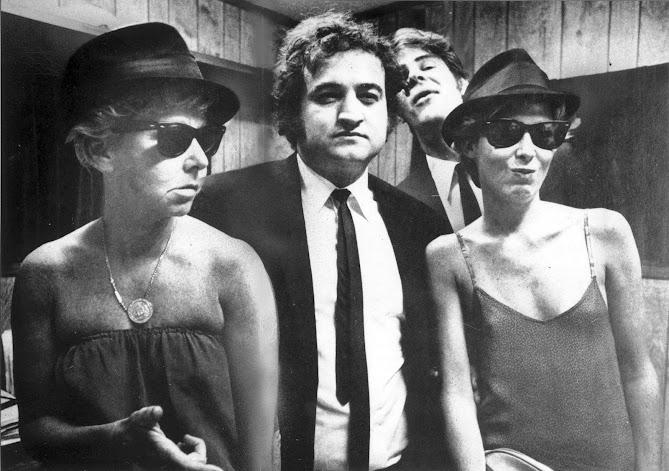
From left to right: Mayor Jane Byrne, John Belushi, Dan Aykroyd, and Kathy Byrne strike a "Blues Brothers" pose at ChicagoFest in August 1979.
Byrne used special events like ChicagoFest to revitalize Navy Pier and the downtown Chicago Theatre. Byrne and the Cook County Democratic Party endorsed Senator Edward Kennedy for president in 1980. Still, incumbent President Jimmy Carter won the Illinois Democratic Primary and even carried Cook County and the city of Chicago. Simultaneously, Byrne and the Cook County Democratic Party's candidate for Cook County States' Attorney (chief local prosecutor), 14th Ward Alderman Edward M. Burke, lost in the Democratic Primary to Richard M. Daley, the son of her late mentor, Daley, then unseated GOP incumbent Bernard Carey in the general election. Other events in her mayoralty include Pope John Paul II's debut papal visit that October and, the finding of Soviet Ukrainian escapee Walter Polovchak the following year-1980-and, his announcement of his desire to stay in America permanently and not go back to the USSR with his parents.

On March 26, 1981, Byrne decided to move into the crime-ridden Cabrini-Green housing project on the near-north side of Chicago after 37 shootings resulting in 11 murders occurring during three months from January to March 1981.
Mayor Jane Byrne greeted President Ronald Reagan (born & raised in Illinois) at Meigs Field in 1981.
In her 2004 memoir, Byrne reflected on the decision to move into Cabrini-Green: "How could I put Cabrini on a bigger map? ... Suddenly I knew — I could move in there." Before her move to Cabrini, Byrne closed down several liquor stores in the area, citing the stores as hangouts for gangs and murderers. Byrne also ordered the Chicago Housing Authority to evict tenants suspected of harboring gang members in their apartments, which totaled approximately 800 tenants.

Byrne moved into a 4th-floor apartment in a Cabrini extension building on North Sedgwick Avenue with her husband on March 31 at around 8:30 pm after attending a dinner at the Conrad Hilton hotel. Hours after Byrne moved into the housing project, police raided the building. They arrested eleven street gang members who they learned through informants were planning to have a shootout in the Mayor's building later that evening. Byrne described her first night there as "lovely" and "very quiet." Byrne stayed at the housing project for three weeks to bring attention to the housing project's crime and infrastructure problems. Byrne's stay at Cabrini ended on April 18, 1981, following an Easter celebration at the project, which drew protests and demonstrators who claimed Byrne's move to the project was just a publicity stunt.

On November 11, 1981, Dan Goodwin (nicknamed "Spiderman"), who had successfully climbed the Sears Tower the previous spring, battled for his life on the side of the John Hancock Center.

William Blair, Chicago's fire commissioner, ordered the Chicago Fire Department to stop Goodwin by directing a full-power fire hose at him and using fire axes to break window glass in Goodwin's path. Mayor Byrne rushed to the scene and ordered the fire department to stand down.

Then, through a smashed-out 38th-floor window, she told Goodwin, who was hanging from the building's side a floor below, that though she disagreed with his climbing of the John Hancock Center, she opposed the fire department knocking him to the ground below. Byrne then allowed Goodwin to continue to the top.

In January 1982, Byrne proposed an ordinance banning new handgun registration, which was considered controversial. The ordinance was created to freeze the number of legally owned handguns in Chicago and require owners of handguns to re-register annually. The law was approved by a 6-1 vote in February 1982.

Also, in 1982, she supported the Cook County Democratic Party's replacement of its chairman, County Board President George Dunne, with her city-council ally, Alderman Edward Vrdolyak. The Chicago Sun-Times reported that her enemies publicly mocked her as "that crazy broad" and "that skinny bitch" and worse.

In August 1982, Byrne decided to seek a second term as Mayor. At the beginning of her re-election campaign, she was trailing behind Richard M. Daley, then Cook County State's Attorney, by 3% in a poll by the Chicago Tribune in July 1982.
Mayor Jane Byrne, Mayor-elect Harold Washington, and State's Attorney Richard M. Daley gather at a symbolic day-after-the-election "unity luncheon" in 1983 to ease political tensions that had divided Chicago.
Unlike the 1979 mayoral, where Byrne received 59.3% of the African-American vote, Byrne had lost half of that vote. Byrne was defeated in the 1983 Democratic primary for Mayor by Harold Washington; the younger Daley ran a close third. Washington won the Democratic primary with just 36% of the vote; Byrne had 33%. Washington went on to win the general election.
Jane Byrne, seated, disk jockey Jonathon Brandmeier, and Kathy Byrne sing while taping a rock video of "We're All Crazy in Chicago" in 1985. "It's good for everybody to poke fun at themselves once in a while," said the former Mayor.
Byrne ran against Washington again in the 1987 Democratic primary but was narrowly defeated. She endorsed Washington for the general election, in which he defeated two Democrats running under other parties' banners (Edward Vrdolyak and Thomas Hynes) and a Republican. Byrne next ran in the 1988 Democratic primary for Cook County Circuit Court Clerk. She faced the Democratic Party's slated candidate, Aurelia Pucinski (endorsed by Mayor Washington and is the daughter of then-Alderman Roman Pucinski). Pucinski defeated Byrne in the primary and Vrdolyak, by then a Republican, in the general election. Byrne's fourth run for Mayor involved a rematch against Daley in 1991, and Byrne received only 5.9 percent of the vote, a distant third behind Daley and Alderman Danny K. Davis.

Byrne had entered hospice care and died on November 14, 2014, in Chicago, aged 81, from complications of a stroke she suffered in January 2013. Her funeral was held at St. Vincent de Paul on Monday, November 17, 2014. She was buried at Calvary Catholic Cemetery in Evanston, Illinois.
Gov. Pat Quinn hands a sign to former Chicago Mayor Jane Byrne during a dedication ceremony to officially name the Circle Interchange in her honor, Friday, August 29, 2014.
In July 2014, the Chicago City Council voted to rename the plaza surrounding the historical Chicago Water Tower on North Michigan Avenue the Jane M. Byrne Plaza, in her honor.

Compiled by Dr. Neil Gale, Ph.D. 

Wednesday, February 27, 2019

Illinois, a Brief History Beginning Around 12,000 B.C.

Southern Illinois is bordered on three sides by the Mississippi, Ohio, and Wabash Rivers. Several other rivers traverse its countryside, including the Big and Little Muddy, Little Wabash, Saline, and Cache Rivers. The southern part of the state is characterized by wooded hills, farms, underground coal mines, strip mines, and low marshlands.

sidebar
The word "Mississippi" comes from the Ojibwe Indian Tribe (Algonquian language family) word "Messipi" or "misi-ziibi," which means "Great River" or "Gathering of Waters." French explorers, hearing the Ojibwe word for the river, recorded it in their own language with a similar pronunciation. The Potawatomi (Algonquian language family) pronounced "Mississippi" as the French said it, "Sinnissippi," which was given the meaning "Rocky Waters."

The earliest inhabitants of Illinois were thought to have arrived about 12,000 B.C. They were hunters and gatherers but developed a primitive agriculture system and eventually built rather complex urban areas that included earthen mounds. Their culture seemed to disappear around 1400-1500 A.D.
The Beardstown Mounds in 1817.
The Illinois (aka Illiniwek or Illini) is pronounced as plural: The Illinois was a Confederacy of Indian tribes consisting of the KaskaskiaCahokiaPeoria, Tamarais (Tamaroa, Tamarois), Moingwena, Mitchagamie (Michigamea), Chepoussa, Chinkoa, Coiracoentanon, Espeminkia, Maroa, and Tapouara tribes that were of the Algonquin family and spoke Algonquian languages.

Other Indian tribes, including the Potawatomi, Ojibwe, and Odawa Nations, as well as the Miami, Ho-Chunk, Menominee, Sauk (Sac), Meskwaki (Fox), Kickapoo, arrived in Illinois around 1500 A.D. Archeologists are not sure if these Indians are were related to the previous inhabitants. They left behind all artifacts, including burial sites burned-out campfires along the bases of bluffs, pottery, flints, implements, and weapons. Interesting structures that were built by Indian tribes are known as stone forts or pounds. Visitors can see the prehistoric Stone Fort built in Giant City State Park near Makanda. At least eight other structures are known in the region.

The French were the first Europeans to reach Illinois. The Very First Frenchman in Southern Illinois was a Poacher. When 
Marquette and Jolliet arrived in 1673, the Indians welcomed them. French explorers named Illinois by referring to the land where the Illiniwek Indian tribes lived.

The French explored the Mississippi River, establishing outposts and seeking a route to the Pacific Ocean and the Orient. Because of increasing Indian unrest and warfare in northern Illinois, the French concentrated on building outposts in the southern part. The earliest European settlers in Southern Illinois concentrated along the Mississippi, Ohio, and Wabash rivers at the state's southern end. Their settlements became important way stations, supply depots, and trading posts between Canada and ports on the lower Mississippi River. Important early outposts in Southern Illinois were located at Shawneetown and Fort Massac on the Ohio River.

The English ruled the Lower Great Lakes region after defeating the French in the French and Indian War and with the signing of the Treaty of Paris in 1763. Their rule of this area was short-lived.

During the American Revolution in 1778, the state of Virginia backed a military expedition led by 23-year-old George Rogers Clark. Landing at Fort Massac in Illinois (which was abandoned a decade earlier), his force of 175 soldiers marched across Southern Illinois. It defeated the English at Forts Kaskaskia, Illinois, and Vincennes in western Indiana. This laid the claim by the Americans to this territory. When news of the conquest by Clark reached Virginia, it claimed Illinois as one of its counties. Virginia ceded the county of Illinois to the federal government in 1783 when it realized it could not govern so sparsely populated and distant land.

Non-French-speaking settlers arrived slowly in Illinois, and probably less than 2,000 non-Indians lived in Illinois in 1800. But soon after that, many more settlers came from the backwoods of Kentucky, Tennessee, Virginia, Georgia, and the Carolinas. These early settlers were of English, German, Scottish, and Irish descent. They chose to settle in the southern part of Illinois as its wooded hills reminded them of the mountains they left behind. They found abundant wood and lived off the land, growing crops, fishing, and hunting for game.

In 1787, the federal government included Illinois in the Northwest Ordinance, including Ohio, Indiana, Michigan, and Wisconsin. Illinois became a part of the Indiana Territory in 1800. Illinois settlers wanted more control over their own affairs, and Illinois became a separate territory in 1809.

On December 17, 1811, a great earthquake at Cahokia Mounds awakened the settlers in Illinois with a violent trembling. Fields rippled like waves on an ocean. Trees swayed, became tangled together, and snapped off with sounds like gunshots. In some places, sand, coal, and smoke blew up into the air as high as thirty yards. People as far away as Canada and Maryland felt the tremors. It was reported that the earthquake shook so violently that tremors were felt as far away as Boston. It was reported that this earthquake made the Mississippi River flow backward momentarily. The river changed its course in several spots due to the earthquake, as new islands appeared and others disappeared in the river. The earthquake is estimated to have been equivalent to an 8.0 on the Richter scale, although the Richter scale did not exist at that time. Fortunately, few people lost their lives because the quake centered in a sparsely populated area.
Cave-in-Rock
There was very little violence in the Illinois frontier. Murders and violent assaults were rarely reported. However, bandits and river pirates operated along the Mississippi and Ohio Rivers for decades. On the Ohio River, these bandits and pirates are often located in or near Cave-in-Rock, a natural cave facing the river. The bandits and river pirates added to the hazards and uncertainties of pioneer life. Murders and counterfeiting (aka: 'coiners') made settlers eager to have law enforcement agencies nearby.

In 1818, the U.S. Congress approved an Act that enabled the Illinois territory to become the 21st state of the Union. Immigration to Illinois increased after it became a state as more settlers arrived from New England and foreign countries. These settlers tended to migrate to central and northern Illinois, causing a noticeable Yankee influence in northern Illinois as opposed to the southern influence in the southern region due to a majority of settlers coming from southern states. The state's population exploded from 40,000 people in 1818 to 270,000 in 1835. The 1850 census reported that 900,000 people lived in Illinois.

Early statehood problems engulfed Illinois. In the 1830s, the state was near bankruptcy because of government financing of canals and railroad construction. The national financial Panic of 1837 added to the state's problems before the prosperity of the 1850s relieved this situation. Railroads like the Illinois Central Railroad were built to allow the state's agricultural products to be shipped to market.

Sometime in the 1830s, Southern Illinois became known as Little Egypt. The most likely reason this region is known as Little Egypt is that settlers from northern Illinois came south to buy grain during years when they had poor harvests in the 1830s, just as ancient people had traveled to Egypt to buy grain (Genesis 41:57 and 42:1-3). Later, towns in Southern Illinois were named Cairo, Thebes, and Karnak, following the Little Egypt theme.

In 1830, Congress passed a bill permitting the removal of all Indians living east of the Mississippi River. For the next 20 years, Indians were marched west to reservations in Arkansas and Oklahoma, including the bands of the 
Illiniwek tribes living in Illinois. In the Fall and Winter of 1838-39, Cherokee Indians were marched out of Georgia and the Carolinas across Southern Illinois to reservations in the west. It was estimated that 2,000 to 4,000 Cherokee men, women, and children died during this 1,000-mile journey west. It became known as the Trail of Tears due to the many hardships and sorrows it brought to the Indians.

The first bank to be chartered in Illinois was located at Old Shawneetown in 1816 and was built of logs.
 The first building, used solely to house a bank in Illinois, was built in 1840 in Old Shawneetown and was used until the 1920s. The Old Shawneetown State Bank has been restored as a historical site.
The Old Shawneetown Bank


Cotton and tobacco were grown in the extreme southern region of Illinois. Cotton was grown mainly for the home weaver, but during the Civil War, enough cotton was grown for export since a regular supply of cotton from the South was unavailable. Enough tobacco was grown to make it a profitable crop for export. Cotton and tobacco are no longer grown for export in the region. Other Illinois foods for export included maple syrup, honey, grapes, roots, berries, crab apples, plums, persimmons, mushrooms, nuts, fish, deer, fowl, hogs, cattle, and poultry. The invention of the steamboat greatly expanded the profitability of crops exported from Illinois.

The County of Saline was named for its ancient salt works along the Saline River. It attracted deer, buffalo, and antelope, who obtained salt simply by licking the mud banks along the river where Indians and the French made salt. From 1810 until 1873, commercial salt production produced as much as 500 bushels daily. The owner of one of the salt works built a large house in the 1830s on the Saline River near Equality, known today as the Old Slave House. Still standing, its small attic rooms were thought to be used to house slaves or indentured servants who toiled in the salt works.
Old Slave House
Even though it was prohibited since the 1780s under the Northwest Ordinance that established the territory, slavery continued in Illinois. Indian tribes were the first to have slaves (usually captives from another tribe), and the French introduced it in the 1700s. Laws were passed in Illinois after it became a territory in 1809 and later when it became a state, which allowed people to own indentured servants in Illinois, an equivalent to slavery. Other laws were enacted that prohibited people from coming to Illinois to free their slaves.

As many of the original settlers in Southern Illinois came from southern states, many had pro-southern sympathies and a fear that freed blacks would flood into their new homeland. The underground railroad existed in Southern Illinois but was not as active as in other parts of the state. The Civil War caused many families to have divided loyalties.

Many of these Illinois Black Codes or Laws remained on the books until November 4, 1864, when John L. Jones, born a free Negro, distributed his pamphlet, "The Black Laws of Illinois and a Few Reasons Why They Should Be Repealed," spurring the Illinois General Assembly to repeal all of them. Within weeks, Gov. Richard J. Oglesby signed the bill repealing the black laws.

Compiled by Dr. Neil Gale, Ph.D. 
Tuesday, February 26, 2019

Mother Goose Gardens (Amusement Park), La Salle, IL (1957-1968)

Once the area's premier amusement park, Mother Goose Gardens opened in 1957 on nearly 50 acres near the south edge of Starved Rock State Park (Route 71 & the entrance to Starved Rock State Park). The name "Mother Goose Gardens" was copyrighted in 1957 by the Starved Rock Realty Company.
Each story from Mother Goose was represented by large characters that you could touch and climb on, captured in time, including a 30-foot reproduction of Mother Goose. There was a small pond that surrounded Mother Goose and ducks roamed the enclosed area surrounded by a white picket fence.
The amusement park had a big milk can at the entrance. Attractions included kiddie carnival rides like hand-peddled cars, a miniture train, tractor ride, the little dipper roller coaster, a Ferris wheel with canvas seats, a circular boat ride a petting zoo with Santa's reindeer, games of chance, a giant teepee pony rides. All the animals were owned by Jean Lyons, of La Salle and she operated the pony rides. The park had a souvenier stand.
Legend has it the origins of Mother Goose Gardens came after local investors visited a Wisconsin Dells attraction, Storybook Gardens. It was popular for years with local families as well as Starved Rock visitors.

However, it was never a financial success. Mother Goose Gardens was closed in 1968. The owners sold the amusement park acreage to the state in 1968.

Compiled by Neil Gale, Ph.D.


Illiniwek Indians made a bid for power in the late 1600s Mid-west America, based on bison and slavery.

Most historical accounts describe the Illiniwek Indians, of the late 1600s as a weak and beleaguered people, shattered by war.

{{The Illiniwek Indian tribe was a Confederacy of tribes [aka: Illinois (pronounced as plural: Illinois') and Illini]; consisted of the Kaskaskia, Cahokia, Peoria, Tamaroa, Moingwena, Michigamea, Chepoussa, Chinkoa, Coiracoentanon, Espeminkia, Maroa, and Tapouara tribes.}}

Their Grand Village of the Kaskaskia (aka: The Village of La Vantum), near present-day Starved Rock State Park, 80 miles southwest of Chicago, was depicted as little more than a refugee center, propped up by the French Fort St. Louis du Rocher.
The reality, however, is quite different, argues University of Illinois history professor Robert Morrissey, in an “editor’s choice” article in the December issue of the Journal of American History.

The Grand Village and surrounding settlements were then likely the largest population center north of Mexico City, and the Illinois were making “perhaps the most remarkable bid for power in 17th century native North America,” according to Morrissey, who also has written a book on colonial Illinois during this period.

The Illinois Indians were exploiting a unique ecological and social borderland at the center of the continent – between tallgrass prairie to the west and woodlands to the east, and between distinctly different peoples of the Great Plains and the Great Lakes, he said.

There they could hunt plentiful bison at the eastern edge of their range. And there they also could raid Indian villages to the west for slaves, to trade to Indians to the east, where slaves were sought mostly as “replacement kin” for those lost to war and European disease.

“In that particular moment, and in that particular space, these people rose to quite considerable power, and yet they’re not part of the narrative of early American history, and the place is totally off the map,” Morrissey said.

Much of the reason can be traced back to accounts by the French who established an outpost and mission near the Grand Village in the 1670s, he said. “I don’t think they understood what they were looking at when they arrived in the Illinois country.”

The Illinois and other Algonquian-speakers in the Great Lakes region had suffered what seemed to be devastating attacks by the eastern Iroquois, as part of what were called the Beaver Wars, Morrissey said. “I think this caused the French to miss the ways that the Algonquians, and especially the Illinois, were themselves acting aggressively and were themselves acting out of their own motivations.”

The French also exaggerated their own importance in those accounts, Morrissey said. “The French were not the biggest thing happening in the Illinois people’s lives at this moment, and when we read those sources, it sometimes seems like the French think they are.” They also had reason to exaggerate Illinois weakness and their own importance in search of greater support from the French government and the Catholic Church.

Taking a more-critical look at French accounts, and supplementing that with archeological and environmental sources, Morrissey is seeking to tell native history in a broader context.

In his story of the Grand Village, for instance, he notes that the Illinois, a loose confederation of at least 13 subgroups or kinship groups – among them the Cahokia, Kaskaskia and Peoria – were recent arrivals themselves. Their ancestors, or “proto-Illinois,” had lived south of Lake Erie and in the Ohio River Valley, and moved west in the 1500s and early 1600s.

Their move may have been prompted by climate changes resulting from the “Little Ice Age,” which shortened growing seasons in the Ohio Valley and moved the bison range east into Illinois.

They had settled in villages along and west of the Mississippi River before moving into the upper Illinois River Valley. What they saw or found there, according to Morrissey, were the advantages of a literal and metaphorical “ecotone,” a term used by biologists to describe a border zone between adjacent communities of vegetation. Some species thrive in such zones, moving between and exploiting multiple habitats.

The Illinois thrived in that ecotone for about two decades, Morrissey said. They found opportunities and power in bison hunting, trading and then slave trading.

The Grand Village was ultimately short-lived, in part due to the inherent violence and other corrosive effects of the slave trade, Morrissey said. One aspect of that was that many more women than men were taken as slaves since they were more valuable as replacement kin, and Illinois men then took some of those female slaves as additional wives.

This degraded the status of Illinois women and caused rifts and often abuse within these polygamous families, Morrissey said. Many Illinois wives sought refuge in the Catholic mission and Christianity.

Resources were also an issue. Nearby forests were thin, so village residents lacked firewood, and it’s possible they even reached limits on bison hunting, supporting a population of up to 20,000.

The story of the Illinois and the Grand Village holds importance because it shows native people acting on their own motivations in a bid for power, separate from European influence, Morrissey said. It also reveals the significant and often-neglected place of the Midwest in early American history, he said.

“Historians of early America often still tell their narratives in terms of Indian reaction to Europeans, as if Europeans were the most important thing happening in Indian worlds,” Morrissey said.

“My agenda here is to suggest that there are a lot of other factors playing into what native people were doing, and why they were doing it. Many of the logics of their actions have probably nothing to do with Europeans, or only partially to do with Europeans. To understand them, we need to recontextualize the story from an indigenous perspective.”

By Craig Chamberlain
Edited by Neil Gale, Ph.D. 

Monday, February 25, 2019

Chicagoan Keanon Kyles, a black opera singer, gets his big break after years as a night janitor.

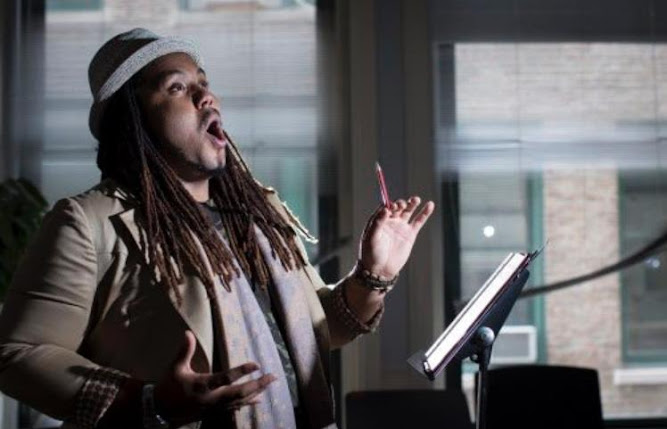
Bass-baritone operatic singer Keanon Kyles performed in his studio at the Fine Arts Building at 410 South Michigan Avenue, Chicago. Kyles has worked as a janitor and voice coach to fund his dream. Never give up on your dreams, someone told Keanon Kyles along the way. It stuck, even in dark moments, like when he'd find tears dropping as he cleaned corporate offices on his night shift job as a janitor.
Kyles, 31, is an opera singer, a rare black male in a music genre many may see as staged musical dramas with high-pitched singing. A little time with the talented Kyles changes that thinking.

"It started when I was 7. My mother signed me and my sister up with the Chicago Children's Choir. We worked our way up to the top concert choir," Kyles said.

"We went on tours all around the world. That was my childhood. At age 13, I joined Gallery 37's Operatics Ensemble. It was the first time I was part of an opera production. I realized I had a strong interest and love for it," he said.

"High school was when I really came to believe I had a chance at being an opera singer. My teacher picked me to perform an aria for a state competition with two weeks to prepare," he said." I won us an honor superior. That's when I thought: 'This could be something.'"

After years of chasing that dream, at times feeling beaten, Kyles, raised in the Washington Heights community's Brainerd neighborhood on the South Side of Chicago, got his big break.

He earned the lead role in "Rigoletto," an opera in three acts by Giuseppe Verdi in Scotland. The role of this hunchback court jester is one of the most powerfully dramatic character roles in opera.

"He was just a kid when he auditioned to be in the elite ensemble I conducted for Gallery 37. He had such a good voice," said Andrew Schultze, an eminent opera singer, conductor, stage director and teacher who has sung throughout the U.S. and Europe, from Carnegie Hall to Milan's La Scala Opera House.

Kyles' longtime mentor and voice coach, Schultze, again worked with him as a teacher at Columbia College, where Kyles obtained a music degree in 2010.

"It's been wonderful to see this kid who was always interested in music become focused on opera. He sings gospel. He sings jazz. He sings everything. But he just kept saying, 'I want to do opera,'" Schultze said.

"He has this talent. It's compelling him. It's propelling and impelling him," said Schultze, who will travel with his wife to see Kyles' performance. "He's such an unaffected person, a really nice guy. I told him, 'Keanon, Rigoletto is the one role I've always wanted to play. I've studied that role but never gotten to do it. Now, you see, you are singing it for me!'"

The third of four children of William and Vivian Kyles, a construction contractor and stay-at-home mom, Kyles left home after college to share a North Side apartment with roommates. To pay the bills while chasing his dream, he contacted a placement agency that had employed him during college. All they had was janitorial work.

"I was like, 'Ummm … I'll get back to you.' I needed a job but wasn't expecting to be cleaning nothing up," said Kyles, voice soft as butter, melodic even in conversation. "After talking to my mother, I had a talk with myself. I realized this was just a job. And that's when adulthood started."

He has worked as many as three jobs at a time to fund his opera journey, weathering frustration and occasional tears. But as his performance gigs increased, so did his exposure.

Doors began to open. In the summer of 2015, he was accepted into Europe's premiere young artist performance festival, Italy's Trentino Music Festival. In the summer of 2016, he secured the role of Colline in Clyde Opera Group's U.K. production of "La Boheme," one of the world's most popular operas. The performance garnered him Clyde Opera Group's Rigoletto role. This would put him on the map.
Bass-baritone operatic singer Keanon Kyles poses for a portrait near his studio at the Fine Arts Building, 410 South Michigan Avenue, Chicago.
"When I realized his interest was classical music, I was thrilled because most young African Americans who go into music are drawn to hip-hop," his mother said. "When he graduated from Columbia and did his recital, everyone was amazed because he sings in three languages. His stage presence brings music alive, even if you don't understand a word. He has that same presence in character and spirit, just a bright light."

Kyles just wants to share his gift.

"I sing R&B. I sing gospel. I sing all those things, but nothing stands out to me more than opera," Kyles said. "Since opera is a European-driven genre, I wanted to represent the blacks because we can sing. We can do that. We can sing in Italy. We can sing in France. People will put limits on you based on your skin color until you prove them wrong, and that's what I wanted to do. I wanted to prove everybody wrong and to prove to people that there were African Americans interested in opera. Put yourself in an arena that nobody would expect you to ever be."
"I want young people to know they don't have to wait for anybody to hand them something or tell them you deserve it," he said. "If you believe it, work at it. Being a star doesn't begin when you reach the spotlight. It starts the moment that the light bulb goes on. This is what you want to do."

Compiled by Dr. Neil Gale, Ph.D.

Sunday, February 24, 2019

The Biography of the Honorable Jesse White.

Jesse Clark White was born in Alton, Illinois, on June 23, 1934. He moved to Chicago with his parents and attended Schiller Elementary School In 1943. He attended Waller High School, where he was active in school athletics, being named All-City in basketball and baseball. He also excelled at tumbling and hoped to play professional baseball after graduation, fielding offers from the St. Louis Browns and the Pittsburgh Pirates. However, White's father insisted that he first go to college. White enrolled at Alabama State College, majoring in physical education. He played baseball and basketball, earning All-Conference honors in both sports. 

Upon graduation, White signed with the Chicago Cubs organization. However, four days before leaving for spring training, he was drafted by the United States Army, where he attended jump school and was trained as a paratrooper. White was soon assigned to the 101st Airborne Division. After his discharge in 1959, White returned to Chicago, where he finally began his professional baseball career, playing for several seasons with the Chicago Cubs organization. 

When Secretary of State Jesse White was a young Chicago Cubs prospect in the early 1960s, legendary slugger Ernie Banks would hold court at spring training dinners with other black players. White says Banks was "our godfather," a player "who we rallied around. And we would meet at this restaurant, and we'd talk baseball. And he'd give us guidance about how to conduct ourselves." The Cubs' playoff run means a little more to the 24-year government officeholder, who played from 1959 to 1966 in the Cubs' farm system. He made it close to the major leagues but never got that coveted call. Still, the advice White says Banks relayed about hard work and moving up in the world could apply as neatly to politics as to baseball. "You cannot just expect a promotion from the sky," White said.

He says the only time he played at Wrigley Field besides a softball game among lawmakers was at a tryout in 1956, 11 years after the team's last World Series appearance. After that tryout, he was signed by the Cubs organization but would be drafted by the Army shortly afterward. "Instead of going to spring training, I went to basic training," White said. White started playing for the low-level Potashers of Carlsbad, New Mexico, i
n 1959. He eventually made it to the highest levels of the minor leagues, playing a couple of years for the AAA Salt Lake City Bees in the early 1960s.
Jesse White played for the Cubs' AAA team, the Salt Lake City Bees, in the early 1960s. 
He finished with a lifetime .291 batting average, but the game is different now. "I think there's more enthusiasm for the game today, especially here in Chicago, than ever before," he said. "I cannot ever remember this enthusiasm for the Cubs. The players are a lot younger. They're a lot faster. And they pitch the ball a lot faster. "But we played... for the love of the game and not so much for the money involved because we didn't get paid that much."

Off-season, White also worked as a physical education instructor at Schiller Elementary School, the school he attended as a child, and the Chicago Park District. In December 1959, White was asked to organize a gym show at the Rockwell Garden Housing Project. This show laid the foundation for what would become known worldwide as the "Jesse White Tumblers." Team members must stay away from gangs, drugs, and alcohol, stay in school, and maintain a minimum "C" average. The team consists of male and female participants as young as age 6.

With 7 units, the team gives more than 1,500 performances each year at major sporting events and community, business, and charity functions. The Jesse White Tumblers attract national and international attention and have performed throughout the United States in all 50 states and the Countries of Belize, Bermuda, Canada, China, Croatia, Israel, Japan, and others. The team has also been featured in commercials, national television shows, and motion pictures.

Because the organization requires its student-athletes to maintain at least a "C" average, team members and trainees who fall below this standard must attend tutoring classes or show proof that they are enrolled in a tutoring program. Our program assists with homework, encourages independent reading, improves writing skills, spelling and handwriting, and practices basic math facts. The program also helps improve science and social studies grades through study skills and develops higher thinking skills through group and individual work. So far, the Tumblers have served as a positive alternative for over 16,500 underprivileged Chicago children. 

As White continued to juggle teaching and tumbling, he was approached to run for a seat in the state legislature, replacing Robert Thompson, who was retiring. In 1974, he was elected to the Illinois House of Representatives, where he served on the Committees on Aging, Elementary & Secondary Education, and Public Utilities and chaired the Committee on Children and Human Services. Among the bills proposed by White in the House was the Good Samaritan Bill, which allowed hotels to offer leftover food to soup kitchens without threat of liability. 

Except for the 1977-79 term, White served in the Illinois General Assembly until 1992, when he was elected Cook County Recorder of Deeds. In 1996, he was reelected to the same office and served until 1998, when he made history by being the first Black elected Secretary of State for Illinois.
Illinois Secretary of State Jesse White. 
The Secretary of State's office is responsible for issuing license plates and titles, maintaining driver records, and overseeing the State Library, State Archives, and the organ and tissue donor program.

In May 1995, White was inducted into the Southwestern Athletic Conference Hall of Fame. He was an all-city baseball and basketball star at Chicago's Waller High School (now Lincoln Park Academy). He was inducted into the Chicago Public League Basketball Coaches Association Hall of Fame in June 1995.

Compiled by Dr. Neil Gale, Ph.D. 

Beginning January 1, 2019, State law mandates black history courses at public colleges in Illinois.

Public colleges and universities throughout the state of Illinois must now offer a course studying black history.
May 3, 1968, black students occupied Northwestern University's bursar’s office, alleging that NU hadn’t confronted Evanston’s segregated housing. Among their demands was a greater presence of minorities at the university, where there were about 45 to 50 blacks among 6,500 undergraduates. 
In 1981, a state law was passed to make sure that all public schools in Illinois teach black history. And in 2016, Chicago Public Schools history teachers believed that CPS didn’t do enough to implement black history classes into its curriculum.

The fact that the existing state mandates weren’t always followed is one reason state Rep. La Shawn K. Ford co-sponsored the bill. “We’re going to have an audit on every school district in the state. In today’s times, where we have so much racial tension, we need to know each others’ culture,” Ford said. “You can’t have institutional learning that’s not complete.”

South Side native Joshua Adams, an assistant professor of media and communications at Salem State University, believes the legislation is a step in the right direction since most students never take a black history course until college. “The way American history is taught around the country often leaves most students unequipped to know about and think critically about where we came from as a country and where we are going,” Adams said.

Elizabeth Todd-Breland, Ph.D. an assistant professor of history at the University of Illinois at Chicago and author of “A Political Education: Black Politics and Education Reform in Chicago since the 1960s,” believes oversight of the law is paramount.
“Given the way that black history has been ignored or distorted—particularly the history of slavery in some secondary textbooks and curriculum—I think requiring black history to be offered at the post-secondary level is important,” Todd-Breland said. “It will also be important to monitor the implementation of this to make sure these courses are not marginalized among other requirements.”

By Evan F. Moore, Chicago Sun Times
Edited by Neil Gale, Ph.D.