Saturday, April 15, 2023

Illinois' Moniker: The Sucker State.

You probably recognize Illinois’ state nickname as "The Prairie State," which dates back to the 1840s. On the other hand, "Land of Lincoln" was made the official state slogan of Illinois in 1955. In fact, Illinois' exclusive use of the Land of Lincoln insignia was later authorized by a special U.S. copyright. 
The name and image of Illinois' most famous adopted son have become synonymous with the state and are on Illinois license plates and 'Welcome to Illinois' highway signs.
Most people don't realize that Illinois had a less noble sobriquet for much of the 19th century, "The Sucker State." And although there is no doubt that this nickname was associated with Illinois, the origin of the term is subject to debate. There are at least three interpretations.

One explanation involves a practice that was fairly common among travelers and inhabitants of the prairie. When water was needed, long, hollow reeds were thrust down into crawfish holes, and the water was literally sucked up, as through a straw. Such watering holes were called "suckers" in the local vernacular.

Another explanation derives from the fact that the central and southern portions of Illinois were originally settled by pioneers from Kentucky, Virginia and Tennessee, all tobacco-growing states. The sprouts around the main stem of a tobacco plant are commonly referred to as "suckers." These sprouts are cut off and discarded before they sap the vital circulating fluid of the plant, taking the nutrients away from tobacco plants 20 to 30 useable leaves. Most settlers of the area were poor and, in fact, had moved to Illinois in hopes of a better life. Society at that time, as throughout most of our nation's history, tended to look down on poor migrants as a burden. It was expected that these particular settlers would fail in their new venture and perish, like the tobacco sprouts that were cast off as undesirable. They were derisively called "suckers," and the term came to refer to the entire region of Southern Illinois, which at the time held most of the state's population.

Probably the most popular explanation of how Illinois came to be known as the Sucker State involves the state's first lead mine, which was opened in 1824 near Galena. As word of the mine spread, thousands of men descended on Galena in search of work. Most came from Missouri and southern Illinois, traveling north on steamboats up the Mississippi River to Galena in the spring, where they would work until autumn and then return home. These travels corresponded to the migration pattern of a fish called a “sucker,” and the name was attributed to these workers by Missourians as a witticism. With six to seven thousand men coming to the Galena mines each year by 1827, the mass influx and exodus generated considerable strains and rivalries. In retaliation for the derisive term “suckers,” Illinoisans started calling Missourians “pukes,” a reference to the way in which Missouri had vomited forth to Galena the worst of her residents.

sidebar
The white sucker is a species of freshwater cypriniform fish inhabiting the upper Midwest and Northeast in North America. It's also found as far south as Georgia and as far west as New Mexico. The fish is commonly known as a "sucker" due to its fleshy, papillose lips that suck up organic matter and aufwuchs (plants and animals adhering to parts of rooted aquatic plants) from the bottom of rivers and streams. Other common names for the white sucker include bay fish, brook sucker, common sucker, and mullet. 
The White Sucker

Over Illinois’ 205-year history, the state’s residents have been called other names. The Land of Lincoln, as well as The Prairie State, are considerable improvements.

Compiled by Dr. Neil Gale, Ph.D.

Friday, April 14, 2023

World War II, U.S. Submarines Traveled the Chicago Sanitary and Ship Canal.

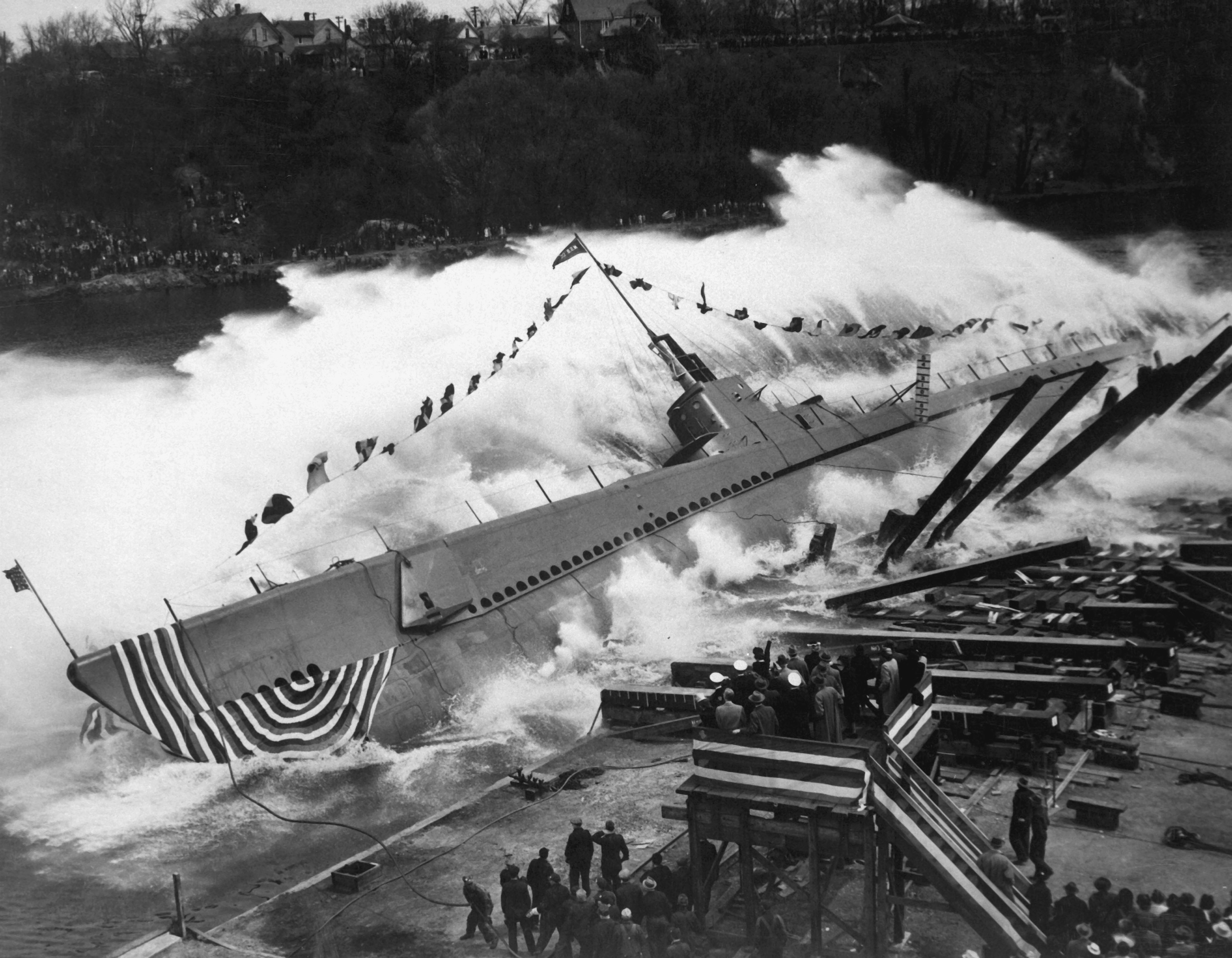
In 1940, the Manitowoc Shipbuilding Company (1902-1968) in Wisconsin was commissioned to construct submarines by the U.S. Navy for use in WWII. The company had never built a submarine before, completed the first sub 228 days ahead of schedule, and promptly was awarded additional contracts. Ultimately, Manitowoc constructed 28 submarines, saving the Government more than $5 million in contract costs.
Launching of USS ROBALO on May 9, 1943, at Manitowoc Shipbuilding Company, Manitowoc, Wisconsin.


sidebar
The Manitowoc Shipbuilding Company bought Bay Shipbuilding Company in 1968  and moved their operation to Sturgeon Bay, Wisconsin.

The subs were tested in Lake Michigan, a process referred to as "shakedown training," and were deemed fit for service. The question is how to get the subs from Lake Michigan to open water? 

sidebar
The St. Lawrence Seaway is a system of 15 locks, canals, and channels in Canada and the United States that permits ocean-going vessels to travel from the Atlantic Ocean to the Great Lakes of North America. The St. Lawrence Seaway opened for seafaring traffic  on April 25, 1959.
WWII Submarine in floating dry dock at Lockport on the Chicago Sanitary and Ship Canal, c.1943.


The Sanitary and Ship Canal opened in 1900 to carry shipping traffic and to alleviate pollution entering Lake Michigan from the Chicago River. The subs had a draft of 15 feet, and the Chicago River and Sanitary Canal could handle that without a problem. Here's how the trip was accomplished:
USS Pogy (SS 266): Keel Laid – September 15, 1941; Launched – June 23, 1942; Commissioned – January 10, 1943. USS Pogy served ten war patrols in the Pacific Ocean in World War II, sinking a total of 16 Japanese ships. She earned eight Battle Stars and the Navy Unit Commendation.


The Periscopes and radar masks were removed in order to clear bridges. One railroad bridge remained too low to pass the subs at Western Avenue. The Navy paid for lift machinery to elevate the bridge so the submarines could clear. The submarines then traveled down the canal to Lockport, where they were loaded onto a floating dry dock (barge) for the remainder of the trip down the Illinois River, towed by the tugboat Minnesota through the 9-foot-deep Chain of Rocks Channel at the confluence of the Mississippi and Missouri Rivers, and down the Mississippi to New Orleans. There the periscopes and radar masts were reinstalled.


Locals stood along the canal's sides, watching the submarines travel on their way to war.

ADDITIONAL READING:

Compiled by Dr. Neil Gale, Ph.D.

Lost Towns of Illinois - Sag Bridge, Illinois.

Sag Bridge was a village that is now part of the Village of Lemont. It had a hotel and its own post office, a number of businesses, a railroad station, a stop on the electric line between Chicago and Joliet, and a port on the I&M canal.
Photo of farmland where the Cal-Sag Channel now is. The town of Sag Bridge is behind the buildings in the background on the left. On the right, the land rises to St. James Church on the bluff. 1910


Joshua Bell, who came to Sag Bridge in the 1830s, was the postmaster and owner of the saloon/hotel. Although the town soon found it too expensive to continue as a village, it had a school district composed of one of the last one-room schoolhouses in the state, which did not close until 1961.

When the glaciers retreated from Northern Illinois, Prehistoric Lake Chicago remained, which eventually receded, leaving Lake Michigan. As it receded, it left two valleys, the Des Plaines River Valley and the Sag Valley, on either side of an elevated triangle of land called Mount Forest Island.

Sag Bridge was located on the south side of the Sag Valley. The historic St. James at Sag Bridge, the oldest continuously operating Catholic Church in Cook County, was built on the north bluff in the forests at the western edge of Mount Forest Island. The cornerstone of the church was laid in 1853. It took six years to haul the quarried rock up the bluff to complete the building.

Before permanent settlement, Mount Forest Island had been inhabited by Indians who valued the land for its vantage point and strategic location.
St. James Catholic Church and Cemetery, aka Monk's Castle and St. James at Sag Bridge Church, is a historic church and cemetery in the Sag Bridge area of the village of Lemont, Illinois. It is claimed to have been built on the site of an Indian village, possibly over an Indian mound, and later a French fortification building. Father Jacques Marquette and Louis Joliet stopped there during their exploration.

Many immigrants to Sag Bridge came from Ireland to find jobs digging the I&M canal in the 1840s, and when the canal was finished they stayed to farm or work in the local quarries. In the 1890s, the sanitary canal, the waterway that reversed the flow of the Chicago River, brought more Irish to Sag Bridge and Lemont, as well as the Bridgeport neighborhood of Chicago.

What does “Sag” mean, and what was the bridge? The answers are speculative. The term Sag probably derived from a Potawatomi Indian word, Saginaw, which may have meant “swamp.” The Sag Valley was a low-lying swampy area, and it is presumed that a bridge may have provided transport across it. The name could also refer to the geographic coming together of the two valleys. When one considers that recorded history relates that the first white settlers to arrive in the area came in 1833 and that the oldest grave at St. James Cemetery is that of Michael Dillon, buried in 1816, further fuel is added to doubts about the accuracy of the history.

Compiled by Dr. Neil Gale, Ph.D.

The Ghosts of Sag Bridge, Illinois.
The late 1890s seems to be when ghost activity peaked in the area of Sag Bridge, Illinois, now the northeast corner of Lemont. Many ghostly tales, some well documented, began here.

In late December of 1897, a rash of new sightings and hauntings was stirred up. Some said it was due to the discovery of the skeletons of nine Indians, well documented by scientists from Chicago. Professor Dosey determined the skeletons were several hundred years old, one being over seven feet tall. This was not the first time: skeletons had been turning up in and near Sag Bridge for years. But now villagers began reporting phantom Indians on horseback riding through the town at night and other visions of roaming spirits. Some felt this was due to the fact that the skeletons had been disturbed and demanded they be reburied. Some were reburied, but some were sent to the Field Museum in Chicago.

Not only Indians haunted the area. There were tales of a horse-drawn hearse traveling along Archer Avenue, pulling an infant’s casket, which was seen to glow through the viewing window. A county policeman reported chasing several figures in monk-like robes until they vanished before his eyes. A priest is rumored to have seen the ground rise and fall as if it were breathing.

Much of this activity seems to have been near St. James at Sag Bridge, a church in the middle of the forest, surrounded by a cemetery dating back to the early 1800s, years before the church was built. It is said that the site was originally an Indian village and an ancient Indian burial ground. Even in the daytime, the property gives off an eerie atmosphere.

A story told about St. James at Sag Bridge also happened in 1897. Two musicians, Professor William Looney and John Kelly, had provided entertainment for a parish event, which went on until 1 am. Not wanting to return to their homes at this late hour, they slept overnight in a small building on the property. Looney was awakened during the night by the sound of galloping hoofs on the gravel road and looked out the window. He could see nothing to account for the sound, and gradually it faded.

Looney woke Kelly to tell him what had happened, and as they spoke, the sound returned. Both men looked out, and as the sounds again faded, the form of a young woman appeared in the road. The sounds again approached, and this time horses and a carriage were seen coming partway up the drive. The woman danced in the road until she entered the shadow, and the horses and carriage disappeared, only to start again a short time later. Each time they appeared, something new was added to the scene, and the woman began to call, “Come on!” as she disappeared.

The men reported the incident to local police the next morning, and it was verified that NO drinking had taken place to account for the tale. Since that time, similar sightings have continued to be reported by respectable residents. It is said the ghosts were the spirits of a young parish helper and housekeeper from the church, who fell in love and decided to elope. The man told his young lover to wait partway down the hill while he hitched the horses, but they were startled and bolted as he was coming for her. The wagon was overturned, and both were killed.

By Pat Camalliere, "The Mystery at Sag Bridge."

Thursday, April 13, 2023

John Schmidt, aka Johann Otto Hoch thought to have killed over 50 women.

Johann Otto Hoch (aka The Bluebeard Murderer and Chicago Bluebeard) (1855-1906) is the most famous and last-used alias of a German-born murderer and bigamist, John Schmidt. He was found guilty of the murder of one wife but is thought to have killed more, perhaps up to 50 victims. He was hanged in Chicago on February 23, 1906, for one murder. 
Picture of John Schmidt, aka Johann Otto Hoch, (left front) and four unidentified men in a room in Chicago, Illinois. Hoch was accused of bigamy with 11 to 23 wives and was suspected of murdering six or more of his wives. He was convicted of killing his wife, Marie Walcker, by slow poison and was hanged in 1906.


Hoch was born John Schmidt in 1855, at Horrweiler, in the Grand Duchy of Hesse (present-day Rhineland-Palatinate, Germany). He emigrated to the United States in the 1890s and dropped his surname in favor of assorted pseudonyms, where he began to marry a string of women, frequently taking the name of his most recent victim. Hoch used matrimonial ads to find victims. He would swindle all their money and either leave them or kill them with arsenic, then begin his pattern all over again.

Chicago police would dub him "America's greatest mass murderer," but statistics remain vague in this puzzling case. We know that Hoch bigamously married at least 55 women between 1890 and 1905, bilking all of them for cash and slaying many, but the final number of murder victims is a matter of conjecture.

Sensational reports credit Hoch with 25 to 50 murders, but police were only sure of 15, and in the end, he went to trial (and to the gallows) for a single homicide. Hoch's first and only legal wife was Christine Ramb, who bore him three children before he deserted her in 1887.

One of his last wives was a Chicago woman who ran a candy shop near Halsted and Willow. He had slipped her some arsenic shortly after the wedding, thrown a big pity party for himself while she lay in agony, and then proposed to her sister while the coffin was still in the room. Hoch married the sister a day or two later, then took her money and ran.

Hoch was executed in Chicago on February 23, 1906. After his execution, several cemeteries refused him burial (see below),

A TURN-OF-THE-CENTURY PARTIAL ACCOUNT
REPORTS ON MANY OF HOCH'S VICTIMS:

1881, Austria – marries Annie Hoch

1883, New York – Hoch arrives with his wife Annie, an invalid who dies several years later

1888, New York – After arriving from Württemberg, Germany, Hoch is said to have married an immigrant servant girl who "died" before two months passing {alleged}. During his 1905 New York arrest, it was also alleged Hoch had married and either left or killed women in Vienna, Austria, London, England, and Paris, France.

1892 Chicago – Mrs. Hoyle Hoch died

1892, Chicago – May: Hoch, under the name C.A. Meyer, rents a flat and has a new wife (wife reportedly died after three weeks)

1892, Chicago – June: Hoch, under the name H. Irick rents a flat and has a new wife (wife reportedly died a month later)

1893, Milwaukee – Hoch, under the name "Dr. James," marries Lena Schmitz-who died 

1893 Milwaukee – Hoch marries Lena Schmitz's sister Clara who also died.

1894 Chicago – Under a new alias, Hoch rents a flat with a new wife (wife reportedly died after two months)

1895 Chicago – arrested under the alias "C.A. Calford" and charged by Mrs. Janet Spencer with having eloped; married and deserted her with a few hundred dollars of her money; he is identified as an abductor of a Hulda Stevens and a participant in a diamond robbery

1895 April – Under the name Jacob Huff, Hoch marries Karoline/Caroline (Miller) Hoch, widow, Wheeling, WV. She died on June 15, 1895. He faked his death, took her surname Hoch and went to Chicago.

1895 July 5 – Arrives in Chicago

1895, July 15 – Buys a saloon in Chicago

1895, August 5  – aka Jacob Hoch, he marries Mrs. Maria Steimbucher of Chicago-she died four months later; Hoch sold the property for $4,000. Before dying, she declares that she has been poisoned, but no notice is taken of her statement.

1895 November – Hoch marries Mary Rankin of Chicago; Hoch disappears with her money the next day. {It is also alleged that about 1895, Hoch, aka Schmidt, went back to Germany but fled from a warrant charging that he was not only bankrupt but also owed 3,000 Marks}

1896 April – Hoch, aka "Jacob Erdorf," marries Maria Hartzfield of Chicago; Hoch disappeared with $600 of her money after four months.

1896 September 22 – Hoch, aka "Schmitt," marries widow Barbara Brossett of San Francisco. "Schmitt" disappeared 2 days later with $1,465 of her money; she is so affected by the losses she dies afterward.

1896 – Hoch proposes to landlady Mrs. H. Tannert of San Francisco, who refuses him.

1896 November  Hoch marries Clara Bartel of Cincinnati, Ohio; she dies three months later.

1896 – A Mrs. Henry Bartel dies in Baltimore {Bartel being a Hoch alias. It is also alleged that Hoch married two other times in Baltimore: a Mrs. Nannie Klenke-Schultz; Mrs. Henrietts Brooks-Schultz; an unnamed Boston woman married to a "Louis/Charles Bartels" came to Baltimore and seized his furniture}

1897 January – Marries Julia Dose of Hamilton, Ohio. In Cincinnati, Hoch disappears the same day with $700 of her money.

1897 July 20 – Hoch, aka "Henry F. Hartman," marries in Cincinnati.

1897 December 6 – Hoch marries a woman in Williamsburg, New York, and disappears with $200 {alleged}

1898 January 16 – Hoch, aka "William Frederick Bessing" marries Mrs. Winnie Westphal in Jersey City-Hoch disappears with $900.00 

1898 Buffalo, New York – a Mrs. Wilhelmina Hoch died {alleged}

1898 March – Chicago Hoch appears, aka "Martiz Dotz," with a wife who died June 1898.

1898 June – Hoch, aka Adolf Hoch, aka Martin Dose, arrested in Chicago for selling already mortgaged furniture; gets one year in jail.

1899 Milwaukee – Hoch marries an unnamed sister of Mrs. J.H. Schwartz-Marue; the bride dies, and Hoch disappears with $1,200

1899 Norfolk, Virginia – A different Mrs. Hoch died suddenly

1900 – Claimed to married a Mary Hendrickson

1900 – Allegedly, Hoch, aka "Albert Buschberg," married Mary Schultz of Argos, Indiana. Schultz, her 15-year-old daughter Nettie and $2,000 "disappeared."

1900 – A "Jacob Hoch" married Anna Scheffries of Chicago 

1900, December 12 – Hoch, aka "John Healy," marries Amelia Hohn of Chicago; deserts her after getting $100.

1901, January – Hoch, aka "Carl Schmidt," marries in Columbus, Ohio; after two weeks, he deserts her along with $400.

1901 – Hoch marries Mrs. Loughken-Hoch in San Francisco; she dies "suddenly."

1901, November –  Hoch marries Anna Goehrke; he deserts her.

1902, April 8 – marries Mrs. Mary Becker of St. Louis; she died in 1903

1902 May – Hoch, aka "Count Otto van Kern," marries Mrs. Hulda Nagel; husband persuades wife to convert real estate into cash; while the wife is shopping, her trunk containing $3,000 is robbed on contents and "Kern" deserts wife.

1903 June 18 – Hoch, aka "Dr. G.L.Hart," flees after trying to poison Mabel Leichmann-a bride of three days; Hoch flees with $300 worth of diamonds and $200 of her money 

1903 Dayton, Ohio – Hoch marries Mrs. Annie Dodd {deserts her}

1903 Dayton, Ohio – Hoch marries Mrs. Regina Miller Curtis (deserts her)

1903 Milwaukee – Hoch courts Ida Zazuil but leaves her after a quarrel

1903 December – Hoch uses marriage license for Zazuil's engagement and marries Mrs. T.O'Conner of Milwaukee-deserts her and absconds with $200 of her money

1904 January 2 –  aka "John Jacob Adolf Schmidt" marries Mrs. Anna Hendrickson of Chicago in Hammond, Indiana, and disappears January 20 with $500 of her money.

1904 June – Hoch marries Lena Hoch of Milwaukee; she dies three weeks later, leaving Hoch $1,500.

1904 October 8  Hoch alias "Leo Prager" marries Bertha Dolder of Chicago. He disappears after buying $1,200 worth of rugs from the $3,500 she gives him for a furniture store.

1904 October 20 – Hoch alias "John Schmidt" marries Caroline Streicher of Philadelphia. He disappeared on October 31, 1904.

1904 November 9 – Hoch appears in Chicago.

1904 November 16 – Hoch alias "Joseph Hoch" leases a cottage in Chicago from a bank from November 16, 1904, to January 1, 1905; buys furniture for $120.

1904 December 10 – Marries Marie Walcker of Chicago-who sells her candy store for $75.00 and gives Hoch her life savings of $350.

1904 December 20 – Marie Walcker becomes ill.

1905 January 12 – Marie Walcker-Hoch dies.

1905 January 15 – Hoch marries Marie's sister Mrs. Fischer in Joliet, Illinois, who gives Hoch $750. Hoch leaves after Mrs. Fischer's sister denounces Hoch as a murderer and swindler. Note: Hoch married Fischer under the alias of John "Hock," he is also alleged to have married, swindled, and deserted Anna Frederickson on January 23,1905. John Hock is believed by the police to have murdered ten women and been illegally married many times. 

Hock, accused by Mrs. Emelle Fisher Hock of poisoning her sister two days before marrying herself, was the janitor of the old "Holmes Castle" where so many women were murdered. He had profited by the training of his employer, H.H. Holmes, who was hanged in Philadelphia on May 7, 1896, convicted and sentenced to death for only one murder, that of accomplice and business partner Benjamin Pitezel.

"I believe it possible that this man Hock was the janitor of the 'Holmes Castle,'" said  Lieutenant Storen. "He answers the description of the janitor who disappeared after testifying on behalf of Holmes."

1905 January 30 – Hoch alias "Harry Bartells" proposes to his landlady Mrs. Catherine Kimmerle of New York City; she refuses, and Hoch is arrested; Hoch claims the alias of "John Joseph Adolf Hoch."

1905 February 1 – Two indictments returned against Hoch for bigamy, alleged number of wives to be twenty-nine.

1905 February 5 – Five more alleged wives of Hoch identify him

1905 May 19 – Hoch was tried and found guilty of the murder of Marie Walcker, sentenced to death June 23, 1905.

1905 June 23 – Cora Wilson of Chicago advances money so Hoch can appeal the sentence to Illinois Supreme Court, which sustains the lower court and sets the execution date for August 25, 1905.

1905 August 25 – Hoch execution was put off until the October session of the Illinois Supreme Court.

1905 December 16 – Illinois Supreme Court refuses to intervene.

While awaiting execution, Hoch actually received several proposals for marriage. Fortunately, the inexorable processes of the law saved the authors from their own folly. 
Picture of John Schmidt, aka Johann Otto Hoch, at the defendant's table of his murder trial.
1906 February 23 – Hoch is executed in Chicago.

Chicago Tribune, Saturday, February 24, 1906.
LAW WINS FIGHT: HOCH IS HANGED
Johann Hich died on the gallows yesterday. The sentence of the court that he should be hanged between 10 and 2 o'clock was carried out shortly before the latter hour. Stoically he stepped on the drop, made a last declaration of his innocence, and his life was given in legal atonement for the murder of Maria Walcker Hoch, one of the many wives whom he was accused of poisoning.

After his execution, several cemeteries refused him burial, so Hoch was taken to the Cook County Insane Asylum at Dunning in Chicago. 

sidebar
Originally, it was simply known as "Dunning," the family name of the original owners of the town located within Jefferson Township. Future names included the Cook County Farm was established in 1851 and opened in 1854 to care for the poor working on the farm. The Cook County Insane Asylum opened in 1869, the Infirmary in 1882, and the Consumptive Hospital (Tuberculosis) opened in 1899. Although "Dunning" officially closed on June 30, 1912, it reopened the next day as Chicago State Hospital and changed its name to the Charles F. Read Zone Center. In 1970, the Chicago-Read Mental Health Center was established, incorporating the old hospitals.

The unclaimed bodies from the City Cemetery's potter's field were reportedly exhumed and moved to the County Farm beginning in September 1854. The County Farm, also known as the County Poor Farm, located in the township of Jefferson (today's Jefferson Park annexed by Chicago), has a confusing history of its own. The dead buried within these grounds include those who died in the county's "Insane Asylum," 117 unclaimed victims of the Chicago Fire, and others, including "inmates" who lived within the grounds during its various functions. The 
Cook County Cemetery at Dunning became the official cemetery serving the poor and indigent of Cook County, Illinois, from 1854 to well into the 1920s. 

And then... it was forgotten. Hidden behind the fences surrounding the Dunning institution, the cemetery, without markers or headstones, was out of sight and out of mind until March of 1989 when builders attempted to recycle the land into houses and condos.

Johann Otto Hoch's body was moved to Elmwood Cemetery in River Grove, Illinois, in March 1989 when builders attempted to develop the land. Hoch's body was one of the many bodies that were exhumed and moved to Elmwood Cemetery. 

Compiled by Dr. Neil Gale, Ph.D.

Tuesday, April 11, 2023

Chicago's Founding Hot Dog Co's.: David Berg & Co. (1860); Oscar F. Mayer & Bro. (1883); Vienna Beef (1893).

David Berg & Company — 1860
David Berg & Company had developed a following of customers fond of their signature, "Kosher Style" hot dogs, beginning in 1860. David Berg hot dogs were sold at the 3-day 1860 Republican National Convention held at the Wigwam in Chicago.

Abraham Lincoln was nominated as the Republican Presidential Candidate, although Lincoln, following tradition, did not attend the Convention, staying in Springfield when he got the news he won. 
 
sidebar
Abraham Lincoln ate mechanically, never having a thought about what he was eating. At the Lincoln's table discusses his excessively low caloric intake, how he ate anything set before him, and made no complaints or comments of any kind about the food or meal. Mary never got accustomed to that.
sidebar
The presumption was that ketchup/catsup would be hard to find in the 1860 National Convention, the origin of Chicagoland's ritual of, "No Ketchup on a Chicago Hot Dogs."

Chicago-Style Hot Dogs include ALL of these ingrediants: mustard, sweet relish, diced onion, tomato thin-wedges/slices, a pickle spear or two, sport peppers (no other pepper substitutions) and a sprinkle of celery salt on a poppy seed bun.
 
This medley creates a less sweet version of ketchup flavors: sweet, tangy, savory and a kiss of heat, making ketchup redundant. It's been claimed that substituting any other type of pepper, and nobody's judging you, clouds one's taste buds from the true flavor experience of a Chicago dog.

David Berg was the pioneer who introduced Hot Dogs at baseball stadiums. Hot Dogs were served at the 1901 home of the Chicago White Sox at the "American Grant Park Baseball Stadium."


In 1978, David Berg made a six-foot, 681-pound premium beef hot dog in a 100-pound poppy seed bun covered with two gallons of mustard.

David Berg filed for Chapter 11 Bankruptcy in November 1992.

Oscar F. Mayer and Bro. — 1883
Oscar F. Mayer and Brother (Gottfreid), the second highly successful Chicago sausage company, was established in 1883. They were sponsors of the German building at Chicago's 1893 World's Columbian Exposition.


Oscar Mayer moved to Chicago in 1876 when he was 17 to work for Kohlhammer's Market. He then worked six years for the Philip Armour & Company meatpackers at the Chicago Union Stock Yards, and Mayer had saved enough money to lease a failing Kolling Meat Market business.
In 1906, they became one of the first companies to volunteer to participate in a new Federal Meat Inspection program to certify the purity and quality of products. Cleanliness was scored so issues could be addressed in person and improvements could be measured for the next inspection. 

Vienna Beef — 1893
A late-comer to the Hot Dog game in Chicago. When Vienna Beef set up shop at the 1893 World's Fair, they quickly became the Chicago hot dog king. 
Courtesy of Foŭ TosHopṕe, Sycuan Reservation, California, USA


In 1992, almost a hundred years later, David Berg joined the Vienna Beef Products family. Vienna produced the David Berg line of products for some time, using the original recipes.

sidebar
While it's impossible to be exact, a very high percentage of Chicagoland hot dog places likely use Vienna Beef. A safe 2023 estimate would be somewhere around 80-90%, but even that could be conservative.

Chicago's Biggest Hot Dog Makers Start a Wiener War.
This is a dog fight Chicago will relish.

Vienna Beef, one of the world's most famous hot dog makers, is suing the owner of a rival hot dog company, accusing him of either stealing Vienna's 118-year-old recipe or lying to customers by claiming that he's using it.

The rival is none other than a grandson of one of the two men who founded the company after their hot dogs became a hit at the 1893 World's Fair.

In this wiener war, one of the only things the owners of Vienna Beef and Red Hot Chicago (1986-2012), are likely to agree on is that you don't put ketchup on a Chicago-style hot dog.

They also might agree that Chicago's dog — with its mustard, bright green relish, tomato slices, pickle spear, chopped onion and more — is far superior to New York's grilled or boiled dog, which by Chicago standards is practically naked with only sauerkraut and mustard.

The lawsuit accuses Red Hot Chicago of false advertising, unfair competition and trademark infringement. But it also offers a reminder that hot dogs are no joking matter in Chicago, where the "meal on a bun" is part of local history and where loyalty to one of the region's 2,000 hot dog stands is passed down from generation to generation.

"This is Chicago, and we take hot dogs seriously," said Tanya Russell, a mail carrier who stopped at Fast Track, a downtown stand, to deliver some letters and grab a Vienna hot dog before finishing her route.

The fight could be a long one, in large part because of the legacy at stake.

Scott Ladany's grandfather arrived as an immigrant from Austria-Hungary and set up a hot-dog consession at the World's Fair. At the time, he "started with little more than hopes, dreams and his sausage-making skills," attorney Jami Gekas wrote.

The grandfather, Samuel Ladany, eventually helped found the business that is now Vienna Beef. Fast forward to the early 1980s, when Scott Ladany was leaving the company. He sold his 10 percent stake and agreed not to "use or divulge" any of Vienna's recipes and, according to the lawsuit, promised not to compete with Vienna for at least 2½ years.

In 1986, after that condition expired, he founded Red Hot Chicago.

Ladany has declined to comment, but in court documents he insists he did not steal anything and that Red Hot's recipe is its own. At the same time, he always made it clear that his family history — complete with the World's Fair photographs and pictures of his grandfather that Vienna had showcased — were going to take center stage at Red Hot Chicago, too.

So, not only did he settle on "A Family Tradition Since 1893" as his company motto, but he also included Vienna Beef's name right in his advertising literature.

And the reason, Gekas, told the judge, is simple: It's all true.

Vienna Beef CEO Jim Bodman says he worries that the messages will confuse customers.

"He was dancing right up to the line by saying it's a family tradition," Bodman said.

"They want to ride Vienna's coattails ... and sell their product using Vienna's brand recognition," Vienna's attorney, Phillip Reed, said recently at a court hearing.

Even the judge handling the case wondered if all the talk about history might mislead customers.

"Isn't there an implication ... that this is one big hot dog family?" asked U.S. District Judge Sharon Johnson Coleman.

It isn't.

Bodman said he's been aggravated for years by Red Hot's advertising. Then, a few months ago, Red Hot began advertising that it was using a "time-honored family recipe" that's more than a century old — a claim that appeared in print in a food industry magazine.

"That goes over the line," he said, explaining the lawsuit filed this month.

The way hot dog makers see it, recipes are the key to success, just like the formula for Coca-Cola and the secret spices that go into KFC chicken.

Alex Lazarevski of Express Grill in Chicago said that while he has someone else make his sausages, he hires that person to do so with the seasonings that the hot dog stand owner gives him, already mixed.

"I don't want anybody else to get a hold of it," said Lazarevski, who says the recipe is patented.

Vienna's 118-year-old recipes are so important to the company that for years they were kept in a vault. And even today, outside vendors who mix the spices and oils "only handle a portion of the blending process."

That way, "neither vendor knows the entire process, blend and formulation of the Vienna Recipes," according to the lawsuit.

At a recent hearing, Gekas acknowledged that it was a "mistake" for Red Hot to suggest at one point that it had a recipe dating back to the 1800s. But she said the mistake was made by a "marketing person" and it was made only once.

Vienna's Reed has acknowledged a mistake of his own.

In a court document filed Friday, he backed away from one of the complaint's most explosive allegations: That Ladany or his representatives either lied to hot dog vendors, saying that their hot dogs used Vienna's recipe, or asked them to buy the cheaper dogs and pass them off as Vienna products to their customers.

Gekas, who disputed that contention in court, would not comment on Vienna's latest document. But at the hearing, she kept returning to the same point: Ladany is not trying to trick anybody when it comes to his background or his company's history.

"What he is doing is sending a different message: 'I know what I'm doing. I grew up in the business,'" she said. Ladany, she wrote in one document, "represents true Chicago hot dog tradition." 

(AP) June 22, 2011 

Lawsuit Dismissal Order —  Signed by the Honorable Sharon Johnson Coleman on 2/16/2012. Civil case terminated.

October 17, 2017 — I did get into an expensive lawsuit with Vienna. As part of resolving the legal dispute, I agreed to merge Red Hot Chicago with Vienna Beef in 2012 and accept an executive position with my old family business, says Scott Ladany.

Compiled by Dr. Neil Gale, Ph.D.