Monday, March 27, 2023

Illinois' Fourth (4th) Statehouse, Vandalia, Illinois.


The fourth Illinois statehouse in Vandalia served as the State capitol from 1836 until 1839 and is the oldest surviving capitol building in the state. The first (1818-1820) was at Kaskaskia, the state’s first capital. The second (1820-1823), third (1824-1836), and fourth (1836-1839) were all in Vandalia. The fifth (1839-1876) is in Springfield and is preserved as the Old State Capitol State Historic Site. The sixth is the current capital (1876-present) in Springfield.


As a historian, I was escorted into the roped-off and closed rooms to take pictures on October 9, 2013. The volunteer had a wealth of knowledge and joined my Facebook group after I finished the photoshoot. 

The Vandalia Statehouse is significant for its association with Abraham Lincoln, who served in the House of Representatives. In 1974 the Statehouse was placed on the National Register of Historic Places.


The Statehouse is located in the center of a city block in downtown Vandalia, a two-story painted brick structure. Porticoes on the north and south sides of the “restored” building reproduce those added in the 1850s. 


The first floor contains a large entry hall and rooms representing the offices of the Auditor, Treasurer, and Secretary of State, as well as the Supreme Court chamber. The second floor comprises a central hall and recreated House and Senate chambers, each containing a visitor gallery reached by staircases. 


The visitors’ Gallery is off-limits due to the fire code stating there must be two exits; the Gallery has only one.

The square on which the building is located is handsomely landscaped, with many trees. A large statue, the “Madonna of the Trail,” donated by the Daughters of the American Revolution and dedicated in 1928, is located on the southwest corner. It commemorates Vandalia as the official terminus of the historic National Road.


Visitors are offered free guided tours through the building or can view the historically furnished rooms independently from the roped-off open doorways. Informational signs describing each room are located in the hall, but nobody is permitted into the rooms. A small exhibit in the first-floor hall outlines Abraham Lincoln’s connection with the Statehouse. 
An accessible restroom was built on the northwest corner of the Statehouse grounds. 


Compiled by Dr. Neil Gale, Ph.D.

Sunday, March 26, 2023

Chinatown History, Chicago, Illinois.

Looking to escape the anti-Chinese violence that had broken out on the west coast, the first Chinese arrived in Chicago after 1869 when the First Transcontinental Railroad was completed. By the late 1800s, 25% of Chicago's approximately 600 Chinese residents settled along Clark Street between Van Buren and Harrison Avenues in Chicago's Loop. 

In 1889, 16 Chinese-owned businesses were located along the two-block stretch, including eight grocery stores, two butcher shops and a restaurant. 

In 1912, the Chinese living in this area began moving south to Armour Square. Some historians say this was due to increasing rent prices. Others see more complex causes: discrimination, overcrowding, a high non-Chinese crime rate, and disagreements between the two associations ("Tōngs") within the community, the Hip Sing Tōng and the On Leong Tōng.
Guey Sam Restaurant.

The move to the new South Side Chinatown was led by the On Leong Merchants Association in 1912, which had a building constructed along Cermak Road (then 22nd Street) that could house 15 stores, 30 apartments and the Association's headquarters. While the building's design was typical of the period, it also featured Chinese accents, such as tile trim adorned with dragons.


In the 1920s, Chinese community leaders secured approximately 50 ten-year leases on properties in the newly developing Chinatown. Because of severe racial discrimination, these leases must be secured via an intermediary, H.O. Stone Company. Jim Moy, then-director of the On Leong Merchants Association, decided that a Chinese-style building should be constructed as a strong visual announcement of the Chinese community's new presence in the area. 


With no Chinese-born architects in Chicago then, Chicago-born Norse architects Christian S. Michaelsen and Sigurd A. Rognstad were asked to design the new On Leong Merchants Association Building in the spring of 1926. Michaelsen and Rognstad drew their final design after studying texts on Chinese architecture. When the building opened in 1928 at the cost of a million dollars, it was the finest large Chinese-style structure in any North American Chinatown. 


The On Leong Association allowed the Chinese Consolidated Benevolent Association to put its headquarters in the new building and use it as an immigrant assistance center, a school, a shrine, a meeting hall, and office space for the Association itself. It was often informally referred to as Chinatown's "city hall." 


In 1928, Michaelsen and Rognstad designed two other buildings in the area—Won Kow Restaurant, Chinatown's oldest restaurant, and the Moy Shee D.K. Association Building, the former receiving a two-story addition in 1932.
Guey Sam's Chinese Restaurant, on Wentworth Avenue in Chicago's Chinatown, is shown in 1928 during a celebration of the anniversary of the Republic of China. Chop Suey palaces like Guey Sam were targeted for closing earlier in the 1900s. 


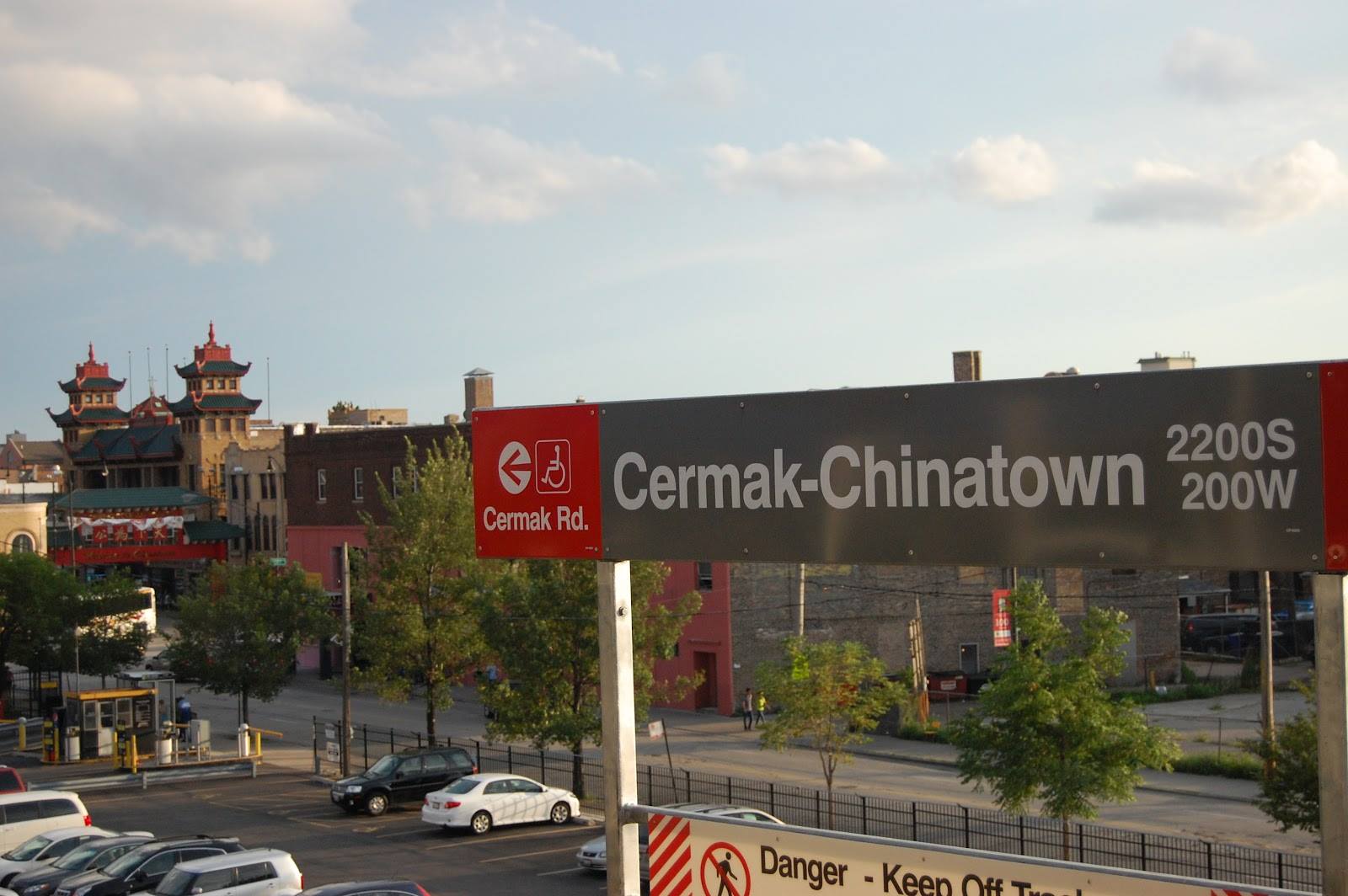
The Chinatown Gate was built in 1975 at the intersection of Wentworth Avenue and Cermak Road. It is the entrance to Chinatown's oldest and most compact section. The colorful gate is known for the ornamental street lamps and Chinese dragon carvings on the sidewalks. A Chinese inscription on the gate declares, "The world is for all."


During the late 1980s, a group of Chinatown business leaders bought 32 acres of property north of Archer Avenue from the Santa Fe Railway and built Chinatown Square, a two-level mall consisting of restaurants, beauty salons and law offices flanked by 21 new townhouses. 


Additional residential construction, such as the Santa Fe Gardens, a 600-unit village of townhouses, condominiums and single-family homes still under construction on formerly industrial land to the north.


Compiled by Dr. Neil Gale, Ph.D.

The History of Grafton, Illinois, with Personal Photos of my day trip on October 18, 2013.

James Mason was born in Grafton, Massachusetts, in July 1783. He was engaged in trade in the West Indies and worked in New York City as a partner in the wholesale grocery business. He came west, settling in Edwardsville, Illinois, where he invested in real estate.

In August 1818, he married Sarah Von Phul, the sister of a prominent St. Louis businessman. James Mason was licensed to operate a ferry across the Mississippi River at Grafton in 1833. He and his friend, Dr. Silas Hamilton and leading St. Louis businessmen envisioned a town where Grafton is now. In 1833, Mason and his partners were incorporated as the "Grafton Manufacturing Company" to establish grist, woolen, and cotton mills and to do general manufacturing, trading and shipping. Mason and Hamilton died in 1834 before their plans became a reality.

On April 15, 1836, James Mason's Brother Paris, and James Mason's widow, Mrs. Sarah Mason, assumed responsibility for surveying, platting and selling lots and incorporating the town. Mrs. Mason named the settlement Grafton in honor of her husband's birthplace. Paris Mason took charge of the Mason enterprises in Grafton until 1840, James and Sarah Mason's daughter married William H. Allen, and he eventually took over and expanded Mason's interests. His activities included mercantile, produce, flour mills and banking. Allen participated in the Illinois Constitutional Convention in 1860 and served as 6th district State Senator in 1871.

According to the Jersey County Democrat, on February 1, 1867, Grafton's business community was comprised of 5 general stores, 2 blacksmith shops, 1 drugstore, 1 wagon shop, 1 butcher shop, 2 shoe shops, 1 harness maker, 1 tin shop, 2 flour/grist mills, 1 watchmaker and silversmith, 1 mill for sawing rock, 3 cooper shops, 2 physicians, but no Hotels.
GODFREY BUILDING - This Greek revival building was erected by Jacob Godfrey in the 1840s of local limestone as a general store. Godfrey was a tailor by trade. He also served as Constable for several terms. In 1858, Godfrey partnered with Henry Eastman to build another general store that served the community with at least 3 other general stores. The Godfrey building was mostly used as a general store but served as the town’s post office for some time.


MASONIC LODGE - The Grafton Stone and Transportation Company built this limestone building with locally quarried stone in 1869. All of the doors latches, hinges, door lintels, desk fixtures, wall sconces, lamp stands and the massive chandeliers were hammered by hand at a forge on the site. The upper story contained “Armory Hall,” a 30’ x 70’ hall used for public purposes. In 1885, the building was purchased by the Grafton Full Moon Masonic Lodge #341. Masonic activities have been held at the site since that time.


BANK - James M. Allen and his son-in-law Edmund A. Pinero established the first bank in Grafton in 1871. They served us as directors with Christopher P. Stafford and Ernst Meysenburg. The bank operated as a private concern until 1873. The door to the vault of their bank can be viewed at the Visitors Center. This building was constructed in 1913 as a bank after the original building that housed a drug store burned. The building constructed by Mr. Meysenburg was considered “fire and burglar proof and modern in every respect.” The building served as Grafton’s Post Office until the mid-1960s.


RUEBEL HOTEL - Michael Ruebel was born in Bavaria in 1834 and came to Grafton in 1863 after serving four months in the army during the Civil War. He worked three years at the cooper’s trade, and then moved to saloon keeping and eventually added the hotel business. In 1884, Ruebel began construction on a three-story brick building with a stone foundation that became the Ruebel Hotel.

It was estimated to cost $7,000 and was the largest hotel in Jersey County. The hotel had 32 rooms and also included a parlor, office, billiard room, store and dining room as well as a large kitchen. The Ruebel family remained in the hotel business for many years. An 1895 advertisement offered a Fourth of July stay for $1.00 to $1.50 in a hotel with all the “Latest Modern Improvements.”

The hotel was destroyed by fire in 1912 and the present structure was built to replace it. The burled walnut bar in the hotel was originally part of the Bavarian Exhibit at the 1904 World’s Fair in St. Louis and was transported to Grafton by steamboat. The bar was saved when numerous patrons and citizens carried it out of the building during floods. The Hotel has changed hands several times. For many years Charles Amburg, descendent of Michael Ruebel operated it.


COUNTRY CORNER


LA MARSH HOUSE OF BEDS AND BLUES
Compiled by Dr. Neil Gale, Ph.D.

The South Side Rapid Transit 'L' Railroad (CTA Green Line), extended for the 1893 World's Fair.


Chicago would start its first elevated 'L' train line in 1888. 


The first 'L' line ran to the south side, known as the "Alley L" because its elevated tracks were squeezed above the alley between State Street and Wabash Avenue downtown, pulled by steam locomotives.


It was extended to reach Jackson Park when Chicago was chosen to host the World's Fair in 1890. 

Jackson Park was a terminal on the Jackson Park Branch of the Chicago 'L.' The station opened on May 12, 1893, and closed on October 31, 1893, with the conclusion of the World's Columbian Exposition.
The 'L' station in Jackson Park, inside the 1893 Columbian Exposition fairgrounds. Architecturally, the station was a simple shed covering the concourse between the stairs and the platforms. The 'L' platforms are behind the shed on the left, while the fair's Intermural Railway and its connection are on the right.


The line was electrified on July 27, 1898.

Only one train station from that 'L' line remains at Garfield Boulevard near the University of Chicago.

Compiled by Dr. Neil Gale, Ph.D. 

Saturday, March 25, 2023

Gipps Brewing Company, Peoria, Illinois. (1881-1954)

Peoria has long since attained a leadership position in brewing and distilling interests, and its output along those lines exceeds any other city of equal size in the country. At the head of its enterprise are men of marked business ability, keen discernment and unfaltering energy — men who recognize the possibilities of trade and utilize each opportunity for its full worth. 


George H. Gipps is a representative of this class, and his position in the business circles of the city is that of general agent for the Terre Haute Brewing Company. He has been identified with the brewing trade since he completed his education. He was born near Morton, Tazewell county, Illinois, on August 3, 1863, on the farm belonging to his father, John Mathuen Gipps. John came from England to the New World in 1845 and traveled to the country's interior, settling upon a tract of land near Morton, Illinois. He successfully engaged in farming there for several years, watching his expenditures carefully. When he had sufficient capital, he embarked on the brewing business in Peoria, engaging in that line of trade in about 1864.
Toth Buffet Serves Gripps Beer.


George was associated with Mr. Howe in the establishment and management of a little ale brewery, which was afterward moved to the foot of Bridge street, where the large plant of the Gipps Brewing Company stood. Gradually he developed a business of extensive proportions. As his trade increased, he enlarged his facilities and, in time, drew his patronage from a vast territory. He was president of the Gipps Brewing Company at the time of his death, November 27, 1881, at sixty-three. His wife, Ellen Dawson, was also a native of England, and they were married in New York City in 1852. They had two children, the elder being Mrs. Bessie Smith, the wife of C.B. Smith of Peoria. The mother passed away in this city in 1898.


George H. Gipps was but six years of age when the family left the farm and took up residency in Peoria so that his education was acquired in the schools of this city, which he attended until he left high school to become an active factor in business life. 

George was offered the opportunity to enter the establishment of the Gipps Brewing Company, and he did so, thoroughly acquainting himself with every part of the trade. He remained there until 1885 when he became associated with the Union Brewing Company, of which he was secretary for 15 years. He then withdrew from that connection to accept the agency and position of manager with the Terre Haute Brewing Company in 1900. He has been connected with this corporation as its general agent, having supervised extending its trade relations. The position is an enormous responsibility and involves the most critical considerations and duties, for which Mr. Gipps's long experience has prepared him well.
In 1888 was celebrated the marriage of Mr. Gipps and Miss Jennie V. Tripp, a daughter of R.H. Tripp. They had two children, Charles M. and Della T. 


Mr. Gipps has advanced to a high position as a Mason. He had served as high priest of Peoria Chapter for three years, as a Knight Templar Mason and was a member of the Mystic Shrine. He also belonged to the Benevolent Protective Order of Elks. He had various other social relations, including a member of the South Side Turners, the Concordia Singing Society and the Creve Coeur Club. His social qualities have made him famous, while his business ability has gained prominence.
The Garden Theatre opened in 1913 at 2139 SW Adams St., Peoria, and closed in 1942.


From 1837 until the 1980s, Peoria played a significant role in beer production.

Compiled by Dr. Neil Gale, Ph.D.