
Saturday, January 28, 2023

Lost Communities of Chicago - Aldine Square Neighborhood, 1874-1938.

Aldine Square was built on untouched prairie land on the South Side of Chicago.

Since the onset of the 20th century, Aldine Square has been one of the city's most fashionable neighborhoods for a few decades. Its big brick and limestone townhomes surrounded a wooded park with a lake and footbridge.

Built in 1874 between 37th Place and 38th Street, bounded by Vincennes Avenue (entrance) to the east and Eden Avenue (entrance) - no longer exists) to the west. 
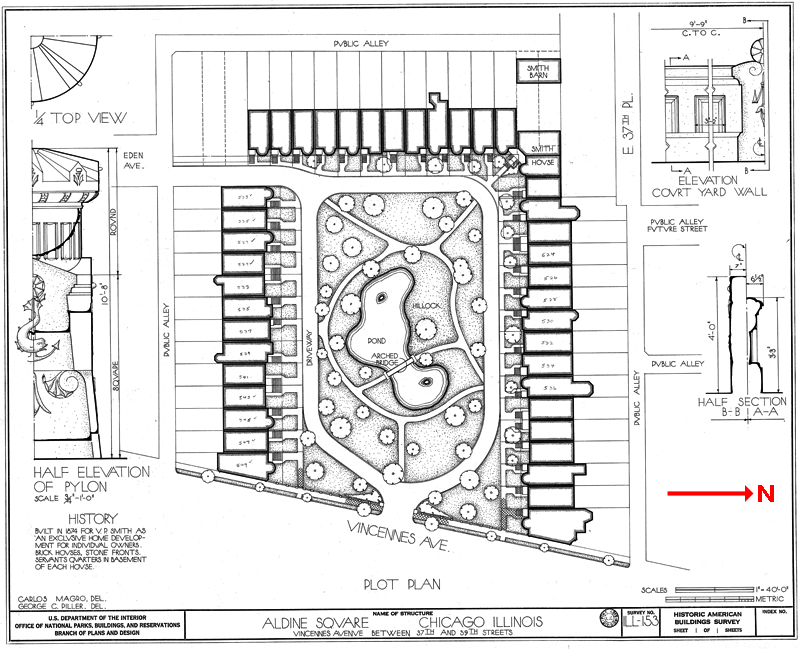
Plot Plan of Aldine Square, Chicago.


Aldine Square Postcard.


Aldine Square was where judges, attorneys, and folk in society lived. In 1877, the Chicago Tribune called it "the most charming of all the beautiful places of residence in the city." It consisted of 42 houses built of brick and limestone that surrounded a park with a pond and was initially paved with Belgian Woodblock. Homes in the neighborhood carried an "Aldine Square" address.
Looking westward shows the Aldine Square main entrance on Vincennes, marked by two enormous stone pylons. Ragtime giant Jelly Roll Morton lived at 545 Aldine in 1918.


Towards the end-of-life of Aldine Square, near the Eden Street entrance, was a dumping ground over which a sign read, "No Dumping Here."

But by 1938, Aldine Square was gone, razed to build the now-demolished Ida B. Wells public housing project, and is all but forgotten. Fortunately, just before Aldine Square was demolished, the federal government sent photographers Joseph Hill and Robert Tufts to document the site. Their photographs, taken between 1934 and 1936, are among the few visual records of this spectacular Place that looked impressive even in its final days.
The original wood and iron footbridge.
So, what happened to Aldine Square? When black migrants from the South began settling in the Chicago area beginning in the 1920s, the white residents of Aldine Square and the surrounding neighborhoods moved away. 

The onset of the Great Depression in 1929 further exacerbated economic conditions, and the area quickly became slum housing.
Here you can tell the still-stately homes have seen better days. The simple wooden footbridge in the foreground replaced the more elaborate iron and wood original one.


The Chicago Tribune documented this in a 1929 story about a neighborhood reunion held by Aldine Square's original families. The article said the gathering was held at a downtown hotel by residents who "moved away from the path of the advancing Negro district."

That Negro district had some of the most substandard housing in the city, and the big, new, modern Ida B. Wells public housing project was supposed to fix those ills. Aldine Square, which occupied a small portion of the future public housing site, was in the path of progress.

Ironically, the Ida B. Wells homes have been demolished and replaced by upscale housing in the newly gentrified neighborhood.

Compiled by Dr. Neil Gale, Ph.D.

Friday, January 27, 2023

Lincoln College and the City of Lincoln, Illinois

THE CITY OF LINCOLN, ILLINOIS
In 1852 Logan County was a popular place for settlers. Logan County was so popular because of the easy access to the waterways (Kickapoo, Salt, and Sugar creeks) and the abundance of wildlife. 

The City of Lincoln was founded in February of 1853 by three men: Virgil Hickcox, a railroad director; John D. Gillett, a cattle rancher known as "Cattle King of the World" in future years; and Robert B. Latham, the Sheriff of Logan County.

However, what made Lincoln so desirable was the future railroad. When the government wanted to connect Springfield to Bloomington, they encountered a small problem. Springfield and Bloomington were nearly 60 miles apart, and the steam trains of the day required a water stop point every 30 miles, along with the railroad that also required a passenger depot every 30 miles. This water point and passenger depot would be in Lincoln.

When realizing Lincoln would be the railroad stop, people quickly realized this would be a great opportunity. Seizing this opportunity became the goal of the three businessmen. These businessmen created a business venture called the Town Site Company. These three men were Virgil Hickcox, a railroad director. John D. Gillett, a cattle raiser known as "Cattle King of the World" in future years and a landowner in Cornland, and Robert B. Latham, the Sheriff of Logan County. The first step in creating Lincoln was obtaining the rights to the land. The venture needed to purchase the land that Isaac and Joseph B. Loose owned. Sheriff Latham traveled to Franklin County, Pennsylvania, where Isaac Loose lived to purchase the land. On February 3, 1853, Sheriff Latham purchased the land from Isaac and Joseph B. Loose for $1,350. To continue the development of Lincoln's new town, the Town Site Company realized that it needed some legal assistance. So Virgil Hickcox called on his friend and neighbor to help with the legal matters. The attorney's name was Abraham Lincoln. Then a week and a half later, after purchasing the land, the proposed town of Lincoln became the new county seat after a bill was passed to move the county seat from Mt. Pulaski to the City of Lincoln.

The next step in the process was to design the City of Lincoln. The County Surveyor, Conway Pence, created the City of Lincoln around the railroad. All the streets ran parallel and perpendicular to the railroad. In addition, he designed four blocks that were for the county. In these four blocks were two parks, one court house and one jail. Now that the city was planned, it was time to bring in the people. On August 24, 1853, the men of the Town Site Company met with Abraham Lincoln at his law office. Sheriff Latham was appointed the representative, and it was announced that the new town would be named Lincoln. There is controversy over who had the original idea to name the town Lincoln. Sheriff Latham claims that he had the idea. However, John Gillett's daughter insists it was her mother's idea. Unfortunately, no one knows who named the town Lincoln, but Lincoln will always be the first town named after Abraham Lincoln before he became president.


On August 27, 1853, lots for the town went up for sale. On that day, over ninety lots were sold, with prices ranging from forty to one hundred and fifty dollars. The Town Site Company's proceeds were over six thousand dollars. The same day after the sale, Abraham Lincoln christened the town using watermelon juice from a nearby wagonload of melons. There is a watermelon statue near the railroad depot commemorating where Abraham Lincoln christened the town. You will find it near the corner of Broadway and Sangamon streets.


LINCOLN COLLEGE IN LINCOLN, ILLINOIS


Lincoln College was established in 1865 to fill the need for an institution of higher learning in central Illinois. Commissioners investigated several sites and, in December 1864, selected Lincoln, Illinois. On February 6, 1865, the Illinois General Assembly secured a charter for the new university. The ground was broken for University Hall, the first college building, just six days after Abraham Lincoln's birthday. 


By September 1866, the foundation had been completed, and the cornerstone was laid. In November 1866, instruction for men and women began. The first commencement in 1868 honored three graduates. Thus Lincoln College took its place among the pioneer educational institutions of Midwest America.

On March 30, 2022, after 156 years of history, the school's president, David Gerlach, announced Lincoln College's permanent closure.

Compiled by Dr. Neil Gale, Ph.D.

Thursday, January 26, 2023

Tiny Towns in Illinois: The Village of Metcalf, Illinois

Metcalf is a village in Young America Township, Edgar County, Illinois, United States. Metcalf, with a population of 239 in the 2020 census.

Metcalf was founded as a railroad town in its early history as the Baltimore & Ohio and the Norfolk & Western Railroads intersect.


Schooling was made available for the children of Metcalf in the late 1800s. The only remnant of the grade school building was the cornerstone. 

Construction of the Metcalf High School building began in 1921 and opened in 1922. The last graduating class of High School was the class of 1949 due to the consolidation with Hume, Illinois. In the fall of 1949, the school changed its name to Young America High School. 


The Class of 1968 was the last class to graduate from Young America High School. Yet another consolidation took place, and a new K-12 facility was built near Hume, joining the towns of Metcalf, Hume, Brocton, and Redmon. 

In 1969 the Metcalf building was purchased and used as a Shelter Care until 1979. Then, in April of 1980, the building was destroyed by fire. 

The sundial had been on the high school's lawn since 1922 and was purchased by the Class of 1932, who moved it to Metcalf Park. The cornerstones from the Metcalf Grade School and the old Metcalf High School were also placed in Metcalf Park.

Compiled by Dr. Neil Gale, Ph.D.

Thursday, January 19, 2023

Jockey Men's briefs were first sold in Chicago's Marshall Field & Co. in 1935.

In 1876, Samuel Thrall Cooper founded S.T. Cooper & Sons, the predecessor of Jockey International, Inc. Samuel Cooper started his hosiery business in St. Joseph, Michigan, to help lumberjacks who were suffering from their poor quality socks . . . laying Jockey's foundation for "Satisfying the Human Need for Comfort."

By 1878, S.T. Cooper & Sons produced nearly 2,500 pairs of seamless stockings daily. Over the next 25 years, Cooper's sons (Charles, Henry and Willis) became skilled in the business. In 1897, they introduced the Black Cat brand of hosiery for men, women & children. In 1898, the brothers moved the company and eventually moved the company into an ambitious new direction . . . Men's Underwear.

In 1900, the brothers incorporated the Cooper Underwear Company and began producing White Cat underwear. The new Cooper Underwear Company mill, which manufactured White Cat union suits, was completed in 1902. This location still serves as the longtime headquarters of Jockey International, Inc.

In 1912, the patented Cooper union suit, branded as the Kenosha Klosed Krotch, rose to the top of the underwear market and was sold faster than it could be produced.

Cooper hired Joseph C. Leyendecker, illustrator for The Saturday Evening Post, to create the "Man on the Bag" image . . . a staple of the company's brand identity and a classic American advertising image.
The Saturday Evening Post created the "Man on the Bag" ad image.


Cooper Underwear hired Arthur Kneibler in 1928 to head its sales and marketing team.

In 1929, the Cooper Underwear Company officially changed its name to Cooper's, Inc. That year, Coopers' developed the Singleton, a new-style union suit with short legs and a sleeveless top, packaged them in cellophane bags, a first in the underwear trade and a huge selling point in modern self-service apparel stores.

In 1934, Arthur Kneibler received a postcard from the French Riviera showing a man in a bikini-style swimsuit. This simple postcard inspired the creation of the one and only Jockey brief.

He saw this garment as a potential prototype for a new kind of men's support underwear. In September 1934, Cooper's produced an experimental prototype, men's brief style #1001. In response to its introduction, competitors labeled the new underwear style as a fad. 

On January 19, 1935, Marshall Field and Company, the premier Chicago department store, unveiled a window display featuring the new brief. That day, Chicago was experiencing a severe blizzard, and the skimpy men's underwear in the window contrasted with the wintery conditions outside. 


Under these circumstances, Marshall Field &Co. managers were ordered to take the briefs out of the window display. When the workers assigned to carry out the order were delayed, the new underwear style stayed on display, prompting an unexpected demand surge for the product. More than 600 briefs were sold before noon at 50¢ apiece.

Over the following three months, Marshall Field & Co. sold 30,000 briefs, and Jockey briefs began "Changing the Underwear Habits for Men Nationwide." 

The Jockey Y-Front brief was invented later that year and became Cooper's most sought-after item. The success of the Y-Front brief was followed by the design of the Jockey Midway Brief.

Cooper's signed its first international license agreement with the Canadian J.R. Moodie company in 1936. That same year, European export agents began placing orders for Cooper's products. During the remaining century, licensee agreements were signed in Australia, Europe, South America, Asia and Africa.

At a retail convention in Chicago in 1938, Cooper's hosted one of the first Underwear Fashion Shows featuring "The Cellophane Wedding."

A Cooper's salesman in 1939 invented a ground-breaking countertop display and dispenser to organize sizes and styles of underwear.

1946 ushered in one of the company's most important merchandising tools...endorsements from star athletes… one of the first being home run king Babe Ruth. In 1947, the Jockey® brand name was stitched into the waistband of the underwear for the first time.

Cooper's advertised in the first issue of Sports Illustrated magazine in 1954.

The Jockey Low Rise brief was born in 1961 and became hugely successful in Europe. Cooper introduced the Jockey Life Low Rise briefs to the United States in 1965.

In 1971, Coopers, Inc. changed its name to Jockey Menswear, Inc., and then changed its name to Jockey International, Inc. in 1972.

Jockey launched the first generation of its Web site in 1997. Jockey increased its retail capabilities in 1999 with the launch of Jockey.com.

Today Jockey International, Inc. is active in more than 120 countries, marketing underwear, socks, thermals, sleepwear, activewear, sportswear, and loungewear, in men's, women's and children's ranges.

Compiled by Dr. Neil Gale, Ph.D.

Friday, January 13, 2023

The World's Largest Catsup Bottle, Brooks Old Original Tangy Catsup, Collinsville, IL.

The World's Largest Catsup Bottle stands proudly on IL Route 159, just south of downtown Collinsville, Illinois. You just can't miss it. 

This unique 170-foot water tower was built in 1949 by the W.E. Caldwell Company for the G.S. Suppiger catsup bottling plant. Today's painted label is "Brooks Rich & Tangy Catsup."

sidebar
The Brooks brand name was retained by each new owner. Brooks product line earned a  surpeior reputation for quality and consistancy over many years.

It all started in 1891. A group of Collinsville businessmen raised $5,000 ($148,000 in 2023) and created the "Collinsville Canning and Packing Company." The struggling little plant went through a few different owner-operators until 1907, when the Brooks brothers, Everett and Elgin, purchased the business. They operated under the name of "Triumph Catsup and Pickle Company." Soon the name became "Brooks Tomato Products Company." 

By 1919 Brooks Tomato Products Company with its office in the Kneedler Building on Main Street in downtown Collinsville. Everett W. Brooks was the President.

In 1920, the brothers sold to the "American Cone and Pretzel Company" of Philadelphia. 

The G.S. Suppiger Company purchased the Collinsville processing plant. This move expanded the operations 3-fold. Suppiger also gained copyright ownership of the popular Brooks brand names and logos in June 1933.

Twelve-foot-high Brooks Catsup
Bottle adorned with neon slowly
rotates on a pole. c.1949
The catsup factory had great success, surviving the Great Depression and growing by leaps and bounds through the 1940s. The plant produced much more than catsup, including chili beans, spaghetti, hominy, soups, and other sauces. 

It was renamed the "Brooks Tabasco Flavor Catsup" and became extremely popular. So much so that the McIlhenny Tabasco Company threatened a lawsuit claiming the term "tabasco" was their copyrighted property. Not wanting to fight a costly legal battle, the Suppigers changed the name to "Brooks Old Original Tangy Catsup."

The company promoted its product well. In Belleville, Illinois and St. Louis, Missouri, Jumbo 12-foot high Brooks catsup bottles, adorned with neon, slowly rotated while perched on a sign pole. Brooks advertised in Sportsman's Park, home of the St. Louis Cardinals and the St. Louis Browns baseball teams. 
 
At one time, it was America's № 1 seller among tangy catsups and the best seller in Metro (includes the Belleville, Illinois area) St. Louis, Missouri. Brooks outsold all other brands combined, 2 to 1.

The G.S. Suppiger Company purchases the Collinsville processing plant. This move expands the operations 3-fold. Suppiger gained ownership of the popular Brooks brand names in June 1933.

In 1947, W.E. Caldwell Company of Louisville, Kentucky, was contracted to build a 100,000-gallon water tower. Final drawings were approved in 1948, and the World's Largest [Watertower] Catsup Bottle was completed in October 1949. 

A water tower was needed for plant operations and to supply water to the new fire protection sprinkler system. Gerhart S. Suppiger, then president of the company, suggested the tower be built in the distinctive tapered shape of their catsup bottles. Everybody was amused by the idea.

A 100,000-gallon water tower, 70 ft─1in high, made of a riveted steel tank. The tank shall sit atop 100-foot legs at the south edge of Collinsville, Illinois.

In 1959, Brooks Foods merged with P.J. Ritter Company, and the Suppigers sold their share of the company in 1960. Catsup bottling operations were moved to Summit, Indiana, in 1963, and the old factory was used as a warehouse. 

Old-timers mourned for the sweet smell of catsup that no longer wafted through town. 

Brooks Foods, Inc. became a division of Curtice-Burns, Inc. of Rochester, New York, in February 1967.
The Oscar Mayer Wienermobile makes its first visit to the Brooks Catsup Bottle on June 18, 1987.


In 1993, Curtice-Burns, Inc., the then-parent company of Brooks Foods, decided to sell the property. The water tower's future was in jeopardy, and the Catsup Bottle Preservation Group was formed.  


Brooks was willing to deed the tower to the city of Collinsville, Illinois, but the city declined the offer citing the cost of repairing and repainting the structure was far too much for the city's budget. The Preservation Group started a nationwide "Paint It!" campaign and began to raise the needed funds. 

In 1995, due to the efforts of the Catsup Bottle Preservation Group, this landmark roadside attraction was saved from demolition and beautifully restored to its original appearance.

sidebar
The water tower catsup bottle was inducted into the National Register of Historic Places in August 2002. The landmark had already been world-renowned for some time.

Recognized worldwide as an excellent example of 20th-century roadside Americana, the World's Largest Catsup Bottle regularly garners international attention and attracts visitors and tourists daily. 

Compiled by Dr. Neil Gale, Ph.D.