Upon President Lincoln's death, his son Robert Lincoln sent a telegraph to David Davis, Justice of the United States Supreme Court and a close friend of the president's. The message was simple, Robert requested Justice Davis to take charge of his father's affairs.
ROBERT TODD LINCOLN
Wasting no time, Davis went to Washington to be there for the family. Together, Robert and his mother, Mary, issued a letter to the Judge of the Sangamon County Court in Illinois. Their request was to have the Judge appoint Davis as the administrator of Lincoln's estate.
In his opening court briefing, Davis estimated the president's estate to be worth $85,000. The money would be split between Mary and the two boys, Robert and Thomas. What would wind up happening is a two-year legal process.
The court case was finally closed in November of 1867, the sum of $110,974.62 ($200,000 today) shall be divided among the three surviving family members at $36,991.54 each. David Davis did not charge the estate any fees, charges, or attorney costs. Months later, Mary and Robert separately sent letters to Davis thanking him for how he handled Abraham's affairs and for his generosity.
What's ironic was that President Lincoln, being a lawyer, and having all his ailments, didn't have a will. The family would have avoided two years of Probate.
Phonevision was a project by Zenith Radio Company to create the world's first pay television system. It was developed and first launched in Chicago.
E.F. McDonald's vision wasn't that far from what some early pioneers intended for radio. Though he continued to call himself "the father of the radio," Dr. Lee de Forest (inventor of the "audion" vacuum tube and the "discoverer" of regeneration if the courts are to be believed) turned his back on the broadcast frenzy. He was appalled by the crass commercialism already in place by the 1930s. De Forest thought that the public should be allowed to sit down and enjoy a concert, a history lesson, or just simply the news of the day without being huckstered by a fast-talking shaving cream salesman.
But it was not to be. It all boiled down to economics and time. Radio needed commercial sponsorship if it was to survive and grow. As the industry was abandoning the mechanical era and embracing the new electronic era of television research, design and manufacture, it became abundantly clear that if television was to survive and surpass radio as the popular medium, it needed the cash flow that only commercial television sponsorship could provide. McDonald, chairman and owner of independent radio manufacturer Zenith Radio Corporation in Chicago, firmly believed De Forest's thinking. Zenith had experimented with "subscription television" as early as 1931.
Phonevision Program Guide cover.
By 1947 they had a working system and, in 1951, coined and trademarked the name "Phonevision" to identify their efforts. After receiving FCC approval, a 90-day test run was conducted utilizing 300 families from the Lakeview-Lincoln Park Chicago area. This area was chosen due to the limited broadcast range of the station.
Chicago Broadcast TV Networks 1950-1954.
KS2XBS was located at the Field Building downtown, and its Phonevision central distribution center was at 3477 North Clark Street. The lucky 300, equipped with a set-top converter (the first in a long line of boxes to sit atop the TV) and a dedicated telephone line, enjoyed first-run movies that were supplied under a special deal with Zenith and some of the major film studios. A typical broadcast day for Phonevision subscribers might include The Enchanted Cottage, a Robert Young film from 1945 (very recent compared to the movies available on television at the time). The film would be shown three days in a row, scheduled at different times each day. The station would receive the movie two days in advance and store them in a special film vault. Jerry Daly, along with his projectionist staff of Jim Starbuck and Roland Long, was responsible for the safety of the film. Television, in the beginning, was considered Hollywood's mortal enemy. But McDonald and Zenith were determined to prove that the two could work side by side. For the not-so-low price of $1 ($3.25 in 1951), folks could see a major motion picture in their living rooms without commercial interruption.
The experiment was attracting citywide attention. People tried to build or buy pirate boxes to circumvent the system and avoid payment. In the first month of the test, only the video was scrambled. The audio was as clear as a whistle; many sat through the scrambled picture and just listened. The second month, however, changed all that when Zenith began to scramble the sound, making all those pirate boxes obsolete.
The people who paid for their Phonevision service were required to do the following to watch their movies. Call the Phonevision operator and ask to be "plugged in." Daisy Davis and Dean Barnell supervised the operators day and night. The subscriber would turn to channel 3 on the television and turn on his Phonevision converter, which would be patched into the antenna terminals on the set and a phone line. According to The Zenith Story, an in-house 1954 publication, those families averaged about 1.73 movies weekly. Not quite enough to qualify as a commercial success. The results were disappointing as McDonald had hoped to transform KS2XBS into commercial licensed WTZR.
The experiment was plagued by technical problems right from the beginning. Passing planes and trucks was known to wreak havoc on the signal making the experience less than enjoyable. This was, of course, provided you even received the scrambled signal. But Zenith refused to give up and, in 1953, was ready to try again.
But by this time, commercial television was firmly in place, and the advertisers (who told the networks when to jump) generally frowned upon the "alternative" to commercially sponsored television. Educational television, though noncommercial, was not considered a threat. By 1953, all of the experimental licenses in Chicago had been replaced by commercial ones. Zenith, so involved with its Phonevision system, apparently didn't see or chose to ignore the situation, and KS2XBS found itself in a difficult situation.
1953 was the year that brought together The American Broadcasting Company and United Paramount Theaters. Because licensees could only own one television station in the same market- a problem quickly arose. UPT, through its Balaban & Katz subsidiary, owned WBKB Channel 4. ABC-TV owned and operated WENR-TV on channel 7. CBS, itself lagging behind for a completely different reason- its Peter Goldmark-designed field sequential color television system, did not own a station in the Chicago market. Its shows were carried mainly by WBKB. CBS quickly coughed up $6 million for the station in a sweetheart deal arranged by CBS head Bill Paley and ABC head Edward Noble.
sidebar
Subscription broadcast television used a method referred to as "narrowcasting." Employing this method, a station would transmit a scrambled picture and a code encoded in a single sideband of the audio signal. A set-top decoder would read the code and descramble the picture. Different "levels" of service (in reality, differing codes) would allow the subscriber access to the service's regular programming, special events, and late-night adult programming.
But the sale was not without its conditions. For several years, Milwaukee's WTMJ-TV and KCZO, a Kalamazoo station, had been broadcasting on channel 3, and this caused interference problems for both stations. The FCC ordered WTMJ-TV to move to channel 4 and WBBM-TV to channel 2.
McDonald cried foul and petitioned the FCC to allow Zenith to continue its experiments on channel 2 since "they had occupied the channel since 1939" when W9XZV, Zenith's original station on channel 1, first went on air on March 30, 1939. A shuffling of VHF allocations found the station at the number two position. But there are no squatters' rights in broadcasting. Whether it was because of the deep pockets at CBS or just the FCC's disappointment with Zenith's less-than-desirable results of its Phonevision experiments, the commission stood firm. It was the second time Zenith's channel position was challenged. Before the war, NBC had threatened to petition the FCC for the W9XZV channel 1 license. On July 5, 1953, WBBM-TV moved to its current home on channel 2, and Zenith signed off for good.
The 50-second show's opening will test your memory and prove your age.
This wasn't the end of Phonevision, however. Zenith conducted another experiment with an improved system that would have been tried on KS2XBS. In 1954, Zenith used New York station WOR-TV, and this experiment was considered a success over the Chicago version. In the same year, Zenith also tried its Phonevision system in New Zealand and Australia. By the early seventies, Zenith was still trying to make its Phonevision a successful commercially viable venture, this time in Hartford, Connecticut, and again as late as 1986 using the Centel Cable system in Traverse City, Michigan. None were successful enough.
The idea of a pay television system in Chicago lingered in obscurity until the early eighties when the changing face of broadcast television inspired one major network to re-examine an old idea.
It was not until 1983 that Chicago saw another pay television experiment. This time ABC would use its WLS-TV to try a strategy to increase competition between cable television and home video.
In Chicago, viewers were offered three choices in subscription television: a service called Sportsvision, which had been formed by a partnership between White Sox owners Jerry Reinsdorf and Eddie Einhorn and media mogul Fred Eychaner, who, through a series of intricate deals, brought WPWR channel 60 to the Chicago airwaves and split the license with Marcello Miyares who ran WBBS; ON-TV, a service of Oak Communications Inc., which purchased forty-nine percent of struggling UHF outlet WSNS channel 44 to air its content on that station as well as others in large metropolitan areas across the country; and Spectrum, a division of United Cable, that purchased airtime from WFBN channel 66, which was actually licensed to Joliet.
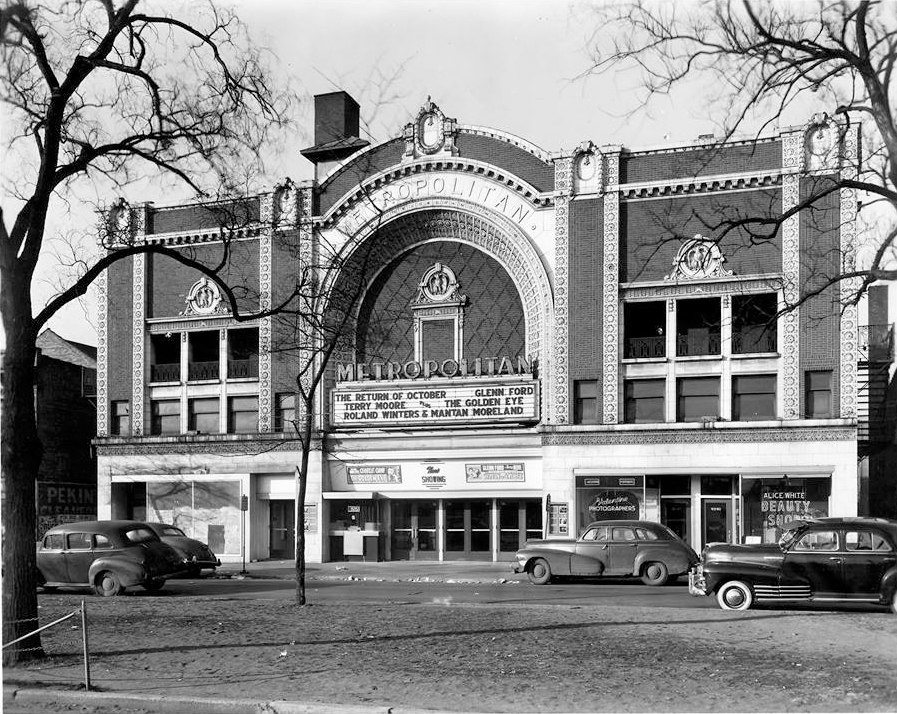
When the Metropolitan Theatre opened in 1917 for the Ascher Brothers circuit on South Parkway (today South Martin Luther King, Jr. Drive) and East 46th Place, the South Side neighborhood was mainly middle-class Irish and German Jews. After WWI, as Negroes poured in from the South, the area changed to a predominantly Negro community.
The Metropolitan Theatre could seat almost 1,400 in elegant surroundings and be equipped with a state-of-the-art projection system and air-conditioning, still a rarity in movie theatres, especially ones outside the downtown Loop. It was designed by Henry L. Newhouse.
Until the Metropolitan Theatre opened, its nearest competition was the far-smaller Revelry Theatre around the block on 47th Street, which went out of business just a few years later. Ascher Brothers staffed the Metropolitan Theatre with an all-white staff. In its early years, there was constant tension between Negro patrons and the Theatre’s employees. According to the Theatre management, trouble was not tolerated.
However, in 1923, a Negro customer filed a complaint of discrimination with the National Association for the Advancement of Colored People (NAACP) against the Ascher Brothers. They pledged to work with the NAACP to avoid any future incidents of discrimination.
When Carl Lewis, a Negro man, was hired as the Metropolitan’s assistant manager in 1926, it marked the first time in Chicago that an Negro rose to managerial ranks at a Theatre.
Around this time, Ascher Brothers hired Sammy Stewart, who was the biggest name in jazz in early to mid-1920s Chicago, to perform at the Metropolitan Theatre. Stewart began to draw crowds of Negroes by the thousands to the Theatre, and it was soon the most successful in the circuit.
Not only was Sammy Stewart a huge draw, but other major names in jazz of the era, like Fats Waller and Erskine Tate, also played at the Metropolitan Theatre.
By the late-1920s, it was the most popular motion picture Theatre in Chicago for Negroes.
However, by the early-1930s, with the Great Depression ongoing and the opening of the palatial Regal Theatre and Savoy Ballroom just up South Parkway, the audience at the Metropolitan Theatre began to decline rapidly.
Also, the Theatre management was growing less and less to pay for the soaring costs of A-list performers and first-run features, which the Regal Theatre and Savoy Theatre’s owners were more than happy to do. It was taken over by Warner Brother Circuit Management Inc in 1931.
Still, the Metropolitan Theatre survived, in fact, longer than its rival, the Regal Theatre. Known in its later years as the Met Theatre, it screened second-run and later exploitation films before closing in 1979.
Despite the pleas of area preservationists, stung by the loss of landmarks like the Regal Theatre and the Savoy Theatre, who hoped to one day turn the former Theatre into a community center, the city ordered its demolition in 1997.
In historical writing and analysis, PRESENTISM introduces present-day ideas and perspectives into depictions or interpretations of the past. Presentism is a form of cultural bias that creates a distorted understanding of the subject matter. Reading modern notions of morality into the past is committing the error of presentism. Historical accounts are written by people and can be slanted, so I try my hardest to present fact-based and well-researched articles.
Facts don't require one's approval or acceptance.
I present [PG-13] articles without regard to race, color, political party, or religious beliefs, including Atheism, national origin, citizenship status, gender, LGBTQ+ status, disability, military status, or educational level. What I present are facts — NOT Alternative Facts— about the subject. You won't find articles or readers' comments that spread rumors, lies, hateful statements, and people instigating arguments or fights.
FOR HISTORICAL CLARITY
When I write about the INDIGENOUS PEOPLE, I follow this historical terminology:
The use of old commonly used terms, disrespectful today, i.e., REDMAN or REDMEN, SAVAGES, and HALF-BREED are explained in this article.
Writing about AFRICAN-AMERICAN history, I follow these race terms:
"NEGRO"was the term used until the mid-1960s.
"BLACK"started being used in the mid-1960s.
"AFRICAN-AMERICAN" [Afro-American] began usage in the late 1980s.
— PLEASE PRACTICE HISTORICISM —
THE INTERPRETATION OF THE PAST IN ITS OWN CONTEXT.
Initially, there was nothing remarkable about a Memorial Day gathering of striking steelworkers at Sam's Place, a Southeast Side tavern, 85 years ago. A day without picket lines and walkouts would have been something to discuss during the Great Depression. The demonstrators had no idea they were walking into history when they marched south from the houses, railroad yard and barge docks.
But at 118th Street and Burley Avenue, they confronted a phalanx of Chicago police drawn up in front of a Republic Steel plant, where cops and workers had previously clashed since the walkout began a few days earlier.
An AP photographer witnessed what happened next: "There was so much shouting I couldn't make out what was being said, but it looked like the police were trying to persuade the strikers to go home.
"Suddenly, I heard a shot which, I think, came from the strikers. The strikers immediately began throwing clubs — big ones, bricks and pieces of machinery.
Violence was endemic to labor disputes of the time. On this occasion, a film crew from Paramount News was on the scene, transforming this tragic encounter into the Depression Era's equivalent of earlier labor struggles in Chicago, like the Haymarket Riot and Pullman strike.
"Some police are shown swinging their clubs," noted a Tribune reporter after screening the footage.
"Billows of gas are being wafted over the heads of the rioters. The motion picture is accompanied by sound effects, in which words are indistinguishable. Gunshots can be heard momentarily, perhaps a second or two. No shooting can be seen, and it is impossible to determine where the shots came from."
What happened in that film and what to call it remained in dispute. Was it a Memorial Day Massacre, as trade unionists saw it? Or, a Republic Steel Riot, as the company and city officials dubbed it? Police and protesters, of course, recalled the incident differently.
Eighty-five thousand steelworkers in five states walked out on Wednesday, May 26, 1937, idling 37 plants. Five Chicago-area mills shut down, with 22,000 workers walking out. Four days later came the deadly clash at Republic Steel.
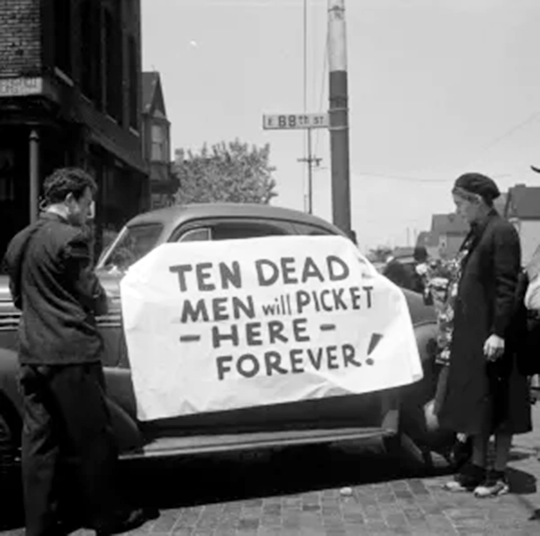
On Sunday, May 30, 1937, striking Republic workers and their allies attempted to set up a picket line in the [public] prairie land in front of the mill. Chicago police, who were already on the scene, responded with guns and clubs, injuring roughly 100 hundred people and killing 10 men.
Sam R. Popovich, Earl J. Handley, Kenneth Reed, Hilding Anderson, Alfred Causey, Leo Francisco, Otis A. Jones, Joseph Rothmund, Anthony Taglieri, and Lee Tisdale were murdered by the Chicago Police to protect commerce over people.
A tumultuous time resulted in 10 dead, 60 injured, and 40 police injured.
Officers claimed they responded to violence with violence to protect the mill and the whole country from the Commies (communists). A congressional investigation showed the claims of worker violence to be false, and only a handful of those present that day held radical left-wing political beliefs.
Molly West, a young Polish immigrant, involved in union organizing, told the Tribune: "Once I got close to the mill, we heard shots. I was lucky because I was knocked down, and other people fell on top of me."
Patrolman Walter B. Oakes said: "Suddenly, there was a shower of bricks and clubs. The mob pushed forward, and I was struck across the back with a club and knocked to the ground."
Under a headline, "Murder in South Chicago," a Tribune editorial blamed the violence on "a murderous mob ... inflamed by the speeches of CIO organizers." The initials then stood for Committee for Industrial Organization, an upstart wing of the union movement led by John L. Lewis. The miners union head, Lewis, had decided to organize the less-skilled workers whom craft-union leaders traditionally disdained. A slap in the face of the union movement's establishment set off a fury of organizing.
Two governmental investigations came to opposite conclusions. A Cook County coroner's jury "absolved the police of blame, holding the killings were justifiable," the Tribune reported. A U.S. Senate committee, chaired by Sen. Robert La Follette of Wisconsin, a notable liberal, said the police used "excessive force."
Muddying the waters, even more, the cameraman who took the newsreel footage claimed it didn't tell the whole story. He said "he was changing lenses in his camera at the time of the strikers' attack and that his film shows an incomplete picture of what happened," according to the Tribune's coroner inquiry report.
In the lean years of the 1930s, workplace disputes weren't limited to the classic standoff of bosses versus workers, which further divided contemporaries' views of violence. Some workers saw their salvation in banding together, and others, thinking themselves lucky to have a job, wanted no part of the union movement.
When the Republic Steel workers walked out, about 1,000 remained on the job, the company feeding and housing them on-site. "We got a good place to eat, sleep, and play," one told a Trib reporter. "Think I'm gonna quit with four kids?"
Angered by the nonstrikers' obstinacy, union members and their supporters set out on that fateful march from Sam's Place. What did they aim to do? According to the police, the demonstration was designed to be violent. A police captain said he had heard a leader at the meeting that preceded the march say, "We'll get those cops, knock them over, take their guns away from them, and go right into the plant."
According to the Tribune, that was part of a larger conspiracy, "a plan to seize control of the country in the style and manner of the 1917 Russian October Revolution" (officially known as the Great October Socialist Revolution under the Soviet Union, aka The October Revolution, and the Bolshevik Revolution).
After Pastor William Waltmire of the Humboldt Park Community Methodist Church gave a eulogy to each of the slain strikers whose families chose the church for the funeral of their loved one, Pastor William told the story differently.
"The men lying here had a dream of brotherhood," said Pastor William, "They sought to begin a new world, a good world, in which all people could live free, follow their dreams, and be happy together."
A man and woman look at a sign on the driver's side of an automobile parked at the Republic Steel strike, Chicago, 1937.
On March 18, 1925, a dark “smokey fog” touched down approximately three miles northwest of Ellington, Missouri, and it would become known as the Tri-State Tornado. By all accounts, the Tri-State Tornado was one for the record books.
The Tri-State Tornado is the U.S. record holder for the longest tornado track (219 miles), most deaths in a single tornado (695), and most injuries in a single tornado (2027). While it occurred before modern record keeping, it is considered by all accounts to be an F5/EF5 Tornado. It crossed the three states, thus its namesake “Tri-State,” tearing through thirteen counties of Missouri, Illinois, and Indiana. It crossed over and destroyed or significantly damaged nine towns and numerous smaller villages.
The resulting map perhaps shows why this tornado was so deadly. First off was the speed of the tornado. The average speed across its life span was an astonishing 62 miles per hour, with forward speeds, at times, reaching 73 mph. Also worth noting is that the tornado followed a slight topographical ridge with a series of mining towns perfectly aligned on the path.
Crossing the Mississippi river, the tornado struck the town of Gorham, Il. Gorham was a town of about 500 people; of those 500, 37 were killed and 250 injured. One notable effect in Gorham was the grass being torn from the ground in a gully on the east of town. The next town was Murphysboro. Eugene Porter reported the tornado to be “about a mile wide.” The town of Murphysboro suffered heavy losses, with 234 casualties reported along with 623 injuries. About 100 square blocks of the town were destroyed along, with another 70 by a fire after the tornado.
Perhaps the most spectacular show of power came from the next town in line, DeSoto, Il. Trees were snapped off at knee height, and stumps were ripped from the ground. No structure was left standing in the tornado’s path. Of the 69 people killed in DeSoto, 33 were killed in a school.
A child and puppy atop the wreckage of a home in Murphysboro, Ill., after the tri-state tornado ripped through town March 18, 1925.
Next up, West Frankfort was a mining town, and most men worked in the mines. The miners went to the surface to see the problem when the electricity went out. The miners came to the surface of a destroyed landscape. Most of the 148 deaths and 400 injuries in West Frankfort were women and children, given the men were in the mine.
A man in Parrish, Illinois, survived the tornado by clinging to a railroad track while the town was destroyed. 46 people died, and at least 100 were injured here. Between Gorham and Parrish, 541 lives were taken.
The tornado continued northeast, and most farms and an occasional schoolhouse or general store were destroyed over the next hour.
The total time on the ground of the Tri-State tornado was 3 hours and 30 minutes. During that time, it traveled 219 miles and killed 695 people, most of them in Illinois.