Sunday, April 24, 2022

Melvin Price Locks and Dam & National Great Rivers Museum, Alton, Illinois.

The National Great Rivers Museum is located adjacent to the Melvin Price Locks and Dam on the Illinois side of the Mississippi River in Alton, Illinois.


MELVIN PRICE LOCKS AND DAM
Melvin Price Locks and Dam is a dam and two locks at river mile 200.78 on the Upper Mississippi River, about 17 miles north of Saint Louis, Missouri. The collocated National Great Rivers Museum, at 1 Lock and Dam Way in East Alton, Illinois, explains the structure and its engineering.


Melvin Price Locks and Dam replaced Lock and Dam 26, which opened in 1938, and was demolished in 1990. Almost from the beginning, Lock and Dam 26 was plagued with structural deficiencies. 
The Lock and Dam 26, 1938-1990


Scour holes developed below the dam. This was of particular concern because some of the holes were deeper than the wooden pilings supporting the dam. The scouring of the riverbed led to the disintegration of the concrete and a loss of foundation material, which eventually resulted in excessive deflections and settlement of the lock walls and dam piers.


The construction of the Melvin Price Locks and Dam constituted the first replacement of an original installation of the 9-Foot Channel Project. The new structure is located two miles downstream of the razed Lock and Dam 26, but the significance of the new installation is not limited to its colossal size. Throughout its design and construction, the Corps engaged in an extensive program of computer-assisted design, testing, and evaluation to create a structure that represents the state of the art in river navigation control works.

The Melvin Price Locks and Dam helps to control the flow of the Mississippi and is the means by which barges are able to navigate the river.


The main lock is 1,200 feet long and 110 feet wide; the auxiliary lock is 600 feet long and 110 feet wide. The main lock has a vertical lift gate and a miter gate while the auxiliary lock has two miter gates. The dam is 1,160 feet long with 9 tainter gates, each 110 feet wide by 42 feet high.

It is named after Illinois Congressman (Charles) Melvin Price (1905-1988) who served as:
  • Member of the St. Clair County, Illinois Board of Supervisors (1929–1931) at 24 years of age.
  • Member of the U.S. House of Representatives from Illinois's 22nd district (1945-1949).
  • Member of the U.S. House of Representatives from Illinois's 25th district (1949-1953).
  • — Chairman of the Ethics Committee (1967–76).
  • Member of the U.S. House of Representatives from Illinois's 24th district (1953-1973).
  • Member of the U.S. House of Representatives from Illinois's 23rd district (19731983).
  • — Chairman of the Joint Committee on Atomic Energy (1973–74).
  • — Chairman of the House Committee on Armed Services (1975-1985).
  • Member of the U.S. House of Representatives from Illinois's 21st district (1983-1988) totaling 59 years of service.
Congressman Price is probably most famous for his role in enacting the Price-Anderson Nuclear Industries Indemnity Act. He died in 1988 of pancreatic cancer. Price is the namesake of the Melvin Price Locks and Dam, in East Alton on the Upper Mississippi River, and the Melvin Price Federal Building and United States Courthouse in East St. Louis.

NATIONAL GREAT RIVERS MUSEUM
National Great Rivers Museum, Alton, Illinois. The large gift shop is in the background.


The National Great Rivers Museum, opened in October of 2003, is one of eleven planned regional visitor centers operated by the U. S. Army Corps of Engineers. Located adjacent to the Melvin Price Locks and Dam, this 12,000-square-foot facility is the result of a collaboration between the Corps and the nonprofit Meeting of the Great Rivers Foundation and tells the story of the Mississippi River. The Museum features state-of-the-art interactive displays and exhibits that help visitors understand the many aspects of the Mississippi River and how it affects our lives.

Compiled by Dr. Neil Gale, Ph.D.

Monroe City One-room Schoolhouse, Valmeyer, Illinois.


The one-room Monroe City Schoolhouse that stood for nearly 100 years in Monroe City, Illinois, was moved to a new location in the new Valmeyer, Illinois (on the bluffs). 

The Monroe City School was built in 1918 and closed in 1955.
Monroe City School Postcard.


Property owner Melvin Allscheid donated the 1,200-square-foot schoolhouse to the Valmeyer Community Heritage Society. They moved the structure 10 miles from KK Road just east of Bluff Road to a new concrete foundation on a village-owned property at 321 South Cedar Bluff Drive and Empson Drive, just across the street from the current Valmeyer school campus, in April of 2011.

Today the one-room schoolhouse is home to the Valmeyer Community Heritage Society.

Compiled by Dr. Neil Gale, Ph.D.

George Kreischer's General Store, Valmeyer, Illinois.

George Kreischer operated the store in partnership with Albert H. Pieper from 1924 until 1927 when Kreischer bought out Pieper's share of the store. 

Kreischer then operated the store for 42 years (1969). The store's motto was; "Kreischer's - A Good Place to Trade.


This was the type of general store, or "mercantile" as they were called at that time, where you would purchase your goods from large barrels and containers. In those days there was no self-service, a store employee, or the owner, would get you the items you wanted to buy and bring them to the counter.
Check out their telephone number.
Flour and sugar came in large cloth sacks, pickles came in barrels, full bunches of bananas would hang from the ceiling, and customers would pull off what they wanted. In the early years, many locals would barter. Perhaps they would bring fresh eggs from their chickens to trade for flour, sugar, or other items.


Ruth and Weldon Kohnz stand behind the counter at the R & W Market, just after purchasing it from George Kreischer. The Kohnz's operated the store from 1969 to 1970, then it was purchased by Clayton and Jeanette Schneider. 


For a time the Schneider's operated two markets - their original store - the "Lee Melliere" store they had purchased in 1966, and this store at the corner of Lake and Main in Valmeyer.

The village of Valmeyer weathered Mississippi floods in 1903,1943,1973, and 1993. The last flood caused the town to vacate its location from the American Bottom at the base of the bluffs to the top of the bluffs.

I sent a message to the Village of Valmeyer, Illinois about Kreischer's Store. Response: That property went through the [1993] flood buyout and was demolished.
Old Valmeyer in the 1993 flood.


Bluffs in the background with a house in the old abandoned Valmeyer area.


In old Valmeyer, there is a 5-million-square-foot underground city in the bluffs complete with streets, fire hydrants, and lighting. It all started in the late 1800s. Watch this amazing 3½ minute video.

Compiled by Dr. Neil Gale, Ph.D.

The Meyer Brewing Company, Bloomington, Illinois. (1862 to 1922)

Established during the Civil War, the hometown brewery sold kegs and later bottles of beer until Prohibition in 1920. First known as Meyer & Wochner, the brewery was located on the south end of Bloomington, on the grounds of what's today Highland Park Golf Course.


The brewery, like most of its 19th-century counterparts, was owned and operated by German immigrants. The first owners, Anton (or Antone with an "e") Meyer and Francis X. Wochner, were born in the Baden region of Germany. Meyer became a well-traveled brewery foreman in the United States, and Wochner settled on a farm near Springfield. Around 1862, the two moved to Bloomington and purchased a small brewery.


Meyer married Sophia M. Wochner, sister of his business partner, making the ties between the two families both financial and familial.


According to an October 1883 description of the brewery, the complex included the main building, two ice houses, two malt houses, stables, cooper shops (for the assembly and repair of barrels), a well house, and an office. The main building held a 100-barrel capacity copper kettle where the barley mash and hops were "cooked." The beer was then cooled and stored in casks in the brewery's vaults.

Meyer & Wochner primarily served the local market, though the beer was sold in other areas of the state, and perhaps even elsewhere in the Midwest. The brewery was known for its "American Eagle" brand beer, and by 1910, it was advertising "Blue Label" and "Extra Select" lagers.

Periodic waves of temperance fervor swept across the United States throughout much of the 19th and early 20th centuries. Not surprisingly, savvy brewers responded by extolling the supposed health benefits of beer, especially in comparison to whiskey and other hard spirits. "A Cool, Invigorating and Healthful Beverage," proclaimed a Meyer & Wochner advertisement from 1895.


Also, brewers began selling bottled beer for home consumption in order to promote their products as respectable and family-friendly. "Drink it at Luncheon and Dinner - Keep it at Home," read a 1910 newspaper ad. "We Make a Specialty of Supplying Family Trade."

Meyer unexpectedly died in 1883 at the age of 50. When Francis Wochner passed away in 1899, Meyer's eldest son, Henry, assumed control of the brewery. Several years later, the business reorganized as Meyer Brewing Co.


With the emergence of an active local temperance movement in the 1910s, the Bloomington brewery faced an increasingly precarious future. The end, though, apparently came with the passage of the 18th Amendment, which banned the manufacture and sale of "intoxicating liquors."

In the spring of 1922, the city of Bloomington purchased the idle brewery and extensive grounds. The city renamed the area Highland Park, and then built a nine-hole golf course (later expanded to 18 holes) on the site.

There were other Bloomington breweries, such as Louis Stein's, bought out by Meyer & Wochner in the 1870s. It was Stein who constructed the "cave" in what's now called Forrest Park in order to keep his beer cool. Many longtime residents will remember clandestinely exploring the brick-lined tunnel before city workers sealed off the entrance.

Thankfully, the old brewery has not completely disappeared from the landscape. Local architect Edgar Lundeen once recalled that salvaged bricks from a Meyer & Wochner building were used in the construction of Ewing Manor, which was completed in 1929. At Highland Park, two brewery buildings still stand. The large maintenance building and the smaller pro shop are reminders of Bloomington's long-gone age of German brewers. 

Compiled by Dr. Neil Gale, Ph.D.

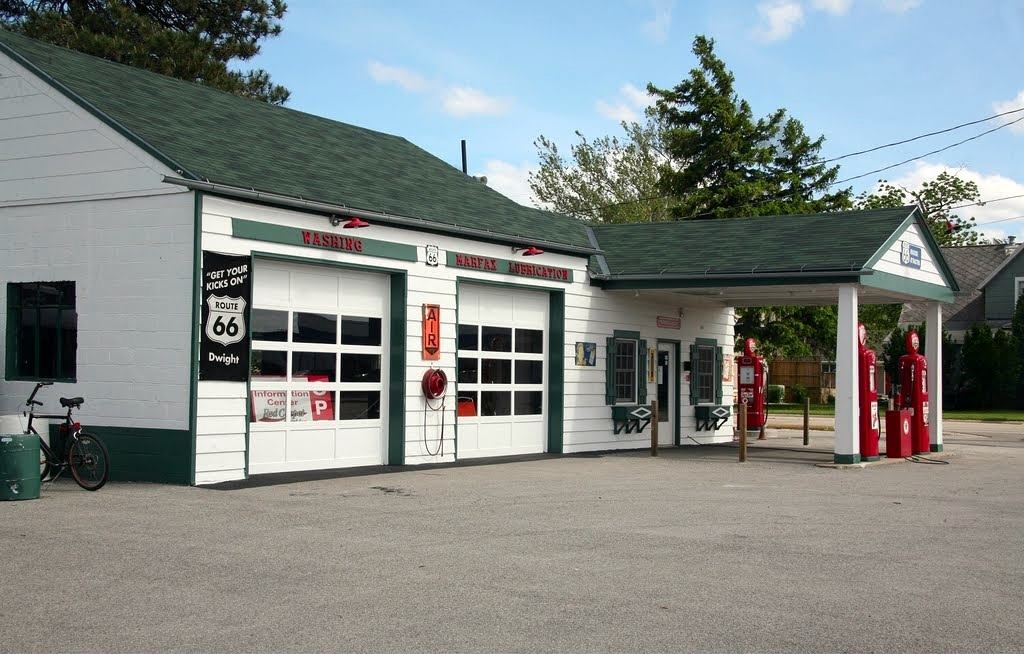
Ambler Texaco Gas Station, on Route 66 in Dwight, Illinois.

Ambler Texaco Gas Station, also known as Vernon’s Texaco Station and Becker’s Marathon Gas Station, is located along historic Route 66 in the Village of Dwight. The station gets its name from longtime manager Basil “Tubby” Ambler, who operated the station from 1938 to 1966. 


The original 1933 building Jack Shore built consisted of an office with wood clapboard siding, an arched roof with asphalt shingles, and residential windows adorned with shutters and flower boxes. A sheltering canopy supported by two tapered columns was extending out from the office over three Texaco gas pumps.  Mr. Shore also constructed an ice house located on the property. 


The station’s design, with its cottage look, may strike the contemporary traveler as quaint--or perhaps even odd. Why, after all, shouldn’t a gas station look like a gas station? But this domestic style, common along Route 66, had a distinct purpose and stems from a time in the early 20th century when gas stations were just beginning to seriously intrude upon the suburban landscape of America. The oil companies wisely opted to tread lightly on this new, non-commercial territory. Gas stations were consciously styled to be homey and inviting to customers, as well as inconspicuous in their new residential, suburban surroundings.


In the early 1940s, following a national trend that saw gas stations evolve into full-service garages, Mr. Ambler added a service bay of simple concrete block to the north side of the original building. Although he left the station in 1966, the station continued servicing motorists until nearly the turn of the 21st century, making it one of the oldest continually operated service stations along the Mother Road.


Over the years, the station naturally underwent a number of changes. Windows were removed and added, fresh paint applied, and new roofing laid down. The tall, elegant red pumps of the 1930s gave way to the squat dispensers of the 1960s; and Marathon Oil eventually superseded the Texaco Fire Chief brand. 


The station operated as a gas station for 66 years until 1999 and was an auto repair shop until 2002, when the owner Phillip Becker generously donated the station to the Village of Dwight. With the help of a $10,400 matching grant from the National Park Service’s Route 66 Corridor Preservation Program, the Village of Dwight painstakingly restored the station to its former glory, taking the main office and canopy area back to the 1930s and the service bay area back to its 1940s appearance. 

Today, the station serves as a visitor’s center for the Village of Dwight. It was listed in the National Register of Historic Places in 2001 and received a Cost-Share Grant from the National Park Service Route 66 Corridor Preservation Program in 2002.

Compiled by Dr. Neil Gale, Ph.D. — BOD, Route 66 Association of Illinois, 2013-2015