Wednesday, March 16, 2022

Research Raises Civil War Death Toll.

For 145 years, the numbers stood as gospel: 618,222 men died in the Civil War, 360,222 from the North, and 258,000 from the South — by far the most significant toll of any war in American history.
Lithograph of the Battle of Gettysburg.


But new research shows that the numbers were far too low.

By combing newly digitized census data from the 19th century, J. David Hacker, a demographic historian from Binghamton University in New York, has recalculated the death toll and increased it by more than 20% — to 750,000.

The new figure is already winning acceptance from scholars. Civil War History, the journal that published Dr. Hacker’s paper, called it “among the most consequential pieces ever to appear” in its pages. And a pre-eminent authority on the era, Eric Foner, a historian at Columbia University, said:
“It even further elevates the significance of the Civil War and makes a dramatic statement about how the war is a central moment in American history. It helps you understand, particularly in the South with a much smaller population, what a devastating experience this was.”
The old figure dates back a century and a half, the work of two Union Army veterans who were passionate amateur historians: William F. Fox and Thomas Leonard Livermore.

Fox, who had fought at Antietam, Chancellorsville, and Gettysburg, knew well the horrors of the Civil War. He did his research the hard way, reading every muster list, battlefield report, and pension record he could find.

In his 1889 treatise “Regimental Losses in the American Civil War, 1861-1865,” Fox presented an immense mass of information. Besides the aggregate death count, researchers would learn that the Fifth New Hampshire lost more soldiers (295 killed) than any other Union regiment; that Gettysburg and Waterloo were almost equivalent battles, with each of the four combatant armies suffering about 23,000 casualties, and that the Union Army had 166 regiments of black troops; and that the average Union soldier was 5 feet 8¼ inches tall and weighed 143½ pounds.

However, Fox’s estimate of Confederate battlefield deaths was much rougher: a “round number” of 94,000, a figure compiled from after-action reports. In 1900, Livermore set out to make a more complete count. In his book, “Numbers and Losses in the Civil War in America, 1861-65,” he reasoned that if the Confederates had lost proportionally the same number of soldiers to disease as the Union had, the actual number of Confederate dead should rise to 258,000.

And that was that. The Fox-Livermore numbers continued to be cited well into the 21st century, even though few historians were satisfied with them. Among many others, James M. McPherson used them without citing the source in “Battle Cry of Freedom,” his Pulitzer-winning 1988 history of the war.

Enter Dr. Hacker, a specialist in 19th-century demographics, who was accustomed to using the two-census method to calculate mortality. That method compares the number of 20-to-30-year-olds in one census with the number of 30-to-40-year-olds in the next census, 10 years later. The difference between the two figures is the number of people who died in that age group.

Pretty simple — but, Dr. Hacker soon realized, too simple for counting Civil War dead. Published census data from the era did not differentiate between native-born Americans and immigrants; about 500,000 foreign-born soldiers served in the Union Army alone.

“If you have a lot of immigrants age 20 moving in during one decade, it looks like negative mortality 10 years later,” Dr. Hacker said. While the Census Bureau in 1860 asked people their birthplace, the information never made it into the printed report.

As for Livermore’s assumption that deaths from disease could be correlated with battlefield deaths, Dr. Hacker found that wanting too. The Union had better medical care, food, and shelter, especially in the war’s final years, suggesting that Southern losses to disease were probably much higher. Also, research has shown that soldiers from rural areas were more susceptible to disease and died at a higher rate than city dwellers. The Confederate Army had a higher percentage of farm boys.

Dr. Hacker said he realized in 2010 that a rigorous recalculation could finally be made if he used newly available detailed census data presented on the Internet by the Minnesota Population Center at the University of Minnesota.

The center’s Integrated Public Use Microdata Series had put representative samples of in-depth, sortable information for individuals counted in 19th-century censuses. This meant that by sorting by place of birth, Dr. Hacker could count only the native-born.

Another hurdle was what Dr. Hacker called the “dreadful” 1870 census, a poorly handled undercount taken when the ashes of the war were still warm. But he reasoned a way around that problem.

Because the census takers would quite likely have missed as many women as men, he decided to look at the ratio of male to female deaths in 1870. Next, he examined mortality figures from the decades on either side of the war — the 1850s and 1870s — so that he could get an idea of the “normal” ratio of male to female deaths for a given decade. When he compared those ratios to that of 1860-70, he reasoned, he would see a dramatic spike in male mortality. And he did. Subtracting normal attrition from the male side of the equation left him with a rough estimate of war dead.

It was a better estimate than Fox and Livermore had produced, but Dr. Hacker made it clear that his was not the final answer. He had made several assumptions, each of which stole accuracy from the final result. Among them: that there were no war-related deaths of white women; that the expected regular mortality rate in the 1860s would be the average of the rates in the 1850s and 1870s; that foreign soldiers died at the same rate as native-born soldiers; and that the War Department figure of 36,000 black war dead had to be accepted as accurate because black women suffered so terribly both during and after the war that they could not be used as a control for male mortality.

The study had two significant shortcomings. Dr. Hacker could make no estimate of civilian deaths, an enduring question among historians, “because the overall number is too small relative to the overall number of soldiers killed.” And he could not tell how many of the battlefield dead belonged to each side.

“You could assume that everyone born in the Deep South fought for the Confederacy and everyone born in the North fought for the Union,” he said. “But the border states were a nightmare, and my confidence in the results broke down quickly.”

With all the uncertainties, Dr. Hacker said, the data suggested that 650,000 to 850,000 men died due to the war; he chose the midpoint as his estimate.

He emphasized that his methodology was far from perfect. “Part of me thinks it is just a curiosity,” he said of the new estimate.

“But wars have profound economic, demographic, and social costs,” he went on. “We see at least 37,000 more widows here and 90,000 more orphans. That’s a profound social impact, and it’s our duty, as historians, to get it right.”

Compiled by Dr. Neil Gale. Ph.D.
Contributor, Guy Gugliotta 

Sunday, March 13, 2022

HI-FI Tavern Bombing on March 26, 1961.

On Friday night, March 26, 1961, surgeons removed the right arm and both legs of Charlene Frazer, 23, and both legs of Martha Jackson, 26, from a bomb explosion in the basement of a popular Chicago tavern.
The interior view shows blast damage to the floor and ceiling of a near northside. Note the Jukebox in the background.


The Jukebox was blaring something called "Nutville," and a score of 20 or more merrymakers were dancing in the HI-FI Tavern at 943 North Wells Street, at Walton Street, Chicago, when the explosion happened. Dozens more were in booths or on bar stools sipping drinks.
NUTVILLE — with Billy Cobham - Horace Silver
Bill Hardman - Bennie Maupin - John Williams

Mary Petty, 24, whose father, George, 54, owns the place, said she was behind the bar when "suddenly, there was a terrible noise, and the lights and music went out." People were hurled into the walls, and the bomb in the basement blasted a 15-foot diameter hole in the tavern's floor upstairs. The first floor is a 30 by 50-foot tavern floor upstairs. People were rescued from the basement.

Miss Leona Thames, who lives at 947 North Wells Street, said she was thrown from her chair as she watched television. She said clouds of smoke were pouring from the tavern when she looked out. The second deputy fire marshal John Scanian said no fire followed the blast.

Ambulances and Squadrols[1] began removing the injured to nearby hospitals. The fire department sounded an extra alarm, and police blocked off the area from spectators and cleared traffic for emergency vehicles.

One of the victims, Cyrus Leatherman, 34, of 923 North Sedgwick Street, was questioned by police in Wesley Memorial Hospital, said:

"I was dancing when the whole floor just came right up. I went clear to the ceiling and I thought I was going to remain hanging there. It was the craziest rock 'n' roll I ever anced."
First floor looking at the 15-foot diameter hole in the floor and the damage to the ceiling. 


Edward Neville, the detonation expert of the police bomb squad, said the explosion apparently occured in the basement of the three-story brick building. Neville said it positively was a bomb. 

Captain Robert Thomsen said an outside basement door had been forced open before the blast, and it had been wired shut, but the wire was cut with a sharp instrument.

The first 12 people removed were taken to Henrotin Hospital. The following 22 were sent to Wesley  Memorial Hospital, five were taken to Passavant Hospital, and one was sent to Grant Hospital.

Only three uninjured people were in the tavern: the owner's daughter, Miss Mary Petty, and the two bartenders, Sylvester Green and Clarence Bell. They were shielded from the effects of the blast by the bar, which remained intact.

The concussion threw people into the apartments above the tavern from beds and chairs, but none were injured. No one on the street was hurt by the blast.


Fire Department officials concluded that the blast was definitely caused by a dynamite time bomb.

Compiled by Dr. Neil Gale, Ph.D.


[1] Squadrols are vehicles used by police as both squad cars and ambulances. The Chicago Police called them "Paddy Wagons."

Tuesday, March 8, 2022

Illinois' Driftless Region Explained.

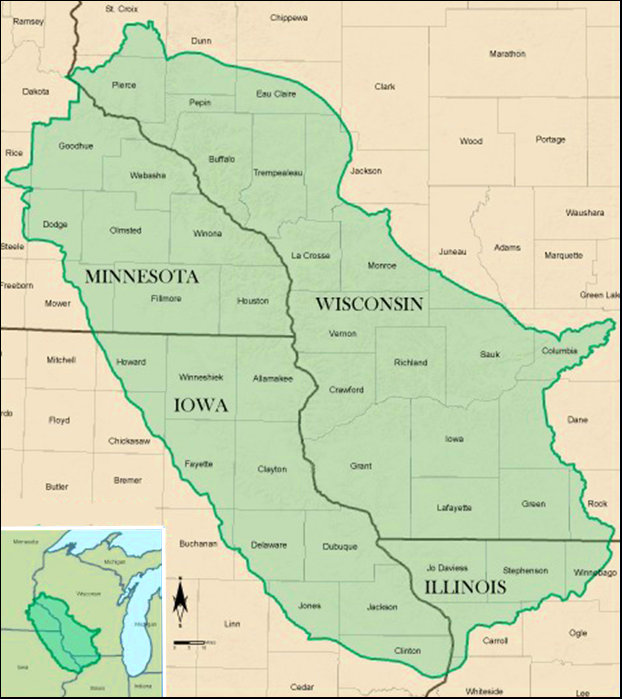
The driftless region or zone consists of the extreme northwestern corner of Illinois, southwestern Wisconsin, southeastern Minnesota, and northeastern Iowa. Illinois' driftless region borders are not well defined. Generally, they contain all of Jo Daviess and Stephenson Counties and the western portions of Carroll County near the Mississippi River.
The Upper Mississippi Region, about 15,000 square miles, was miraculously left untouched by glacial erosion and sediments during the last ice age.


Galena, Illinois, is a perfect example of a driftless region. "Driftless" refers to the geological history of the area; its ground hasn't been eroded by glaciers in the Pleistocene (last) Ice Age, nor does it have rocks or sediments (termed drift) transported by the moving glaciers. 


The driftless region is characterized by steep hills, forested ridges, deeply carved river valleys, Karst[1] geology with spring-fed waterfalls, and cold-water trout streams.
The Illinois Counties in the Driftless region.


As in Wisconsin, the Illinois portion of the driftless area became a significant center for Lead and Zinc Mining in the 1800s. The city of Galena was named after the lead sulfide mineral Galena.

In Soldiers Grove, Wisconsin, the Driftless Brewing Company took advantage of the fresh, naturally filtered water. The great-tasting spring water is crucial to brewing their beer brands, and they chose to pay homage to the driftless area they occupy.

Compiled by Dr. Neil Gale, Ph.D.


[1] Karst
is an area of land made up of limestone. 

Limestone, aka chalk or calcium carbonate, is a soft rock that dissolves in water. As rainwater seeps into the rock, it slowly erodes. 
Driftless area in southwest Wisconsin.


Karst landscapes can be worn away from the top or dissolved from a weak point inside the rock. Karst vistas feature caves, underground streams, and sinkholes on the surface. Where erosion has worn away the land above ground, steep rocky cliffs are visible.

                   ██  Karst Landscapes in Illinois.

Tuesday, March 1, 2022

Sears Tower - The History of the First Sears Tower.

The Sears Tower (now Willis Tower), 233 South Wacker Drive, Chicago, was once the tallest building in the world, 1,729 feet at the highest point, with 108 floors until 1998. It is easily one of Chicago's most recognizable buildings. However, the 'Loop' Sears Tower was not the first Sears Tower in Chicago.

In 1904, the company purchased over 40 acres of land on Chicago's West Side and embarked on one of the most significant retail development projects. The Sears Merchandise Building Tower complex occupied an area bounded on the north by Arthington Street, the south by Fillmore Street, the east by Spaulding Avenue, and the west by Central Park Avenue. 


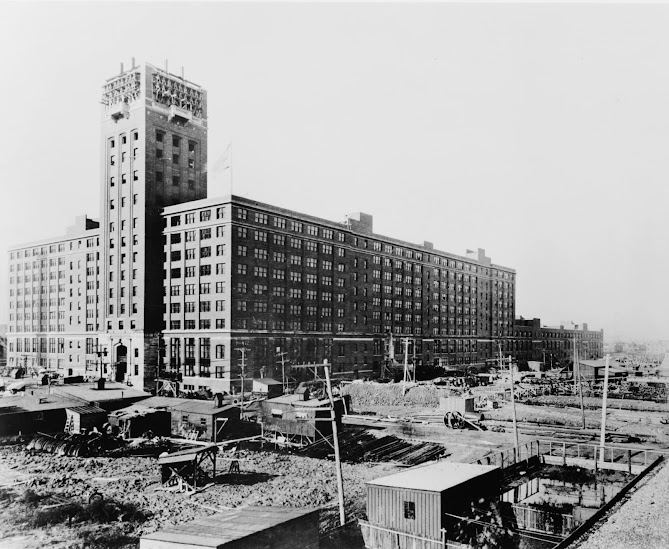
The Sears Merchandise Building Tower at 925 South Homan Avenue, Chicago, is a fourteen-story structure with a limestone base and Chicago Common Brick walls. It is crowned by a Classical Revival top floor round-arch windows and a modillion cornice. It housed water tanks for firefighting, offices, and secretarial training facilities on the upper levels. It also housed the early radio broadcast facilities for WLS-AM.


The centerpiece of the company-owned "city within a city" was its central administration building, a merchandise development house, a mail-order processing facility, and a power plant large enough to provide electricity and heat to the entire complex.
The full extent of the Sears, Roebuck, and Company Complex (towering cluster of buildings in the center) circa 1950.
CLICK FOR A FULL-SIZE PICTURE
The Print Shop then turned into the Merchandise Development Laboratory, was an L-shaped, six-story building finished in Chicago Common Brick. It housed the print shop for the Sears catalog from 1905 to 1926. It served for about forty years as its principal product testing laboratory.

By 1926, the first ground-level parking lots replaced the athletic fields. This happened when a strategic shift from catalog sales to retail stores started with easy auto travel, making travel to a store more practical. 

By 1943, the complex had become a city within itself. Sears created their own services for practical use, which were well advanced in what was required at the time, including:
  • A company fire department with volunteer firemen and early fire sprinklers.
  • A 200,000-gallon water tank is also used for fire prevention purposes.
  • A newspaper publicity office.
  • A cafeteria serving breakfast and lunch—initially, men and women were separated.
  • A private bank offering discounted services for employees on-site (today, a Credit Union).
The company's growth continued through the 20th century, and by the 1960s, it was the largest retailer in the world.

The company's growth continued through the 20th century, and by the 1960s, it was the largest retailer in the world. Changing trends in retail sales and methods led to a decline, and the company's mail-order business was scaled back in 1987, moving out of these premises. The corporate headquarters had been moved to the new Sears Tower in 1973.

The complex stood vacant for nineteen years. 

The abandoned complex presented the City of Chicago with a redevelopment quagmire. In 1992, a nonprofit partnership organized by former Sears management began to redevelop the site named Homan Square. The mail-order merchandise building was demolished, except for its main tower, and its land has been redeveloped to include new residences, retail, and a community center.
The "John D. and Alexandra C. Nichols Tower at 925 South Homan Avenue, Chicago


In 2015, the tower was renamed the "John D. and Alexandra C. Nichols Tower, which restored the building. It is now a hub for nonprofit arts, multi-media education, youth leadership development, job training, and more. The School of the Art Institute of Chicago has its classroom on the 12th floor. The Sears Roebuck plaque is still visible on top of the building.

The surviving buildings can be seen from Homan and Arthington. 

Compiled by Dr. Neil Gale, Ph.D.

Sunday, February 27, 2022

What happened to Terminal 4 at O'Hare International Airport?

Up until 1984, O'Hare only had three terminals, named Terminals 1, 2, and 3. But in 1985, the airport decided to expand with a new international terminal. The "Sky's the Limit" at O'Hare International Airport was installed in 1987. The walkway is part of the United Airlines terminal. It was designed by the famous Architect Helmut Jahn (1940-2021). 


The lighting was designed by Michael Hayden, a neon artist. The "people mover" welcomes people with the glow of the neon all while listening to George Gershwin's "Rhapsody in Blue." It's located between Concourses B and C in Terminal 1.
 Take a ride on the "Sky's the Limit" walkway.

From 1985 to 1993, Terminal 4 was a temporary international terminal while O'Hare built a bigger, better, and new international terminal.


However, the temporary Terminal 4 was tiny and foreign airlines complained about the lack of operating space. So airport officials decided to open half of the new terminal to take some congestion out of the temporary one. During the summer of 1993, international flights arrived into the finished half of the new international terminal while still taking off from the temporary one.


To avoid any confusion between the two international terminals (they couldn't call them both Terminal 4), the new terminal was named Terminal 5. When construction was finally complete, and the departing international flights could also take off from the new terminal, the temporary one was shut down. By that time, the name "Terminal 5" had already stuck.

The old Terminal 4, located on the ground level of O'Hare's short-term parking garage, now serves as the airport's bus-shuttle depot. 

People often ask, "What happened to Terminal 4?" The standard answer is "As long as you know what terminal you're going to, it doesn't make much difference." The number isn't retired, though; eventually, a new terminal building will be christened "Terminal 4."

Compiled by Dr. Neil Gale, Ph.D.