Saturday, December 16, 2023

A Summary of French Influence in Illinois.

Forward

French Illinois—Where Empire Met Elegance
Long before Illinois became a state, it was the beating heart of a French colonial dream known as le Pays des Illinois. This section explores the legacy of French explorers, traders, and settlers who carved out a distinct cultural corridor along the Mississippi—one that still whispers through limestone ruins, vertical log homes, and the fleur-de-lis etched into local lore.

What Set the French Apart? Unlike other colonial powers, the French didn’t just conquer—they connected. They forged alliances with Native nations through diplomacy, trade, and kinship rituals, such as the calumet ceremony. Their settlements, such as Cahokia (1699) and Kaskaskia (1703), became hubs of multicultural exchange, blending French, Native, and African traditions into a unique frontier society.

Architectural Flair & Urban Planning French homes featured poteaux-sur-sol construction—upright hewn logs on sills—with wraparound porches that offered shade and sociability. Their villages were laid out with central churches, artisan workshops, and communal spaces, reflecting a sense of civic order and aesthetic grace that stood in contrast to the rugged utilitarianism of British and American settlements.

Strategic Strongholds & River Networks: The French built forts like Fort de Chartres and Fort Massac, not just for defense, but also as administrative centers and supply stations that linked Canada to New Orleans. Their mastery of river navigation turned Illinois into a vital artery of empire, with outposts like Prairie du Rocher and St. Philippe anchoring trade and governance.

Culture, Craft, and Celebration, French Illinois was alive with festivals, music, and skilled craftsmanship. Despite restrictions on local industry, settlers imported fine goods and cultivated a community of skilled artisans, including blacksmiths, stonemasons, and carpenters. Church life and recreation flourished side by side, painting a picture of frontier life that was both industrious and joyful.

A Legacy That Endures Though floods and wars erased many physical traces, the spirit of French Illinois survives in restored sites, historic trails, and cultural initiatives like the French Creole Corridor. From the vertical logs of the Cahokia Courthouse to the limestone walls of Fort de Chartres, these remnants invite us to rediscover a chapter of Illinois history where diplomacy, design, and diversity reigned supreme.

sidebar
The state of Illinois became Païs des Illinois (Country of Illinois), when Virginia ceded their County territory in 1778.

While Cahokia was undoubtedly a significant center of French colonial life in early Illinois, several other villages and settlements thrived beyond its shadow, each with its own unique story and contributions to the state's rich history.

French explorers ventured into the Illinois county of Virginia as early as the 17th century, lured by tales of fertile lands and abundant resources. By the late 1600s, permanent settlements began to take root, driven by the fur trade, missionary zeal, and the quest for agricultural and mineral wealth.

Early French Settlements
The town of Kaskaskia, Illinois, was founded in 1703. The Jesuits established the village as a missionary outpost and later developed it into a French trading post and farming community. Kaskaskia became the capital of French Illinois and a bustling hub for fur trade and agriculture. Jesuit missionaries established a strong presence, and the town boasted a vibrant cultural scene, featuring music, theater, and numerous celebrations.

The village of Prairie du Rocher was founded in 1722; nestled along the Mississippi River, it became known for its skilled farmers and artisans. Residents cultivated wheat, corn, and tobacco and crafted furniture, tools, and other goods. The community also played a vital role in the salt trade.
Prairie du Rocher Cemetery. Note the Iron Crosses Grave Markers.

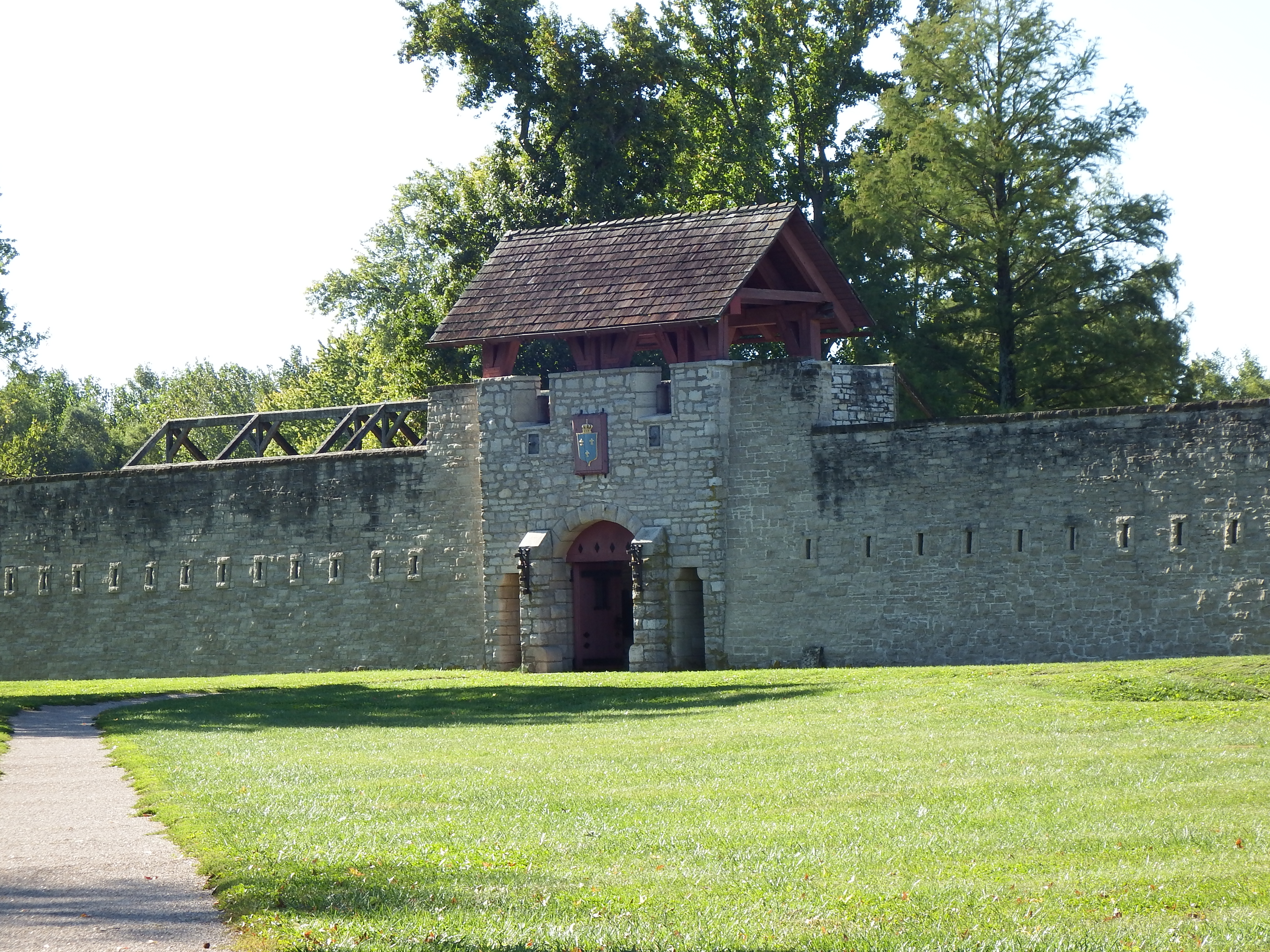
Fort de Chartres was constructed in 1718 between Kaskaskia and Cahokia. This fort served as the French military and administrative center in the region. It played a crucial role in defending against British incursions and overseeing trade routes. The nearby village of St. Anne, established in 1720, grew in tandem with the fort, with French residents supporting the military by engaging in farming and fur trading.
Fort de Chartres Gatehouse. Climbing the 18-foot-high gatehouse provided a panoramic view of the surrounding area.


Village Life and Culture
French colonial architecture had a different building process. Homes were typically built with poteaux-sur-sol (post-on-sill) construction, featuring square-hewn logs and covered porches. This style contrasted with the standard unhewn log cabins among American settlers.

Examples of Poteaux-Sur-Sol Construction:

French villagers relied heavily on farming, cultivating crops such as wheat, corn, and vegetables. They also kept livestock, hunted, and fished, ensuring a degree of self-sufficiency. They engaged in lively trade, exchanging goods with Native American tribes and other European settlements. The fur trade was significant, with furs shipped to New Orleans via the Mississippi River.

Strong Community Bonds
The Catholic faith played a central role in village life, with churches serving as social and cultural centers. Residents celebrated holidays and festivals together, fostering a strong sense of community.

Challenges and Transformations
The outcome of the French and Indian War (1754-1763) led to the cession of French territory east of the Mississippi to Britain, significantly impacting French village life in Illinois. Many residents relocated to Spanish Missouri, while others adapted to British rule.

The American victory in the Revolutionary War in 1783 marked another significant transition, as Illinois became part of the United States. French villagers gradually integrated into American society, preserving their cultural traditions while adapting to the new political and social realities.

The French Legacy
The legacy of French village life in Illinois continues to be celebrated and preserved through Historic sites. Many French villages, like Kaskaskia and Prairie du Rocher, are designated historic landmarks, showcasing their original architecture and way of life. Festivals and celebrations, such as the Prairie French Festival in Prairie du Rocher, keep French traditions alive through music, dance, and food.

Compiled by Dr. Neil Gale, Ph.D.

Friday, December 15, 2023

The City of Chicago's First Foot Steps.

James Thompson surveyed Chicago, filing the plat on August 4, 1830, the official recognition of Chicago's location. Chicago was incorporated as a town on August 12, 1833, with a population of about 350.

The City is bounded on the South and West by a prairie, varying from ten to twelve miles in width, some portion of which is high and of a very superior quality. It is surrounded in every direction by a country the most productive in the world, already brought into a state of successful cultivation, and sending to its market annually a vast amount of produce of every description for sale, exchange for goods, or shipment, as the case may be. The climate is healthy and salubrious, as much so as any in the West. With a population of 4,170, the town of Chicago filed new Incorporation documents on March 4, 1837, becoming the City of Chicago.

The City is divided into six Wards. The first and second Wards, divided by Clark Street, are bounded by Chicago River's South Branch and the Lake, the first Ward lying East and the second West of Clark Street. 

The third and fourth Wards, divided by Randolph Street, are situated on the West side of the North and South Branches, the third South, and the fourth North of Randolph Street. 

The fifth and sixth Wards, divided by Clark Street, are bounded by the North Branch, Chicago River, and the Lake, the fifth being West, and the sixth East of Clark Street.

The Fort Dearborn Reservation was incorporated within the city limits in 1839,

Compiled by Dr. Neil Gale, Ph.D.

Tuesday, November 28, 2023

The Chicago Home Insurance Building: The Pioneer of Skyscraper Architecture in 1885.

Standing tall and proud amidst the bustling streets of Chicago, the Home Insurance Building etched its name in the annals of architectural history as the world's first true skyscraper.

Designed by the visionary architect William Le Baron Jenney, this impressive 138-foot-tall, 10-story structure revolutionized how buildings were conceived and constructed, paving the way for modern skyscrapers that dominate cities worldwide. Construction of the Home Insurance Building began in 1884 at the Northeast corner of LaSalle and Adams Streets and was completed in 1885.

sidebar
Two additional stories were added to the Chicago Home Insurance Building in 1890. This increased the building to 12 stories and its height to 180 feet.

CONCEPTION, DESIGN AND CONSTRUCTION
In the late 19th century, Chicago was booming, its population swelling and its businesses expanding. The demand for office space was surging, and traditional masonry construction methods were proving inadequate to meet the growing needs. 
During Construction
The Home Insurance Building's origins can be traced back to the late 1870s when the Home Insurance Company of New York sought to establish a branch office in Chicago. The company's management envisioned a grand and imposing structure reflecting its prominence in the insurance industry. In 1884, they approached Jenney, a respected architect known for his innovative designs and use of fireproof construction. Jenney faced the challenge of creating a tall, fire-resistant building that could withstand Chicago's harsh weather conditions.

PIONEERING CONSTRUCTION TECHNIQUES
Interior Views
Note the full-size windows.
Jenney's solution was a 10-story, 138-foot-tall building with a frame made of wrought and cast iron, along with Bessemer rolled steel beams (steel), a revolutionary concept at the time. Before this, buildings were primarily constructed using masonry walls, limiting their height and fire resistance. The steel frame provided the strength and support needed to build taller buildings, allowing for thinner walls and larger windows hung on the steel frame. It could withstand the weight of its walls and floors. The building also featured fireproofing measures, including fireproof terra cotta cladding and hollow tiles filled with concrete.

This revolutionary design enabled the building to reach an unprecedented height of 138 feet and set a precedent for future skyscrapers.

IMPACT AND LEGACY
The Home Insurance Building was a testament to Jenney's architectural ingenuity and marked a turning point in skyscraper design. Its innovative use of a steel skeleton frame and other features established the foundation for modern skyscrapers, paving the way for taller, safer, and more efficient buildings.
The "I WILL" Postcard Series № 186C: Home Insurance Building, Chicago. From the private collection of Dr. Neil Gale. Chicago Postcard Museum.
The building's impact was immediate and far-reaching. It inspired a wave of skyscraper construction in Chicago and other cities, transforming urban landscapes and ushering in a new era of vertical architecture.

The building's impact extended beyond its structural innovations, influencing the aesthetic of skyscrapers. Its exterior, clad in terracotta panels, reflected a transition away from the heavy ornamentation of Victorian architecture towards a more streamlined and modern aesthetic.

While the Home Insurance Building was demolished in 1931 to make way for the Field Building, another skyscraper, its impact on architecture and urban development remains profound. It stands as a symbol of innovation and ingenuity, forever etched in the history of skyscrapers and the evolution of modern cities.
Architect and Engineer William LeBaron Jenney was born on September 25, 1832. He died in Los Angeles, California, on June 14, 1907, at the age of 74.

Compiled by Dr. Neil Gale, Ph.D.