Sunday, July 2, 2023

Riverside (Amusement) Park, Havana, Illinois. (1904-1967)

Riverside Park was located in Havana, Illinois, along the Illinois River. It opened in 1904, featuring a variety of rides and attractions.
The "Midway" is a 'street' or lane with one or both sides having concession after concession with games of chance, refreshments, souvenirs, a beer garden, and 
entertainments.


The wooden roller coaster, the "Bass Bullet," was built in 1920 with three drops and a white-knuckle top speed of 30 mph. Other attractions included a carousel, kiddie rides, a dance hall, a concession stand and a picnic area. 
This photo is a visual aid.


The Riverside Grille served American fare overlooking the Illinois River. The Grille is well known for miles for the freshly caught Illinois River Black Bass with our recipes. Riverside Park hosted various events throughout the season, including company/family picnics, concerts, and weekend Fairs and Festivals. 

The park closed in 1967 due to financial difficulties. The land was later sold and developed into a housing subdivision.

Compiled by Dr. Neil Gale, Ph.D.

Saturday, July 1, 2023

Rainbow (Amusement) Park (1950-1971); Fun Harbor USA (1971-1981); Fun Harbour, Waukegan, Illinois. (1992-2016)

RAINBOW PARK
Rainbow Park, a small amusement park, opened in 1950 on Lakehurst Road in Waukegan, Illinois, by a group of local businessmen. Rainbow Park featured a carousel, a Ferris wheel, and other kiddie rides. It was a popular destination for families and quickly became a fixture in the Waukegan community.

The park continued to grow and expand in the years that followed. New rides and attractions were added, and the park became a destination in the Chicago area. 

In the early 1970s, the park added a few carnival rides, including a Ferris wheel, bumper cars, and a Tilt-A-Whirl.

Rainbow Park was renamed Fun Harbor USA in 1971 and underwent a major renovation.

FUN HARBOR USA
The park's entrance was redesigned, and several new rides and attractions were added. A water park was added, which became a popular attraction for families during the summer months. Fun Harbor continued to grow and evolve over the years. The park added some new rides, including a roller coaster and a water slide. The park also added new food vendors and arcade games.

In the late 1970s, Fun Harbor began to face financial difficulties. The park struggled to compete with Dunes Kiddieland and other amusement parks in the area. They eventually closed in 1981.

ABANDONED
The park sat abandoned for 11 years before it was purchased by new owners Marc Klibanow and Jim Persino in 1990. 

FUN HARBOUR
Klibanow & Persino invested heavily in the park. The new and improved park reopened in 1992 under the name Fun Harbour. The amusement center had a large arcade with the latest pinball machines, video games, and Skee-Ball machines that dispensed tickets for performance in a "tickets-for-toys" system.

The variety of fun included batting cages and go-karts. An 18-hole, nautical-themed miniature golf course, rated by the US ProMiniGolf Association (USPMGA) at level 4 of 5 in difficulty.
Tokens Were Used Instead of Quarters for Pinball Machines, Video Games and skee-ball.
There were three birthday party rooms: The Dolphin, The Mermaid and The Pirate. The closure of Fun Harbour in 2016 was due to a combination of factors, including declining attendance, competition from other amusement venues, and financial difficulties. 

Compiled by Dr. Neil Gale, Ph.D.

Trout (Amusement) Park, Elgin, Illinois. (1890s-1922)

Trout Park in Elgin, Illinois, has a long and interesting history. 

The park was originally owned by Dr. P.W. Pratt, who enclosed a 70-acre parcel of land known as "Cedar Swamp" and began a fish hatchery on the site in 1872. It is situated on the east side of the Fox River, 1½ miles north of Elgin.

The hatchery was successful, and the park became known as "Trout Park." In the 1890s, the park was also home to an amusement park, which featured a variety of rides and attractions.

The park became a popular resort for pleasure seekers, especially Germans from Chicago. In 1895, the city of Elgin purchased the park and opened it to the public.


In the early 1900s, Trout Park was home to an amusement park, a botanical garden, and the Trails & Treasures Tea Room. The amusement park featured a carousel, a roller coaster, and other rides. The botanical garden was filled with various plants, including rare white cedar trees. The Trails & Treasures Tea Room featured a wall of windows with a view of the river and was a trendy spot for afternoon tea.

In 1910, Trout Park became home to Elgin's first semi-professional baseball team, the Elgin Kittens. The Kittens played their home games at a stadium in the park that could seat 3,500 spectators. The team played in the Northern Association, a minor league baseball league, from 1910 to 1912.

Trout Park remained a popular destination for Elgin residents throughout the 20th century. 

The park was designated an Illinois Nature Preserve in 1972 due to its rare white cedar trees and other natural features. Today, the park is still popular for hiking, fishing, and picnicking.

Compiled by Dr. Neil Galew, Ph.D.

Friday, June 30, 2023

Vandalia Beach Amusement Park, Vandalia, Illinois. (1927-1982)

Vandalia Beach was an amusement park located in Vandalia, Illinois. It opened in 1927 and operated for over 50 years. The park was located on the banks of the Kaskaskia River and featured a variety of rides, attractions, and a swimming pool. 

The park was opened by Harry and Alice Clark in 1927. 

Rides included the small wooden roller coaster built in 1928 and a toddler kiddieland.

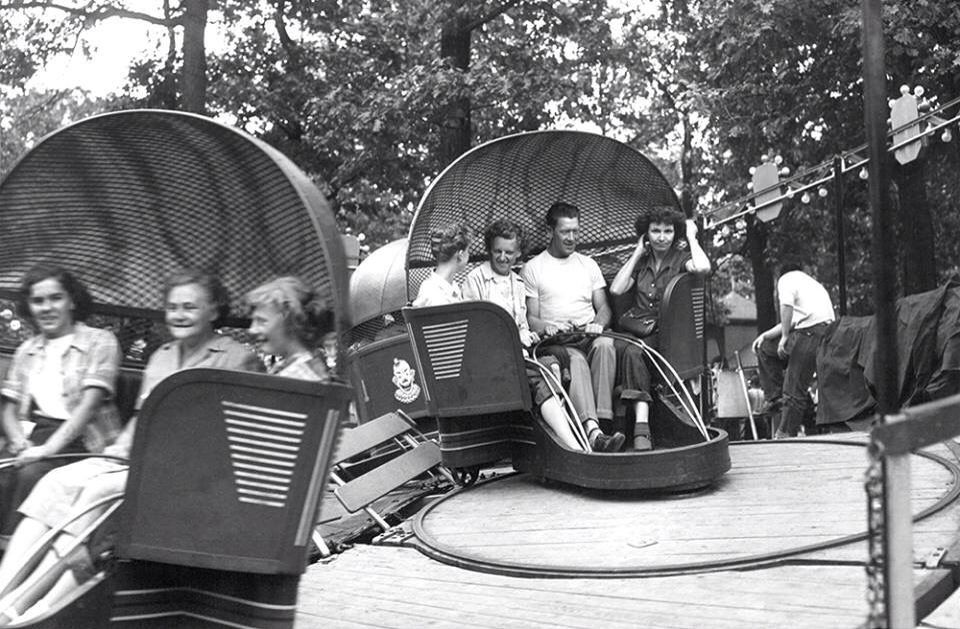
In 1946, Clark and Parks Amusement Company purchased Vandalia Beach Amusement Park, which also owned several other amusement parks in the Midwest. Clark and Parks invested heavily in Vandalia Beach, adding new rides and attractions, like the Tilt-a-Whirl, a Ferris wheel, and a swimming pool.
This photo is a visual aid.


The park became a popular destination for families from all over the region.

In the 1970s, Vandalia Beach began to decline. The park was no longer as well-maintained as it once was, and attendance began to drop. In 1982, Clark and Parks announced that Vandalia Beach would be closing. The park's final day of operation was September 5, 1982.

The site of Vandalia Beach is now a residential development. However, the park's swimming pool still stands and is now used by the Vandalia Park District.

Compiled by Dr. Neil Gale, Ph.D.

Zoo Park and Pleasure Resort, Springfield, Illinois. (1906-1917)


In historical writing and analysis, PRESENTISM introduces present-day ideas and perspectives into depictions or interpretations of the past. Presentism is a form of cultural bias that creates a distorted understanding of the subject matter. Reading modern notions of morality into the past is committing the error of presentism. Historical accounts are written by people and can be slanted, so I try my hardest to present fact-based and well-researched articles.

Facts don't require one's approval or acceptance.

I present [PG-13] articles without regard to race, color, political party, or religious beliefs, including Atheism, national origin, citizenship status, gender, LGBTQ+ status, disability, military status, or educational level. What I present are facts — NOT Alternative Facts — about the subject. You won't find articles or readers' comments that spread rumors, lies, hateful statements, and people instigating arguments or fights.

FOR HISTORICAL CLARITY
When I write about the INDIGENOUS PEOPLE, I follow this historical terminology:
  • The use of old commonly used terms, disrespectful today, i.e., REDMAN or REDMEN, SAVAGES, and HALF-BREED are explained in this article.
Writing about AFRICAN-AMERICAN history, I follow these race terms:
  • "NEGRO" was the term used until the mid-1960s.
  • "BLACK" started being used in the mid-1960s.
  • "AFRICAN-AMERICAN" [Afro-American] began usage in the late 1980s.

— PLEASE PRACTICE HISTORICISM 
THE INTERPRETATION OF THE PAST IN ITS OWN CONTEXT.


Zoo Park and Pleasure Resort was an ambitious but short-lived amusement park on nearly 200 acres at North Eighth Street Road, north of the Illinois State Fairgrounds.
The Giant Racer roller coaster at Zoo Park and Pleasure Resort in Springfield, Illinois.


Work began on Zoo Park in 1906, a year when many people apparently believed Springfield was deficient in recreation opportunities. In April, the Illinois State Register reported that, in addition to Zoo Park, another development group had started construction of Springfield's White City Park, an amusement park off East Cook Street, and major renovations were underway at “Springfield’s old stand-by,” Mildred Park (located where Bunn Park is today). The already popular Irwin’s Electric Park near Auburn also was adding attractions, the story said, and plans were in the early stages to create another park near Clear Lake, between Springfield and Riverton. Some plans for Zoo Park were accomplished, including the construction of the Giant Racer roller coaster and the dance pavilion. But the park ultimately failed because streetcar lines were never extended past the fairgrounds and because of competition from Springfield's White City Park, which was closer to the city and had much better transportation connections. On September 20, 1906, an article in the Illinois State Register reported developers were dreaming of “an amusement resort much larger than exists in any other western city.”
Construction work on the gigantic coaster, which is 1,900 feet long, is almost finished, and painters are at work on it and on the large arcade, erected to contain the myri(a)d of small attractions.
The arcade, like all of the buildings now in progress of erection …, is very large, being 75×365 feet, and with a beautiful architectural roof.
A lake, partly natural and partly artificial, is also completed and has a ground area of thirty acres. But two or three boats are now in use, but a large fleet will be built in the Zoo workshops this winter and put in readiness for the spring opening.
That story, like many others to come, was optimistic about a streetcar connection. Grading and surveying were well underway, the Illinois State Register said, and workers “will soon begin the erection of a bridge across Spring Creek. This will open the line into the Zoo Park, proper.…” However, the park’s organizers struggled to convince the Illinois Department of Agriculture to grant a streetcar right-of-way along the west side of the fairgrounds, and the streetcar route never came to pass. Newspaper stories say stock in the venture ─ four separate companies were incorporated in connection with Zoo Park, although the main one seems to have been the Illinois State Zoo and Amusement Company ─ was sold across the state. A group of stockholders from Belleville, seeing no return on their money, began in 1909 to question how it had been spent. An Illinois State Journal article on the Belleville investigation, however, suggested the Zoo Park company had largely played fair with its investors.
The Zoo Park … gives evidences now of the expenditures of several thousand dollars. The giant coaster, said to be only 120 feet short of a mile in length of track, has been almost finished. There are three pavilions in the 223-acre tract, one for dancing, another for café purposes and the third for billiards and pool. The penny arcade, 365 by 75 feet, is partially finished. Back of the arcade is a small pony track.
A small lake is at the south part of the park. The lake has been partially stocked with fish and several small boats have been placed on it.
All lots included in the addition have been sold, according to an employe of the Zoo and Amusement company.
As the streetcar line continued to meet delays, the Journal added, “Some effort was exerted to interest people in the project of carrying patrons to and from the park in automobiles and carriages, but the matter soon slumbered.” Other 1909 stories reported the road from the fairgrounds to the park had been graded, “putting it in good condition for pleasure driving,” and that a bus line was to operate to the park on Sundays.
It’s not clear if the bus ever ran. But that’s just one of the uncertainties about Zoo Park more than a century later. For instance, contemporary newspaper stories give a range of sizes, anywhere from 178 to 238 acres, for the Zoo Park property. (It’s possible that some of those estimates included Olentangy Heights while others did not.)

Various newspaper stories, probably based on statements from the park’s operators, gave the length as 1,200, 1,900, and over 5,000 feet (a mile is 5,280 feet). Whatever its length, it’s also not clear whether the coaster ever ran. Reports written long after the park folded usually say the ride was never completed and no one ever used it. In addition, newspaper articles published at the time, though they regularly mention the roller coaster at Springfield's White City Park, make almost no similar references to Zoo Park’s “Velvet Coaster” being in operation.

sidebar
Riverview Amusement Park in Chicago had a roller coaster called the "Velvet Coaster." It opened for the 1907 season and closed at the end of the 1919 season. It was 2,200 feet long.
But there is one such mention: An
Illinois State Register brief published on September. 22, 1912, suggests Zoo Park’s roller coaster actually did run. By 1912, rather than selling tickets to the general public, the park seems to have catered mainly to outings held by church groups, clubs, labor unions and similar organizations. The mention was in the Illinois State Register’s “High School Notes” column. (Springfield High was the city’s only public high school at the time.) The item says, in full:
The entire school will take a hay rack ride next Friday to the Zoo Park where lunch will be served free to all; boating, fishing, swimming and the roller coaster will tend to make the time go fast.
Zoo Park also had a zoo, although, again, some later coverage said the only animals it held were “one camel, a small herd of deer and buffalo and a few monkeys.” That may have been true later in the park’s existence, as Zoo Park sold all its animals except “those that eat grain and hay” to the Jones Brothers Circus sometime before 1909. Earlier, however, the park had a real zoo, at least for a time. Among its inhabitants were two lions, Nero and Nellie, who attacked a maintenance worker on March 15, 1907. The animals had been confined to a small anteroom while their main cage was being painted, but they somehow jarred the door loose and attacked the painter, Maxoumi Ben-Rahman. He was rescued by the lions’ owner and trainer, identified in the Illinois State Register’s story only as “Senor Cardona,” and the park’s manager.
"They ran to the cage and found the Arab lying upon his back with the lion, Nero, standing with one foot upon his chest. Cardona dashed into the cage and the lion was beaten back to the corner."
Ben-Rahman, whom the newspaper described as “the Arab who was seen so many days last summer driving the donkey around the city in the interests of the Zoo,” was not seriously injured. sidebar
Another of Cardona’s lions, Sappho, was the mother of the first two lion cubs ever born in Springfield. She gave birth on March 1, 1907, at Johnny Connors’ Empire Theatre, where Cardona and his lions were performing. However, both cubs were accidentally smothered by their mother shortly after birth.
Picnics and similar outings were held frequently at Zoo Park well into the decade, starting in 1910. However, the park could never overcome its remote location and competition from Springfield's White City Park, so in February 1919, Judge E.S. Smith appointed a receiver for the bankrupt park. At the time, the park’s debts were stated at $12,000, while the land was estimated to be worth $35,000 and the park’s other assets at $4,000. The land was auctioned off in July, with newspaper stories revealing another discrepancy in the acreage involved. The Illinois State Register in February had reported the property totaled 193 acres, while the final sale, according to the Journal, was 179 acres. The auction resulted in a price of $131 per acre or a total of $23,449. The buyer, Beulah Maxcy, was expected to farm most of the property, although structures on the land still included a house and “an immense pavilion, which will probably be changed into a barn,” the Journal said. Even the auction didn’t come off without a hitch, however. Maxcy’s $131 was topped by another auction patron, Santo Salamone. The two continued to raise each other until Maxcy refused to top Salamone’s $140 price. It turned out, however, that Salamone, a railroad worker and recently returned World War I veteran, thought he was bidding only on a single acre. “They can buy the rest,” he said. “I only have money for one.” Auction organizers rebid the sale. Maxcy was awarded the contract at the $131 per acre that had been her final offer before Salamone joined the bidding. The Journal writer concluded with what was probably intended to be the obituary of the Zoo Park.

sidebar
Zoo Park and Pleasure Resort's Giant Racer roller coaster was dismantled in 1917.
This property, at one time, held great promise for its promoters, who incorporated their amusement company at $100,000. It failed in its promise and had passed to private ownership, and former haunts of amusement soon will boast nothing else but grazing cattle and growing crops. In 1925, the Zoo Park pavilion was remodeled and reopened for dancing several nights a week to combos like Bradley’s Orchestra and Chicago’s Ernie Young’s Orchestra. In July, local dancers Harry Miles and Max Forman introduced the Charleston, “a new dance from the East,” to Zoo Park patrons. The pavilion featured a “polished hard maple floor, 3,516 feet of dancing space, a wide veranda with seats and beautiful decorations,” ads said. The next year, operator George Pehlman remodeled the pavilion again – to a Spanish atmosphere – and renamed it the Coral Gables. As a dance hall, Coral Gables endured a couple more years, hosting regular “hotsy-totsy” dances featuring the Frank Hodalski Orchestra in 1928 and 1929. However, the club apparently did not reopen in 1930. The park’s last gasp apparently was as a picnic site under the name Greenwood Park in 1937. Finally, in 1941, a Journal classified ad offered “white pine framing and sills for sale; an old Zoo Park building one mile north of the fairgrounds on North Eighth Street Road.” The former park site now is the location of widely spaced rural homes north of the Springfield Sanitary District’s Spring Creek sewage treatment plant.

Olentangy Heights, in Springfield, Illinois, began selling and constructing homes in 1949.

By Sangamon County Historical Society
Edited by Dr. Neil Gale, Ph.D.

Thursday, June 29, 2023

Exposition Amusement Shelter, Peoria, Illinois. (1907-1923)

The Exposition Amusement Shelter was an amusement park in Peoria, Illinois, operated from 1907 to 1923. The Peoria Traction Company built the park to promote weekend travel on its new electric line.
This photo is a visual aid.
sidebar
The Bloomington-to-Peoria, Illinois Interurban line formally opened in April 1907.

Exposition Amusement Shelter quickly became a popular spot, attracting visitors from all over the Peoria area.

The park featured a variety of rides and attractions, including a roller coaster, a swing ride, a dance pavilion, a 2,500-seat auditorium, a swimming pool, and various games of chance and concessions. The park also had several camping cottages.

Exposition Amusement Shelter's popularity declined in the early 1920s as more people began owning automobiles. The park closed in 1923 as the Great Depression made it nearly impossible to operate at a profit.

The park's grounds were eventually sold and subdivided. The former camping cottages were moved to other locations and converted into permanent homes. The auditorium was demolished in 1936. Today, there are no remaining structures left.

Compiled by Dr. Neil Gale, Ph.D.

Rainbow Playland, Waukegan, Illinois. (1928-1941); Dunes Kiddieland, Waukegan, Illinois. (1941-2003)

RAINBOW PLAYLAND
Rainbow Playland was founded by the Lundblad family. The park was renamed Dunes Kiddieland in 1941, surrounded by dunes, giving it its name. 

Rainbow Playland was a children's amusement park, located on a 10-acre parcel of land on the shore of Lake Michigan.

Rainbow Playland was known for its small, family-friendly rides. Lundblad was inspired to create a park for children after taking his own children to some other amusement parks in the Chicago area. He found that many of the rides and attractions at these parks were too large and scary for young children. Lundblad wanted to create a park where children could feel safe and have fun.

The park boasted about its petting zoo, playground, and picnic area.
This photo is a visual aid.
DUNES KIDDIELAND
The park's name was inspired by the sand dunes near the park. Dunes Kiddieland Park's rides and attractions were designed to cater to pre-teens and blended in with the natural surroundings. The Tilt-a-Whirl, for example, was painted to look like a sand castle. Some popular rides included a small Carousel, the Tilt-A-Whirl, a Kiddie Train, and later, Bumper Cars. 

Dunes Kiddieland closed in 2011 after the owner retired at the season's end.

These parks were owned by the same family for 75 years.

Compiled by Dr. Neil Gale, Ph.D.

Wednesday, June 28, 2023

Cagle Amusement Park, Marion, Illinois (1919-c.1967)

Cagle Amusement Park, Marion, Illinois, operated from 1919 to the late 1960s. Hosea W. Cagle constructed a large amusement resort about two miles west of Marion. The resort had a large lake, bathing pool, airplane landing strip, kiddie and preteen amusements.
This photo is a visual aid.
Part of the resort was the Marion Golf Club and a dance pavilion. The Country Kitchen restaurant was also located in the park.

Compiled by Dr. Neil Gale, Ph.D.

Alexander Amusement Park, Princeton, Illinois. (1922-1953)

Alexander Park dates back to 1922. Alexander Park was a privately owned area built by Alex Anderson and his two sons, Lester and Robert. At the time, it was the first outdoor pool with a re-circulating water system in this part of the country. The pool was originally 100 feet long and 75 feet wide.

The park had a dance hall that accommodated up to 1,000 people. The "Alexander Park Ballroom" hosted various events, including dances, concerts, and community meetings. The park also had a children's roller coaster, a merry-go-round, an 18-hole miniature golf course, and other kiddie amusement rides.

The pool was managed by Robert Anderson, son of Alexander. In 1937 management was taken over by William (Bill) Howard. In 1951, Robert Anderson and Bill Howard could see a need for remodeling and expanding the facilities at the pool. Extensive research was done over 2 years to build a new pool house.

In the spring of 1953, the Anderson Family generously donated the Alexander Pool with 11 acres of park to the Princeton Park District. The park was renamed Alexander Park and Pool.

In June 1954, the new bathhouse was opened. It was determined that the traffic coming through the entrance at the Park Tavern was hazardous due to all of the children that could be in that area. A blacktop road was constructed to go into the park from the East, and a new road was built from Park Avenue West, fittingly named Anderson Street.


In October 1977, a bid was accepted from Charles H. Eichelkraut & Son of Ottawa, Illinois, to construct the new swimming pool. In June 1978, the current Alexander Pool was opened. The park is used for community events like the Princeton Family Fun Fest.

Compiled by Dr. Neil Gale, Ph.D.


Tuesday, June 27, 2023

Douglas Park Amusements, Danville, Illinois.

Douglas Park Amusements was an amusement park located in Danville, Illinois that opened in 1953 at 1333 East Main Street in Danville. The park was owned and operated by the City of Danville and employed about 20 people during the summer months. Douglas Park Amusements was a popular destination for families from Danville and the surrounding area.


The park was open from May to September each year. The park featured a number of rides, including the Little Dipper roller coaster, a Tilt-A-Whirl, a carousel, boats, a Ferris wheel, and a miniature train. There was also a playground, a picnic area, a number of games of skill, and a refreshment stand. The park was especially busy on weekends and during the summer months. 


The park closed sometime in the late 1970s. The exact date of closure is unknown, but it is believed that the park was closed due to financial difficulties.
Brenda Mac driving the train at Douglas Park Amusements.

Today, the site of Douglas Park Amusements is still a public park. However, there are no longer any rides or attractions. The park is now used primarily for picnicking, walking, and playing sports.


Although Douglas Park Amusements is no longer in operation, the memories of the park live on in the hearts of those who visited it. The park was a place where families could make memories that would last a lifetime.


Compiled by Dr. Neil Gale, Ph.D.

Al Capone, a big fan of jazz music, gave many now-famous jazz musicians their start in Chicago.

Louis Armstrong


Al Capone supported jazz musicians. Capone was a big fan of jazz music, and he helped to promote and support Negro jazz musicians in Chicago. 

During the Prohibition Era (1920-1933), alcohol was banned in the United States. It's claimed that Al Capone owned, in whole or part, a few hundred speakeasies in Chicago. His love for live jazz music played in speakeasies to attract more patrons. The performances saved jazz musicians from poverty and provided musicians with a steady income and stable living conditions, helping them focus on their music and promoting the development of jazz music. This also explained why the Jazz Age overlapped with the Prohibition Era.

Between 1923 and World War II, Chicago was the jazz capital of the world thanks to the Great Migration, which brought thousands of Negroes from the Deep South to Chicago's South Side. More than 70 nightclubs, ballrooms, and theatre halls lined the Douglas Community's Bronzeville Neighborhood streets, particularly along a stretch of State Street known as "The Stroll" from 31st to 39th Streets.
The Sunset Café315 East 35th Street, Chicago, Illinois.
Louis Armstrong, Cab Calloway, Count Basie, Earl Hines, Jelly Roll Morton, Fats Waller, Billie Holiday, King Oliver and his Creole Jazz Band, and Nat King Cole all came of age in clubs owned and controlled by Al Capone. Sadly, "The Stroll" was demolished after World War II.

sidebar
The Sunset Café is highly recognized in the earliest forms of U.S. jazz history.

The Sunset Café held significant value to the infamous Al Capone. Joe Glaser's mother was the original owner of the building until her passing. She leased the building to Edward Fox and Sam Rifas, who were direct employees of Al Capone. After Louis Armstrong and Joe Glaser left for New York, Edward Fox became the sole manager of the Café and the band under the leadership of Earl Hines. Since the Café was located within the Chicago Outfit properties, that connection allowed the Sunset Café to remain open during the Great Depression, unlike many other jazz clubs.

sidebar
Joe E. Lewis, comedian, actor and singer, was attacked by Al Capone lieutenant, "Machine Gun" Jack McGurn's men in 1927 after he refused to take his act to the Green Mill Cocktail Lounge, 4802 North Broadway, which Capone partly owned.


Lewis was assaulted in his 10th-floor Commonwealth Hotel room, on November 8, 1927, by three enforcers sent by McGurn. The enforcers, including Sam Giancana and Leonard "Needles" Gianola, mutilated Lewis by cutting his throat and tongue and leaving him for dead. Capone was fond of Lewis and was upset with the assault but would not take action against one of his top lieutenants. Instead, he provided Lewis with $10,000 ($175,000 today) to aid his recovery and eventually resumed his career.

Later renamed the Grand Terrace Café when Al Capone bought a 25% stake, this "black-and-tan" (integrated) jazz club was one of the most essential venues in music history. It's where Earl "Fatha" Hines and Louis Armstrong made a name for themselves playing duets in the mid-20s. A few years later, it's where Cab Calloway and Nat King Cole landed some of their first professional gigs alongside legends like Count Basie, Dizzy Gillespie, Charlie Parker, Sarah Vaughan, and even Benny Goodman.

When the Grand Terrace Café opened in place of the Sunset Café, pianist Earl Hines took up the mantle of bandleader. Ed Fox managed both Hines and the club. During Hines' time at the Grand Terrace, the band was broadcast nationally every weekend for an hour on WMAQ and another hour on WNEP. 

The Grand Terrace Café closed in 1940, and the building served as the district office of Congressman William L. Dawson for many years. Glaser sold the building to Meyers' father, Henry, in 1962, who then opened Meyers Ace Hardware.

Capone's support helped to make jazz music a mainstream art form.

A Chicago branch of New York City's Cotton Club was run by Al's brother Ralph "Bottles" Capone.

As a result of Capone's support, jazz music flourished during the Prohibition era, making jazz music a mainstream art form.

It is important to note that Capone's support of jazz musicians was not entirely altruistic. He saw jazz music as a way to make money and gain influence. However, his support positively impacted the development of jazz music, and he is credited with helping to make it one of the world's most popular genres of music.

Compiled by Dr. Neil Gale, Ph.D.

sidebar
June 28, 2023, 10:12 AM CT.

Thank you, Neil, for unequivocally portraying Al Capone the way he was. It is an excellent article. There was a reason that my family was so good to the opposition.
Your Friend,                                             
Deirdre Marie Capone 

The Wigwam, Chicago.

There is a third building that should stand on the street, which led from Abraham Lincoln's Kentucky Log Cabin to the White House. Lincoln was obliged to pass this building before he reached Washington D.C. The building was built in 1860, at the corner of Market Street (North Wacker Drive today) and Lake Street in Chicago, a large structure one hundred and eighty feet long and one hundred feet wide. 


It was made of plain pine boards, and in some respects, both the characteristics of a log cabin and a government building were conserved. It was called the "Wigwam," which was built on the site of the old Sauganash Hotel.


On the morning of May 16, 1860, the delegates of the Republican Convention arrived for the purpose of naming the next candidate for the Presidency of the United States on the Republican ticket. It was on Friday, March 18, that this purpose was achieved. It may be truly said that Lincoln passed from his Cabin to the White House by way of the Wigwam. 


Compiled by Dr. Neil Gale, Ph.D.

Monday, June 26, 2023

The rocking chair that President Lincoln was sitting in when shot at Ford's Theatre.


One of the most interesting relics associated with the assassination of President Abraham Lincoln is an old rocking chair that is currently on display at the Henry Ford Museum in Dearborn, Michigan. Lincoln was seated in this chair at the time of the attack by John Wilkes Booth. When the conspirators were tried, it came into possession of the government along with other items which were exhibited at the trial.
The Chair is displayed in a hermetically sealed, temperature and humidity-controlled room.


Major Henry Rathbone [1], who was in the box with the Lincolns at the time of the shooting, made this statement in his affidavit signed two days after the President's death. When the party entered the box, a cushioned rocking arm-chair was standing at the end of the box, furthest from the stage. ... The President seated himself in this chair, leaving the chair once to put on his overcoat. He remained seated until he was shot.

Compiled by Dr. Neil Gale, Ph.D.


[1] Major Henry Rathbone was stabbed in the chest by John Wilkes Booth during the assassination of President Abraham Lincoln at Ford's Theatre on April 14, 1865. Rathbone attempted to stop Booth from escaping and was stabbed in his chest just below his left nipple that, pierced his lung. He survived the attack, but the wound left him permanently disabled.

President Lincoln's Last Handwritten Note on April 14, 1865.

For many years it has been understood that Lincoln's last handwritten note was on a card and inscribed as follows:

"April 14, 1865. Allow Mr. Ashmum & friend to come in at 9 am tomorrow. A Lincoln."

Example: A handwritten note on the back of a piece of scrap paper. Note the writing on the reverse side.
Let this man take the oath of Dec. 8, 1863 + be discharged.
A. Lincoln, March 2, 1865.
Mr. Emanuel Hertz, Lincoln collector, believes he has discovered a later writing in the form of a pardon to which Lincoln put his signature. This valuable document reads: "Let the prisoner be released on taking the oath of December 8, 1863. A. Lincoln. April 14, 1865." It was the last presidential act before going to Ford's Theatre.

It tells us all we will ever need to know about Lincoln that the most popular form of his autograph is not on legal briefs or military documents, or even wartime letters but on small slips of paper bearing, more or less, a dozen words of forgiveness:

Let this man take the oath of December 8, 1863 and be discharged.

The Oath of December 8 was announced by Lincoln, on that day, in his annual message to Congress in 1863. He would offer a pardon to any man who would swear, without coercion, his allegiance to the Union. The Proclamation of Amnesty and Reconstruction provided, then, a general pardon to soldiers in the Rebellion and to those, too, who deserted the Union cause. 

The Oath reads in part: "I, [name], do solemnly swear, in the presence of Almighty God, that I will henceforth faithfully support, protect and defend the Constitution of the United States, and the union of states thereunder; and that I will, in like manner, abide and faithfully support all acts of Congress passed during the existing rebellion with reference to slaves... So help me, God.”


The Proclamation of Amnesty and Reconstruction
BY THE PRESIDENT OF THE UNITED STATES OF AMERICA:

A PROCLAMATION.

WHEREAS, in and by the Constitution of the United States, it is provided that the President “shall have power to grant reprieves and pardons for offences against the United States, except in cases of impeachment;” and

Whereas, a rebellion now exists whereby the loyal state governments of several states have for a long time been subverted, and many persons have committed, and are now guilty of, treason against the United States; and

Whereas, with reference to said rebellion and treason, laws have been enacted by congress, declaring forfeitures and confiscation of property and liberation of slaves, all upon terms and conditions therein stated, and also declaring that the President was thereby authorized at any time thereafter, by proclamation, to extend to persons who may have participated in the existing rebellion, in any state or part thereof, pardon and amnesty, with such exceptions and at such times and on such conditions as he may deem expedient for the public welfare; and

Whereas, the congressional declaration for limited and conditional pardon accords with well-established judicial exposition of the pardoning power; and

Whereas, with reference to said rebellion, the President of the United States has issued several proclamations, with provisions in regard to the liberation of slaves; and

Whereas, it is now desired by some persons heretofore engaged in said rebellion to resume their allegiance to the United States, and to reinaugurate loyal state governments within and for their respective states: Therefore–

I, ABRAHAM LINCOLN, President of the United States, do proclaim, declare, and make known to all persons who have, directly or by implication, participated in the existing rebellion, except as hereinafter excepted, that a full pardon is hereby granted to them and each of them, with restoration of all rights of property, except as to slaves, and in property cases where rights of third parties shall have intervened, and upon the condition that every such person shall take and subscribe an oath, and thenceforward keep and maintain said oath inviolate; and which oath shall be registered for permanent preservation, and shall be of the tenor and effect following, to wit:–

“I, [Full Name], do solemnly swear, in presence of Almighty God, that I will henceforth faithfully support, protect, and defend the Constitution of the United States and the Union of the States thereunder; and that I will, in like manner, abide by and faithfully support all acts of congress passed during the existing rebellion with reference to slaves, so long and so far as not repealed, modified, or held void by congress, or by decision of the supreme court; and that I will, in like manner, abide by and faithfully support all proclamations of the President made during the existing rebellion having reference to slaves, so long and so far as not modified or declared void by decision of the supreme court. So help me God.”

The persons excepted from the benefits of the foregoing provisions are all who are, or shall have been, civil or diplomatic officers or agents of the so-called Confederate government; all who have left judicial stations under the United States to aid the rebellion; all who are, or shall have been, military or naval officers of said so-called Confederate government above the rank of colonel in the army or of lieutenant in the navy; all who left seats in the United States congress to aid the rebellion; all who resigned commissions in the army or navy of the United States and afterwards aided the rebellion; and all who have engaged in any way in treating colored persons, or white persons in charge of such, otherwise than lawfully as prisoners of war, and which persons may have been found in the United States service as soldiers, seamen, or in any other capacity.

And I do further proclaim, declare, and make known that whenever, in any of the States of Arkansas, Texas, Louisiana, Mississippi, Tennessee, Alabama, Georgia, Florida, South Carolina, and North Carolina, a number of persons, not less than one tenth in number of the votes cast in such state at the presidential election of the year of our Lord one thousand eight hundred and sixty, each having taken the oath aforesaid, and not having since violated it, and being a qualified voter by the election law of the state existing immediately before the so-called act of secession, and excluding all others, shall reëstablish a state government which shall be republican, and in nowise contravening said oath, such shall be recognized as the true government of the state, and the state shall receive thereunder the benefits of the constitutional provision which declares that “the United States shall guaranty to every state in this Union a republican form of government, and shall protect each of them against invasion; and on application of the legislature, or the executive, (when the legislature cannot be convened,) against domestic violence.”

And I do further proclaim, declare, and make known that any provision which may be adopted by such state government in relation to the freed people of such state, which shall recognize and declare their permanent freedom, provide for their education, and which may yet be consistent as a temporary arrangement with their present condition as a laboring, landless, and homeless class, will not be objected to by the National Executive.

And it is suggested as not improper that, in constructing a loyal state government in any state, the name of the state, the boundary, the subdivisions, the constitution, and the general code of laws, as before the rebellion, be maintained, subject only to the modifications made necessary by the conditions hereinbefore stated, and such others, if any, not contravening said conditions, and which may be deemed expedient by those framing the new state government.

To avoid misunderstanding, it may be proper to say that this proclamation, so far as it relates to state governments, has no reference to states wherein loyal state governments have all the while been maintained. And, for the same reason, it may be proper to further say, that whether members sent to congress from any state shall be admitted to seats constitutionally rests exclusively with the respective houses, and not to any extent with the Executive. And still further, that this proclamation is intended to present the people of the states wherein the national authority has been suspended, and loyal state governments have been subverted, a mode in and by which the national authority and loyal state governments may be reëstablished within said states, or in any of them; and while the mode presented is the best the Executive can suggest, with his present impressions, it must not be understood that no other possible mode would be acceptable.

Given under my hand at the city of Washington the eighth day of December, A.D. one thousand eight hundred and sixty-three, and of the Independence of the United States of America the eighty-eighth.



By the President:
WILLIAM H. SEWARD, Secretary of State.
December 8, 1863