The Chicago Water Tower was completed in 1869 by architect William W. Boyington. It is 154 feet high and made from yellowing Joliet limestone. Inside was a 138-foot high standpipe, three feet in diameter, to balance the water flow.
 In addition to firefighting, the pressure in the pipe was regulated to control water surges in the area. The foundation of the Water Tower consists of 168 piles filled with concrete and capped with 12-inch oak timbers. Massive stones in cement complete the base up to six feet below the grade.
 |
| Looking northeast on Chicago Avenue at the Chicago Water Tower and Pumping Station in 1869. |
 |
| Looking north on Pine Street (now Michigan Avenue) shortly after the Chicago Fire. 1871 |
The octagonal tower is centered and set back from the top of the third section, rising 154 feet above ground level. The standpipe was removed in 1911 when it was no longer needed. However, the spiral staircase that encircled the standpipe is still intact and used to reach the tower cupola. Together with the adjacent Chicago Avenue Pumping Station, it drew clean water from water cribs in Lake Michigan.
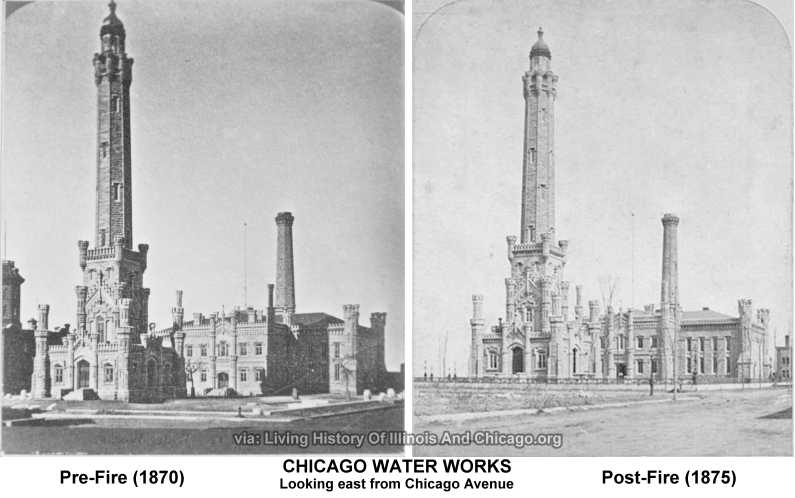
The Water Tower gained prominence after the Great Chicago Fire of 1871. While some incorrectly believe the tower was the only building to survive the fire, a few other buildings in the burnt district survived along with the tower. The Water Tower was the only public building in the burnt zone to survive and is one of just a few surviving structures still standing today.
 |
| Chicago Water Tower, 1890. |
 |
| Looking south along Pine Street (now North Michigan Avenue) from Pearson, Chicago, 1892. |
 |
| Water Tower and Pumping Station looking northwest from the corner of Pine Street (Now North Michigan Avenue) and Chicago Avenue, Circa 1890 |

In 1918, when Pine Street (now North Michigan Avenue) was widened, the plans were altered to give the Water Tower a featured location.
 |
| Looking North on Michigan Avenue, Chicago. 1926 |
 |
| Water Tower, Kaufman & Fabry, 1929 |
 |
| The intersection is at Michigan Avenue and Pearson Street, Chicago. 1940s |
 |
| Double-decker Chicago Motor Coach Company bus in front of the Water Tower on Michigan Avenue, Chicago. 1941 |
 |
| Looking east at the Chicago Water Tower, circa 1975. That's Water Tower Place - Shopping Center & Condominiums under construction. |

The Chicago Water Tower was designated the first American Water Landmark in 1969 and a Chicago Landmark in 1971. Chicago Avenue Water Tower and Pumping Station were listed on the National Register of Historic Places as "Old Chicago Water Tower District" in 1975.
In 2014, Water Tower Park was renamed "Jane Byrne Park" to honor the 50th Mayor of Chicago (1979-1983) and the first female mayor of the City of Chicago.
- St. Ignatius College Prep.
- St. Michael's Church, Old Town, Chicago.
- Chicago Water Tower.
- Chicago Avenue Pumping Station.
- Police Constable Bellinger's cottage at 2121 North Hudson, Chicago.
- Ironically, O'Leary's House, located at 137 DeKoven Street, was spared from the fire. O'Leary's Post Fire House Photographs.
Claims of Surviving Structures:
- Old St. Patrick's Church was located at 121 Adams Street (700 West Adams Street, today) it was a survivor of the 1871 Chicago Fire because the church was not in the burnt district. The Church was a few blocks farther west than the fire reached.
- St. James Cathedral at 65 East Huron Street, Chicago, was totally gutted when the Great Chicago Fire erupted. Nothing was left but the stone walls, the Civil War Memorial, and the bell tower, whose bells rang for as long as possible, warning the neighborhood of the encroaching fire.
NOTE: Addresses are before the City of Chicago's Renaming and Renumbering in 1909. Use the documents below to get today's street names and current address numbers.
- Chicago Street Renaming Document of 1909
- Chicago Street Renumbering Document of 1909
- Chicago Street Renumbering Document of 1911 for Chicago Loop Addresses.
ADDITIONAL READING: A Brief History of North Michigan Avenue, Chicago, Illinois.
Compiled by Dr. Neil Gale, Ph.D.
Compiled by Dr. Neil Gale, Ph.D.