Wednesday, December 7, 2022

The George Stickney Haunted House, McHenry County Illinois, in the Village of Bull Valley.

The tiny Village of Bull Valley, Illinois, has one of the strangest houses in northern Illinois. Initially located far off the beaten path, it remains secluded today along a quiet, primarily deserted country highway. George and Sylvia Stickney built this English country house in the middle 1800s. They chose such an isolated place for peace and quiet and for their spiritual activities. Both were said to be accomplished mediums and wanted to host parties and seances for their friends. The seclusion offered by the Illinois countryside made the perfect setting.
The George and Sylvia Stickney House.
The house itself was very unusual in its design. It rose to a full two stories, although the second floor was reserved for a ballroom that ran the entire building length. During the Civil War, the house served as quarters for Federal soldiers and was home to the first piano in McHenry County. But this was not why the place gained its fame or notoriety.

As devout practitioners of Spiritualism, the Stickneys insisted on adding distinctive features to the design of the house. These features, they assured the architect, would assist them when holding seances and gatherings at the property. Since the seances would be held quite often, they specified that the house should have no square corners in it. They explained that spirits tend to get stuck in corners, which could have dire results. It has also been suggested that the Stickney's believed that corners attracted the attention of evil spirits as well, a common belief in Spiritualist circles of the time.

According to legend, one corner of a room accidentally ended up with a 90° corner. How this could have happened is unknown. Perhaps the architect either forgot or could not complete the room with anything but a right angle. Maybe he thought that the Stickneys would never notice this one flaw. But they did see! And here, the legend takes an even stranger turn.

The stories say that it was in this corner that George Stickney was discovered one day slumped to the floor, dead from an apparent heart failure, although no visible signs suggested a cause of death. Was he right about square corners? Could a ghost, summoned by a seance, have been trapped in the corner?

After the death of her husband, Sylvia Stickney gained considerable fame as a spirit medium. The upstairs ballroom was converted into a large seance chamber. People came from far and wide to contact the spirit of their deceased loved ones and relatives. Sylvia also claimed to stay in contact with her unlucky husband and departed children.

Today the mansion is occupied by the Village of Bull Valley and its police department.

In 2005 Bull Valley Police Chief Norbert Sauers described his experiences with possible paranormal events in the Stickney Mansion. Sauers said village employees have heard numerous sounds that defy explanation. He heard footsteps in the second-floor ballroom, a room used today as storage for village records. The footstep sounds have extended out onto the stairwell at times. Other occurrences include hearing human-sounding voices and noises. Sometimes they hear toilets flushing when they are alone in the house.
The Village of Bull Valley and Bull Valley Police Department.


The Chief said he has personally experienced objects moving around on his desk, lights turning off, door knobs turning and a door opening seemingly by themselves, and voices from thin air. The Chief once heard a shout in his ear when no one was around him. Another police officer in Bull Valley claims to have come face to face with an apparition of Stickney's father-in-law.

According to a local news report, "over the years, two men who carry a badge and gun" have quit their jobs over supernatural events.

The Stickney house is listed on the National Register of Historic Places and is presumed to be haunted.

Compiled by Dr. Neil Gale, Ph.D.

Tuesday, December 6, 2022

Nikola Tesla's "Egg of Columbus" at the 1893 Chicago World's Columbian Exposition.

Nikola Tesla (1856-1943) was a Serbian-American engineer and physicist who made dozens and dozens of breakthroughs in the production, transmission and application of electric power.

Tesla Electric Light and Manufacturing Company was in Rahway, New Jersey, that operated from December 1884 through 1886. Tesla is forced out of the Tesla Electric Light Company with nothing but worthless stock.
Nikola Tesla (1856-1943)


He endured a brutal winter of 1886/87 working as a ditch digger. He persevered, determined to develop his concept of generating electricity through rotating magnetic fields. However, Tesla knew that he must find a way to help investors and supporters understand the potential of his invention.

The rotating magnetic field is one of Tesla's most far-reaching and revolutionary discoveries. This is a new and wonderful manifestation of force — a magnetic cyclone — producing striking phenomena that amazed the world when he first showed them. It results from the joint action of two or more alternating currents definitely related to one another and creating magnetic fluxes, which, by their periodic rise and fall according to a mathematical law, cause a continuous shifting of the lines of force.

sidebar
Tesla invented the first alternating current (A/C) 'motor' and developed A/C electric  generation and transmission technology.

There is a vast difference between an ordinary electromagnet and the one invented by Tesla. In standard electromagnets, the lines are stationary, and in Tesla's invention, the lines are made to whirl around at a furious rate. The first attracts a piece of iron and holds it fast; the second causes it to spin in any direction and speed desired. 

Long ago, when Tesla was still a student, he conceived the idea of the rotating magnetic field. This remarkable principle is embodied in his famous induction motor and power transmission system, now universally used.
Tesla's exhibit at Chicago's 1893 World Columbian Exposition.


Tesla devises a machine to illustrate the concept: an electromagnetic motor that generates the force needed to spin a brass egg and stand it upright on its end.
Nikola Tesla's "Egg of Columbus" was exhibited
at Chicago's 1893 World Columbian Exposition.
Tesla named the device the "Egg of Columbus" after the famous story in which Christopher Columbus challenged the Spanish court and investors to stand an egg upright. When they failed, Columbus took an egg and crushed the bottom flat so it would remain upright. They accused him of playing a cheap trick. Still, Columbus overcame their objections by explaining that an idea can seem impossible until a clever solution is found, at which point it suddenly becomes easy.
How The "Egg of Columbus" Works.
Canadian Tesla Technical Museum.
Tesla Projects Laboratory Inc.
 
Tesla incorporates this logic in his Egg of Columbus to present his concept of alternating current A/C electricity to investors. It is a stroke of brilliance that results in funding from investors Alfred S. Brown, director of Western Union, and Charles F. Peck, a big-shot attorney from New York City. 

sidebar
Tesla’s first laboratory opened in April 1887 and was located at 89 Liberty Street in New York’s Lower Manhattan Financial District. This is where Tesla began planning and developing his designs for the A/C induction motor.

Tesla wrote in his autobiography of this time in his life when he went from ditch digger to laboratory owner, where he finally built the first models of his induction motor concept: "Then followed a period of struggle in the new medium for which I was not fitted, but the reward came in the end, and in April 1887, the Tesla Electric Company was organized, providing a laboratory and facilities. The motors I built there were exactly as I had imagined them. I made no attempt to improve the design but merely reproduced the pictures as they appeared to my vision, and the operation was always as I expected."
Nikola Tesla (year unknown).


sidebar
In 1893, three years prior to the earliest attempts in Hertz wave telegraphy, Tesla first described his wireless system and took out patents on a number of novel devices which were then but imperfectly understood. Even the electrical world at large laughed at these patents. But large wireless interests had to pay him tribute in the form of real money, because his "fool" patents were recognized to be fundamental. He actually antedated every important wireless invention.

Nikola Tesla lived a century behind his time. He had often been denounced as a dreamer even by well-informed men. He has been called crazy by others who ought to have known better. Tesla talked in a language that most of us still do not understand. But as the years roll on, Science appreciates his greatness, and Tesla receives more tributes.
"Today, Nikola Tesla is considered to be the greatest inventor of all time. Tesla has more original inventions to his credit than any other man in history. He is considered greater than Archimedes, Faraday, or Edison. His basic, as well as revolutionary, discoveries for sheer audacity, have no equal in the annals of the world. His master mind is easily one of the seven wonders of the intellectual world."                                                                                        ─ Hugo Gernsback
sidebar
There are a lot of assumptions made reguarding Tesla's private life. One of the few 
things that we know for sure is that Tesla never married. Tesla's seemingly indifference  in women {friends, like a sister}, made him the perfect target for whispers and gossip that he was homosexual, but, of course, there's no evidence. (Karl-Maria Kertbeny coined the term 'homosexual' in print 1868.) 

Tesla, unbeknownst to him, was the cynosure of all the lady's eyes. Despite being surrounded by beautiful, intelligent, women of substance, many who grew to love Nikola, yet nobody became Mrs. Nikola Telsa.

The issue wasn't the failure to meet his expectations. Instead, it turns out to be Tesla's 'no distractions' attitude allowing him to focus his energy on inventing (solutions to a problem), improvements, and , most importantly, the documentation.
 
"I don't think that you can name many great inventions that have been made by a married man." ─ Nikola Tesla.

Compiled by Dr. Neil Gale, Ph.D.

Saturday, December 3, 2022

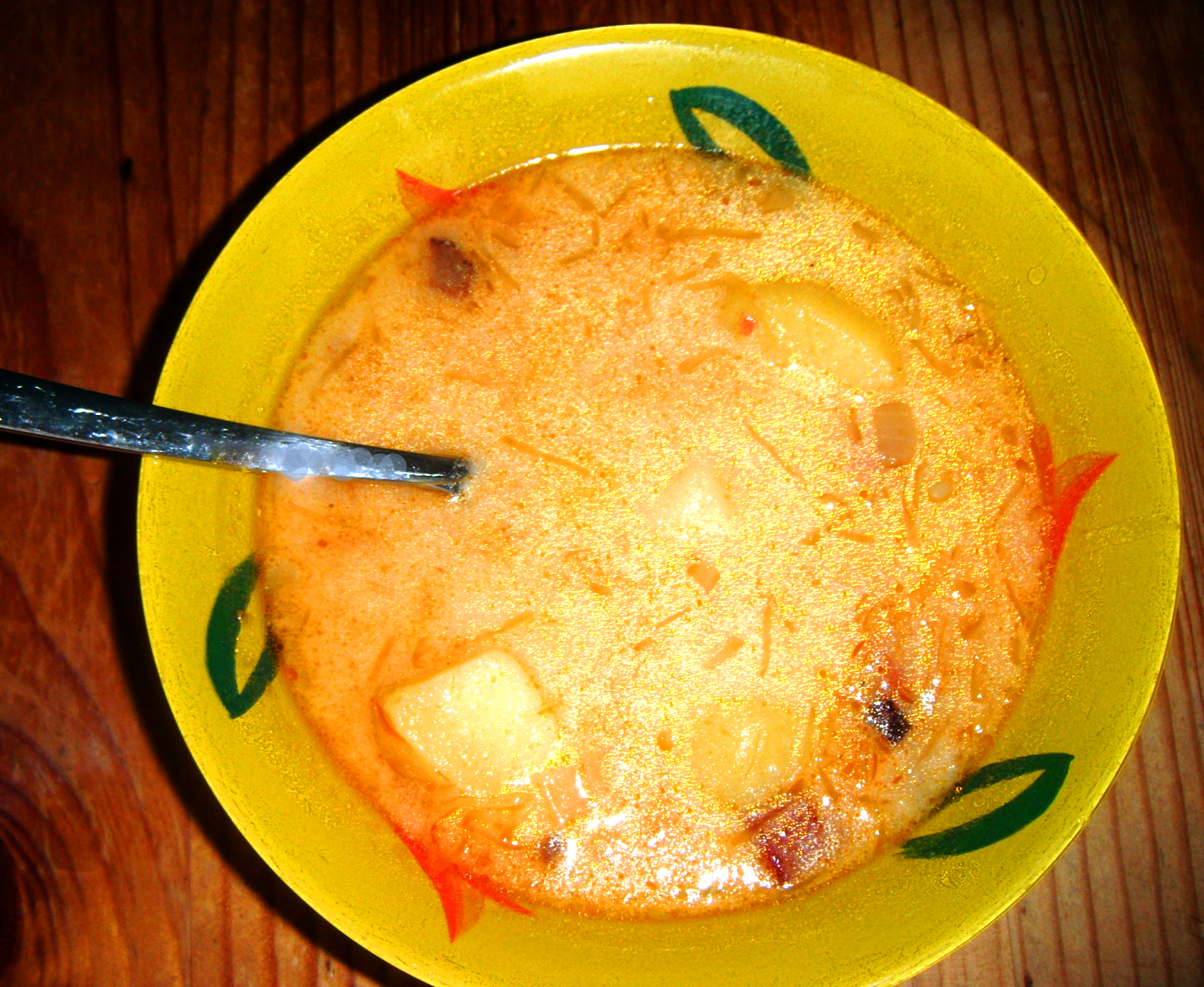
Mel Markon's, Restaurateur, Authentic Sweet & Sour Cabbage Soup Recipe.

Mel Markon's Sweet & Sour Cabbage Soup quickly became my benchmark for judging all other sweet & sour cabbage soups.
An actual photo of Mel Markon's Famous Sweet-and-Sour Cabbage Soup. 


sidebar
A very close 2nd to Mel Markon's came from "What's Cooking Restaurant" in the Lincoln Village Shopping Center, Chicago. It's a brothier, tomatoey soup with chunkier vegetables and a bit sweet. Straight from the old country  

Being a serious "foodie" since I was 7 years old, I must step out of my Chicagoland roots to Manhattan's Carnegie Deli on 57th Street, New York. They opened just offstage from Midtown Manhattan's theater district in 1937.  Carnegie's Sweet & Sour Cabbage Soup had a velvety texture and perfectly cooked beef. It's a shame that they permanently closed on December 31, 2016. 
 
PERSONAL NOTE:  
I ordered a cup of chicken matzo ball soup at the Carnegie. The waitress came to the table and plopped down a bowl of chicken soup with one GIGANTIC  matzo ball resting in the center. The Waitress says, "There ain't no way to get those matzoballs [is 'matzoball' one word?] in a cup, so we serve 'em the matzoball in a bowl,  filled with soup."

INGREDIENTS:
  • 24 cups water (1½ gal)
  • 3 lbs short rib of beef
  • 2 heads of cabbage, cut into bite-size pieces (about 3 pounds)
  • 2 med. onion, chopped 
  • 2 cups tomato ketchup
  • 1 - 4.5 oz can of diced tomatoes, drained
  • 1 cup sugar
  • 1 cup brown sugar
  • 2⁄3 cup lemon juice 
  • 3 tablespoons sweet paprika
  • 2 tablespoons salt - to taste
DIRECTIONS:
  • Boil the meat in [filtered] water using a stainless steel or enameled pot. 
  • Skim the froth as it rises.
  • Skim the froth/fat off the broth a few times while it simmers for 1 hour.
  • Transfer meat to a cutting board and trim off bones, fat, and grizzle.
  • Cut the cooked meat into bite-sized pieces, and add back to the broth. 
  • Add remaining ingredients and simmer for 30 to 60 minutes.
Ready In: 2hrs 30mins
Serves: 18

By Dr. Neil Gale, Ph.D.

Saturday, November 19, 2022

The History of Mold-A-Rama Inc., Brookfield, Illinois.

The inventor, Tike Miller (J.H. Miller), did not set out to create one of the most unique vending machines ever constructed. He merely wanted to replace a broken piece for his Holiday Nativity set. When he went to the department stores, they only sold complete sets. Seeing the need, he and his wife started making plaster Nativity pieces in their basement. Soon, he had a factory, making dozens of plaster figurines that he sold in those same department stores.

In later years, Miller crafted additional lines of figurines. They made a line of Space Invaders, Jungle Animals, Holiday Specialties, and his famous Dinosaurs. The difference in these figures was that they were made with waxy plastic instead of plaster. It is thought that this is where Miller first started his experiments with plastic and his new plastic injection process. Using his plastic injection molding machines, Tike made hundreds of wax/plastic dinosaurs in his Quincy, Illinois, factory.
1965


In the late 1950s, Tike Miller sold the rights to his idea of a souvenir-making machine to Automatic Retailers of America Inc. (ARA). For the next few years, he worked with ARA to develop a new vending machine that could make a wax souvenir for anyone with a quarter. A new division of ARA was born, and the term Mold-A-Rama entered the public vernacular.

Debuting at the 1962 Seattle World's Fair, the bubble-topped machines created waxy, plastic models of the Fair's showcase building, the Space Needle, a monorail, a Buddha, a 3D sculpture of the Fair's logo, and other fun designs. At 50¢ each ($5 today), the souvenirs weren't cheap, but the experience of watching the statue created before your eyes must have convinced fairgoers they were seeing the future of manufacturing. 

The William A. Jones Company was founded on April 22, 1971, when Jones purchased his first Mold-A-Rama machines from Roy Ward in Chicago.

Roy was an employee of the original Mold-A-Rama Inc. and purchased several machines and two operating locations, Brookfield Zoo & The Museum of Science and Industry, both in Chicagoland, from ARA. When they decided to dissolve the Mold-A-Rama division of ARA, he operated for only a few years and then decided to sell his machines and retire.

Jones was a Michigan State Graduate working as a supervising accountant at Interstate United, a vending & food service Company much like ARA. After a particularly long day, Bill told soon-to-be retiring coworker Doris Ward, "Why don't you have your husband sell me his business so I can get out of this rat race the same time you do." She replied, "Roy and I were discussing finding a buyer last night." A year and a half later, after working with Roy on weekends, Bill Jones acquired all the Mold-A-Rama machines in the Chicago area.

The production of the Mold-A-Rama machines ended in the mid-1960s.
By 1971, the original Mold-A-Rama Inc. had dissolved entirely, and ARA grew. Today, that company is known as Aramark Food Company (worth $10.5 Billion today). A handful of small businessmen saw the potential in Mold-A-Rama machines and kept them out and running. One of them was Paul Nathanson, an operator out of Minnesota. Paul and Bill soon began working with each other, sharing purchases of custom-made parts. They loaned each other materials and helped each other when needed. Paul Nathanson was one of the original franchisees of Mold-A-Rama and had several working accounts and many more machines than William. But in the early eighties, Paul decided he wanted to call it quits, and William bought him out and became the Midwest's biggest operator of Mold-A-Rama machines.

sidebar
Some years after Mold-A-Rama Inc. was dissolved by ARA, Tike Miller was back to wearing his inventor hat. Recognizing Aluminum's value and popularity, his newest creation reclaimed this precious metal and then paid the recycler cash for the aluminum cans they had deposited. Years ahead of its time, the “Golden Goat,” as it was called, could fit in any supermarket parking space, taking up only a couple of parking spaces. Tike Miller was truly ahead of his time.

William A. Jones Co. had expanded from just the Chicago area to four states, and William brought in his sons Paul and Bill Jr. to help run the business. The Mold-A-Rama machines just keep getting older and older but are a favorite for visitors at major attractions nationwide.

At one time in the early 1970s, Mold-A-Rama machines were ubiquitous in museums, zoos, and other attractions all over the US. They were injection molding machines, and the plexiglass bubble allowed you to see a tiny part of the process — basically, the two halves of the mold coming together. Then, when they separated, you saw your molded statue in all its shiny plastic glory as a spatula-like device scraped the statue off the base underneath, dumping it into a slot for your convenient retrieval. There were dozens of designs in various colors — some specific to the place — like Disney theme parks and Sea World — while others were more generic.
The Complete Set of Disney Characters. ©Moldville
Mold-A-Rama — Disneyland Toy Factory. 25¢


There were animals, vehicles (including the Space Shuttle), things like Santa, Christmas trees, and even the Houston Astrodome. The statuettes grow frail as they age and become more susceptible to catastrophic breakage after a couple of decades. 

The Mold-A-Rama figures were a delightful treat from childhood. People remember the excitement fondly at feeding quarters into the machine, waiting while the loud rumbling and hissing of the pneumatics involved, and finally, seeing the molded creation revealed before it was unceremoniously dumped into the retrieval slot. It was still quite warm at this stage, and the instructions on the machine cautioned the new owner to hold the figure upside-down by the base until it had cooled to prevent any still-liquid plastic from spilling out through the two holes in the base. The hot plastic smell was unique and highly memorable even to this day.

In 2011, Jones Co. changed the company name to Mold-A-Rama and incorporated. Now, the largest operator of Mold-A-Rama machines in the Midwest is once again known as . . . Mold-A-Rama Incorporated.

Bill Jr. died in 2014. In 2015, William A Jones decided to step back into semi-retirement.

Compiled by Dr. Neil Gale, Ph.D.


2022 MOLD-A-RAMA MACHINE LOCATIONS

        Mold                                        Location
 
BROOKFIELD ZOO, CHICAGO, IL
3 Monkeys (Teal)             Tropic World Entrance
Tree (Green)                     Bookstore Annex
Santa (Red)                     Bookstore Annex
Reindeer (Brown)             West end of Pachyderm Building
Choir Girl Ornament (Blue)     Bookstore Annex
Rhino (Army Green)     East end of Pachyderm Building
Seal (Pink)                     Bookstore Annex
Gorilla (Black)                     Tropic World Entrance
Large lion (Orange)            Restrooms Coast Gifts & Café Del Sol
Penguin (White)             Restrooms Coast Gifts & Café Del Sol
Walking Bear (tan)             Underwater viewing Great Bear Wilderness
Polar Bear (White)             Underwater viewing Great Bear Wilderness
Otter (Silver)                     Just inside the Swamp exit

COMO PARK ZOO, ST. PAUL, MN
Gorilla (Black)                     Primates Building
Sea Lion (Red)             Aquatic Animal Building
Vintage Lion (Yellow)     Large Cats Building
Polar Bear (Light Blue)             Aquatic Animal Building

FIELD MUSEUM, CHICAGO, IL
Quetzalcoatlus (Light Blue)     Upper level in front of Evolving Planet
T-Rex (Red)                     Upper level in the rear hall of Evolving Planet
Apatosaurus (Green)             Main level in front of Africa
Bushman Gorilla (Brown)     Main level in front of Becoming Jane
Stegosaurus (White)     Ground level by Sea Mammals
Ankylosaurus (Green)             Ground level by Sea Mammals

HENRY FORD MUSEUM, DEARBORN, MI
Weiner Mobile (Orange)              In front of Plum Market Kitchen
Mustang (Orange)            In the back of Liberty & Justice for All
Abraham Lincoln (White)    In the back of Liberty & Justice for All
Rosa Parks Bus (Green)             Corner of Liberty & Justice for All
Mickey Mouse (Red)     Giant Screen Theater
Henry Ford(Gray)             Giant Screen Theater
Model T (Black)             Made in America Manufacturing
Kennedy Limo (Black)             Presidential Vehicle Wall
Train (Silver)                     In front of the Allegheny Train
Gasser (Blue)                     In front of the Allegheny Train

MILWAUKEE COUNTY ZOO, MILWAUKEE, WI
Bat (Black)                                  Outside exit of small mammals building
Elephant (Grey)             Outside of Conservation outpost
Tiger (Orange)                     North end of Feline House
Giraffe (Red)                    Across from Giraffe yard west side of the Mall
Gorilla (Black)                     Indoor Gorilla Exhibit
Lion (Yellow)                     South end of Feline House
3 Monkeys (Brown)             Outside the west wall of Primate House
Skull (White)                     In front of the Polar Bear exhibit
Ghost (Purple)                     On the East side of the mall, across from the Giraffes
Panther (Tan)                     Walkway near Flamingo Cafe’s Patio
Standing Frank (Green)             Under the Mold-A-Rama tent next to the train station
Eagle (Blue)                     Under Mold-A-Rama tent next to the train station
Seahorse (Silver)             Outside the west wall of Primate House

MUSEUM OF SCIENCE & INDUSTRY, CHICAGO, IL
Tractor (Green)             By the farm exhibit
U505 (Gray)                     Lower level near U505 entrance
Baby Chicks (Yellow)     Main level in Genetics across from hatchery
Train (Black)                     Main level by Great Train story
Chicago Skyline (Red)             Main level near the silver elevator
Robot (Silver)                     Inside Mold-A-Rama exhibit
Monorail (Green)             Inside the Mold-A-Rama exhibit
HMS Bounty                     Inside the Mold-A-Rama exhibit
Choir girl ornament (White)     Inside the Mold-A-Rama exhibit

SAN ANTONIO ZOO, SAN ANTONIO, TX
Elephant (Gray)             Across from the Jaguar before Riverview
Giraffe & Baby (Orange)             Across from the Jaguar before Riverview
Flamingo (Red)             Next to the Crossroads Cafe
3 Monkeys (Green)             Next to the Crossroads Cafe
Rhino (Brown)                     Near Carousel Ticket Booth
Lion (Yellow)                     Across from Lory Landing
Hippo (Blue)                     Across from Lory Landing
Kangaroo (Pink)             Near Carousel Ticket Booth

Friday, November 18, 2022

The History of the Tom Tom Tamale Manufacturing Company, Chicago, Illinois.

The tamale is recorded to have originated in “Mesoamerica as early as 8000 to 5000 BC” in Pre-Columbian history. As making tamales is a simple method of cooking corn, it may have been brought from Mexico to Central and South America. However, according to some archaeologists, the tamales date from the year 100 AD. They found pictorial references in the Mural of San Bartolo, in Petén, Guatemala.” Although the tamales may have moved from one country to another, as many other countries in South and Central America seem to have their own version of tamales, there is no evidence of “where the migration of the tamales went from north to south” or vice versa within the Americas.

Modern-day manufactured tamales, called 
corn roll tamales, became popular in the early 1940s.
A Frozen Tom Tom Tamale
Tom Tom Beef Tamales have been a staple of Chicago since 1937. Served straight from metal steamers at Italian beef and hot dog stands across the city of Chicago. Corn roll tamales were invented in Chicago, and we have found ways to love them.

Unlike traditional tamales, usually made with masa (cornmeal dough), stuffed with vegetables, meat and or cheese, and then rolled in a natural wrapper, like a corn husk or a banana leaf, before warming, frequently by steam. Unlike anything you'll find in Mexico, Chicago’s corn roll tamales are an industrial product. 
Hand-made Corn Tamales.


Chicago’s original tamales are manufactured on equipment that extrudes cylindrical shafts of brownish-colored cores of lightly seasoned beef, cornmeal, and yellow cornmeal wrapped in a yellow cornmeal exterior. The two big Chicago corn roll tamales brands are Tom Tom Tamale Manufacturing Co., Chicago (est.1937) and Supreme Tamale Co., Elk Grove Village (est.1950).

Tamales were brought to the United States in the late 1800s or early 1900s by Mexican workers who may have pocketed a few before heading off to work in the fields, according to the Southern Foodways Alliance, part of the University of Mississippi’s Center for the Study of Southern Culture.

In those fields, specifically in the Mississippi Delta, Mexican workers likely encountered Black workers with whom they shared the tamales.

sidebar
Tamales were immortalized by Delta bluesman Robert Johnson, of the Faustian bargain at the crossroads, in “They’re Red Hot:”

Hot tamales and they’re red hot,
yes, she got ’em for sale.
I got a girl, say she is long and tall.
She sleeps in the kitchen with her feet in the hall. 
Hot tamales and they’re red hot,
yes, she got ’em for sale.

During the Great Migration, Blacks brought along their tamales. The first documented sale of tamales in Chicago was at the 1893 World’s Columbian Exposition, a hotbed of the culinary invention that also introduced such landmark innovations as Brownies, Aunt Jemima pancake mix, and a few other new food inventions.

However, the spread of corn roll tamales in Chicago may have less to do with Mexican and Black food traditions and more with Greeks and Armenians. The Petros family bought the Tom Tom Tamale & Bakery in 1937, and the Paklaian family bought Supreme Frozen Products in 1950.
Supreme Tamale Company, Inc., 1495 Brummel Avenue, Elk Grove Village, IL.,
got its start out of a factory in Chicago on the corner of Chicago
and Washtenaw Avenues in 1950.
sidebar
The brand name came about, or so the story goes, because the company was once owned by two Greek fellows named `Athanasios,' explains company president Nick Petros. "Since 'Athanasios' is somewhat of an exotic name. In English, they were called 'Tom.' So, two Toms became Tom Tom. Whether or not this is a true story I don't know," Petros admits, "but it's a good story."

The “bunch” tamales, a variant of corn roll tamales still available at places like Superdawg's on Devon and Milwaukee Avenues in Chicago. Bunch-style tamales are 1/4 the size of corn roll tamales and divided with origami-like precision into four baby tamale fingers.
Bunch Tamales


This carb-heavy street food seems designed to fill up whatever belly space remains unoccupied after one puts away an Italian beef sandwich or a Chicago-style hot dog with all the fixings. Chicago corn roll tamales are usually one of the least expensive items on a menu, though it’s not exactly a value: at Superdawg, tamales are $3.50 each, and their jumbo (their regular size is 6 hot dogs to a pound) hot dog with fries is $7.25.

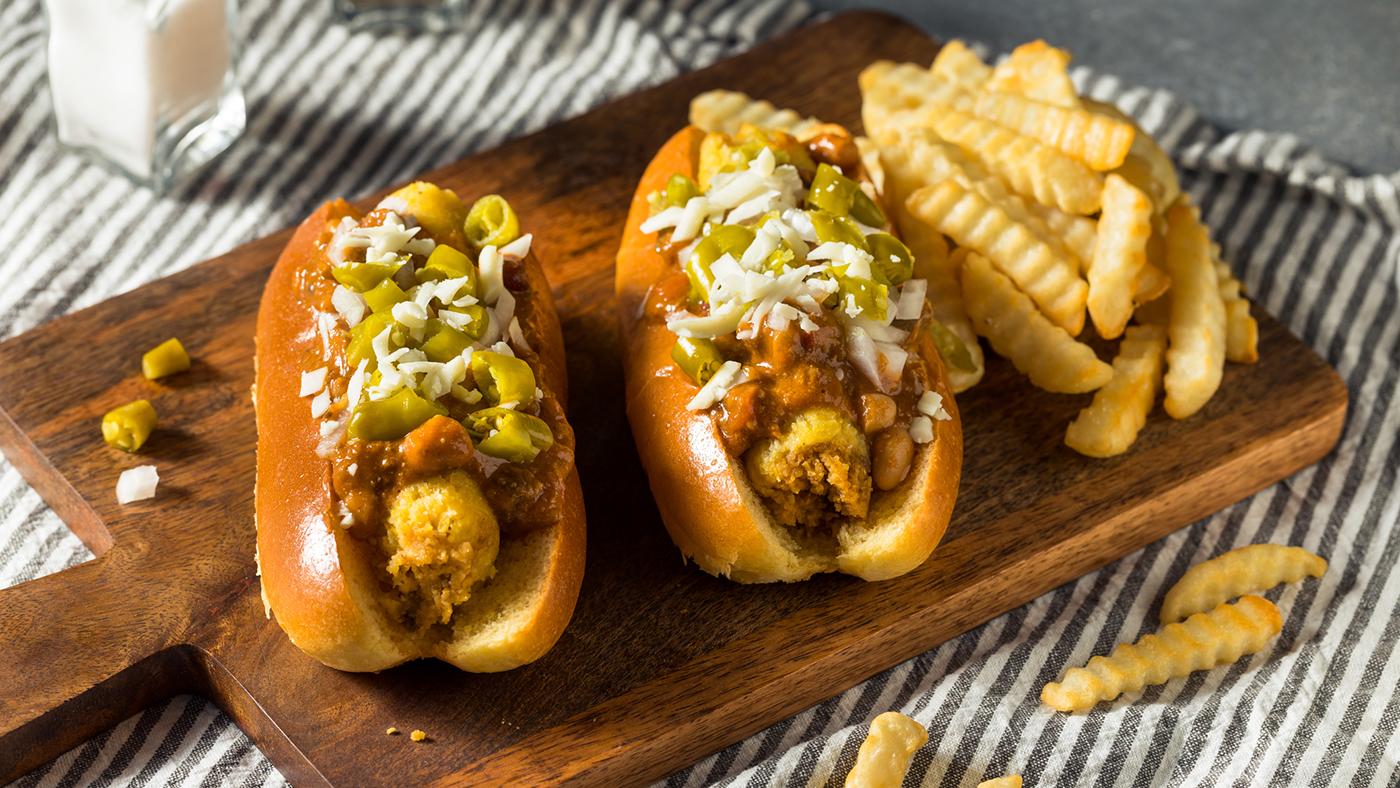
Corn roll tamales are the star of another Chicago food, the “tamale boat,” also called “chili cheese tamales,” in which tamales are submerged in chili to become a kind of lush, spongy cornmeal dumpling that absorbs flavors beautifully. This version of corn roll tamales is usually served with sports peppers, chopped onions and cheese, which add even more flavor.

Corn roll tamales are also used in other Chicago original foods, like the Mother-in-Law (a tamale in a hot dog bun, ladled with chili, dressed with standard Chicago hot dog condiments), as served at many hot dog joints. 

Sidebar
Bourdain brought the national spotlight to Chicago's southside "Mother-in-Law" sandwich, claiming it to be “disturbing in design, but strangely compelling." Back in 2009, when No Reservations aired its Chicago episode, he called the city “a colossus right smack in the middle of the country” with “everything that I love about a city — tall towers, hard corners, and sharp elbows. And, of course, food.”
The Mother-In-Law Sandwich


Few deem Chicago corn roll tamales to be a culinary masterpiece on the level of a Chicago Italian beef or a Chicago hot dog. Still, it’s Chicago, and it's ours. I recommend you have your Chicago corn roll tamales in a boat with chili, onion and cheese. Many also add sports peppers, but, of course, toppings are your choice.

Tom Dziedzic sent me some photos of his mother working at Tom Tom in 1939 or 1940.
"Mom often talked about working at Tom Tom Tamale Bakery and how much fun these women had while working together." writes Tom Dziedzic, "My mom is standing second from right, in the different uniform."
Mrs. Dziedzic, center, and Tom Dziedzic's future Godmother,
Jean Mazur, on the right.
sidebar
An honorable mention goes to Veteran Tamale which began in 1946 at 33rd and Morgan streets in Chicago. In 1947 they bought the building at 3133 South Archer Avenue. The family stopped using meat in the 1960s after inspectors with the United States Department of Agriculture continually hassled them. Veteran Tamale switched to spiced, textured soy protein cooked in lard, then ditched the lard for vegetable oil. The final vegetarian recipe was ideal for Catholics abstaining from meat during Lent. Veteran Tamale closed in January 2017.


Compiled by Dr. Neil Gale, Ph.D.