
Monday, July 31, 2023

The First Nine Stagecoach Routes out of Chicago.

The earliest stagecoach routes were established in 1832 through the 1840s as Chicago rapidly grew and became a transportation hub. The routes had stops to change teams for meals, lodging, and nature calls. 


The stagecoaches allowed people to travel long distances quickly and were primarily carefree as paid passengers but for road and weather conditions. Transportation played an essential role in the steady growth of Chicago.

  • Chicago─Fullersburg (Oak Brook, today) route was the first stagecoach route out of Chicago. The route fare was 10¢ ($3.25 today) for the 15-mile trip between Chicago and Fullersburg. Frink, Bingham & Co. Stagecoach was established in 1832 by John Frink and Charles K. Bingham. The Chicago to Fullersburg route followed the "Indian Boundary" line drawn between the Potawatomi and Ojibwe Indian tribes in 1816. The line ran through what is now Cook County, Illinois. The Indian Boundary line connected Chicago with the Des Plaines River, a tributary of the Illinois River, which, in turn, is a tributary of the Mississippi River. Chicago's population exploded. The Chicago and Aurora Plank Road was built along the Indian Boundary in 1834 and was one of the first plank roads in Illinois. The Chicago and North Western Railroad was built along the Indian Boundary in the 1850s.
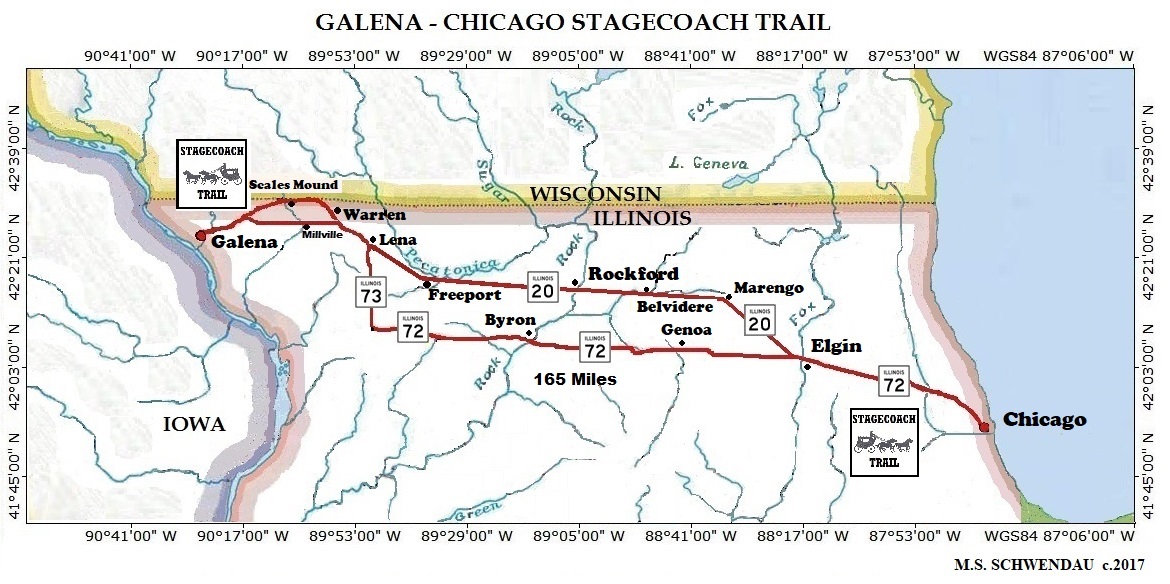
  • Chicago─Galena route was the most popular stagecoach route in Illinois. The trip took about five days. A single trail linking Chicago to Galena was formally established in 1839 by John Frink and Martin Walker, who, together in 1840, established Frink, Walker & Co., Stage Line in Chicago. It spurred economic growth in both cities and the birth of many villages, which began as stagecoach stops, and soon, supporting businesses popped up.
  • Chicago─Peoria route was first established in 1833 when a one-horse stagecoach was placed in service between the two towns, and it took 2 days (24 hours). A two-horse wagon was put into service the following year, and the route was extended southwest to Ottawa. The stagecoach line expanded to include Aurora, Joliet, and Bloomington stops. The stagecoach route continued to operate into the 1850s when it was replaced by the railroad.
  • Chicago─Rockford stagecoach route was among the earliest in Illinois. It was established in 1835 by John Kinzie. The route linked Chicago, a quickly growing town (Inc. Aug.12, 1833), with the village of Rockford, which was located on the Rock River. A popular route, coaches were often crowded, and the trip could be rough and uncomfortable. However, the route was also relatively fast, taking about 12 hours. This route was replaced by the Chicago and Galena Union Railroad in 1850. 
  • Chicago─Milwaukee was a Lake Michigan paddleboat route. The distance between Chicago and Milwaukee was about 12 hours by paddleboat at the end of the 1830s. The fastest paddleboat on the Chicago─Milwaukee route was called the 'Milwaukee,' which was put in service in 1839. The Milwaukee cruised 12 miles per hour, making the trip between Chicago and Milwaukee in just under 10 hours. Three meals, snacks, and perhaps Beer were available.
  • Chicago─Detroit route took about four days to travel. Many stagecoaches stop, changing horses and drivers, perhaps a different coach, saloons to eat and board, or boarding houses for a night's stay. 
  • Chicago─Joliet stagecoach route was initially operated by the Chicago and Joliet Stage Company as a mail and passenger route. The stagecoaches traveled round trip between Chicago and Joliet three days a week. The one-way trip took about four hours.
  • Chicago─Aurora route was initially operated by the Chicago and Aurora Stage Company in 1842 as a mail route, adding a large passenger carriage. The 4-horse stagecoaches traveled between Chicago and Aurora, a 30-mile trip that took about three hours, twice a day, each leaving at six in the morning and at three in the afternoon, making it possible to travel back and forth and be back home for supper. The route was often dangerous, prone to flooding and bandits. 
  • Chicago─Elgin The first stagecoaches on the Chicago─Elgin route began operating in 1838. The Chicago and Elgin Stage Company initially operated the route primarily as a mail route and passenger transport. The stagecoaches traveled between Chicago and Elgin twice a day, and the trip took about two hours. The Chicago─Elgin stagecoach ceased operating in the late 1850s, as railroads became the dominant mode of transportation, U.S. Mail, and shipping in the Midwest and beyond. 
What Stagecoach Travel in 1830s Chicago and Illinois was really like. 

The stagecoaches were eventually replaced by railroads, but they played an essential role in the early development of Chicago and surrounding areas. They connect Chicago to other parts of the state and the country, which promoted the city's growth.

Compiled by Dr. Neil Gale, Ph.D.

Sunday, July 30, 2023

Thomas Lincoln's, President Lincoln's Father, Fifteen Houses Chronology

A list of the cabins that Thomas Lincoln, President Lincoln's father, occupied or built from his birth in 1778 until he died in 1851.

LINVILLE CREEK, VIRGINIA
Thomas Lincoln's father purchased two hundred and ten acres of land on Linville Creek, in Rockingham County, Virginia, on August 7, 1773. It's where he had been living since his marriage in 1770. Thomas Lincoln was born in 1778 in a cabin on that land tract. He lived there until 1782 when his parents migrated to Kentucky. 

GREEN RIVER, KENTUCKY
The Lincolns lived on a tract of land in Lincoln County, now Casey County when they first arrived in Kentucky in 1782. It is more likely, however, that they resided in Crow's Station, near where Danville, Boyle County, now is, if they contemplated working the Green River lands. The ferocity of the Indians would not allow a scattered population at this time. Crow's Station was the headquarters of the pioneer,  Lincoln, earlier in the year when he was on his prospecting trip in Kentucky.

LONG RUN, KENTUCKY
The first residence of the Lincolns, in Kentucky, of which we have positive evidence, is on Long Run, in Jefferson County. Here the family also found it necessary to live in the fort at Hughes Station when the Indians were troublesome, but likely they occupied the cabin on their 400-acre tract during part of the time. Thomas Lincoln's father, Abraham Lincoln, was killed by Native Americans in May 1786.

BEECH FORK, KENTUCKY
The exact site to which the Widow Lincoln moved her family after the massacre of her husband had yet to be determined, although the general location is made known by a road order which speaks of her cabin on Beech Fork. She reared her family and kept her home together until all the children, except Thomas, were married. Three weddings in the Lincoln home in 1801 were indirectly responsible for the family moving to Rardin County. 

MARROWBONE CREEK, KENTUCKY
On November 28, 1801, Thomas Lincoln purchased a tract of land in Cumberland County, Kentucky. He undoubtedly put up a temporary structure to show possession and "batched" there long enough to claim the land grant. Evidence shows that his residence here was for short periods, as he was often found in Hardin County at various intervals.

MILL CREEK, KENTUCKY
The following purchase of Thomas Lincoln's was made to provide his mother with a home. In the fall of 1803, he paid £118 ($20,000US today) cash for a farm on Mill Creek, about twelve miles north· west of Elizabethtown in Hardin County. He divided his time between this and his Murrowbone Creek farm. His sister and her husband lived with his mother.
Thomas Lincoln
MIDDLE CREEK, KENTUCKY
Alter Thomas Lincoln married Nancy Hanks, in the Berry cabin, on Beech Fork. He brought his bride to Elizabethtown on Middle Creek in Hardin County, where he had purchased a lot and built a cabin. They lived for two years, and their first child was born here. The cabin's location has yet to be discovered, and the picture often exhibited as their Elizabethtown cabin home is spurious.

SOUTH FORK OF NOLIN, KENTUCKY
Thomas Lincoln moved from Elizabethtown to his new purchase on the South Fork of Nolin in late 1808. This farm was the largest tract of land he had owned, and he paid $200 cash for it. It was here on February 12, 1809, that Abraham Lincoln was born. The cabin was situated three miles south of where Hodgenville, LaRue county, now is, and in what was then Hardin county.  

KNOB CREEK, KENTUCKY
About two years after Abraham Lincoln was born, his father moved the family to a cabin on Knob Creek and secured possession of a tract of land there. Abraham lived from when he was two years old until he was seven. This cabin site was also in what was then Hardin County but which later became LaRue County. It was the last Kentucky residence of the Lincolns. 

LITTLE PIGEON CREEK, INDIANA
Between Thanksgiving and Christmas in 1816, Thomas Lincoln moved his family to what is now Spencer County, Indiana, and settled on the Southwest Quarter of Section 32, Township 4, South of Range 5 West. Tradition speaks of three different shellers which were erected on this site. Like other Lincoln cabins, the cabin which stood there at the time of the family's move mysteriously disappeared. This was the home of Abraham Lincoln from the time he was seven until he came of age.  

SANGAMON RIVER, ILLINOIS
On March 14, 1830, the Lincoln caravan went into camp at Decatur, Macon County, Illinois. Ten miles southwest of this town, near the Sangamon River, the party's men erected a cabin with John Hanks's assistance. This cabin has been given so much prominence and furnished Information and brochures about its being exhibited on Boston Common. Pieces of the cabin were sold for souvenirs. Tradition states that what was left of it was lost at sea en route to England.

BUCK GROVE, ILLINOIS
Sickness, the rigors of a cold winter, and the possibility of Abraham leaving home were responsible for Lincolns  Starting back towards Indiana after a year's residence on the Sangamon. They were persuaded to settle in Buck Grove, close to some of Mrs. Lincoln's relatives, where a cabin was erected in Section 5, Township 11, Range 8. Lincoln remained here on this first Coles County site for three years.   

WALKER'S PLACE, ILLINOIS
There is evidence that Lincoln moved from section five to section ten after his Buck Grove residence and purchased forty acres of land on which he built a cabin. This home was about three-quarters of a mile south of where the town of Lema, Coles County, now stands. 

PLUMMER'S PLACE, ILLINOIS
On November 25, 1834, Thomas Lincoln purchased 80 acres of land in the same township where he was residing, securing half of the quarter section number sixteen. A cabin was erected, and a residence was established until the sale of the property on December 27, 1897. This was probably the third cabin Thomas Lincoln had erected in Coles County.  

GROVE NEST PRAIRIE, ILLINOIS
By the spring of 1838, Thomas Lincoln had become established in the cabin on the new purchase at Goose Nest Prairie, also in Coles County. Here he lived until the day he died in 1851. The place where he died finally came into possession of the National War Museum company, but, like some of the former homes of the pioneer, its disappearance is clothed in obscurity.  

Compiled by Dr. Neil Gale, Ph.D.

Friday, July 28, 2023

Abraham Lincoln's Government Job at New Salem, Illinois.

Postmaster Lincoln
1860 Portrait of Abraham Lincoln by Leopold Grozelier.
The appointment of Abraham Lincoln as Postmaster of New Salem, Illinois, on May 7, 1833, was his first recognition by the general public. The fact that his political faith was not in harmony with the administration then in power must have assured him that he had gained the goodwill of all his neighbors. Following his election as a captain in the Black Hawk War and the very complimentary vote he received as a candidate for the legislature, this honor proved that he had the faculty of making friends. This was a fundamental qualification if one were to succeed in pioneer politics.

While the appointment as Postmaster did not come to Lincoln as a political favor for contributing to the party's success, then directing the affairs of the government, the position did afford him some exceptional opportunities for paving the way toward his own political success. He learned the entire population of that part of old Sangamon County, which later became Menard County. He was usually the first to make the acquaintance of new settlers who sought out the post office, that one point of general contact and information known in pioneer days.

The privilege of reading the newspapers and periodicals that came to the post office was of greater value than the purely local associations. It gave him a more comprehensive reading than most citizens in the county and allowed him to keep advised on all sides of any public question. I recently discovered in the Morgan County courthouse at Jacksonville, Illinois, the record book of the Postmaster at that place, which gives us a better knowledge than we had had before of the many journals in circulation in the state when Lincoln was Postmaster at New Salem. This old record book gives the titles of the papers and magazines and the names of the subscribers who received the publications between October 1831 and December 1832. Lincoln might be called a contemporary of the Jacksonville postmaster. His term of office began five months after the filing of these records. On the back cover of the old book is this citation: "Samuel Hill for two letters 37½¢." Hill was the Postmaster whom Lincoln succeeded at New Salem. As Jacksonville and New Salem were not more than thirty-five miles apart, it is reasonable to conclude that most of the publications which went through one post office were circulated through the other.

Mail arrived at the New Salem Post Office once a week, delivered on a route that ran from Springfield, IL, to Millers Ferry, IL. If addressees didn't collect their mail at the Post Office, which was customary, Lincoln delivered it personally — usually carrying the mail in his hat.

Lincoln received compensation of $55.70 ($1,931 today) in the fiscal year 1835. Besides his pay, Lincoln could send and receive personal letters free and get one daily newspaper delivered for free. Lincoln served as Postmaster until the office closed in May 1836.

About $18 ($590 today) was left in the New Salem Post Office's coffers when it closed in 1836, so Lincoln held onto the money. When a government agent later visited Lincoln to collect the funds, the future President, who was financially strapped then, retrieved the money from a trunk and presented it to the agent.

EARLY PUBLICATIONS
The following publications were delivered by the Postmaster of Jacksonville, Illinois, to subscribers residing in Morgan County, Illinois, between October 1, 1881, and December 31, 1832. The names of the subscribers and the amounts of postage they paid are listed with the title of the publication in a book in the archives of the Morgan County courthouse:

Alarm, Beardstown Chronicle, Bibical Repository, Boston Recorder, Casket, Christian Advocate, Christian Messenger, Christian Watchman, Cincinnati American, Evangelist, Farmers Chronicle, Focus, Gospel Herald, Home Messenger, Illinois Herald, Home Missionary, Journal of Commerce, Kankawn Banner, Kentucky Gazette, Kentucky Reporter, Ladies Book, Lexington Observer, Liberal Advocate, Louisville Focus, Louisville Post Advertiser, Marietta Gazette, Millenial Harbinger, Missionary Reporter, Missionary Herald, Missouri Republican, National Intelligencer, National Preacher, New York Observer, New York Optic, New York Post, New York Spectator, Niles Register, Ohio Patriot, Old Countryman, Palmyra Central, Philadelphia Evening Post, Plough Boy, Presbyterian, Revivalist, Sangamon Journal, Southern Advocate, Spirit Pilgrims, Standard, St. Louis Republican, St. Louis Times, Sunday School Banner, Sunday School Journal, Susquehana Democrat, Tennessee Herald, Theology, Vandalia Whig, Wayne Sentinel, Western Luminary, Western Pioneer, Youth's Friend. 

Compiled by Dr. Neil Gale, Ph.D.