Saturday, June 10, 2023

Ford City Center, Chicago, Illinois.

THE WAR EFFORT
Ford City Center was initially built as a manufacturing plant for the Dodge Chicago Plant in 1942. It was used to produce B-29 bomber aircraft engines and other war materials during World War II. Approximately 17,000 workers were employed. By October, Building No. 1 was finished. 
The Dodge Chicago Plant office building, 7401 South Cicero Avenue, Chicago, Illinois, in 1942. Built on 500 acres of undeveloped (greenfield) land. The Dodge Chicago plant office building was 32,844 sq. ft. It also had a loading dock of 2,300 sq. ft. The plant had 5,551,744 sq. ft. or 128 acres of floor space. Only B-29 airplane engines were built here, each using over 18,000 individual parts. Five machines were built for every B-29 so replacements would be readily available.


By the spring of 1943, 10 steel, concrete and wood buildings had been constructed. The building covered approximately 6,000,000 square feet. The largest building was Building No. 4. It covered 62 acres and was built out of reinforced concrete. The plant contained 7,000 miles of underground piping and 15 miles of cables and wires for water and power.

By December 1945, the plant was left vacant due to the end of World War II. The government attempted to sell it without success.

The plant was later retrofitted for automobile production by the Tucker Corporation. The "Tucker Torpedo" was the name given during the concept and design phases. All 51 production cars sold under the "Tucker 48" nomenclature, so named for its model year.
The building remained a white elephant until the Korean War when it was reopened to build airplane engines for the war effort under contract from Ford Motor Company. The Ford company modernized everything inside the building, employing nearly 12,000 people. The facility closed again in 1959.

FORD CITY
In 1961, the government sold the shuttered plant to Harry F Chaddick, who, along with other investors, planned to develop a shopping center. Some buildings were torn down to make room for parking lots. The buildings that remained were remodeled to attract retail tenants. Developers divided the building into separate portions for the mall.

Ford City opened in 1965. The mall consists of two halves, a strip mall and an enclosed mall. 
Ford City Floor Plan 1966


The mall's original front facade and Main Entrance. A Woolworth Five and Dime and Harvest House Cafeteria are in the foreground, with a National Food grocery and JCPenney off in the distance.


The mall consists of two halves, a strip mall and the enclosed mall. The strip mall portion is connected to the enclosed mall by a tunnel called "Peacock Alley." It utilizes the basement between the severed halves of the buildings directly below the parking lot. The Connection was originally called Peacock Alley from the late 1970s through the 1980s. It was built in 1943 as part of the Ford City factory complex. The arcade was named after the famous Peacock Alley at the Waldorf-Astoria Hotel in New York City. As Ford City began to decline in the 1980s, many of the stores in the arcade closed, and the arcade itself became rundown. Changing the name to The Connection did not help revitalize the arcade, which closed in January 2019.
The Grand Mall at Ford City, soon after the official opening of the shopping center. The interior entry of the Harvest House Cafeteria is on the left. The Ford City Grill, also operated by F.W. Woolworth, is in the center of the image.


Another vintage view of the Grand Mall. The entry of the Wieboldt's department store, which anchored the west end of the complex, appears in the background.


Ford City Floor Plan 1975

Wieboldt occupied the western-facing space until 1987, when Carson Pirie Scott & Co. moved in. Montgomery Ward last occupied the southern-facing space until that chain's bankruptcy. That space has since been demolished. JCPenney occupies the eastern-facing space. 

In January 1988, a $52 million renovation got underway. The entire complex was given a facelift, store spaces were reconfigured, and the 10-bay Ford City Food Court was built in a previously-existing area. New signage, water features, flooring and skylights were installed.
A 1986 exterior view of the Ford City Wieboldt's. The nation's largest single-level department store was represented by 219,300 square feet.


Ford City was renamed Ford City Mall in 1989.
Ford City Floor Plan 1990


The General Cinema Corporation Ford City 14-multiplex was built, as a freestanding structure, in the southeast parking area. This venue debuted on August 1, 1990, with the Ford City I-II-III and Ford City East theaters being shuttered. The 14-multiplex was upgraded when the AMC Theatre bought it.
JCPenney built one of their "New Generation" stores at Ford City. It was the chain's largest single-level location. A freestanding JCPenney's Auto Center is seen on the right.
Turn Style had anchored the east end of the strip mall portion until the store was sold and converted to Venture and then to Sears until they closed the store in August 2010.

Until February 2008, General Growth Properties Inc., a private investment company, managed the mall.

In 2009-2010, Ford City Mall began a multimillion-dollar long-term capital redevelopment program undertaking North Mall infrastructure work, Cicero Avenue frontage and North Mall parking lot resurfacing. During this time, new tenants such as Conway (later Fallas), U.S. Cellular, Rodeo, Amici, Star Diamond Jewelers, GNC, She Bar, Eldorado Fine Jewelers, Avon, China Max, Sprint, and other stores opened for business at Ford City Mall. 
In early 2011, the Cicero Avenue pylon signs were refurbished for the second phase of the long-term capital redevelopment plan. This allowed tenants to gain maximum store signage exposure along heavily trafficked Cicero Avenue.

As part of the 2011 capital redevelopment program, Ford City Mall is demolishing several small out parcel buildings and a former vacant anchor store, leading the way to future development options under discussion.

In the summer of 2012, Ford City Mall closed part of The Connection and moved all retailers upstairs.

In mid-2013, a facelift renovation was announced, which was to have commenced in mid-2014. This would have rebuilt the complex's interior, relocated its Food Court, reconfigured most inline store space as big box retail and added several freestanding restaurants.

Ford City's renovation began in 2016. Plans include renovating the mall with corridor seating, new lighting and flooring and a newly remodeled food court. The Carson Pirie Scott & Co. and JCPenney were remodeled. A Five Below store in the North Mall portion opened in September 2016. In addition, several out parcels will be constructed near the Southern end of the mall as well as a new CTA transit center to be opened in 2017. An out-lot building that housed a Chipotle Mexican Grill and a Mattress Firm opened in 2017. An H&M store opened on August 9, 2018.

On April 18, 2018, Carson Pirie Scott & Co.'s parent company, The Bon-Ton Stores, announced they would close all of Carson's locations, including the Ford City, due to their bankruptcy. The store closed on August 29, 2018. 

Ford City Floor Plan 2019
The closure of Carson Pirie Scott & Co. left JCPenney as the only remaining anchor.

THE UNDER 17 MALL CURFEW
In 2009, the mall did institute a curfew for unaccompanied minors. The curfew prohibits children under 17 from entering the mall after 6pm on weekdays and 7pm on weekends. There are a few exceptions to the curfew, such as if the minor is accompanied by a parent or guardian or if they are attending a scheduled event at the mall. The curfew was instituted in response to concerns about minors' loitering, vandalism, and theft. The mall management believes that the curfew will help to create a safer and more welcoming environment for all shoppers.

Compiled by Dr. Neil Gale. Ph.D.

Friday, June 9, 2023

Oakbrook Center, Oak Brook, Illinois.

The tenth shopping mall in Chicagoland was developed by a joint venture of Chicago's Marshall Field & Company and the Urban Investment & Development Company under the guidance of Phillip Klutznick. He had been instrumental in creating the Park Forest Plaza (1949) and Old Orchard Center (1956) shopping malls.

sidebar
Phillip Klutznick was instrumental in creating Park Forest Plaza (1949), Old Orchard Center (1956), and Oakbrook Center (1962) shopping malls. River Oaks Center was developed by a joint venture of the Hartford, Connecticut-based Aetna Life Insurance Company and Chicago's Phillip Klutznick of KLC Venture, Limited. (1966)

Construction began on Oakbrook Center in 1960 at 22nd Street and Kingery Highway in Oak Brook. The $25 million facility was built on a 160-acre parcel located 16 miles west of downtown Chicago in suburban Oak Brook. The open-air complex was designed by Richard Marsh Bennett of the Loebl, Schlossman & Bennett firm (architects of the 1957 Chicago Loop Synagogue). Buildings were constructed with basements.
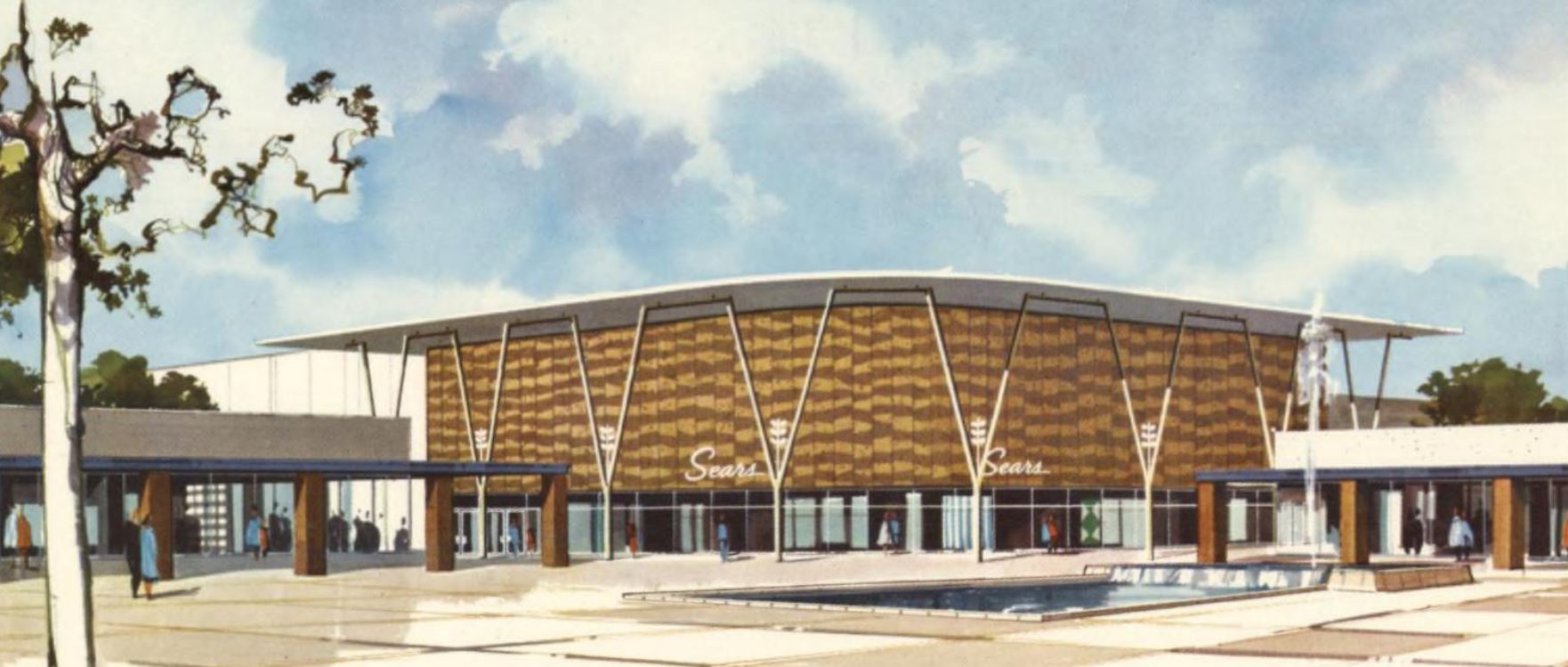
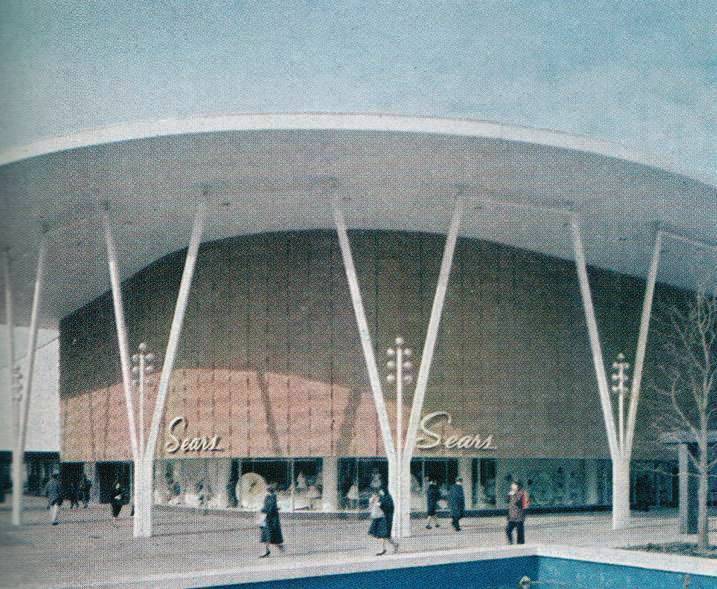
Oakbrook Center Sears encompassed 284,000 sq. ft., not including the freestanding Auto Center.


Thirty-seven stores and services were dedicated on March 5, 1962.
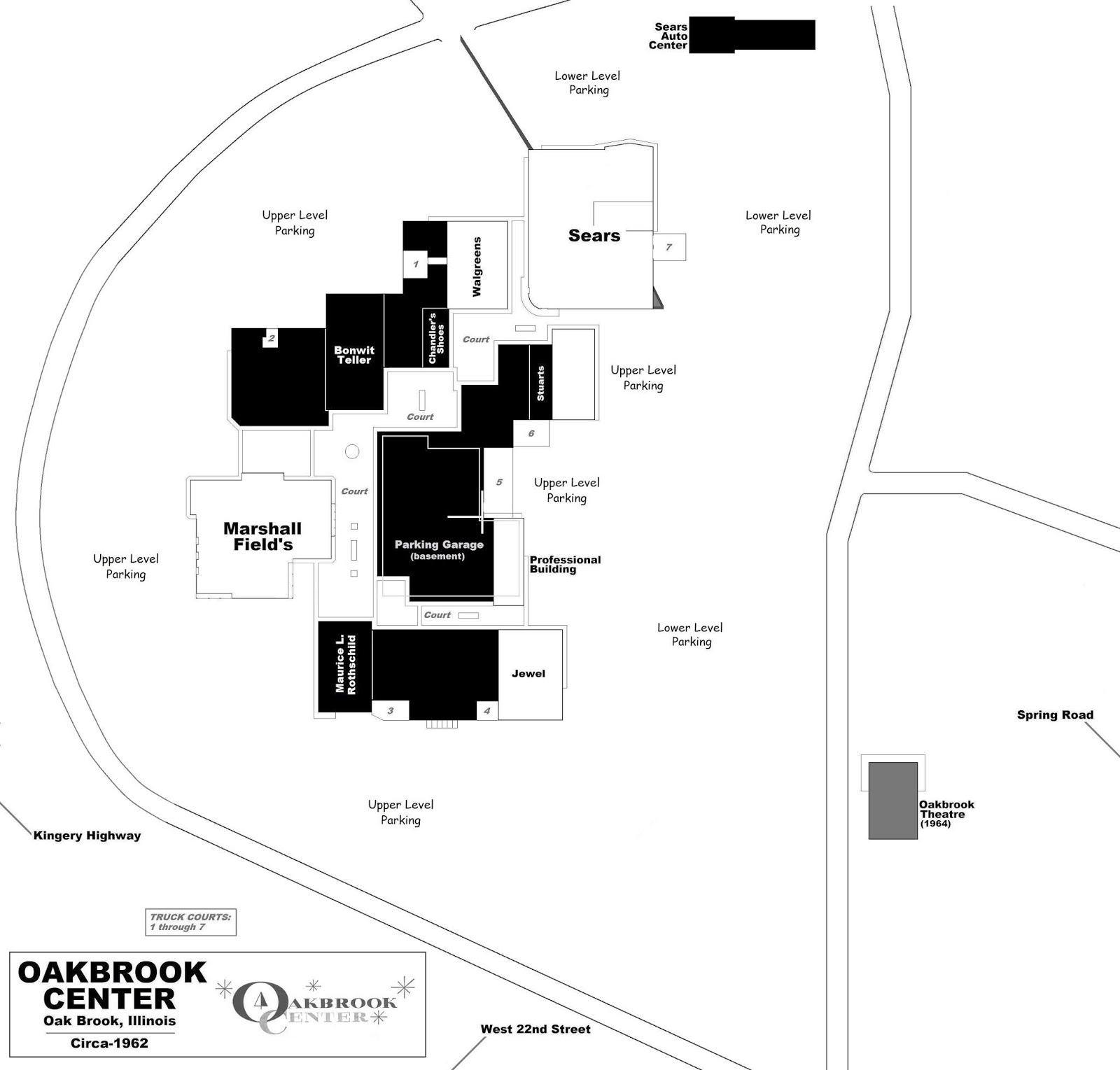
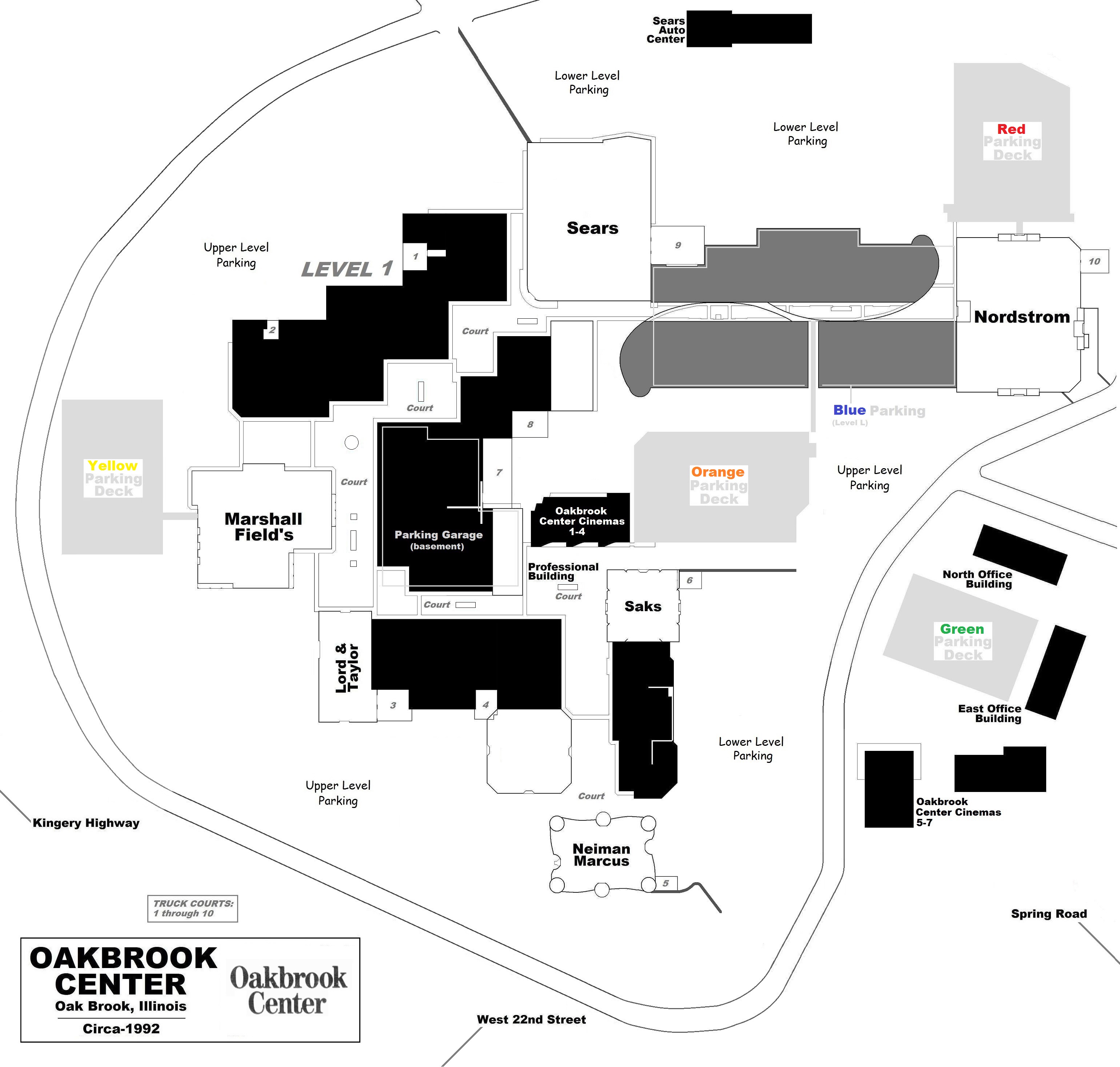
A site plan of the original facility. When fully leased, it housed fifty-six businesses. The surrounding parking area could accommodate 6,900 vehicles. One of the mall's many features was its Professional Building, an 8-story office tower.


Anchoring the mall was a 4-level Marshall Field & Company (365,000 sq. ft.) and a 3-level Sears Roebuck and Company (285,000 sq. ft.). The fully-leased shopping hub housed fifty-six stores and services. These included Walgreens, Stuarts Ready-To-Wear For Ladies, Maurice L. Rothschild, Fabric Mart, an S.S. Kresge 5 & 10, Jewel Supermarket and 3-level (66,000 sq. ft.), New York City-based Bonwit Teller.
A 1960s View.
Oakbrook Center C. D. Peacock Jewelers.
In its original incarnation, Oakbrook Center encompassed 1,300,000 leasable square feet, making it the second-largest shopping center in the United States, and New Jersey's Garden State Plaza was the largest.

The first motion picture venue at the mall, the Balaban & Klatz Oakbrook Theatre, opened on December 25, 1964. This freestanding venue was twinned in 1983, then reconfigured as a tri-plex in 1984.
Marshall Field & Company, 1963.


Meanwhile, commercial competitors had entered the marketplace. In Lombard, Yorktown Center, 3 miles west, was completed in 1968. Woodfield Mall, 14 miles northwest in Schaumburg, opened in 1971. There was also the North Riverside Park Mall, 7 miles east, in North Riverside, which was opened in 1975.

A third anchor department store was added to Oakbrook Center in the early 1970s. A structure housing Maurice L. Rothschild was razed and replaced by a 2-level (101,900 sq. ft.) New York City-based Lord & Taylor opened on February 20, 1973.


A more extensive expansion got underway in 1980. In 1981, a new Southeast Wing was completed in dark gray. The mall's southeast corner was expanded with a 2-level, twenty-tenant store block with three anchor department stores. Dallas-based Neiman Marcus opened their 3-level (113,000 sq. ft.) operation on August 28, 1981. A 3-level (91,000 sq. ft.) New York City-based Saks Fifth Avenue began business on September 11, 1981. San Francisco's I. Magnin also completed a 2-level (81,000 sq. ft.) store in the same year. Oakbrook Center then encompassed approximately 1,660,000 leasable square feet.
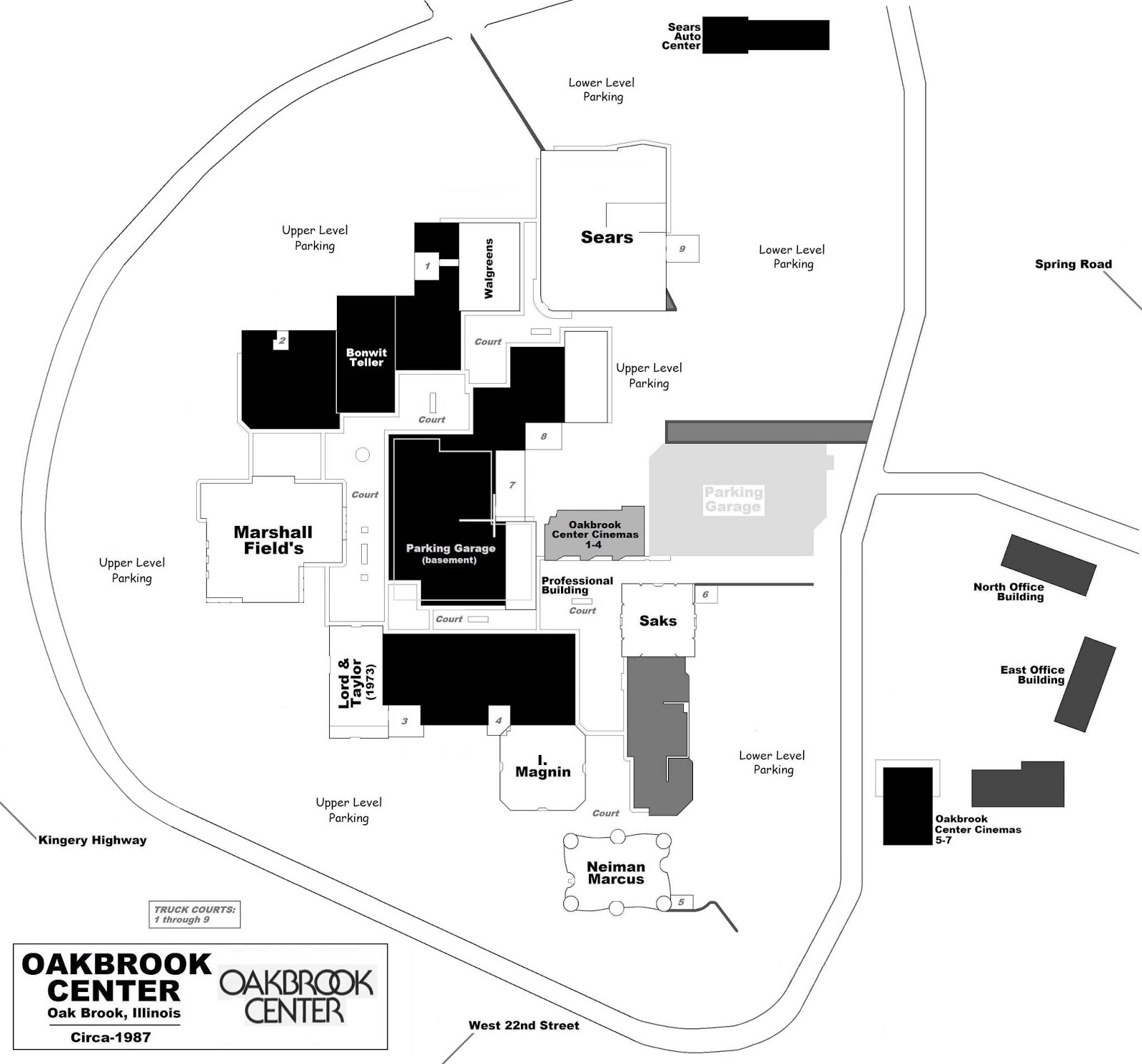
This 1987 layout includes the new Oakbrook Center Cinemas 1-4. The original venue was rebranded as Oakbrook Center Cinemas 5-7.


In the fall of 1987, another 2-level store block and a parking garage were completed. These were adjacent to a new Southeast Wing. This housed the Cineplex Odeon Oakbrook Center Cinemas 1-4, which showed its first features on December 25, 1987. The original 3-screen venue was rebranded as the Cineplex Odeon Oakbrook Center Cinemas 5-7.

A subsequent expansion of Oakbrook Center was announced in July 1989. This was to include a 2-level (248,000 sq. ft.) Northeast Wing, which included a 3-level (220,000 sq. ft.) Nordstrom and three parking garages. A full enclosure of mall courts and concourses was considered too expensive for the benefits.

The AMC Oakbrook Center 12 theaters opened in 1989.

Nordstrom's store, the sixty-fourth in the Seattle-based chain and first in the Midwest, held its official grand opening on April 5, 1991. 

In other areas of the mall, anchor alterations were underway. The first involved Bonwit Teller, a 1962 charter tenant. It closed in June 1990. Crate & Barrel, which opened its first shopping mall store at Oakbrook Center in 1971, relocated into the Bonwit Teller space.

Oakbrook Center expanded again between 1989 and 1991. This addition brought the Midwest's first Nordstrom and four parking garages. I. Magnin closed on February 16, 1991, and its space was divided into four stores, including Eddie Bauer and Tiffany & Company. 
With this 1992 remodel, the mall encompassed 2,090,000 leasable square feet.


Saks Fifth Avenue closed in December 2002. New York City-based Bloomingdale's renovated the building and opened its third Home & Furniture Store on September 12, 2003.

The two Oakbrook Cinema complexes had also been shuttered early in the 21st century. The in-mall 1-4 theaters showed their final features on February 19, 2001, and were refitted as additional retail space. The 5-7 theater operated until 2003. It was demolished and replaced by The Cheesecake Factory, which opened in August 2004.

Between 2001 and 2004, Oakbrook Center changed hands three times. The first buyer, Chicago-based Urban Retail Properties, sold to Holland-based Rodamco in June 2001. In turn, the Maryland-based Rouse Company acquired the property in May 2002. When Chicago-based General Growth Properties acquired the portfolio of the Rouse Company in November 2004, Oakbrook Center became a General Growth Properties holding. 

Macy's acquired Marshall Field's on July 27, 2005. The merger was finalized on September 9, 2006, and all of the Marshall Field's stores were rebranded as Macy's.

The closing of Bloomingdale's Home & Furniture Store created a vacancy in early 2012. The following 2 years were spent remodeling common areas, downsizing stores and finding new tenants for empty spaces.

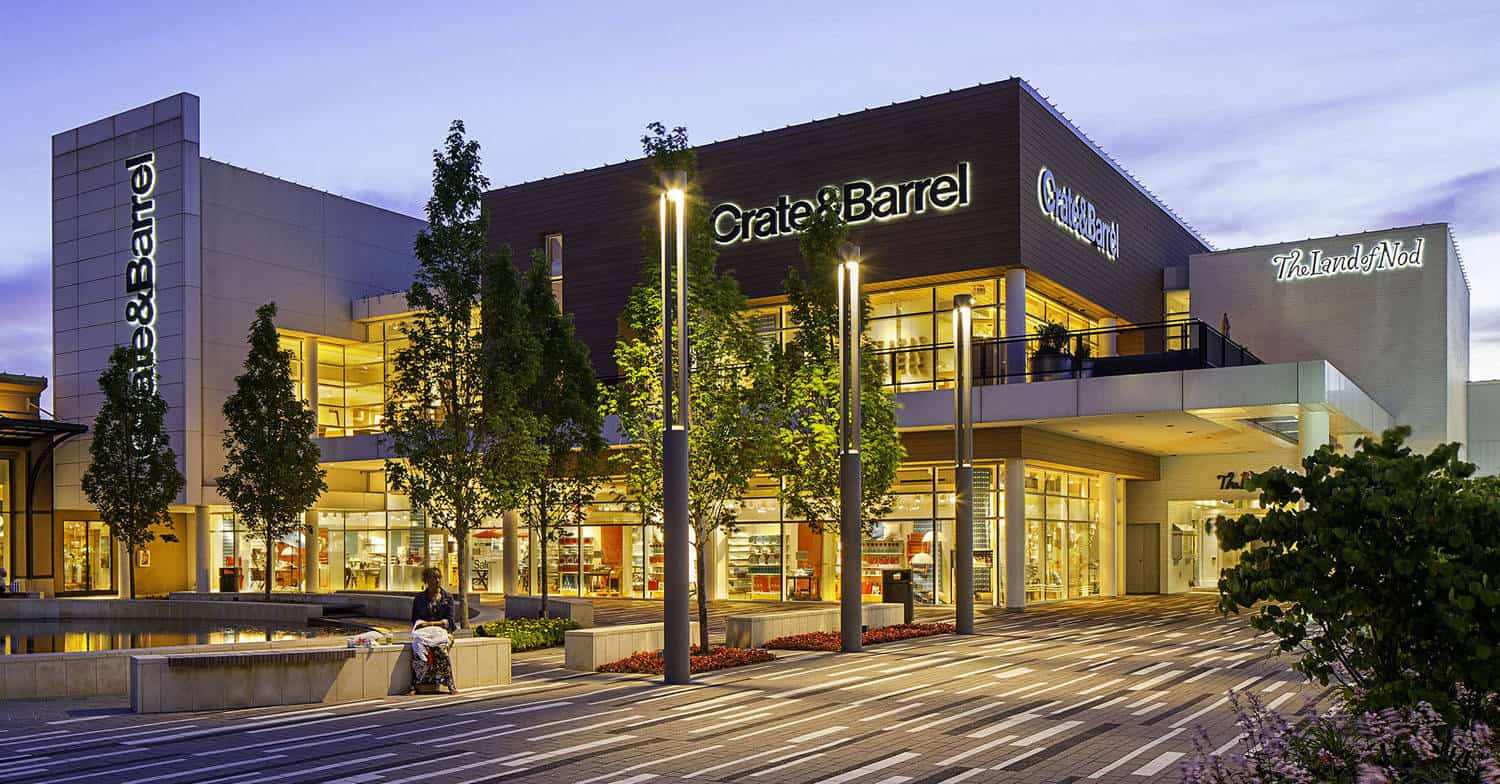
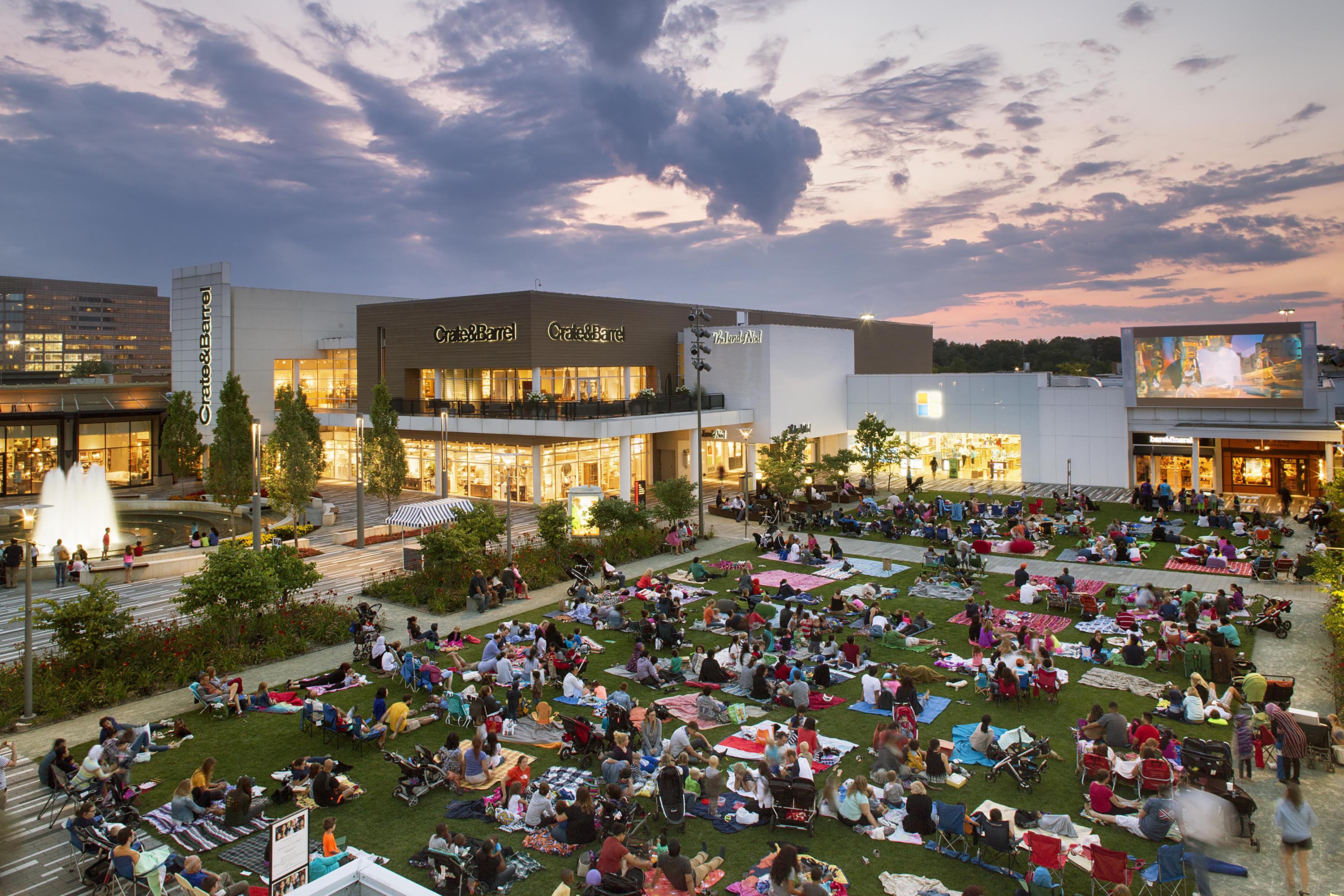
A two-phase court and concourse redesign added new landscaping, outdoor seating, fountains, entertainment venues and Fire Totems (to provide heat for wintertime shoppers). The court fronting Crate & Barrel became a Village Green, whose centerpiece was a year-round Vortex Fountain. An Amenities Pavilion was installed near Sears.


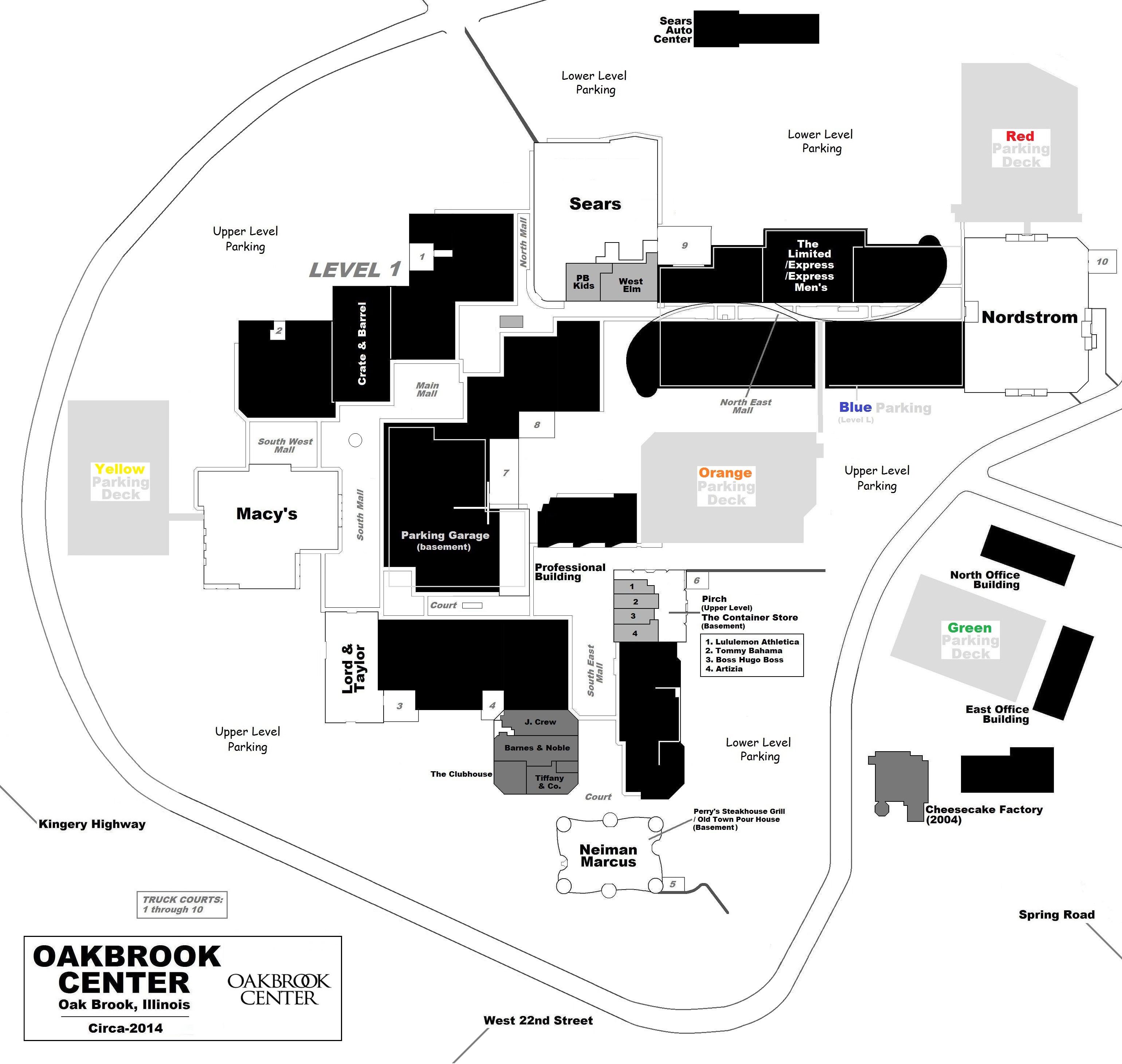
The vacant Saks Fifth Avenue - Bloomingdale's building was divided into six tenant spaces. On Level 1 were new Lululemon Athletica, Tommy Bahama, Hugo Boss and Artizia stores. Level 2 was occupied by Pirch (30,400 sq. ft.), which sold high-end fixtures for the kitchen, bath and outdoors. The Lower Level became a Container Store (27,000 sq. ft.). 
Oakbrook Center, 2013


Sears also began downsizing their 3-level store in 2013. The initial project partitioned a section of Level 1 space with a new P. B. Kids and West Elm stores. These opened in September and October 2013. The revitalized Oakbrook Mall was officially rededicated on November 22, 2013.
2014 Oakbrook Center Floor Plan.


The northeast store block was reconfigured between 2015 and 2016. Four Level 2 store spaces were gutted and rebuilt as The District At Oakbrook Center, a 9-bay food court. Motion pictures also returned to the mall following a 13-year hiatus. The American Multi-Cinema Oakbrook Center 12 showed its first features on October 13, 2016.
In late 2016, a renovation of the northeast store block was completed. Level 1 space was subdivided further. L.L. Bean, Ballard Designs and other tenants joined the existing P. B. Kids and West Elm stores. KidZania, a children's learning center, was installed on Level 2. The renovation also included an upscale food court on Level 2, called The District.

Sears temporarily closed in September 2017. Sears downsized into its basement floor (62,000 sq. ft.) and closed for good on April 28, 2019.


The freestanding Sears Auto Center, shuttered in March 2018 and demolished, was replaced by a new fitness club. The Sears reconfiguration project culminated in the store's grand reopening, which was held on October 4, 2018. 

Based in Hamilton, Bermuda, Brookfield Property Partners acquired a share of General Growth Properties in 2016. In August 2018, Brookfield Property Partners established 100% ownership of the corporation.


Lord & Taylor also pulled up stakes after 49 years, closing on February 27, 2021. By 2022, the Sears and Lord & Taylor buildings had been subdivided into smaller store spaces.
Omniplan 2023


Compiled by Dr. Neil Gale, Ph.D.

Thursday, June 8, 2023

The Brickyard Shopping Center, Chicago, Illinois.

CAREY BRICKWORKS
The Carey Brick Works thrived, producing 300 million Chicago common and street paver bricks yearly from the clay, creating a deep pit. The old brick kilns didn't meet modern environmental standards, and Carey Brick Works closed. Carey opened Chicago's Thunder Mountain Ski Resort in 1967, which boasted the longest vertical slope, 285 feet to the bottom of the clay pit, of any place within 200 miles.

THE BRICKYARD SHOPPING CENTER
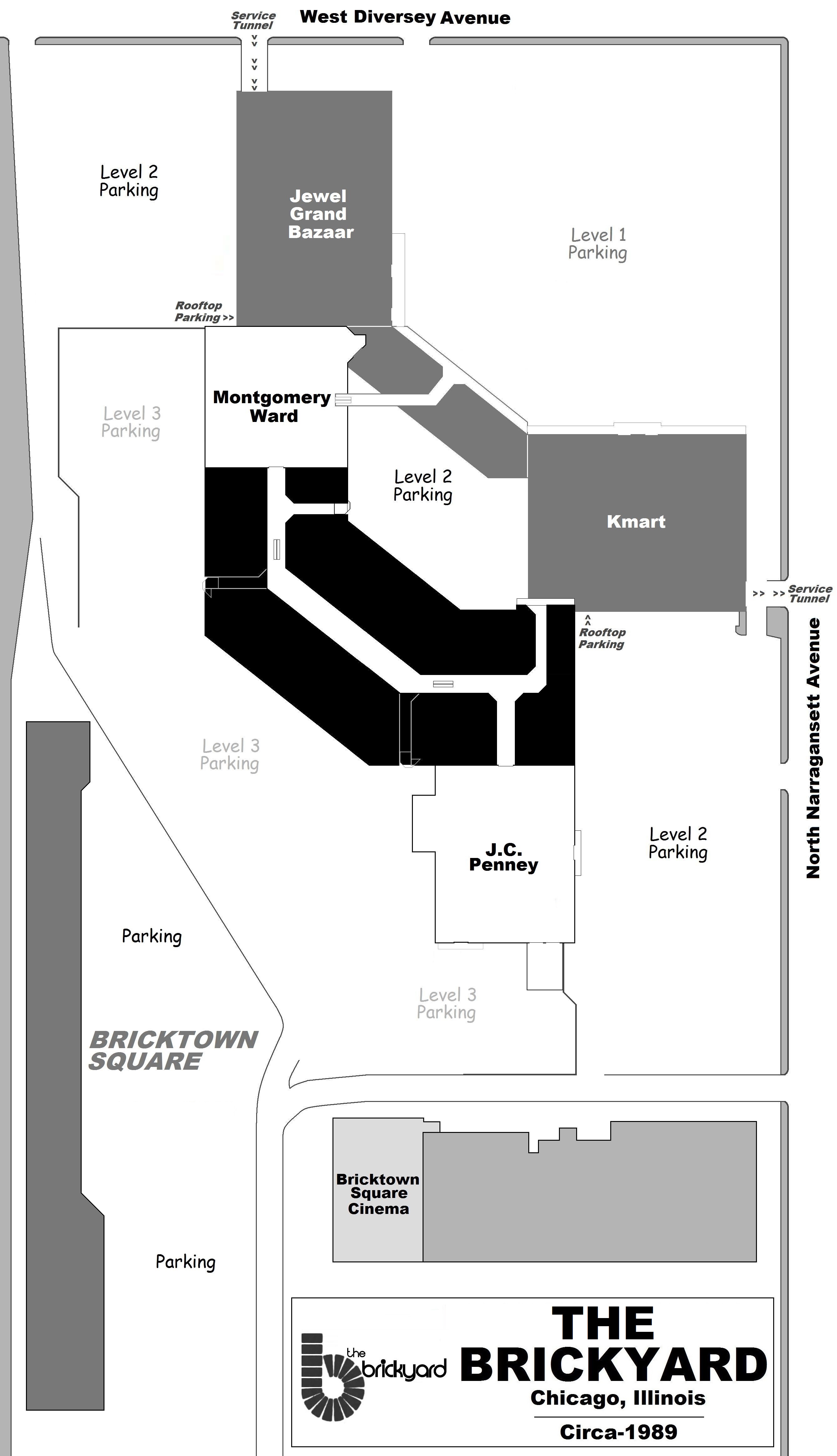
In April 1975, plans for a Brickyard site shopping complex were announced. The ground was broken on September 17, with Mayor Richard J. Daley turning the first shovel of earth. A (250,000 sq. ft.) Convenience Mall was built. This was anchored by a single-level Jewel Grand Bazaar (90,400 sq. ft.), Osco Drug Center on the north, and a single-level Kmart on the southeast (118,700 sq. ft.).

Phases I and II of The Brickyard were designed by New York City's Edward M. Cohen and E.N. Maisel Associates. Phase I (the Convenience Mall) opened on March 16, 1977.

Twelve inline stores lined a single-sided, enclosed shopping concourse. These included Bresler's 33 Flavors, Page Two Card & Gifts, Gladan Jewelers, Ricky's West Restaurant, Fayva Shoes, Radio Shack and Fashion Action.
A north-south cut-away view of the Brickyard. The new Phase II mall increased the total area of the shopping hub to approximately 920,800 leasable square feet. Phase II was connected -via escalator- with the original Convenience Mall section below. The escalator ascended to -and descended from- the first level of the Wards store.


A 2-level, fully-enclosed mall was built to the southwest and on top of the Convenience Mall. This Phase II mall was anchored by a 2-level Montgomery Ward (180,000 sq. ft.) on the north and a 2-level JCPenney (190,800 sq. ft.) on the south. The Wards store and the new enclosed mall opened on March 1, 1979. JCPenney opened for business on July 11.
Phase I section is shown in gray. Known as the Convenience Mall, it covered around 250,000 leasable square feet and was anchored by Kmart and a Jewel Grand Bazaar. A second fully enclosed structure was added, which housed two levels of inline stores anchored by Montgomery Wards and JCPenney.


The Brickyard cost 50 million dollars to construct. The 3-level complex housed approximately 920,800 leasable square feet. Among its 117 stores were Richman Brothers, Claire's Boutique, Woman's World Shops, Susie's Casuals, The Orange Bowl snack bar, Joe Singer Shoes and Legion Magnavox.


There were several major retail centers in the vicinity. These included the Belmont-Central business district 1/2 mile northeast, in Chicago, Harlem Irving Plaza (1956) 2 miles northwest, in Norridge, North Riverside Park Mall (1976) 4.5 miles southwest, in North Riverside, and Lincolnwood Town Center (1990) 7 miles northeast, in Lincolnwood. Despite all the competition, The Brickyard was an astounding success in its early years.


The Brickyard site's southwestern and southern sectors were still undeveloped in 1983. They were acquired by the owner of the mall and cleared and graded. In December 1986, E.N. Maisel Associates sold The Brickyard to the Metropolitan Life Insurance Company. 
A freestanding strip center, Bricktown Square, was added to the mall site in 1988. The combined leasable areas of both complexes now stood at around 1,198,200 square feet. The mall housed 119 stores and provided free parking for 4,000 autos.


The newly cleared land was developed with Bricktown Square, a 277,400 sq. ft. strip plaza. The open-air complex housed tenants such as Toys "R" Us, SportMart, a Fretter SuperStore and a 6-screen Cineplex Odeon Bricktown Square Cinema. This venue showed its first feature films on May 14, 1989. 


During the demolition of the Brickyard, the Bricktown Square strip mall was left standing. The Brickyard was given an indoor-outdoor facelift in the early 1990s. Mall entrances were rebuilt, and a food court was installed. The Brickyard Mall was the new name of the Brickyard Center, and a new logo was created.
A refurbished Kmart reopened as a Big Mart on April 23, 1997. This was the Michigan-based chain's first Big Kmart conversion. Unfortunately, this store remodeling was not enough to stave off the impending decline of the mall. By 1998, it was in a downward spiral exacerbated by an anchor store exodus. 

Big Kmart closed in the summer of 2000, Montgomery Ward left in February 2001, and JCPenney, which had been demoted to an Outlet Store in April 1999, was shuttered in April 2001. These three anchor stores were never leased again. Jewel-Osco remained as the mall's only major operational store.

By late 2002, New York City's Whitehall Street Real Estate had acquired the "functionally obsolete" shopping mall, deciding that total demolition was in order. 

A joint venture was formed with the Illinois-based Mid-America Real Estate Corporation.

The mall complex was bulldozed in December 2002. Jewel-Osco was temporarily left standing until a new store could be built. The Bricktown Square strip center was also left intact.

A 40-million-dollar plaza, known as The Brickyard, was built. Its first phase, including a new 64,200 sq. ft. Jewel-Osco, opened for business in March 2004. Phase II of the 551,000 sq. ft. complex featured a Target and a Lowe's store. Target's grand opening was held on October 10, 2004. At the same time, the Illinois-based Inland Real Estate Investment Group acquired the new and improved Brickyard.

Compiled by Dr. Neil Gale, Ph.D.