Thursday, March 23, 2023

Hamburger University, from the World Renowned, McDonald's Corporation, Chicago, Illinois.

The McDonald's chain was famously born when an ambitious milkshake mixer salesman named Ray Kroc partnered with and eventually bought out Maurice and Richard McDonald, two brothers with a small but popular chain of hamburger restaurants. Kroc opened his first new location in Des Plaines, Illinois 1955, naming it McDonald's.
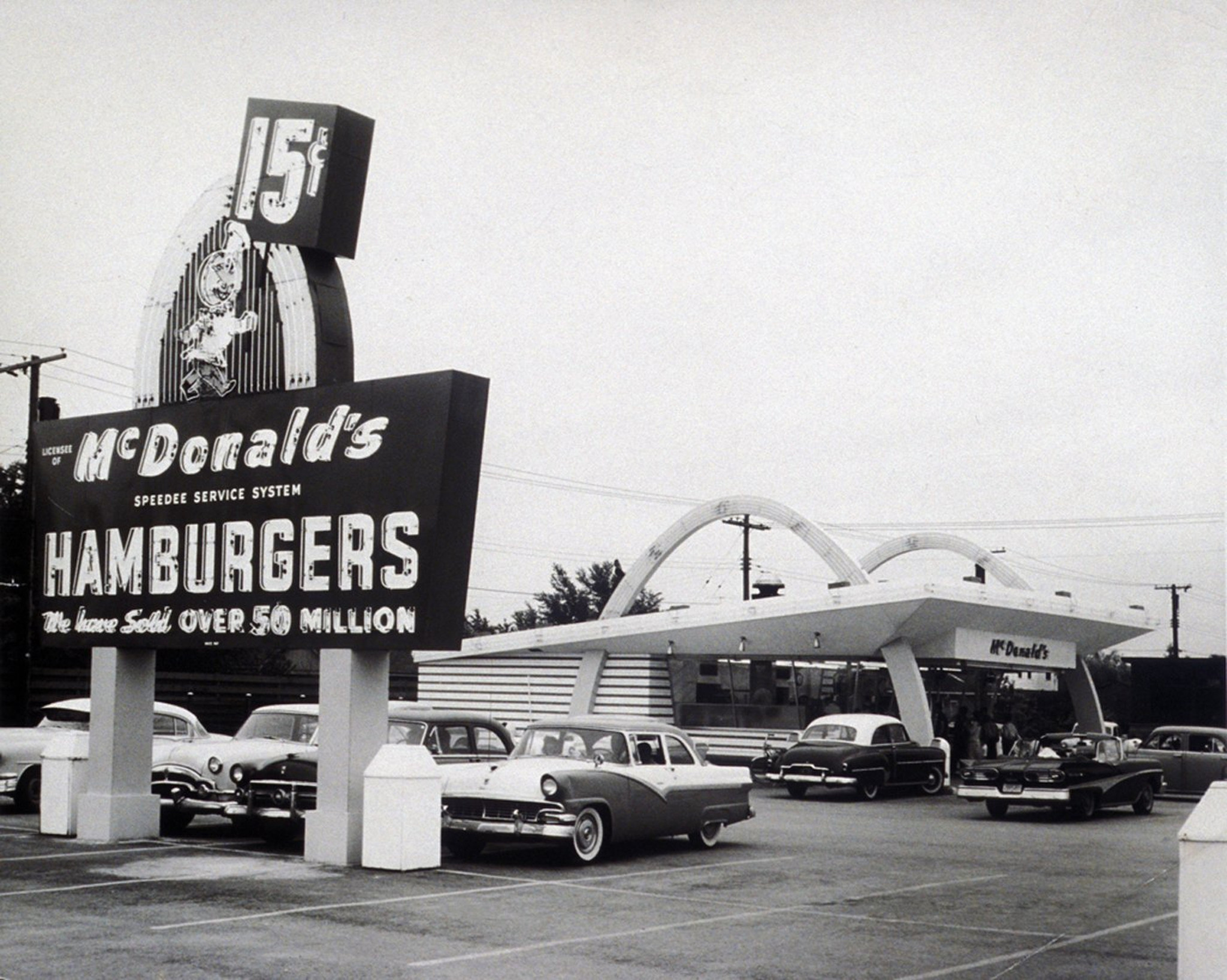
The McDonald's № 1 Store Museum (1955-2017) in Des Plaines, Illinois, was a replica of the first McDonald's restaurant in Des Plaines, opened by Ray Kroc in April 1955. The company usually refers to this as The Original McDonald's, although it is not the first McDonald's restaurant but the ninth; the first was opened by Richard and Maurice McDonald in San Bernardino, California, in 1940, while the oldest McDonald's still in operation is the third one built, in Downey, California, which opened in 1953. However, the Des Plaines restaurant marked the beginning of future CEO Kroc's involvement with the firm. It opened under the aegis of his franchising company McDonald's Systems, Inc., which became McDonald's Corporation after Kroc purchased the McDonald brothers' stake.


The third McDonald's restaurant opened on August 18, 1953, at 10207 Lakewood Boulevard, Downey, California. It was also the second restaurant franchised by Richard and Maurice McDonald before the involvement of Ray Kroc in the company. The original building is a museum, while the red roof in the background is a modern McDonald's serving food and kid's toys.


Hamburger University started in 1961 with a class of 15 people and was held in the basement of a McDonald's restaurant in Elk Grove Village, Illinois. Fred L. Turner, a grill cook, developed and operated the educational program. Soon, Turner's McDonlad's corporate education and training programs became the pioneering concept for other businesses. 

Fred Turner became McDonald's CEO in 1973 and replaced Kroc as Chairman in 1977, later named Senior Chairman upon Kroc's death. Under Turner, McDonald's expanded its operations to 118 countries, with over 31,000 outlets and over a billion hamburgers sold. Fred retired in 2004, serving as Honorary Chairman until he died in 2013.

sidebar
Those who attended Hamburger University in its earliest days received hands-on instruction from Fred Turner and Ray Kroc.

Hamburger University was designed exclusively to instruct personnel employed by McDonald's Corporation or by McDonald's Independent Franchisees in the various aspects of the business and operations of McDonald's.

sidebar
The first "Corporate College" was created by General Electric (GE) as a place for Nationwide management employees to learn in conjunction with the company's business plans and development goals. GE Crotonville, Ossining, New York, started in the mid-1950s. Today, it's called the GE Management Development Institute.

This makes Hamburger University one of the first corporate education programs of its kind. McDonald's retains more rising stars by developing talent and leadership at Hamburger University.

McDonald's Global Headquarters was located on an 80-acre campus in Oak Brook, Illinois, from its founding until 2018, when the McDonald's headquarters moved to Chicago's West Loop into a new complex built on the former site of Oprah Winfrey's Harpo Studios.

Managers in McDonald's restaurants graduated from Hamburger University, eventually moving to a 130,000-square-foot, state-of-the-art facility on the McDonald's Home Office Campus in Oak Brook, Illinois.

sidebar
2022 - TOP 5 CORPORATE UNIVERSITIES
       1) Google; Googleplex
       2) McDonald's Hamburger University
       3) Apple University
       4) Disney University
       5) Intel Network Builders University

Students at McDonald's Hamburger University, for example, at the restaurant ownership level, learn to successfully run a restaurant and report and analyze the books. Further education is necessary to become an executive to support the franchises and help them develop business skills and focus on leadership skills. With a degree, the graduate is confident and ready to support McDonald's employees, restaurant owners, and sales growth.

Hamburger University is a fundamental degree-granting institution, so much so that credits earned can be applied toward an associate's or bachelor's degree at other colleges and universities.

McDonald's Home Office Campus and Hamburger University moved to 1045 West Randolph Street, Chicago, and opened in its new home in June 2018. 
1045 West Randolph Street, Chicago, Illinois.


McDonald's office space, including Hamburger University, occupies 490,000 square feet of the building.

They have grown from the old main campus in Oak Brook, Illinois, to the addition of seven satellite campuses worldwide at one time: Tokyo, London, Sydney, Munich, São Paulo, Shanghai, and Moscow. A faculty of 30 resident professors teach and communicate in 22 languages with the help of translators and technology. 

sidebar
McDonald's has reopened its doors under a new name in Russia after the fast food giant pulled out of the country over its invasion of Ukraine. Fifteen McDonald's restaurants in and around Moscow reopened with their new name, "Vkusno & Tochka," which translates as "Tasty and that's it." Businessman Alexander Govor, who already owns 25 restaurants in Siberia, agreed to buy all 847 Russian McDonald's outlets after the chain boycotted the country in early March. He vowed to keep all their 62,000 employees on equivalent terms for at least two years.

To date, Hamburger University has produced around 330,000 degree holders worldwide.

Compiled by Dr. Neil Gale, Ph.D.

Tuesday, March 21, 2023

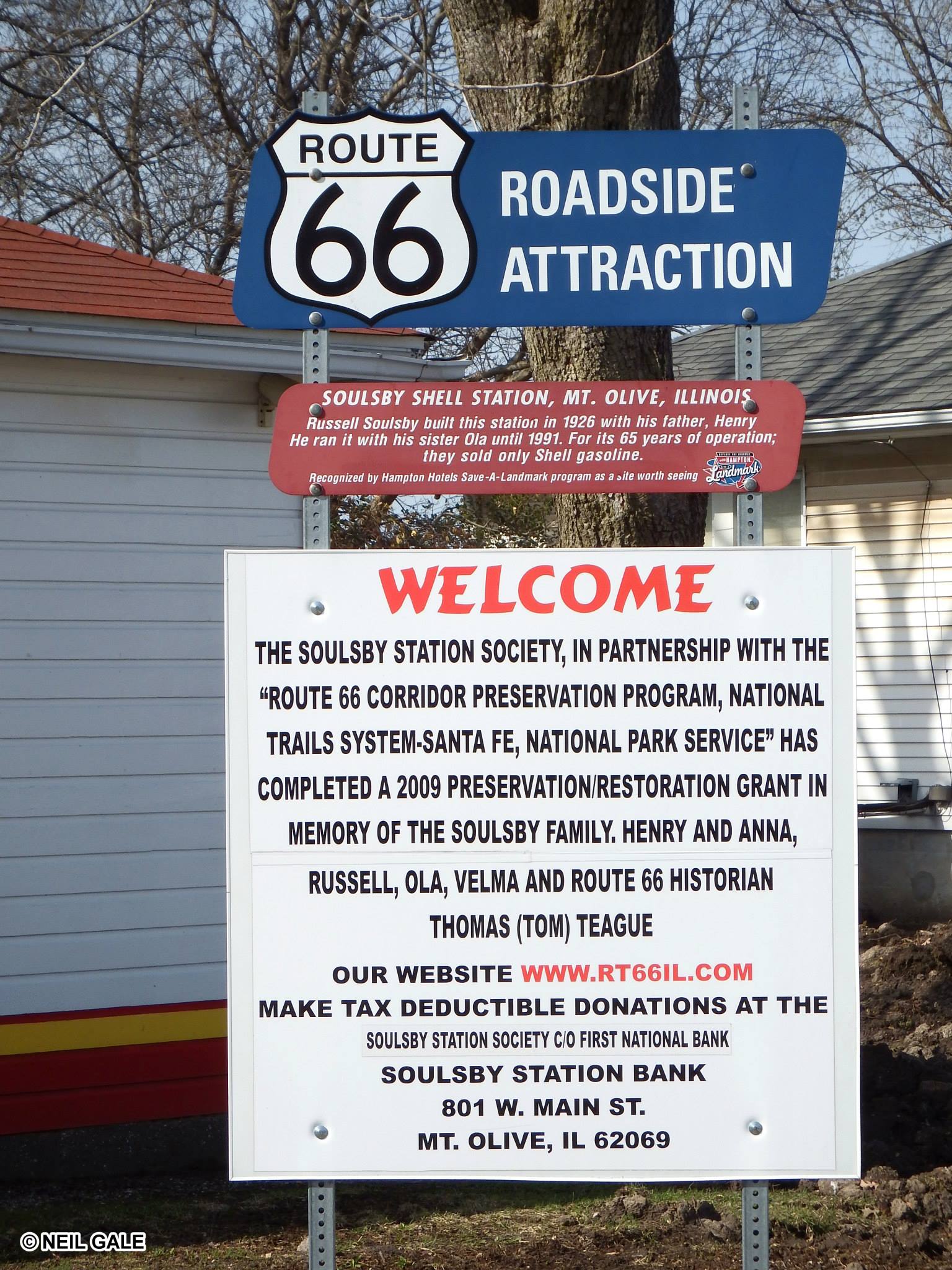
Soulsby Shell Service Station, Mount Olive, Illinois, on Route 66.

The advent of the national road system in 1926 ushered in a golden age for mom-and-pop entrepreneurs. For Henry Soulsby of Mount Olive, it happened just in time. Mr. Soulsby followed his Irish immigrant father into mining, but in the mid-1920s, an injury forced him above ground. Understanding that a national highway would soon pass through Mount Olive, he invested most of his life savings in two lots at the corner of 1st Street, now called Old Route 66. With the balance, he built an automotive service station.
The Soulsby Station is an excellent example of a house with a canopy form. By the time Mr. Soulsby built his station in 1926, the leading oil companies had been hiring architects to design stations that would blend well with neighborhoods to minimize local opposition to the crudeness often associated with gas stations. Mr. Soulsby designed the building himself, considering these trends and blending well with the surrounding area.
Although the Great Depression soon began, the station thrived. America was broke, but it was still traveling. As Will Rogers would say, "We might be the first nation to drive to the poorhouse in an automobile."
When Henry Soulsby retired, his children Russell and Ola Soulsby took over the station, a partnership that would endure until Ola died in 1996. Each was as adept as the other at pumping gas, checking the oil, and looking under the hood or chassis to detect and fix problems. Russell always had an eye for technology. During World War II, he was a communications technician in the Pacific theater. He turned his experience into a radio and television repair business shortly after coming home. He used the antenna on the station's roof to test his work.
Route 66 was a great agent of progress and development, but its success helped spell its doom. In the late 1950s, Interstate 55 began supplanting it in Illinois, and the Soulsby Station ended up a mile from the new thoroughfare in Mount Olive. In 1991, the Soulsby Station stopped pumping gas but continued to check oil, sell soda pop ("pop" in northern Illinois), and greet the ever-growing legion of Route 66 tourists. Sending everyone off with a wink and a wave, Russell and Ola closed the doors for good in 1993 and sold the station in 1997 to a neighbor, Mike Dragovich. When Russell Soulsby died in 1999, his funeral procession took him under the canopy one last time; this time, it was his friends' turn to wink and wave.
The current owner, Mr. Dragovich, and the Soulsby Preservation Society began preservation efforts in 2003, removing vinyl siding, restoring the original doors and windows, and repainting the exterior. In 2004, the National Park Service provided grant support for restoration efforts. Today, the station looks essentially the same as it did during its post-World War II heyday. It was listed in the National Register of Historic Places in 2004.
People worldwide drive by to imagine what Old Route 66 would have been like in its heyday.

Compiled by Dr. Neil Gale, Ph.D.
Photos Copyright © 2014, Neil Gale.

Baltimore & Ohio Railroad Co. (B&O) Depot in the City of Flora, Illinois.

The Flora B&O Depot has been critical to the town’s history. In 1872, the first depot was built, and this building was funded by selling bonds to businesses and citizens. This depot was destroyed by a fire in 1916. 


When a new depot was completed in 1917, it contained three floors. The main floor was used for passengers, and it had a large waiting room with a baggage room and restrooms. The Western Union office, yard office, mailroom and ticket office were also located on this floor.

The second floor held the offices of essential depot members. Men who occupied these offices included the chief clerk, division engineer, superintendents, dispatchers, carpenters, signal supervisors, train masters and road foremen, railroad law enforcement officers, and the district’s physician.


The third floor contained large offices. Later, these offices became one social room. There, railroad employees and their families held potluck dinners and socials. Not only was the depot a hub of transportation and commerce, but it was also a center for much of the social life in the community.

The depot building was an enormous part of the economic life of the community during the early years of the 20th Century. In the 1920s, the railroad employed half the wage earners in Flora, and in 1924, three hundred employees worked at the local station.

In the 1950s, cars became the chief means of transportation as roads improved. Travelers no longer looked to trains as the primary source of transportation. The depot quickly became less important to the community. The days of 12-passenger trains stopping at Flora daily turned into a fond memory. 
In 1998, the Flora B&O Depot was named one of three sites in Clay County on the National Register of Historic Places. With this recognition and the interest of many community citizens, the Flora Community Development Corporation (FCDC) purchased the depot from CSX Railroad Company.

FCDC successfully obtained three federal grants to restore the building, matched by local donations from citizens. Today, the University of Illinois Extension Service rents the third floor, and the second floor is a rented community room for meetings and various activities. The first floor houses the Flora Chamber of Commerce office, a museum containing city and county historical artifacts and two unfinished rooms available for occupancy.

Flora Depot
Edited by Dr. Neil Gale, Ph.D.