Saturday, March 11, 2017

Chicago's Western Avenue name was changed to Woodrow Wilson Road in 1924.

As any true Chicagoan knows, Western Avenue is the longest street in the city. Would you believe it was once named Woodrow Wilson Road?
Northeast Corner of Devon Avenue and Woodrow Wilson Road, Chicago, Illinois. circa 1925.
Woodrow Wilson, 28th President of the United States, died on February 3, 1924. He’d been an icon of the Progressive movement and led the country through the First World War. The Chicago City Council wanted a suitable way to honor him.

It is not unusual for the City of Chicago to have streets named after U.S. Presidents, as the Digital Research Library of Illinois History Journal™ article reports "The History of Chicago's President Street Names."

A few years after Theodore Roosevelt died, the aldermen changed 12th Street to Roosevelt Road. What was good for a dead Republican president should be good for a dead Democratic one. 

Since the city already had Wilson Avenue (named after John P. Wilson, lawyer, and donator to Children's Memorial Hospital), it was decided to use President Wilson’s full name on his street.
It’s not clear why the lawmakers chose Western Avenue for renaming. On April 25, 1924, they voted to re-designated the street as Woodrow Wilson Road.


On April 26, 1924, the Tribune dropped a bombshell on the people of Chicago, though the newspaper didn't play it as the 8-column banner lead nor even above the fold. In fact, the seven-line, one-paragraph item was hanging on to the bottom of the front page. 

Back in 1924, Chicagoans were just angry about the change. They protested the change, petitioning their aldermen with hundreds of signatures. The Tribune seemed to wage its own silent protest by not using the new name in articles: automobiles still crashed, banks were still robbed and famous people still interacted with the public on a roadway called Western Avenue.

Aldermen appeared to have repealed the Wilson name sometime in June, about the same time Wilson supporters offered the alternative solution of renaming Municipal Pier after the recently deceased 28th president. That didn't fly either, of course; that honor went to the Navy.

The 12th street-to-Roosevelt Road change had caused little controversy. But now the property owners along Western Avenue objected to the expense involved in renaming their street. Within a few weeks, they’d gathered over 10,000 signatures asking that the old name be restored.

The Tribune sent its inquiring reporter to the corner of “Washington Boulevard and Woodrow Wilson Road” to gauge public opinion. Most people said the change didn’t make any difference to them. One young lady did say she favored the new name because “it sounds lots nicer, and we see enough old things around here.”

The property owners prevailed. Less than a month after its original action, the council ordered the street to change back to Western Avenue. A proposal to rename Navy Pier after Wilson went nowhere.

In 1927 the council changed Robey Street to Damen Avenue, despite resident protests. When Crawford Avenue was renamed Pulaski Road in 1933, that set off a battle that lasted 19 years before Pulaski was legally accepted. More recently, a proposal to change part of Evergreen Avenue to Algren Street was abandoned in the face of local resistance. 

In the 1930s, the Chicago City College system came to the rescue with Woodrow Wilson Junior College. Even that didn't last: In 1969, the school was renamed Kennedy-King College after Robert F. Kennedy and Rev. Martin Luther King Jr. Wilson Avenue on the North and Northwest sides is named after a different Wilson.

The lesson seems to be that changing a street name will always rub some people the wrong way and is a high cost for changes to maps and for businesses. That’s why the city came up with the idea of honorary streets in 1964.

Chicago designated its first honorary street name in 1964, declaring the section of LaSalle Street between Wacker Drive and Jackson Boulevard the "Golden Mile" to honor the city's financial clout. Over the next nearly two decades, only two more signs were designated, according to the Chicago Department of Transportation.

Compiled by Neil Gale, Ph.D.

Looking West from the Top of the Willis (Sears) Tower, Chicago, Illinois.

Looking West from the Top of the Willis (Sears) Tower, Chicago, Illinois.

Friday, March 10, 2017

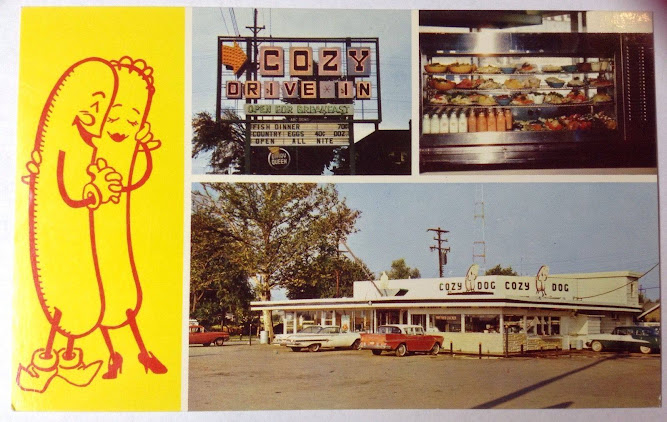
The History of Cozy Dog Drive-In on old Route 66, Springfield, Illinois.

Cozy Drive-In claims to be the original home of the cornbread battered hot-dog-on-a-stick. Think Corndog. 

sidebar
It's doubtful that Buzz Waldmire invented the corndog but renamed it the  Cozy Dog as a marketing ploy.
  • 1941: Pronto Pup in Oregon claims to have invented the corn dog on a stick.
  • 1942: Neil and Carl Fletcher start selling "Corny Dogs" at the Texas State Fair.
  • 1946: Cozy Dog in Illinois claims to be the first to serve corn dogs on sticks.
The Cozy Dog was invented by Buzz Waldmire. "You'd just better not call it a corndog" because employees are trained to loudly correct you, even if you say corndog a few times. 
A Cozy Dog is usually eaten with mustard. The hand-cut french fries are fantastic.
Cozy Dog was officially launched at the Lake Springfield Beach House on June 16, 1946. Shortly after, the Cozy Dogs were introduced to the crowds at the Illinois State Fair that same year.

The first Cozy Dog House was located on South Grand between Fifth and Sixth Street in Springfield, Illinois.
A 1950s photograph of the first Cozy Dog with a Manager and Ed Waldmire standing in the parking lot.
A second Cozy Dog House was located at Ash & MacArthur. The Cozy Dog Drive-In was born; built on the old Route 66, South Sixth Street today, in Springfield, in 1949.
In 1996, Cozy Dog moved to its current location, where Sue (Ed's daughter-in-law), Josh, Eddie, Tony & Nick (Ed's grandsons) continue on with the business right next door to the original location.
Cozy Dog Drive-In, 2935 South Sixth Street, Springfield, Illinois.
Route 66. Pen and Ink drawing by William Crook, Jr. ©2010


There is artwork by one of the sons of the late Buzz Waldmire, Bob Waldmire. The famous "Wall Dog" artist, Bob Waldmire, has painted images on the sides of buildings along Route 66. As an artist, he also did postcards, posters, and maps with many pictures of Route 66.
Cozy Dog uses Oscar Mayer Weiners to make their Cozy Dogs. I witnessed an employee open a retail package of Oscar Meyer hot dogs and place them in the steamer. I was personally disappointed.
Sadly, Bob Waldmire passed away from abdominal cancer on December 16, 2009. There is also some Buzz Waldmire memorabilia inside Cozy Dog, such as family photos and his book collection. Cozy Dog features a gift shop selling Route 66 merchandise.
An example of Bob Waldmire's artwork.
Another example of Bob Waldmire's artwork.
VIDEO
"To the end of Route 66"
by Bob Waldmire


Compiled by Dr. Neil Gale, Ph.D.