Saturday, April 22, 2023

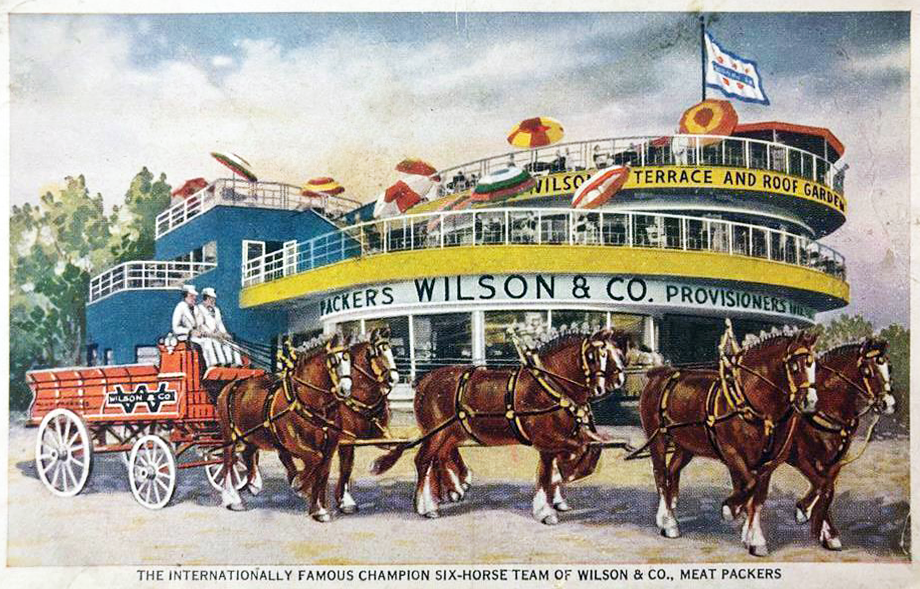
Wilson & Company at the 1933/34 Chicago's Century of Progress World's Fair.

The Wilson & Company Certified Bacon Slicing Exhibit continuously sliced and packed 8,000 pounds of Bacon daily from 11:00 am to 11:00 pm in this beautiful modern exhibit at the 1933/34 Chicago Century of Progress World's Fair.
The 1933-34 Chicago Worlds Fair Wilson Exhibit Building.


Wilson & Co. extends a cordial invitation to all its customers and friends to see the Wilson  & Co. Exhibit Building on Northerly Island, in the heart of the Midway at A Century of Progress.
The Wilson & Co. Certified Bacon Slicing Exhibit is slicing and packing continuously from 11:00 am to 11:00 pm in this beautiful modern exhibit at the 1933/34 Chicago World's Fair, A Century of Progress.


Unique in the history of the Meat Packing Industry, a complete Bacon Slicing Room is in continuous operation in this beautifully designed building. Lovely girls in trim uniforms slice and pack 8,000 pounds of Certified Bacon daily under the same sanitary conditions found in all Wilson & Co. plants. During the 329 days the fair was open in 1933/34, 2,632,000 pounds of Bacon was sliced.

The picture above represents the Wilson deluxe Certified Sliced Bacon room in full operation on the first floor of our Exhibit Building. The giant slicer cuts 400 slices each and every minute. Girls are packing these slices of Certified Bacon with chrome tongs. No human hand touches Certified Bacon until it reaches the homes of consumers.

This room is glass enclosed and kept at a uniform temperature of 55° F. The same degree of efficiency and cleanliness is maintained in this Certified Bacon Slicing Room as is in effect in every one of Wilson & Co. plants in the United States. Wilson's Certified Sliced Bacon is Wilson Selected, Government Inspected, and Quality Controlled. It is the finest Bacon that science can produce. Millions of housewives take great pride in serving Wilson's Certified Bacon at their tables, and dealers everywhere are as proud to handle a product of exceptional quality and goodness.

Arranged around the Certified Bacon Slicing Room corridors are the interesting and instructive exhibits of all Wilson & Co. by-products, from soap to sporting goods and hair insulation.

The Wilson Terrace Restaurant and Roof Garden Restaurant are found on the second and third floors, where wholesome, satisfying plate lunches or steaks can be had at moderate prices.
The Wilson Terrace and Roof Garden Restaurants, Partial Menu.
$1.25 in 1933 Equals $29.00 in 2023.


Wilson & Co. had 10 Food Stands and the Wilson & Co. Stables at the World's Fair.
True lovers of horses will delight in the beauty of this prize-winning six-horse Clydesdale team. They participate in the "Wings of a Century" Pageant daily and are also on exhibition in their own Wilson & Co. stables on the fairgrounds.


History of Wilson & Company, 4100 South Ashland Avenue, Chicago, Illinois.
Wilson & Co. evolved over the years to adapt to a changing market and changing leadership. The business began in 1916 when founder Thomas Edward Wilson took control of the Chicago meat packinghouse Sulzberger & Sons Co. and rebranded it as Wilson & Company. 

By 1917, the Company ranked as one of the 50 largest industrial corporations in the United States and continued to employ thousands of workers at its plant in Chicago until the 1950s.


From its inception, Wilson & Co. has been noted for its progressive policies and efficient methods of operation. It has built an enviable reputation for efficiency of service, integrity, and high business ideals, and the same cardinal company characteristics have been instilled into all of its thousands of employees. 

Wilson & Co. held several subsidiaries that utilized animal by-products to manufacture sporting goods, pharmaceuticals, and industrial chemicals. Ashland Manufacturing ─ a subsidiary of Sulzberger & Sons Co. established in 1913 ─ manufactured athletic gear under the Thomas E. Wilson brand and became Wilson Sporting Goods in 1931.

The Company's headquarters are in Chicago, with other plants and branch houses throughout the United States, Canada and Europe. In 1916, Mr. Wilson founded the Company, heading it until 1934, when his son, Edward F. Wilson, succeeded him. The elder, Mr. Wilson, was then elected chairman of the Board.
Wilson & Co. full-page advertisement for "Wilson's Certified Brand Catsup and Chili Sauce," 1918.


Wilson's meat-packing plants are located in Chicago, Kansas City, Los Angeles, Oklahoma City, New York City, Albert Lea, Minnesota, Cedar Rapids, Iowa, and Nebraska City, Nebraska. Wilson & Co.'s Butter and Cheese factories are located at Abilene, Lubbock and Amarillo, Texas; Wichita, Kansas, Altus, Oklahoma City, Blackwell and McAlester, Oklahoma; Ottumwa, Cedar Rapids, Eagle Grove and Reinbeck, Iowa; Dixon and Lanark, Illinois.

The Company has upwards of 90 branch houses in the United States, in addition to the plants as mentioned above, and has branches, subsidiaries and agents in the United Kingdom, Norway, Sweden, and Denmark, as well as at other points in Continental Europe, Mediterranean Countries, South America, Central America, the West Indies, Mexico, Canada and Newfoundland, China, the Canary Islands, Singapore, Bangkok, Siam, Manila, and Batavia. There are approximately 25,000 persons employed by the Company, of which upwards of 1,000 are salesmen.

Mr. Thomas E. Wilson is a notably outstanding figure in the meat packing industry. In addition to making many valuable and constructive contributions to the industry, he was the founder of the Institute of American Meat Packers and its first president.

Timeline of Wilson & Company
March 22, 1916 - Thomas Edward Wilson is named President of the Chicago meatpacking firm Sulzberger & Sons Co. after banks force a change of management. Sulzberger & Sons had been accused of German sympathies when a shipment of meat was intercepted by a British blockade.

July 21, 1916 - Sulzberger & Sons Co. is renamed Wilson & Co.

Ashland Manufacturing – a subsidiary manufacturing athletic gear – is renamed Thomas E. Wilson & Co.

1917 - Wilson & Co. ranked as one of the 50 largest industrial corporations in the United States.

1927 - Thomas E. Wilson’s son, Edward Foss Wilson, enters the family business, starting in the stockyards.

1931 - Edward Foss Wilson named Vice President of Wilson & Co.

Subsidiary Thomas E. Wilson & Co. is renamed Wilson Sporting Goods.

1933/34 Wilson & Co. shows at the Chicago Century of Progress World's Fair. 

February 27, 1934 - Edward Foss Wilson is named President of Wilson & Co., and Thomas E. Wilson becomes Chairman of the Board.

1953 - Edward Foss Wilson becomes Chairman of the Board of Wilson & Co.

January 5, 1967 - Wilson & Co. is acquired by Ling-Temco-Vought, Inc., and its headquarters are transferred from Chicago, Illinois, to Dallas, Texas.

Ling-Temco-Vought reorganizes the company into three publicly-traded divisions: Wilson & Co. Inc. (meat), Wilson Sporting Goods Co., and Wilson Pharmaceutical & Chemical Corp.

1969 - Wilson Pharmaceutical & Chemical sold to American Can.

1970 - Wilson Sporting Goods is acquired by PepsiCo.

1976 - Wilson & Co. is renamed Wilson Foods Corporation.

1981 - LTV Corporation (Ling-Temco-Vought) divests itself of Wilson Foods.

1988 - Wilson Foods is acquired by Doskocil Companies, Inc.

1989 - Amer Group of Finland (later Amer Sports Oyi) acquires Wilson Sporting Goods.

1990 - Doskocil files for Chapter 11 bankruptcy and sells off Wilson Brands division.

1995 - Doskocil changes its name to Foodbrands America, Inc.

1997 - IBP, Inc. acquires Foodbrands America, Inc. (including Wilson Foods).

2001 - Tyson Foods acquires IBP, Inc. (along with remaining Wilson meat brands).

2018 - A Chinese investor group led by Anta Sports Products acquires a majority stake in Amer Sports Oyj.

Compiled by Dr. Neil Gale, Ph.D. 

Friday, April 21, 2023

The Polluted Chicago River History of Improvements in Water Quality.

Along the Chicago River, further from the lakefront, the river remained something to be tolerated rather than enjoyed.

definition
Water pollution is the contamination of water bodies that, include lakes, rivers, oceans, aquifers, reservoirs and groundwater, usually due to human activities, so it negatively affects its uses.  

In 1926, the "Henry C. Grebe & Co. Inc. Shipyard" moved to Chicago on the north branch of the Chicago River at Belmont Avenue, across the river from the famous Riverview Amusement Park. During WWII, the shipyard built over 56 ships, wood and steel, for the U.S. Navy, including 21 tugboats, 4 tankers, and 28 minesweepers.
Grebe Shipyard looks east across the Chicago River. Note Riverview Park's rides, Shoot the Chutes and The Bobs Roller Coaster in the background, circa 1928.


The opening of Chicago's first wastewater treatment plant in 1928 reduced the amount of raw sewage, but the river remained laden with industrial chemicals and byproducts. Riverside real estate was cheap, and river wards, dominated by pollution and stench, were still some of the poorest neighborhoods in the city.

During the Great Depression, many lived directly on the river's North Branch in a floating makeshift houseboat squatters' camp near Irving Park Road.
Houseboats sat along the Chicago River's North Branch between 1920 - 1929.


Around the same time, riverfront property near Division Street on Diversey Parkway was chosen as the site for one of the nation's first low-income housing projects, the Chicago Housing Authority's Julia Lathrop Homes.
Aerial view of 18th Street and the Chicago River during the river straightening project in May 1929.


The overcrowded, impoverished area on and around Goose Island became known as "Little Hell," a reference to the conditions on the island and the coal gasification plant that belched out smoke and flames nearby. It was occupied by a succession of immigrant groups who came to work in the steel mills and other factories along the North Branch.
Four girls standing in an empty lot in Little Hell in September 1902. 


The relationship between Chicago's river and its people has entered a new chapter in recent years. Aided by the mid-twentieth-century deindustrialization, a growing sense of environmental stewardship, federal regulations such as the Clean Water Act of 1972, and yet another round of monumental public works projects, the Chicago River continues to undergo dramatic improvements in water quality and accessibility.

Construction on the Tunnel and Reservoir Plan (TARP), or Deep Tunnel, began in 1975. The first portion of the massive underground system began functioning in 1981. It is a project that outdoes even Chicago's forebearers in terms of investment. When it is completed in 2029 at the cost of $3.8 billion, it should be able to hold up to 20.55 billion gallons of excess water.

The Deep Tunnel project has reduced the number of combined sewer overflows (CSO) that take place in a year. But even in the areas where it is fully operational, it hasn't managed to eliminate them completely. And given the increasing prevalence of intense, fast-moving storms, the Metropolitan Water Reclamation District of Greater Chicago (MWRD) now says that TARP will unlikely completely resolve Chicago's sewage overflow problem in the future.

Since shortly after the passage of the federal Clean Water Act of 1972, a network of environmental groups has steadily gained in size and political strength and used it to monitor polluters and pressure government agencies, including the MWRD, to continue improving the Chicago River.

Compiled by Dr. Neil Gale, Ph.D. 

Thursday, April 20, 2023

The Winning of the Illinois County of Virginia (1778) from the British in the American Revolution (1775-1783).

The Illinois County was already occupied by settlers, most of whom spoke Algonquian and Siouan languages before the French and English arrived. (Map by Jacques Nicolas Bellin, 1755)


After winning the French and Indian War in 1763, the British controlled forts at Detroit and in what is now Indiana and Illinois.

sidebar
The Illinois County of Virginia (1673-1778) was a political and geographic region, part of the British Province of Quebec, claimed during the American Revolutionary War on July 4, 1778, by George Rogers Clark of the Virginia Militia as a result of the Illinois Campaign. The Virginia-based local government lasted only six years. Illinois County was extinguished when Virginia ceded its claims to the Northwest Territory to the United States in 1784. 

After the American Revolution started, those British bases became a threat to Virginians rather than a source of protection. The British repeated the tactics used by the French in the French and Indian War. Delivery of guns and ammunition to Native Americans enabled them to attack backcountry farms and settlements, with the greatest impact on Kentucky County Virginians. The General Assembly had created Kentucky County in 1776 to counter efforts by Richard Henderson and the Transylvania Company to split that territory off from Virginia.

The British built a new fort on the Wabash River at Vincennes in 1777, enhancing the supply route. The Virginian response to the threat to western settlement during the American Revolution matched the British response in the French and Indian War - capture the supply bases to cut off supplies to the Native Americans, as Fort Duquesne was captured in 1758.

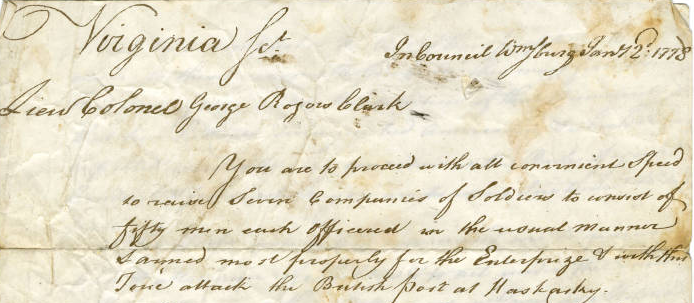
George Rogers Clark, the ranking militia officer in Kentucky County, traveled back to Williamsburg. He convinced Gov. Patrick Henry and other key officials that a military response was necessary. The cost concerned the officials in Williamsburg, but Clark got two sets of orders from Governor Henry.

His public orders authorized him to defend Kentucky, but the secret orders allowed him to launch an attack west into British-held territory. Clark desired to seize Detroit but started by capturing easier targets with no British forces to defend them.
Governor Patrick Henry provided secret orders in 1778 for George Rogers Clark to attack Kaskaskia and Vincennes. (January 2, 1778)


Clark gathered about 175 men to form the Illinois Regiment, recruiting from Carolina to Fort Pitt. In a private letter signed by Thomas Jefferson, George Mason, and George Wythe, he was assured that his recruits would be granted a bounty of 300 acres of land in addition to standard pay.

He managed to move by boat downstream from Louisville on the Ohio River by marching cross-country to Kaskaskia on the Mississippi River. The few British officials at Kaskaskia were surprised and offered no resistance. The Roman Catholic vicar there championed the American cause, and the French residents welcomed Clark's force. The residents at Cahokia and Vincennes were equally supportive, and in July 1778, the British lost control of the territory south of Detroit.
George Rogers Clark obtained supplies in Virginia, then traveled to Kentucky and seized control of the future Northwest Territory in 1778-1779.


In December, Lieutenant Governor Henry Hamilton brought a handful of regular British troops from the 8th Regiment of Foot, Detroit militia, and Native Americans from Detroit and quickly recaptured Vincennes. He chose to upgrade Fort Sackville there rather than attack Clark at Kaskaskia. Because getting supplies to Vincennes was so tricky, Hamilton sent most of his men back to Detroit.

Clark made a middle-of-winter march to recapture Vincennes before Hamilton could strengthen defenses there. Clark led an expedition of nearly 175 men, including French allies recruited at Kaskaskia, 180 miles east through the flooded wilderness, through swamps with water at times as high as their shoulders.
In February 1779, the Virginians marched from Kaskaskia to Vincennes through prairie and forests flooded by seasonal high waters.


The winter march from Kaskaskia to Vincennes required 17 days to cover over 150 miles.


Clark wrote later in his memoirs:

In the spring, we knew that Governor Hamilton would be at the head of such a force that nothing in this quarter could withstand his arms, that Kentucky must immediately fall... We saw but one alternative, which was to attack the enemy in their quarters... the enemy could not suppose that we should be so mad as to attempt to march eighty leagues through a drowned country in the depths of winter, that they would be off their guard and probably would not think it worthwhile to keep out spies that... we might surprise them.
Kentucky County was exposed to raids by Native Americans, which the British supplied from Detroit and other forts.


Hamilton was caught by surprise and lacked adequate manpower to defend the fort. After a brief resistance, he surrendered.
George Rogers Clark recaptured Fort Sackville at Vincennes and imprisoned Lieutenant Governor Henry Hamilton in 1779.


Clark had Hamilton and the British officers taken 1,200 miles east to Williamsburg. He was imprisoned as a common criminal rather than treated as an officer captured in War. Hamilton was treated harshly because Governor Thomas Jefferson and top Virginia officials thought he was responsible for Native American raids in the backcountry where settlers were scalped. Because the British provided resources for the raiders, Hamilton was called the "Hair Buyer."

Clark lacked the resources to attack Detroit, and the British occupied the fort until 1796.
George Rogers Clark and the Illinois Regiment recaptured Vincennes in 1779.


The Virginia General Assembly asserted its claim to the captured territory by creating the Illinois Country in 1778.

In 1781, it authorized the officers in the Illinois Regiment to identify a 150,000-acre parcel north of the Ohio River where land grants would be awarded for service in that regiment. General Clark was given over 8,000 acres, officers received over 2,000 acres each, and privates were granted just 108 acres each. Clark's Grant of 150,000 acres, including 1,000 acres designated for creating the town of Clarksville, ended up within the state of Indiana.
The General Assembly created Illinois Country on December 9, 1778, after George Rogers Clark captured Vincennes and brought Lieutenant Governor Henry Hamilton to Williamsburg as a captive.


During the 1783 peace negotiations that ended the American Revolution, American control of the territory was acknowledged. The Northwest Territory was ceded to the United States of America in the Treaty of Paris. The western boundary was drawn from Lake of the Woods, then by a line to be drawn along the Middle of the Mississippi River until it shall intersect the Northernmost Part of the thirty-first Degree of North Latitude.

The British refused to evacuate forts, citing that the Americans were violating the treaty by refusing to allow British lenders to collect on debts owed by Americans. British forces left the fort at Detroit only in 1796, after the British and their Indian allies were defeated in the Battle of Fallen Timbers in 1794, many tribal leaders signed the Treaty of Greeneville in 1795, and the US Senate ratified the Jay Treaty in 1796.

Compiled by Dr. Neil Gale, Ph.D. 

Cloud Gate, aka “The Bean,” is one of Chicago’s most popular sights.

Cloud Gate, aka “The Bean,” is one of Chicago’s most famous sights. The monumental work of art anchors downtown Millennium Park and reflects the city’s famous skyline and the surrounding green space. 


Sir Anish Mikhail Kapoor, a British-Indian sculptor specializing in installation and conceptual art, is responsible for creating the Cloud Gate.

Cloud Gate was created using computer technology to cut 168 massive stainless-steel plates into precise shapes, piecing them together like a puzzle and welding them shut. Once fully assembled, the 12-foot-high central arch provided a “gate” to the concave chamber on the underside of the sculpture prompting Kapoor to formally name the piece Cloud Gate. A network of two large internal rings connects a truss, assembling the sculpture and directing the weight to two points at the base. The stainless-steel skin was attached to the internal structure with flexible connectors that allowed it to expand and contract in response to the extreme weather conditions in Chicago. The Millennium Park Foundation completely underwrote the cost of Cloud Gate using funds from private donors.

The Bean is a work of public art in the heart of Chicago. The Cloud Gate sculpture is one of the world’s largest permanent outdoor art installations. The monumental work was unveiled in 2004 and quickly became one of Chicago’s iconic sights. The Bean is 33 feet high, 42 feet wide, and 66 feet long. It weighs about 110 tons.

The Bean’s reflective surface was inspired by liquid mercury. This shiny exterior reflects the people moving around the park, the lights of Michigan Avenue, and the surrounding skyline and green space, perfectly encapsulating the Millennium Park experience. The polished surface also invites visitors to touch it and observe their reflections, giving it an interactive quality.

Today, Cloud Gate is a Chicago landmark.

Compiled by Dr. Neil Gale, Ph.D. 

Sunday, April 16, 2023

Lost Towns of Illinois - Murpheysboro, Illinois.

The oldest and least known lost village in Macon County is Murpheysboro (with an "E") in Friends Creek township. It was just south of the town of Old Newburg on the farm known to old settlers as the Volgamot farm.


Platted sometime in the early 1830s by a North Carolinian named Murphy. Murpheysboro, at one time, had four or five log houses, a girls' school, a blacksmith shop and a general store. For a while, it flourished and was thought to rival Decatur, Illinois. 

When the railroad bypassed Murpheysboro, people up and moved. Buildings were dismantled and moved or sold. It didn't take long for Murpheysboro to disappear.

Nothing remains of the town. Even its precise location has been forgotten.

Compiled by Dr. Neil Gale, Ph.D. 

Lost Towns of Illinois - Dantown, Illinois.

Early county notes the Dantown area as a Spanish trading post being the center of Indian activity. Colonel Daniel Conklin of Ohio arrived in Macon County, Illinois, and Conklin platted the Village of Dantown in 1854.

It was about one and a half miles East of Argenta, Illinois. 
Google map of the area.


The corn whiskey distillery was the village's employer and friend to all. There were four streets, several stores, about 15 homes, a grist mill, a sawmill, and a tile yard. 

Because drinking, gambling, fighting, and flagrant debauchery, got out of hand, the village of Dantown was called "Hell's Half Acre." 

After Conklin's death, a heavy whiskey tax during the Civil War and the railroad bypassed the town by one mile to the west. Buildings were dismantled and moved or sold. It didn't take long for Dantown to disappear.

V.D. Ross operated the Dan-town distillery as late as 1910. The area's decline was accelerated when most of Macon County went dry in 1907. Up until then, Dan-Town was producing up to 100 gallons a day.

Compiled by Dr. Neil Gale, Ph.D.

The 1730 Arrowsmith Battlefield of the Meskwaki (Fox) and the French in McLean County, Illinois.

Soon after their first contact with the French in Wisconsin, the Meskwaki (Fox Indians) began to develop a feeling of distrust and suspicion, which broke out later in hostilities that proved very detrimental to trade and settlement over a vast area of New France. The Foxes were a sturdy race — self-reliant and revengeful, cherishing their vengeance long and venting it when the moment seemed opportune. After a great many years of unpleasant relations with this tribe, the French authorities were able to secure the assistance of other Indian nations to aid in their destruction.  

A decisive battle between the Foxes and the French (aided by other Indian tribes — enemies to the Foxes) was fought in 1730. This battle, lasting twenty-three days, is recorded on the pages of history, but writers have not been able to definitely locate this fateful struggle. Some historians have said it probably was fought near Starved Rock, while another has it placed (some thirty-five miles to the northeast) not far from Piano in Kendall County, Illinois. These locations have not been satisfactory to historians because of conflict with the official reports. The best authorities have located it on the uncharted prairies with no nearby landmarks. Under such circumstances, only a careful analysis of all available records and situations will reveal the accurate site of the battle. 

At that time, distance and directions could only be given approximately. Yet, they are definite enough to be of great value in locating this battle site when other official reports and local records are examined and compared. The location is plainly designated in a statement made by Hocquart, Intendant of New France, who was at. Quebec. On receiving the messengers direct from the scene of action, he reported to the French minister as follows: "I have no doubt, Monseigneur, that you have learned, by way of the Mississippi, of the defeat of the Renard savages that happened September 9, 1730, in a plain situated between the River Wabash and the River of The Illinois, about sixty leagues (270 miles) to the south of the extremity or foot of Lake Michigan to the east, southeast of Le Rocher (French for "the Rock"), in the Illinois country." (Fort St. Louis du Rocher on Starved Rock)

This story and the facts are given here conclusively fix the scene of this battle at the long unidentified "mysterious battlefield" in eastern McLean County.


On the Jacob Smith farm, two miles southeast of the village of Arrowsmith, McLean County, Illinois, are a few scattered trees. This is the remainder of what was formerly known as Little Grove and is now known as Smith's Grove. The headwaters of the Sangamon River flow along the south and southeast of this group of trees. To the north and northwest, a hill rises to an elevation of about twenty feet above the level of the river. The first settlers of this community noticed that there were many depressions and ridges on the top of this knoll, and they were then supposed to be remains of Indian pits or caches. These were said to be irregularly shaped and irregularly placed with the greatest depth not over two and one-half feet from the tops of the ridges to the deepest part of the depressions. 

The following is an excerpt from a discussion of "The Arrowsmith Battle Ground" written by Captain John H. Burnham and published in the Transactions of the Illinois State Historical Society in 1908:

"One beautiful day in May, 1897, a party consisting of several pioneers of eastern McLean County and a few of the members of the McLean County Historical Society made a very interesting exploration of the central attraction of the grove, and we shall never forget our intense interest as we made our discoveries. We dug into four or five of the dozen or fifteen of the pits or depressions, which were scattered irregularly over the acre of land at the top of the little knoll, and found the apparent bottoms of these pits at depths not exceeding three feet, and mostly two feet from the apparent average natural level of the ground. Bones were found in nearly all of them, but they nearly all appeared to be bones of animals."

On several occasions, Captain John H. Burnham and Judge H. W. Beckwith of Danville had together investigated places that appeared to be of historical significance. Thus, it was only natural for Captain Burnham to write to his friend at Danville, telling him of the 1897 expedition to the Arrowsmith battlefield, and Judge Beckwith answered as follows. Dated December 3, 1897:

Dear friend Burnham,

I am glad to hear of the finds over on the Sangamon. This may be the missing link in Illinois history. I trust the search will continue until relics are found that will prove conclusively whether the combatants were French or Anglo-Americans. Expeditions were sent out from Fort de Charters prior to 1735 against the Fox Indians. Also forays were made from Kentucky into that region around 1812.

The Illinois State Historical Society was organized in 1899 with Judge Beckwith as president. At the first annual meeting, Judge Beckwith outlined the great work to be done by historical societies in Illinois: Your chairman cannot too forcibly urge the necessity there is to localize many of the recorded events in our early State history. To illustrate: 

Among the expeditions sent out from Fort de Charters to chastise the Sauk (Sac) and Meskwaki (Fox) Indians, always enemies of the French, was one that foimd and defeated these savages entrenched towards the soinces of the Sangamon river. Now if otu' zealous friend, Captain Burnham, and his industrious associates, can identify this battle ground in McLean county, as your chairman hopes they may, it will be an ample reward for the historical society at Bloomington.

Judge Beckwith passed away in 1903, and Captain Burnham, busy with other activities, did not follow the details to a definite conclusion.

Some articles collected from the above site, either during the 1897 expedition or by community residents over previous years, were presented to Captain Burnham and given to the McLean County Historical Society in Bloomington. They included two hundred bullets; three knife blades (which may have been scalping or dirk knives [a long-bladed thrusting dagger]); various copper ornaments; a piece of pistol barrel; parts of nearly straight deer-horn prongs (deer antler points); part of a link of an iron chain; a peculiar piece of iron (flat-scraper for deer skins); a part of a gun barrel which had also been flattened, probably for use as a scraper; a gun lock; a steel blade (possibly the blade of a dirk knife, but more likely a razor blade on which the maker's name, Pierre Minan, could be read.) 

Another interesting fact in connection with this "battle site" is this: About fifty rods to the northeast, on the downward slope from the hill, early community settlers noticed what appeared to be rifle pits. They were laid out in the manner of an old-fashioned rail fence. These earthworks were built in haste, for they were not dug to a great depth. Though plainly visible before the cultivation of the prairie effaced them, they can no longer be seen on the ground's surface. Pits similar to these were found across the river to the south and southeast of the grove. 
The Section of "New France" Involved in the Conflict.


Many bullets were found during the years in which the surrounding land was cultivated. Most of them were discovered near the grove, outside of the location of the pits, and in the direction of the trenches to the northeast and to the south. However, bullets have been picked up in great numbers for a distance of a nearly one-half mile in the southern direction. The shots are large, and many appear to have been hammered into a form from bar lead. The type of these bullets suggests a remote date, and their surface coating of the patina indicates prolonged exposure to the elements. It is also interesting to note that on some occasions, when wood from this grove was being burned in an open grate, melted lead was observed trickling from the fire. In 1906, while a large oak tree from this grove was being sawed into lumber, the saw cut through a shot of the above type. The bullet was near the heart of the log, which was four feet in diameter. We greatly regret that no one, at that time, thought to count the rings of growth to the surface.

In June 1932, Mr. Frank W. Aldrich, who was present with the party that had investigated this site with Captain Burnham thirty-five years before, and several young men, visited this spot hoping to gain further information. There was no trace of anything unusual on the surface at this time. Our excavations on the hill revealed numerous workings of the soil to a depth of about two and one-half feet. Charcoal, bones, teeth, an arrow, and a bullet were found, but we could not locate the outline or extent of the early pits or fortifications. It was interesting, however, to visit with the members of the Smith family, who have resided there and tilled the soil since the prairie sod was broken. In the regular farming routine, they have gathered quantities of bullets and recently unearthed numerous relics, including six traders' axes and a gun barrel. Nothing was of as much interest to me as a statement from one of the young men relative to a zigzag ridge that had been visible until recent years. He stated that this ridge approached the hill from the northeast but that continuous soil cultivation had obliterated it.

The McLean County Academy of Science became interested in the battlefield. On May 12, 1934, a large group of members and friends visited the site and made excavations. A more systematic investigation than any in recent years was planned. One trench dug across the hill in a northern direction revealed the definite locations of ten of the pits. Worked soil, bones, and charcoal were the indications in each of these pits. Other objects of interest found at this time were several shots and a short section of a gun barrel. With the historical facts before them, the party contemplated the local setting and returned home feeling satisfied with their efforts.

The silent remains of this field speak perfectly with this story which is made up of the historical records of the events.

The Foxes were continuing their depredations against the French and their savage allies. The overt act was burning the son of the principal chief of The Illinois tribe. The chief's followers immediately arose against the offenders. The Kickapoos, Mascoutins, and Illinois of Le Rocher (the Rock) made themselves masters of the passes to the northeast. As a result of this careful guarding, the Foxes, who had planned to find refuge for their women and children among the Iroquois, were forced to give up the northern route leading to the east. They then built a fort near the Rock, a league below the enemy. This fort would, undoubtedly, have been the location of the final battle had the Foxes not decided to take the southern route to the east  — the trail which followed the Bloomington moraine. Leaving the fort near the Rock, they started southward with their women and children. The Illinois warriors followed and harassed them at every opportunity. When the Foxes paused and built a fort (near the present site of Arrowsmith), The Illinois, with others, dug in on a hill on the prairie where they could watch and have protection. Messengers were sent out by these watchers to the various French posts.

St. Ange was notified at Fort de Charters. He put himself at the head of the French there and started in the direction of Fort Fox. On August 10, 1730, they joined the three or four hundred savages who had preceded them by a few days. On the 12th, scouts who had been sent ahead reported the location of the Fort at St. Ange. The march continued mainly through a wooded country, and at daybreak, on the 17th, they came in sight of Fort Fox. According to the report: "This was a small grove of trees surrounded by a palisade situated on a gentle slope Rising on the west and northwest side of the bank of a small river, in such manner that on the east and southeast sides they Avere exposed to our fire. Their Cabins were tiny and Excavated in the earth Like the Burrows of the Foxes from which they take their name." St. Ange's men opened fire at once. After the firing began, The Illinois and others watching from the nearby hill joined them. The Foxes made t^vo unsuccessful sorties during the day. St. Ange camped southeast of the Foxes on the opposite side of the river, where trenches for fortification were dug that night. Later redoubts were constructed Avithin two pistol shots of the enemy. These were designed to prevent the enemy from obtaining water, but the Foxes clearly excavated underground passages leading to the river. 

De Villiers, commander at the post on the St. Joseph River (Niles, Michigan), reports: "I had the honor of sending you a report on my first journey to Le Rocher, with the nations to prevent the Renards (The Fox) from passing over to the Iroquois." On August 6, two Mascoutin messengers came to De Villiers and stated that the Renards had struck the Indians of Le Rocher. The Illinois, seeking revenge, pursued them. After a day's battle, the Renards, with their families, took possession of a small grove of trees and fortified themselves. Mention is also made in De Villiers report of "Watchers" who dug in on a hill on the prairie. "On the following day, they parleyed Avith one another to gain time and to obtain assistance. During these parleys, the Pouatoutamis (Potawatomi) sent Papissa (an Indian runner), with a young man to the Ouyatanons (near Lafayette) to ask the aid of the tribes and the French at that post." Fox messengers were also there trying to bribe the Ouyatanons to help their people by keeping the road to the East open. The Ouyatanons promised to assist the Foxes and assured them they would soon see them.

De Villiers, having sent word to the French at Detroit and De Noyelle of the Miami post (near Fort Wayne, Indiana), left his post on August 10, 1730. He took the French and Indians of that locality and proceeded toward the Fox Fort. On the way, he was joined by the Kickapoos and Mascoutins (of Le Rocher). He arrived at the encampment of the Renards on August 20 and took charge of the combined forces. His description of the fort is as follows:

Fort Renards was in a small Grove of trees, on the bank of a little river running through a vast prairie, more than four leagues (4 miles) in circumference, without a tree, except Two groves about 60 arpents (2.2 miles) from one another."

The Ouyatanons arrived the same day, but it was soon apparent that they were unwilling to completely break their promise to the Foxes. They tried many times to persuade the enemy to spare the lives of the Foxes. 

De Noyelle, with the French and Indians from the Miamis, arrived on the scene on September 1. He joined De Villiers' men on the right of the Fox Fort. The governor of Canada sent a message by De Noyelle that forbade making any treaty with the Foxes.

Altogether the French and Indian warriors now numbered about fourteen hundred. Much privation and suffering on the part of both the Foxes and the enemy forces caused some desertions. However, the siege lasted twenty-three days. 

On September 8, an hour before sunset, a violent storm arose. The night was very dark and foggy, and the Foxes, taking advantage of this, started off across the prairie towards the southwest. The French, hearing the crying of the children, was aware of this attempt, but they could not follow them until the next day when the Foxes were overtaken and almost completely destroyed. 

De Villiers prepared his report and sent his son, Coulon, and Pierre Reaume, a Fox interpreter, who had been in the West many years, to carry the message to Hocquart at Quebec. Hocquart states that he questioned the son on all the facts of the report and got some details that had been omitted. He also gathered the expressions of Reaume, which were according to Canadian usage. Chaussegros de Lery, the chief engineer in building the walls of Quebec under the direction of Vauban, was called in. He drew up a battle plan from the report with notes on the same.

In the description of this battle, many interesting details have necessarily been omitted. However, we have included incidents and conditions that definitely aid in determining the location of this conflict. To that end, a summary of our findings, with the conclusions, follows:


1. Notes on De Lery's map state that the battle scene was east by southeast of Le Rocher. Two reliable messengers, Coulon de Villiers and Pierre Reaume, said the battlefield was between The Illinois and Wabash Rivers and about sixty leagues (270 miles) south of Lake Michigan. This is the approximate location of the Arrowsmith field. 

2. Observations of the early settlers of Arrowsmith point to the following facts on De Lery's map: the pits on the hill and the trenches to the northeast and the southeast. The Sangamon River flows east at this place, as shown on De Lery's map. The trench opened by De Villiers to approach the hill showed for many years as a zigzag ridge from the northeast. The complete confirmation of the character and location of the pits on the hill has been brought about by three investigators interested in getting the exact facts.

3. The two sorties against St. Ange left many bullets for some distance south of the fort, and this has been verified by the finding of many shots in this area. Hundreds of crude patina-coated shots were found, and they compare precisely with the type that belongs to the period of this battle.

4. The Foxes wished to go east to the Iroquois. The passes to the northeast were held by enemies, and to avoid the swamps, they sought the regular trails along the higher ground. This search brought them along the route near the Arrowsmith field.

5. When the distance traveled and the length of time taken by each of the armies to arrive at the battlefield is considered, there is added evidence that this is the site of the battle. 

6. The two following statements of St. Ange and De Villiers are facts about the natural setting of the Arrowsmith field: "A small grove of trees on the bank of a little river running through a vast prairie" and "On a gentle slope rising to the west and northwest on the bank of a small river."

7. Confirmatory to our findings is a letter from the French Commander at Detroit in 1752, which states that certain tribes had built a fort on the prairies of the Mascoutins at the place where De Villiers had attacked the Foxes about twenty years before. This location is, without a doubt, the hill five miles southwest of the Arrowsmith field where The Illinois and other tribes dug in and watched the Foxes, and Messengers were sent out from there. It is positively known that a stockaded fort was located on this hill as late as 1812.

8. There is no evidence that the battle was fought elsewhere.

There were indications of a battleground near Piano. John F. Steward's boyhood home was near the location, and he became intensely interested in identifying it. Sending to France, he secured several manuscripts in 1901. He, at once, interpreted them to show that the unlocated Battle of 1730 was fought there. A few years later, Mr. Steward received copies of De Lery's battlefield maps but found difficulty applying them to the Piano site. 

By discrediting the official reports, Stanley Faye recently placed the battle site east of Lowell on the Vermillion River. This location deserves about the same consideration as Steward's Maramech Hill.
The Battle Site After Two Hundred Years.


With landmarks remote, with the passing of many years, and with the changing ownership of the "Illinois country," the site of this battle was lost. Indeed, when we realize the horrible scenes of bloodshed enacted here, the human suffering and untold agony, it might have been well to have made no effort to remove the veil that has so long obscured the horrors of this field. Yet, to the historian, there is a specific lure for complete records, and the sentiment is abandoned for the truth. It has been a pleasure to gather from various sources the evidence that so conclusively brings to light a complete story of this long-mysterious battleground. There in the bosom of the "grand prairie," had been hidden a secret that the ages might never have disclosed.  
An engraved boulder was unveiled Sunday on the Roy Smith farm near the Village of Arrowsmith, Illinois, marking Etnataek, the site of a bloody Indian-French battle in 1730. Etnataek is Algonquin for “where fight, battle or clubbing took place.” After the extensive historical study, William Brigham of Bloomington (above), Historian and former superintendent of schools, established the battle site in the Arrowsmith area. Modern historians and archaeologists no longer use the French term Etnataek to describe the site. 1951


Compiled by Dr. Neil Gale, Ph.D.

Saturday, April 15, 2023

Illinois' Moniker: The Sucker State.

You probably recognize Illinois’ state nickname as "The Prairie State," which dates back to the 1840s. On the other hand, "Land of Lincoln" was made the official state slogan of Illinois in 1955. In fact, Illinois' exclusive use of the Land of Lincoln insignia was later authorized by a special U.S. copyright. 
The name and image of Illinois' most famous adopted son have become synonymous with the state and are on Illinois license plates and 'Welcome to Illinois' highway signs.
Most people don't realize that Illinois had a less noble sobriquet for much of the 19th century, "The Sucker State." And although there is no doubt that this nickname was associated with Illinois, the origin of the term is subject to debate. There are at least three interpretations.

One explanation involves a practice that was fairly common among travelers and inhabitants of the prairie. When water was needed, long, hollow reeds were thrust down into crawfish holes, and the water was literally sucked up, as through a straw. Such watering holes were called "suckers" in the local vernacular.

Another explanation derives from the fact that the central and southern portions of Illinois were originally settled by pioneers from Kentucky, Virginia and Tennessee, all tobacco-growing states. The sprouts around the main stem of a tobacco plant are commonly referred to as "suckers." These sprouts are cut off and discarded before they sap the vital circulating fluid of the plant, taking the nutrients away from tobacco plants 20 to 30 useable leaves. Most settlers of the area were poor and, in fact, had moved to Illinois in hopes of a better life. Society at that time, as throughout most of our nation's history, tended to look down on poor migrants as a burden. It was expected that these particular settlers would fail in their new venture and perish, like the tobacco sprouts that were cast off as undesirable. They were derisively called "suckers," and the term came to refer to the entire region of Southern Illinois, which at the time held most of the state's population.

Probably the most popular explanation of how Illinois came to be known as the Sucker State involves the state's first lead mine, which was opened in 1824 near Galena. As word of the mine spread, thousands of men descended on Galena in search of work. Most came from Missouri and southern Illinois, traveling north on steamboats up the Mississippi River to Galena in the spring, where they would work until autumn and then return home. These travels corresponded to the migration pattern of a fish called a “sucker,” and the name was attributed to these workers by Missourians as a witticism. With six to seven thousand men coming to the Galena mines each year by 1827, the mass influx and exodus generated considerable strains and rivalries. In retaliation for the derisive term “suckers,” Illinoisans started calling Missourians “pukes,” a reference to the way in which Missouri had vomited forth to Galena the worst of her residents.

sidebar
The white sucker is a species of freshwater cypriniform fish inhabiting the upper Midwest and Northeast in North America. It's also found as far south as Georgia and as far west as New Mexico. The fish is commonly known as a "sucker" due to its fleshy, papillose lips that suck up organic matter and aufwuchs (plants and animals adhering to parts of rooted aquatic plants) from the bottom of rivers and streams. Other common names for the white sucker include bay fish, brook sucker, common sucker, and mullet. 
The White Sucker

Over Illinois’ 205-year history, the state’s residents have been called other names. The Land of Lincoln, as well as The Prairie State, are considerable improvements.

Compiled by Dr. Neil Gale, Ph.D.

Friday, April 14, 2023

World War II, U.S. Submarines Traveled the Chicago Sanitary and Ship Canal.

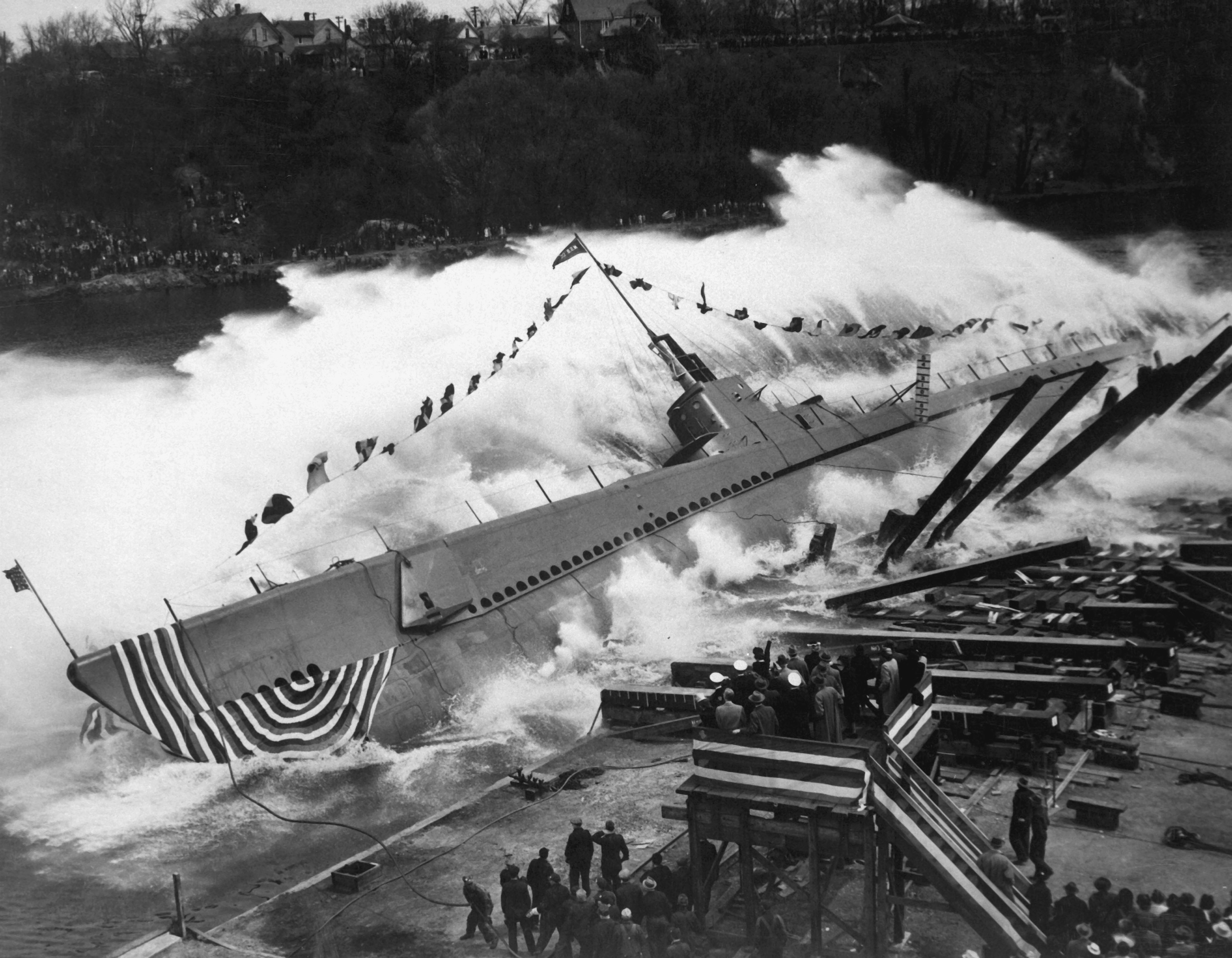
In 1940, the Manitowoc Shipbuilding Company (1902-1968) in Wisconsin was commissioned to construct submarines by the U.S. Navy for use in WWII. The company had never built a submarine before, completed the first sub 228 days ahead of schedule, and promptly was awarded additional contracts. Ultimately, Manitowoc constructed 28 submarines, saving the Government more than $5 million in contract costs.
Launching of USS ROBALO on May 9, 1943, at Manitowoc Shipbuilding Company, Manitowoc, Wisconsin.


sidebar
The Manitowoc Shipbuilding Company bought Bay Shipbuilding Company in 1968  and moved their operation to Sturgeon Bay, Wisconsin.

The subs were tested in Lake Michigan, a process referred to as "shakedown training," and were deemed fit for service. The question is how to get the subs from Lake Michigan to open water? 

sidebar
The St. Lawrence Seaway is a system of 15 locks, canals, and channels in Canada and the United States that permits ocean-going vessels to travel from the Atlantic Ocean to the Great Lakes of North America. The St. Lawrence Seaway opened for seafaring traffic  on April 25, 1959.
WWII Submarine in floating dry dock at Lockport on the Chicago Sanitary and Ship Canal, c.1943.


The Sanitary and Ship Canal opened in 1900 to carry shipping traffic and to alleviate pollution entering Lake Michigan from the Chicago River. The subs had a draft of 15 feet, and the Chicago River and Sanitary Canal could handle that without a problem. Here's how the trip was accomplished:
USS Pogy (SS 266): Keel Laid – September 15, 1941; Launched – June 23, 1942; Commissioned – January 10, 1943. USS Pogy served ten war patrols in the Pacific Ocean in World War II, sinking a total of 16 Japanese ships. She earned eight Battle Stars and the Navy Unit Commendation.


The Periscopes and radar masks were removed in order to clear bridges. One railroad bridge remained too low to pass the subs at Western Avenue. The Navy paid for lift machinery to elevate the bridge so the submarines could clear. The submarines then traveled down the canal to Lockport, where they were loaded onto a floating dry dock (barge) for the remainder of the trip down the Illinois River, towed by the tugboat Minnesota through the 9-foot-deep Chain of Rocks Channel at the confluence of the Mississippi and Missouri Rivers, and down the Mississippi to New Orleans. There the periscopes and radar masts were reinstalled.


Locals stood along the canal's sides, watching the submarines travel on their way to war.

ADDITIONAL READING:

Compiled by Dr. Neil Gale, Ph.D.

Lost Towns of Illinois - Sag Bridge, Illinois.

Sag Bridge was a village that is now part of the Village of Lemont. It had a hotel and its own post office, a number of businesses, a railroad station, a stop on the electric line between Chicago and Joliet, and a port on the I&M canal.
Photo of farmland where the Cal-Sag Channel now is. The town of Sag Bridge is behind the buildings in the background on the left. On the right, the land rises to St. James Church on the bluff. 1910


Joshua Bell, who came to Sag Bridge in the 1830s, was the postmaster and owner of the saloon/hotel. Although the town soon found it too expensive to continue as a village, it had a school district composed of one of the last one-room schoolhouses in the state, which did not close until 1961.

When the glaciers retreated from Northern Illinois, Prehistoric Lake Chicago remained, which eventually receded, leaving Lake Michigan. As it receded, it left two valleys, the Des Plaines River Valley and the Sag Valley, on either side of an elevated triangle of land called Mount Forest Island.

Sag Bridge was located on the south side of the Sag Valley. The historic St. James at Sag Bridge, the oldest continuously operating Catholic Church in Cook County, was built on the north bluff in the forests at the western edge of Mount Forest Island. The cornerstone of the church was laid in 1853. It took six years to haul the quarried rock up the bluff to complete the building.

Before permanent settlement, Mount Forest Island had been inhabited by Indians who valued the land for its vantage point and strategic location.
St. James Catholic Church and Cemetery, aka Monk's Castle and St. James at Sag Bridge Church, is a historic church and cemetery in the Sag Bridge area of the village of Lemont, Illinois. It is claimed to have been built on the site of an Indian village, possibly over an Indian mound, and later a French fortification building. Father Jacques Marquette and Louis Joliet stopped there during their exploration.

Many immigrants to Sag Bridge came from Ireland to find jobs digging the I&M canal in the 1840s, and when the canal was finished they stayed to farm or work in the local quarries. In the 1890s, the sanitary canal, the waterway that reversed the flow of the Chicago River, brought more Irish to Sag Bridge and Lemont, as well as the Bridgeport neighborhood of Chicago.

What does “Sag” mean, and what was the bridge? The answers are speculative. The term Sag probably derived from a Potawatomi Indian word, Saginaw, which may have meant “swamp.” The Sag Valley was a low-lying swampy area, and it is presumed that a bridge may have provided transport across it. The name could also refer to the geographic coming together of the two valleys. When one considers that recorded history relates that the first white settlers to arrive in the area came in 1833 and that the oldest grave at St. James Cemetery is that of Michael Dillon, buried in 1816, further fuel is added to doubts about the accuracy of the history.

Compiled by Dr. Neil Gale, Ph.D.

The Ghosts of Sag Bridge, Illinois.
The late 1890s seems to be when ghost activity peaked in the area of Sag Bridge, Illinois, now the northeast corner of Lemont. Many ghostly tales, some well documented, began here.

In late December of 1897, a rash of new sightings and hauntings was stirred up. Some said it was due to the discovery of the skeletons of nine Indians, well documented by scientists from Chicago. Professor Dosey determined the skeletons were several hundred years old, one being over seven feet tall. This was not the first time: skeletons had been turning up in and near Sag Bridge for years. But now villagers began reporting phantom Indians on horseback riding through the town at night and other visions of roaming spirits. Some felt this was due to the fact that the skeletons had been disturbed and demanded they be reburied. Some were reburied, but some were sent to the Field Museum in Chicago.

Not only Indians haunted the area. There were tales of a horse-drawn hearse traveling along Archer Avenue, pulling an infant’s casket, which was seen to glow through the viewing window. A county policeman reported chasing several figures in monk-like robes until they vanished before his eyes. A priest is rumored to have seen the ground rise and fall as if it were breathing.

Much of this activity seems to have been near St. James at Sag Bridge, a church in the middle of the forest, surrounded by a cemetery dating back to the early 1800s, years before the church was built. It is said that the site was originally an Indian village and an ancient Indian burial ground. Even in the daytime, the property gives off an eerie atmosphere.

A story told about St. James at Sag Bridge also happened in 1897. Two musicians, Professor William Looney and John Kelly, had provided entertainment for a parish event, which went on until 1 am. Not wanting to return to their homes at this late hour, they slept overnight in a small building on the property. Looney was awakened during the night by the sound of galloping hoofs on the gravel road and looked out the window. He could see nothing to account for the sound, and gradually it faded.

Looney woke Kelly to tell him what had happened, and as they spoke, the sound returned. Both men looked out, and as the sounds again faded, the form of a young woman appeared in the road. The sounds again approached, and this time horses and a carriage were seen coming partway up the drive. The woman danced in the road until she entered the shadow, and the horses and carriage disappeared, only to start again a short time later. Each time they appeared, something new was added to the scene, and the woman began to call, “Come on!” as she disappeared.

The men reported the incident to local police the next morning, and it was verified that NO drinking had taken place to account for the tale. Since that time, similar sightings have continued to be reported by respectable residents. It is said the ghosts were the spirits of a young parish helper and housekeeper from the church, who fell in love and decided to elope. The man told his young lover to wait partway down the hill while he hitched the horses, but they were startled and bolted as he was coming for her. The wagon was overturned, and both were killed.

By Pat Camalliere, "The Mystery at Sag Bridge."