Saturday, April 8, 2023

Abraham Lincoln Pleads His Case as a Defendant at 18 years old.


Abraham Lincoln worked on a ferryboat near Posey’s Landing on the Ohio River in Spencer County, Indiana, in the fall and winter of 1826-27. In the spring, Lincoln built a small flatboat for his own use at Bates’ Landing, about a mile and a half downriver. He intended to earn money by carrying produce down the river.

This business languished, however, and Lincoln, his meager savings gone, turned to carrying passengers to steamboats in the middle of the river. One day he was motioned to the Kentucky shore by brothers John T. and Len Dill, who were operating a ferryboat nearby.

Two brothers who lived on the Kentucky side of the river, John T. and Len Dill, had the ferry rights across the Ohio River from a point opposite Anderson River. One day Lincoln was motioned to the Kentucky shore by the brothers. A tense confrontation occurred as the brothers accused Lincoln of infringing on their business. Lincoln’s obvious strength may have encouraged a legal rather than a physical resolution. In any event, Lincoln and the brothers turned to Samuel Pate, a farmer and justice of the peace.

The Dill brothers accused Lincoln of interfering with their legally established business. Lincoln admitted to conveying passengers to the middle of the river. Lincoln argued that he had carried no one who was a potential customer of the Dills’ ferry.

sidebar
The pertinent clause of Kentucky law read: "... if any person whatsoever shall, for reward, set any person over any river or creek, whereupon public ferries are appointed, he or she so offending shall forfeit and pay five pounds current money, for every such offence, one moiety to the ferry-keeper nearest the place where such offence shall be committed, the other moiety to the informer; and if such ferry-keeper informs, he shall have the whole penalty, to be recovered with costs."

The evidence presented revealed that Lincoln had limited his operations to depositing his passengers on board steamers in the middle of the river and that he had never ferried any of them clear across the Ohio River.

Judge Samuel Pate, narrowly interpreting the act from William Littell’s Statute Law of Kentucky, “respecting the Establishment of Ferries,” ruled that inasmuch as there was no occasion cited on which Lincoln had "set any person over [shore to shore] any river or creek." Lincoln, however, had taken passengers only to the middle of the river. Case dismissed.

This case, the first in which Lincoln appeared as a defendant, led to a friendship between him and Samuel Pate, which, some have speculated, may have stimulated his initial interest in the law.

Compiled by Dr. Neil Gale, Ph.D.

Friday, April 7, 2023

Abraham Lincoln's Legacy.

Abraham Lincoln by Alexander Hesler, 1860.
CAMPAIGN
By May of 1860, Lincoln was nominated for President in the Republican National Convention in Chicago. He was running against a deeply divided Democratic Party, positioning the nation on the brink of fundamental change. A Republican win would end the South's political dominance of the Union. Ultimately, Lincoln carried all northern states, but New Jersey and Lincoln's win in the heavily populated North achieved victory in the Electoral College. 

Four years later, in November 1864, amid the civil war, the United States held another presidential election, a feat no democratic nation had ever accomplished. Even when Lincoln felt no hope of winning, he never seriously considered postponing the election. Despite his doubts, Lincoln achieved a huge Electoral College victory, with a considerable margin of 55% of the popular vote. Thousands of Lincoln votes by soldier-citizens were one key to his victory.

CHALLENGES
When Lincoln left Illinois and headed east for his inauguration, he told the crowd at the Springfield railroad station that he confronted challenges equal only to those that had faced the nation's first president: Washington had had to create a nation; Lincoln now had to preserve it. 

Lincoln's election was evidence of the sectional discord that had ripped the United States apart during the 1850s, as slavery became a critical political and moral issue. As Lincoln had remarked, "A house divided against itself [over slavery] cannot stand." This proved prophetic with the collapse of the national party systems (the Whigs disappeared altogether) as North and South evolved into separate societies ─ one based on free labor, the other on slavery. 

sidebar
Although the term "free labor" might suggest the same meaning as slavery, the word "free" had nothing to do with bondage or working for no wage, but rather indicated concepts of freedom, independence, and self-reliance. The concept emphasized an egalitarian (all people are equal and deserve equal rights) vision of individual human potential, the idea that anyone could climb the ladder of success with hard work and dedication.

Lincoln's election prompted the South to withdraw, or secede, from the Union. In his first inaugural address, Lincoln delivered a final plea to the South to remain, but to no avail. War broke out in April 1861 with the attempt by the Federal government to resupply South Carolina's Fort Sumter. Despite the partisans' optimism that the war would be over quickly, it became a long, desperate, and exceptionally bloody conflict that would fundamentally reshape the nation.      

sidebar
The poet Steve Scafidi (1967─) characterized Lincoln's challenges as those confronted by a doctor trying to perform brain surgery while a dog gnaws at his leg. 

Lincoln's tasks were staggering, both in detail and in scope. Politically, he had to navigate between the many demanding factions and interests of the North. He also had the unprecedented task of organizing and prosecuting what would become the first industrial war, a conflict that ranged across the whole country, involved all of its resources, and was fought by an army not always up to the task. Finally, constitutionally and politically, Lincoln grappled with the evolving meaning of the Civil War. Initially, Lincoln espoused only the cause of Unionism. But as the war continued, he saw that saving the Union was inseparable from the cause of Negroes freedom. In his 1863 Gettysburg Address, he argued that the war must lead to "a new birth of freedom," or it would have been fought in vain.

MAJOR ACTS
In practical terms, the achievements of Abraham Lincoln are mammoth yet simple to describe: he confronted the South's secession and the Union's dissolution with all the political and practical tools at his command to defeat the Confederacy and restore the United States. 

His skills as a practical politician were extraordinary as he juggled the contending interests of his constituencies, which included the army, Congress, foreign countries, and ordinary Americans he was conscious of representing. It must be remembered that Lincoln was, above all, an extremely skillful politician, one frequently underestimated by both friends and foes. 

His use of the levers of power in pursuing his evolving war aims greatly expanded the power of the executive in American politics, setting a precedent that later presidents would build on. His suspension of habeas corpus was controversial both then and now; the military draft caused violent riots, and through government contracting and the expansion of state activity, such as the approval of a transcontinental railway and the Morrill Act to settle western lands, he laid the foundations for a better country.

LEGACY
Lincoln's legacy is based on his momentous achievements: he successfully waged a political struggle and civil war that preserved the Union and ended slavery. He created the possibility of civil and social freedom for Negroes.


President Lincoln issued the Emancipation Proclamation on January 1, 1863, as the nation approached its third year of a bloody civil war. The proclamation declared "that all persons held as slaves" within the Confederacy "are, and henceforward shall be free."

On February 25, 1863, President Lincoln signed The National Currency Act into law. The Act established the Office of the Comptroller of Currency, which was responsible for organizing and administering a system of nationally chartered banks and a uniform national currency. 

sidebar
The Confederate Congress authorized the recruitment of slaves as soldiers with permission of owners in March 1865.

John Wilkes Booth shot President Lincoln on Friday, April 14, 1865, at Ford's Theatre in Washington, D.C. Lincoln was immediately moved to the William and Anna Petersen's House across the street from Ford's Theatre. Abraham died from his injury on Saturday, April 15, 1865.

However, his assassination prevented him from overseeing the reconstruction of the Union he had helped save. The assassination also had the effect of turning Lincoln into a martyr of almost mythological dimensions. As Edwin Stanton remarked when Lincoln died, "Now he belongs to the ages," Lincoln has not lacked idolaters who viewed him as an almost supernatural representation of American genius. 

It is much more realistic to see Lincoln as a practical genius. Temperamentally, he was humane, tolerant, and patient. But he also had an extraordinary ability to see and adapt to events, responding decisively when necessary. Above all, there is his evolution on civil rights. He began the Civil War with thoughts only of restoring the Union but ended up committing the nation to freedom for Negroes. 

One of the great unanswerable questions in American history centers on how our nation's social trajectory might have changed had Lincoln lived to serve his entire second term.


Compiled by Dr. Neil Gale, Ph.D.

The Settlement of Chicago and How it was Incorporated.

Until 1833, Chicago was just a settlement with only the Cook County organization for a government. In 1833 with a population of approximately 300, it was incorporated as a town. It became a place of considerable importance and attracted a great body of immigrants who came West that year, producing many improvements.
An 1833 Map of Chicago.


The Indian lands were to be sold, and Chicago started out with a boom. The inns were crowded, and travelers considered themselves fortunate if they could secure a place on the floor to sleep. 

During the summer of 1833, 160 houses were built, and the number of stores increased from five or six to twenty-five. The Green Tree Tavern was the first structure built as a public house among the new buildings. While the old Kinzie house and several other houses had been open to travelers, there had never been a building put up for that purpose until the Green Tree in 1833.

Read a first-hand account of a traveler's overnight stay at the Green Tree Tavern.


sidebar
Chicago's First Three Taverns:
Wolf Point Tavern opened in December of 1828. The Wolf Point Tavern was rechristened by its owner, Chester Ingersoll, The Travelers' Home, in October 1833.

Eagle Exchange Tavern  - Mark Beaubien opened the Eagle Exchange Tavern in a log cabin on the south bank in 1829. In 1831 Beaubien added a frame addition and opened Chicago's first hotel, the Sauganash Hotel.

The Green Tree Tavern was built in 1833 - The Green Tree Tavern was later renamed the City Hotel, then the Lake Street House, and finally the Tenement House.

The United States Government began to pay some attention to the growing town on Lake Michigan's shore, and the harbor was improved at the expense of $325,000 ($12M today).

The channel of the river was straightened, widened, and deepened. The sand bar at the mouth of the river turned the river down (south) the shore from Water Street to Madison before emptying into the lake was cut through, and vessels could enter and pass up to the forks. The mail arrived semi-weekly and departed for Galena, Springfield, Alton, and St Louis.

On October 26, 1836, the Town Board took the necessary steps to secure a charter for the city of Chicago. A public meeting was held on November 25, and E. B. Williams, as President, appointed J. D. Caton, Ebenezer Peck, T. W. Smith, W. B. Ogden and Nathan Boiles delegates to draw up a charter for presentation. This charter was presented to the board on December 9, and the Legislature passed the bill approving the charter on March 4, 1837.

THE FIRST CITY LIMITS.
The first meeting was held on August 12, and Colonel Owen was chosen as President. The boundaries of the village were: Commencing at the intersection of Jackson and Jefferson streets, thence north on Jefferson to Ohio Street, thence east on Ohio Street to the lake, thence south along the lake to the middle of the river, thence up to State street, thence South along State to Jackson street, thence west to the place of beginning, comprising about seven-eighths of a mile square. The Jog made from the mouth of the river to State Street was because of the military reservation there. This was the incorporated village of Chicago.

But during this time, the village of Chicago was fast growing in population, importance and fame. By 1837, the population was over 4,000 people, and the citizens thought it was time to keep pace with the dramatic growth and have the city chartered. 

In 1833 the population had been 200, and in 1836 it had increased to 8,820. The harbor was in the process of improvement, the Illinois and Michigan Canal had begun, land speculators were buying up the land, and there was plenty of capital in Chicago.

On October 26, 1836, the Town Board took the necessary steps to secure a charter for the city of Chicago. A public meeting was held on November 25, and E. B. Williams, as President, appointed J. D. Caton, Ebenezer Peck, T. W. Smith, W. B. Ogden and Nathan Boiles delegates to draw up a charter for presentation. This charter was presented to the board on December 9, and the Legislature passed the bill approving the charter on March 4, 1837.

sidebar
The indigenous tribes of the Chicago area were the Potawatomi, Ojibwe, and Odawa Nations, as well as the Miami, Winnebago (Ho-Chunk), Menominee, Sauk (Sac), Meskwaki (Fox), Kickapoo tribes, and the Illinois.

The first plat of the Chicago settlement was filed in 1830.

Cook County was created on January 15, 1831 by an act of the Illinois State Legislature as the 54th county established in Illinois. The unincorporated Fort Dearborn settlement at the mouth of the Chicago River became the new county's seat. On May 7, 1831, Cook County elected its first officials.

Chicago was incorporated as a town on August 12, 1833, with a population of about 350. With a population of 4,170, the town of Chicago filed new Incorporation documents on March 4, 1837, to become the City of Chicago and for several decades was the world's fastest-growing city. 

Compiled by Dr. Neil Gale, Ph.D.

Thursday, April 6, 2023

The Miracle House, 2001 North Nordica Avenue, Chicago, Illinois. (1954)

Frank Lloyd Wright meets The Jetsons.
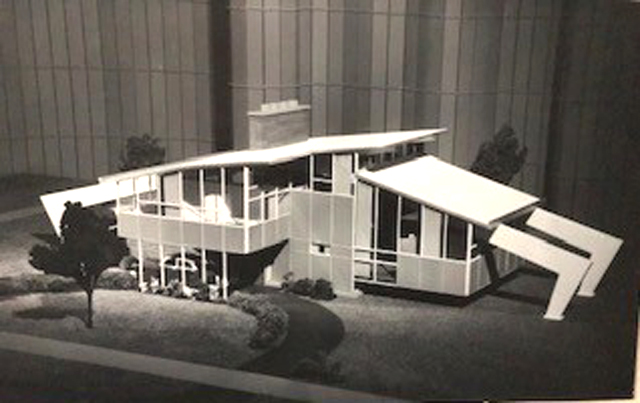
Scale Model. Locals called it the "Spider House," "Grasshopper House," or "Glass House."

The bold, mid-century modern "Miracle House" stands at 2001 N. Nordica Avenue in the Galewood neighborhood within the larger Austin Community Area. The genesis of the house is perhaps unlike any other in Chicago, for it was built as a grand prize for a raffle sponsored by the nearby St. William Catholic parish. The name Miracle House first appeared on the raffle tickets, and it has stuck with the property. 

In 1953, Fr. Frank Cieselski of the expanding parish conceived a house raffle to raise funds for a new church, school, convent and rectory. Edo Belli, a 36-year-old Chicago modernist architect and a Catholic who had attracted the backing of Archbishop Samuel A. Stritch for other diocesan commissions, offered to design the house free of charge and was given complete freedom of design. Indeed, Fr. Cieselski urged the architects to produce a boldly futuristic design that would capture attention and boost ticket sales.


Today, the house is a unique work of modern residential architecture in Chicago with a structural system based on two giant steel arms acting as a suspension bridge rather than load-bearing walls and columns. The Miracle House is unique for its almost all-glass exterior, making it innovative in its openness and connection with its exterior surroundings.
The primary elevation of the house faces south onto Armitage Avenue. The second-floor kitchen with a glazed curtain wall is suspended over the driveway, creating a carport, reflecting the centrality of the automobile in residential architecture in America in the postwar era. The first floor is clad in coursed Lannon stone, a widely used material in the mid-twentieth century.


The Miracle House resulted from a campaign to raise capital funds for the expansion of a Catholic parish complex that resulted in not just the construction of the house itself but also St. William parish a mile away. Thus, it reflects the important contributions religious communities made to Chicago neighborhoods. The futuristic design of the house also reveals the cultural optimism for novelty and the future that captivated America in the 1950s, even as the Cold War menaced on. 
Detail the pair of 36-ton steel trusses from which the house is suspended. They were fabricated by the Chicago Bridge & Iron Company, which donated its services to the project like many suppliers.


The house is also significant as the work of Belli & Belli Architects and Engineers, Inc., a small, family-run architecture firm founded in 1946 in Chicago, which by 1953 was a booming office with 45 employees. Belli & Belli played an outsize role during the modern era in Chicago and throughout the nation. The firm's designs were marked by structural innovation and an expressive modern aesthetic that was arguably more popular than the austerities of the International Style.
Chicago's Hugh Hefner with his wife, Mildred, and daughter Christine in his new 1955 Cadillac Eldorado Convertible in front of the "Miracle House." 1955


sidebar
The house was built entirely with donated labor and materials, including the stainless steel arms from which the house is suspended. General Electric donated appliances, retailer Sol Polk (Polk Brothers) donated furnishings and the General Bridge and Steel Company provided the steel arms. The raffle raised enough money to not only pay for a new church but a new parish rectory, a convent and a school. 
In addition to the prominence of the automobile in residential architecture, outdoor living also became a new priority in the postwar era. At the west elevation of the Miracle House, sliding glass doors lead to a patio, and a canopy over the terrace was added later.


The Galewood Neighborhood in the Austin Community.
Galewood first developed as a 320-acre frontier farm settled by New York transplant Abram Gale in 1838. In 1899, a portion of the farm was leased to the Western Ho Golf Club, which remained there until the late 1920s. In 1927, the golf club and what remained of the farm were subdivided for residential development by G. Whittier Gale, grandson of the original settler. Many of the homes in the neighborhood are bungalows and various revival styles of architecture, including Tudor, Georgian, and French eclectic from before World War II and Cape Cod and Ranch-style homes from the postwar era. Galewood has a distinctly suburban feel, with the houses deeply set back on large, manicured lots.

Building Design and Construction
The Miracle House is essential to the Galewood neighborhood of Chicago and the local St. William Catholic parish. The idea of selling $1 tickets for a raffle with a chance to win a futuristic house was motivated by St. William's need to expand its campus, an expansion that the raffle succeeded in funding.

The raffle drawing was held at the old Lion's Club in Chicago in December 1955. 
A raffle ticket from which the house derived its name. Purchasers were entitled to a house tour in the months leading up to the drawing.
A $1.00 Raffle Ticket Equals $11.00 Today.

To that extent, the raffle not only added the Miracle House to the neighborhood in 1954 but eventually, by 1961, also a new church, convent, school, and rectory at the four corners of the intersection of Sayre and Wrightwood Avenues. Belli & Belli designed all these buildings in the modern style, and for the church, Edo Belli employed a thin-shell concrete wall and roof structure, a new technology of which Belli & Belli was an early adopter. Coincidentally, Belli & Belli's offices were located in the neighborhood.

When Edo Belli agreed to volunteer to design the Miracle House, Belli & Belli had already designed the first of what would become many churches, institutions, and hospitals for the Catholic church in general and the Archdiocese of Chicago in particular. In addition, the firm took on commercial work, but Edo Belli had yet to design a single-family dwelling other than for himself and his family. The Miracle House was a project that Edo Belli had to discuss with Cardinal Stritch, as the residential design was different from a standard part of his firm's practice.

The house would be built on a large lot (100' x 200') at the northeast corner of Nordica and Armitage Avenues. Precisely how this property was identified, or the decision-making that led to its purchase, is still being determined. Its proximity one mile south of St. William parish was undoubtedly a factor.

Construction began as soon as Belli's design was completed in late 1953. As word of the planned raffle to win a futuristic house got out, donated labor and material started pouring in to assist with the construction for a good cause and publicity. The Chicago Bridge & Iron Company contributed the massive steel arches, and General Electric donated all the necessary appliances, making this an all-electric house. Sol Polk of Polk Brothers, a famed Chicago appliance and electronics retailer, provided all the furnishings free of charge. Sol Polk also led the raffle promotion. Trade unions offered their services pro bono. Jim Belli, Edo's son, believes the only thing that should have been donated was the windows.

When construction of the Miracle House finished in late 1954, purchasers of a $1 raffle ticket were entitled to a house tour in the months leading up to the drawing in December of that year. The raffle was also promoted with custom-made glass ashtrays depicting the house. 
This 6"x 2½" ashtray/candy dish was given to purchasers of multiple raffle tickets.
Movie star and former neighborhood resident Kim Novak announced the winning ticket. She attended St. Williams, and her parents lived on Sayre Avenue, a half block from the Miracle House site.

The house winner was Joseph Novelle, who lived a half block away on Nordica. 

He owned the house briefly, selling it in 1957 to the Marano family, who put on a compatible addition in 1965 as their family grew. The Maranos remained in the house until 1989 when they sold it at auction to Alexander Fletcher, a Chicago fireman, who lived there for 10 years. 

In 1999, Dr. David Scheiner, M.D. bought the house and lived there as only its fourth owner in Novelle's 65-year history. (Dr. Scheiner had a long-established medical practice in Hyde Park, Chicago, where one of his patients was Barack Obama in the years before he became President.)

When it was completed in 1954, the house measured 20' x 56', with the primary elevation facing south onto Armitage Avenue. The house is suspended from two 36-ton steel arms spanning 100' in an east-west direction. The bridge-like structural system eliminated the need for load-bearing walls, allowing ample glazing and an open interior free of columns. The exterior on the second floor consists of a glazed curtain wall, while on the first floor, the exterior is rendered in Lannon stone, which is also used on the interior of the first-floor living room.
Lannon stone walls on the exterior carry into the interior of the first-floor living room. The floors are polished travertine. The short terrazzo stairway leads up to a split-level recreation room.


The first floor is a split level with the ground-level layout occupied by a living room and a recreation room (originally bedrooms) on the lower level. The kitchen and dining rooms are on the second floor, and a main bedroom fills the third floor. The large expanses of glass create a light-filled and spacious interior with terrazzo and travertine floors. The most incredible room is above the south-facing carport - the kitchen, a beautiful projecting room with three glass walls emitting light on the south, west, and east.
Another view of the living room shows a flitch-matched wood wall panel and clerestory windows. Unlike more austere forms of modern architecture, the Miracle House is a "Contemporary" style with more broad appeal.
The Marano family added a bedroom to the house in 1965 to accommodate a growing family of eight children. Belli & Belli was offered the commission but declined due to the substantial number of hospital and commercial commissions on the boards at the time. A neighborhood architect, Ray Basso, took the job and generally respected Belli's original design, containing his work to the north side of the house, where the unique, original design stands on its own as approached from the south.
The suspended structure allowed for large areas of glazing, as shown in this view of the second-floor kitchen with terrazzo floors. Such opening up of exterior views of large manicured lawns was another characteristic of mid-century modern residential architecture.
For years, the Miracle House was a drive-by destination for locals in the Galewood community and fans of modern architecture. Postcards were printed, and celebrities visited, including Hugh Hefner, who grew up in the neighborhood. The Miracle House is still recognized as a local landmark in the Galewood community.

The Contemporary Style of Mid-Century Modern Residential Architecture
The Miracle House is a clear example of mid-century modern residential architecture. This catch-all includes a range of fluid styles and where commonly agreed-upon definitions remain elusive. Virginia McAlester's Field Guide to American Houses, revised in 2013, is regarded as the most definitive guide to American domestic architecture. It defines the "Contemporary Style" as best representing the Miracle House design.

While different styles fall under the mid-century modern umbrella, they all responded to social and technological changes and new ways of living in postwar America. These transformations are well described in a 1960 issue of House & Garden:

Few periods in history can match the past decade in the number of spectacular changes it has witnessed in our daily lives. From a nation well supplied with automobiles, we have turned to a nation living on wheels, and the not-too-surprising result is that the garage has become the actual entrance of today's house. In months, TV grew from a rather expensive toy into standard household equipment, and in the process, a new room—the family room- was added to the house. Insulating glass walls of the southern California house have become equally comfortable for the climate of northern Illinois. The whole country has succumbed to a passion for cooking, eating and lounging outdoors, but at the same time, land on which to build, cook, and lounge has become progressively scarcer.

Despite their stylistic differences, mid-century modern houses typically have attached garages incorporated into the building. Open floor plans and large living rooms for TV are commonplace. Large windows take full advantage of views of large, landscaped lawns. All these characteristics are visible in the design of the Miracle House.

The Contemporary Style rejected historical styles of architecture. However, the style allowed for more materials, textures, and forms, making it more popular than the austere forms of mid-century modern house design.

The design of contemporary-style houses is clearly influenced by Frank Lloyd Wright's Usonian Houses, built with natural materials, free-flowing interiors, and a blending of interior and exterior spaces. Contemporary-style houses were popular from 1945 to 1965 when architects designed them for individual clients or were built in large numbers by developers, most notably by Joseph Eichler, who made thousands of contemporary-style homes in the San Francisco Bay area.

The Contemporary House style emphasized the convenience of open floor plans and blending indoor and outdoor spaces. The houses are typically two stories in height with flat or shallow-pitched and exposed roof structures. Exterior walls are clad in various materials, including brick, wood, and stone, often combined. Entrances are usually recessed or off-center. All these character-defining features are visible in the design of the Miracle House.

sidebar
Dr. David Scheiner bought the house in 1999 on the advice of his late wife, who had known about the home while growing up on the Northwest Side. “I walked in, and my jaw dropped,” Scheiner said, noting that he purchased the whole thing for around $375,000 at the time. The home, he said, is 70 percent glass, the floors are marble, and the Jetson's-style stainless-steel arms (they do not support the house) imitate the flying buttresses that hold up European cathedrals. Dr. Scheiner was Barack Obama’s personal doctor for nearly two decades, right up until Obama won the presidency in 2008.

On April 21, 2021, the Chicago City Council unanimously approved the landmark status of the Miracle House.

sidebar
A 2023 Real Estate Appraisal: $563,000.

Compiled by Dr. Neil Gale, Ph.D.

Wednesday, April 5, 2023

The Varsity Theater, 1710 Sherman Avenue, Evanston, Illinois. (1926-1988)

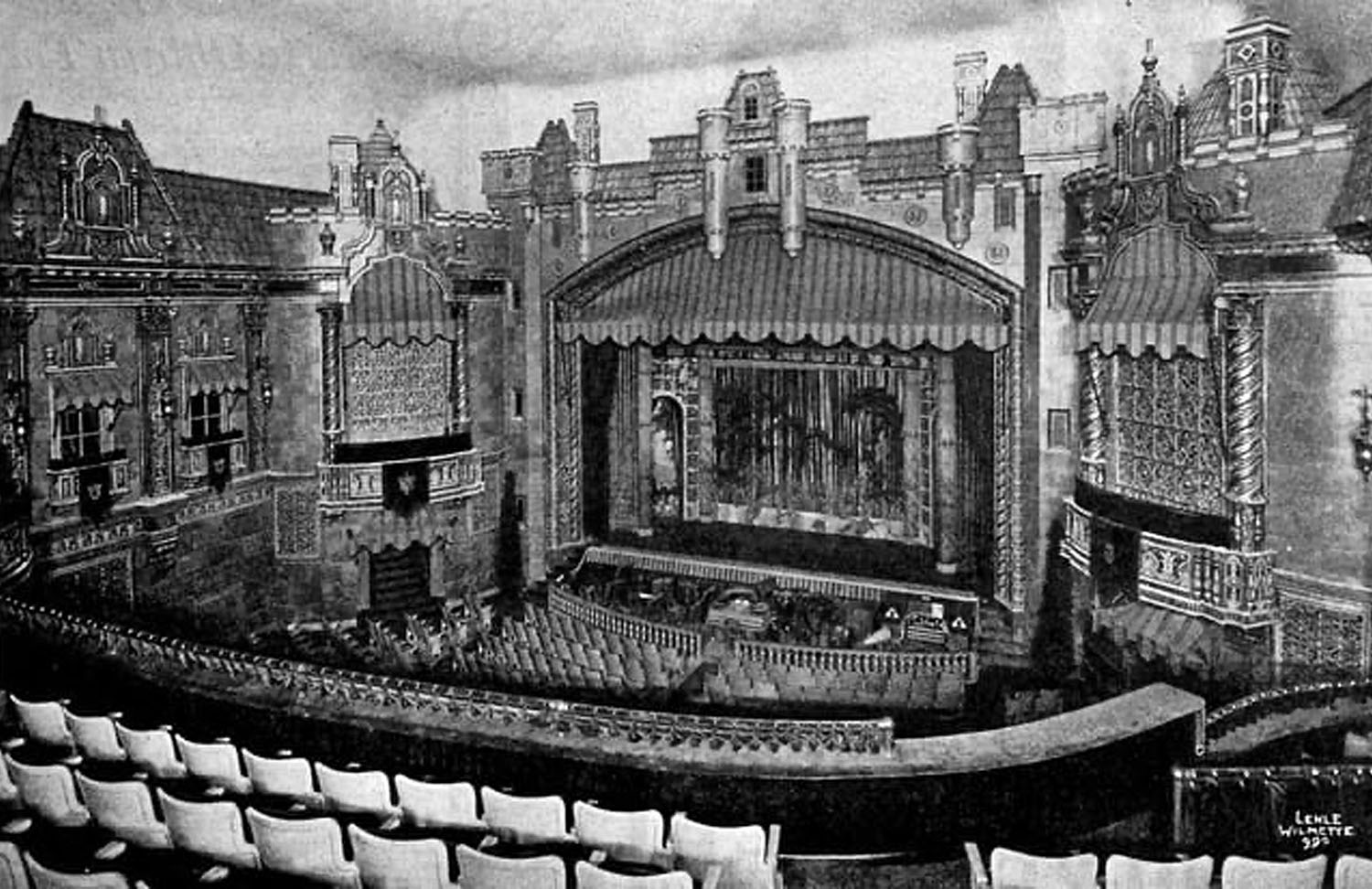
The Varsity Theater opened on December 24, 1926, at 1710 Sherman Avenue, Evanston, Illinois. The theater was commissioned by Evanston native Clyde Elliot and was designed by John E.O. Pridmore. It was the only known example of an atmospheric theater designed as a French Chateau. 
The Varsity Theater, 1944, and the Marshall Field & Company Evanston Store.


sidebar
Just 4 years, 3 months, and 11 days later, the Nortown Theater, 6320 North Western Avenue, Chicago, Illinois, opened on April 4, 1931, another Pridmore design. It was also an atmospheric theater designed with a seaside theme, sea horses, mermaids, and zodiac motifs. The theater closed in 1990 and was demolished in 2007.
 
The Nortown Theater, Chicago, Interior from the Balcony.


More specifically, the Varsity Theater was designed to represent the courtyard of a French chateau "of magnificent coloring and rare charm." The sidewalls represented castle walls, abutting the proscenium with turrets and buttresses hiding organ chambers and pipes within. The proscenium arch formed "a massive gateway with flying flags and pennons" and suggested the view out over a lowered drawbridge from the castle courtyard of the auditorium out onto the stage beyond.

Noted scenic company Sosman & Landis Co. was credited with creating the auditorium's elaborate French interior. They were founded in 1878, and many of its artists and mechanics have practically spent their lives developing their art. The company's first theatrical scenic painting began at the old McVicker Theater in Chicago.

At 2,500 seats, the Varsity Theater was one of the largest suburban Chicago movie palaces ever built and was also one of the most spectacular. The cerulean blue sky dome featured twinkling stars, floating fleecy clouds, and a delicate crescent moon that sailed slowly overhead during the performance.

The theater's 3-manual, 26-rank organ was built by the Genevan Organ Company. Leo Terry, former organist at the Capitol Theater, Chicago, one of the foremost theater organists in the country, will preside over the giant Geneva organ. Called an "atmospheric console," the Geneva organ was sunken and rose into view during organ numbers.
The Varsity Theater. 1967.


The lighting scheme of the Varsity expresses the early French era. The illumination in the auditorium was early French period, a crude lantern-type of fixtures enameled in bright colors. The modern Italian lobby used old iron and antique gold metalwork finishes. The company making the lighting fixtures supplied them for the new Palmer House Hotel and the new Stevens Hotel in Chicago. 

The marvelous lighting effects and the ceiling treatment enhance the illusion of sitting outdoors in the chateau courtyard. Overhead is a cerulean blue sky with twinkling stars, floating fleecy clouds and a delicate crescent moon that sailed slowly overhead during the performance. Its rising and setting begin so timed that it slowly fades from view behind the chateau just at the close of the performance, a distinctive innovation in theater decoration.
The Varsity Theatre Interior from the Balcony in 1926.


The Varsity closed in 1988. Almost immediately after the theater closed, the main level and lobby were gutted and turned into retail space.

In 2010 the City of Evanston received a $50,000 grant from the National Endowments for the Arts to conduct a feasibility study on reopening the theater as a performing arts center. In July 2011, the study concluded that the first floor of the theater was currently occupied by a retail store and not available for redevelopment and that the performing arts needs of Evanston were greater than the Varsity Theater could accommodate alone. They recommended developing several performing arts spaces in downtown Evanston instead of just one central location.

Compiled by Dr. Neil Gale, Ph.D.
Valencia Theater, 1560 Sherman Avenue, Evanston, Illinois.

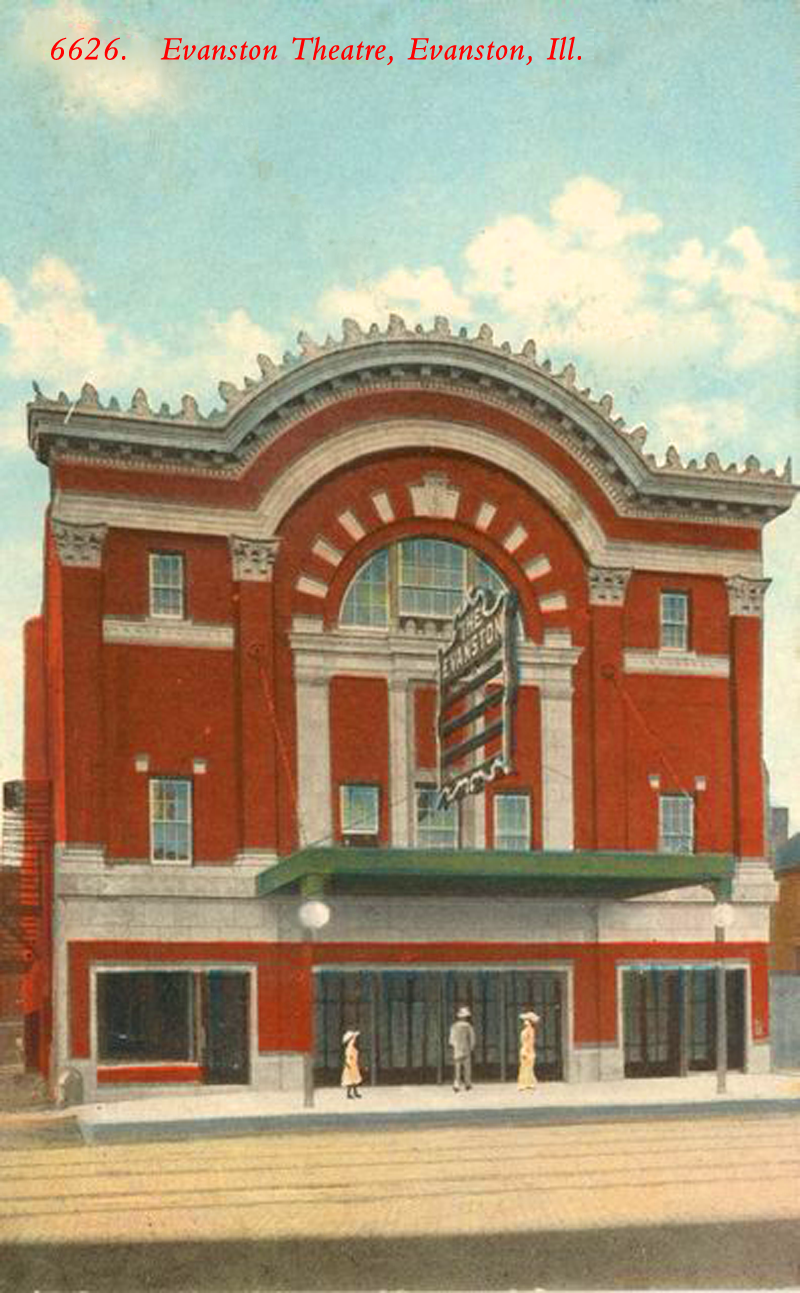
The Evanston Theater


At 1560 Sherman Avenue, where James Carney had lived since 1884 in the old Willard House. The Evanston Amusement Company built the Evanston Theatre in 1910-11. Designed by the Chicago architect John Edmund Oldaker Pridmore (1867-1940), the $65,000 ($2,058,000 today) theatre opened on August 21, 1911.

Featuring "polite vaudeville," the 950-seat theatre changed its bill on Mondays and Thursdays and had matinees on Wednesdays and Saturdays. The interior decoration was by the H. Neilson Company, the carpets and draperies by the Hasselgren Studio, and the furniture and fixtures from Marshall Field & Company. 


After a fire that caused a loss of about $35,000 ($822,600 today) in December 1917. It reopened as the Evanston Strand Theater in 1918. In December 1922, it reopened as The New Evanston Theater. 

Renamed The Valencia Theater was completely rebuilt in September 1932 with Art Deco decor. It was taken over by Balaban & Katz. It later was operated under B & K’s successor chains, ABC Theatres and finally, Plitt Theatres.

The Valencia was razed in 1975 to make way for the American Hospital Supply building, replaced in the early-1980s by an eighteen-story building that now houses the world headquarters of Rotary International.

Compiled by Dr. Neil Gale, Ph.D.

Tuesday, April 4, 2023

Devon Theater, 6225 North Broadway, Chicago, Illinois.

The Devon Theater at 6225 North Broadway, Chicago, was originally known as the Knickerbocker. It was built by the Lubliner & Trinz circuit in 1915 by architect Henry L. Newhouse. 


Located in Chicago's Edgewater neighborhood, the theater was later renamed the Devon, even though it was more than two blocks south of Devon Avenue on Broadway.

Around the time it was renamed, the operation of the Devon was taken over by Essaness. It continued to operate through the 70s as a second-run movie theater and later housed a church for a time. 


The Devon Theater was demolished in 1996 after the entire block was acquired by Loyola University.

Compiled by Dr. Neil Gale, Ph.D.

Chuck Wagon Diner with a Kentucky Fried Chicken, Champaign-Urbana, Illinois.


The Chuck Wagon was in Champaign from 1956 to 1976, when it was sold and moved to Villa Grove. The diner was moved to downtown Urbana in 1983, where it operated as the Elite Diner from 1983 to 2002. The diner then went to Homer and eventually to Michigan.


In 1956 Mountain View Diners of Singac, New Jersey, delivered the new Chuck Wagon to Bob and Nixie Dye in Champaign, Illinois. It was one of the last diners manufactured by Mountain View Diners.
The Dyes operated the Chuck Wagon Diner and also offered Kentucky Fried Chicken. The Chuck Wagon Diner was the 14th Kentucky Fried Chicken franchise in America.


In 1976, the diner and its contents were sold at auction. Then it became the Elite Diner for many years. Eventually, it was moved to Michigan. It was rescued from a lot in Detroit, where it had been sitting idle since 2002. It was in poor condition. The diner arrived in Princeton in December of 2007. An extra dining room, a kitchen, restrooms, and a full basement were added. Then the Ketchums found the original sign and the foyer in Illinois. From Rhode Island came the 1950s pie case and ice cream parlor.


The 1953 Happy Days Jukebox came from Michigan, and the counter mounts for the Jukebox also came from Michigan. The counter mounts for the Juke Box were installed, as well as a heated wheelchair ramp, sidewalk, and steps. After many months of repairing, scrubbing, polishing, and building to restore the vintage 1950s diner to its original condition, the Chuck Wagon Diner opened in April of 2010 on Ketchum's property in Princetown, NY.

Compiled by Dr. Neil Gale, Ph.D.


"Iconic Chuck Wagon diner relocated, rejuvenated in New York."


The old Chuck Wagon diner in Champaign has found new life in New York.

The diner, which once graced the corner of Neil and Springfield in Champaign and later became home to the Elite Diner in Urbana, had its grand opening this month in Princetown, New York.

The original owner of the stainless steel diner, Bob Dye of Champaign, was on hand for the event.

"It looked just like it came out of the factory when I bought it in 1956," said Dye.

New owners Tom and Sally Ketchum located the old diner in Detroit and arranged to have it hauled to New York. They reunited it with the original Chuck Wagon sign, which had been stored in Chicago for three decades.

Dye traveled to New York for the grand opening and, while there, ate many of his meals at the diner.

"It was a packed house, and people were standing in line all day," he said. His meals included beef and noodles, bacon and eggs, pot roast, cereal, and pancakes.

Sally Ketchum said she and her husband opened the Chuck Wagon in late April but delayed the grand opening until May.

"We had to have Bob Dye up here to cut the ribbon," she said. "Bob's quite a guy."

She said that the restored diner is equipped with a jukebox and counter mounts so diners can select records from their booths. An extra dining room was built, and a heated wheelchair ramp was added.

The Ketchums located the diner's original foyer in southern Illinois and moved it to New York.


"It's the first time the foyer, the diner and the sign have been together since 1976 when they auctioned it off," she said.

By Don Dodson.
The News-Gazette, June 25, 2019

The First Sears, Roebuck, and Co. Retail Store in Chicago, Illinois, opened in 1925.

Richard Warren Sears and Alvah Curtis Roebuck established Sears, Roebuck, and Co. in 1892.
The Sears retail store was in the "Merchandise Building," within the 1906 building complex in the North Lawndale community of Chicago. It was bounded on the North by West Arthington Street, the West by Central Park Avenue, the East by Spaulding Avenue, and the South by West Fillmore Street. 


On February 2, 1925, under the direction of Robert E. Wood, Sears opened its first retail store in the Merchandise Building, which was within the 1906 building complex in the North Lawndale community of Chicago. It was bounded on the North by West Arthington Street, the West by Central Park Avenue, the East by Spaulding Avenue, and the South by West Fillmore Street. 

A second store opened in November 1928 at Lawrence and Winchester, followed by a growing list of locations in Chicago and beyond. In the first year, less than 5% of sales came from retail; by 1931, retail represented half of the company's sales. In 1932, Sears spent a million dollars to make William LeBaron Jenney's landmark 1891 Leiter Building its State Street flagship store. This store included an optical shop and a soda fountain.

Sears, Roebuck, and Co. Chicago Tribune, Sunday, March 15, 1925, full-page Ad referring to the New Merchandise Building Store.


TOP LEFT TEXT BOX IN 1925
CHICAGO TRIBUNE AD ABOVE.
During the summer of 1928, three more Chicago department stores opened, one on the north side at Lawrence and Winchester, a second on the south side at 79th and Kenwood, and the third at 62nd and Western. 

In 1929 Sears took over the department store business of the Becker-Ryan Company. 

sidebar
The Sears exhibit at Chicago’s A Century of Progress Exposition featured “a veritable pageant of merchandising during the last hundred years.”

In March of 1932, Sears opened its first downtown department store in Chicago on State and Van Buren Streets. Sears located the store in an eight-story building, built in 1893 by Levi Z. Leiter, which housed the Stegel-Cooper department store for years. The original Chicago occupant was William Bross, who, in 1871, mounted his house on wheels and rolled it down State Street to the corner of Van Buren Street. He kept his house on wheels for several years because of the marshy conditions of the land. Leiter's building, designed by famous skyscraper architect William LeBaron Jenny, included New England granite walls.

The store sat on the corner of Van Buren, State and Congress streets, costing over a million dollars to refurbish. A 72-foot-long electric Sears sign greeted shoppers at the front entrance. A stunning black and white terrazzo covered the main floor. The State Street store was the first Sears store in a downtown shopping district, the sixth store in Chicago.

Opening day for the State Street store took place deep in the Great Depression. Local newspapers reported that 15,000 shoppers visited the new store, and several thousand people flooded the store’s employment office. Sears did everything it could to help put people to work, employing 750 Chicago workers for four months during the renovation. Once completed, Sears staffing reached over 1,000 people.

In a message to Sears Chairman Lessing Rosenwald, Illinois Governor Louis Emmerson stated, "I cannot help but feel that this opening will mean a great deal for your organization as well as for your city." Rosenwald proudly proclaimed, "We regard the opening of our new store on the world’s greatest thoroughfare as one of the high spots of our company’s history."

The sale of tombstones, farm tractors, and ready-made milking stalls caught customers’ attention within the store. The sporting goods department featured a model-hunting lodge. The toy department was second in size to Marshall Field & Company, which at one time had the world's largest toy department. 
Monorail ride in Chicago's Downtown Toy Department, November 8, 1946.


Other attractions included a candy shop, soda fountain, lunch counters, a shoe repair shop, a pet shop, dentists, chiropodists, a first aid station with a trained nurse, a children’s playground, and a department for demonstrating kitchen utensils.

There were many other milestones through the years. Sears launched the Allstate Insurance Co. and a philanthropic organization, acquired Coldwell Banker and Dean Witter, introduced the Discover Card, and was the exclusive provider of many popular brands, including Kenmore and Craftsman.

This story is true. Sears had more to offer than just merchandise:

I hope you have all seen the reports about how Sears is treating its reservist employees who are called up for World War II (1939–1945) service? By law, they are required to hold their jobs open and available, but nothing more. Usually, people take a big pay cut and lose benefits as a result of being called up in WWII. Sears voluntarily paid the difference in salaries and maintained all company benefits, including medical insurance and bonus programs, for all reservist employees for up to two years. Sears is an exemplary corporate citizen and should be recognized for its contribution.

Descending to the basement, you’d ride the world’s skinniest escalator. Turn left, and you were in a wonderland of Craftsman tools. Turn right, and you were in a Hillman’s grocery store.

Sears, Roebuck, and Co. Chicago State Street Store closed its doors on April 6, 2014.

Compiled by Dr. Neil Gale, Ph.D.