The Midget [1] Club bar was owned by Chicago native Parnell St. Aubin, who’d played a Munchkin soldier in The Wizard of Oz. His wife, Mary Ellen Burbach, was a former Mae West impersonator with the vaudeville troupes Rose’s Parisian Midget Follies. Mary also performed with: Fred Roper & His Wonderful Midgets, Henry & Dolly Kramer Midget Troupe, and Nate Eagle’s Hollywood Midgets.
In 1934, at Chicago’s World Fair, ‘A Century of Progress,’ Mary was part of the cast of ‘Midget City,’ “a colony of Lilliputians, living in miniature houses, furnished with tiny furniture.” A year earlier, Parnell had appeared in the same Midget Village, playing ‘Little Elmer,’ the smallest Midget at the fair. Both shows cost 25¢ to enter.
 |
| 1933 Chicago World Fair, Midget Village. |
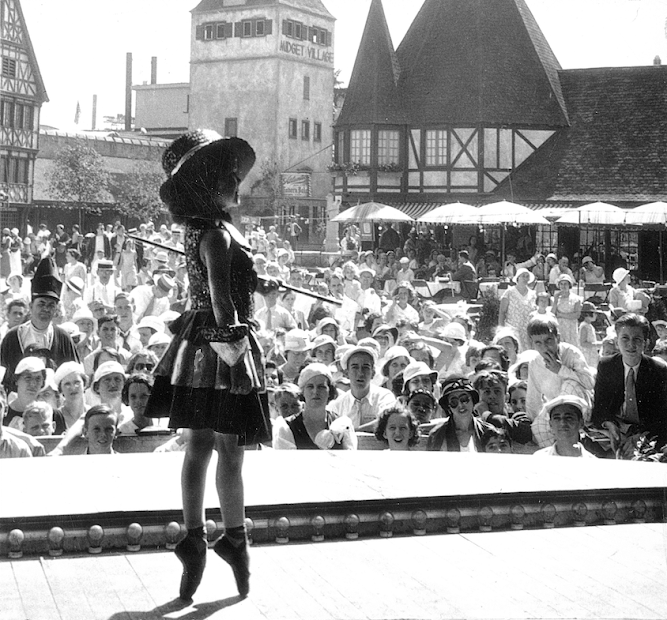 |
| Eyes center on dainty Stella Royal performing in an outdoor theatre in the Midget Village, Century of Progress, Chicago, 1933. |
The couple met in the Toy Department of Chicago’s State Street Goldblatt’s Department Store in 1932, where Mary Ellen worked as one of Santa’s elves during Christmas.
Parnell had come to see the little people at Goldblatt’s. When Parnell laid eyes on Mary, attention was swift and mutual. They got engaged on St. Valentine’s Day, February 14, 1933, 49 days after their first meeting. Mary and Parnell were married on Tuesday, April 4, 1933.
And then came the bar. “We created the bar to fit our size,” said Mary in 2008. “It was custom-built. Pint-size, so we could easily maneuver around, tend bar and serve customers.”
The Chicago Reader recalls: “The club was built for people of small stature: the stools were miniature, and the pay phone was installed just feet above the floor. St. Aubin, who was three-foot-seven, would climb up on a stool to reach the cash register. A large mural of Munchkins marching along the yellow brick road was painted behind the bar.”
 |
| The Midget Club |
Richard Reeder was 16 when he first visited the bar, delivering supplies for his uncle’s company, Veteran Supply, in 1962. “It blew my mind,” he recalls. “I remember photos of St. Aubin with Judy Garland and Ray Bolger. It was just so out of context and, like Oz, a place of wonder and fantasy.”
The bar welcomed patrons of any height, and they did not discriminate. “If I depended on the midget trade, Parnell said, “I’d starve.”
After Parnell died on December 4, 1987, Mary kept the Oz theme alive, becoming First Lady of the Oz Festival, an annual tribute event in Chesterton, Indiana.
Compiled by Dr. Neil Gale, Ph.D.
[1] Midget (from midge, a tiny biting insect) refers to a very short but normally proportioned person. While not a medical term, it has been applied to people of short stature, often with dwarfism. The word Midget has a history of association with the performance arts as little people were often employed by acts in the circus, vaudeville, etc. The term midget is now rarely used and is considered offensive. But its usage was very common until the end of the 20th century.
"Dwarf" refers to an extremely short adult who is 4 feet 10 inches tall. The average adult height in dwarfism is four feet. Common complications include bowing of the legs, hunching of the back, and crowded teeth.