Wednesday, September 28, 2022

Manhattan Beach, Windsor Bathing Beach, Rocky Ledge Beach, and Rainbow Beach, at 75th - 79th Streets at Lake Michigan, Chicago.

Today's Rainbow Beach at 75th Street at Lake Michigan in Chicago was named for the U.S. Army's 42nd Rainbow Division in World War I. Rainbow Beach Park began as two separate beaches; "Manhattan Beach" and "Windsor Bathing Beach."

Manhattan Beach was a popular spot for middle-class families to enjoy until the turn of the 20th century. Because the beach was private and not monitored, issues surfaced in the neighborhood. Problems of sexual promiscuity and minors drinking alcohol were some of the reasons the City of Chicago reclaimed the land to operate it as other Chicago beaches.

Manhattan Beach


The first was established in 1908 by the Special Parks Commission, a city agency that studied open space needs and created parks, playgrounds and beaches in densely populated areas of Chicago. 
Manhattan Beach advertising The Fair Department Stores.


A small beach at 79th Street at Lake Michigan was called "Rocky Ledge Beach." The name referred to the area's rocky terrain and the manufactured limestone ledge that served as a shore promenade and prevented shoreline erosion.
The heavily used Manhattan Beach had men's & women's toilets and changing rooms by 1912.
Manhattan Beach was Illuminated by electric lights. The beach remained open until 9:30 pm to benefit working folks and provide families more time together.

In 1914, the city began efforts to expand the beach and soon acquired the land between 75th and 79th Streets, nicknamed "Rocky Ledge Beach." The City Council officially renamed the cojoined area "Rainbow Beach" in 1918. The little Rocky Ledge Beach continued operating as a children's beach.
Windsor Beach

Manhattan and Windsor beaches were consolidated in 1959 when the Chicago Park District began leasing the sites from the City of Chicago. Rocky Ledge quietly joined Rainbow Beach's party.

For many years the park lacked sufficient indoor recreational facilities. In 1999 the Chicago Park District constructed a large field house. Designed by David Woodhouse Architects, the field house takes full advantage of Rainbow Beach and Park's breathtaking views of the lakefront and skyline.

Compiled by Dr. Neil Gale, Ph.D.

Monday, September 26, 2022

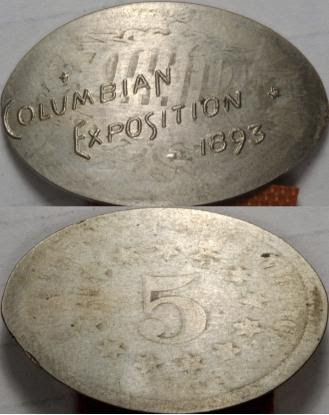
The First Elongated Coin Souvenirs in America were at Chicago's 1893 World's Columbian Exposition.

Modern Example with
Four Different Stamps
It's generally accepted that the first elongated coins in the United States were sold at Chicago's 1893 World's Columbian Exposition. A commemoration of the 400th anniversary of Christopher Columbus's discovery of America. 

Coins were rolled through a hand-cranked machine with two die rollers with a reverse-engraved image cut into one of the steel rollers. Regular coins are run between the rollers with over 20 TONS of pressure, causing the "elongated" shape of the coin. Elongated coins came in all denominations, including blank tokens and foreign coins. In the U. S. the 1¢ penny was the most common coin and was sold as souvenirs.

The penny roller takes a different approach, with a purpose-built machine that 'eats' a coin, usually of a small or inexpensive denomination and then 'presses' the coin out between two rollers, engaged by a set of large gears. The rollers are engraved with a design pressed into the elongated metal. This way, the inserted coin is both 'drawn out' while being imprinted. 

The rolling of elongated coins seemed to be rather popular for the first 23 years of their existence, and a large amount was rolled between 1893 and 1916. Then for some unknown reason, there was a slack period between 1916 and 1932. After 1932 momentum seemed to regenerate, and the number of coins rolled had steadily increased. In the 1970s, there was a resurgence of penny rolling innovation, with automated penny rolling machines appearing in popular amusement parks, zoos, and museums. 

In recent times, many of us have watched or personally placed a penny on a train track, watched the train go by, then search for the flattened penny beside the track. In this case, the penny gets stretched and elongated into random shapes. Still fun.

Compiled by Dr. Neil Gale, Ph.D.


Buy Souvenir Coins at the Fair.
We'll Stamp Any Coin You Present.