
Sunday, September 25, 2022

Checkerboard Flying Field & U.S. Air Mail Field in Broadview, Illinois.

Before 1919, the tract of land located south of Roosevelt Road and west of First Avenue in today's Broadview, Illinois, was a cornfield.

During the spring of 1919, clothing merchants Decker & Cohen acquired this land and constructed an airfield. A metal hangar was erected on the northeast comer of this field, near the banks of the Des Plaines River. Meadows and pasture lands that were relatively level and free of holes made a suitable landing field for the airplanes of this era. Flying operations were possible in this field without having to prepare special runways.
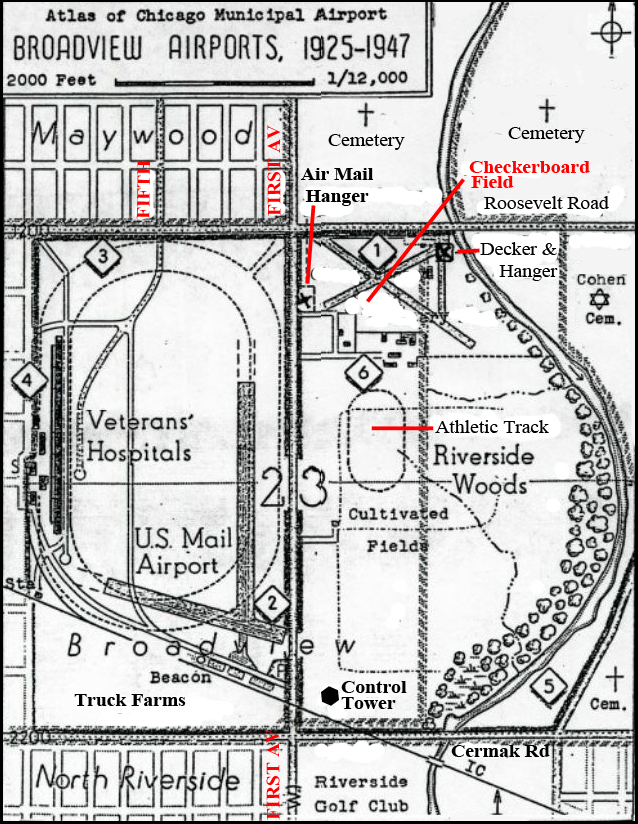
I cleaned up this map to make it easier to read.


Chief mechanic Louis Meyer and ex-Signal Corps pilots David Behncke and Bert Hassell uncrated and assembled two planes the company had purchased. These airplanes, equipped with 90-HP Curtiss OX motors, were Curtiss JN-4 models, more commonly known as "Jennies." The Jennies carried a pilot and a passenger, fore and aft, in open cockpits and enough gasoline for about two hours of flying time at a speed of sixty miles an hour. They were first put into action on June 13, 1919, as Checkerboard Flying Field opened for business and began sending the Jennies on delivery runs, bringing "Society Brand Clothes" to local towns within a 120-mile radius.

When Checkerboard was operating, bright red and white Checkerboard designs were found on the Jennies (to aid in the eye-catching advertisement of Society Brand Clothes) and on the hangar's roof (to help pilots locate the airfield). Such bright patterns made it difficult to miss the airport when planes passed overhead!
Broadview Air Mail Field, previously U.S. Air Mail Field.


Obviously, the pilots did more than just deliver clothes in those Jennies. Off-hours were devoted to flying lessons, joy rides and pleasure hops. In addition, there was always stunt flying on weekends; such attractions brought people from miles around, creating a carnival atmosphere at the airfield.

In September 1921, the spectators were entertained by Ethel Dare dropping from the clouds, and in 1922 Bessie Coleman entertained crowds at Checkerboard. Such excitement induced the spectators to buy raffle tickets for the chance to ride in one of the planes."
U.S. Air Mail Field, aka Broadview Air Mail Field.
The first recorded instance of an Air Mail delivery was in January 1911 from Nassau Boulevard Flying Field in Garden City. New York to Mineola, New York. 

The first organized Air Mail route was started on May 15, 1918, by the Post Office Department and the Army Air Force, and utilized Army pilots and airplanes flying between Washington D.C. and New York City with Philadelphia as a halfway stop. Initially, Curtiss Jennies with 150-HP Hisso motors were used on this route.

At the end of World War I, the Army converted many DeHavilland Observation and Bombing Planes into mail planes for the proposed transcontinental Air Mail route.

In August of 1919. the Post Office Department took over the entire Air Mail operation, hired their own pilots, bought their own planes and started mail flights from New York City to Cleveland, Ohio, with Bellefonte, Pennsylvania as the halfway stop. On May 31, 1921, the route to Washington D.C. was discontinued. The Jennies were discontinued then, and the DH-4 became the official Air Mail plane.

The official Air Mail plane had problems; most significantly, the plane's engine endurance for the long transcontinental haul was troublesome Plus, the structural modifications amounted to some 600 changes in the fuselage. The forward cockpit was removed and moved further back, leaving space for the mailbag compartment, and the Liberty engine had to be overhauled.

These 400HP Liberty motors enabled the DH-4 to carry a cargo load of 400 pounds plus 100 gallons of gasoline at speeds up to 100 mph for as long as four hours.

Before the end of the summer of 1919, the route was extended from Cleveland to Chicago, with Bryan, Ohio, as a refueling stop. A strip of land in Grant Park, extending south along the lakefront from Randolph Street, was used as a landing field. A small hangar was erected at the north end of this field, about where the Amoco Building is today. Field size at Grant Park was limited, and prevailing lakefront winds made operations hazardous. Soon after, Checkerboard was proposed as a new site due to its superior year-round flying conditions. In 1920 it was officially designated as Chicago's Air Mail field.

Early in 1920, a hangar was built on the west side of the field along First Avenue, several hundred feet south of Roosevelt Road. A small garage-type office was also built at the north end of the hangar, and in January, the Air Mail operation officially moved to Checkerboard Field. Operations went well the rest of that winter until a heavy April 1 snowfall followed by an early thaw softened the ground so badly that several landing aircraft nosed over in the mud and were severely damaged. Air Mail operations immediately returned to Grant Park and remained as cinder runways were put in at Checkerboard.

On May 15, 1920, Checkerboard resumed operations with its new runways and regular flights to and from Omaha, Nebraska, began. By the end of the month, the Air Mail service was fully established at the increasingly well-known Checkerboard Airmail Field. Later in 1920, Decker & Cohen clothing deliveries were discontinued, making Checkerboard exclusively an Air Mail field. Additions and modifications to the field included the setting up of a repair hangar, brought in from Bustleton, Pennsylvania, just north of the original hangar that summer.

The first transcontinental flights were attempted on February 22,1921. Four different airplanes participated in the grueling trip, two leaving from San Francisco and two departing New York. The four simultaneous flights were intended to prove to Congress that day-night transcontinental flights were possible. Of the two New York-based flights, one was forced down shortly after takeoff, and the other landed at Checkerboard, only to be grounded by a snowstorm. The first pilot from San Francisco crashed and died in Nevada, but the second made it to North Plane, Nebraska, where a relay pilot named James H. ("Jack") Knight took over. Knight left North Plane at 7:50PM and arrived at Omaha, Nebraska, at 1:15AM, where he found that his relief pilot had been snowed in Chicago and had never made the flight to meet him at Omaha. Knight decided to continue on himself and fly the 435 miles to Chicago even though the Midwest was getting blasted by the fiercest snowstorm they'd seen in years. Since the Des Moines refueling stop was also shut down due to the weather. Knight was forced to an alternate site in Iowa City, which had also closed down once they had heard that the relay flight from Chicago had been canceled. Fortunately, the Iowa City night watchman could guide Knight to a safe landing just as the plane's fuel ran dry.

While his plane was being refueled. Knight ate a donut and drank some coffee. He wasted no time and took off into the driving snow as soon as his plane was ready; he arrived at Checkerboard at 8:40AM, proving once and for all that day-night coast-to-coast service was indeed feasible.
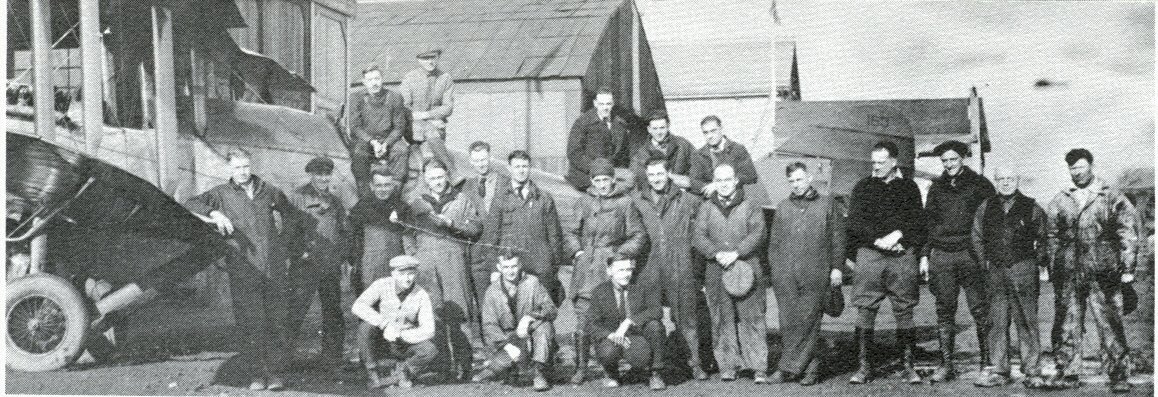
Checkerboard Flying Field
In June of 1921, a large hangar was obtained from a former Army airfield at Key West, Florida, and was assembled south of the original Checkerboard hangar. Though this new building was intended to be used as a separate repair hangar, it soon became the only one when the original hangar burned down on Christmas Day. This wasn't all bad, as the newer structures were more substantial and larger than the older ones. It was said that ."..the mechanics really appreciated doors that closed tightly to keep out the cold winter wind. Later, all major repair and overhaul operations were moved to Checkerboard Flying Field from New York, making it my maintenance center for the entire service. By this point, my Air Mail service had extended as far west as Omaha and Iowa City, with St. Louis and Minneapolis soon to follow.

Checkerboard operated from 1919 through 1923; after that, it was occupied by Yackey aircraft. Checkerboard, now no longer an Air Mail center, continued as a private and commercial airstrip until 1924 when David Behncke sold the field to Wilfred A. Yackey. Checkerboard served as an overhauling center, where French Brequet bombers were converted to five-place civilian transport planes. Later, Yackey built and planned to start production of a new aircraft of his own design; his progress on this endeavor ended on October 4,1927, when he crashed and died during a test flight of one of his new planes. The Government Civil Aviation Board declared Checkerboard unsafe for private and commercial use in 1927.

Let us backtrack a few years to 1918; the Government bought the land west of First Avenue, built Hines Hospital near 9th Avenue and turned the eastern portion of the land over to the Post Office Department, who in turn started making their own Air Mail field there and finished it in 1921. January 1923, the burning down of the Checkerboard repair hangar put pressure on the Post Office Department to complete their own field on the west side of First Avenue, from Roosevelt Road south to the Illinois Central Railroad tracks just north of Cermak Road (22nd Street). The brick and steel building, designated as the repair facility, was the closest one to First Avenue and the Railroad tracks and still has a facing stone on its north elevation that reads "U.S. Air Mail." Two additional hangars were built west of this prominent building along the tracks and used for service and operations.

A 200-foot-wide L-shaped cinder runway was constructed, with the long leg running the length of 5500 feet along First Avenue; the short leg extended west-northwest toward the Hines hospital building, which was the only building on the grounds at the time. Army fliers at that time said. ."..it was the best field in the country and large enough to handle all the types of aircraft of that era." This field, which opened in May 1922, was generally known as the Broadview Air Mail Field."

"U.S. Air Mail" airport is currently part of Loyola Hospital, and Checkerboard Field is now the Miller Meadow Forest Preserve.

Compiled by Dr. Neil Gale, Ph.D


For those who don't believe that Broadview was north of Roosevelt Road (22nd Street).


Saturday, September 24, 2022

A Former Southwest Chicago Suburban Airfield's Connection to Aviation History.

Cornelius R. Coffey made aviation history in the 1930s at Harlem Airport at 87th Street and Harlem Avenue in today's Bridgeview.
Cornelius R. Coffey
In the history of Negro aviation, Bessie Coleman, the first Negro woman to earn a pilot's license, is usually remembered as the one who opened the skies to Negro aviators. 

Less well known was Cornelius Coffey, who, with much the same vision and fighting the same obstructions, changed a cornfield in south Chicago into an airport that housed the nation's first large group of young, talented Negro aviators. 

In the years just before and after World War I, some 180,000 Negro Southerners immigrated to Chicago, settling on the city's rough south side. Bessie Coleman, a Texas transplant who wanted to fly, learned that aviation schools didn't accept Negro applicants, and she had to sail to France to earn a pilot's license. "Queen Bess" subsequently became the toast of the Chicago Defender newspaper, and when she died in a fall from her airplane in 1926, some 10,000 Chicago Negro mourners filed past her casket.

Coffey never met Coleman, and the Arkansas native quietly mapped his own route to the sky. Young Coffey possessed a great gift for mechanical work. He was the top graduate in a south Chicago auto engineering class in 1925, quickly earning the allegiance of Emil Mack, the white Chevrolet dealer who employed him. Coffey later found a spot at the dealership for a mechanic friend named John Robinson.

The two young men wanted to fly, but no one would teach them, so they taught themselves. Later, in 1929, they enrolled in an aviation mechanics program at Chicago's Curtiss-Wright School of Aviation. When they showed up for class, they were turned away because they were Negro, even though they had already paid their tuition. Mack threatened to sue on their behalf, and the school reluctantly admitted the pair. 


In 1931, the 28-year-old Coffey finished first in his graduating class and Robinson second. Two weeks later, Coffey took the exam to earn his mechanic's license from the U.S. government. The school must have been impressed because it changed its policy, inviting the men to return and teach all-Negro classes. They did. The aviation mechanic's degrees didn't open many doors, however. Coffey and Robinson were still unwelcome at airstrips except Akers Airport, near where they worked, so when Akers closed, they were grounded.

The men joined with several other local Negro aviation enthusiasts to form the Challenger Air Pilots Association (the name referred to the Curtiss Challenger engine). The new group looked for a place to fly from. In 1931, the group, joined by one or two white pilots from Akers, bought a half-mile-wide tract of land in Robbins, an all-Negro town southwest of Chicago. There they buried boulders, dropped trees, roughly leveled the terrain, and cobbled together a hangar from second-hand lumber. When they finished, their small fleet of disparate craft—a Church Mid-Wing, an International F-17, and a WACO 9—was parked at what historians consider the first Negro-owned airport in the United States.

The achievement is primarily a historical footnote: About a year later, a violent thunderstorm roared through Robbins, demolishing the hangar, flipping airplanes, and scattering hopes.

But a few miles north, at 87th Street and Harlem Avenue in Oak Lawn (today's Bridgeview) intersection, William Schumacher had purchased 140 acres of farmland with an airport in mind, and his brother Fred would manage it. Before Robbins' devastating storm, Fred Schumacher visited Robbins and, probably sensing a good tenant, invited the group to come to use his brother's airport.

After the storm, while Coffey was on a trip to Detroit, Robinson and two other Challenger members—pilot Dale Lawrence White and Curtiss-Wright school graduate Harold Hurd—approached Fred Schumacher to take him up on his offer. The facility was taking shape. Grass had sprouted where cornstalks had been plowed under, and a hangar and office sprang up along Harlem Avenue.

Schumacher readily agreed to rent the lower end of the airport to the Challenger group. Still, in an interview recorded for the Smithsonian Video History Program on Negro aviators, Hurd said that Schumacher initially insisted on segregation. He was already running an all-white school. "Look, fellas," he said, "I'm going to put you at the end of the field to save you from having any trouble with the other guys."

Negro and white pilots parked their airplanes in separate hangars, sharing Harlem's four sod runways, the longest of which was 2,000 feet. The rural area soon echoed with the thundering exhausts of Curtiss engines; the sky above the corn and wheat fields of Worth Township teemed with WACOs, Travel Airs, and Taylor Cubs. The leaders of the Challenger group were acknowledged to be Coffey and Robinson. 

At Harlem Airport, Schumacher asked Coffey to recertify the overhauled aircraft of his white customers, enabling Coffey to begin earning money as a mechanic. It started an amicable working relationship with the man Coffey called "Shoes." The Coffey Flying School operated on the airport's south end, and Schumacher's school was on the north. Coffey taught both white and Negro students together. "Every 10 students I took, I had one white student and one girl student in that unit," he said years later.

One of those "girl students" was Willa Brown, a former Curtiss-Wright student of Coffey's. In 1938, the pert 27-year-old traveled to Harlem to take flying lessons from her old teacher. Two years earlier, Brown, a former Gary, Indiana schoolteacher with a master's degree in business administration, had strutted into the Chicago Defender newsroom in jodhpurs and boots to promote an amateur airshow at Harlem. City editor Enoc Waters was so taken by her that he assigned himself to cover the event.


At Harlem, Brown became the first Negro woman to earn a pilot's license in the United States. She became indispensable to Coffey's operation and the Negro aviation movement. For a time, she also was Coffey's wife. In 1939, editor Waters proposed that the Challenger Air Pilots Association broaden its scope; within weeks, the new National Airman's Association was chartered, with Coffey as president, Dale White as vice president, Brown as secretary, and Waters as the group's unofficial promoter.

Smith remembers that Coffey and his instructors washed out few students, almost willing the young men and women to succeed. Smith himself struggled until Brown rescued him. She asked Smith to go for a ride one day. Smith was six-foot-two and weighed 210 pounds, and the five-foot-two Brown took off in a Cub. "She said, 'I've been watching you, Quentin, and I know you can learn to fly. Let me show you something,'" he remembers. "She pulled it up into a stall, and we spun seven or eight times—and you don't spin a Cub!—and then she pulled it out, and this little lady said to me, 'You can't be King Kong, Quentin. You've got to be gentle. You're going to learn to fly today.'" And he did. Smith completed training at Tuskegee and was assigned to a bomber group based in Seymour, Indiana.

In late 1939, civilian pilot training sites were announced; they included seven for Negro students (Tuskegee, which had finally begun flight instruction, was one). Harlem Airport was the only Negro training site that was not a college campus.

Coffey was to direct flight training and personally maintain the aircraft of his renamed Coffey School of Aeronautics. Willa Brown would run a ground school at Chicago's Wendell Phillips High School and coordinate the overall program.

"Shoes" sold Coffey a 50-horsepower Piper Cub needed for primary flight training, and another white friend helped Coffey buy a second one. For secondary training, Coffey and Brown cajoled the Curtiss-Wright school into lending two 220-horsepower WACO PT-14s.
The Coffey school also would teach cross-country and flight instruction; it and Tuskegee were the only Negro programs offering all four levels of instruction. Each trainee received 35 hours of flight time. By June 1941, the school's fleet—mostly Cubs—had increased to 10. When rain caused excessive puddling on Harlem's sod runways, the students practiced from paved airfields in Harvey or Joliet.

Everything about the civilian pilot training program at Harlem was modest. Coffey and Brown lived in a small cottage at the southern tip of the airport, a building that doubled as the Civil Air Patrol unit headquarters. Classroom work was conducted in a small one-room building crowded with student desks. 

The government wouldn't fund student housing at Harlem, so in 1942 supporters of the program erected a dormitory: a cot-lined room with adjacent latrines and showers. At one end, Brown supervised a dining area that served three meals daily to flight students and anyone else who wandered in.

"The atmosphere at Harlem was camaraderie," Quentin Smith recalls. He trained at the airport in 1942 at the invitation of Brown, whom he had known in Indiana. Smith says in his months at Harlem, all the student pilots had at least some college education and quickly bonded. "Every day, it wasn't raining, and we weren't flying. All we had to do was study," he recalls. "In the evenings, we'd get in the planes and get the feel of them. I probably wouldn't have made it without all the camaraderie. I mean, out there, we were so far from Negro people, we had to drive 20 miles just to see any."

Coffey and Brown procured olive green Civilian Conservation Corps uniforms to bolster the students' esprit de corps (a feeling of pride, fellowship, and common loyalty). They also quietly used some of their earnings to set up a pool of cash that the unpaid students could dip into for incidental needs.

Coffey remained committed to integration. When the Army Air Corps announced that the military unit from Tuskegee would be segregated from white servicemen, Coffey, speaking as NAA president, objected. "We'd rather be excluded than segregated," he declared. In the end, Army traditions prevailed. The Tuskegee Airmen would be a separate fighting unit known informally as the Red Tails; their most famous mission was flying escort for bombers in Europe.

Coffey offered to pay the Negro teen­ager, Bev Dunhill, 50 cents an hour to work at Harlem, plus give him 30 minutes of flying time each weekend. Dunhill instantly accepted though he didn't tell his airplane-fearing mother for six months. Each day Dunjill rode a streetcar to the end of the line at 63rd Street, where Coffey met him and drove him to the airport. The teen spent his days pushing airplanes from the hangar, washing fuselages and performing minor maintenance.

The number of pilots that the Harlem wartime program turned out is unknown, but it was in the hundreds. No airplane was ever wrecked. After the war, Coffey worked at Harlem but spent most of the next two decades teaching aviation mechanics in high schools and an area college.

Some of the aviators from Harlem's early years had distinguished careers. Coffey got a patent on a popular carburetor warming system, and the Federal Aviation Administration honored him with an aerial navigation waypoint ("Coffey Fix" in FAA spelling) to align aircraft landing at Chicago Midway Airport. Harold Hurd was inducted into the Illinois Aviation Hall of Fame. Dale White broke employment barriers for Negro mechanics. Willa Brown ran twice, unsuccessfully for Congress, the first Negro woman to try for a Congressional seat. Quentin Smith stayed active in aviation, becoming president of the Gary, Indiana Regional Airport Authority. And Bev Dunhill, who had entered the cadet program at Tuskegee as World War II ceased, re-enlisted in 1949 and became an F-86 jet combat instructor in Korea, along with a pilot named Gus Grissom.


Harlem Airport grew even busier in the post-war years, with six flying schools, a repair service, and half a dozen hangars. Forty acres were added, and 10 unpaved runways crisscrossed the field.


In September 1956, the airport lost its lease. A parcel of land that had once been a cornfield was transformed once more, this time into a residential sub­division and a shopping center named Southfield Plaza. 

Today, customers walk to Shop' N Save, Hobby Lobby, and Walgreens on the pavement where leather-helmeted pilots once revved engines to taxi and take off. Grassy airstrips scarred by ruts have disappeared under smooth streets lined with houses and trees. The acreage's only link to aviation is several hundred feet overhead, where airliners descend toward landings at Midway Airport.

For Harlem's 23-year existence, Fred Schumacher was manager, building his business on twin pillars: full service and a relatively enlightened sense of brotherhood. When the facility closed, he picked up and moved to Chicago-Hammond Airport. Probably the person in the best position to know, Schumacher told a newspaper reporter at Harlem's closing that some 350,000 hours of instructional flying had been logged at the rough field. This number represented a lot of realized dreams, regardless of their race.

Compiled by Dr. Neil Gale, Ph.D.