Friday, January 12, 2018

The Eads Bridge is the world's first steel-truss bridge and an engineering marvel spanning the Mississippi river between East St. Louis, Illinois and St. Louis, Missouri.

After the Civil War and the expansion of the nation's railroad system, it became apparent that for St. Louis (the Gateway to the West) to survive, a bridge across the Mississippi River was essential. In 1867, the St. Louis Bridge and Iron Company, made up of a group of City bankers and businessmen, hired James Buchanan Eads (1820-1887) to build one. Eads was a self-educated engineer and had never built a bridge before. But during the Civil war, he had been called on by Washington to construct several Ironclad gun ships and completed his contract in an incredible 65 days.
The construction of the bridge began in 1867. Giant granite-faced piers support three graceful arches and two decks. Eads Bridge was the first bridge to carry railroad tracks, the first to use tubular cord members and the first to depend entirely on cantilever construction for its superstructure. Pneumatic caissons were used for the first time in the U.S. in the construction of its piers, which were sunk to the unprecedented depth of 123 feet.
This new design is a testament to Eads' brilliance as an engineer, but it is also evidence of the grueling fight that the builders had to wage against the ferry and shipping interests. These powerful companies had controlled the crossing of the Mississippi since Capt. James Piggott started the first ferry across the river in 1795. His company sold out to the Wiggins Ferry Company, who came to dominate the riverfront on the Illinois side of the river.

These interests lobbied for restrictions and specifications on the height, construction, and span of the bridge that they thought could not be surmounted by any engineer. Unfortunately for them, James B. Eads was one of the best engineers of his age and he found "work-arounds" for all of their artificial obstacles.
The Eads bridge spans the Mississippi River between East St. Louis, Illinois and St. Louis, Missouri. At 6,442 feet long, it was the longest arch bridge in the world. It first opened to foot traffic on May 29, 1874.
This chromolithograph shows the construction of the bridge and the finished product as it would have looked in 1874. It was published by Compton and Co. in St. Louis in 1874.
The bridge was completed for a cost of nearly $10 million, and dedicated on July 4, 1874. In recognition of this unparalleled engineering achievement, Eads Bridge was named a National Historic Landmark, the highest designation given by the National Park Service, in 1964. It was made a National Historic Civil Engineering Landmark by the American Society of Civil Engineers in 1971 and designated a City Landmark the same year.

Compiled by Neil Gale, Ph.D.  

Thursday, January 11, 2018

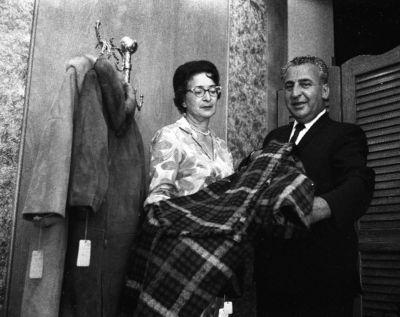
Seymour Paisin Ladies Apparel on Devon and Talman Avenues in Chicago, Illinois.

1963
The Seymour Paisin Ladies Apparel (Seymour Paisin on Devon, Inc.) was located at 2629 West Devon at Talman Avenues in Chicago's West Rogers Park Neighborhood. Seymour Paisin (1912-1987) and his wife and co-founder Ruth (1914-1977) opened Seymour Paisin Ladies Apparel in 1950, and the shop closed in the early 1980s.

Seymour Paisin Ladies Apparel, a beloved fixture on Chicago's vibrant West Devon Avenue, was more than just a women's clothing store - it was a hub of style, sophistication, and community. From 1950 to the early 1980s, this family-owned boutique brought high-fashion flair to the Windy City, courtesy of its dedicated owners, Ruth and Seymour Paisin.

The Paisins began quarter-page advertising in the Chicago Tribune in September 1951.

As you stepped inside, you were enveloped in a world of elegance, surrounded by racks of exquisite dresses, coats, and scarves from top designers. The Paisins took pride in curating a selection that would make their customers feel like royalty, and their personalized service made everyone who walked through the door feel like a valued friend.

With her keen eye for style, Ruth would often travel to New York and Paris to stay ahead of the latest trends, bringing back the most coveted pieces to share with her loyal clientele. Meanwhile, Seymour's warm smile and welcoming nature made everyone feel at home, whether browsing or seeking advice on the perfect outfit for a special occasion.

As the years passed, Seymour Paisin Ladies Apparel became a staple of Chicago's fashion scene, with generations of women relying on the store for their most essential wardrobe needs. Though the store may have closed its doors in the early 1980s, its legacy lives on through the countless memories made within its walls and the vintage treasures circulating among collectors and fashion enthusiasts online today.
1973
My mom shopped there a lot! We lived 2½ blocks away, and she would take me out for a walk when I was very young. I can remember sitting in one of their big chairs and looking out the windows, watching traffic go by and people walking on Devon Avenue while my mom tried on dress after dress.
Chicago Tribune, September 13, 1951
Dress Label
Ruth & Seymour Paisin


By Dr. Neil Gale, Ph.D.