Saturday, August 8, 2020

The Only Lincoln vs Douglas Base Ball Game Occurred on Tuesday, July 24, 1860, in Chicago.

On April 7, 1858, while Abraham Lincoln was arguing legal cases in Bloomington and planning for his upcoming campaign to challenge Stephen Douglas, a small story appeared in his hometown Illinois State Journal. Buried between stories of a ballooning accident in Louisiana and a glowing report of the Illinois wheat crop was a story announcing that “The National Association of Base Ball Players” had been organized in New York a week earlier. It went on to announce that the group had adopted a constitution and that Judge William H. Van Cott had been elected its first president.
From the “Illinois State Journal,” April 7, 1858.
While many people tend to think of base ball as a purely 20th-century invention, it actually is firmly rooted much earlier in our nation’s history. Although historians disagree about exactly when and where it originated, they agree that by the 1840s there were numerous clubs in major cities playing variations of the game we know today.
From “Harper’s Weekly,” October 15, 1859.

In Illinois, one of the earliest games occurred between two amateur teams from Joliet and Lockport in August 1851. To the southwest, in St. Louis, the first club was organized on August 1, 1859, with more quickly to follow. As enthusiasm for the sport grew, it evolved from pick-up games in open lots to purpose-built fields, and eventually, perhaps as early as 1861, into formal stadiums similar on a reduced scale to what we know today.

Just as important as the physical aspects of the game was the role that base ball began to take on within our culture. Displays of masculinity, athletic prowess, and regional pride were key components of the sport’s growing popularity, but its adaptability to other aspects of daily life further expanded its reach. Nowhere was this truer than in the coming together of base ball and politics. In 2012, author Stacy Pratt McDermott provided a remarkable example of this in an essay entitled Base Balls and Ballots: The National Pastime and Illinois Politics during Abraham Lincoln’s Time. 

In the late 1850s, there were three or four base ball clubs in Chicago. The Excelsior club is the most prominent one and was one of the pioneer clubs. In fact, the Excelsior club was formed in 1857 and played games in 1858. McDermott explained how in the summer of 1860 the players of the Excelsior’s were divided into their support for Lincoln or for Douglas during the 1860 Presidential contest. Rather than debate the merits of their respective candidates or their political platforms, the players decided that the President should be determined on the diamond.

On the afternoon of July 24th, the two teams took the field before an estimated 1,200 fans. The game was tight, but in the end, the Douglas team edged out the Lincoln team by a score of 16-14. [Time-Period Rules]
In the following day’s Chicago Tribune Newspaper:
Chicago Tribune, Wednesday, July 25, 1860.
No evidence exists that either Lincoln or Douglas acknowledged the outcome of this contest. However, it becomes clear that even within the anxious political climate of 1860, base ball had firmly established itself within our culture.

“Four Score and Seven” Magazine
Edited by Neil Gale, Ph.D.

Thursday, August 6, 2020

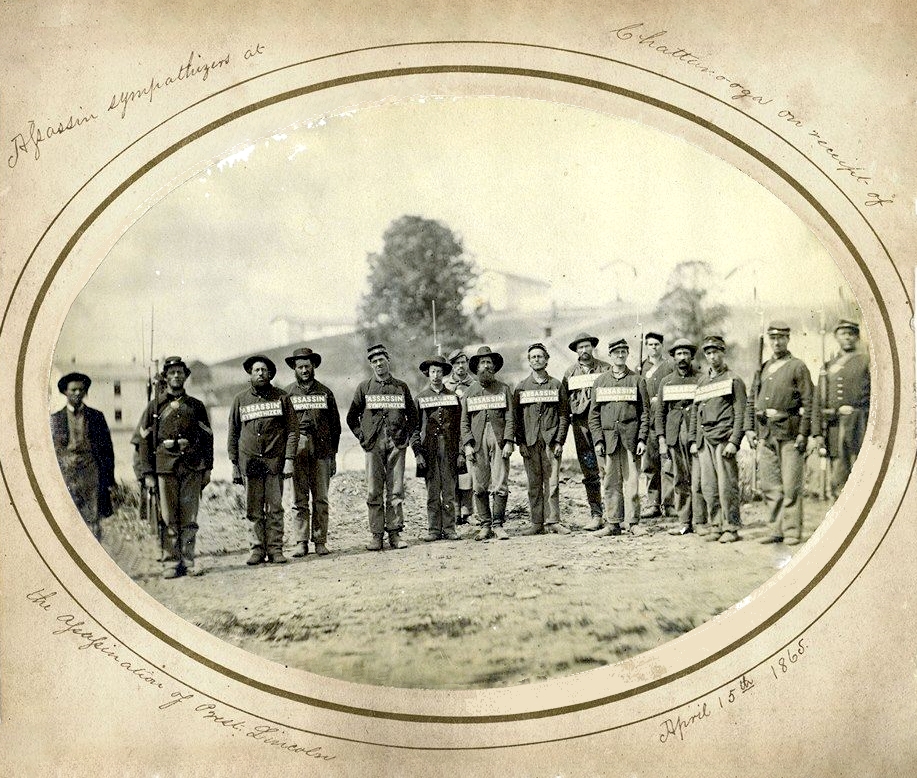
Union Lincoln Assassin Sympathizers Face Punishment, April 15, 1865.

Not all Union men mourned the loss of their leader, President Lincoln.
A group of arrested Union Army Lincoln assassin sympathizers being guarded by Union soldiers in Chattanooga, Tennessee, April 15, 1865.
CLICK FOR FULL-SIZE VIEW
NOTE: The pencil inscription on the face of the picture mat says: "Assassination Sympathizers at Chattanooga on Receipt of the Assassination of Pres. Lincoln April 15th 1865."
The Nashville Press described this image shortly after it was taken on April 15, 1865. “We saw a photograph yesterday of ten men who were arrested at Chattanooga, Tennessee, last Sunday for expressing pleasure at hearing of the death of President Lincoln,” reported a correspondent, who added, “Upon the breast of each man was a tin plate with the words ‘Assassin Sympathizer’ painted on it.” The men were sentenced to labor on the streets in Chattanooga by day while wearing the placards, and by night they were confined in irons.

The Press identified the men by name. They were a mix of soldiers, government contractors, and citizens. The order of the men in the picture is unknown.
Government employees: E. Jones, R.C. Jones, and James Martin.
18th Ohio Infantry privates: David Alspaugh, Cyrus Leight, Moses H. Matheny, and Henry D. Metzer. 
Citizens: C.G. Moxley (Blacksmith), and S. Moxley
The soldiers were all late war recruits: Leight, Metzer, and Alspaugh were substitutes who mustered into Company K during the last week of March 1865. Matheny mustered into the regiment in February 1864, making him the veteran of the group. 

The four men eventually received honorable discharges. They also hailed from Ohio, the same state as U.S. Congressman Clement Vallandigham, the leader of the Copperhead faction of anti-war Democrats, and a powerful opponent of the Lincoln administration.

A fragmentary period pencil inscription on the back of the mount notes that a lieutenant presented the photograph to a major general.

Compiled by Neil Gale, Ph.D.
Contributer JSTOR

Wednesday, August 5, 2020

The History of Abraham Lincoln's Father, Thomas Lincoln (1778-1851).

According to the date on his headstone, Thomas Lincoln was born on January 6, 1778, although there is evidence that he was born in 1776. His place of birth was in Rockingham County, Virginia, and he was the fourth of five children born to Abraham and Bathsheba Lincoln. 
Thomas Lincoln (1778-1851)
Thomas Lincoln moved to Kentucky in the 1780s with his family. In May of 1786, Thomas witnessed the murder of his father by Indians "...when he was laboring to open a farm in the forest." That fall, his mother moved the family to Washington County, Kentucky (near Springfield), where Thomas lived until he was eighteen. From 1795 to 1802, Thomas held various jobs in several locations—positions that increased his earnings and helped feed the Lincoln family. In 1802 he moved to Hardin County, Kentucky, where one year later, he purchased a 238-acre farm. Four years later, on June 12, 1806, he married Nancy Hanks. Their first child, a daughter named Sarah, was born a year later.

In 1808, Thomas bought a 300-acre farm on Nolin Creek. There, on February 12, 1809, his son Abraham was born. A third child, named Thomas, died in infancy.

Thomas was active in community and church affairs in Hardin County. He served as a jury member, a petitioner, and a guard for the county prison. He could read a little, was a skilled carpenter, and was a property owner. In 1815 he purchased—for cash—still another farm, the Knob Creek farm. This Knob Creek farm was the first home Abraham Lincoln could remember in later life. 
The Lincoln family lived on 30 acres of the 228-acre Knob Creek Farm when Abraham was 2½ until he was ne 8 years old. Replica Log Cabin. 
Dozens of Kentucky farmers and Thomas fell victim to Kentucky's chaotic land laws. The title to each of the three farms he had purchased proved to be defective, and he lost land or money in each case and, in disgust, moved to Indiana in December 1816. There, the land ordinance of 1785 ensured that land was retained once purchased and paid for. Abraham Lincoln claimed many years later that his father's move from Kentucky to Indiana was "partly on account of slavery, but chiefly on account of the difficulty of land titles in Kentucky."

Slavery was outlawed in Indiana. It is interesting to know that in Hardin County, Kentucky, there were 1007 slaves and only 1627 white males over 16 in 1811. The Little Mount Separate Baptist Church broke from the Regular Baptist Church over the issue of slave ownership. Thomas Lincoln, a carpenter, farmer, and laborer, was forced to compete against wageless workers.

In Indiana, the Lincolns settled near Little Pigeon Creek in Perry County, later part of Spencer County. Here, Thomas farmed and sold his skills as a carpenter. He put his strong, tall eight-year-old son to work planting, harvesting, cabin building, and wielding an ax.

The autumn frosts of 1818 had beautifully colored the leaves of mature oak, hickory, and walnut trees when Nancy Lincoln became critically ill. She was stricken with a milk sickness that was poisoned, caused by the plants White Snakeroot (Ageratina altissima) and Milkweed (Asclepias).

Cows occasionally ate this abundant weed and passed the poison on in their milk. People who drank this poisoned milk or ate its products faced death. 

Nancy Lincoln died on October 5, 1818.
NOTE: Dr. Anna Pierce Hobbs Bixby (1812–1873) from the village of Rock Creek, Illinois, discovered that White Snakeroot (Ageratina altissima) or Milkweed was the cause of milk sickness from grazing cows eating the wild plant which fatally poisoned the cow's milk consumed by frontier settlers.
Left without a wife and mother for his children, the resourceful Thomas remarried on December 2, 1819. He chose a widow from Elizabethtown, Kentucky, Sarah Bush Johnston. These two hardy pioneers, Thomas and Sarah, united their two families. Sarah's three children—Elizabeth, Matilda, and John—joined Abraham, Sarah, and cousin Dennis Hanks to make a new family of eight. Besides trading his carpentry skills, managing a farm, and looking after his family, Thomas found time during the next few years of his life in Indiana to assist in building the Little Pigeon Baptist Church, become a member of the church, and serve as a church trustee. By 1827, Thomas realized his dream by becoming the outright owner of 100 acres of Indiana land.

Fear of white snakeroot poisoning, news of the fertile Illinois soil, and the possible breakup of his family lured Thomas Westward in March 1830. Thomas sold his Indiana land and moved first to Macon County, Illinois, and eventually to Coles County in 1831. His son Abraham left home to make his way in the world during the family's move to Coles County. Thomas Lincoln remained a county resident for the rest of his life.

Thomas Lincoln's status as a respectable, responsible, and talented citizen is now secure from his detractors. He, no doubt, did leave a mark on his famous son. Thomas was by all accounts well-liked by his neighbors and a good storyteller, as was his son. Thomas's evident dislike of slavery created an atmosphere in Lincoln's youth that would allow Abraham to say many years later that he could not remember a time when he was not antislavery in sentiment. 

Thomas Lincoln died in his house in 1851 (at 73 years old), and where his widow died in 1869 stood three miles from Shiloh Cemetery, where they are buried. Thomas had lived in Kentucky, Indiana, and Illinois, paid his taxes regularly and left no unpaid debts behind him. 

FATHER AND SON RELATIONSHIP
During Lincoln's youth, and particularly after the death of his mother, Abraham's relationship with his father changed and became increasingly strained. Due to his failing eyesight and likely declining health, Lincoln relied on Abraham to perform the work needed to run the farm. He also sent Abraham to work for neighbors, generating money for Thomas. 
Michael Burlingame's book, "The Inner World of Abraham Lincoln," classified Abe's subservience, "Abraham Lincoln was like a slave to his father," he penned in his personal biography.

Thomas was a stern disciplinarian who would cane, slap, or knock Abraham down for minor infractions and innocent mistakes, like forgetting a chore or speaking to strangers who approached the family farm before his father did. As Abraham got older, he eagerly awaited coming of age to move away and have as little to do with his father as possible.

Although the degree to which it impacted their relationship is unclear, there was a struggle between Abraham's yearning for knowledge and Thomas' lack of understanding about the importance of studying in Abraham's life. Abraham seemed particularly critical of his father's lack of education and lack of an earnest drive to see that his children received a good education. Historian Ronald C. White wrote that negative portraits of Thomas Lincoln come "from a son who said his father 'grew up literally without education,' the very value Abraham would come to prize the most." Abe was unaware of his father's early struggles, particularly how the death of his grandfather forced Thomas to become a laborer.

Abraham never fully understood how hard his father struggled during his early years. It required an immense effort from Thomas, who earned three shillings a day for manual labor or made a little more when he did carpentry or cabinetmaking. To accumulate enough money to buy his first farm." Father and son also differed in their religious beliefs; Thomas was a conventional Baptist. Growing up in a nonconformist household, Abe developed independently as a free-thinker. Lastly, some say that Thomas favored John Johnston, his stepson, over Abraham. Their relationship had become strained after Abraham left his father's house and even more so after Abraham reluctantly bailed Thomas out of financial situations. His stepbrother, John D. Johnston, also made repeated requests for money.

Although Abraham provided financial assistance on a few occasions and once visited Thomas during a bout of ill health, when he was on his deathbed Abraham sent word to a stepbrother: "Say to him that if we could meet now, it is doubtful whether it would not be more painful than pleasant; but that if it is his lot to go now, he will soon have a joyous meeting with many loved ones gone before; and where the rest of us, through the help of God, hope before long to join them." Abraham preferred not to attend his father's funeral and would not pay for a headstone for his father's grave. Aside from the strained and distant relationship between father and son, Abraham's actions may have been influenced by a "painful midlife crisis" and depression.

During Thomas Lincoln's lifetime, he and his wife were not invited to Abraham's wedding and never met Abraham's wife or children. In his book Lincoln, David Herbert Donald stated, "In all his published writings, and indeed, even in reports of hundreds of stories and conversations, he had not one favorable word to say about his father." However, Abraham did name his fourth son Thomas, the choice of which, Donald said, "suggested that Abraham Lincoln's memories of his father were not all unpleasant, and perhaps hinted at guilt for not having attended his funeral."

In response to his unhappy relationship with his stern, demanding father, Abraham was caring and indulgent with his children, particularly Willie and Tad, with whom he had more in common than Robert.


Compiled by Dr. Neil Gale, Ph.D.

Monday, August 3, 2020

The First Daguerreotype Photograph of Abraham Lincoln taken in 1846.

CLICK FOR AN ENLARGED PICTURE
This daguerreotype (the correct horizontal view) is the earliest confirmed photographic image of Abraham Lincoln. It was reportedly taken in 1846 by Nicholas H. Shepherd in Springfield, Illinois, shortly after Lincoln was elected to the United States House of Representatives. Shepherd studied law at the law office of Lincoln and Herndon.

Séances in the White House Red Room with Mary Todd Lincoln.

HOW SPIRITUALISM COMFORTED THE NATION DURING AND AFTER THE CIVIL WAR.

Death plagues us all: it is the only certainty in life and plays an integral role in the human experience. When a loved one perishes, it is their survivors who are left to pick up the pieces. In a time of mourning, grief-stricken loved ones turn to a plethora of coping mechanisms, and over time, the way we mourn has evolved dramatically. Often, people turn to organized religion or spirituality as a source of comfort and connection to lost people. Many White House ghost stories, most of which are centered on the Lincoln family, have roots in the nineteenth century when spiritualism and séances were relatively common because the Civil War changed how Americans understood death and how they mourned.

The American Civil War (1861-1865) was the bloodiest conflict in the nation's history. Fought over the expansion of slavery, the Civil War resulted in approximately 750,000 American fatalities, nearly equal to the total number of American deaths in the Revolutionary War, the War of 1812, the Mexican-American War, the Spanish-American War, World War I, World War II, and the Korean War combined. Never before had the nation experienced death like this. The survivor must understand the meaning of their loved one's life and death to properly grieve. According to historian Drew Gilpin Faust:

The particular circumstances of the Civil War often inhibited mourning, rendering it difficult, if not impossible, for many bereaved Americans to move through the stages of grief. In an environment where information about deaths was often wrong or entirely unavailable, survivors found themselves both literally and figuratively unable to 'see clearly what… has been lost.'

When these soldiers perished far away from home, observance of grief was impossible, and the state of the soul of the deceased at the time of death was forever lost to the family. Bodies were left on the battlefield for a variety of reasons: lack of a structured recovery system, attempts to disgrace the enemy and lower its morale, junctures of battle, and discrimination between officers and their subordinates.
The White House during the Lincoln administration (1861-1865). Mathew Brady.
While spiritualism, a belief system centered on a doctrine in which the dead can communicate with the living, existed long before the Civil War, it was not popularized until the mid to late nineteenth century. By 1897, it was believed that spiritualism had more than eight million believers in the United States and Europe, primarily drawn from the middle and upper classes. The uniqueness and scope of death during the Civil War left thousands of families without the proper outlets to grieve. It transformed wives into widows, children into orphans, and mothers into mourners. According to one study on the rise of spiritualism during the nineteenth century, "Spiritualist activity increased rapidly in America at a time when bereaved citizens were seeking new assurance of continuity and justice after death and when traditional religion was becoming less able to offer this assurance." For instance, séances were used as an attempt to reach out to lost loved ones with the assistance of a trained medium. This professional claimed the mystic ability to communicate with the deceased. Spiritualism expanded so rapidly during and after the Civil War because it offered grieving survivors closure that the war had denied them.

Ordinary Americans were not the only ones to turn to spiritualism as a coping mechanism during the Civil War. In fact, First Lady Mary Todd Lincoln, the wife of President Abraham Lincoln, practiced spiritualism in the White House. Mrs. Lincoln was born into a wealthy Protestant family from Kentucky in 1818. Throughout her life, she suffered an immense amount of loss, including her mother at a young age, three out of four of her children, and the Brutal Assassination of her husband before her very eyes. She first turned to spiritualism as a tool for processing her grief after the death of her second youngest son, William, or "Willie", in February of 1862. According to a newspaper article published the day after Willie's death, "His sickness, an intermittent fever assuming a typhoid character, has caused anxiety and alarm to his family and friends for a week past… The President has been by his side much of the time, scarcely taking rest for ten days past." Willie was only eleven years old at the time of his passing, a victim of typhoid fever.
Mary Todd Lincoln as the First Lady of the United States (1861-1865).
Mary became inconsolable after the passing of Willie and desperately searched for an outlet for her grief. Shortly after his death, she was introduced to the Lauries, a well-known group of mediums in Georgetown. Mrs. Lincoln found such comfort from the séances held by the group that she started hosting her own séances in the Red Room of the White House. Evidence suggests that she hosted as many as eight séances in the White House and that her husband was even in attendance for a few of them. The séances proved to be such an effective coping mechanism for Mrs. Lincoln that she once remarked to her half-sister that "Willie Lives. He comes to me every night and stands at the foot of the bed with the same sweet, adorable smile he always had. He does not always come alone. Little Eddie [her son who perished at the age of four] is sometimes with him." Through spiritualism, Mrs. Lincoln, like many Americans at the time, found solace in the belief that one could communicate with lost loved ones. Despite this, Mrs. Lincoln did take a step back from her practice after several months due to societal pressures.
William (Willie) and Thomas (Tad) Lincoln pose with their cousin,
Lockwood Todd is the nephew of Mary Todd Lincoln. This photograph
was taken in Mathew Brady's Washington, D.C. studio in 1861.
The ghosts of Willie and Eddie Lincoln were not the only Lincoln ghosts believed to haunt the White House. The ghost of their father, President Abraham Lincoln, is arguably the most well-known spirit at 1600 Pennsylvania Avenue. The assassination of President Lincoln shook the nation to its core, and almost immediately, rumors about his spirit began to circulate. Many cite that he appears in the Lincoln Bedroom and the Yellow Oval Room. First Lady Grace Coolidge, British Prime Minister Winston Churchill, and Queen Wilhelmina of the Netherlands have all claimed to have seen Lincoln's ghost. These rumors were perpetrated by White House employee Jeremiah "Jerry" Smith. He served as the official duster of the White House for over thirty-five years, starting in the late 1860s. He often congregated around the North Entrance and told reporters stories of ghost sightings on slow news days.
William H. Mumler photographed Mary Todd Lincoln around 1872 in Boston, Massachusetts. Mumler was a spiritual photographer who claimed his technique captured his subjects and their departed loved ones.
In 1870, Mary secretly visited William H. Mumler, a self-proclaimed spirit photographer. Even though he was accused of fraud, the former first lady requested to be photographed with her late husband. The resulting picture, which depicts the ghost of President Lincoln looking over his wife, was circulated widely, though it was not alone. In fact, "Prints, photographs and literary representations of Lincoln as a spirit abounded in the months and years after his assassination, chronicling his passage into the afterlife from the moment the Angel of Death appeared above his bed." The nation fought hard to hold on to Lincoln's ghost because he represented a spirit coming home and looking over its family from above. During a time when so many families had lost fathers and sons, it was comforting to know that the father of the nation was still looking over them as well. Hearing stories of Lincoln's ghost gave these families hope that their own fallen father figures were also looking over them as well. Moreover, his ghost demonstrated that he and the soldiers who perished in battle were able to find comfort despite the circumstances of their untimely deaths.
The assassination of President Abraham Lincoln at Ford's Theatre in Washington D.C. on April 14, 1865. The President was carried across the street to the Petersen House, where he died the following morning. Currier & Ives
The majority of White House ghost stories developed during the nineteenth century when spiritualism reached its peak. This was a side effect of the nation's shifting conceptions of death and mourning during the Civil War. Today, these stories have lost most of their prevalence because death is perceived much differently in the twenty-first century. The level of deaths that occurred during the Civil War no longer holds true in comparison to modern warfare. Fallen soldiers are easier to identify thanks to advancements in DNA and the use of dog tags.

Additionally, life expectancy and childhood survival rates have climbed exponentially since the nineteenth century. Death is less commonplace and visible than it was during the Civil War. Spiritualism offered a coping mechanism that was necessary during a time when life was shrouded in death. While today's society sees Lincoln's ghost as a silly myth, it once brought solace to a wounded nation.

By Alexandra Kommel
White House Historical Association
Edited by Dr. Neil Gale, Ph.D.

Wednesday, July 29, 2020

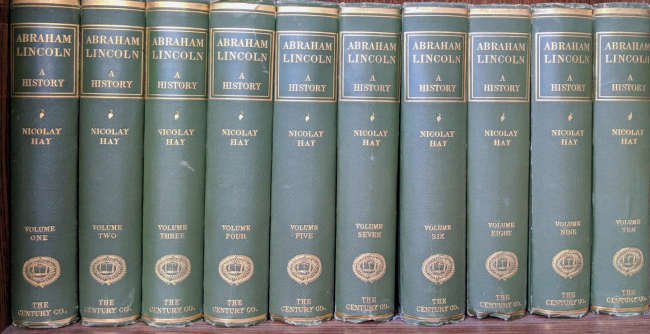
"Abraham Lincoln ♦ A History." The Complete Ten-Volume Set in Searchable PDF Format.

"Abraham Lincoln  A History" is a ten-volume account of the life and times of Abraham Lincoln, written by John Nicolay and John Hay, who were Lincoln's personal secretaries during the Civil War (1861-1865). Published in 1890.


Cable Court, a One Block Private Street, a Turnaround for Cablecars, in Chicago.

The Hyde Park turnaround, which ran on a separate electric cable, was at Cable Court (East 56th Street and South Lake Park Avenue, [1500W] was named in honor of Ramson R. Cable, President of the Rock Island Rail Road in 1857.
The private street, Cable Court (5622S 1500W) is pictured here from Lake Park Avenue looking east. Circa 1950
Cable Court ran between 56th and 57th Streets. When the cable car system was abandoned the street was used for a turnaround for electric trolly buses which did not use the streetcar tracks. 

During an Urban Renewal project shortly after this photo was taken the street was reclaimed for buildings.

Compiled by Dr. Neil Gale, Ph.D.

Tuesday, July 28, 2020

The Assassination of Abe Lincoln's Dog, Fido.

Fido was a mixed breed dog with floppy ears and a yellowish coat. When fireworks and cannons announced Abraham Lincoln’s victory in the Presidential election of 1860, poor Fido was terrified. The Lincolns were worried that the long train trip to Washington, D.C., in 1861, combined with loud noises, would terrify Fido. 
In 1893 John Eddy Roll copyrighted this picture and turned it into a Carte de Visite (Cabinet Card) that was sold at the 1893 World's Columbian Exposition held in Chicago.
A Cabinet Card that was sold at the 1893 Chicago World's Columbian Exposition.
John and Frank Roll, two neighborhood boys, promised to take good care of Fido. Mr. Lincoln made them promise to let Fido inside the house whenever he scratched at the front door, never scold Fido for entering the house with muddy paws, and feed him if he came to the dinner table. The Lincolns gave the boys the roll pillows from their sofa so Fido would feel at home! Did you know the name “Fido” is Latin? Fido is from “Fidelitas,” which translates as “Faithful.”
A cropped picture of Fido from a Cabinet Card.
Fido outlived President Lincoln but came to a similarly tragic end in 1866. Fido was exceedingly friendly and had a habit of showing his congeniality by depositing his muddy forepaws plump on the breast of anyone who addressed him familiarly. His excessive friendliness eventually caused his death in a very unique way, in that Fido suffered the fate of his master—assassination. 

So there was Charlie Planck, one day in 1866 heavily intoxicated, sitting on a curb, head hanging down. Some accounts say he was whittling a stick. In any event, he was holding a "sharp, long-bladed knife." A friendly yellow dog came up to him, the way it often approached strangers. And it put its muddy forepaws on Charlie Planck. In a blind, drunken rage, Planck drew the knife and plunged it into Fido's chest.

Wounded and whimpering, the most famous dog in Springfield—an in all of America, for that matter—struggled to make his way back home, back to the Roll house, hobbling, hobbling, while blood poured from his chest. But it was too far. He would make it only as far as the Universalist Church on the corner of Fifth and Cook, just three blocks from the Roll mansion.

Fido, mortally wounded, his yellow coat matted with blood, labored to the backside of the church. He curled up tight against the chimney as if to keep warm. And there he died.

Poor old Fido was buried by loving hands in a spot that is kept sacred to this day.

Compiled by Neil Gale, Ph.D.

President Lincoln Reviews Court Martials.

On July 18, 1863, in a six-hour session, President Lincoln reviews several pardon cases; regarding one, he writes Advocate General Joseph Holt regarding the case of soldier Michael Delany sentenced to be executed: “Let him fight instead of being shot.
I am in a state of entire collapse after yesterday’s work,” Presidential aide John Hay writes the next day. “I ran the Tycoon through One hundred Court martials! A steady sitting of six hours!” Hay writes in his diary: “Today we spent six-hours deciding on Court Martials, the President, Judge Joseph Holt, and I was amused at the eagerness with which the President caught at any fact which would justify him in saving the life of a condemned soldier. He was only merciless in cases where meanness or cruelty was shown.”

Lincoln was especially averse to punishing with death cases of cowardice. Lincoln said, "it would frighten the poor devils too terribly, to shoot them."

Compiled by Neil Gale, Ph.D.

Saturday, July 25, 2020

The Four Draft Versions of Lincoln's Gettysburg Address.

There were five versions of the Gettysburg Address that were acknowledged by Abraham Lincoln in his lifetime. Here are those versions, along with the Associated Press (AP) wire copy from November of 1863.
Painting of Abraham Lincoln giving the Gettysburg Address.
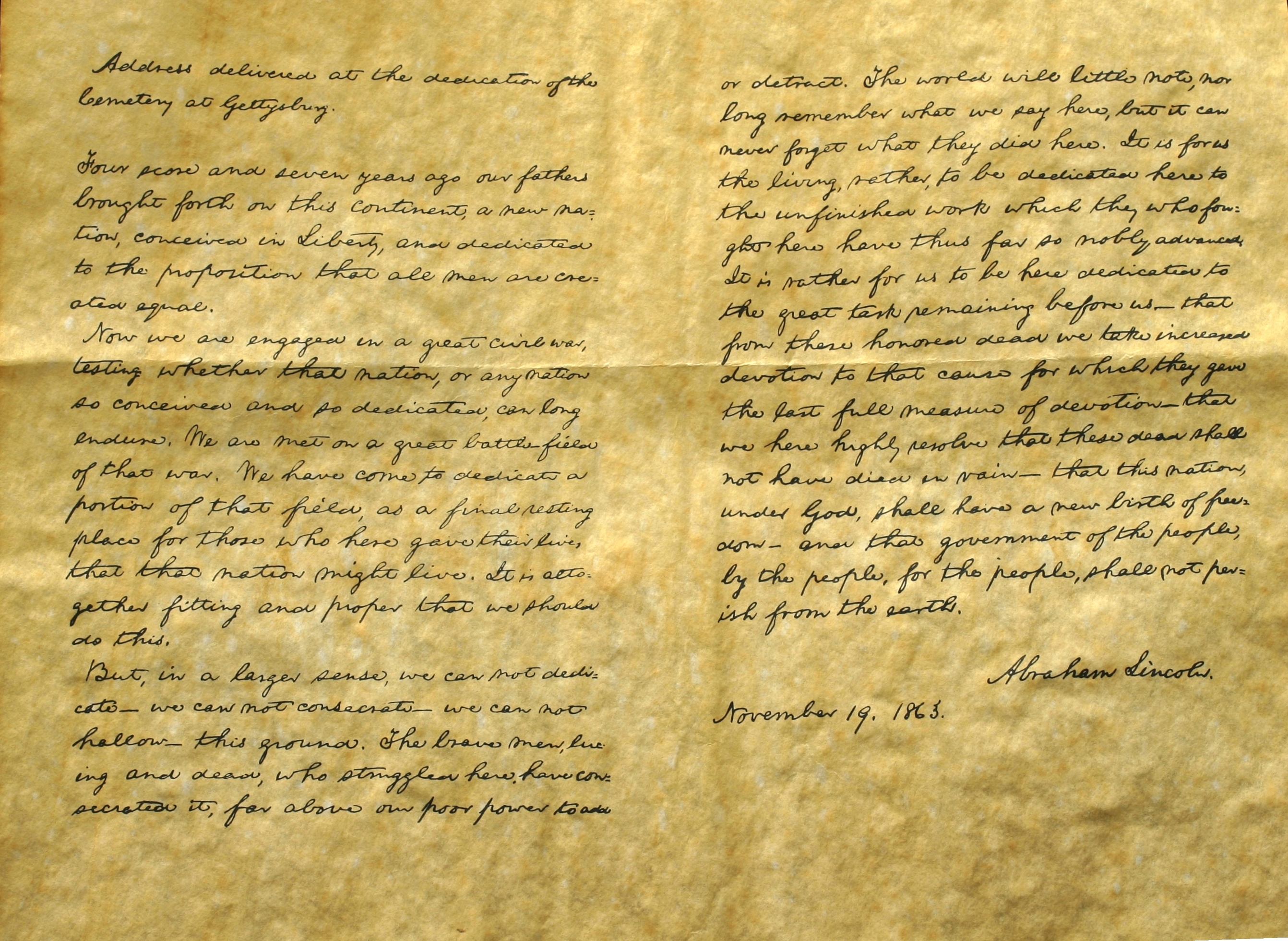
THE OFFICIAL ADDRESS DELIVERED BY ABRAHAM LINCOLN [271 WORDS]
CLICK FOR AN ENLARGED PHOTOGRAPH
"Four score and seven years ago our fathers brought forth on this continent a new nation, conceived in Liberty and dedicated to the proposition that all men are created equal.

"Now we are engaged in a great civil war, testing whether that nation or any nation so conceived and so dedicated, can long endure. We are met on a great battle-field of that war. We have come to dedicate a portion of that field, as a final resting place for those who here gave their lives that that nation might live. It is altogether fitting and proper that we should do this.

"But, in a larger sense, we can not dedicate — we can not consecrate — we can not hallow — this ground. The brave men, living and dead, who struggled here, have consecrated it, far above our poor power to add or detract. The world will little note, nor long remember what we say here, but it can never forget what they did here. It is for us the living, rather, to be dedicated here to the unfinished work which they who fought here have thus far so nobly advanced. It is rather for us to be here dedicated to the great task remaining before us — that from these honored dead we take increased devotion to that cause for which they gave the last full measure of devotion — that we here highly resolve that these dead shall not have died in vain — that this nation, under God, shall have a new birth of freedom — and that government of the people, by the people, for the people, shall not perish from the earth.” 

THE HAY VERSION [268 WORDS]
Four score and seven years ago our fathers brought forth, upon this continent, a new nation, conceived in Liberty, and dedicated to the proposition that all men are created equal.

Now we are engaged in a great civil war, testing whether that nation, or any nation, so conceived, and so dedicated, can long endure. We are met here on a great battlefield of that war. We have come to dedicate a portion of it as a final resting place for those who here gave their lives that that nation might live. It is altogether fitting and proper that we should do this.

But in a larger sense, we can not dedicate—we can not consecrate—we can not hallow this ground. The brave men, living and dead, who struggled, here, have consecrated it far above our poor power to add or detract. The world will little note, nor long remember, what we say here, but can never forget what they did here. It is for us, the living, rather to be dedicated here to the unfinished work which they have, thus far, so nobly carried on. It is rather for us to be here dedicated to the great task remaining before us—that from these honored dead we take increased devotion to that cause for which they here gave the last full measure of devotion—that we here highly resolve that these dead shall not have died in vain; that this nation shall have a new birth of freedom; and that this government of the people, by the people, for the people, shall not perish from the earth.

THE EVERETT VERSION [271 WORDS]
Four score and seven years ago our fathers brought forth, upon this continent, a new nation, conceived in Liberty, and dedicated to the proposition that all men are created equal.

Now we are engaged in a great civil war, testing whether that nation, or any nation so conceived, and so dedicated, can long endure. We are met on a great battle-field of that war. We have come to dedicate a portion of that field, as a final resting-place for those who here gave their lives, that that nation might live. It is altogether fitting and proper that we should do this.

But, in a larger sense, we can not dedicate, we can not consecrate—we can not hallow—this ground. The brave men, living and dead, who struggled here, have consecrated it far above our poor power to add or detract. The world will little note, nor long remember what we say here, but it can never forget what they did here.

It is for us, the living, rather, to be dedicated here to the unfinished work which they who fought here, have, thus far, so nobly advanced. It is rather for us to be here dedicated to the great task remaining before us—that from these honored dead we take increased devotion to that cause for which they here gave the last full measure of devotion—that we here highly resolve that these dead shall not have died in vain—that this nation, under God, shall have a new birth of freedom—and that government of the people, by the people, for the people, shall not perish from the earth.

THE BANCROFT VERSION [271 WORDS]
Four score and seven years ago our fathers brought forth, on this continent, a new nation, conceived in Liberty, and dedicated to the proposition that all men are created equal.

Now we are engaged in a great civil war, testing whether that nation, or any nation so conceived, and so dedicated, can long endure. We are met on a great battle-field of that war. We have come to dedicate a portion of that field, as a final resting-place for those who here gave their lives, that that nation might live. It is altogether fitting and proper that we should do this.

But, in a larger sense, we can not dedicate, we can not consecrate—we can not hallow—this ground. The brave men, living and dead, who struggled here, have consecrated it far above our poor power to add or detract. The world will little note, nor long remember what we say here, but it can never forget what they did here.

It is for us the living, rather, to be dedicated here to the unfinished work which they who fought here have thus far so nobly advanced. It is rather for us to be here dedicated to the great task remaining before us—that from these honored dead we take increased devotion to that cause for which they here gave the last full measure of devotion—that we here highly resolve that these dead shall not have died in vain—that this nation, under God, shall have a new birth of freedom, and that government of the people, by the people, for the people, shall not perish from the earth.

THE BLISS VERSION [272 WORDS] The original draft.
Four score and seven years ago our fathers brought forth, on this continent, a new nation, conceived in Liberty, and dedicated to the proposition that all men are created equal.

Now we are engaged in a great civil war, testing whether that nation or any nation so conceived and so dedicated, can long endure. We are met on a great battle-field of that war. We have come to dedicate a portion of that field, as a final resting place for those who here gave their lives that that nation might live. It is altogether fitting and proper that we should do this.

But, in a larger sense, we can not dedicate—we can not consecrate—we can not hallow—this ground. The brave men, living and dead, who struggled here, have consecrated it, far above our poor power to add or detract. The world will little note, nor long remember what we say here, but it can never forget what they did here. It is for us the living, rather, to be dedicated here to the unfinished work which they who fought here have thus far so nobly advanced. It is rather for us to be here dedicated to the great task remaining before us—that from these honored dead we take increased devotion to that cause for which they here gave the last full measure of devotion—that we here highly resolve that these dead shall not have died in vain—that this nation, under God, shall have a new birth of freedom—and that government of the people, by the people, for the people, shall not perish from the earth.

THE ASSOCIATED PRESS (AP) VERSION [266 WORDS] "Applause" not counted.
Four score and seven years ago our fathers brought forth upon this continent a new nation, conceived in liberty and dedicated to the proposition that all men are created equal. [Applause] Now we are engaged in a great civil war, testing whether that nation or any nation so conceived and so dedicated, can long endure. We are met on a general battle-field of that war; we are met to dedicate a portion of it as the final resting place of those who here gave their lives that that nation might live. It is altogether fitting and proper that we should do this, but in a larger sense we cannot dedicate, we cannot consecrate, we cannot hallow this ground. The brave men, living and dead, who struggled here, have consecrated it far above our poor power to add or detract. [Applause] The world will note, nor long remember, what we say here, but it can never forget what they did here. [Applause]. It is for us, the living, rather to be dedicated here to the unfinished work that they have thus far so nobly carried on. [Applause]. It is rather for us here to be here dedicated to the great task remaining before us, that from these honored dead we take increased devotion to that cause for which they here gave the last full measure of devotion. That we here highly resolve that the dead shall not have died in vain. [Applause] That the nation shall, under God, have a new birth of freedom, and that the Government of the people, by the people and for the people, shall not perish from the earth. [Long applause. Three cheers given for the President of the United States and the Governors of the State."]

Compiled by Dr. Neil Gale, Ph.D.

Wednesday, July 22, 2020

The Bewildering Chicago Murder of Michael Stopec in 1927.

The mysterious James Britt, who rented room 330 of the apartment hotel known as the Morelia Apartments, located at 4047 North Kenmore, in which Michael Stopec, alias Harvey Foxton, was found slain Friday night, July 22, 1927, was identified by Charles Krieger, 29 years old, a former pal of Stopec.

Stopec's body was found in his apartment, kneeling in front of a sofa and shot in the heart. His neighbors said they heard the shot and saw a woman leaving the scene. The breakfast table was still set for three people, but only two meals had been touched.

Krieger had a criminal record, and the police, comparing his description at the bureau of identification with reports furnished by residents in the hotel where Stopec was killed, decided that Krieger and Britt were the same. The search centered on Krieger, believing that he did the shooting or was a witness to it.

Two women who had been friends of the dead man were held for questioning. The police were convinced a woman was involved in the slaying. It was thought that Mrs. Emma Stopec, the victim's wife, was in the room when her husband was shot. She was sought for questioning.

Anna O'Grady, known as 'Babe,' was taken into custody. She said she was engaged to marry the man she knew as Foxton. Here was another motive, the police said, pointing out that Stopec may have been killed by his wife in a fit of jealousy. Miss O'Grady approved of this theory. She said she heard that Mrs. Stopec was extremely jealous. She also admitted the possibility of her fiancée being slain by rival bootleggers.

Miss O'Grady and Lillian Wallen were found in Stopec's apartment, 148 W. Goethe Street, where they said they were waiting for James Curtain and George Dunasik. All were questioned regarding the murder.

Another theory of Chief of Detectives William E. O'Connor is that Stopec was slain by members of a booze ring following a dispute over dividends. 

It was discovered that Stopec rented an apartment under the name James Britt. He was married but was dating at least five women. At age 28, he already had a rap sheet for larceny and burglary and was suspected of being a bootlegger.

On July 25, 1927, it came to light that a county jail prisoner Robert Stanley, 33 years old, supplied several missing links into the murder of Michael Stopec. Captain John Norton, acting on information furnished by Lilian Wallen and Babe Grady, began the search for Stanley, which ended at the cell where Stanley was being held on a larceny charge. After prolonged questioning, Stanley admitted, according to Capt. Norton that it was a message he delivered to Stopec, which sent Stopec to his death at his Kenmore Apartment. "A fellow, I won't say who told me to tell Mike to meet him up there. So I let Mike use my car, and he drove the two girls, Lilian Wallen and Babe Grady, as far as Graceland Cemetery."

Henry Guardino was suspected of firing the shot which killed Stopec. It was learned that bad feelings existed between Guardino and Stopec over the affection of Gertrude 'Billie' Murphy.
Gertrude 'Billie' Murphy, 22, is brought in for questioning in the murder case of Michael Stopec, who was shot and killed in an apartment hotel on July 22, 1927. 
Two witnesses had said they saw Guardino enter the death apartment on the day of the murder, and when arrested, Guardino was carrying a pistol of the caliber used by the killer. Guardino admitted he visited the apartment, which had been engaged by a man, still sought, who gave the name "James Britt." But Guardino persists in denying knowledge of the shooting.

Another person, in addition to the killer and his victim, is known to have been present at the time of the shooting and Capt. Norton admits there is some possibility of Stanley, the prisoner, being this third person. Another theory is that the third person was a woman.

"It is clear that Stanley hastened to give himself up at the jail to avoid arrest in the murder case," said Chief of Detectives William E. O'Connor. Mrs. Murphy was still in custody.

Police interviewed five women and four men, all with good reasons for wanting Stopec dead. His wife was one of them. So was his fiancée. Stopec was scheduled to be married the week after he was murdered, despite the fact he was already married. There were also accusations that he was a broker of shady marriages, arranging for pals to marry recently widowed women who had received large payouts from their husband's life insurance policies.

Despite all the suspects, no one was ever charged with his murder. The main suspect, Robert Stanley, was arrested in August 1927, but the grand jury and coroner couldn't find enough evidence to bring him to trial, and he was released.

Whoever killed Michael Stopec got away with it.

Compiled by Dr. Neil Gale, Ph.D.

Sunday, July 5, 2020

The 1894 Fire in Rogers Park Community of Chicago.

We should all be familiar with the Great Chicago Fire of 1871 that burned from Sunday, October 8, 1871, to early Tuesday, October 10, 1871, killing nearly 300 people and destroying about four square miles of Chicago. Almost unknown is the "Saturday Night Fire" that struck downtown Chicago ten blocks north of the great fire the night before on October 7, 1871, leveling four-city blocks.

HOW PHILLIP ROGERS' LAND FORMED THE BASIS OF ROGERS PARK
On April 29, 1878, Rogers Park was incorporated as a village of Illinois governed by six trustees. At one time West Ridge was adjoined with neighboring Rogers Park, but it seceded to become its own village in 1890 over a conflict concerning park districts (known as the Cabbage War) and taxes. The Village of Rogers Park was annexed to Chicago on April 4, 1893, along with the Village of West Ridge, each becoming one of Chicago's 77 communities today.
The Birch Forest extended from about Birchwood Avenue south to Touhy Avenue, about 1/2 mile, and west to just west of where Sheridan Road is today, in the Rogers Park community of Chicago, ca.1900.
By the turn of the 20th century, a lot of Rogers Park lakefront was still Birch and Oak Forests which, not surprisingly, gave its name to Birchwood Avenue. The subdivision of Birchwood Beach extended from Birchwood Avenue south to Touhy Avenue, about 1/2 mile, and west to the Chicago, Milwaukee, and St. Paul Railroad tracks (today's CTA Red Line) in the Rogers Park community of Chicago. The Birchwood Country Club, a nine-hole golf club was short-lived from 1906-1913 and was limited to 100 individual members living in the Birchwood Beach area.

THE GREAT ROGERS PARK FIRE
On Wednesday, August 8, 1894, one-city block of Rogers Park bounded by Clark Street, Market Street (Ravenswood Avenue), Greenleaf Avenue, and Jackson Avenue (Estes Avenue) went up in flames. Clean up and rebuilding took several years.
The shaded area shows the burnt district at Rogers Park.
By a fire that broke out in that part of the city known as Rogers Park at 9:30 a.m. yesterday (Wednesday, August 8) an entire block was wiped out, including stores, factories, and dwellings, fourteen in all, while ten families were driven out homeless. The loss of property was $34,550, but during the excitement, many persons narrowly escaped injury, while five were hurt.

The scene of the fire was but a few hundred feet northeast of the Chicago & North Western Railway depot (now Metra) and in the principal business portion of the former village. The burned territory is bounded by Clark Street, Greenleaf Avenue, Jackson Avenue, and Market Street, along which the Chicago & North Western Railway has its right-of-way. At the southwest corner of the block at Greenleaf Avenue and Market Street was the Planing Mill of George Gerner & Sons, composed of one- and two-story Frame Buildings, occupying 100 feet of ground each way. The fire started either on top or within the Boiler Room of the mill, the generally accepted theory being that it was set by sparks from a passing engine on the North Western tracks.

Only a block away, on the east side of Clark Street and Jackson Avenue, stands the old Rogers Park Village Hall, the pride of all citizens there, which is now the headquarters of Precinct 44 of the Chicago Police Department and Chicago Fire Department Truck Company № 25, with two men under the command of Lieutenant Healy. The two pieces of horse-drawn apparatus there consist of a truck, hose wagon, and chemical combined and is of the general variety used in country towns. The alarm at the Gerner factory was immediately sent in for this piece of apparatus, but it is reported that it was fully 20 minutes before the scene of the fire was reached, and, of course, the big mill, dry as tinder, like everything else in the neighborhood was doomed. Moreover, the fire was reaching after three frame cottages standing north of the mill, and for Burbank’s Drug Store, a two-story frame building standing east of the mill and facing Clark Street.

The firemen attached their lines to the hydrants, but the streams issued from them would barely reach a foot from the nozzle. Rogers Park, though annexed to Chicago for nearly a year, has been without city water all that time, and compelled to depend on a private waterworks, which were pumping under about ten pounds pressure when yesterday’s fire broke out. Calls for assistance were quickly sent out by Lieutenant George W. Perry to the Evanston and city departments. Hose companies from Evanston were earliest to respond, but by the time of their arrival, all of the buildings save one in the doomed block had been destroyed, and the fire was endeavoring to grasp the City Hall across Clark Street, as well as a long row of frame buildings containing the Rogers Park Library, several stores, and the houses of many families. The City Hall was set on fire several times, but the Evanston firemen managed to avert the danger, while several young men from the same classic town by hard work prevented one building from going down on the burning block.
After the flames had almost destroyed everything on the block, Fire Marshal Frederick J. Gabriel of the 13th Battalion arrived, followed by the Engine Companies № 70, № 55 from 685 Sheffield Avenue, № 56 from Noble Street and Clybourn Avenue, № 53 from Clybourn and Southport Avenues, and Hose Company № 4 from Clark Street and Belmont Avenue, and № 6 from Balmoral and Ashland Avenues. Some of the companies had driven six miles at full pace, with the thermometer at 95° F in the shade, and men and horses were alike worn out. But the former went to work with a will in a dire emergency. Every building on the block save one had gone down, and the fire had extended to the east side of Clark Street, where the two-story building occupied by W.P. Foote’s grocery store and home and the office of Expressman Anthony Cook had taken fire. Captain A. William Lawson and Lieutenant Quinlan with their men pushed into the building to stay the start the fire had taken for the destruction of another block. While at work Lawson and Quinlan were overcome by the heat and fell into a mass of burning debris on the second floor, whence they were rescued after heroic efforts, both being painfully burned. The building was gutted. Marshal Gabriel and Lieutenant Perry had by this time succeeded in getting the manager of the private waterworks to put on a greater pressure, and after a hot fight at Clark Street and Greenleaf Avenue, the flames were barred from further progress.

At 10:00 a.m. the wires of the Chicago, North Shore & Milwaukee Railroad Company and the Chicago Telephone Company were burned or cut down to avert danger, and there was no telephonic or electric car communication between the city, the northern suburbs, and Evanston until late last evening.

Police Officer John Weldon was the hero of the fire. He is from Summerdale Station. After the Burbank store and residence on the corner of Greenleaf Avenue and Clark Street had been encircled by the fire he rushed up the stairway leading to rooms above. Mrs. Gurney, the mother-in-law of Dr. Lowell, was there with Mrs. Burbank, both women frantic from fear. Mrs. Burbank hurried down the stairway, her clothing taking fire in her progress. She was seized by bystanders, who extinguished the flames on her gown, and she escaped with a few slight burns. In the meantime, Officer Weldon held Mrs. Gurney at a window, from which smoke was issuing freely, and was calling for a ladder. He knew the attempt down the stairway was fraught with danger. Finally, a ladder was placed against the window and the officer carried Mrs. Gurney to the ground where both fell unconscious from the smoke they had inhaled. Officer Weldon was also burned on one side of the face. Other praiseworthy work was done by Lieutenant George W. Perry and the twenty-two men of his command, in the way of saving threatened property and one of their deeds was of particular daring. On the railroad track, less than fifty feet from the blazing mill stood a tank car loaded with oil and wedged in between the other cars on either end of it. There was great danger of an explosion of the oil, which would have added horror to the fire disaster. Lieutenant Perry called all his men together and with desperate strength, they removed the cars from one end of the tank car, which had become heated to a dangerous point, and then they shoved the oil car to a safe distance.

The three cottages north of the planing mill on Market Street, now Ravenswood Avenue went down in a hurry before the flames. Nicholas Stuer and his wife, living in a part of the first cottage, lost everything, while Louis Petrie saved only a pair of trousers. Nicholas Michaels, living in the next cottage, saved part of his effects, while James Michaels, in the third cottage, saved all his furniture. The last building on Market Street, a large livery stable operated by J.P. Goodwin, was quickly destroyed, with a number of sleighs and a quantity of feed. He succeeded in saving his horses, carriages, and hearse.

Fronting on Clark Street, besides the Burbank Building, were a double two-story frame building occupied by John Hinds’ Bakery and John Weas’ Shoe Store, a brick building occupied by Sharp Brothers’ dry goods store, and a brick residence annex, and the frame residence and Butcher Shop of John Lindley. The undertaking establishment of Peter Weimeschkirch, which also constituted the Rogers Park Morgue, was but partially destroyed, the undertaker finding time to save most of his stock. His residence was saved.

George Gerner, in whose planning mill the fire originated, thinks with proper protection the fire should have been extinguished in a few minutes with but little loss.

Serious complaints were made against the private waterworks and the newly-annexed people think the city should take charge of the water supply. Harvey Eugene Keeler is the Superintendent of the works, which are said to have been originally built by the National Tube Company and later delivered to a stock company. The works stand at Touhy Avenue and Sheridan Road and are substantial and well equipped. Citizens complain that besides not being protected in cases of fire the water company charges exorbitant rates.

Compiled by Neil Gale, Ph.D.
Source, Rogers Park/West Ridge Historical Society.
Source, Chicago Tribune.