Friday, May 5, 2023

Abraham Lincoln's Pet Peeves.

One thing that bothered Lincoln was dishonesty or deception, especially from politicians. He famously said, "I desire to so conduct the affairs of this administration that if at the end, when I come to lay down the reins of power, I have lost every other friend on earth, I shall at least have one friend left, and that friend shall be down inside of me."

Lincoln was also known to dislike wastefulness and inefficiency in government and bureaucracy. He believed the government should be run efficiently and effectively to serve the people.

Additionally, Lincoln was known to dislike certain aspects of the legal system, such as technicalities to avoid justice or the excessive use of legal procedures to delay trials. He once said, "Discourage litigation. Persuade your neighbors to compromise whenever you can. Point out to them how the nominal winner is often a real loser ─ in fees, expenses, and waste of time."

Overall, Lincoln was a man of strong convictions and beliefs and likely had many things that he found frustrating or annoying. However, these are a few examples of things he was known to have disliked.
No, Not this kind of Pet Peeve.


Compiled by Dr. Neil Gale, Ph.D.

Thursday, May 4, 2023

Kiddie Park, 4200 North Harlem Avenue, Chicago, Illinois. (1939-1953)

Kiddy Park opened on April 29, 1939, at 4200 North Harlem Avenue, Chicago, by Charles “Charlie” F Reid. 

sidebar
In 1948, a local improvement association incorporated Norridge as a village, stymieing an effort by Chicago to annex the area.


CLICK THE IMAGES TO READ THEM.


On the same corner as KiddyTown Amusement Park (1953-1964), which opened on the east side of the future Harlem Irving Shopping Center, which opened in 1955, in Norridge, Illinois.


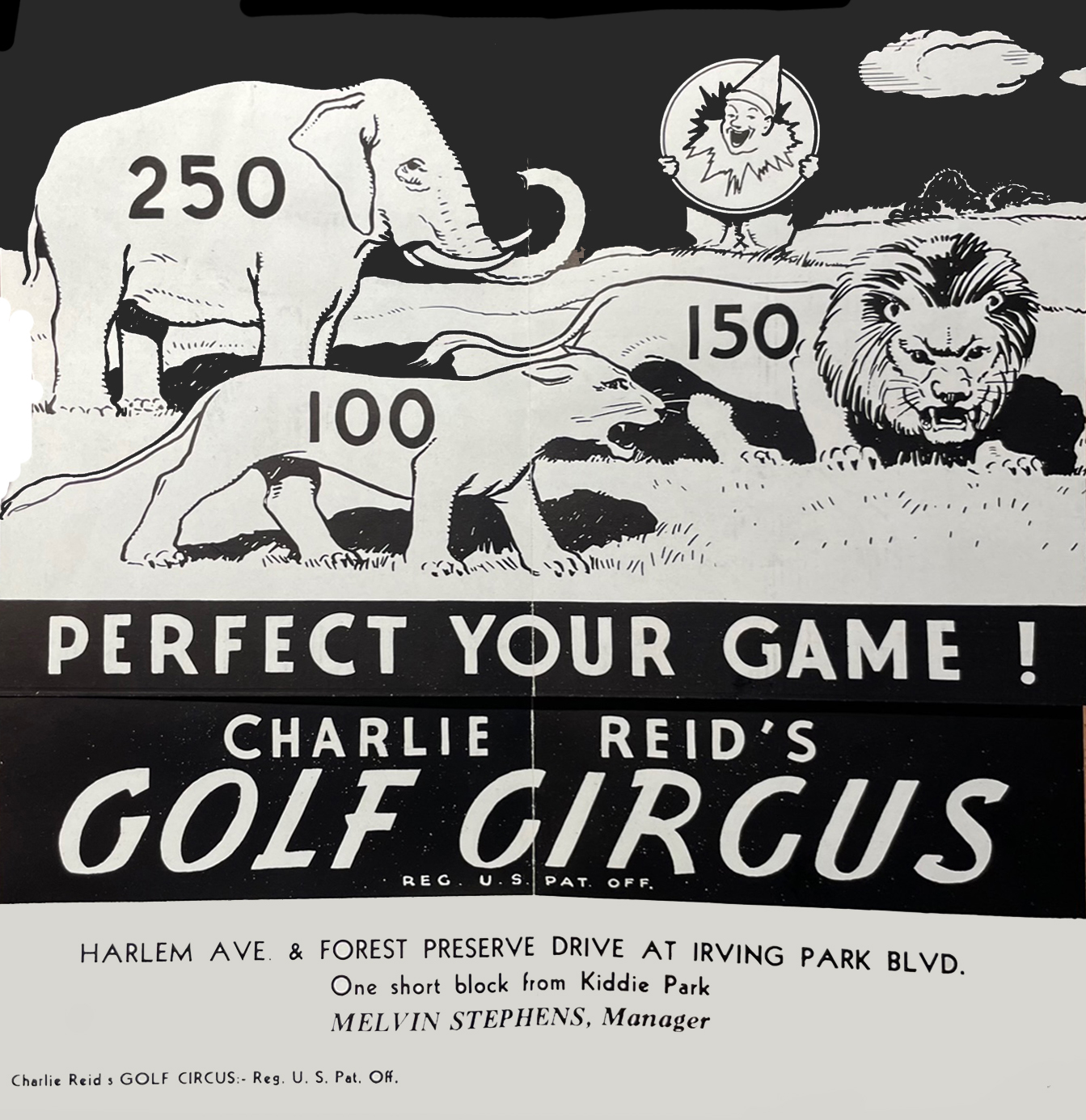
Charlie was quite the entrepreneur, opening the Charlie Reid Golf Circus just to the north of Kiddie Park. Soon after starting Kiddy Park, he branded himself as Montana Charlie and started a few businesses and sold some products under that brand.

Charlie Reid Golf Circus
I'm guessing that the Giraffe was too slim to hit at 250 yards.


If Daddy and Mother wish for recreation, they may visit the Charlie Reid Golf Circus, where they can practice their Golf in surroundings so unusual that every minute will be real joy and pleasure.

They may improve their Golf by aiming at animals─try, hitting the Elephant on the "noodle" at 250 yards─the Lion at 200 yards─they can try and hit a Tiger or a Clown─and all the time, they are improving their golf drive and having fun while they do it. 


Compiled by Dr. Neil Gale, Ph.D.
Thank you, France Costabile, for the pictures and your story.

Monday, May 1, 2023

May is Asian American and Pacific Islander (AAPI) Heritage Month.

This year (2023) marks the 44th anniversary of celebrating Asian American and Pacific Islander (AAPI) Heritage. 

The original observation was seven days beginning on May 4, 1979, as Asian Pacific American Heritage Week passed by the U.S. Congress and signed into law by President Jimmy Carter on October 5, 1978. 


President George H.W. Bush extended the celebration for the entire month on May 7, 1990, and designated it Asian Pacific American Heritage Month in Proclamation № 6130.

It is difficult to identify the "first" Asian in frontier Illinois since the history of Asians in Illinois' footprint dates back several centuries and is complex. However, it is known that Asians, particularly the region's indigenous peoples, have lived in what is now Illinois for thousands of years. 

sidebar
Illinois is the sixth largest state with 828,847 (2020 Census) Asians. California is home to 6,764,118 Asians, followed by New York with 1,884,346, and Texas comes in third with 1,656,166 Asian residents.

The first recorded Asian immigrants to Illinois were likely Chinese workers who helped build the transcontinental railroad between 1863 and 1869. It is also important to note that many Asians, mainly of South Asian descent, were brought to Illinois as indentured servants or slaves during the colonial era.

The first group of Japanese in Chicago arrived in 1892 with jobs and skills to build the Ho-o-den Pavilion at the World's Columbian Exposition.
Ho-o-den Pavilion at the 1893 Chicago World's Columbian Exposition.


Kamenosuke Nishi was the first known (documented) Japanese individual in Chicago. He relocated from San Francisco, California, in 1893 and opened a Gift Shop at 27th Street and Cottage Grove Avenue. Nishi parlayed his vision and honed his sales and management skills into $700,000 in profit.

sidebar
Today, Cottage Grove Avenue's north terminus is at 33rd Street, which heads only eastbound.

In the early 1900s, about 400 Japanese immigrants lived in Chicago. After WWII, the U.S. Government resettled 20,000 Japanese families or individuals to Chicago from World War II internment camps.

Because the Japanese did not emigrant to Chicago on their own, that alone denied them the opportunity to develop their unique neighborhood and identity, as Chinatown, Little Italy, Greek Town and other Chicago ethnic neighborhoods did.

Compiled by Dr. Neil Gale, Ph.D.

Saturday, April 29, 2023

The Murder of Labor Racketeer, Timothy “Big Tim” Murphy in 1928 Rogers Park, Chicago.

On June 26, 1928, Chicago labor racketeer Timothy D. Murphy, “Big Tim” (May 23, 1885-June 26, 1928), was shot to death at his Bungalow at 2525 West Morse Avenue in Chicago's Rogers Park community. Murphy was a Chicago mobster, labor racketeer, and U.S. mail thief who controlled several major railroads, laundry and dye workers' unions during the 1910s and early 1920s.
2525 West Morse Avenue, Rogers Park Community, Chicago, Illinois.


Timothy Murphy grew up in the Back of the Yards neighborhood on Chicago’s South Side. He was a towering 6' 3," slab-bodied and mostly genial boy who later boasted of selling newspapers to the famous meatpacker Jonathan Ogden Armour outside of the main offices of Armour & Company at 43rd Street and Racine Avenue. When he was older, Murphy got a job as a railroad switchman for the Chicago junction line, which would give him lifelong sympathy for the working man's plight.

Murphy was a devoted family man and had many friends. He was regarded as a great pal to just about everyone, but his dual nature made him dangerous when provoked. All the good work that he might have accomplished in labor organizing and politics was sabotaged by his associations with criminals and hoodlums ─ and by his own dabbling in crime. In 1909, he became involved with Mount Tennes, the so-called “Telegraph Gambling King” of Chicago. Tennes set up his first telegraph switchboard in a train station in Forest Park and received race results from tracks in Illinois, Kentucky and New York. Tennes had an illegal monopoly on the information. For a share of the profits, his operators sent the results to hundreds of bookie joints, gambling parlors and pool halls all over the city. Murphy’s alliance with Tennes earned him a huge amount of money but two years later, he sold Tennes out to a grand jury and walked away without a blemish on his record.

While working with Tennes, Murphy had learned the art of bribing public officials and decided to try out politics. In 1915, he ran a highly successful campaign for the state legislature, getting elected from the working-class, Irish-Catholic Fourth Ward. He used the clever slogan “Elect Big Tim Murphy ─ He’s a Cousin of Mine!” Murphy spent just one term in Springfield, returned to Chicago, and got involved in the labor rackets.

Through his friend, Maurice “Mossie” Enright, an organizer with the American Federation of Labor and a convicted murderer, he was able to organize gas station attendants, garbage collectors, and then street sweepers. Strikes, wage increases, and higher union dues followed, and Murphy got a percentage of everything. He and Enright operated from Old Quincy No. 9, a famous saloon at Randolph and LaSalle Streets, and for a time, the two men were inseparable. Eventually, the two men had a falling out over the division of proceeds from the settlement of a labor strike, and their friendship came to an end. Like Mount Tennes years before, Enright was blindsided by Murphy’s ruthless ambition.

On February 3, 1920, Enright was getting out of his car in front of his home on Garfield Boulevard when five men in another automobile pulled up and opened fire on him before he could draw his own revolver and defend himself. Enright was hit 11 times and was dead when the other car pulled away. His wife found him moments later, lying in a pool of his own blood. Tim Murphy, Michael Carozzo, the head of the Street Sweeper’s Union, and several others were arrested and questioned about the murder, but each man had an alibi and was let go.

You’re likely not surprised to learn that Enright’s murder still remains unsolved.

Murphy continued to run the three unions but was too restless and greedy to be happy with the small amount of money that was coming in. In 1920, he organized his first mail robbery. It went off without a hitch, understated and bloodless, and occurred after informants told Murphy about an overheard telephone conversation concerning money coming into the Pullman station. Two bags of cash that amounted to just over $125,000 were sent by insured, registered mail and arrived at the Illinois Central Station in Pullman on August 30. When the train pulled in, a bank messenger named Minsch was waiting on the platform. He signed for the sacks and tossed them onto a mail chute. Three boys with a cart earned a quarter each from Minsch by loading whatever he sent down the chute into his car. The boys were waiting but had trouble lifting the two bags. Two men were standing nearby, apparently waiting for someone, and saw the boys and walked over to help. The boys directed the men to take the bags to Minsch’s car, but they kept walking, tossed the two bags into the backseat of another car, and drove away. One of the men was Big Tim Murphy, and the other was his partner, Vincent Cosmano.

Unfortunately for Murphy, someone talked, and the two men were arrested and indicted by a grand jury. Murphy needed money for lawyers, so he decided to rob another train to get it.
(L-R) Tim Murphy, Fred Mader, John Miller, and Cornelius Shea during their murder trial in 1922.

 This time, he bribed a mail clerk in Indianapolis for a tip on a weekly shipment of cash and government Liberty Bonds that was sent to the Federal Reserve in Chicago. Murphy put together a crew (which included Cosmano, his long-time driver, Ed Guerin, Mike Carozzo, and two brothers, Frank and Pete Gusenberg), and they set up surveillance on the Dearborn Station at Polk Street. After they learned when the money shipment arrived, they pulled off the robbery on April 6. They escaped in a stolen Cadillac with $380,000 ($5,735,000 today).

It didn’t take long for the police to get suspicious, and the mail clerk that Murphy had bribed was the first to confess. Ed Guerin also talked because Murphy never gave him his share of the money. A judge issued a search warrant for the house where Murphy’s father-in-law lived, and postal inspectors found a trunk in the attic that was so heavy with cash and bonds that it took four men to haul it out. The bills in the trunk were brand new, and the Federal Reserve had a list of their serial numbers. The money, plus the two confessions, sent Murphy to Leavenworth for four years.
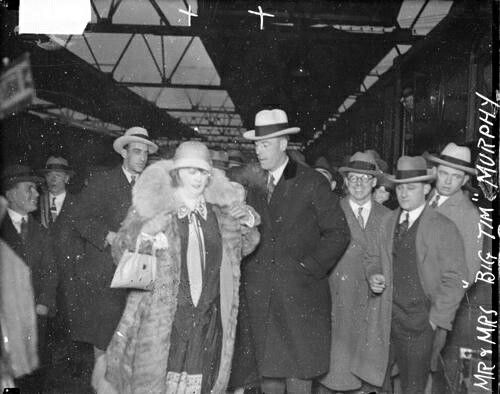
Big Tim Murphy and His Wife, Phyllis, in 1926.

Murphy was washed up when he was released from prison. But he was an eternal optimist and began devising new schemes to make money while his long-suffering wife, Florence, pestered him to find a suitable line of work.

Murphy wasn’t interested. There was too much money to be made as a criminal. He began cooking up a series of hare-brained schemes, including a banana plantation in Texas, a portable grocery store on wheels, a dog track, a travel agency, and even a plan to manufacture stop-and-go traffic lights. The latter was an idea ahead of its time, but no one was interested in what Big Tim was selling. He finally realized that the union dues of the rank and file, not his get-rich-quick schemes, made money, and he decided to take up where he had left off with labor organizing. He tried organizing tire dealers, jelly manufacturers, gasoline dealers, and garage workers, but none of them worked out.

Finally, he hatched a plan to take over the Cleaners and Dyers Union, a union with 10,000 members that was already controlled by Al Capone. Murphy stormed into the business office of the union on South Ashland Avenue with a gunman at his side and announced a “hostile takeover.” They surrendered.

Murphy’s attempt to take over a union run by Al Capone was the last mistake he ever made.

On the evening of June 26, 1928, Murphy was spending a quiet night at home in the West Rogers Park neighborhood on the far North Side. His wife was away at a church festival, and he was listening to the 1928 Democratic National Convention on the radio with his brothers-in-law, Harry and William Diggs. Around 11:00 pm., someone knocked loudly on the front door. Instead of going to the door, Murphy and Harry Diggs slipped out the side door and went around the house to see who was there. When they saw no one, Murphy walked across the front of the house and onto the lawn. Just then, gunfire broke out from a sedan that was parked on the street, and Murphy was shot down in the yard. As the car sped away, the Diggs brothers spotted four men inside, although none of them were ever identified.

Murphy was carried into the house, and as he lay dying, he tried desperately to say something to his brothers-in-law but died before he could speak. The police arrived before Florence returned from church. When she found her husband’s bloody body lying on the living floor, she collapsed on top of him and began to weep. She promised revenge: “If I knew who had killed Tim Murphy, I wouldn’t tell anybody ─ I wouldn’t wait for anybody. I’d take a gun and kill them as they killed him.”

Big Tim Murphy was laid to rest at Holy Sepulchre Cemetery, Alsip, Illinois, and unlike the gaudy gangster funerals of the 1920s, only a modest crowd attended the service. No gangland officials or politicians were at the service, although a few South Side and Back of the Yards characters did turn out for the wake the night before the burial. Too much had changed while Murphy had been in prison, and his hold on the Chicago rackets had slipped away in his absence. He was not a man anyone wanted to get close to, and even the tags on the funeral flowers were removed so that no outsider could know who sent them. The Catholic Church refused every form of funeral service, so an old friend who was an undertaker on the South Side recited the Lord’s Prayer, the only words spoken over his body.

It was a sad end to a man who started out with a lot of potential but greed and a failure to realize when ambition had gone too far finally cost him his life.

Ninety-five years after the shooting that claimed Big Tim's life, the bullet holes from that violent summer night are still visible in the yellow bricks of the bungalow where he once lived. They serve as the visible reminder of a man who never achieved fame in the annals of Chicago crime but left a bloody mark on it nonetheless. His murder was never solved.

Compiled by Dr. Neil Gale, Ph.D.

Friday, April 28, 2023

Couch Place, an Infamous Alley in Chicago's Loop.

The main walkway next to where the Oriental Theatre is called Couch Place [1]. It's the same alley that was adjacent to the Iroquois Theatre at the northeast corner of Randolph and Dearborn Streets 79-83 Randolph (after the 1911 Loop Renumbering; 36 West Randolph Street).


On Wednesday, December 30,1903, the deadliest theatre and single-structure fires in United States history occurred at Chicago's new "Iroquois Theatre." The first performance at the theatre, a standing-room-only matinée, starred the famous comedian Eddie Foy.

A stage light shorted and sparked during the show, setting fire to the curtain and quickly spreading doom throughout the theatre. Though everyone tried to make a break for it, there were some major flaws in the building design, like how all the fire escapes were unlabeled, locked, and opened inward, and the second-floor fire escape over the alley named Couch Place was unfinished. 

The Iroquois Theatre was billed as "Absolutely Fireproof" in advertisements and in the performances playbill. The spread of the fire is attributed to the large amount of inflammable stuff on the stage. Many people had been found dead in their seats in the balcony and gallery.

Regular "Iroquois" Prices: $1.50, $1.00, 75¢, 50¢

So, by failing to make it outside or jumping to the alley below out of desperation, 602 people died because of the Iroquois Theatre Fire (my robust article) that day.


One hundred and twenty years later, Couch Place is still considered haunted.

Compiled By Dr. Neil Gale, Ph.D.


People that believe there were no real safety standards for public buildings during the turn of the 20th Century, nothing could be further from the truth.

The construction manager, W.A. Merriam, had declared the building “absolutely fireproof”, although he had ignored a number of contemporary safety precautions. On the day of the fire, audience demand was so great to attend the ornate new theatre that there were 200 standing attendees; the fire vents were closed, and the theatre doors were locked. Even by the looser standards of the day, the construction company and theatre owners committed flagrant safety violations. According to some reports, the city safety inspectors had been bribed with free theatre tickets to ignore the offenses.

Very soon after the fire, a grand jury indicted five people: theatre owner Will Davis, Iroquois treasurer and assistant manager Thomas J. Noonan, and stage manager James E. Cummings–for manslaughter, and Chicago’s Building Commissioner Williams and Building Inspector Edward Laughlin–for malfeasance. Ultimately, the defense got the judge to dismiss the case by arguing that the city’s fire ordinances were invalid. No one was punished for the deaths of 602 victims.

The only positive outcome of this tragic event was the major overhaul of the city’s fire safety standards. Not only did the city of Chicago tighten its fire code, but other major cities changed their practices almost immediately as well. Shortly after this fire, New York and London made rules to stop locking theatre doors. The doors of the Iroquois had been locked to prevent people from sneaking in the theatre, which was one of the contributory factors to the high death toll. On June 8, 1904, New York introduced new building standards for theatres in response to the Iroquois tragedy. In 1904 the Von DuPrin company developed the panic bar (also called push bar or crash bar), a version of which is still used today so that people inside a locked building can now exit in an emergency. Most importantly, fire codes were updated throughout the country.


[1] Ira Couch (1806-1857) was a prominent early settler and entrepreneur in Chicago, Illinois, during the mid-19th century. Born in New York in 1806, Couch arrived in Chicago in 1834, just one year after the town was incorporated.

Upon his arrival in Chicago, Couch quickly established himself as a successful businessman. He founded several businesses, including a livery stable, a stagecoach line, and a hotel. In 1837, he built the Tremont House, one of Chicago's most famous hotels during the mid-19th century. The hotel was known for its luxurious accommodations and was a popular destination for politicians, business leaders, and other prominent figures.

Couch was also active in politics. He served as an alderman in the Chicago City Council in the 1840s and was elected to the Illinois House of Representatives in 1846. 

In 1850, Chicago was booming, and the Tremont Hotel was so overbooked that guests had to sleep in the halls. Within three years, Couch was a rich man. He rented the hotel to two men from Boston and retired on his riches.

In 1852, he was elected to the Illinois Senate.

Despite his success, Couch suffered financial setbacks in the mid-1850s. He was forced to sell the Tremont House in 1854 and was later sued by his creditors. He died in 1857, reportedly from complications related to alcoholism.


Couch lies in his Mausoleum in Lincoln Park when the area was a city cemetery.


The free PDF book, "The Great Chicago Theater Disaster, The Complete Story Told By The Survivors," published in 1904 by Marshall Everett.