Wednesday, April 5, 2023

The Varsity Theater, 1710 Sherman Avenue, Evanston, Illinois. (1926-1988)

The Varsity Theater opened on December 24, 1926, at 1710 Sherman Avenue, Evanston, Illinois. The theater was commissioned by Evanston native Clyde Elliot and was designed by John E.O. Pridmore. It was the only known example of an atmospheric theater designed as a French Chateau. 
The Varsity Theater, 1944, and the Marshall Field & Company Evanston Store.


sidebar
Just 4 years, 3 months, and 11 days later, the Nortown Theater, 6320 North Western Avenue, Chicago, Illinois, opened on April 4, 1931, another Pridmore design. It was also an atmospheric theater designed with a seaside theme, sea horses, mermaids, and zodiac motifs. The theater closed in 1990 and was demolished in 2007.
 
The Nortown Theater, Chicago, Interior from the Balcony.


More specifically, the Varsity Theater was designed to represent the courtyard of a French chateau "of magnificent coloring and rare charm." The sidewalls represented castle walls, abutting the proscenium with turrets and buttresses hiding organ chambers and pipes within. The proscenium arch formed "a massive gateway with flying flags and pennons" and suggested the view out over a lowered drawbridge from the castle courtyard of the auditorium out onto the stage beyond.

Noted scenic company Sosman & Landis Co. was credited with creating the auditorium's elaborate French interior. They were founded in 1878, and many of its artists and mechanics have practically spent their lives developing their art. The company's first theatrical scenic painting began at the old McVicker Theater in Chicago.

At 2,500 seats, the Varsity Theater was one of the largest suburban Chicago movie palaces ever built and was also one of the most spectacular. The cerulean blue sky dome featured twinkling stars, floating fleecy clouds, and a delicate crescent moon that sailed slowly overhead during the performance.

The theater's 3-manual, 26-rank organ was built by the Genevan Organ Company. Leo Terry, former organist at the Capitol Theater, Chicago, one of the foremost theater organists in the country, will preside over the giant Geneva organ. Called an "atmospheric console," the Geneva organ was sunken and rose into view during organ numbers.
The Varsity Theater. 1967.


The lighting scheme of the Varsity expresses the early French era. The illumination in the auditorium was early French period, a crude lantern-type of fixtures enameled in bright colors. The modern Italian lobby used old iron and antique gold metalwork finishes. The company making the lighting fixtures supplied them for the new Palmer House Hotel and the new Stevens Hotel in Chicago. 

The marvelous lighting effects and the ceiling treatment enhance the illusion of sitting outdoors in the chateau courtyard. Overhead is a cerulean blue sky with twinkling stars, floating fleecy clouds and a delicate crescent moon that sailed slowly overhead during the performance. Its rising and setting begin so timed that it slowly fades from view behind the chateau just at the close of the performance, a distinctive innovation in theater decoration.
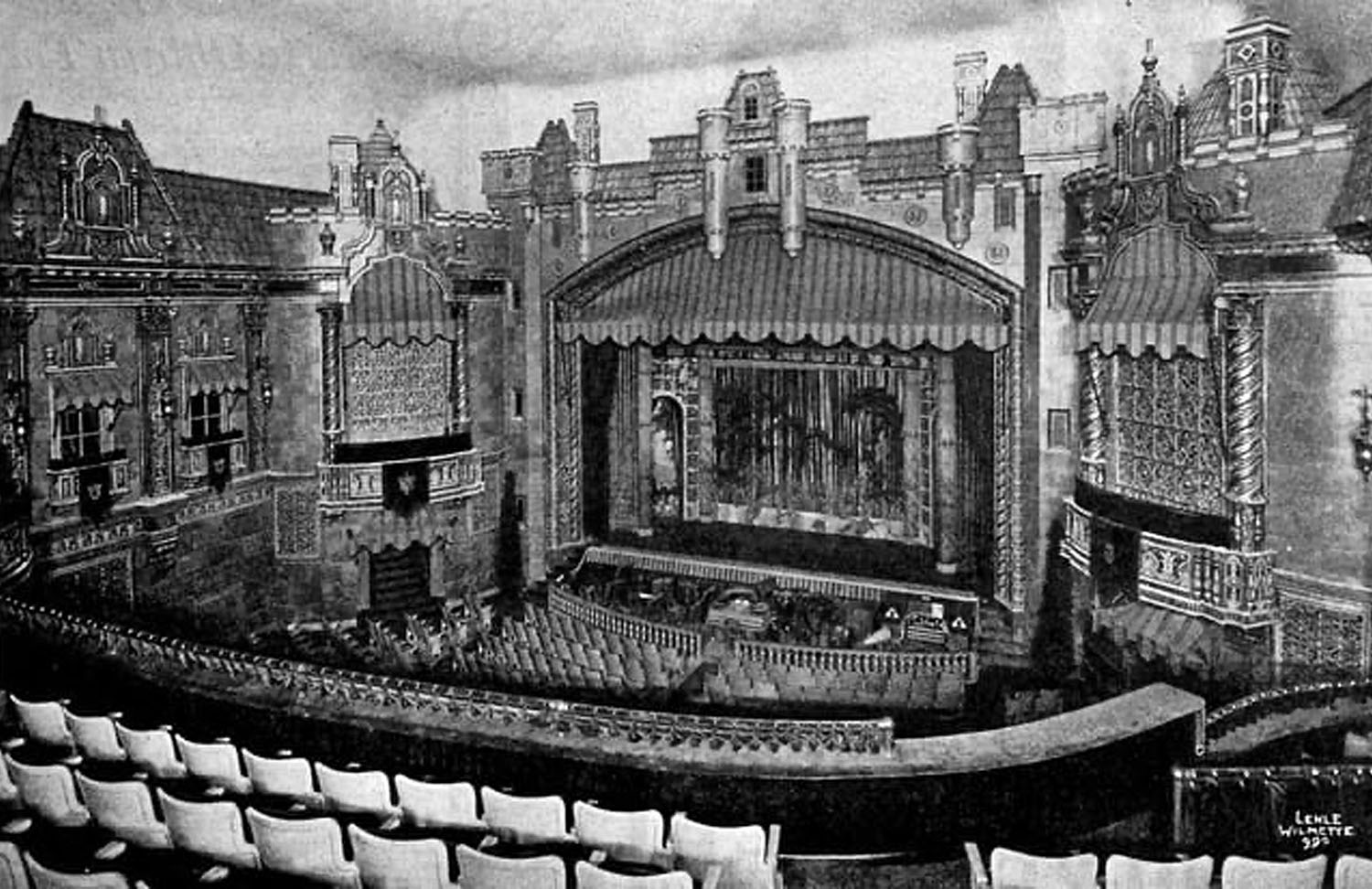
The Varsity Theatre Interior from the Balcony in 1926.


The Varsity closed in 1988. Almost immediately after the theater closed, the main level and lobby were gutted and turned into retail space.

In 2010 the City of Evanston received a $50,000 grant from the National Endowments for the Arts to conduct a feasibility study on reopening the theater as a performing arts center. In July 2011, the study concluded that the first floor of the theater was currently occupied by a retail store and not available for redevelopment and that the performing arts needs of Evanston were greater than the Varsity Theater could accommodate alone. They recommended developing several performing arts spaces in downtown Evanston instead of just one central location.

Compiled by Dr. Neil Gale, Ph.D.

Valencia Theater, 1560 Sherman Avenue, Evanston, Illinois.

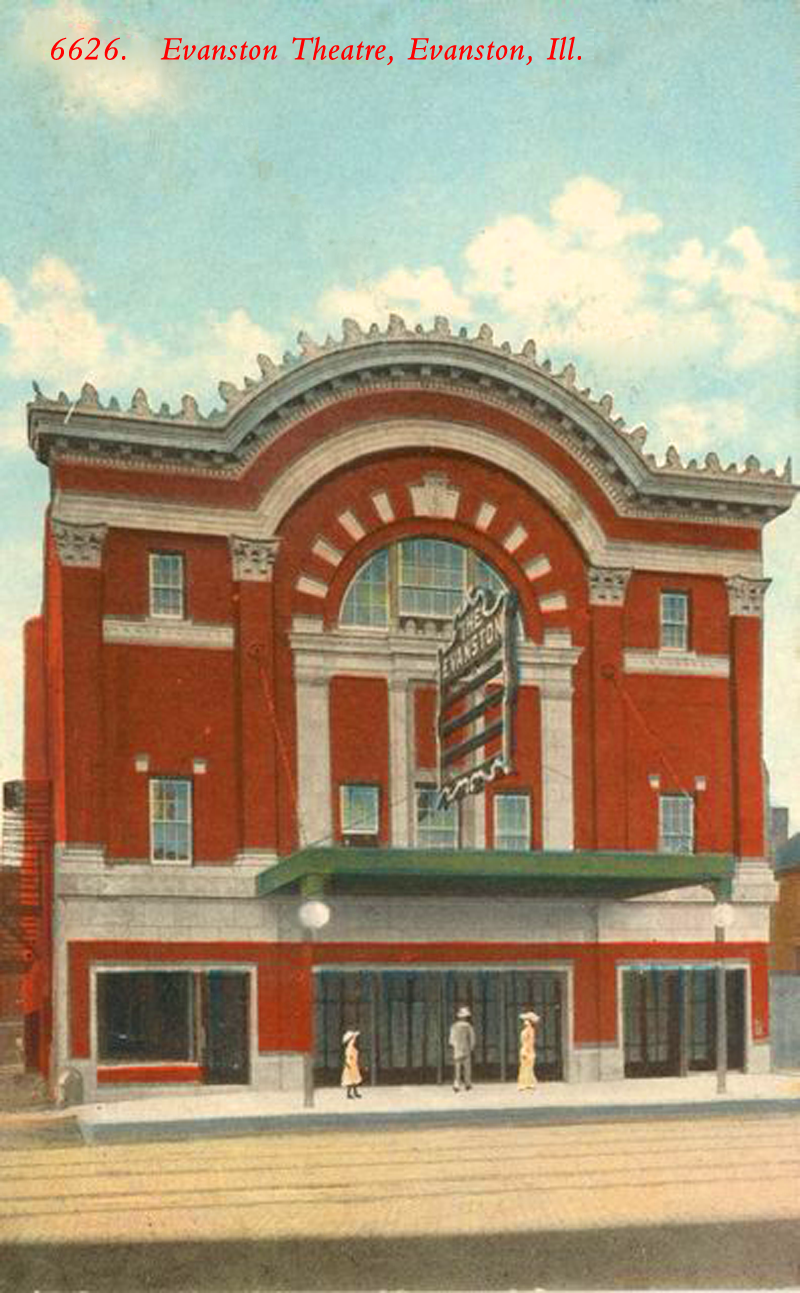
The Evanston Theater


At 1560 Sherman Avenue, where James Carney had lived since 1884 in the old Willard House. The Evanston Amusement Company built the Evanston Theatre in 1910-11. Designed by the Chicago architect John Edmund Oldaker Pridmore (1867-1940), the $65,000 ($2,058,000 today) theatre opened on August 21, 1911.

Featuring "polite vaudeville," the 950-seat theatre changed its bill on Mondays and Thursdays and had matinees on Wednesdays and Saturdays. The interior decoration was by the H. Neilson Company, the carpets and draperies by the Hasselgren Studio, and the furniture and fixtures from Marshall Field & Company. 


After a fire that caused a loss of about $35,000 ($822,600 today) in December 1917. It reopened as the Evanston Strand Theater in 1918. In December 1922, it reopened as The New Evanston Theater. 

Renamed The Valencia Theater was completely rebuilt in September 1932 with Art Deco decor. It was taken over by Balaban & Katz. It later was operated under B & K’s successor chains, ABC Theatres and finally, Plitt Theatres.

The Valencia was razed in 1975 to make way for the American Hospital Supply building, replaced in the early-1980s by an eighteen-story building that now houses the world headquarters of Rotary International.

Compiled by Dr. Neil Gale, Ph.D.

Tuesday, April 4, 2023

Devon Theater, 6225 North Broadway, Chicago, Illinois.

The Devon Theater at 6225 North Broadway, Chicago, was originally known as the Knickerbocker. It was built by the Lubliner & Trinz circuit in 1915 by architect Henry L. Newhouse. 


Located in Chicago's Edgewater neighborhood, the theater was later renamed the Devon, even though it was more than two blocks south of Devon Avenue on Broadway.

Around the time it was renamed, the operation of the Devon was taken over by Essaness. It continued to operate through the 70s as a second-run movie theater and later housed a church for a time. 


The Devon Theater was demolished in 1996 after the entire block was acquired by Loyola University.

Compiled by Dr. Neil Gale, Ph.D.

Chuck Wagon Diner with a Kentucky Fried Chicken, Champaign-Urbana, Illinois.


The Chuck Wagon was in Champaign from 1956 to 1976, when it was sold and moved to Villa Grove. The diner was moved to downtown Urbana in 1983, where it operated as the Elite Diner from 1983 to 2002. The diner then went to Homer and eventually to Michigan.


In 1956 Mountain View Diners of Singac, New Jersey, delivered the new Chuck Wagon to Bob and Nixie Dye in Champaign, Illinois. It was one of the last diners manufactured by Mountain View Diners.
The Dyes operated the Chuck Wagon Diner and also offered Kentucky Fried Chicken. The Chuck Wagon Diner was the 14th Kentucky Fried Chicken franchise in America.


In 1976, the diner and its contents were sold at auction. Then it became the Elite Diner for many years. Eventually, it was moved to Michigan. It was rescued from a lot in Detroit, where it had been sitting idle since 2002. It was in poor condition. The diner arrived in Princeton in December of 2007. An extra dining room, a kitchen, restrooms, and a full basement were added. Then the Ketchums found the original sign and the foyer in Illinois. From Rhode Island came the 1950s pie case and ice cream parlor.


The 1953 Happy Days Jukebox came from Michigan, and the counter mounts for the Jukebox also came from Michigan. The counter mounts for the Juke Box were installed, as well as a heated wheelchair ramp, sidewalk, and steps. After many months of repairing, scrubbing, polishing, and building to restore the vintage 1950s diner to its original condition, the Chuck Wagon Diner opened in April of 2010 on Ketchum's property in Princetown, NY.

Compiled by Dr. Neil Gale, Ph.D.


"Iconic Chuck Wagon diner relocated, rejuvenated in New York."


The old Chuck Wagon diner in Champaign has found new life in New York.

The diner, which once graced the corner of Neil and Springfield in Champaign and later became home to the Elite Diner in Urbana, had its grand opening this month in Princetown, New York.

The original owner of the stainless steel diner, Bob Dye of Champaign, was on hand for the event.

"It looked just like it came out of the factory when I bought it in 1956," said Dye.

New owners Tom and Sally Ketchum located the old diner in Detroit and arranged to have it hauled to New York. They reunited it with the original Chuck Wagon sign, which had been stored in Chicago for three decades.

Dye traveled to New York for the grand opening and, while there, ate many of his meals at the diner.

"It was a packed house, and people were standing in line all day," he said. His meals included beef and noodles, bacon and eggs, pot roast, cereal, and pancakes.

Sally Ketchum said she and her husband opened the Chuck Wagon in late April but delayed the grand opening until May.

"We had to have Bob Dye up here to cut the ribbon," she said. "Bob's quite a guy."

She said that the restored diner is equipped with a jukebox and counter mounts so diners can select records from their booths. An extra dining room was built, and a heated wheelchair ramp was added.

The Ketchums located the diner's original foyer in southern Illinois and moved it to New York.


"It's the first time the foyer, the diner and the sign have been together since 1976 when they auctioned it off," she said.

By Don Dodson.
The News-Gazette, June 25, 2019

The First Sears, Roebuck, and Co. Retail Store in Chicago, Illinois, opened in 1925.

Richard Warren Sears and Alvah Curtis Roebuck established Sears, Roebuck, and Co. in 1892.
The Sears retail store was in the "Merchandise Building," within the 1906 building complex in the North Lawndale community of Chicago. It was bounded on the North by West Arthington Street, the West by Central Park Avenue, the East by Spaulding Avenue, and the South by West Fillmore Street. 


On February 2, 1925, under the direction of Robert E. Wood, Sears opened its first retail store in the Merchandise Building, which was within the 1906 building complex in the North Lawndale community of Chicago. It was bounded on the North by West Arthington Street, the West by Central Park Avenue, the East by Spaulding Avenue, and the South by West Fillmore Street. 

A second store opened in November 1928 at Lawrence and Winchester, followed by a growing list of locations in Chicago and beyond. In the first year, less than 5% of sales came from retail; by 1931, retail represented half of the company's sales. In 1932, Sears spent a million dollars to make William LeBaron Jenney's landmark 1891 Leiter Building its State Street flagship store. This store included an optical shop and a soda fountain.

Sears, Roebuck, and Co. Chicago Tribune, Sunday, March 15, 1925, full-page Ad referring to the New Merchandise Building Store.


TOP LEFT TEXT BOX IN 1925
CHICAGO TRIBUNE AD ABOVE.
During the summer of 1928, three more Chicago department stores opened, one on the north side at Lawrence and Winchester, a second on the south side at 79th and Kenwood, and the third at 62nd and Western. 

In 1929 Sears took over the department store business of the Becker-Ryan Company. 

sidebar
The Sears exhibit at Chicago’s A Century of Progress Exposition featured “a veritable pageant of merchandising during the last hundred years.”

In March of 1932, Sears opened its first downtown department store in Chicago on State and Van Buren Streets. Sears located the store in an eight-story building, built in 1893 by Levi Z. Leiter, which housed the Stegel-Cooper department store for years. The original Chicago occupant was William Bross, who, in 1871, mounted his house on wheels and rolled it down State Street to the corner of Van Buren Street. He kept his house on wheels for several years because of the marshy conditions of the land. Leiter's building, designed by famous skyscraper architect William LeBaron Jenny, included New England granite walls.

The store sat on the corner of Van Buren, State and Congress streets, costing over a million dollars to refurbish. A 72-foot-long electric Sears sign greeted shoppers at the front entrance. A stunning black and white terrazzo covered the main floor. The State Street store was the first Sears store in a downtown shopping district, the sixth store in Chicago.

Opening day for the State Street store took place deep in the Great Depression. Local newspapers reported that 15,000 shoppers visited the new store, and several thousand people flooded the store’s employment office. Sears did everything it could to help put people to work, employing 750 Chicago workers for four months during the renovation. Once completed, Sears staffing reached over 1,000 people.

In a message to Sears Chairman Lessing Rosenwald, Illinois Governor Louis Emmerson stated, "I cannot help but feel that this opening will mean a great deal for your organization as well as for your city." Rosenwald proudly proclaimed, "We regard the opening of our new store on the world’s greatest thoroughfare as one of the high spots of our company’s history."

The sale of tombstones, farm tractors, and ready-made milking stalls caught customers’ attention within the store. The sporting goods department featured a model-hunting lodge. The toy department was second in size to Marshall Field & Company, which at one time had the world's largest toy department. 
Monorail ride in Chicago's Downtown Toy Department, November 8, 1946.


Other attractions included a candy shop, soda fountain, lunch counters, a shoe repair shop, a pet shop, dentists, chiropodists, a first aid station with a trained nurse, a children’s playground, and a department for demonstrating kitchen utensils.

There were many other milestones through the years. Sears launched the Allstate Insurance Co. and a philanthropic organization, acquired Coldwell Banker and Dean Witter, introduced the Discover Card, and was the exclusive provider of many popular brands, including Kenmore and Craftsman.

This story is true. Sears had more to offer than just merchandise:

I hope you have all seen the reports about how Sears is treating its reservist employees who are called up for World War II (1939–1945) service? By law, they are required to hold their jobs open and available, but nothing more. Usually, people take a big pay cut and lose benefits as a result of being called up in WWII. Sears voluntarily paid the difference in salaries and maintained all company benefits, including medical insurance and bonus programs, for all reservist employees for up to two years. Sears is an exemplary corporate citizen and should be recognized for its contribution.

Descending to the basement, you’d ride the world’s skinniest escalator. Turn left, and you were in a wonderland of Craftsman tools. Turn right, and you were in a Hillman’s grocery store.

Sears, Roebuck, and Co. Chicago State Street Store closed its doors on April 6, 2014.

Compiled by Dr. Neil Gale, Ph.D.