Monday, April 3, 2023

The Bishops' Mausoleum in Mount Carmel Cemetery, Hillside, Illinois.


The structure informally known as the Bishops' Mausoleum, designed by architect William J. Brinkmann, is located at Mount Carmel Cemetery and is the final resting place of the Bishops and Archbishops of Chicago; Its formal name is the Mausoleum and Chapel of the Archbishops of Chicago, and it is the focal point of the entire cemetery, standing on high ground. The mausoleum was commissioned by Archbishop James Quigley and was constructed between 1905 and 1912.
Funeral proceedings for Archbishop James Quigley at Mt. Carmel Cemetery.


The roughly rectangular-shaped mausoleum has a stepped pyramidal roof surmounted by a statue of the Archangel Gabriel sounding his trumpet at the moment of the final resurrection.

sidebar
The remains of Bishop James Duggan were interred in the mausoleum in 2001 from his former resting place in Evanston's Calvary Cemetery. While Bishop Duggan died in 1899, his interment in the Bishop's Mausoleum is the most recent.


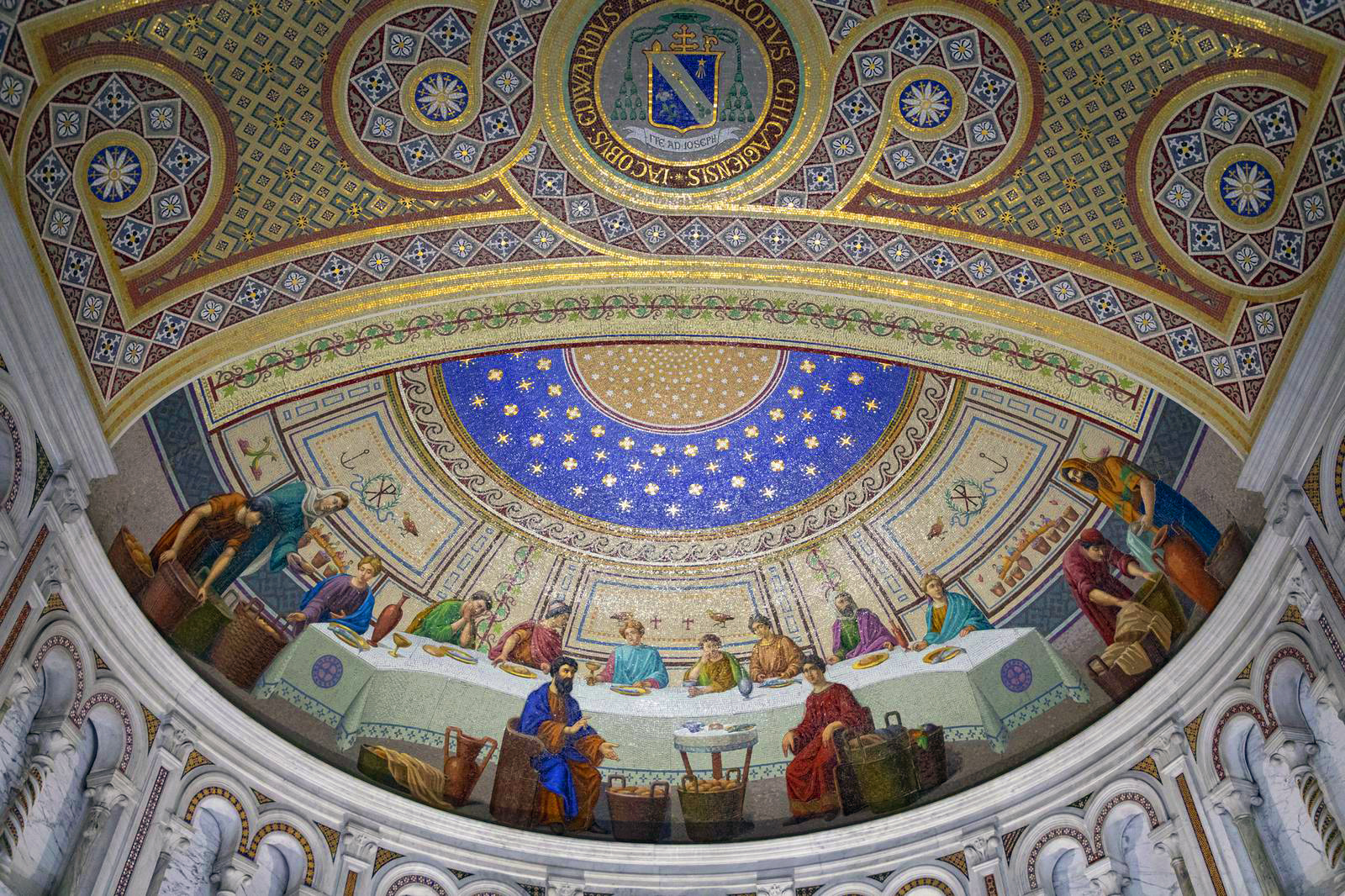
The mausoleum is designed as a Romanesque building outside with a domed Romanesque Classical chapel inside, complete with an altar, religious murals, clerestory windows providing light, and crypts flanking the altar on either side. 
The Altar.


Domed Romanesque Classical Tiled Ceiling.


In architecture, an apse is a semicircular recess covered with a hemispherical vault or semi-dome.


The Papal and U.S. flags also flank the altar. However, Brinkmann did not design the lavish interior, although he was more than capable, as evidenced by his interior for Our Lady of Sorrows Basilica. Instead, Archbishop Quigley engaged one of the foremost religious architects of the day, Aristide Leonori, noted for his 1899 design of the Mount St. Sepulchre Franciscan Monastery in Washington, D.C., as well as the interiors of early 20th-century Mediterranean churches. 


For the mausoleum chapel interior, Leonori relied heavily on using marble and mosaics to give the chapel a Roman look while still referencing Celtic, Nordic and Slavic saints in the design, thus reflecting the archdiocese's many ethnic groups and national churches.
A craftsman replacing missing mosaic tiles in the interior.

The most recent interment was the body of Cardinal Joseph Bernardin after he died in 1996 from liver and pancreatic cancer. Cardinal Bernardin had visited the chapel a few months before his death to select the site of his own crypt, choosing a spot to one side of the late Cardinal John Cody. Bernardin was said to have remarked, "I've always been a little left of Cody."

Notable people in organized crime buried at Mount Carmel Cemetery:
  • Al Capone
  • Frank Capone
  • Ralph Capone
  • Vincent Drucci
  • Sam Giancana
  • Genna Brothers (6) – Sam, Vincenzo, Pete, "Bloody" Angelo, Antonio, and Mike "The Devil"
  • Jake Lingle – murdered journalist and mob associate
  • Antonio Lombardo – Chicago mobster and consigliere to Al Capone
  • "Machine Gun" Jack McGurn (aka Vincent DeMora)
  • Charles Nicoletti
  • Frank Nitti
  • Dean O'Banion
  • Frank Rio
  • Roger Touhy – NW suburban Chicago mobster and beer baron, a rival of Al Capone and wrongly convicted through Capone's influence
  • Earl "Hymie" Weiss – mob boss of the North Side Gang and a bitter rival of Al Capone.
Compiled by Dr. Neil Gale, Ph.D.

The House of the Good Shepherd was Founded in 1859 in the Town of Lake View, Illinois.


The Sisters of the Good Shepherd's original building was located on the West side on Price Place. In 1907 they moved to 1126 West Grace Street (at Racine Avenue) in the Town of Lake View, Illinois, The Town of Lake View was officially annexed to Chicago on July 15, 1889.

sidebar
Addresses for shelters are hard to find today, as they are deemed dangerous for women and children sought by their spouses or stalkers. 

Today, Lakeview (not Lake View) is one of Chicago's 77 communities with four neighborhoods; (1) Lake View East, (2) North Halsted, (3) West Lakeview, and (4) Wrigleyville.


The House of the Good Shepherd opened a Technical School for Girls of Color with 25 students in 1911, which was later closed in 1953. 

The Grace Street facility was deemed unsafe and a fire hazard in 1970. The rebuilt facility was opened in 1975, and they opened a domestic violence shelter in 1980 with a Children's Center the same year.

Compiled by Dr. Neil Gale, Ph.D.

Sunday, April 2, 2023

The History of Sparta, Illinois, incorporated in 1837 as “Columbus.”

The Southern Illinois City, originally known as “Columbus,” when incorporated in 1837, adopted Sparta in 1839. When the first settlers came to the area in about 1812, they found almost three-quarters of the land was covered with timber, and the remainder was a rich prairie. Early settlers came to Southern Illinois through South Carolina, and these immigrants were of Scottish and Irish heritage. By 1859, the city had grown immensely, boasting three churches, 10 dry goods stores, three schools and several industries. At this time, the town was officially incorporated by a special act of the state legislature, and it was then incorporated under the State of Illinois General Law in 1873.


Sparta had connections to the Underground Railroad during the Civil War. The Burlingame House still stands in the small rural community of Eden just outside of Sparta. It is a towering two-story brick home in dire need of repair and restoration. Slaves fleeing for freedom were hidden there and later transported to the next stop on the “Underground Railroad.” This was accomplished by the delivery of farm equipment by Mr. Burlingame. A bit further north, another home owned by Mr. William Hayes offered the same protection to slaves seeking freedom. However, in 1844, Mr. Hayes was tried and found guilty of transporting four slaves northward. Today, the Hayes home is still occupied by members of the Hayes family.
In 1930, two young Sparta men broke the world aircraft endurance record of 427 hours. The Hunter Brothers, John and Kenneth (Kenneth only 16 years old), flew the plane “The City of Chicago,” and their brothers Albert and Walter flew a support plane called “Big Ben.” Fuel, home-cooked meals, and laundry was lowered into the “Chicago.” After the historic flight, the brothers could procure distribution of the Midwest airmail route, which they hoped would be the basis for a future airline. Three of the brothers lost their lives in tragic accidents. John lost his life at 29 while “cat-walking” over Rosedale, Missouri, and fell into the whirling airplane prop. Albert died when he fell off the roof of a barn. Kenneth was killed in a weather-related flying accident in 1975. Walter Hunter left the airmail company and became a pilot for American Airlines. Today, the Sparta airport, or Hunter Field, is the base for emergency medical helicopters, air cargo and crop dusting services.

Hollywood came to Sparta in the mid-1960s. The producers of the film “In The Heat Of The Night” found Sparta to represent the small Mississippi town portrayed in the movie. Rod Steiger and Sydney Poitier were the main stars of the crime mystery. Several old businesses and homes were used during the filming. Later, a TV series was formatted after the movie.

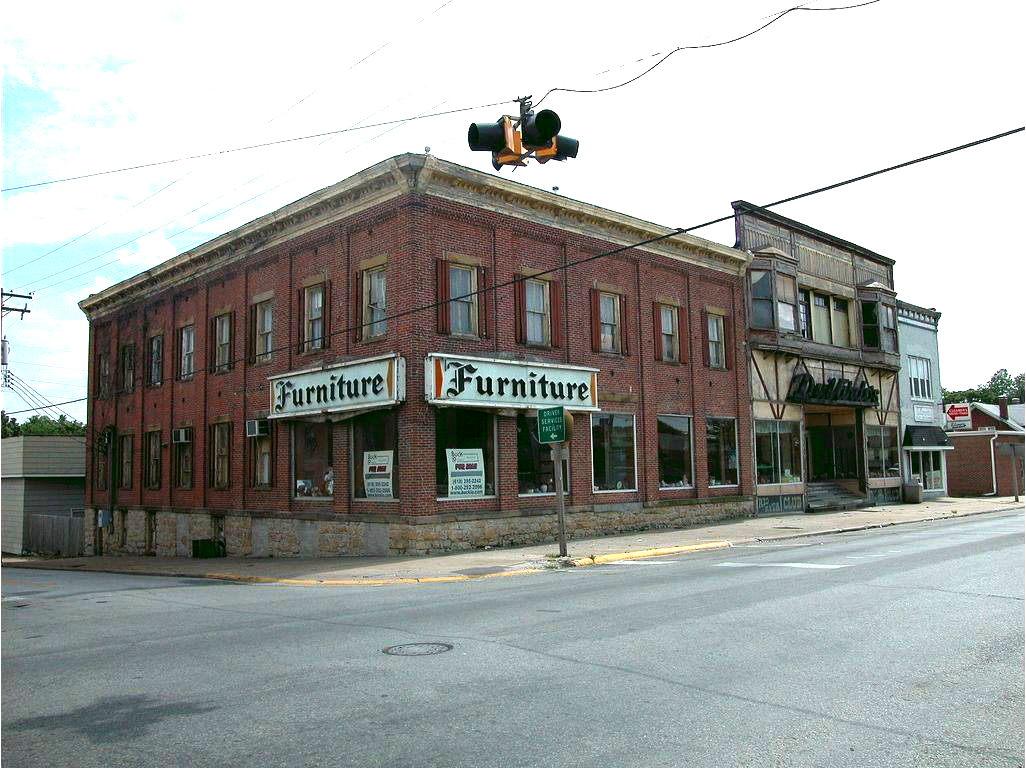
Today, you can drive down South St. Louis Street and West Third and see several of the city’s oldest homes. The historic area is known as Bricktown. 


The Old G. M. & O. Depot is also located on Second Street, now the home of the Misselhorn Art Gallery. The depot features the work of the late Roscoe Misselhorn, gifts, books and prints for railroad buffs, and “In The Heat Of The Night” fans.


Compiled by Dr. Neil Gale, Ph.D.

Jack Robbins Clothes Neon, Incandescent, Store Sign with a Spinning Element, Chicago, Illinois. (1942-2006)


Jack Robbins Clothes opened in 1942 at 5613 West Belmont Avenue, Chicago, Illinois. He was the president of the Belmont-Central Chamber of Commerce from 1960 to 1963. Jack Robbins died on September 13, 1997, in North Palm Beach, Florida, at 90. Lawrence Robbins, Jack's son, ran the business until he closed it in 2006. 


The Robbins sign combined neon and flashing bulbs. The clock (on one side) and the letter "R" on the other side rotated at a speed so traffic both ways could see the time. The sign and building were destroyed by fire in 2009. 

The sign was a "landmark" in the neighborhood. Shoppers that parked on Belmont used the Robbins sign as the marker to find their car.


Compiled by Dr. Neil Gale, Ph.D.

Friday, March 31, 2023

National Watch Company, Elgin National Watch Company, Elgin, Illinois. (1864-1968)

The company was first incorporated in August 1864 as the National Watch Company in Chicago, Illinois. The founders of this company were Philo Carpenter, Chicago's first pharmacist and drug store owner, Howard Z. Culver, then-Chicago mayor Benjamin W. Raymond, George M. Wheeler, Thomas S. Dickerson, Edward H. Williams and W. Robbins. 

In September of the same year, the founders visited the Waltham Watch Company in Waltham, Massachusetts. They convinced seven of Waltham's makers to work for their new company.

The growing young city of Elgin, Illinois, some 30 miles northwest of Chicago, was chosen as the factory site. Initially, the city was asked to donate 35 acres of land to construct the factory as part of the deal. A derelict farm was selected for this. However, the owners refused to sell the property unless the city purchased their 71 acres for $3,550 ($66,000 in 2023). Four Elgin businessmen agreed to buy the property and donated the required 35 acres to the new watch company. A temporary factory constructed the machines needed to make watch parts. 

The company was reorganized in April 1865.


The factory was completed in 1866. It was steam-powered and built close to the river for the water source. The enormous boilers generated enough steam to run the engines required for powering the factory, resulting in a tall and massive chimney.

The first movement, completed in April 1867, was named the B.W. Raymond in honor of Benjamin W. Raymond, the company's president. The watch was an 18-size, 15-jewel, key wind and set, full plate design (later assigned grade 69). 

In 1867 some of the B.W. Raymond grade 15-jewels movements were built with Pennsylvania Rail Road on the dial for service on the Pennsylvania Rail Road.


sidebar
In 1869, the National Watch Company won "Best Watches, Illinois Manufacture" at the 17th Annual Illinois State Fair, for which it won a silver medal. 


By 1870 the plant was turning out 25,000 watches each year and employed nearly 300 men and 200 women. During the early part of the 1870s, the factory was enlarged. By late 1873 the product line included at least 14 different grades, and production was estimated at 100,000 movements per year.

The National Watch Company, like the American Waltham Watch Company, relied on jewelry wholesalers to distribute the movements it produced. Elgin did not make watch cases. Retail customers would pick out a watch movement and a watch case, and a jeweler would fit them together. Elgin employed representatives to help sell the product to wholesalers and ran advertisements in magazines and newspapers to purchase their movements through local jewelry stores.

They produced the Elgin Almanac from 1871 to 1876 to help advertise watches.
Elgin National BW Raymond, Model 8, Grade 240, mfg 1909.


The company officially changed its name to the Elgin National Watch Company in May 1874 because "Elgin" became a synonym for their watches. 

During the mid-1870, the company developed a lower-priced line of watches. Elgin became best known for producing the "working man's" mid-grade watches. They produced several high-grade watches.


Special pocket watches were offered for railroad use. Models included the 23 Jewel "Veritas," the "BW Raymond," and the famous "Father Time" clock, facing the river on the Jewelers Building at 35 East Wacker Drive, Chicago.
Weighing an estimated six tons, the clock was donated to the building by one of its first major tenants, the Elgin National Watch Company. The lantern points towards the Chicago river. It still runs.


Elgin National Watch Company shipped its first wristwatch in 1910.
Antique 1912 Elgin Victorian
Limited Edition Men's 10k GF
Art Deco Style
In 1960 Elgin introduced the first American-made wristwatch to be qualified for railroad service, the grade 730A, also named B.W. Raymond.

During World War II, all civilian manufacturing was halted. The company moved into the defense industry, manufacturing military watches, chronometers, fuses for artillery shells, aircraft instruments and sapphire bearings used for aiming cannons.
Starting from Scratch, piece by piece by hand, they complete a pocket watch.


Over time additional plants were operated in Elgin, Aurora, Illinois and Lincoln, Nebraska. The original factory in Elgin closed in 1964 after having produced half of the total number of pocket watches manufactured in the United States (dollar-type not included). 

In 1964 the company relocated most manufacturing operations to a brand new plant in Blaney, South Carolina, which renamed itself Elgin, South Carolina. 

The factories shut down in 1968. The copyright to the name "Elgin" was also sold in 1968.

Compiled by Dr. Neil Gale, Ph.D.