Saturday, September 17, 2022

Lost Towns of Illinois - Totten Prairie, Illinois.

When the Indians were sporting over the prairies of Illinois and wolves were prowling through the forests, William Totten placed his family and effects in a one-horse cart in Ohio and found his way to Kentucky, then to Indiana, and finally to Fulton County, Illinois, where he settled in 1823. Mr. Totten was remarkable for retaining peace with the Indians. When on the warpath, they would visit him, trade and sport with him and leave peaceably. 

Totten Prairie (aka Totten's Prairie) was a small settlement in Cass Township, Fulton County, Illinois, just to the southeast of the present Smithfield, Illinois. It was named after William Totten, who was the first to settle here in 1823. He settled upon the southwest quarter of section 27.


By an act of the State of Illinois legislature approved on January 28, 1823, Fulton county was given authority to organize. A commission consisting of Hugh R. Colter, John Totten and Stephen Chase was appointed to locate the county seat. In the same year, William Totten was appointed as a Constable.

The Sheriff was ordered to summon persons to compose the first grand jury "for the next term of the Circuit Court," which was to have been held at the courthouse on the second Monday of October 1823. From the Circuit Court records, it is evident that no Court was held until the following spring, when another jury was summoned, which was composed of almost the same men. Totten was on that list as a Grand Jurist.

Totten and others built a fortified blockhouse on Totten's prairie during the Winnebago troubles in 1827 [1]. 

Black Hawk (Ma-Ka-Tai-Me-She-Kia-Kiak) was very friendly to the Totten's and would not allow his braves to disturb them, even during the Black Hawk War of 1832. He often visited the Totten's, and they shot at targets as a pastime. 

A small cemetery, called Totten Cemetery or Old Totten's Prairie Cemetery, still exists in Smithfield, Illinois.


Compiled by Dr. Neil Gale, Ph.D.


[1] The Winnebago War was a brief conflict that took place in 1827 in the Upper Mississippi River region of the United States, primarily in what is now the state of Wisconsin and the northern portion of Illinois. Not quite a war, the hostilities were limited to a few attacks on American civilians by a portion of the Winnebago (or Ho-Chunk) Indian tribe. The Ho-Chunks were reacting to a wave of lead miners trespassing on their lands and to false rumors that the United States Government had sent two Ho-Chunk prisoners to a rival tribe for execution.

Lost Towns of Illinois - Tedens, Illinois.

Tedens is a ghost town in Lemont, Downers Grove Township, DuPage County, Illinois.


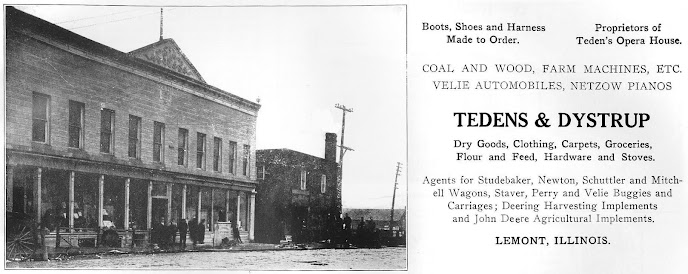
John Henry Tedens (1833-1899) operated a department store at 106 Stephen Street in Lemont beginning in 1862. In the late-1890s, the business changed to Tedens Hardware Store. Tedens Opera House opened on the second floor in 1896.
Newspaper advertisement for the John Tedens and Alderman Dystrip's Department Store. Look at the store's offerings.

Compiled by Dr. Neil Gale, Ph.D.

Friday, September 16, 2022

Lost Towns of Illinois - Tacaogane, Illinois.

Tacaogane was a former settlement in Massac County, Illinois.


It was shown on the 1684 map of Louisiana by Jean-Baptiste-Louis Franquelin, who placed the settlement near the confluence of the Ohio and Tennessee Rivers, though the exact location of the settlement is undocumented.

"Tacaogane" may be a corruption of an Algonqian or Iroquoian word referring to speakers of another language, though it isn't clear which group this may refer to. Despite its apparent proximity to Kincaid Mounds, it is unlikely that Tacaogane refers to a surviving Mississippian settlement from the late 17th century.

Compiled by Dr. Neil Gale, Ph.D.

Lost Towns of Illinois - Sylvan, Illinois.

Sylvan was a former settlement in Cass County, Illinois, located two and one-half miles west-southwest of Newmansville. 


A few old farmhouses still stand. The town was populated during the mid-19th century mostly by Irish immigrants. There is one cemetery there.

Compiled by Dr. Neil Gale, Ph.D.

Lost Towns of Illinois - Schoper, Illinois.

Located about eight miles from Carlinville, the town of Schoper (aka Standard City) was originally Thomas Schoper’s 500-acre family farm. 

After a coal shortage in 1917, Standard Oil Company wanted a reliable coal supply. In 1918, Standard Oil of Indiana bought the farm (literally) from Mr. Schoper.

After completing several geological surveys (commissioned by Standard Oil), it was discovered that there was a seven-foot tall seam of coal in the ground at Schoper. The property was conveniently situated near the Chicago and Alton railroad, which was centrally located between the refineries in Wood River (near St. Louis) and Whiting, Indiana (near Chicago). 

In 1918, Standard Oil placed a $1 million order (for 192 houses) with Sears Roebuck and Company for 192 Sears Honor-Bilt homes. The houses were purchased for employees in Carlinville, Wood River and Schoper, Illinois. One hundred and fifty-six of the houses were built in Carlinville (152 of the original 156 homes still stand in a nine-block neighborhood), 12 were built in Schoper and 24 went to Wood River.

Twelve Sears Modern houses were built at Schoper for mine supervisors. There were also boarding houses and dorms built at Schoper for the miners. Standard Oil purchased the farm from Mr. Schoper and sank two mines there, Berry and Schoper. The town of Schoper, aka Standard City, sprang up around the mines.

At its peak, Schoper was the largest coal mine in Illinois, employing 650 men and hoisting up to 4,000 tons of coal daily. About 450 men also worked at the Berry Mine, producing about 2,000 tons of coal per day. The times were good. In the early 1920s, Schoper miners worked about 298 days per year, while nationwide, most coal miners worked about 200 days yearly. 
Schoper circa 1919. At the foot of the sidewalk is a 12-bay garage shared by the occupants of the 12 Sears Houses. The Power House is shown in the background near Schoper Lake. The Whitehall, Gladstone and Warrenton models are shown in the foreground. Click here for Sears model plans and costs.


By the mid-1920s, the boom at Schoper had gone bust. The price of coal dropped after The Great War (1918), and Standard Oil could now buy their coal cheaper from mines in Kentucky (which did not have unions) than they could mine it in Macoupin County.

In July 1925, a small column on the bottom page of the Macoupin County Enquirer sadly announced that the mine was permanently closed.

Nine of the 12 little Sears Houses were painstakingly disassembled and left Schoper the same way they came in: on boxcars, headed off to unknown destinations.

Two of the Sears Homes were moved intact to sites just outside of Standard City. The last Sears House at Schoper (The Sears Gladstone) was home to John McMillan and his wife, a supervisor with the mine. After the mine closed, he became a caretaker charged with myriad tasks, such as making sure the powerful fans down in the mine kept the methane down to acceptable levels. McMillan’s little Gladstone eventually became rental property and burned down sometime in the mid-1990s. 

The last remnant at the site was the Schoper Powerhouse and Mine Offices, a massive concrete Federalist structure which was torn down in Summer 2003.

Today, Schoper is a ghost town.

Compiled by Dr. Neil Gale, Ph.D.