Thursday, September 1, 2022

Lost Towns of Illinois - Melugin Grove, Illinois.

The first settlements of this county were made in or on the fringe of groves. The first business of the commissioners was to lay out Lee County into election precincts:

Precinct № One was known as Gap Grove precinct, and it comprised the territory 
known today as the township of Palmyra.
Precinct № Two was called Dixon.
Precinct № Three was called Franklin.
Precinct № Four was called Melugin.
Precinct № Five was called Inlet.
Precinct № Six was called Winnebago, and it took in the territory now comprising Marion, East Grove, Hamilton and Harmon.

Melugin Grove Cemetery.


We found some settlements named Melugin's Grove, Guthrie's Grove, Franklin Grove, Inlet Grove, Twin Grove, Paw Paw Grove, Palestine Grove, Gap Grove, etc. For that same reason, the sections of Lee County dotted with groves were settled before the beautiful prairie country, which generally offered much better soil. Of course, the wealth of timber for fuel was the settler's first consideration, so the groves were selected.

The Black Hawk War brought thousands of men from all over the state to Lee County, then Jo Daviess County, and made strong friendships for the locality and John Dixon. Among the number were two men who had much to do with Melugia's Grove, Zachariah Melugin and his brother-in-law, John K. Robison.

Through the influence of Mr. Dixon, Zachariah Melugin settled at the grove, subsequently given his name and at that point became the second village in Lee County to be settled.

In 1832 Mr. Melugin lived near Springfield. When the Black Hawk war broke out in 1832, he was on Rock Island and enlisted on the arrival of the troops at the mouth of Rock River. The country around Dixon's Ferry pleased him so well that after settling his affairs back at Springfield, he returned to Dixon's Ferry in 1833.

https://drloihjournal.blogspot.com/2018/09/history-of-fort-dixon-located-along-the-banks-of-the-rock-river-in-the-settlement-of-dixons-ferry-illinois.html

Believing the new stage road between Galena and Chicago would open many possibilities, Mr. Melugin, at the suggestion of Mr. Dixon, selected the grove, twenty miles distant, for a stage station, and when on Jan. 1, 1834, the first stage traveled the route, Mr. Melugin took passage and stopped off at the grove and built his log cabin on what afterward became the northeast quarter of section 4. The Indians were numerous but friendly, and without molestation, he kept house all alone the first winter. The long evenings were generally spent visiting with the Indians who called.

In the spring, his sister, Mary, came from Sangamon County and lived with him until Oct. 12, 1834, when, at Ottawa, he was married to Mary Ross of Ross's Grove in DeKalb County.

During that summer of 1834, Miss Melugin was alone many days amid Indians who dubbed her a ''brave squaw.'' The spring from which water was procured for the stage house was eighty rods (1 Rod = 5.5 Yards) or 1/4 mile away in the timber, but never was she annoyed by Indians. That spring played an important part in another particular. There were no churns, so to be busy when going to the spring, the empty pail was balanced on her head while with both hands, the cream was shaken in a coffee pot until the butter ''came."

During this summer, Miss Melugin paid a visit to Mrs. Dixon at Dixon's Ferry. There she met John K. Robison. He had served in the Black Hawk War from Hancock County, although he enlisted at the mouth of Rock River, and at the close of the war, he remained with the Dixon family as a teacher for the children. On Sept. 10, 1835, Miss Melugin and Mr. Robison were married at the home of Zachariah Melugin by the Reverend Harris, a Methodist circuit rider. That was the first wedding ceremony performed at Melugin's Grove.

Mr. Robison built his house half a mile from Melugin's of unhewed logs, chinked with pieces of wood and plastered over with a mortar made of clay. The shakes used for a roof were made of split trees^, the same as the floor. The shelves for pans and dishes in this house were made by boring holes in the logs, driving in long pins and laying a board across the pins.

In this house, the ménage (members of a household) was exactly as in every other pioneer cabin. The fireplace warmed the room and served for a cooking stove; bread was baked in iron kettles with iron covers, the kettle was placed on one side of the fireplace and covered with coals and hot ashes; potatoes were roasted also in those same ashes. Gourds played a very prominent part in the array of cooking utensils. They were used for baskets, basins, cups, dippers, soap dishes, etc. Hollow trees, sawed, were used for well curbs, beehives and storage receptacles for housing grain. Troughs hollowed from trees were used to contain sugar sap, and during a rain storm, they were used to catch water under the eaves and to store it, and they were used for milk pans. Sometimes the troughs were used as cradles to rock the babies to sleep. The husband made butter bowls, ladles, rolling pins, brooms, etc., from wood with the rudest implements. So, too, the husband mended his own harness and cobbled the household shoes. In the absence of clocks and watches, certain marks on the doors or side of the house indicated the time of day, and the position of the Big Dipper indicated the same by night. The well or the water trough reflected the features for hair-dressing and shaving, and with but one change of clothing for each, the same was washed and ironed while the child slept. And such indeed was the house and the manner of housekeeping with that same John K. and Mrs. Robison.

Brooms in those days were made from young hickory trees about three inches through, peeling off the bark, then with a pocket knife, the men-folks commenced on the end of the stick intended for the brush part and peeled the stick in narrow strips or splints about a sixteenth of an inch thick and about eighteen inches long. The heart of the stick would not peel, which was cut off, leaving a stick about three inches long in the center of these splints. The splints being dropped back over this stick commenced on the handle end and stripped splints toward those already made and long enough to cover them. When the stick was stripped, the splints were all tied together around the stick left in the center of the splints, and the rest of the handle was stripped to complete the broom.

Flint and steel were used to kindle fire, but ''borrowing fire'' when learned, was much more common and much easier when there were neighbors from whom to borrow.

The nearest grain and livestock market for Melugin was Chicago; going and coming back seldom took less than seven days. In a muddy season, the time consumed was more. The nearest gristmill then was Green's mill near Ottawa. A woolen mill there scutched and carded wool into rolls fit for spinning back at home by the women.

John K. Robison brought the first currant bushes to the grove from Nauvoo; he carried them on horseback. The day's fashion was for husband and wife to ride the same horse when they went a distance together, the man sitting ahead and the wife behind.

Mr. Robison was not only the first teacher in Lee County, both at Dixon and Melugin, but he was the first justice of the peace at Melugin. He taught school in his own house until the first schoolhouse was built in 1837; at that time, he had eight pupils.

The first church, Methodist, was organized in 1837 at the house of Zachariah Melugin and Rev. S. R. Beggs became the first pastor, a circuit rider. Until about 1850, church services were held in the schoolhouse, then a church was built. Later, in 1860, another building was erected, which was moved to Compton and was considerably larger.

The first tailor to locate at Melugin was Henry Vroman. The first postmaster was Abram V. Christeance, the first constable. Charles Morgan and his son were the first merchants and kept millinery. Doctor Bissell was the first physician. Cornelius Christeance was the first white child born, John Melugin and W.W. Gilmore followed, all born in the year 1835.

A post office opened on May 18, 1841; it was named Melugin Grove after the village's first settler, Zachariah Melugin. 

Church services were held at private houses when the circuit rider appeared until church buildings or schoolhouses were built In the Grove. The first church to be organized was the Methodist Episcopal Church in 1837, at the house of Melugin. The first Sunday school was organized in 1847 or 1848 by Reverend Haney of the Methodist Episcopal Church.

Zachariah Melugin being from Sangamon County and in the Black Hawk War became intimately acquainted with Abraham Lincoln. When Mr. Melugin returned there, Lincoln visited him at his father's home.

So near as I can learn, A. V. Christeance was the next settler here at Melugin. He took a claim in 1835, the month of June, on the south side of the stage road and used his house as a tavern. He and Mrs. Christeance traveled with an ox team from Schenectady County. New York. By the time they reached Melugin, Mrs. Christeance was so tired she declared she would go no further. That spot happened to be the Grove. Their son, Cornelius, born in 1835, was the first white child born there.

Indians were numerous, and they often covered the tavern floor, sleeping. The prophet, Joe Smith, who seems to have been a familiar figure in Lee County history, stopped there on one occasion.

Although Mr. Christeance would be gone a week or ten days at a time, to market, in Chicago, Mrs. Christeance never was molested by Indians nor by members of the ''Banditti of the Prairie,'' who, then unknown, stopped many times at their tavern.

John Gilmore came along at about the same time as Mr. Guthrie in 1834. These gentlemen selected their claims and returned Mr. Gilmore to his family and Mr. Guthrie to settle business affairs. Mr. Gilmore paid Melugin $50 for part of his claim, the northeast quarter of section 3, while Guthrie took up a claim further east, known as Guthrie's Grove and later as Little Melugin Grove.

The trip of the Gilmore family was almost identical to that of the Christeance family. Only the Gilmores came west in a wagon drawn by horses. About three miles east from Melugin's house, the horses gave out; they could travel no further. It was June 4, 1835. Mrs. Gilmore and her five children had been riding; Mr. Gilmore and Mr. Guthrie had been walking beside the team. The rain had been falling steadily all day. After a consultation, it was decided that Mr. and Mrs. Gilmore and the children should push forward to Melugin's house, three miles west. Mr. Guthrie remained with the team. Late that night, the Melugin house was reached by the tired and bedraggled (dirty and disheveled) Gilmores. The following day help was sent back to Guthrie, and he and the team were conveyed easily to the Melugin home. Mr. Guthrie, too had been a Black Hawk soldier.

Very soon, Mr. Gilmore had built a log cabin twelve feet square, with a puncheon floor, shakes for a roof, held in place by weight poles. A stick-and-mud fireplace and a door were added, and the Gilmores were permanent. In this house, W.W. Gilmore was born on November 8, 1835.

The only work to be had at that time was twenty miles away at Ross Grove in DeKalb County, and the payment for it was made in provisions. To this point, Mr. Gilmore and William Guthrie walked back and forth eastward to work the first of the week.

During one of these absences that winter, near Christmas, the mud and stick chimney took fire and, if permitted to run, would consume the house very soon. In her stocking feet, Mrs. Gilmore rushed to and from the now frozen spring, twenty rods away, carrying water; but she made no headway. The nine-year-old son, A. P. Gilmore, was sent a mile distant through the woods, at midnight, to the house of Mr. Christeance for help. The fire was put out, but the damage to the building had been considerable. That perilous night was stormy and bitter cold, but the pioneer woman of Lee County feared nothing.

Later, Mr. Gilmore added to his house and opened a tavern and stage house. All who did so prospered, and Mr. Gilmore was no exception to the rule. The Galena-Chicago highway became a thoroughfare as important for those days as the great Northwestern is today for our community.

In the fall of 1836, William Guthrie married Miss Ross of Ross Grove, where he had worked most of the winter before. Mr. Gilmore made a great event of it for his old friend Guthrie. Mr. Gilmore hooked up his best yoke of oxen, took his wife and the younger children, Mr. Guthrie and two lady friends and by constant urging, the oxen made the trip that day. The Rosses were great people in those days, and Mr. Guthrie made a great catch, so that wedding day was one of the greatest days the township of Paw Paw in DeKalb County ever saw.

Troy Grove was a place of consequence those days, and it was sometimes the custom to go there for provisions. On one of those trips, Mr. Gilmore met a Methodist preacher named Lummery. The latter was invited to come to Melugin Grove and hold a meeting. Accordingly, in six weeks, the succeeding round of the circuit, the preacher came and held services in the Gilmore cabin, which every soul at Melugin attended and still there was room to spare. A church and a class were organized, and ever since that early date, the church and the class have continued without interruption.

Among those early settlers was O. P. Johnson, who settled at the grove's west end and opened a tavern. He married Elizabeth Ross, one of the historic Ross family of DeKalb County.

Ezra Berry was another of the 1835 pioneers to settle at the grove. He married Miss Eleanor Melugin, the sister of Zachariah.

Some have said the first schoolhouse was built on the farm of Mr. Christeance in 1838. An investigation has proved conclusively the year was 1837 and that Zachariah Melugin was the first teacher succeeding Mr. Robison. Mr. Melugin was a man of superior intellect and ability. So early as the year 1836 or 1837, he composed a poem published in the Rock River Register, the first paper published on Rock River. He died in 1842, and his widow married William Atkinson.

The first funeral in Brooklyn Township was that of a Mr. Little, a Scotchman, whose body was the first to be buried in the cemetery.

Melugin's Grove became a place of importance for a little community. 

A Masonic lodge was organized at the house of O.P. Johnson in 1858, of which John C. Corbus was the first master; John Gilmore was the first senior warden; S. H. Finley, first junior warden; Jonathan N. Hyde, senior deacon; Oliver P. Johnson, junior deacon; J. R. Bisbee, secretary; William Guthrie, treasurer; and Robert Ritchie.

In those halcyon days (a period of time in the past that was idyllically happy and peaceful) Judge R.S. Farrand taught school at Melugin, and it was from Melugin that he came to Dixon to act as deputy sheriff under Jonathan N. Hills, elected from Melugin. Jonathan N. Hyde was elected clerk of the circuit court from Melugin, and Melugin, under Doctor Corbus and others of the old guard, became master of the political game and reigned over county politics more or less.

Until 1873 Melugin's Grove prospered. Then the Kinyon railroad went through Brooklyn Township, about a mile to the south, and Joel Compton platted the town of Compton, a mile away, and all the glamour and tradition of the old grove and the stage route and stage coach days disappeared. 

Compton was founded in 1875 and named after Joel Compton.

One by one, the folks at Melugin's Grove moved their houses to Compton. This kind of move happened all over the midwest when the railroads came through.

Love for the old place was strong, and the ties were hard to break, but the last had to give way. To this day, the population of prosperous Compton are descendants of the old Melugin's Grove stock and so closely intermarried that nearly every family is related to every other family. The sturdy old times established fortunes that the younger ones of today enjoy.

Compton today is a bright, wide-awake, beautifully built and more beautifully kept little village of about three hundred and fifty people. It seems as though every resident of the place owns an automobile. It contains a garage, 80 feet long and 40 feet wide, operated by Sam Argraves, a son of one of the old settlers. There is scarcely an hour of the day this garage is not filled. There is not a town lot, but it has its cement sidewalk. The Illinois Northern Utilities gives it day and night electric light and power service.

Beautiful homes predominate. It supports one of the best hotels in the state under the management of Mr. Card. The Compton Mercantile Company store, owned by Joseph Kaufman, Edward A. Bennett and John L. Clapp, is one of the commodious stores of the county. It carries a big stock and transacts an enormous annual business.

John Archer, just across the way, enjoys a splendid business.

W. H. Dishong is the hardware man. H. A. Bernardin has as fine a furniture store as you will find outside of a big city.

The First National Bank enjoys a splendid business.

But the important enterprise of Compton is the Chandler Hospital. This institution, built by a young physician named Dr. A. W. Chandler, has sprung into national fame, and Doctor Chandler has become one of the most noted surgeons in the country. Patients from the Atlantic to the Pacific have come to the Chandler Hospital for treatment. In a little town, with but one railroad. Doctor Chandler, by sheer ability, has made himself and his hospital famous. In his work, Mrs. Chandler has been a tremendous help. She is one of the most superior women one can find. When in Ms earlier years it became necessary to have the services of one skillful and helpful enough to administer anesthetics, Mrs. Chandler stepped into the breach and supplied the Doctor's greatest need. As a surgeon's support and counselor, Mrs. Chandler has no superior. More delightful, intellectual, attractive and companionable people than Doctor and Mrs. Chandler are not to be found.

Recently they purchased in Dixon one of the most beautiful homes in Lee County, situated on the bank of Rock River. Here during the summer months, they delight in entertaining their friends.

Chandler Hospital is one of the big institutions of Lee County, and for the successful amelioration of human suffering, it outranks any institution in the land. The institution has a reputation extending far and wide. Nothing in Lee County has so extensive a reputation, and it is doubtful if any other spot in northern Illinois is as well known.

Compton and West Brooklyn are splendid grain markets; at least 750,000 bushels are marketed annually.

When in 1873, the Kinyon road was built through Brooklyn Township, the people voted to bond the town for $50,000 to help build it. The bonds were issued and sold, and because of the non-performance of promises made by promoters of the road, payment of the bonds was contested for years; but in the end, the courts ruled for the bonds and, with a compromise, they were paid.

Between West Brooklyn platted on section 8 and Compton platted on section 11, a fierce rivalry existed from the first and only until recent years has the old feud died down. Compton was platted by Joel Compton on his farm. West Brooklyn was platted by Demas L. Harris, O. P. Johnson and R. N. Woods. Believing that the factional warfare would ruin both places, Andrew J. Carnahan conceived the plan of building on his farm, the northeast quarter of section 9, midway between the rivals, another town and on June 19, 1873, he platted Carnahan and built thereon a grain elevator. But the other two places prospered and survived, and after serious financial losses, Mr. Carnahan abandoned his plat. The unused big elevator stands today, a monument to recall the fiercest town site fights that Lee County witnessed. The first church, Methodist, was organized in 1837 at the house of Zachariah Melugin and Rev. S. R. Beggs became the first pastor, a circuit rider. Until about the year 1850, church services were held in the schoolhouse. Then, a church was built. Later, in 1860, another church building was erected, moved to Compton, and considerably enlarged.

The United Brethren occupy the other church.

There was a Masonic lodge in Compton.

Mr. John W. Banks, the supervisor of Brooklyn, operates the only grain elevator in Compton. The place is a famous grain center, and Mr. Banks has marketed as high as 400,000 bushels of grain in a year.

The Chicago, Burlington & Quincy is the only road running through Compton. For a time, it was expected the Chicago, Milwaukee & St. Paul would extend its north and south branches through Compton, but for reasons best known to railroads, it ran a mile to the east and, established the Roxbury station and built an elevator. There are no stores in Roxbury, Wyoming Township, but a large amount of grain that found its way to Compton is now marketed at Roxbury.

Compton installed a complete water and sewer system. Its fire protection facilities are as nearly perfect as possible. The Yocum telephone system has its central office in Compton.

Clemons & Clemons do a brisk business in blacksmithing, wagon making and general repairing.

Mr. Harvey A. Cook tells me as high as forty thousand dollars has been received by the Chicago, Burlington & Quincy road at that station for freight in a year.

Compton and West Brooklyn are amidst one of the best farming sections. Lands run in value about two hundred dollars per acre. There is a voting precinct at each place. When Mr. Compton platted this village, he reserved a ground block for park purposes where he planted trees. In this, he erected a pagoda, and the Compton band gives summer concerts there.

The residences are kept up beautifully, and there are many of them. Doctor Carnahan, the venerable first physician of the place, still resides at Compton, retired. Back in the dawn of things at Melugin Grove, he practiced.

Many retired farmers live there; while others have gone to Dixon, others decline to break old home ties, and all of them are wealthy.

Compiled by Dr. Neil Gale, Ph.D.

Lost Towns of Illinois - Tuscumbia, Illinois.


Tuscumbia was a paper town (a community that appears on maps but did not legally exist)
in Bernadotte Township, Fulton County, Illinois. Tuscumbia was named for Tashka Ambi, a Cherokee Chief.

It was platted by Wade Hampton on March 2, 1837 consisting of 54 lots. It flourished for a while. There was a one-room schoolhouse and a post office, but was abandoned by 1855. 

Illinois experienced rapid settlement during the 1830s. The timeframe of Tuscumbia coincides with the career of Abraham Lincoln, who was elected to the Illinois Legislature in 1834, 1836, 1838, and 1840. In 1838, Lincoln visited Lewistown, nine miles east of the Tuscumbia area, extending the range of his law practice.

Compiled by Dr. Neil Gale, Ph.D.

Wednesday, August 31, 2022

Lost Towns of Illinois - Weston, Illinois.

Weston was predated by a 100-house subdivision named West Field, which was on the verge of growing in size due to the proposed development for 50,000 people. However, DuPage County sued developer William Riley to prevent the town from incorporating, basing their challenge upon a technicality, and further stated that as it had not properly incorporated that the town had no legal right to annex land for development. 

In April 1964, four months after the town's initial unveiling, the project collapsed, and the developer filed for bankruptcy, blaming the county's lawsuit. Had construction proceeded as planned, the town would have contained the largest mall in North America, with some 2,000 stores within it. The town also was to have an airport, more than 11,000 houses, athletics fields, a town center, and even large man-made lakes.

The subdivision was taken over by DuPage County, allowing the few existing residents to remain. The residents then worked again to incorporate as a town in an attempt to free themselves from DuPage County control, eventually seeking help from the Federal Government through the US Atomic Energy Commission. 
Aerial view of Weston, the site for the National Accelerator Laboratory. 1966


The National Academy of Sciences also made a visit to the site of the community. In 1966, after much controversy from within both the community and the surrounding county, the community was chosen as the site for the new Fermi National Accelerator Laboratory at Kirk and Pine Streets, Batavia. 

Shortly after, it was revealed that the town would be contained within the laboratory's boundaries, meaning that the community's residents had to sell their homes to the State of Illinois, and the community of Weston ceased to exist.

Today, some of the original houses are still standing, used by Fermilab for boarding international scientists, but are not accessible to the public.

Compiled by Dr. Neil Gale, Ph.D.

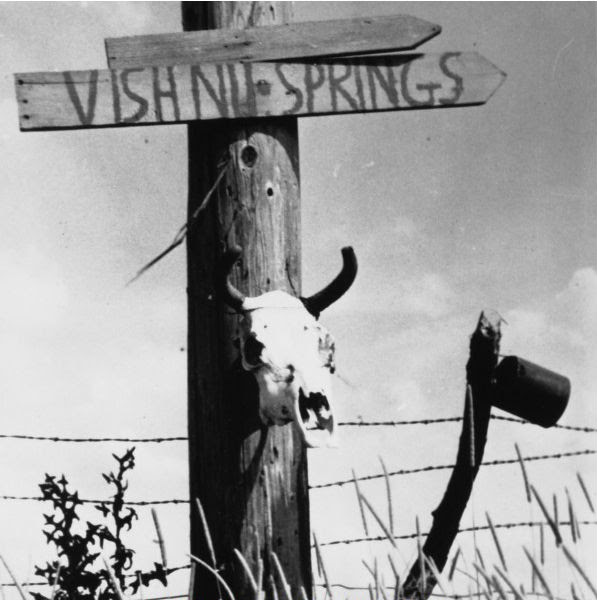
Lost Towns of Illinois - Vishnu Springs, Illinois.

The history of Vishnu Springs goes back to the 1840s when the Ebenezer Hicks family moved to McDonough County from Ohio. Settling in Hire Township, Ebenezer bought parcels of land, ultimately owning over 5,000 acres of ground in McDonough and Hancock counties.


One of these parcels was Section 7 of Tennessee Township (T5N R4W), and located on the property were natural springs. Ebenezer probably knew the springs were there but did not try to capitalize on them. Another man, Dr. J.W. Aiken, from the neighboring town of Tennessee, Illinois, did. However, to do so, Aiken rented the land surrounding the springs from Ebenezer and started promoting them for their medicinal qualities.

At the time, the springs were known as the Tennessee Springs, but shortly after Dr. Aiken rented the ground, the area was referred to as Vishnu Springs. One story for the change in the name is that Dr. Aiken wanted the name of the springs to reflect their healing qualities. Vishnu is the second God of the Hindu trinity, the one who is known as the Preserver of living things. Thus, the name Vishnu was taken.

Another story of the origin of the name is that Ebenezer's son, Darius Hicks, had read an 1861 book by Henri Mouhot. His book describes the discovery of the ancient preserved city of Angkor in Cambodia. The city's water was fed by the river Krishna, the incarnation of Vishnu in the Hindu religion. In either story, the association of Vishnu and healing or preservation and the springs in Tennessee Township came to be.
With the name Vishnu Medical Springs, Dr. Aiken hoped to sell the medicinal waters and draw the infirmed to the springs to be healed. He claimed that the springs' water would cure many ailments, from inflammation of the bladder and kidneys to stomach disorders to diseases "peculiar to women." The cost of a gallon of spring water was 25¢, and Dr. Aiken sold many gallons of water, but probably not at the rate he would have liked.

When Dr. Aiken's association with the Springs ended, we do not know for sure, but we do know that in the 1880s, Darius Hicks' father, Ebenezer, was committed to the insane hospital at Jacksonville, IL, where he died in 1886. When Ebenezer wrote out his will in 1881, he clearly stated how his estate was to be distributed. He left the land in Section 7 of Township 5 North, Range 4 West, the land where Vishnu Springs is located, to the older of his living sons, Darius Hicks.

Darius Hicks' first wife was Ella D. Smith, whom he married in 1874. Evidently, Darius Hicks and his wife may have been having marital problems before Ebenezer's death because in 1885, the father added a codicil to his will stating that everything he had bequeathed to Darius Hicks was to be held by his brother, Franklin, in trust for Darius Hicks if Darius Hicks and Ella were still married when Ebenezer died. He didn't want Darius Hicks to inherit the land and then have it tied up in a divorce settlement if the marriage did indeed fail. Being the shrewd businessman that he was, Ebenezer wanted to protect his investments. He did state, however, that if Darius Hicks' marriage lasted ten years after Ebenezer's death, the property would be returned to Darius Hicks. Needless to say, Darius Hicks and Ella did divorce, and Darius Hicks inherited his share of his father's estate.
The shady valley, surrounded by rocky bluffs that are filled with caves, was long a place that attracted the early pioneers of the region. They used the quiet spot as a place to picnic, and in 1884, one annual gathering was said to have drawn as many as 1500 people from the surrounding area. Not long after this, many residents of the nearby town of Colchester began to realize that the water in the valley differed from the drinking water that could be found elsewhere. All that is remembered today is that the spring water was said to have a peculiar salt content, seven medicinal properties and an especially appealing taste. People began coming from near and far to sample the water, hauling away jugs of it from the springs. Allegedly, doctors sent their patients here on crutches and walked away without them.

By the 1880s, as many as 1500 to 2000 people were gathering here to hold camp meetings and consume the valley's cold waters. In an age when effective medicines were rare, the strange-tasting water offered hope to a great many people. The owners of the land and the springs claimed that the water would “cure of benefit all kinds of debility, neuralgia, rheumatism, palpitation of the heart, dyspepsia, kidney trouble, worms” and even “female troubles, dislocated limbs, broken backs, deafness, blindness and laziness.” And people believed the claims. They began buying the water for 25 cents a gallon, and they carried it home with them.

The March 1889 Colchester Independent reported that a hotel was to be built at Vishnu "to accommodate those who wish to try the healing qualities of the mineral water at that place." The paper also reported that a 26 X 40 ft. hotel would have first-class conveniences and would be built for $2,500. The road from the springs to the main road to the north was already in place, and the stonework for the hotel would commence soon. W.E. Way was foreman of the Vishnu rock quarry, which was owned by Darius Hicks and John Mourning, a man to whom Darius Hicks had sold 1/2 interest in Vishnu. It was later reported that the stone in the quarry was of such a fine quality that men would like to use it when they built their new homes at Vishnu.

A June 1889 newspaper article announced that the stonework for the hotel was done, and the frame was being put up. Tom Walters and his wife would run the hotel once completed. The roof was then put on, and Enoch Way had contracted to do the plaster work at a rate of 10 cents/yard. Four hundred visitors had recently been out to the Springs.

In 1889, Darius Hicks met and married his second wife, Hattie Rush, a widower from Missouri and mother of three young children, Robert, Benjamin, and Maud. Hattie was not a very healthy woman and probably came to the springs for their curative powers. In August 1890, the Colchester Independent reported that: "Mrs. Hicks, wife of Darius Hicks, proprietor of Vishnu hotel, is lying very low, but hopes of her recovery are entertained by her many friends." Hattie died in 1896 from an illness of several months from a complication of diseases, one of which was reported to be Bright's disease, an older name for a form of kidney disease.

In August 1889, a Holiness Camp Meeting, held at Vishnu, drew 2000-3000 visitors. The event was led by Rev. Sherman & Rev. Thompson of Colchester and Taylor Murray of Hire township. They obviously came to share in the experiences of their religious beliefs, but probably many also came to see the new hotel, which was nearing completion. Others probably came to partake of the springs' medicinal qualities, the site's central focus.

That same month, at the request of Darius Hicks and John Mourning, Surveyor Cephus Holmes drew the plat of Vishnu Springs. The plat shows a town that consisted of three blocks, one main street and three alleys. Thirty lots were drawn into the plat with lot sizes averaging 50 X 120 feet. Each lot was to be sold for thirty dollars.

In October of 1889, Andy Ruddell is reported to have been the first settler at Vishnu, with the Colchester Independent reporting two houses built and two more soon to be erected. Ed Sammons was planning on opening a restaurant, and Dave Reece was reported as a homeowner. C. K. Way was surveying his addition to Vishnu.

The following February, the paper reported that Dr. Luce, the Indian doctor, was visiting the springs, probably intending to settle there. Deed records show that he did indeed buy some property in North Vishnu Springs, which was sometimes referred to as "Loose City."

Also, around this time, a man by the name of C. K. Way was considering the potential of the land adjacent to the platted town of Vishnu. He also had a section of land to the south of Darius Hicks' platted and named it Way's addition. Because of strife between Darius Hicks and Way, a reporter to the Independent suggested that a toll booth might be put up between the two properties, so visitors from "the south" would have to pay a toll to get to the springs. Way's addition never prospered.

In 1890, the Independent reported talk of a post office at the springs. However, due to a lack of interest, the post office was not established until June 15, 1895. It was located in the hotel itself. On March 31, 1908, the post office was discontinued, and the postal services were transferred to Colchester.

Trade was on the increase in 1890. Mr. Reece was filling up stock at the store, and there was talk of a barbershop. Prices for goods at Vishnu were competitive with Tennessee and Colchester.

The hotel officially opened in May of 1890. The Capitol Hotel was three stories and cost $2,500.


Just before the hotel's opening, John Mourning decided to sell his interest in Vishnu back to Darius Hicks. A barn was built on site, as well as a livery stable. A windmill was being built to pump water from the springs to a water system that would be used to provide running water to the hotel. A "Driving park" or race track was being made. "John Oakman has bought a new horse and cart. Wonder if he will train him when the driving park is finished." (Independent, May 8, 1890)

In July 1890, Frank Williams fell 16 feet headfirst to the solid rock below while remodeling the windmill. A rope that was being used to raise up part of the windmill broke, and Williams was hit, knocking him off. The initial report of the accident, which reached Colchester, indicated that his injuries were fatal. In actuality, Drs. Aiken and Horrel were called, and they found he had broken some ribs, was cut up and was badly bruised.

Ever since its earliest years, there have been reports of crowds going to the Springs. Many visitors came out for a weekend gathering or a picnic, and others came to partake of the spring waters. After the hotel was built, more people were coming to Vishnu, so to capitalize on getting the visitors from Colchester, the location of the nearest depot, brothers John and Milton Mourning started The Vishnu Transfer Line. For 75¢, one could ride to, and from the springs in a spring wagon, meal included. If a better ride was preferred in a carriage or canopy-topped three-seated two-horse buckboard, the cost was $1.00.

The hotel had come under the management of a first-class hotel keeper, Mr. Thornton Maddox. He had added several amenities to the grounds; croquet was set up in the yard, hammocks were added, and a fountain was planned. A dumb waiter was installed inside the hotel to transport food from one level to another.

Also, in July 1890, the Independent gave a weather report: "It's hot." A new organ was put in the hotel parlor. Visitors were plentiful, and among them were musicians. Miss Ollie Hankins of Tennessee, "an accomplished musician and a good singer," was in residence. Bert Oakman and Prof. H.D. Jackson of Bardolph were guests. And as the paper reported, "Prof. Jackson as a music teacher, was an expert."

Misters Gaites and Powell opened a photograph gallery on Main Street and were doing quite the business. Steps were built on the side of the hill to make the path from the upper ground down to the Hotel an easier walk.

Religious events and visiting preachers were reported in the early years of Vishnu. One such event was the Camp Holiness Day of the previous year. In August 1890, the preacher Rev. Alexander Smith, son of the "Mormon Prophet," presented the religious doctrine of the Latter Day Saints as interpreted by him and his following at a gathering. It was reported by the paper that Alexander Smith and his followers did not recognize polygamy like the Utah saints did.

A couple weeks later, Elder Salisbury, a nephew of Joseph Smith, spoke to a crowd. Some of the attendees had come from California and Colorado to hear Elder Salisbury speak. He, like Alexander Smith, told his listeners that no members of his family practiced polygamy either. He also told of a "blissful land that one could enjoy if they would forsake their evil ways and become obedient to his teachings and wait 1000 years after death."

By December 1890, Darius Hicks had finished a large artificial lake called Lake Vishnu. During that first summer, Hicks continued to publicize the springs, and once the land in the valley went up for sale, it was quickly purchased. The lots were snatched up, and by October, Vishnu Springs had its first real occupant. His name was Andrew Ruddle, and he constructed a small house near the hotel. That winter, David Reece opened the town’s first store.

By the following spring, Vishnu had two more stores, a restaurant, a livery stable and blacksmith and a photo gallery. Darius Hicks organized the “Vishnu Transfer Line” that made trips from Colchester to the new resort. For the cost of 75 cents, a passenger could be transported to Vishnu, have dinner and then be transported back. A passenger could bypass the normally used spring wagon for an additional fee and be taken to the resort in a carriage or a canopied buckboard instead.

Darius Hicks evidently did not get along well with his developer, Charles K. Way, and there was talk of dividing the community into two parts. Way eventually developed land southeast of the hotel. Also, the resort became known for selling and consuming illegal alcohol (Colchester and the county were both “dry” at that time). The drinking on the grounds of the resort led to occasional fighting.

Things were not always good at the springs. In 1890, a stabbing occurred at Vishnu. Andrew Ruddle and John Mourning had an altercation. Ruddle had contracted with Mourning to do some stripping at the quarry. He did some of the work and received some of the pay. When Ruddle confronted Mourning about the rest of the pay, he was told that, like for most jobs, he would be paid in full when the job was done. Ruddle continued to ask for his pay, and Mourning continued to refuse to pay him until the job was done. When Mourning refused one too many times for Ruddle's liking, he attacked Mourning, cutting him with a knife, and opening a long and painful gash in his shoulder. Ruddle fled the scene and remained at large for several weeks. He was apprehended in Missouri and brought back for a court appearance.

Meanwhile, despite the drinking and the fighting, Darius Hicks continued to develop the resort as a place of peace and healing. The hotel boasted several improvements, like running water and an elevator to reach the third-floor ballroom. Amusements were added for the resort travelers, like a real horse-powered carousel, and the lawn around the hotel was fitted with swings, hammocks, croquet grounds, a picnic area and a large pond that was dubbed “Lake Vishnu” and stocked with goldfish. A small stream flowed away from the lake and vanished into the mouth of a large, unexplored cave. Darius Hicks also built a racetrack and established a park, both of which were not in the valley but on a nearby hill. A set of 108 wooden steps had been constructed to reach the part of the town located on the hill. He also promoted and arranged for cultural activities like dances, band concerts and holiday celebrations. He also organized a literary society and opened a schoolhouse for the children who had settled in Vishnu with their parents.

Although it sounds as though the town was rapidly growing, it wasn’t. Most of Darius Hicks’ efforts were being spent on a small number of full-time residents and travelers who came to take in the waters. There were never more than about 30 homes in the valley, and the hotel was not active in cold weather months. The road to the hotel was barely passable, making access nearly impossible. The hotel was also now under bad management.

For these reasons, the village never really gained an economic base, even as a popular resort, for there was no railroad connection to it, and it was far from any sizable town of the era. The residents managed to persevere through and gained a post office in 1896. Darius Hicks eventually moved from his nearby farm to the town itself and served as the local postmaster for several years.

In 1896, Darius Hicks' wife, Hattie, died from Bright's disease.

The following year, Darius Hicks remarried for what would be the last time. This last marriage caused quite a stir in the community as Darius Hicks married his own stepdaughter, Maud Rush. She was only 20 years-old at the time. After marriage, Darius Hicks and Maud moved to a farm north of Blandinsville. Darius and Maud had two children, a boy and a girl.

In 1903, two events would take place that would lead to the decline of Vishnu. On one warm summer day, the carousel was filled with children, carefully watched by the owner, who supervised their play and ensured that the horse that turned the gears continued to walk. It is unclear what happened, but somehow, the supervisor's shirt sleeve became tangled in the gears of the carousel, and he was pulled into them. The children’s cries of delight and laughter turned to screams of terror as the man was crushed to death. The carousel ground to a halt, and it never ran again.

Later on that same year, Maud Hicks gave birth to another daughter, but both mother and child died during the delivery. Legend has it that the event occurred in one of the rooms of the Capitol Hotel and that the event left such an impression that it is still being heard and experienced there today! Regardless of any questions of lingering ghosts, though, Maud’s death was a tremendous shock to Darius Hicks. He certainly never dreamed that his wife, 27 years younger than him, would precede him to the grave. On the day following Maud’s funeral, he took his young son, and he turned his back on Vishnu - never to return. But his troubles were not yet over...

After leaving Vishnu, Hicks bought a farm a short distance north near Blandinsville and took up residence there. He soon hired a housekeeper named Nellie Darrah, a widow, who was needed to help care for Hicks’ two young children. In the following years, Nellie became a mother figure to the children and became romantically involved with Hicks. By the winter of 1908, Nellie had become pregnant and confronted Hicks, demanding that he finally marry her. He refused, and she subsequently gained an abortion. Not surprisingly, the procedure did not go well, thanks to the time period, and she had to be hospitalized.

While in the hospital, Nellie contacted Hicks and threatened to publicize their entire affair. Hicks silently met the threats and quietly removed his .32 caliber rifle from his closet. After writing a letter that explained his entire situation, he shot himself in the head. Hicks died from the wound at the age of only 58.

The death of Darius Hicks sounded a death knell for the community of Vishnu Springs. He had been the main builder and promoter of the town and had literally given the place a spirit. He had remained involved in the town and hotel business, even after moving to Blandinsville. There was no one who was as invested, both financially and personally, in the village. Hicks’ death sent the community into a decline that it never came out of.

Now under indifferent management, the hotel and the town began to attract gamblers, thieves and criminals. On one occasion, a huge quantity of counterfeit half-dollars, which looked like the real thing but were made from pewter, were seized here. Their maker had been passing them off in illegal poker games at the hotel, and someone had eventually alerted the authorities. There were other stories of lawbreakers captured at Vishnu as well and legends that much of their loot was hidden away in the caves around the settlement. If there is any element of truth to such stories, the money still remains lost today.

Dr. Isaac Luce, who had settled in the village during its greatest prosperity, tried to develop the land he owned on the north side of the village but with no success. A man named Campbell also tried to stem the flow of people moving out of the now declining homes and businesses but his enterprise was also doomed to fail.

Eventually, the property was sold and left to decay. By the 1920s, Vishnu was nothing more than a legend-haunted ghost town, abandoned and nearly forgotten in the secluded valley. Vandals stole valuable hotel furnishings and broke out the windows of the buildings and the old hotel. Other visitors found their way to the spot, and the inside of the hotel was filled with their signatures. The earliest names scrawled on the walls are those of Marie Feris and Lil Baker, who came to the Capitol in 1893, when it was still in business. The owners encouraged the now historic graffiti, but the marks and scrawls that still appear today have lost the charm and the innocence of the signatures of the past.

By the 1930s, the hotel had decayed into little more than a shell, and the local banker's owner lost all of his property during the Depression. It seemed that the “curse” that plagued Vishnu was continuing to wreak havoc.

In 1935, a restoration effort was started by Ira Post. He bought the hotel and 220 acres around it. He restored the building and hired Lon Cale as the caretaker. They opened the former resort up as a picnic ground, and while it met with a limited amount of success, Vishnu would never be a community again. He and his family lived at the hotel for weeks at a time, overseeing the work that was being done. As with Darius Hicks, the magic of the little valley had worked its charm on Ira Post, and he longed to open the place back up to the public again.

Post died in 1951, and while the hotel was occasionally rented in the years after, the grounds became overgrown and unkempt. His children had all moved away, and soon even the caretaker was no longer needed to watch over an area that had once again faded into memory. Soon, it was completely abandoned once more.

In April 1968, Alfred White and Albert Simmons talked Ira Post’s niece into letting them try to revitalize the place once again. Their plan was to open the hotel and offer food and country music to the public. The venture soon folded, and Vishnu was abandoned once again.

In the early 1970s, Vishnu Springs saw life again as a sort of commune for a group of Western Illinois University graduates and their friends. They turned the hotel into their home and sacrificed their professional careers to live with nature. Earning enough money to pay the rent and the expensive winter heating bills, the group gardened and raised livestock to make ends meet, occasionally hosting music festivals that featured groups with names such as “Morning, Morning” and “Catfish & Crystal.” Eventually, they were gone, and Vishnu was once again deserted.


The old hotel has continued to deteriorate as the years have passed, and today it is little more than a crumbling shadow of its former self. Despite the interest of local societies and historic groups, the valley remained private property until the death of the last member of the Post family. Since that time, the status of the land has remained in limbo, and the ultimate fate of Vishnu remains a mystery.

And perhaps this very mystery, as well as its isolation, has been the source of the legends that have come to be told here. As the town fell into ruin and the houses collapsed and were covered with weeds and brush, those who ventured into Vishnu came away with strange and perplexing tales. The accounts spoke of a woman in black who roamed through the abandoned streets. Who this woman may have been unknown, but she was said to vanish without a trace when approached. Visitors also told of sounds from Vishnu’s past echoing into the present. They were the sounds of voices, laughter and music as if the glory days of Vishnu were still being lived out - in a world beyond our own.

In 2003, the Western Illinois University Foundation was gifted 140 acres of land in McDonough County, which included Vishnu Springs. The donor, Ira Post's granddaughter, is a 1946 graduate of Western. The site has been named the Ira and Reatha T. Post Wildlife Sanctuary.

Compiled by Dr. Neil Gale, Ph.D.
Lost Towns of Illinois - White Oak Springs, Illinois.


White Oak Springs was a settlement village (1838) in Brown County, Illinois. White Oak Springs was northeast of Benville and north-northwest of Morrelville. 

Arthur Martin was the founder of the White Oak Springs Post office. Martin was a blacksmith by trade and owned his own shop, a general store and a copper shop. Very little information is referenced about White Oak Springs.

Compiled by Dr. Neil Gale, Ph.D.