Monday, April 25, 2022

Lost Towns of Illinois: Village of Wanborough, Illinois.

The former village of Wanborough, Illinois, was established in August 1818 by Morris Birkbeck (1764-1825) an English settler who was an early 19th-century Illinois pioneer, social reformer, author, publicist, and agricultural innovator. He served briefly as the Secretary of State of Illinois. Wanborough was a center of commerce for his fellow countrymen emigrating to the English Settlement in Edwards County, which was two miles west of Albion, Illinois.


Birkbeck was born in Settle, England, the son of an influential Quaker also named Morris Birkbeck and his wife, Hannah Bradford. By 1794, as leaseholder, Birkbeck was farming an estate of 1,500 acres at Wanborough, Surrey, where he was the first man to raise merino sheep in England. On April 24, 1794, Birkbeck married Prudence Bush, daughter of Richard and Prudence Bush of Wandsworth, Surrey. After ten years of marriage, Prudence died on October 25, 1804, leaving her husband with seven children.

In 1814, accompanied by his friend George Flower, Birkbeck traveled to recently defeated France. His Notes on a Journey through France (1814) revealed a good-tempered, fair-minded observer, well-grounded in science and the humanities. A liberal in politics and religion, Birkbeck found it increasingly irritating to be taxed by a government that denied him a vote because of his religion and required him to be tithed by a church he did not belong to.

In the spring of 1817, at age fifty-three, he emigrated to the United States with his associate George Flower and a party consisting chiefly of his children.

During 1817 and 1818, Morris Birkbeck purchased, both for himself and others, 26,400 acres of public land in what became Edwards County, Illinois (the Illinois Territory at that time). George Flower was busy raising more money and organizing colonists in England. Edward Coles, another London acquaintance, had extolled Illinois' virtues and intended to move to the Territory of Illinois, continued to serve President James Madison.

In 1818 Birkbeck laid out the town of Wanborough. Wanborough included two taverns, a grist mill, two stores, a pottery shop, a blacksmith, and one of the State's first breweries. The town, however, lasted for only a short time and was abandoned by 1840.
Village of Wanborough, Illinois Plat.


The same year, Flower, whose 1500 acres adjoined Birkbeck's, laid out the town of Albion nearby. The English idealists quarreled, partly over Julia Andrews, who married Flower rather than the older widower and never reconciled. The joint area known as the English Prairie Settlement had 400 English and 700 American residents in 1819 but only 800 in an informal survey in 1822.

In 1819 Morris Birkbeck organized the Agricultural Society of Illinois. Albion's colonists practiced scientific agriculture, improving livestock through selective breeding and writing tracts to inform settlers of ways to improve crop yields. In about 1819, Birkbeck and Flower experienced a falling out and subsequently transacted all business through intermediaries.

Birkbeck also served as a judge in Edwards County, Illinois. In 1823 Birkbeck, through newspaper articles under the pen name "Jonathan Freeman," helped to consolidate the antislavery forces in Illinois and ensure that it became a free state. In 1824 Coles, who had been elected the new state's second governor, appointed Birkbeck Secretary of State. Birkbeck served for three months but was turned out when the pro-slavery majority in the state Senate refused to confirm his appointment. Albion also became the county seat, although residents of Mount Carmel across the river attempted to retrieve some court records by force and ultimately split off their area as Wabash County, Illinois."

Morris Birkbeck drowned on June 4, 1825, while attempting to swim his horse across the flooded Fox River. Competition from the nearby town of Albion and Birkbeck's accidental drowning in 1825 contributed to the community's demise. A cemetery is all that is left of the village.


NOTE: Birkbeck's Notes on a Journey in America from the Coast of Virginia to the Territory of Illinois (1817) was published in Philadelphia, London, Dublin, and Cork. It ran through eleven editions in English in two years and was published in German at Jena (1818). His Letters from Illinois (1818), published in Boston, Philadelphia, and London, went through seven editions in English, besides being translated in 1819 into French and German. By directing settlers to the prairie lands of the then west, these books had a wide influence.


Compiled by Dr. Neil Gale, Ph.D.

Lost Towns of Illinois: Green Rock, Illinois

In 1939, the city of Green Rock, named for the Green and Rock Rivers that bordered it, was surveyed and platted. It was officially incorporated in 1950 with a charter. Colona was 47 years older than Green Rock and was incorporated in 1903.


Green Rock was unique because it started out as a city. It had several businesses but Colona served as its mail distributor.

The City of Green Rock and the Village of Colona shared many things. There were discussions about merging the two cities that began in the late 1960s. Green Rock residents voted in favor of a merger in 1968, but Colona did not. Residents in both communities voted in favor of the merger 566 in favor to 492 against merging in 1995.

They finally united into one community and renamed it the City of Colona in April of 1997. The was a historical moment as this was the first time in the history of Illinois that two towns merged, by popular vote, rather than one being annexed by the other.

Compiled by Dr. Neil Gale, Ph.D.
Lost Towns of Illinois - Civer, Illinois.

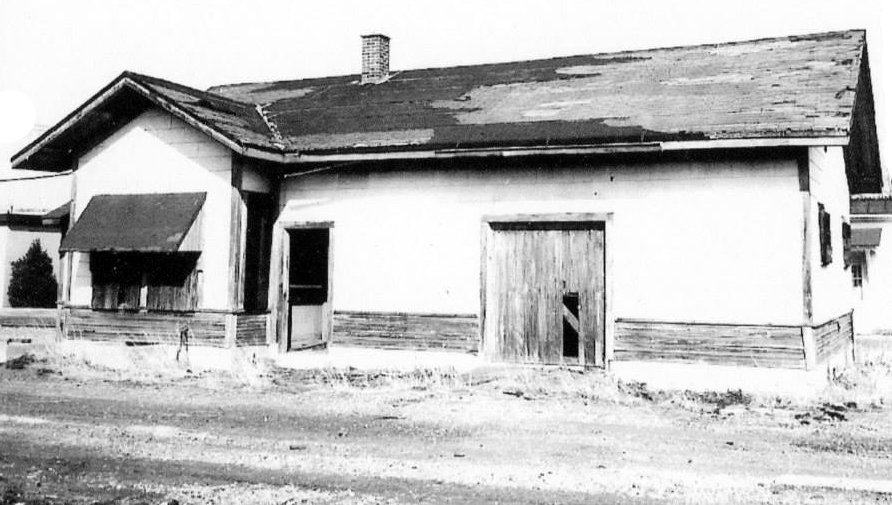
Civer was located in Fulton County, Illinois, beginning as a settlement village six miles west of Canton. The earliest record of Civer (40° 31' 27" N 90° 6' 27" W) was a note from 1835 about Charles H. Turner who was engaged in farming until 1869. Mr. Floyd F. Putman was a native son of Illinois, born in Civer, Fulton County, on October 8, 1880.


David W. Pittman engaged in the grain business at Civer Station in 1885 for over a year.

The Civer Rail Station was on the Toledo, Peoria & Western Railway, an off-shoot from the Chicago, Burlington & Quincy railroad from the point of connection at the Village of Bryant, Illinois, in a northwesterly direction to Civer Station.

A story in the Bloomington Weekly Leader on Thursday, December 14, 1893, mentions two run-away girls walking from the Lewistown rail station north-northwest to the rail station in Civer, about 18 miles.

The town disappeared by 1906. All that's left is the sign marker.

Compiled by Dr. Neil Gale, Ph.D.

The History of the Illinois Central Railroad in Freeburg, Illinois.


The Illinois Central line between Belleville and DuQuoin, Illinois, was built by the Belleville and Southern Illinois Railroad Company,  later to be called the Alton and Terre Haute Railroad Company, which was incorporated by the General Assembly of Illinois Congress on February 14, 1857. Very little was done as far as the construction of an actual RR line until after the Civil War. In 1866, surveying began on the rail line between Freeburg and Belleville. In May 1869, the contract for the building of the line from Belleville and the newly added addition to New Athens was awarded to Messrs. Clark & Co. of Chicago. The contract stipulated that the work is to be completed to Freeburg, which is one-half the distance, by the first day of September 1869, and to New Athens by the first day of October. Of course, this schedule could never be kept as many problems occurred with labor. But the line from Belleville to Freeburg, a distance of only seven miles, was completed by November 1869, and at that time, when the first locomotive rolled into town, there was a huge celebration.
Many Freeburg people had never seen such a massive piece of machinery, clanking and pouring hot white steam from every orifice. Some people ran in fear as the massive engine rounded the curve north of town. The whistle could be heard for miles. By the end of 1870, the 15-mile line from Belleville to New Athens, through Freeburg, had been completed. Now work began to continue the line to DuQuoin and then on to Cairo. This line would now be called the Cairo Short Line. In October 1869, a new locomotive, of thirty tons, 16 x24 cylinders, had been purchased at the McQueen Works in New York, for the amount of $13,500 (
$285,000 today). This engine was specially designed for a passenger train service that had been planned for the new line which was now being extended into St. Louis.
Freeburg Train Station, Circa 1890.
With the start of passenger service, towns along the line would need a station for train stops. The first depot was built in Freeburg in 1870. By the time the station was completed in 1871, the name of the line was changed to St. Louis, Alton & Terre Haute Railroad Company, and remained in operation under this name until October 1895.

Freeburg Illinois Train Station Passengers, Circa 1890s.
At this time, the line was leased to the Illinois Central Railroad Company and this same company purchased the line in February 1907. By this time, the line had been extended to Paducah, KY, and through connecting extensions to the south and north, this line could travel to the Gulf of Mexico or Canada. The line saw the most passenger travel during the period of 1910-1940. It was also during this time that a second rail would be added to the line that extended almost the entire length of the line. In the 1920-1930 period, twelve trains made a stop in Freeburg from 5:45 a.m. to 10:45 p.m. (going both ways). After the war ended in 1945, passenger service began to decline as people were obtaining automobiles or riding the bus. Although a train ride was often fast, comfortable and relaxing, it could also be messy and often the passengers were faced with smoke and soot-filled cars as the trains raced across the tracks.


By September 1958, the ICRR had discontinued all but one passenger stop which headed north to St. Louis in the morning and south to Cairo in the evening. It would take only 8 months until the ICRR decided to dismiss all passenger service in this line. Nobody cared to ride the train anymore.

The ICRR would continue to operate this line for freight purposes until 1999 when it was taken over by the Canadian National Railroad Company. The CNR continues to operate this line to this day with very limited train service.

Many men have served as station agents in Freeburg over the years. The first recorded agent was Mr. Rad Burnett in 1898. He remained until December 1905, when Mr. T.E. Crawford took over, and remained until 1917. At this time, Mr. Charles C. Mulkey became the station agent. He would be located in Freeburg for 21 years and in January 1938, Mr. Roy Virgin, a native of Lementon Station [1] (which was located in the area of the Gas plant south of Freeburg), became the station agent. Mr. Virgin is probably the most remembered of the agents here in Freeburg. In April 1955, Mr. Russell Kilgore was appointed as station agent after Mr. Virgin decided to retire. Mr. Kilgore would be the last agent at this station. By 1960, nearly all freight and mail stops in Freeburg had ceased. The need for a depot had ended and the building became a playground for local kids until, in the mid-1980s, when the depot was torn down. The second track was also removed.
There were other rail lines that almost became a part of Freeburg’s history. In April 1909, St. Louis & St. Libory Railroad Company purchased a “right of way” through Lyman Wilderman’s farm, from the Locust Grove Schoolhouse to the current Illinois Central Railroad line (running east to west, east of the Gas Plant south of Freeburg). Necessary grading would be done immediately and then a switch would be laid to connect with the ICRR line. A completion date of September 1, 1909, was the hope. Grading from Silver Creek, heading west to the ICRR line near Lementon Station had already been completed by June 1909. This line would progress no further and later became an access rail line for the Red Ray Mine.

Another line was planned in December 1905. It would be an electric rail line traveling from East St. Louis to Freeburg by way of Millstadt and Smithton with future extensions heading to Fayetteville and St. Libory. This electric rail line never got past the planning stages.


Compiled by Dr. Neil Gale, Ph.D. 


[1] Lementon Station - John T. Lemen, a trustee of the First Baptist Church resided south of Freeberg. A mine close to the railroad, located on the Ben Hartman farm, was known as the Lemen Mine. Near here, on the William Hartman farm was the Lemen School. Further south, about three miles, was a railroad stop known as Lementon Station.

Sunday, April 24, 2022

Was Rosehill Cemetery Initially named Roe’s Hill?

The town of Chittenden was a subdivision of Lake View Township. In 1859 Chittenden was sold and incorporated as a cemetery named Rose Hill (aka Roe's Hill; Rose Hill). The rail line is the former North Western Railroad Company tracks that ran along the east side of the property in what is now known as Ravenswood Avenue. 

The proper name of Rosehill Cemetery, dedicated in 1859, is debatable. Though most official paperwork gives it as a single word, Rosehill, it’s not uncommon to see it written as Rose Hill. And several popular stories claim that the name was supposed to be Roe’s Hill, and only a clerical error resulted in the name we know today.

Rosehill Cemetery, Founded in 1859, Entrance, Chicago, Illinois.
The often-given story: "The land, seven miles north of downtown Chicago, was once a farm and tavern owned by a stubborn old pioneer named Hiram Roe. When someone wanted to buy the land from the old man for a cemetery in 1859, stubborn old Roe only agreed when the buyer promised to name the cemetery after him – but a clerical error resulted in it being spelled as 'Rosehill' instead."

But, while there’s reason to believe Roe was a real person, the story of him wanting to have the cemetery named after him is certainly fiction. 

Hiram Roe's farm sat atop the highest point in the area, from seventeen to twenty feet above the adjacent prairie on the south and east, and was commonly known as "Roe’s Hill." One of the reasons his land thrived was because, when it rained, it was one of the few farms in the area that didn’t turn into a swamp.

The land wasn’t bought from him and wasn’t intended to be a cemetery when it was first purchased.

Lawsuit records recorded in The Northeastern Reporter in 1895, when a suit for over-payment was going on, make the whole story clear of how the land changed hands: In 1857, Francis H. Benson bought the land where the cemetery now sits, then in the suburban town of Chittenden, for about $25,000 from the Illinois and Wisconsin Land Company. He intended to parcel it out into lots for houses, but the Panic of 1857 hit the economy hard, causing the land to lose about one-half of its value and decimating the market for suburban real estate. The only money Benson made from the land in the first year came from selling off a bit of gravel he found on it.
Trains arrived at Rosehill Cemetery at Chittenden Station, named for the “town” of Chittenden, where the land was sold to the Rose Hill Cemetery Company. 


The elevation and dryness of the soil made Benson think some of the lands would make a good cemetery. He partnered with James Blaney, the first president of Rosehill, to form the Rosehill Cemetery corporation. The company was incorporated in February of 1859, and the cemetery opened for business that summer. Benson and Blaney’s names are both carved onto the gate. When the cemetery published a promotional book in 1913, they said that the name came from wild white roses that grew on the hill.
St. Henry Catholic Church, 6335 North Hoyne Avenue,  Chicago, confirmation documents from 1891 show entry for families living in "East Ravenswood Park (Rose Hill)" from family Search; Film № 008571278 - page 126.


In this very early image, before 1897 or so, the original Northwestern tracks can be seen at ground level. You are looking north. The cemetery is off the left. The large train station is on the east side of the tracks, opposite the cemetery and where passengers would board trains back to Chicago.
But the story that the name of the cemetery may have grown from a hill named for Mr. Roe may not be entirely false; while the “stubborn farmer who owned the land” tales are of decidedly modern vintage, probably about 60 years ago, stories that the land was once called Roe’s Hill appear in several 19th-century sources.
1924 Northern Illinois Principal Cities and Railroads. Rand McNally and Company.
David Rumsey Historical Map Collection.
The first mention found comes from just over 20 years after the cemetery was chartered, when the Chicago Tribune ran an article about onion farming on September 6, 1880. In the article, it said that in the early days of Chicago history, teamsters traveling in the woods seven miles north of town would often stop at the “Jug Tavern” owned by old Man Roe, who made a sort of whiskey that was popular enough for its fame to make them start referring to the area as Roe’s Hill.

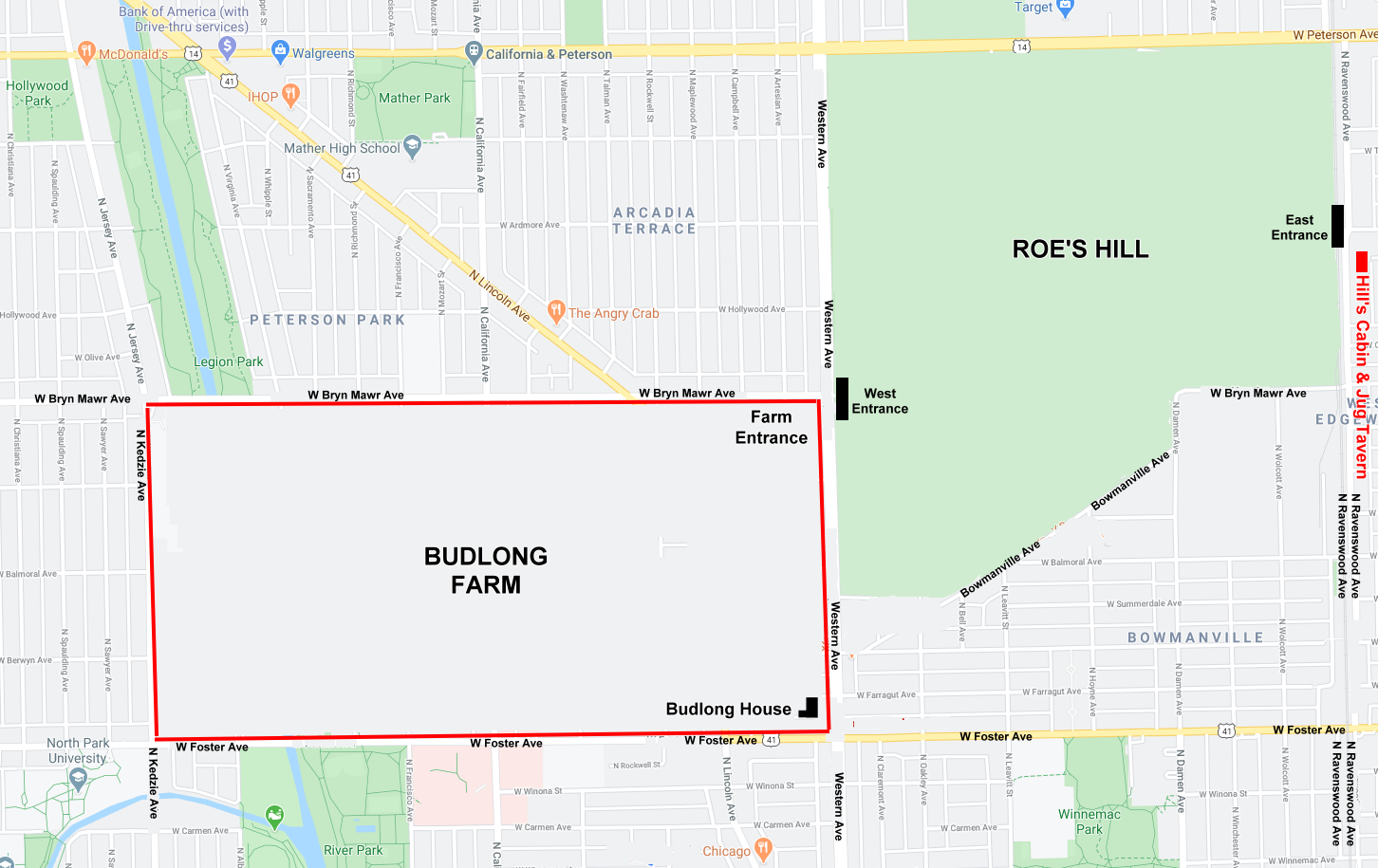
Roe's cabin was near the later residence of J. A. Budlong, which was located at Foster and Western. The Budlong Pickle Farm was located on Western at Berwyn. 

A few years later, A.T. Andreas’ authoritative History of Cook County also mentioned this, stating that the area of Bowmanville was once known as Roe’s Hill for Hiram Roe. 
CLICK FOR A FULL-SIZE MAP
The Tribune mentioned Roe again in 1900 when an article on the origins of the names of various suburbs said that Bowmanville was originally known as Roe’s Hill after Hiram Roe. 

However, census records say nothing about a Hiram Roe in the area. There was a farmer named Hiram Rowe up near McHenry County, but there was no evidence that he ever lived closer to the city. Furthermore, these mentions that the area was called “Roe’s Hill” in the old days (the 1830s-1850s) are all from a few decades later; no instance of anyone calling it Roe’s Hill in the actual “old days” has been found. Andreas and the Tribune may have just been repeating neighborhood gossip and urban legends.
Looking North on Ravenswood Avenue. Note the cemetery's name on the entrance structure; ROSE HILL.


Perhaps the tale that Rosehill was Roe’s Hill may have all been a misunderstanding; In 1856, Robert Ferguson wrote a book on Danish and Norse names in Scotland and said that a Rose Hill in the U.K. was, he believed Roe’s Hill, from the Old Norse word for “King properly.”  Perhaps someone heard that bit and thought it applied to the Rosehill in Chicago.

Still, the fact that sources knew the full name and even the tavern's location makes it look like there was a kernel of truth in the story someplace. So, Hiram Roe remains a bit of a mystery; A tour guide who works at Rosehill said he’d pored through all of the oldest books at the cemetery, looking for any mention of Hiram Roe without finding a word.

ADDITIONAL READING: Ancient Chicago Indian Mounds (Rosehill).

Compiled by Dr. Neil Gale, Ph.D.